Building Name(s): Saloon Building, Telegraph Building
Life Span: 1836-1859 (Saloon), 1859-1871 (Telegraph)
Address: 117 to 125 Lake, SE corner Clark
35 to 39 Clark
Block and Subdivision: 35, Original Town
Architect: Van Osdel
- Fergus’ Chicago Business Directory, 1846
Ellis (Wm.) & Fergus (Robert), job printing offices, 37 Clark, Saloon Bldg, 3d floor.
Democratic Advocate (Free Democrat), weekly, (Wm.) Ellis & (Robert) Fergus, pubs, and props., 37 Clark, Saloon Bldg.
Scammon (Jonathan Young) & Judd (Norman B.), 123 Lake.
Hall & Smith’s Chicago City Directory for 1853
Danks H. P. Daguerrean gallery, 39 Clark, h. 46 Adams
Scammon & M’Cagg, attorneys, 37 Clark
Marine Bank, 37 Clark
Halpin & Bailey’s City Directory for the Year 1863
Telegraph Building cor. Clark and Lake
Illinois & Mississippi Telegraph Co., Lake s.e. cor. Clark
Ruxton & Co., bankers. cor. Clark and Lake. (See adv’t p. 392.)
Miller W. H. C. & Co., (William H. C. Miller, and ————,) watches, jewelry and silver ware, 35 Clark.
Duffy James, cigars and tobacco, 37 Clark and 9 Tremont blk, h. 59 Rush.
Halpin’s Chicago City Directory for 1864
Telegraph Office, Lake, se. cor. Clark
Ruxton & Co., bankers, 37 Clark
John C. W. Bailey’s Chicago City Directory for 1867
Illinois & Mississippi Telegraph Co., E. D. L. Sweet, supt, room 3 se cor Lake and Clark
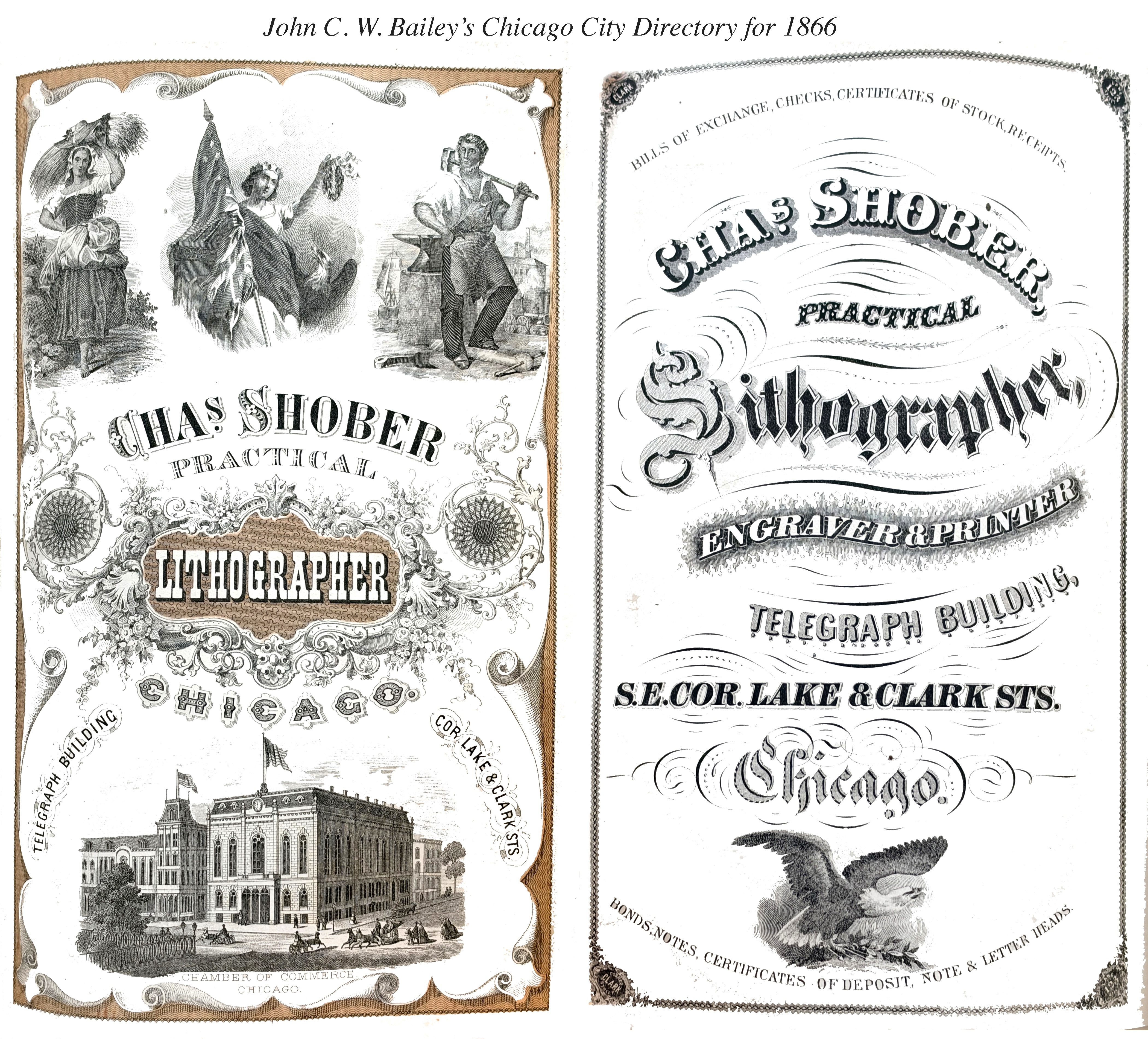
Shober Charles & Co., (Charles Shober and W. Heinemann,) lithographers and engravers, Lake se cor Clark, (See adv’t.)
Edwards’ Annual Directory in the City of Chicago, for 1870
Cobb, Pritchard & Co. (J. E. Cobb and Daniel Pritchard) booksellers, stationers and publishers, 81 and 83 Lake
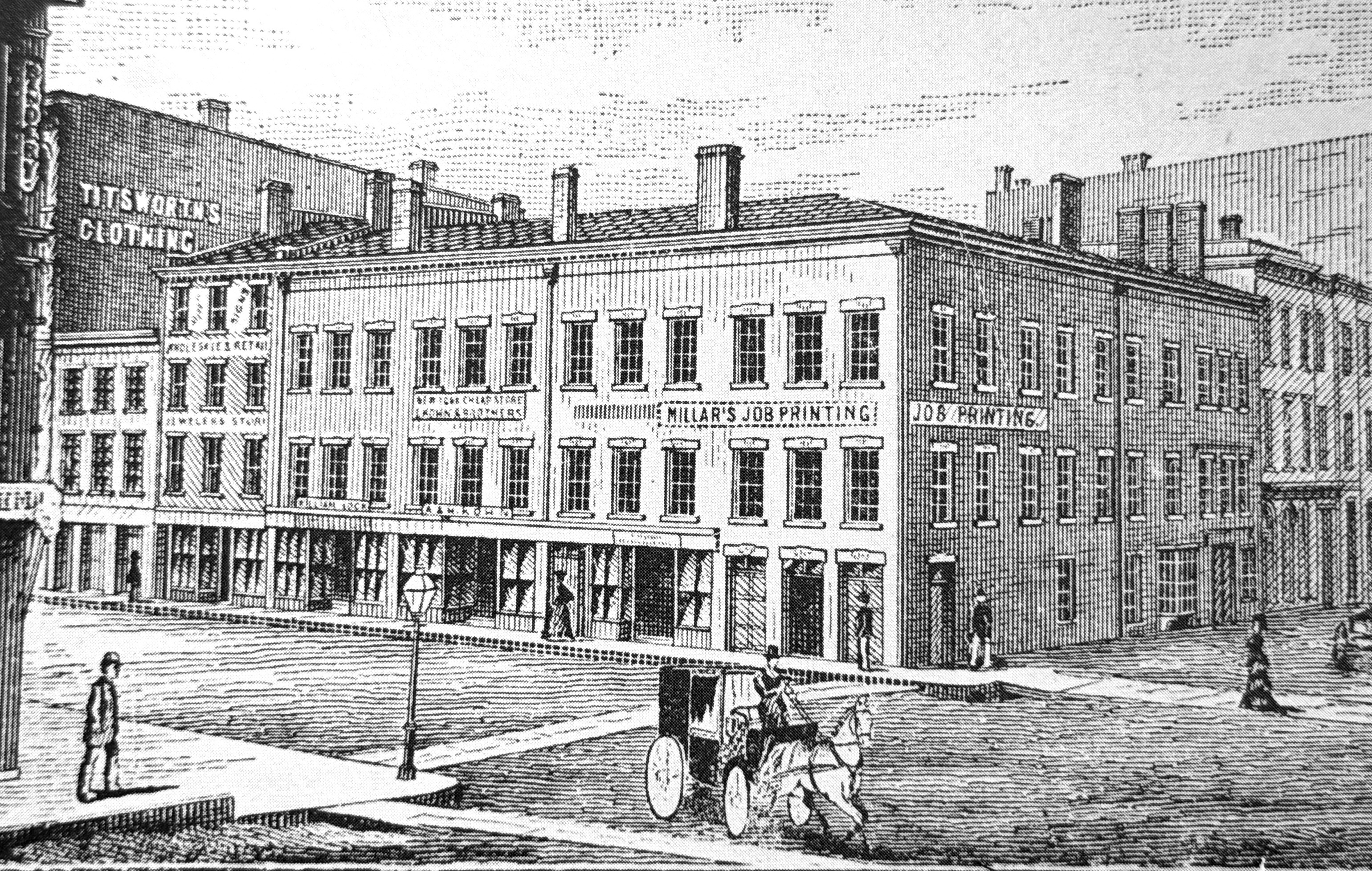
- Saloon Building
About 1836
Chicago Tribune, April 20, 1859
THE SALOON BUILDING.—We learn that the plans for the now saloon buildings on the fine site corner of Lake and Clark streets are now under the hand of the architect, Mr. Van Osdel. The elevation presents a fine, substantial, though not strictly first class block.
Chicago Tribune, May 14, 1859
An elegant and commodious double store is to be finished for the United States Express Company in the new block to replace the Saloon Buildings on the corner of Clark and Lake streets.
Chicago Tribune, March 22, 1859
Next come the old “Saloon Buildings” of our fellow citizen, J. Y. Scammon, now in Europe, eighty feet front on both Clark and Lake streets. This is to be entirely rebuilt, as we learn, this season, the tenants having received notice to quit. This will be one of the finest improvements in the city, as occupied by, and we learn and could not doubt, with buildings entirely worthy of the valuable site.
Next east of these come the first-class stores to be erected, the first adjoining the Saloon Buildings, by Samuel Hoard, Esq.; the next by Tuthill King, Esq., both of the best class pressed brick, with iron store fronts. We thus have reached the improvements midway the block on Lake street completed last season.
Chicago Tribune, October 31, 1859
Aikin & Norton hare removed from the corner of Clark and South Water streets, to the new block on the south-east corner of Clark and Lake streets. A capital location.
Chicago Magazine, March, 1857
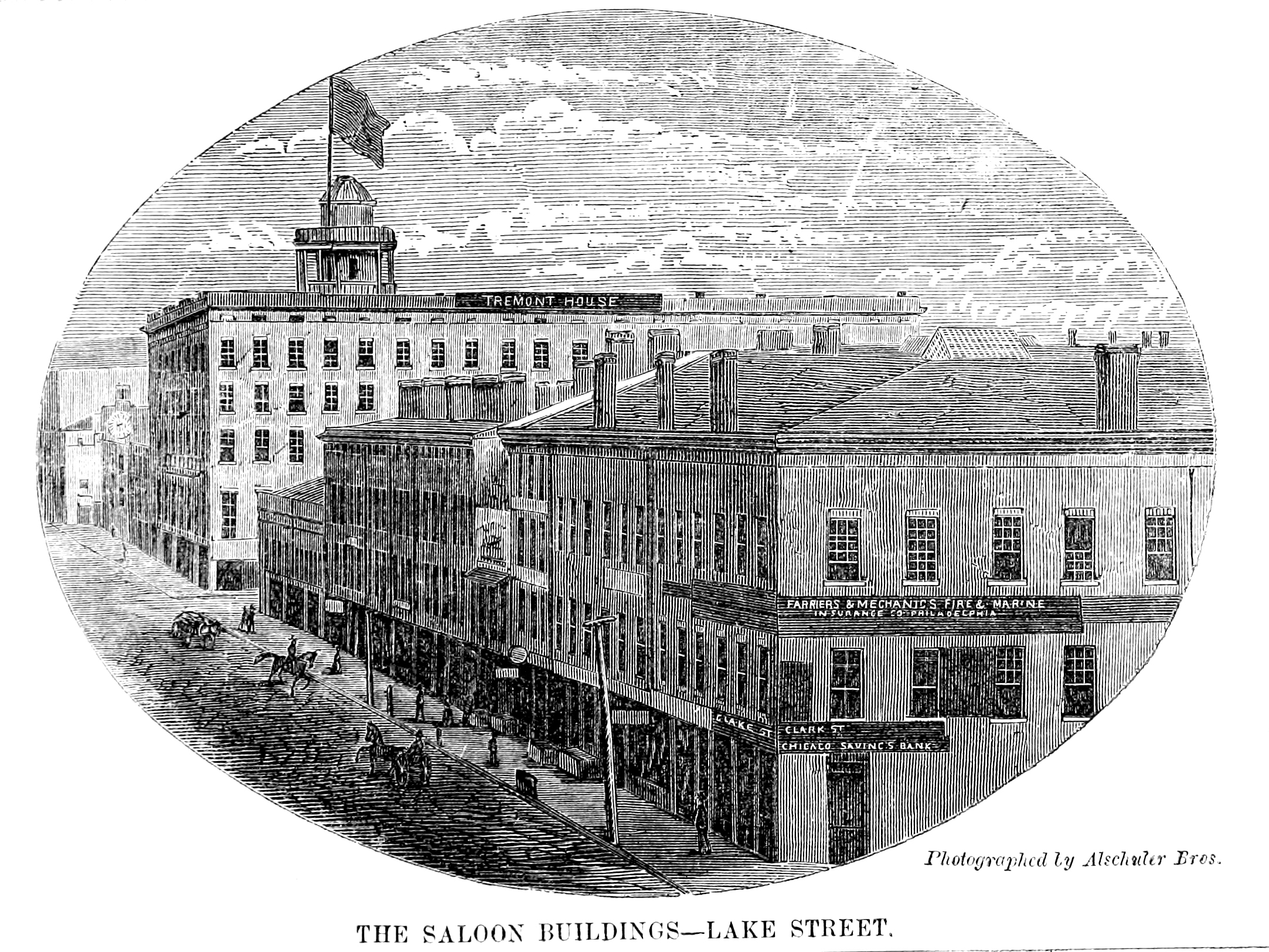
- Telegraph Buildings
Western Railroad Gazette, January 12, 1861
A VISIT TO THE TELEGRAPH OFFICE.—You say there never has been a time when the benefits of the telegraph seemed to be so universally appreciated by the masses as during the past three months—and that never were the daily dispatches to the papers read by more persons with greater avidity. That’s true. Did you ever see the operators at work? Then come with me. Here we are, in the midst of a dozen “sounders” all at work, ticking away, with a noise equal to a Connecticut clock factory. See how fast the operators write, translating the seemingly senseless ticks into letters and words, even more rapidly than you could write and indite the composition.
Now, keep your hands and your eyes to yourself, and say nothing—for this is the sanctum sanctorum”—it is very seldom that any one but operators are admitted here, but Mr. Sweet, the gentlemanly Superintendent, knows we are O. K., and will meddle with nothing. Though a young man yet, Mr. Sweet is a pioneer in this business—the oldest operator in the State, having been connected with this Company since 1849—all the other officers and managers have switched off,” or changed, we believe, but him. As a careful and experienced manager he has no superior.
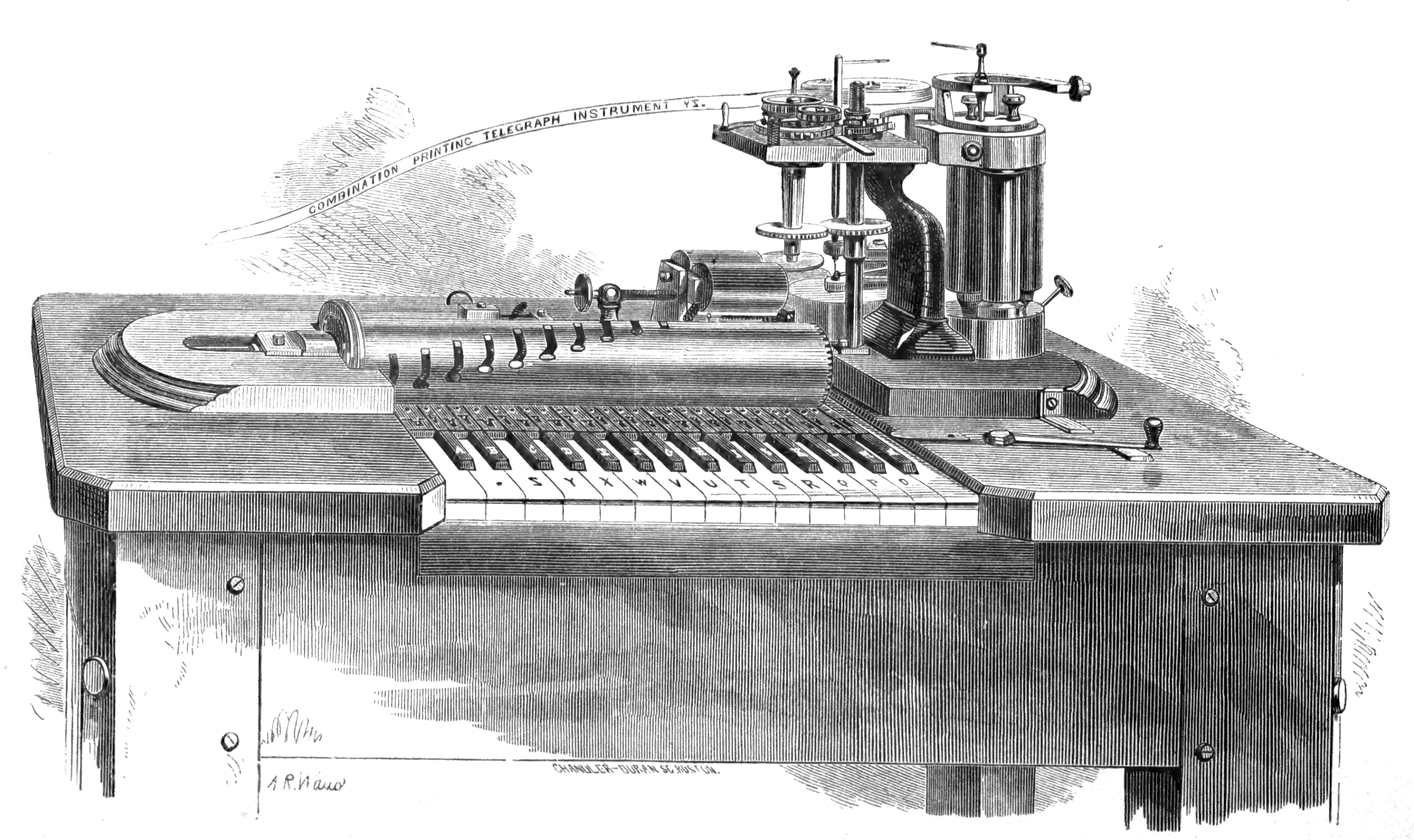
Can you read by sound? All Greek to you, eh? This operator is in communication with Pittsburgh. The one there, is just getting to-day’s dispatches from all points of the East, for the papers. Only think of it! Here it is but three o’clock, and the news is already here of the manner in which the 8th of January is being observed in New York, Boston, Philadelphia, Cincinnati, Washington, and all parts of the country! What a wonder is this Magnetic Telegraph! Do you hear that? Pittsburgh says to Chicago, that New York is in a hurry for an answer to that message sent ten minutes since, and that as Cleveland will be busy in a few minutes on the Report, to send it via Pittsburgh. Here is a message from St. Paul—not cold yet, nor will it be till it reaches its destination—Portland, Maine. Only think of it—look back twenty years, when this message must have been taken by “horse power” all the way from St. Paul to Portland. Now it is sent in as many minutes as it would have required weeks then! What an age of improvement is this, truly!
Here is a beautifully lithographed map from Sage and Sons’ establishment, Buffalo. The blue lines represent the wires of the Western Union Telegraph Company, which traverse Indiana, Ohio and Michigan, and so on farther East. Hiram Sibley, is President; Isaac R. Elwood, Secretary and Treasurer; I. H. Wade, General Agent, and A. Stager, General Superintendent. The red lines show the location of the lines of the Illinois and Mississippi Telegraph Company. Their lines extend along nearly every railroad in this State, and into Iowa and Minnesota to St. Paul. J. D. Caton, is President and General Superintendent; E. D. L. Sweet, Eastern Division Superintendent; J. J. L. Wilson, Western Division Superintendent; and Thos. Bassnett, Secretary. This Company have upwards of 1000 miles of lines in operation, and 158 offices or telegraph stations—83 in the Eastern, and 65 in the Western Division. Nine main lines and three branches, centre in this office. The lines in the upper part of the map, are those of the ” Wisconsin State Telegraph Co.,” with which this Company connect direct at Janesville. That company’s lines are already in operation to Prairie du Chien, St. Paul, Oshkosh, and will soon be opened to Green Bay.
Hark, what’s that? “New Orleans says: 8.12 m.” &c. When one contemplates the hundreds of miles of wire this message has passed through—every letter sounded dot by dot, upon every instrument on the way—the hundreds of streams it has leaped across on the wires—some upon high masts above the reach of the steamer’s chimnies, and others through the gutta percha insulated cable sunk in the deepest water—the hundreds of thousands of telegraph poles it has skipped past,—through as many glass insulators, good, bad, and indifferent—the different scenes that were transpiring in the different (and various) portions of country it has passed over—the vast amount of secession and anti-secession, and “irrepressible conflict,” it has darted through—the mind is almost incapable of comprehending that this dispatch can really have made the time it has.
But this caps the climax—there’s a dispatch now coming, dated New York, 8th, 4 p.m.; and its only quarter past 3! How do you account for that? “Believe its a mistake of an hour ?” No, sir. You see there is 54 minutes difference in time, between New York and Chicago. That message has been just 9 minutes coming here, and it has beat the sun just 45 minutes! You think it “beats all natur’.”—You have heard that “the Telegraph annihilated both Time and Space,” but you were never before able to realize it, certainly.
Now if the reader, whom we have imagined was with us, has enjoyed our visit to the Telegraph Office half as much as we did, we are well satisfied; and with us, he will thank Supt. Sweet, and his corps of busy ticking operators, for their courtesy.
Chicago Tribune, April 6, 1864
RUXTON & CO., BANKERS AND BROKERS,
Have this day removed to No. 37 Clark Street, Two doors south of their old office.
Chicago Tribune, September 6, 1864
We learn that the Illinois and Mississippi Telegraph Co. are about to commence the erection of a new telegraph line from Chicago to Bureau Junction, which shall connect with that line to this city.
History of Chicago, Volume II, A.T. Andreas, 1885
TELEGRAPH COMPANIES.—In 1858, there were but two telegraph companies doing business in the city of Chicago,—The Illinois and Mississippi1 and The Western Union. The history of The Western Union, since that year until 1871, would include almost all that could be written of the other companies, for each in turn has been organized only to be absorbed by that corporation.
A few years before the first mentioned date, the wires of The Western Union had been brought into the city with great display of enthusiasm, a brass band playing gaily as the laborers reeled off the connecting wire. No city ordinance was then required before work could be begun within the city limits, permission of the Board of Public Works alone being necessary. No trouble was experienced, however, as the new organization, by an arrangement with the Illinois and Mississippi Company, brought its wires into the city upon the latter’s poles. The two companies were in no sense rivals, since their lines covered different territory, and they maintained friendly relations under what was known as the “Seven Company Contract,” whereby the principal telegraph companies then existing in the United States pooled their earnings according to an equitable plan, and thus secured continuous and connecting lines. In 1858, the offices of both companies were at No. 11 LaSalle Street, and, though they were operated as one, a separate organization was maintained by each—E. D. L. Sweet being superintendent, and George D. Sheldon, manager, of the Illinois and Mississippi Company; and Emory Cobb, superintendent, and R. C. Rankin, manager, of The Western Union.
In 1860, their offices were removed to Lake Street, at the southeast corner of Clark. In 1861, F. H. Tubbs became manager of the Illinois and Mississippi Company. In 1864, the United States Company, after a severe struggle with The Western Union, succeeded in establishing itself here, having offices at No. 66 Clark Street; E. P. Porter being manager.
In 1866, William H. Hall took Mr. Tubbs’s place in the Illinois and Mississippi Company, to be succeeded the next year by J. E. Ranny. There were also changes in the Western Union, Mr. Cobb retiring, and being succeeded as superintendent by Mr. Rankin, whose place as manager was filled by Fred. Swain.
In April, 1866, the United States Company was absorbed by the Western Union, and in the following July, the Illinois and Mississippi was merged into the same corporation, under a perpetual lease, and all the offices of those companies were moved to Nos. 32-33 Chamber of Commerce. In 1869, they were again moved to the northwest corner of Washington and LaSalle streets. In that year, a new rival appeared, in the shape of the Great Western Company, and a little later a local company, known as the Metropolitan, began doing business at No. 126 Washington Street.
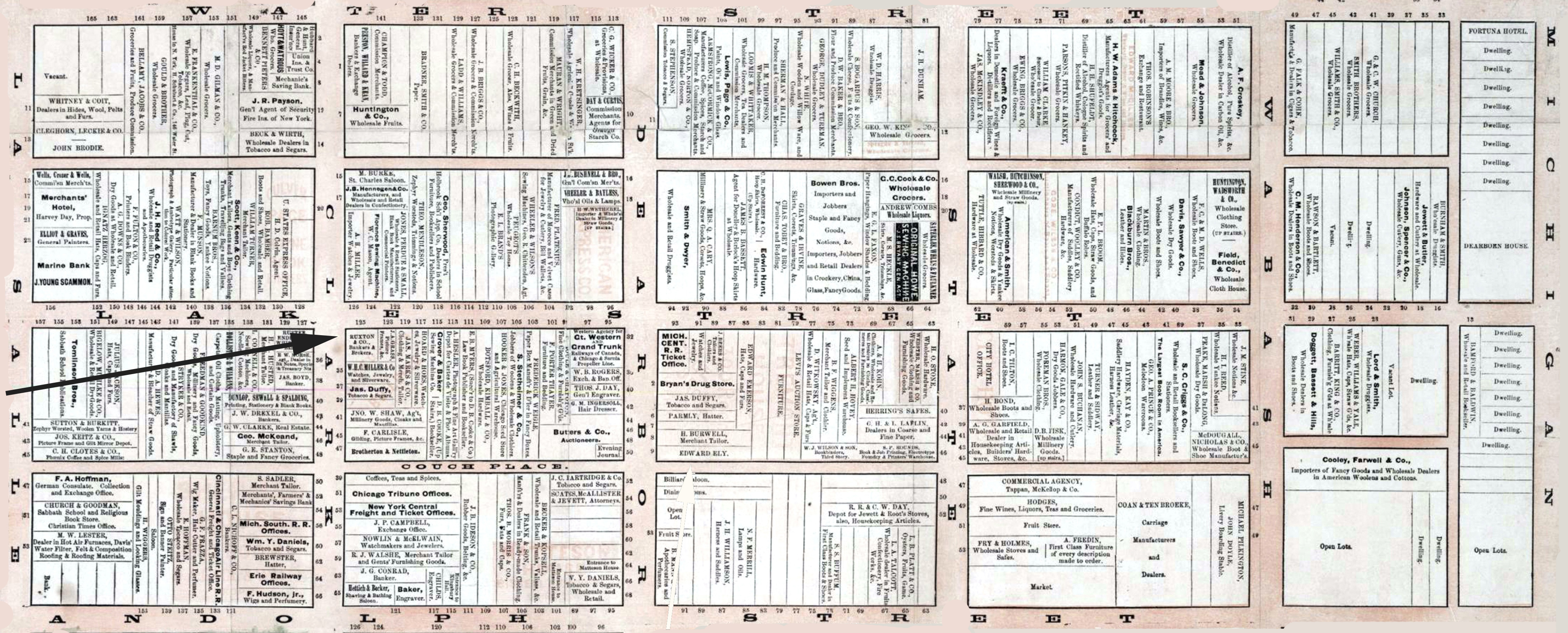
- Telegraph Building
1862
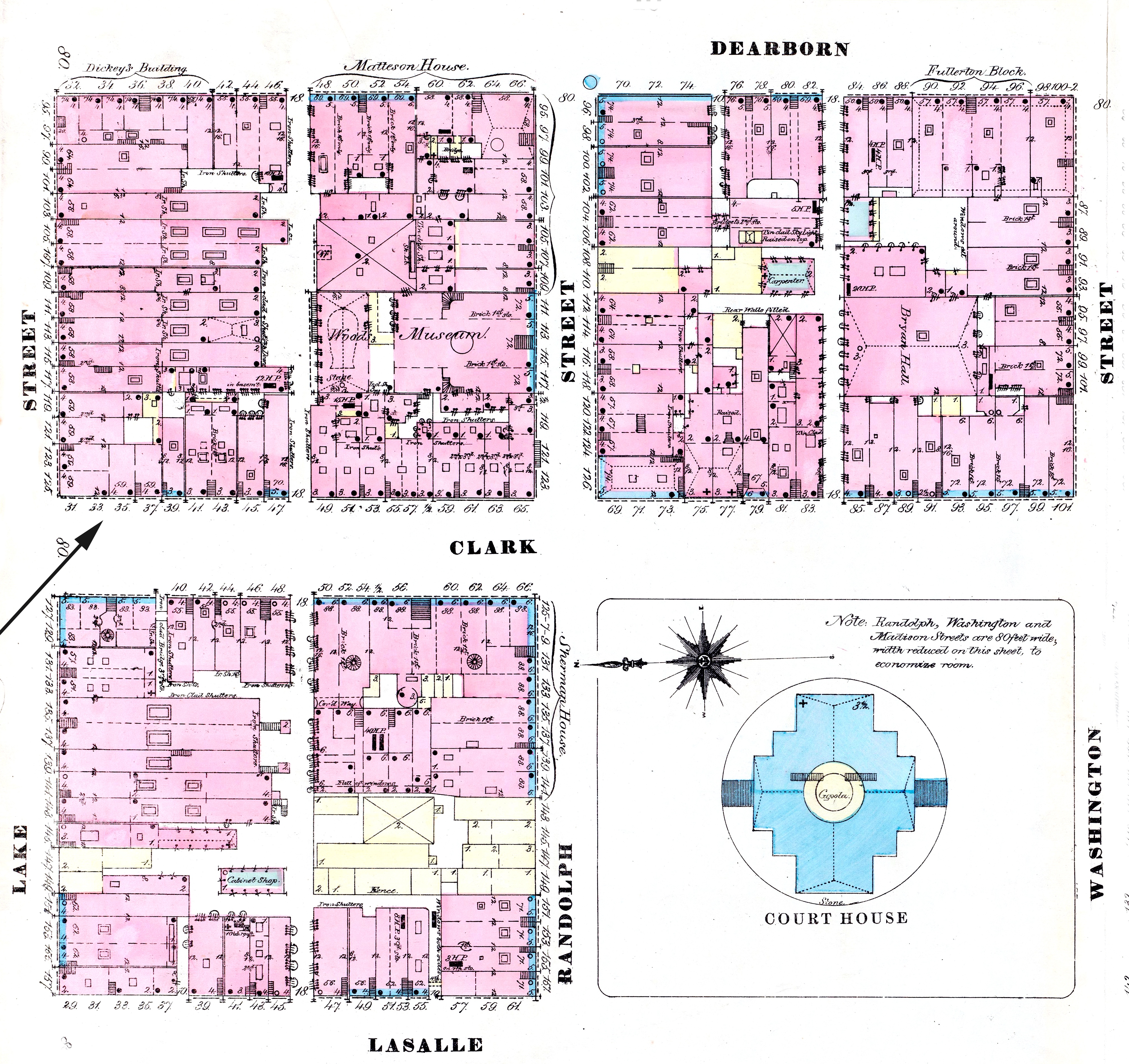
- Telegraph Building
Sanborn Fire Insurance Map
1869
NOTES:
1 D. B. Cooke & Co.’s City Directory for the Year 1859—Illinois & Mississippi Telegraph Co., 11 LaSalle.

Leave a Reply