Holy Name Cathedral I
Life Span: 1854-1871
Location: State and Superior Streets1
Architect: Burling & Baumann
- D. B. Cooke & Co.’s City Directory for the Year 1859
The Church of the Holy Name.
Situated on Wolcott st., S.E. corner Chicago av.
Halpin & Bailey’s City Directory for the Year 1863
Cathedral of the Holy Name. Wolcott, se. c. Superior.
Halpin’s Chicago City Directory for 1864
Cathedral of the Holy Name. Wolcott corner Superior street.
John C. W. Bailey’s Chicago City Directory for 1867
Cathedral of the Holy Name. (Catholic,) N. State cor Superior
Edwards’ Annual Directory in the City of Chicago, for 1870
Cathedral of the Holy Name of Jesus—North State and Superior streets.
Chicago Tribune, December 9, 1853
NEW CATHOLIC CHURCH.
We have heretofore noticed, in our columns, the commencement of a new Church edifice, in the North Division of this city, for the Catholic Parish, to be styled the “Church of the Holy Name of Jesus.” The foundation walls were laid some months ago, but we were left in comparative ignorance of the character of the structure, except that it was to be on an imposing scale. We have now before us, however, a lithgraphic print of the exterior of the building, as designed by the architeet, and according to which it is to be erected. The print was executed by Mr. Mendell, 171 Lake Street, and, we are assured, is a perfect transcript of the design.However large our expectations were, in reference to the structure, the lithographic view shows a design for beauty and magnificence far surpassing our highest expectations.
The style of the building is Gothic, which is the Architecture for Churches; and we feel a deep degree of satisfaction in the fact that our city will soon be able to point to a most noble specimen; for in this every feature, together with solidity of construction and beauty of design are brought together in the most happy union, expressive of the sacred use to which the edifice is to be devoted. This sense of satisfaetion in not a little hightened by the fact that the design for so beautiful a building is the work of Chicago artiste. We trust the public may learn from it that it is not necessary to go abroad for architectural designs, and that Chicago Architects, like Chicago Mechanics, are not only unsurpassed, but in the elements of that genius which enterprise inspires, are in the van, in all useful and beautiful conceptions. The only regret we have is in the fact that a building so beautiful in all of its proportions is to contribute the aggrandisement of a powerful, aggressive, and, as we believe, dangerous Hierarchy, perfectly organized and directed by men of great sagacity and untiring energy. But, nevertheless, we have an instinetive feeling of admiration for all who labor faithfully for what they believe be true, however antagonistical to religious liberty and the spread of the true Gospel, their belief may be. This is especially the ease with reference to the worthy Pastor, Very Rev. J. A. Kissella, who is bending his talents and energies to raise the means to complete this beautiful Temple of Worship. To his enterprise and untiring perseverance will our city be indebted for this noble edifice.
It may not be out of place to mention, in this connection, that the enterprise rests entirely apon individual subscriptions, and that all who desire to contribute, either from a sense of religious duty, or as a teatimonial of their approbation of an undertaking calculated to ornament the city, ean do so with the most perfect assurance that the worthy Pastor, Very Rev. J. A. Kinsella, will most religiously devote it to the purpose intimated by the donor.
We forbear entering into a detailed description of the building, referring all to the lithograph, which will be for sale at the book stores, and which conveys, at one glance, a clearer conception of the character of the edifice than any. thing we could write..
History of Chicago, Volume I, by A. T. Andreas, 1884
Church of the Holy Name.
In 1846 the North Side was made a parish and placed under the charge of the priests of the College of St. Mary’s of the Lake. A small room was fitted up in the old college building, which easily contained the congregation that assisted at mass on Sundays. This was the origin of the Church of the Holy Name of Jesus. In 1848 a church building was commenced by Rev. Jeremiah A. Kinsella, who was at the same time rector of the college, and with whom there were associated the Rev. Fathers William Clowry and John Breen. This building was erected on the southwest corner of St. Mary’s College grounds, at the corner of Rush and Superior streets. It was completed in 1849, and was used for divine service for the first time on Sunday, November 18, of that year. The growth of Catholicism did not make itself especially manifest on the North Side until 1851, five years after the establishment of St. Joseph’s, and two years after the building of the Church of the Holy Name. By this time the number of Catholics had become considerable, and in this latter year Father Kinsella built a small church at the corner of State and Superior streets. This movement gave an impetus to the settlement of Catholics on the North Side, for it is a well known and noteworthy fact that the Catholics prefer to locate near a church, often making many sacrifices in order to do so. In 1852 an addition was made to the little church, but the Catholics increased so rapidly that the necessity of a large and permanent edifice was soon felt. Consequently in the year 1853 the Rt. Rev. Bishop Van de Velde assented to the erection of a large brick church at the corner of State and Superior streets, which should be used as the cathedral of the diocese. The ceremony of laying the corner-stone of the edifice took place August 3, 1853, at 4:30 o’clock p. m. The sermon was preached by the Rt. Rev. Michael O’Connor, Bishop of Pittsburgh. Bishop Van de Velde solemnly blessed the foundation stone. At the ceremonies there were present, in addition to Bishops O’Connor and Van de Velde, the Rev. Fathers McElhearne, Kinsella, Quarter, McLaughlin, Lebel, Tucker, Dunne, Fitzgerald, Clowry, Hoey, Feely, Brady, Kopp, and Donohue. The dimensions of the church were eighty-four by one hundred and ninety feet, and the steeple was two hundred and forty-five feet in height. The material of which the church was built was Milwaukee brick, the style of architecture was Gothic, with windows of stained glass, representing scenes in Biblical history. The building was completed in the fall of 1854, at a cost of $100,000. Catholics then living in Chicago contributed toward this enterprise with extreme liberality. The Catholics of the parish were gratified to enjoy the opportunity of celebrating mass for the first time in this church on Christmas Day, 1854. The Very Rev. Jeremiah A. Kinsella remained priest until January, 1855, when he, in connection with Rev. William Clowry and Rev. John Breen. was requested by Bishop O’Regan to resign. The removal of the clergy was not satisfactory to many of the parishioners, and on Wednesday evening, January 17. a meeting was held in North Market Hall for the purpose of expressing adverse sentiments. A series of four resolutions was passed, the substance of which was as follows:
- 1. Expressing confidence in the priests that had been removed.
2. Pledging themselves to assist in completing the new church, if the priests were permitted to remain.
3. Bowing with most profound respect and reverence to the Church and Bishop, but at the same time appealing to the Holy See.
4. Appointing a committee to draw up a statement of their grievences and forward them to the Pope at Rome.
The committee appointed under the fourth resolution consisted of Charles O’Connor, Patrick Connelly, John Murphy. Edward D. Colgan, Edward Kelly, James Driffy, Patrick McAlpin and John Prindiville. Late in the year 1855 Charles O’Connor brought suit against the Rt. Rev. Anthony O’Regan, Bishop of Chicago, to recover under a contract which the plaintiff had made with a Catholic clergyman, formerly of the city, to build the Church of the Holy Name. The defendant denied all knowledge of such contract, as well as having authorized any party to make such contract for him, but at the same time admitted having offered to pay the plaintiff a fair and reasonable price for the labor expended on the building. On the 6th of November, 1855, a verdict was rendered the plaintiff of $6,263.96. It was decided to take an appeal to the Supreme Court, but no decision on the subject can be found.
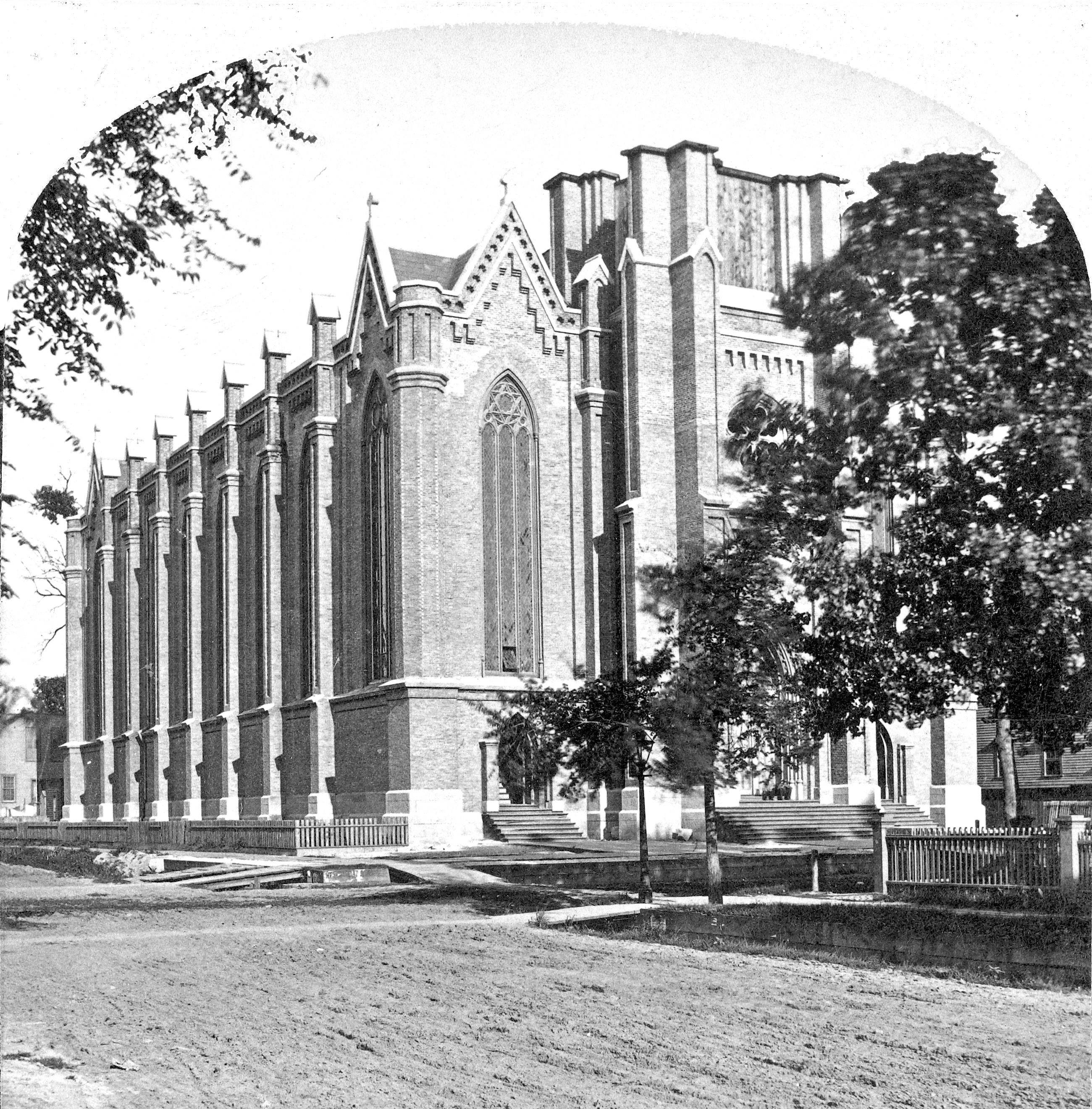
- Cathedral of the Holy Name
John Carbutt #136
About 1869, before a second story was added
Chicago Tribune, June 20, 1864
ALTAR CONSECRATION AT THE CATHOLIC CATHEDRAL—The consecration of the new altars at the Church of the Holy Name Cathedral, yesterday was the occasion of a most imposing and impressive service. Th Right Reverend James Duggan, D.D., Bishop of the Diocese, delivered ann eloquent discourse from Matthew 5th chapter, 20th to 24th verses.
Rev. Dr. Butler acted as celebrant, Rev. Dennis Dunne, D.D., officiated as assistant Priest, and Rev. Dr. McGovern was master of ceremonies. The music was rendered on thevgrandest scale by the orchestra of the Philharmonic Society, and consisted of “Hummel’s Second Mass in E Flat,” and “Ave Verum Corpus’ from Mozart. The altars have been erected at a cost of $4,100, and were executed by the eminent artist, Buscher. They were commenced about two years since, are of black walnut, and consistent in their design with the Gothic architecture of the church. The fronts of the altars present three richly carved medallions, representing the birth, resurrection and ascension of our Lord; above are niches for the twelve apostles, which are at present vacant, but will shortly be supplied with the appropriate statuary. The altar to the east is dedicated to the Savior; the north to the Virgin Mary, and the south to St. Joseph.
The church was crowded on the occasion, and a collection was taken up which realized $1,500.
Chicago Tribune, December 29, 1865
Church of the Holy Name.-Several important alterations have been made to this church during the year, under the supervision of A. Bauer, at a cost of $6,500. The church is located on the corner of Wolcott and Superior streets.
Chicago Tribune, October 12, 1871
The Church of the Holy Name is wrecked all but the spire. That solid piece of work stands as good as ever, and the new story recently added by Frank Agnew shows by its substantial appearance that it was the work of a faithful and skillful mechanic. About a month ago Mr. John Donlin began the framework of the upper portion of the spire, which reached a total height of 260 feet. It was ready for slating, but the fierce wind of Monday night, aided by the fire, blew it down, and it is rumored that six men were injured by the falling timbers.
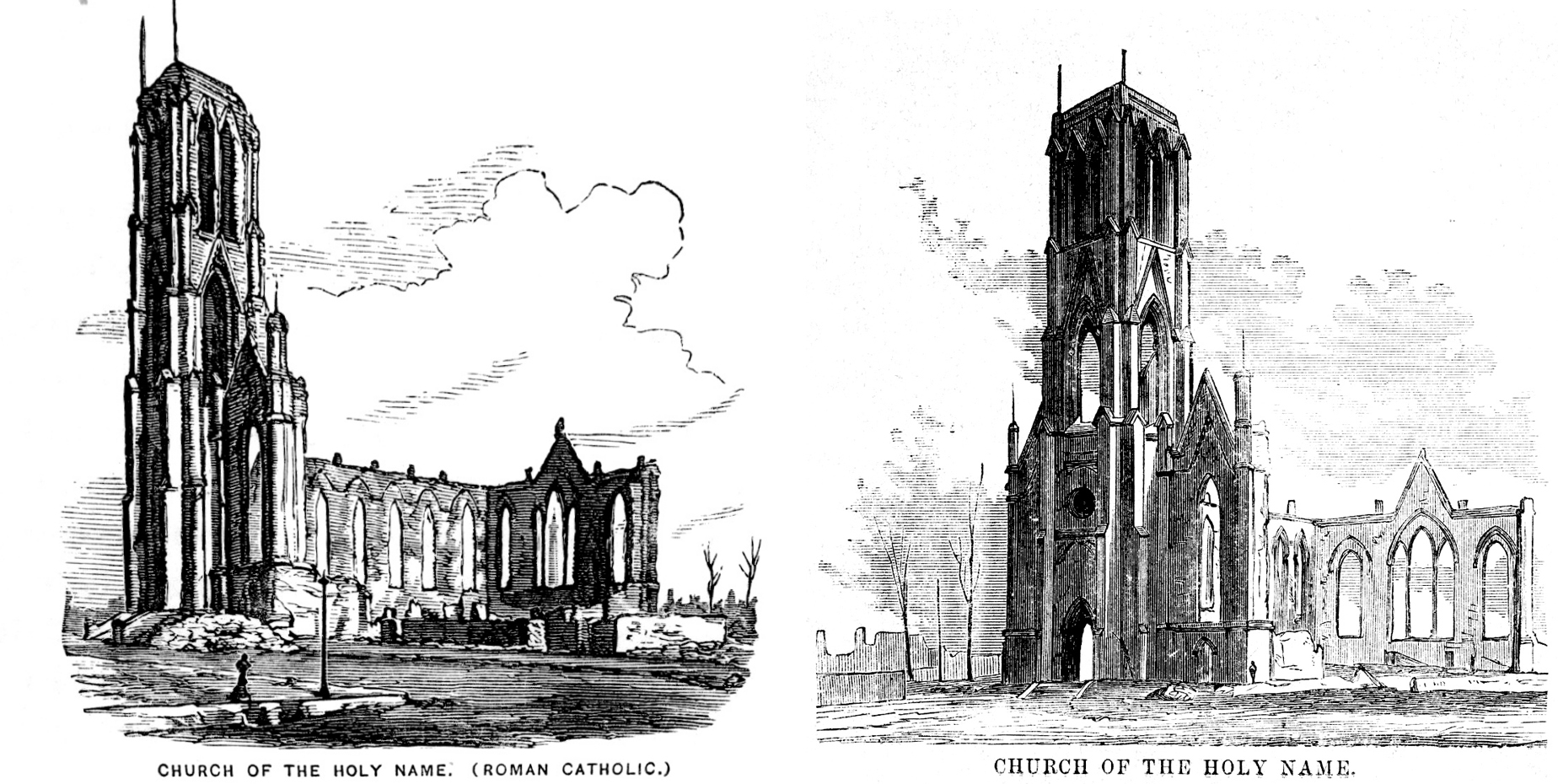
- Church of the Holy Name
After the Great Fire of 1871
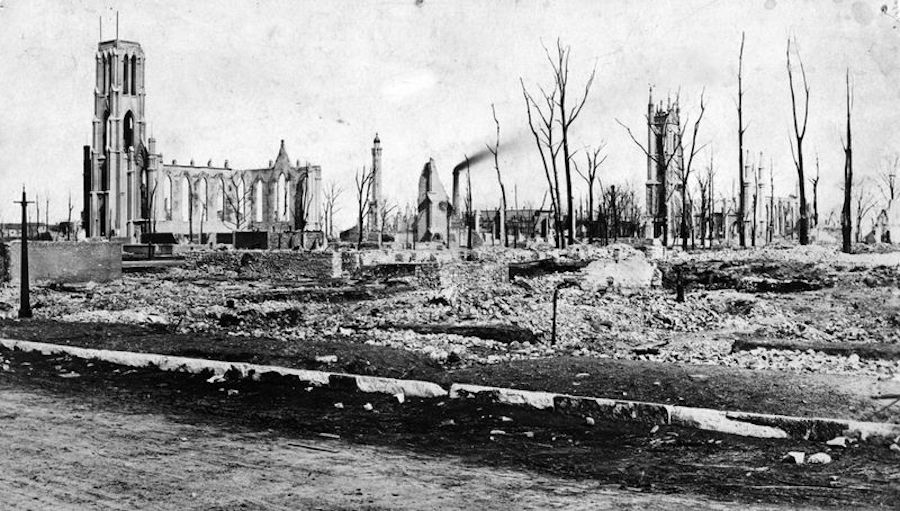
- St. James’ Episcopal Church (right) and Holy Name Cathedral (left) ruins showing the survival of the tower which still stands today. The Water Tower can be seen in between them.
Chicago Evening Post, April 7, 1873
THE HOLY NAME.
The Roman Catholic Cathedral of the Holy Name, which was located on State and Superior streets, a very large building, was entirely wiped out by the great disaster. Hardly anything remains to indicate where its imposing spire once soared toward the clouds. The congregation now bend to heaven in a very humble wooden contrivance, situated opposite their old site. Nothing definite has yet been done in the way of restoration. The Catholic colony in that region sufferd very heavily, but the diocese is rich, and, doubtless, the edifice will not be delayed for any lack of funds. Meanwhile, be it observed, the congregation has been always noticeable for its generosity in church matters. It is stated that the new building, when it is undertaken, will be rendered in every respect worthy of the premier church of the Catholic community in Chicago.
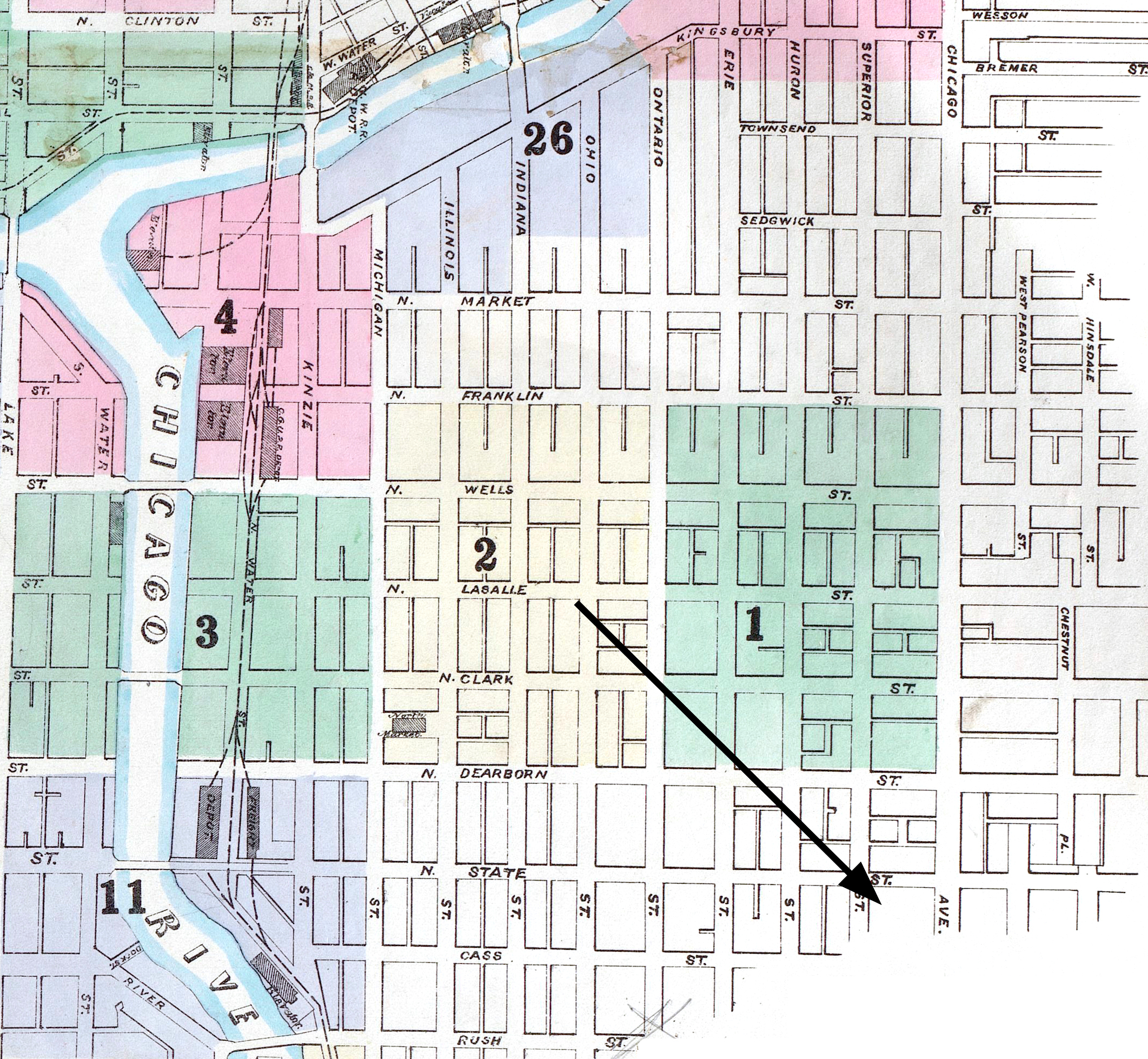
- Unfortunately the 1869 Sanborn Map of Chicago did not include the block which the original Cathedral of the Holy Name stood, the overview map did.
NOTES:
1A communication was received from Ald. Ruh suggesting that the name of Wolcot street be changed to North State street Referred to Committee on Streets and Alleys, North Division.—Chicago Tribune, November 28, 1865.

Leave a Reply