Smith & Nixon’s Block, Nixon Exchange
Life Span: 1864-1869
Location: SW corner of Clark and Washington streets, 116 Washington st., near Clark st.
Architect: Otto H. Matz
- Edwards’ Annual Directory in the City of Chicago, for 1866
Smith & Nixon’s Block, Washington, sw. cor. Clark
Miller W. H. C. & Co., (William H. C. Miller, and ———,) importers and mnfrs of jewelry, etc. 108 and 110 Clark.
Fassett Samuel M. photographer, 114 and 116 S. Clark. r. Hyde Park
John C. W. Bailey’s Chicago City Directory for 1867
Nixon’s Building, Washington e Chamber of Commerce
Smith & Nixon, (James R. Smith and Wilson K. Nixon,) pianoforte dealers sw cor Clark and Washington
Smith & Nixon’s Block, Washington se cor Clark
Lyon & Healy, (George W. Lyon and Patrick J. Healy,) music publishers 114 Clark
Miller W. H. C. & Co., (William H. C. Miller, and ———,) importers and mnfrs of jewelry, etc. 108 and 110 Clark.
Security Life Insurance Co., of New York, James H. Knapp, agt, room 19 118 Clark
Bond & Chandler (M. S. P. Bond and V. L. Chandler), engravers, wood, Smith & Nixon’s blk, sw cor Clark and Washington
Edwards’ Annual Directory in the City of Chicago, for 1867
Smith & Nixon’s Block, Washington, sw. cor. Clark
Smith & Nixon (James R. Smith and Wilson K. Nixon), general agents for Steinway & Son’s pianos. 116 Washington and 114 Clark
Lyon & Healy (George W. Lyon and Patrick J. Healy), music publishers and musical instruments generally, 114 Washington and 116 Clark
Edwards’ Annual Directory in the City of Chicago, for 1870
Smith & Nixon’s Building, Clark, sw. cor. Washington
Miller W. H. C. jeweler, 108 and 110 Clark, r. 1160 Michigan av.
Bond & Chandler (M. S. P. Bond and V. L. Chandler), engraves on wood, 106 Clark
Chicago Tribune, July 21, 1864
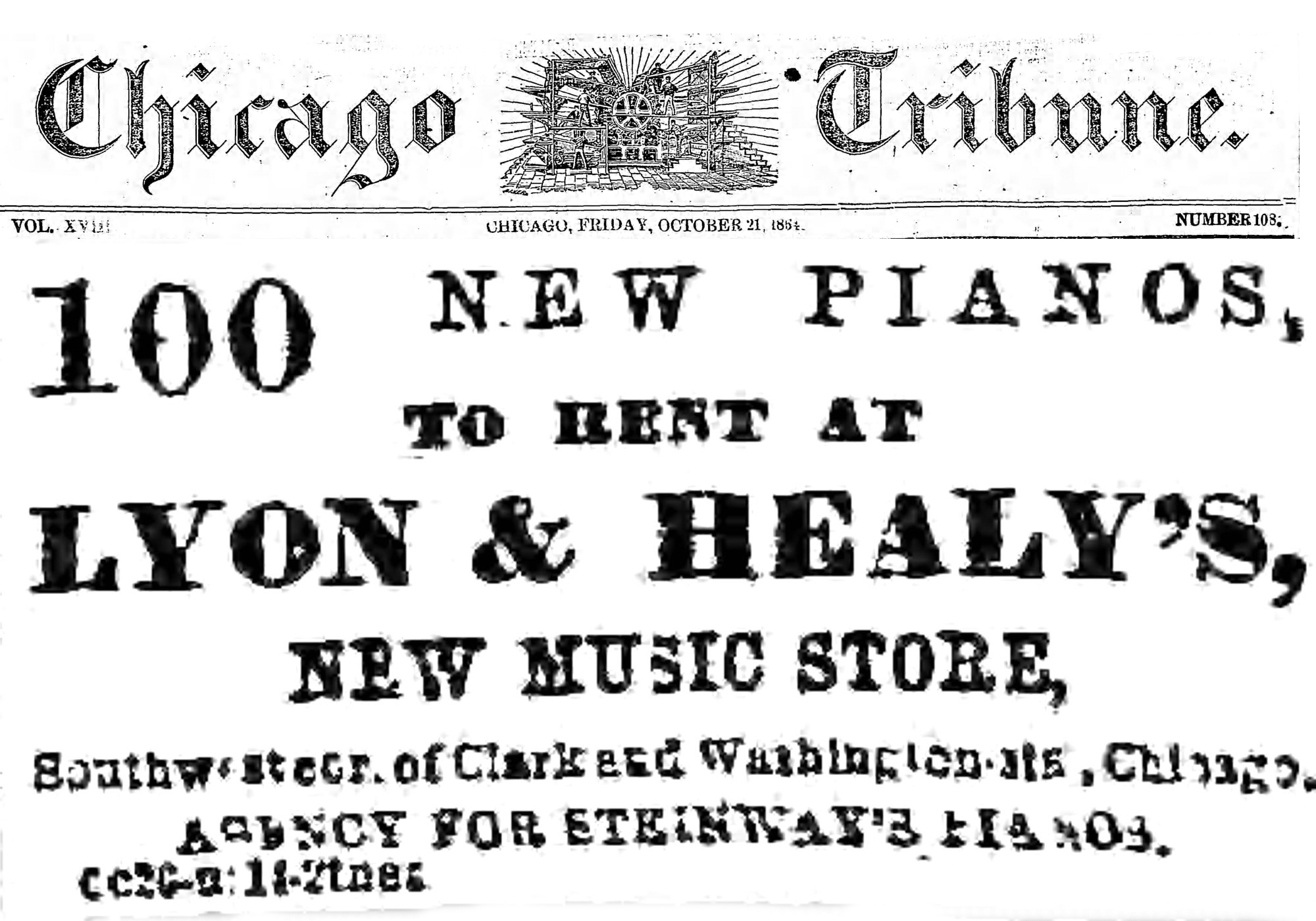 A very fine Music Hall is in course of erection for Smith and Nixon, on the corner of Washington and Clark streets—the opposite corner to the Chamber of Commerce building. The hall which is to be used for operatic or lecture purposes, will be in the centre of a fine block 108 feet front on Washington street, 152 on Clark. This block will be four stories in height with basement, and constructed of pressed brick, highly ornamented with carved stone work. Round the main entrance, which is on Washington street, sixteen feet wide, will be some handsome pilasters running the roof, where they terminate in a massive circular pediment. The windows will all be double beaded, and capped by finely cut arches, while intricately carved mullions separate each two, and every corner of the structure is relieved by handsome marble quoins. Round the roof an elegant medallion cornice will run, and over the main entrance, and at the two ends of the front of the structure will be massive marble balconies. The style of architecture is Florestine, and the cost of construction, including the slate roof, will be about $90,000. The music hall will be fitted up in a truly magnificent manner, and is situated in the very centre of the block, removed from all street sounds. Owing to its position it will be lighted from above.
The first of principal story of the block will be divided into four handsome stores, lit by fine plate glass windows, 5 feet by 12 feet, each pane. The entire front of the second story is leased to an Insurance Company, and the remainder of the building will be divided into brokers’ offices. large portion of the block is engaged by S. M. Fassett, who will open the finest photographic rooms in the city, and one of the largest stores is leased to a well-known jewelry firm. Otto H. Matz is the architect.
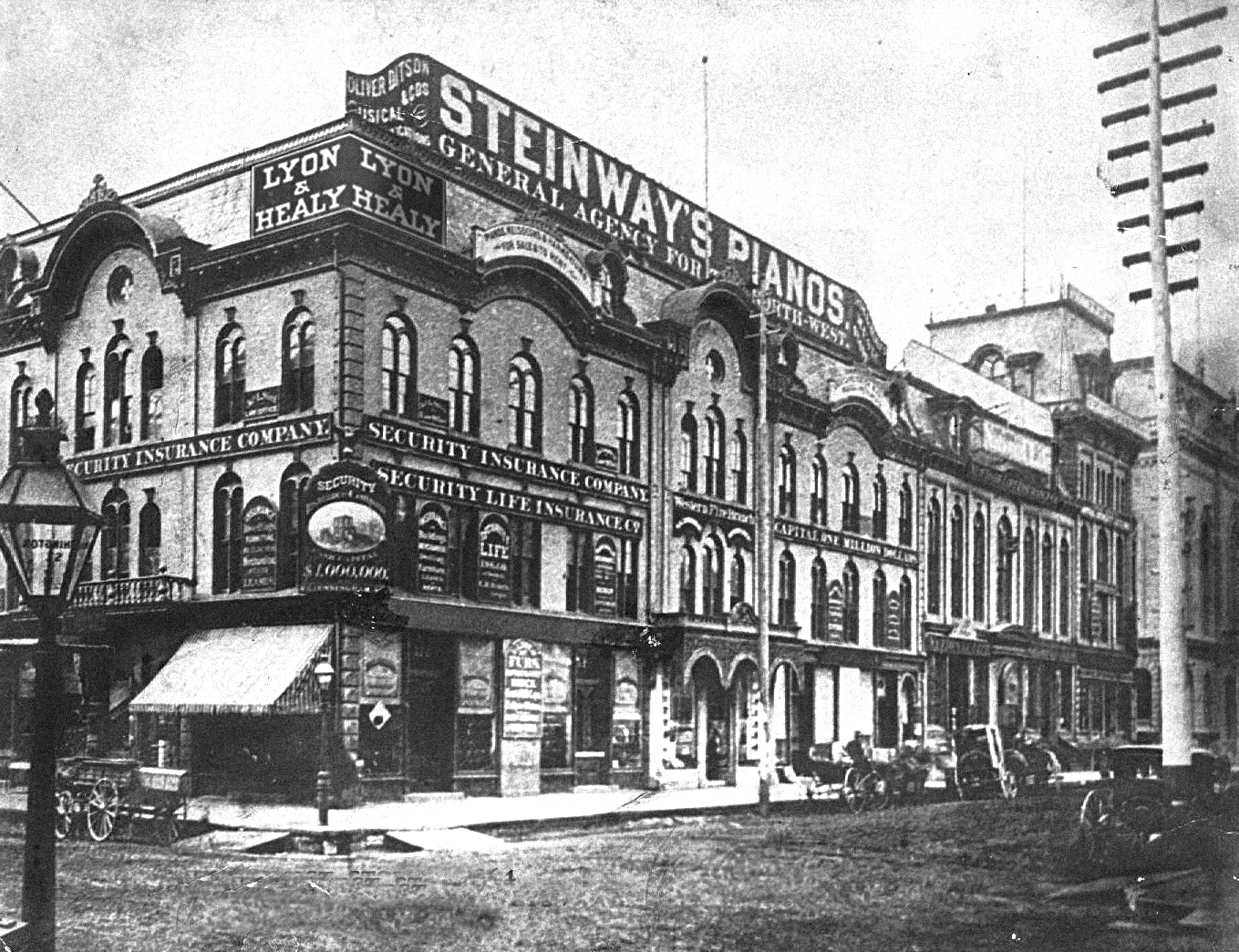
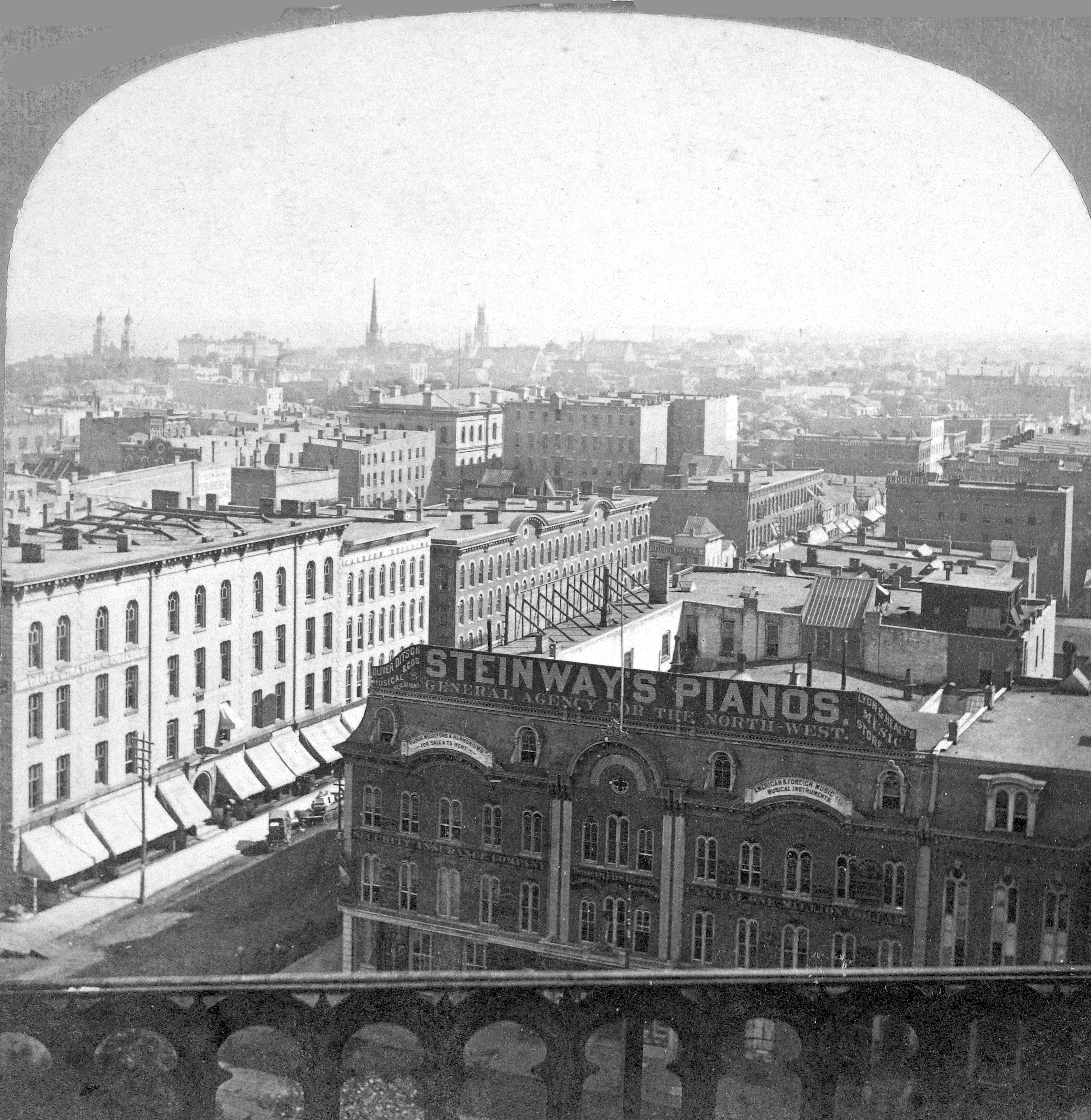
- Lyon & Healy Building
Southwest Corner of Clark and Washington Streets
Chicago Tribune, December 11, 1864
W. H. C. MILLER & Co.—REMOVAL—We notice that Messrs. W. H. C. Miller & Co., for many yearg known at 35 Clark street, have effected a removal to Nos. 108 and 110 Clark street, in Smith & Nixon’s block on the corner of Washington street, where they will open on Monday evening, with one of the largest wholesale and retail stocks of fine jewelry, solid silver and plated goods, diamonds, English, Swiss and American watches &c., ever seen on this continent. They will make a magnificent display in their windows of fifty feet frontage. They are connected with one of the largest manufacturing firms, located at Newark, N. J., and will at all times keep their store replenished with the choicest goods. Parties in search of something recherche for Christmas and New Year’s are requested to call.
Chicago Tribune, December 12, 1864
THE NEW MUSIC HOUSE.—The elegant store forming the entrance to the new Music Hall of Messrs. Smith, Nixon & Ditson, on the corner of Washington and South Clark streets, is happily located for every association befitting music literature and wares, and its occupancy is shared for such purpose by Messrs. Lyon & Healy, who bring with them the prestige of long association with the house of the veteran Ditson, of Boston. They offer to the public and to the trade one of the most superb and complete stocks ever brought to this city, with premises extremely elegant and well lighted for its display and sale. Their relation to the first sources of the very best in all that pertains to their trade will make their store at once a favorite with the music-loving public.
Chicago Illustrated, January, 1866
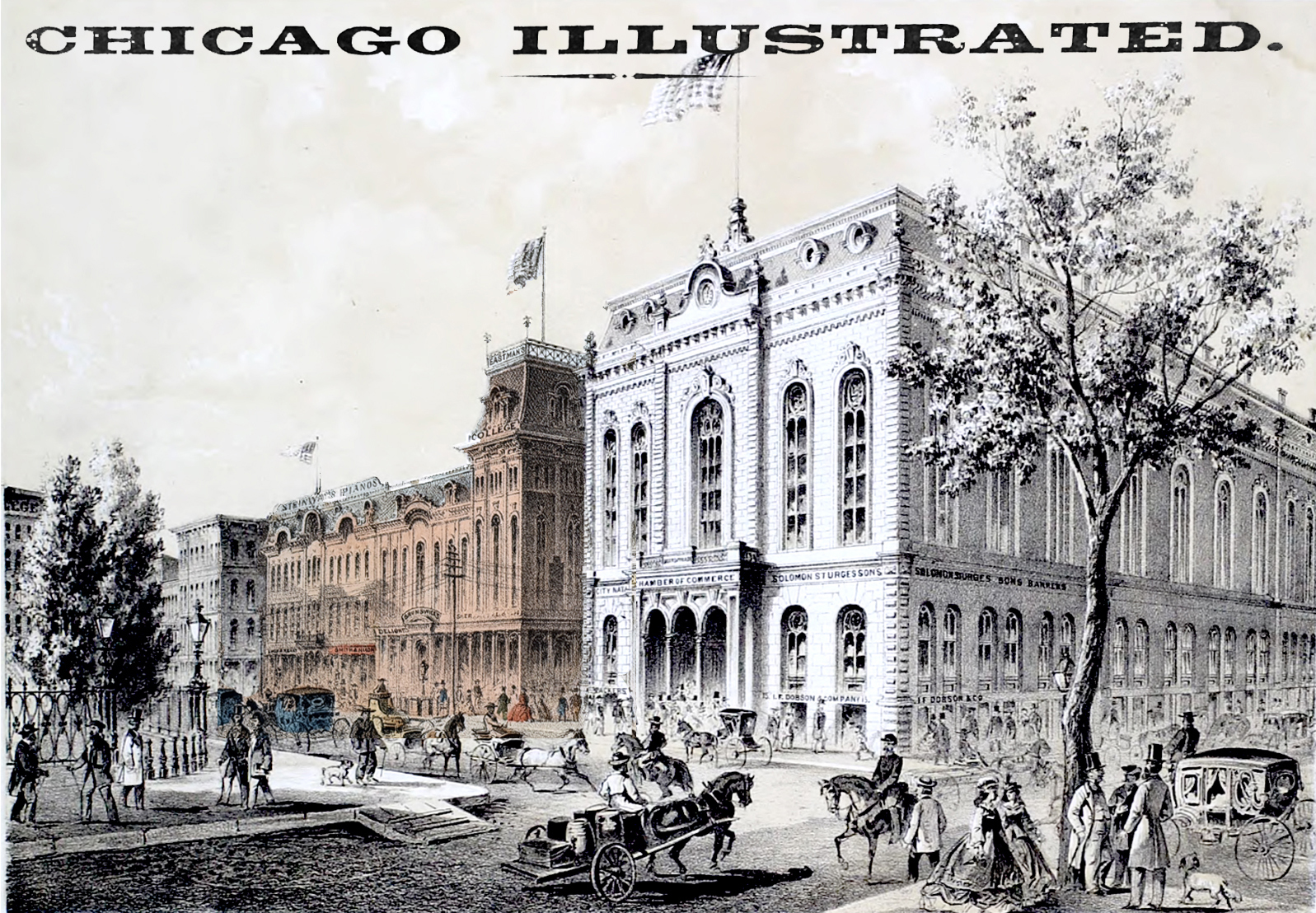
- The Chamber of Commerce building, shown on the right of this picture, is one of the latest of the many new and handsome public edifices erected of late years in Chicago. It is located at the south-east corner of La Salle and Washington streets, and fronts the Court-House square. To the east is the new building of Smith and Nixon; and still further to the east, at the corner of Clark street is the Methodist block.
Chicago Tribune, January 2, 1865
Smith & Nixon’s Music Hall.—A very handsome music hall has been erected this year on the southwest corner of Washington and Clark streets by Messrs. Smith, Ditson & Nixon. The hall is enclosed in a block 103 feet front on Washington street by 183 on Clark. The block is four stories in height, with basement, and is composed of pressed brick, with elegant cut stone trimmings. The Hall is in the very centre of the building. removed from all external noises, and is splendidly fitted up. Unlike other city halls, it will only be used as an audience room. The seats all rise from the stage to the rear, the parquette gradually, then the dress circle, and over that the balcony. The room has no angles, the ceilings and corners are concave, and the stage set in an eliptically shaped alcove, so that every sound is reflected to a focus. The hall is lighted chiefly from above, four skylights transmitting the principal light in the day-time. The block contains stores on each front. a large photographic gallery occupying 98 by 103 feet, three stories in height, and also forty-five offices. Its estimated cost was a littler over $100,000. and the block was erected under the supervision of Otto H. Matz, Esq.
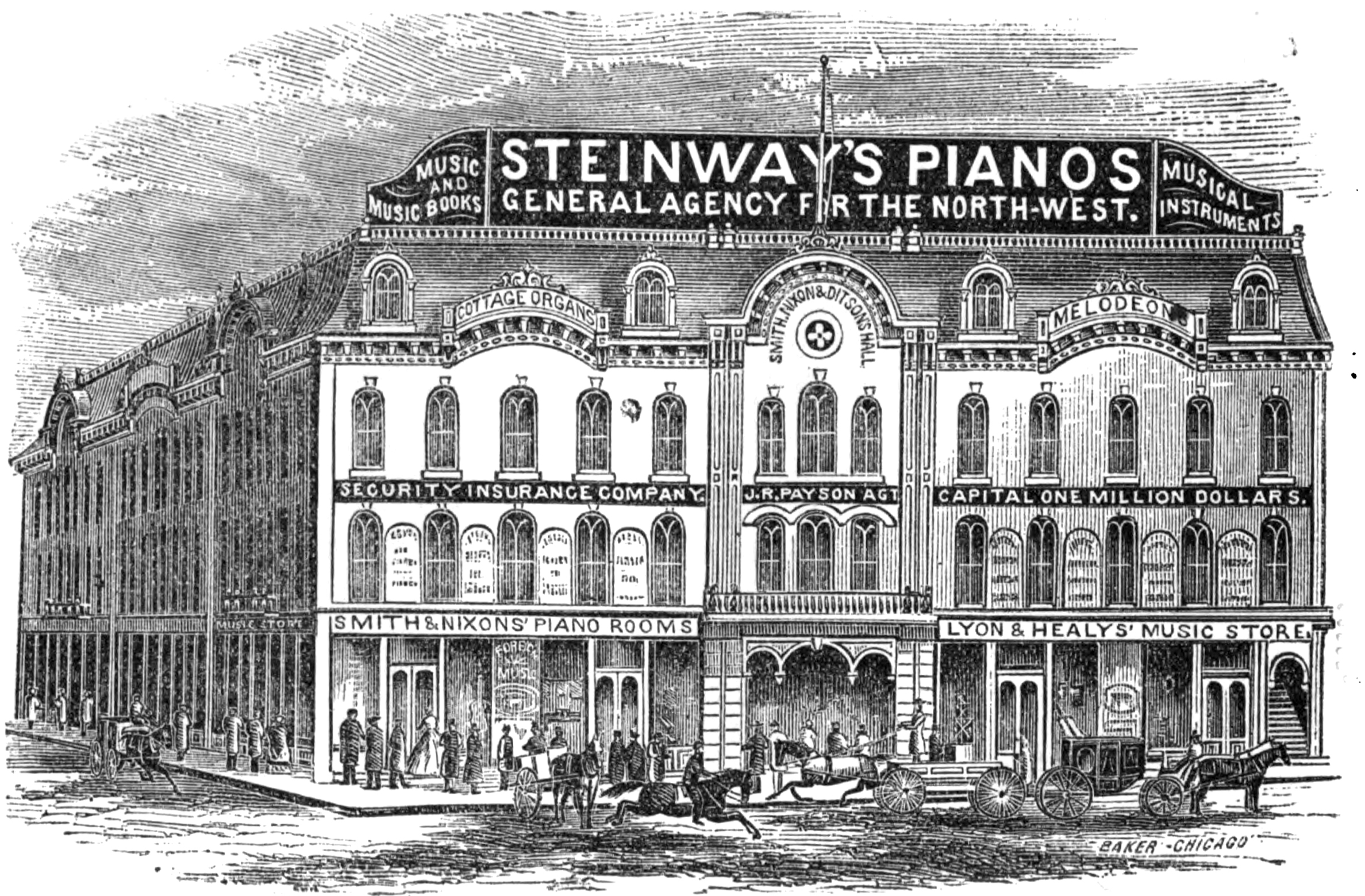
- Smith & Nixon Hall
A Strangers’ and Tourists’ Guide to the City of Chicago
1866
Chicago Tribune, December 29, 1865
Nixon’s Exchange.—This building occupies the space on Washington street, east of the Chamber of Commerce and west of the edifice last described Smith & Nixon’s Hall. It covers an area of of ninety-three feet by one hundred and eighty-two on Exchange place. The Washington street front has the same height, as the Smith & Nixon’s building, and is flanked by a tower thirty feet square and rising to the height of the exchange olace facade. The building is constructed of stone, brick and iron. The fronts are faced with Chicago pressed brick, ornamented with iron quoins, key-stones, pillasters, etc. The cornice is of wood and elaborately carved. The basement and principal story have iron fronts, with plate glass windows throughout. These two stories are nine and fourteen and a half feet high, and divided into eighteen offices, a portion of them provided with iron vaults. The principal story is reached by ornamental iron steps from a stone sidewalk, surrounding the entire building. The second, third and fourth stories are reached from Exchange place by stone steps, twelve feet long, supported by heavy stone buttress blocks, with paneled faces. There is also an entrance to these stories through the large portico on Washington street. The three stories are divided into twenty offices and two large rooms, thirty by eighty-five each, to be used for Commercial College purposes.
The Washington street entrance is ten feet wide through the large portico. In this block is situated “Morse’s Exchange,” a large hall sixty feet square by twenty-five feet in height, with private rooms attached. The building cost somewhat over $100,000. O. H. Matz was the architect.
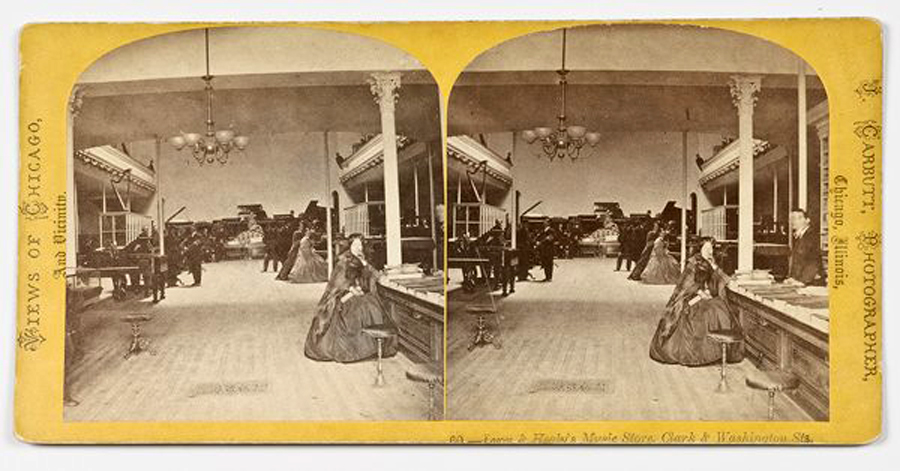
- Interior, Lyon & Healy’s Music Store
Clark & Washington Sts.
Stereoview by John Carbutt
A Stranger’s and Tourists’ Guide to the City of Chicago, 1866
Notable Stores.
The stores of Chicago are widely known, on account of the beauty and splendor of their architectural appearance.
Of these, the magnificent block of Smith & Nixon, occupying nearly the entire square on the southwest corner of Clark and Washington streets, is deserving of especial mention. This is one of the finest business blocks in the entire city. The piano-room of Messrs. Smith & Nixon is the largest and finest in the country, and is well worth a visit. Here, too, is the establishment of Messrs. Lyon & Healy, agents for the celebrated Burdett cottage organ and dealers in every variety of musical instruments. They have the control of the manufactory of this instrument, on the corner of Sedgwick street and Chicago avenue, which is capable of turning out from twenty-five to thirty instruments a week, of the finest quality, and gives employment to seventy-five hands.
The four buildings of the western institution of Eastman National Business College, one of which forms a portion of Smith & Nixon’s block, another situated on the corner of La Salle and Randolph streets, a third opposite, on Randolph street, and the fourth on the corner of Clark and Monroe streets, will attract the attention of the visitor to Chicago. This institution is in the most flourishing condition, and during the season of 1865-66 had a regular attendance of upwards of 1,500 pupils. Its faculty is constituted of able and experienced instructors, and the reputation of the institution is constantly increasing by reason of the thorough and systematic course of study to which it adheres.
Chicago Evening Post, December 23, 1867
W. H. C. MILLER & Co.—This well-known firm, dealing largely in jewelry, watches, silver and plated ware, etc., announce that they are prepared to receive all their old friends, and as many new ones as may desire to call, at their establishment, Nos. 108 and 110 Clark street. They exhibit one of the finest assortments of general jewelry goods ever brought to the city, which will be disposed ef at rates which cannot fail to please those who may be in search of holiday presents.
Chicago Tribune, February 5, 1870
Musical Enterprise.
Messrs. Smith & Nixon and Messrs. Lyon & Healy, the well-known music dealers, have removed from the corner of Washington and Clark streets, to a larger establishment at the corner of Wabash avenue and Washington street. This is probably the finest music store in the West, if not in the entire country. Drake’s Block, in which the store is located, is perhaps the most elegantly finished building in the city, and is a fitting home for the musical trade of the Northwest.
There are other stores devoted to the business of Smith & Nixon and Lyon & Healy. The corner, No. 96, is the retail department, and has been fixed up especially for that purpose. The appointments are elegant in every respect, and nothing has been left undone to gratify the most fastidious taste. Oak and black walnut enter into the composition of the handsome counters and cases. In the corner of the room is a handsomely arranged office.
Through an arched doorway, furnished with a glass door, the visitor enters the piano room, where the famous Steinway pianos are kept in large numbers. Messrs. Smith & Nixon control the piano business. They are the sole agents for the piano in the United States. They have also a house in Cincinnati, and are the oldest and largest piano dealers in the West. Off the piano room is the organ room, where all kinds of melodeons and organs are for sale. In connection with this department is a “dead room,” where owing to its peculiar construction, the least disarrangement or defect of any instrument can be at once detected by the trained ear. These rooms are Nos. 98 and 100.
Beneath these stores is the wholesale department, where all kinds of musical instruments, string and brass, are sold to dealers. The room is arranged to suit this trade. In the basement is also the elevator, boiler rooms, steam engine, &c.
In this splendid establishment are combined four specialties familiar and important to the musical world. They are Steinway’s pianos, Burdett’s organs, Ditson’s publications, and the office of the National Independent. The entire concern is a credit to the city, and merits the success and prosperity which are the due reward of energy and enterprise.
Chicago Evening Post, October 27, 1869

H. M. Higgins.
Over four years ago, the veteran dealer whose came heads this article began the manufacture of pianos for the Chicago market. He designed to and did produce an instrument first class in every respect, and, as a consequence, the “Higgins” stands to-day with hardly a rival among pianos. The judgement of skilled musicians, who have expressed themselves in our hearing, is that neither the Steinway nor Chickering surpasses it in tone and durability. With such an instrument, and under the live management of an energetic man, it is not to be wondered that the trade has outgrown all calculation, demanding to-day greatly enlarged quarters for its accommodation. The new rooms are just being occupied at 150 South Clark street, where our musically inclined readers will find by all odds the most elegant piano hall in the city. There is 30 feet width and 120 feet depth, with 16 feet ceilings, giving a splendid area for the exhibition and trial of instruments. The floor is of walnut and ash, 1¾ inch strips alternated, being both exceedingly desirable and handsome. The large windows are single plate French glass, that cost $400 each. In the rear, elegant offices are fitted, one for the use of the establishment, the other as an instruction room for that accomplished artist, Prof. Louis Meyers. This skillful performer, by the by, after thorough trial and investigation, adopts the Higgins piano, giving it in all cases an unqualified endorsement to his pupils.
It is the aim of Mr. Higgins to supply the demand in this city for first-class pianos, and to that end be guarantees to furnish instruments at from one to two hundred dollars less price each than other dealers dare make on goods of the same quality,
Furthermore, he will lease his pianos for a fair monthly payment, stipulating that at the end of one jeer, if the lessee desires, the instrument maybe taken on purchase, less the lease money paid. We were shown beautifully toned instruments to be rented as low as eight dollars per month. The veteran tuner, Mr. L. Amman, is still in Mr. H.’s employ, backed by fifteen years’ constant, satisfactory service. Mr. A. is perhaps the best tuner in the city, and those having fine instruments to be taken care of, will consult their own interest by leaving their orders with Mr. Higgins. Remember the place, 150 South Clark street.
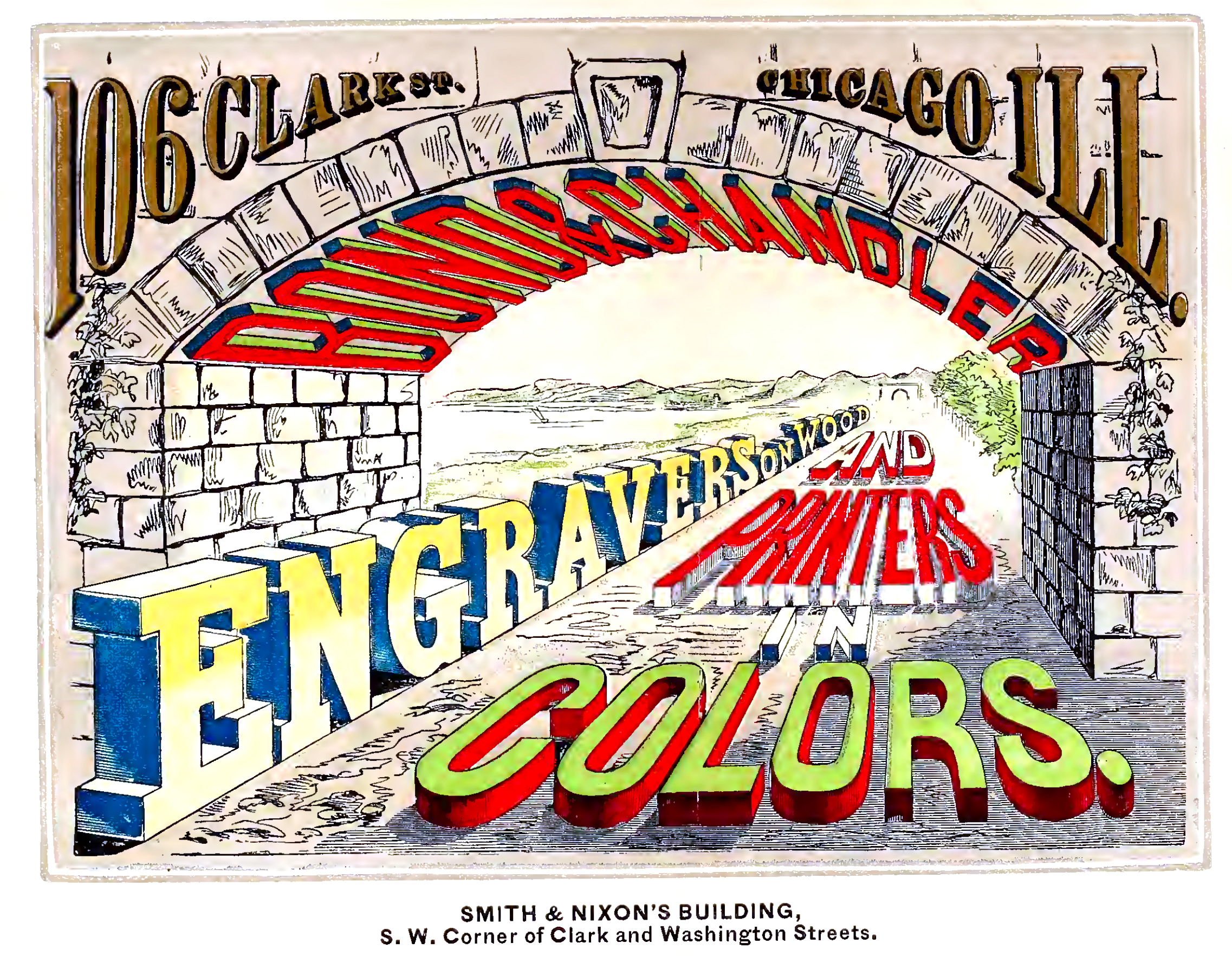
- Bond & Chandler
Smith & Nixon Building
1867
Chicago Tribune, September 5, 1870
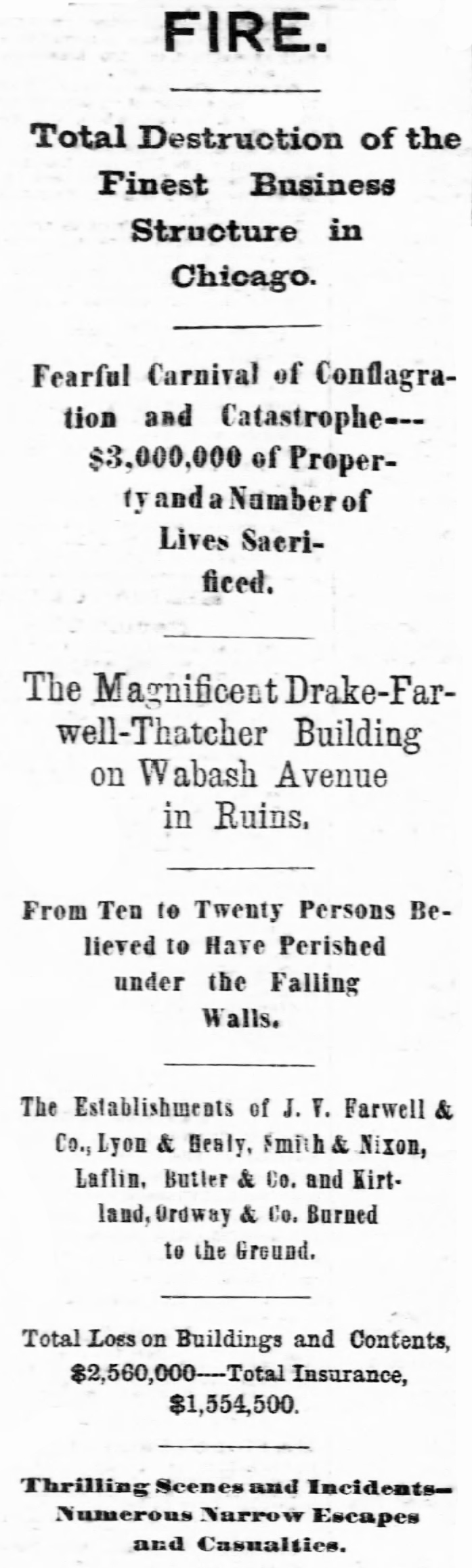 THE FIRE.
Its Inception and Progress.
The quiet and peace which usually prevails on Sunday afternoons, was disturbed yesterday by the fire-bell striking No. 12, which proved to be the signal for the most extensive and destructive conflagration that has occurred in this city since the memorable Lake street fire on the night of February 28, 1868. At three minutes to five o’clock there was a shout of “Fire” along Madison street, which carried down LaSalle and Clark to the Court House, and persons began running towards Washington avenue, in the direction of the smoke. It was found to issue from the upper story of Laflin, Butler & Co.’s paper store, in the new and magnificent block erected about a year ago, on the east side of Wabash avenue, between Washington and Madison streets.
Gusts of Smoke
rose from the southeast rear corner of the building, growing thicker and larger every moment. The engines arrived very quickly after the alarm was sounded, and went to work to get on their streams. The attempt was a miserable failure, and precious moments were lost, not owing to lack of energy on the part of the gallant firemen, but to the false economy on the part of officials over whom they had no control. The suctions were attached to the hydrants, and the engines began to work, but before water could be thrown on the building, the hose connected with three of the engines burst, and was uselss.
The Fire Gains Rapidly,
the smoke at the corner turns into flame, and the work of destruction begins in earnest. The broken hose is repaired and replaced as rapidly as possible, but time that can never be reclaimed, and opportunities that can never be recalled are forever lost. There comes a hoisting apparatus in front of the building. Three firemen get into a sort of a bucket, and others turned a windlass to raise them up so that they can pour the water into the upper stories of the building.
But the Machinery Will Not Work.
The bucket stops half way, having caught in the mast of the machine. The men tug desperately at the windlass; it is freed, and in a few minutes it is on its way upward once more. Fully a quarter of an hour has been wasted in this attempt to accomplish the ascent. When the men get as high as they can, which is only to the third story, they might as well been on the ground, on account of the difficulty of handling the hose in the crazy bucket. The stream is small and ineffectual, and does not reach the upper story.
The Fire Gains Ground.
In the meantime the fir increases, the flames spread rapidly from the rear to the front, and at 5:25 the entire roof is a mass of flame and smoke. Downward into the building the fire eats its way, and in a few minutes the flame and smoke curl upward as if rising from a burning pit. In ten minutes more, or at twenty minutes to 6, the whole of Laflin, Butler & Co.’s building is o fire. The scene even at this early stage is grand. Flame leaps after flame, mounting skyward amid the thick, dark smoke, making the most fantastic shapes and forms imaginable. Around the cornices and windows the fire dances like a demon at play. The light of day is almost obscured by the immense volume of smoke which drifts southerly before a gentle wind, carrying sparks which drop and burn holes in the garments of the vast crowd that had already assembled. There is hardly time to notice minor events for
the fire is traveling fast.
Already the paper store is doomed. Upward and onward surely, steadily, and swiftly the destroyer marches. The roof of the adjoining building, owned and occupied by John V. Farwell & Co., the great dry goods merchants, has caught, and smoke rushes out of the grand Mansard roof. The heat grows intense. The crowd retires before it, and it is growing hotter and hotter every moment. The second roof is covered with flame and smoke. Matters look serious for the building. Volunteers are called for from the crowd to assist in removing the gods.
A Crowd Rushes In,
and the goods are handed out and carried to the Presbyterian Church. further down the avenue. The rescue of the goods goes on, and so does the fire. The cornice begins to fall in large pieces. There is no time to be lost. The bucket machine has been utterly worthless. Its intention may have been good, but its practice is imperfect.The men in the bucket, cannot stand the heat, which is growing fiercer, and they come down. They might have might as well have never gone up. They have done no good. The machine is moved out of the way to Washington street.
The Volunteers are Working Like Heroes
to save the goods. Some of them are away up on the third and fourth stories. Mr. Ira P. Bowen is on the fifth floor, with a Babcock extinguisher, working for dear life, with half a dozen other brave fellows. The smoke gets thick and strong up there, and they have to retreat, their faces covered with wet handkerchiefs to prevent suffocation. They are doubtful about the stairway, and find an exit through the upper story of Lyon & Healey’s building, two doors north. Still there are others in the buisling—a great many—how many God knows, and no one else. They are on the first, second, third, and fourth floors, working as men will work when their impulses prompt them to grand and gallant deeds. The engineer of the building knows what it contains, and is anxious about the lives of the men. He tells officer Wood to turn them out as the upper floor contains hundreds of tons of goods, and if the walls give way they will fall, carrying death to the men below. Wood runs up and drives them from the third and fourth floors. A minute more and he would have been too late. He again enters the store on the same mission. There are a large number inside——and they are in imminent danger. Wood gets inside the door, but, before he has time to say anything, there is a rumbling noise, and a crash, which sends a chill to the heart, and, with a roar like a thunder-clap, the floors fall in from the room to the cellar.
There is a frantic rush to the door by those inside, and men and boys fall over each other in their efforts to escape. Some were caught in the timber and debris. None can tell how went in and how many came out, or how many never came out. Officer Wood, Mr. R.W. Patten and Mrt. G.F. Sterling, are the last to get out, and they say there must have been a dozen men inside. Mr. Patten isw wounded, his back being cut and burned.
The Flames Roar
and leap among the rafters in mad delight. Upward they shoot, the smoke hovering around and over them, while sparks and bits of flame are scattered all over, endangering surrounding property. The fire creeps along the roof of the nnext buildings, occupied by Kirtland, Ordway & Co. and Lyon & Healey, and 5:45 they too are on fire. Men are busy running goods from the building. hose of Messrs. Farwell & Co. are taken to the Second Presbyterian Church, which has been generously thrown open, for the purpose, and those of Lyon & Healey are dragged out into the street. There is no time to spare, for the fire fiend has got loose and is dooming everything that comes in his way.
There is Another Crash,
caused by twenty-five feet of the side wall of Laflin, Butler & Co.’s store falling from a height of sixty feet. The concussion makes the ground tremble, and the affrighted crowd retires in fear and confusion. More of the same wall falls in a few minutes, leaving the interior of the burning visible. It looks like a fiery furnace, and the red and white flame sends forth a fierce heat that can hardly be borne a block away.
It is 5:45; two buildings have been destroyed in three-quarters of a n hour, and yet there are only three streams of water of any use at all and they are not of much service, as they do not rise above the third atory. That hose is spurting an squirting all along the streets, wasting water intended for the building. The impression inn the crowd is that the hose is a fraud, and an imposition, and that it ought to be condemned. It condemns itself. That precious bucket machine has been missed for the last half hour bu half a dozen men who have managed to take it in safely as far as Washington street. Just now it is going under a telegraph wire, and the mast, or pole, on which these men ventured their lives half an hour ago, snaps off, and the thing is a complete failure. The men are released from care of it, and can find something to do elsewhere. So far, there has been but one stream on the rear of the building, and that is weak and worthless. The time lost at the outset is telling fearfully now. Future efforts will be unavailing, even if the hose holds out.
There are half a dozen firemen away up that roof of Lyon & Healey’s, over one hundred feet high, a perfect sea of fire below, dashing in waves against the fated building. Three brave fellows try to get a stream on the roof; but human beings cannot stand fire and smoke, and fire has taken hold of the roof to destroy it. On it went relentlessly, with nothing to impede its course or stop its way. There is no obstacle before it, and the roof is soon enveloped in flames. The firemen escaped in time down the elevator. They have barely got to the bottom, ere a pillar of flame rusches after them down the hatchway. A moment more and they were lost.
It is 5:50, and Lyon & Healey’s building is burning inside. Its fate seems inevitable. Nest door south, is the L-shaped store, occupied by Kirtland, Ordway & Co., dealers in boots and shoes. This store fronts on both Wabash avenue and Washington street. There is now small chance that any of the block will escape, and men begin to remove the stock from the building occupied by Kirtland, Ordway & Co.
The sparks are flying all over, and some fall upon the roof of St. Mary’s Catholic Church, at the corner of Madison street, and at 5:55 the roof is on fire. Some buckets of water are thrown on it and the building is saved. The heat is intense, and the crowds retire before it, and timid persons leave, the sight of the burning mass being too terrific for weak nerves.
At 6:15. The wall between Laflins and Farwell falls with a loud retort into Messrs. Farwell & Co.’s basement, and uprise the sparks and the flame, the latter sending forth a heat that reaches across the street and threatens the buildings there. A strong wall falls inside, giving the flames more food in Lyon & Healey’s building. All this time the hose is bursting, rendering the efforts of the firemen futile. They can do nothing anyway, for the devoted block, which an hour ago stood in all its pride and beauty. The heat again threatens the buildings on the opposite side of the street, and the water is turned on them to cool the fronts. Water is also thrown on the roofs of several buildings in the vicinity to prevent the sparks from setting them on fire.
The rear wall of Farwell’s building falls with a loud report in the alleyway. No one is seriously injured, although the intrepid firemen stand their ground until the very last moment. One man gets frightened, and suddenly letting go of the hose it strikes him in the side breaking two of hs ribs.
6:40. The side walls Layon & Healey’s building, fronting Michigan avenue, falls on Mr. Wilder’s barn, in the alley-way. crushing and destroying it utterly. The entire block is now ablaze, presenting a magnificent spectacle. It can hardly be described. The flames rose all over, just as the moon came out; the heavens were lighted up by an unnatural glare; the smoke and steam rose in dark and curling masses; the walls cracked, wit a report like a pistol, and so the scene increased in grandeur every moment.
The front, from the corner to Lyon & Healey’s building, has fallen gradually, and by piecemeal. Nothing stands but the corner, rising up like an old ruin, or, as a gentleman says, like the ancient tower of Heidelberg.
It is fifteen minutes of 7, and the wall of Kirtland, Ordway & Co. comes down and demolishes a dwelling house, the ruins of which immediately catch fire. The firemen let it burn; they have all they can do but save the corner where Lyon & Healey’s pianos are stored; but even that they cannot do, for in half an hour more, the fire has completed the work of destruction, and the noble pile of buildings and nearly all their valuable contents are destroyed.
The Origin of the Fire
is not definitely known. It was first discovered in the rear of the upper story of Laflin, Butler Co., and is supposed to have been caused by spontaneous combustion among oiled rags, which have been stored there. The flames were first seen by a servant girl employed in a family residing on Michigan avenue, in a house the rear of which faced the burning buildings. She told a little boy, and he ran into the alley-way shouting “fire.” The cry was taken up by several hostlers in the vicinity, one of whom ran to the corner and turned in Box 12. The first engine on the ground ws the Titsworth, which quickly followed by the engines in the district. A second alarm was turned in fifteen minutes after, and in the course of the next half hour to other alarms summoned every engine in the city, including the Illinois and the Winnebago from the suburbs.
J.B. Drake Building
The north one hundred and twenty feet of the building fronting on Wabash avenue was the property of John B. Drake, proprietor of the Tremont House, and was erected at a cost of $160,000. This portion of the structure, although the last to fall victim to the destroying element, will probably be completely destroyed. At the time of writing, the Wabash avenue and Washington street fronts are still standing, but there was little hope that the walls would remain after the interior floors and partitions have been burned. Even though the walls should withstand this eventually, the damage by heat would necessitate their being torn down on account both of safety and utility.
J.V. Farwell and Co.
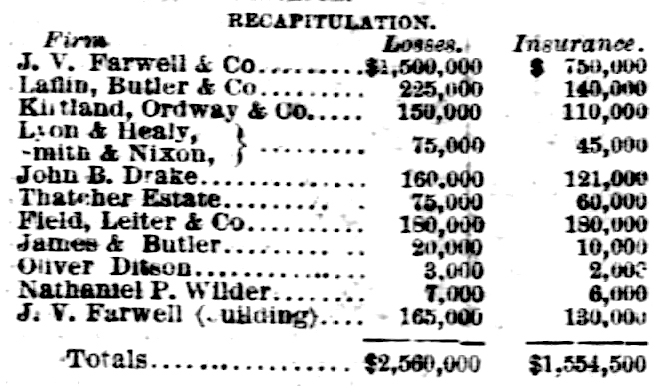
Next south of Drake’s Building was the immense wholesale dry goods establishment, occupying a frontage of seventy feet on Wabash avenue, extending to the alley. This building was exclusively owned and operated by the Farwells, who rank among the leading dry goods princes of America. The basement was filled with domestics; first floor with dress goods; second floor, cloths and woolens; third and fourth floors, notions; fifth floor, duplicate; sixth floor, packing room. One hundred and twenty-five persons were employed in and about the establishment. The stock was valued at $1,500,000, and the building at $165,000. Both were totally destroyed. Farwell & Co. have already rented the building Nos. 72 and 74 Wabash avenue, where by the aid of a large stock of goods which were warehoused at the time of the fire, the business will be continued at once, and it is expected that everything will be in as perfect running order as before within two weeks. The insurance on stock amounted to $750,000; on building, $130,000.
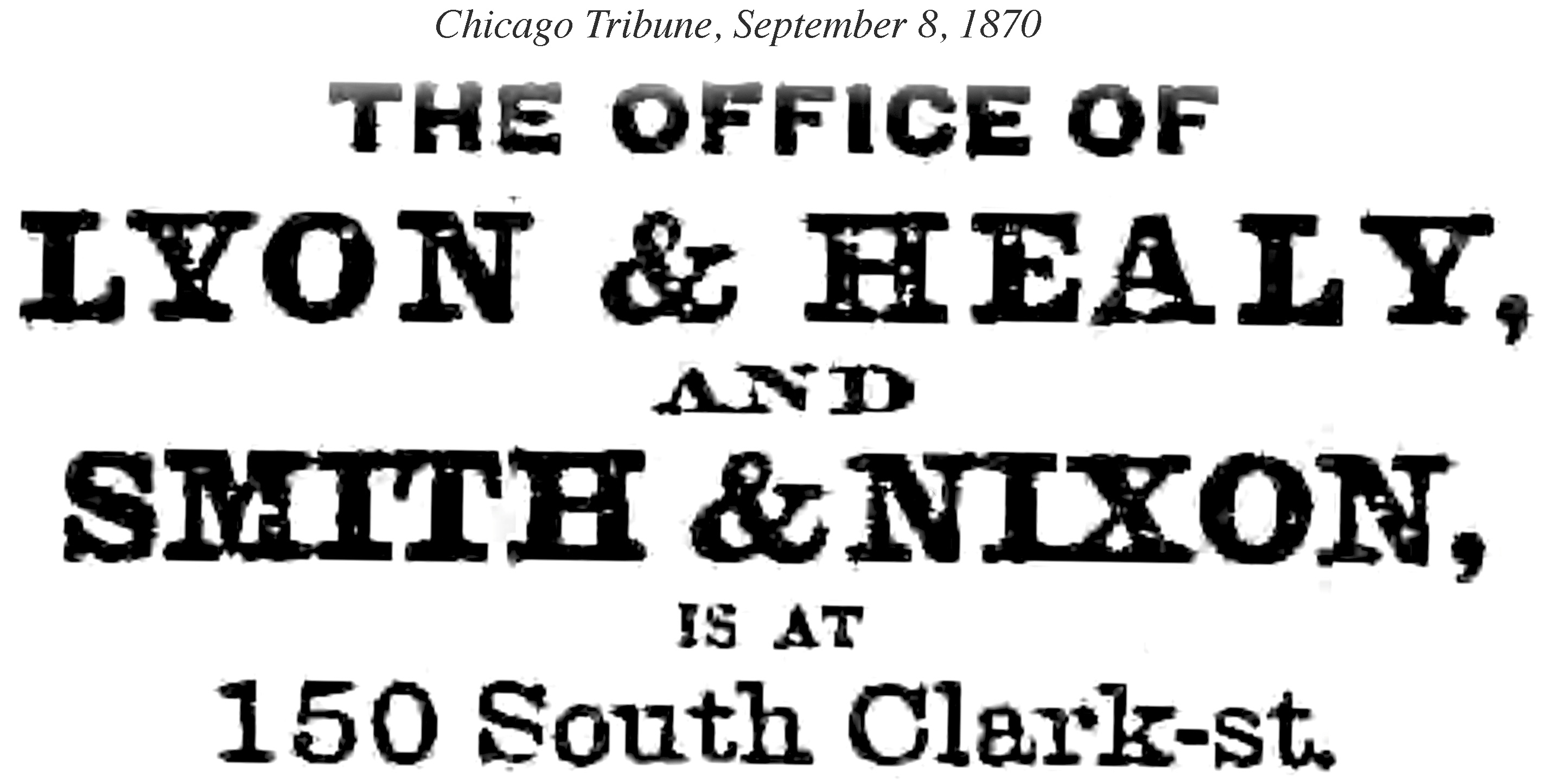
The Music Store
and salesroom for pianos and musical instruments generally, under the proprietorship of Lyon & Healey and Smith & Nixon, occupied Drake’s Building, the basement being used by Lyon & Healey for the storing of sheet music and book stock; the first floor by Lyon & Healey and Smith & Nixon as the retail department music and instruments; the second floor by Lyon & Healey, for the display and sale of pianos; third floor, by Lyon & Healey for general duplicate stock. The total value of the stock was $140,000, of which $65,000 was saved, leaving a loss of $140,000, of which about $45,000 was covered by insurance.
Kirtland, Ordway ans Co.,
wholesale dealers in boots and shoes, occupied a double store in the for of an “L”—one fronting on Wabash avenue and the other on Washington street. They had $150,000 worth of goods, but a small portion of which was saved. They were insured for $110,000.
Field, Leiter & Co.
The third and fourth floors of Drake’s building were occupied by Field, Leiter & Co. for the storage of a vast quantity of fall and winter dry goods, woolens, etc., all of which has been stored there in unbroken packages. These goods, which represented a cash value of about $185,000 were totally destroyed. It should be stated, however, that these these goods had been stored in the building temporarily, and that their destruction will not in the slightest degree interfere with the filling of orders or the supplying of customers by Field, Leiter & Co. Before this meets the eye of the reader, that firm will have perfected arrangements for the replacement of every case of goods destroyed.
The Thatcher Building.
Nos. 114 and 116, uniform in style and height with the other part of the block, was erected by the agents of the Thatcher estate, and had a frontage of forty feet and a depth of one hundred and sixty-three feet. It was erected at a cost of about $75,000, and was insured for $60,000.
Laflin, Butler & Co.
The building was occupied by Laflin, Butker & Co., paper dealers, who held all but the second floor, which was in use by James & Butler, printers. The first floor was stored with general stationery, the basement with printing paper, and the upper floors with material for the manufacture of paper. It was reported that the fire originated among this material, but the gentlemen of the firm assert that none was stored in the rear where the fire broke out. It is difficult to say whether it originated in this establishment, or in that of J.V. Farwell & Co. Messrs. Laflin, Butler & Co. held a stock valued at $225,000, on which was placed insurance to the amount of $140,000. The firm, with enterprise truly Chicagoan, engaged other quarters while their establishment was yet in flames, and will temporarily occupy No. 39 Madison street, near Wabash avenue. They have a full line of goods on the way, and will resume business shortly.
James S. Butler.
The second floor was occupied by James & Butler, printers and binders. They engaged over eighty persons about theor establishment, who are now thrown out of employment. Their loss will reach $20,000, which is insured for $10,000.
Residence Crushed and Burned.
On Washington street, in a triangle formed by the protector of the Farwell builsing, at the rear beyond the Drake Building, stood the residence of Nathaniel P. Wilder, a handsome two-story frame structure. When the danger became imminent, a considerable portion of the furniture was removed, but before the task was entirely completed, entrance to the premises was barred by the heat, and a few moments later the east wall of the Drake Building tumbled through its roof, and what was not crushed was doomed by the flames. A stable in the rear was entirely lost to view amid the debris. The building was valued at $5,000, insured to that amount. The barn was insured for $1,000. The furniture was not insured.
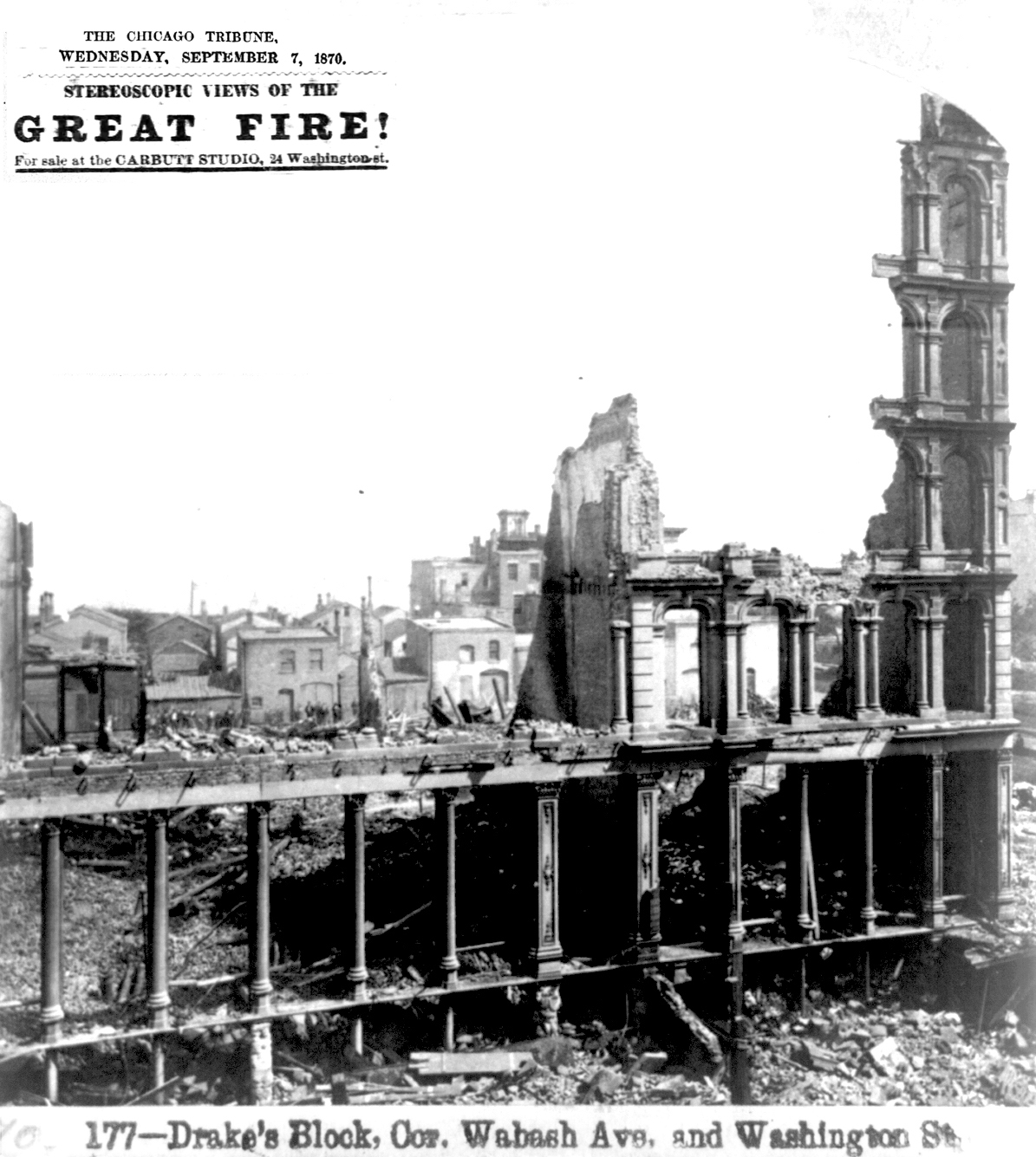
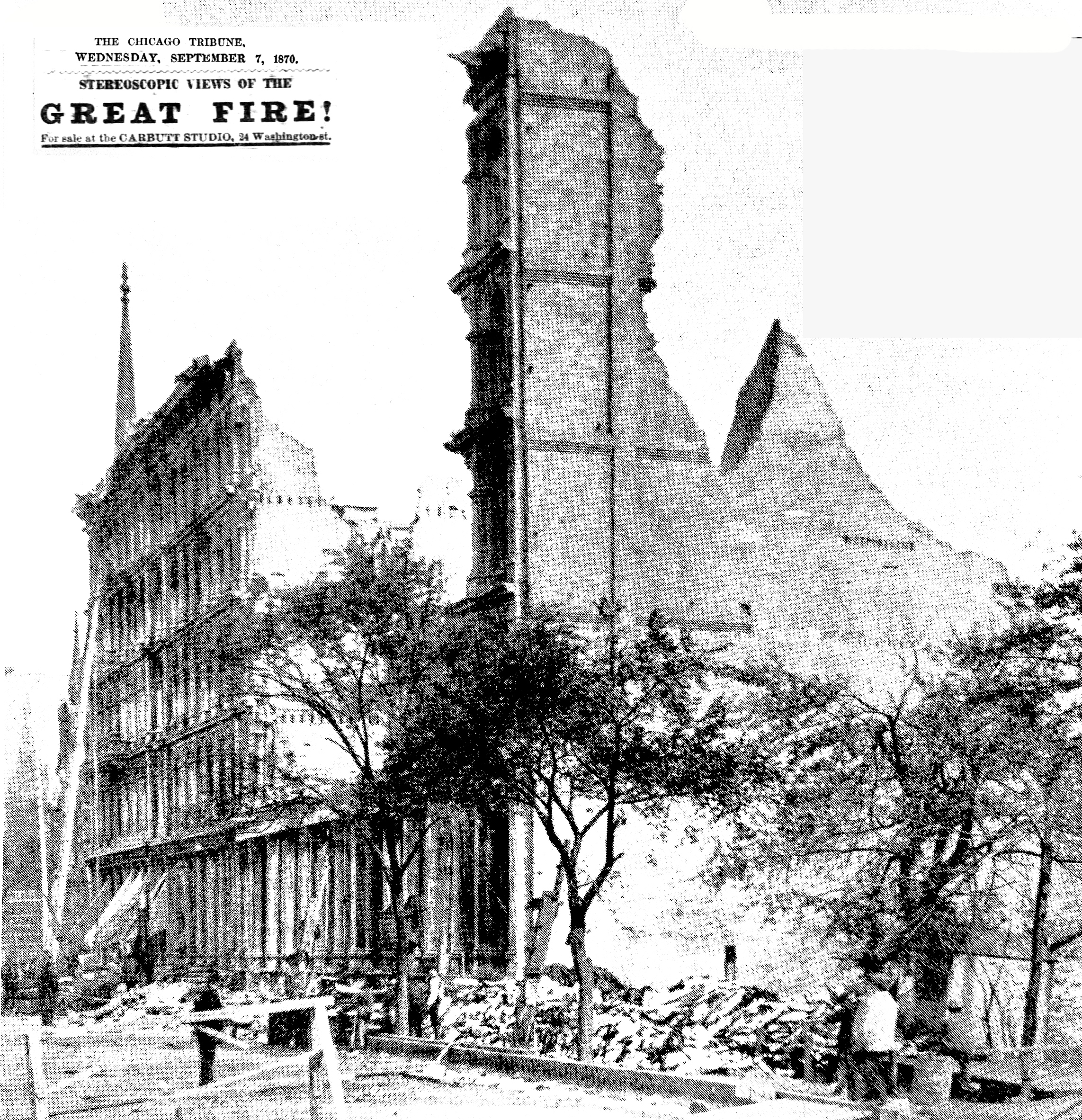
The Drake Block Ruins
John Carbutt’s photography studio was located very close to this building near the SW corner of Washington and Wabash. He immediately started selling stereo-views of the “Great Fire.” Mr. Carbutt left for Philadelphia immediately after this fire. Also, the architect, John M. Van Osdel admitted the building was not fireproof as the walls were not thick enough.
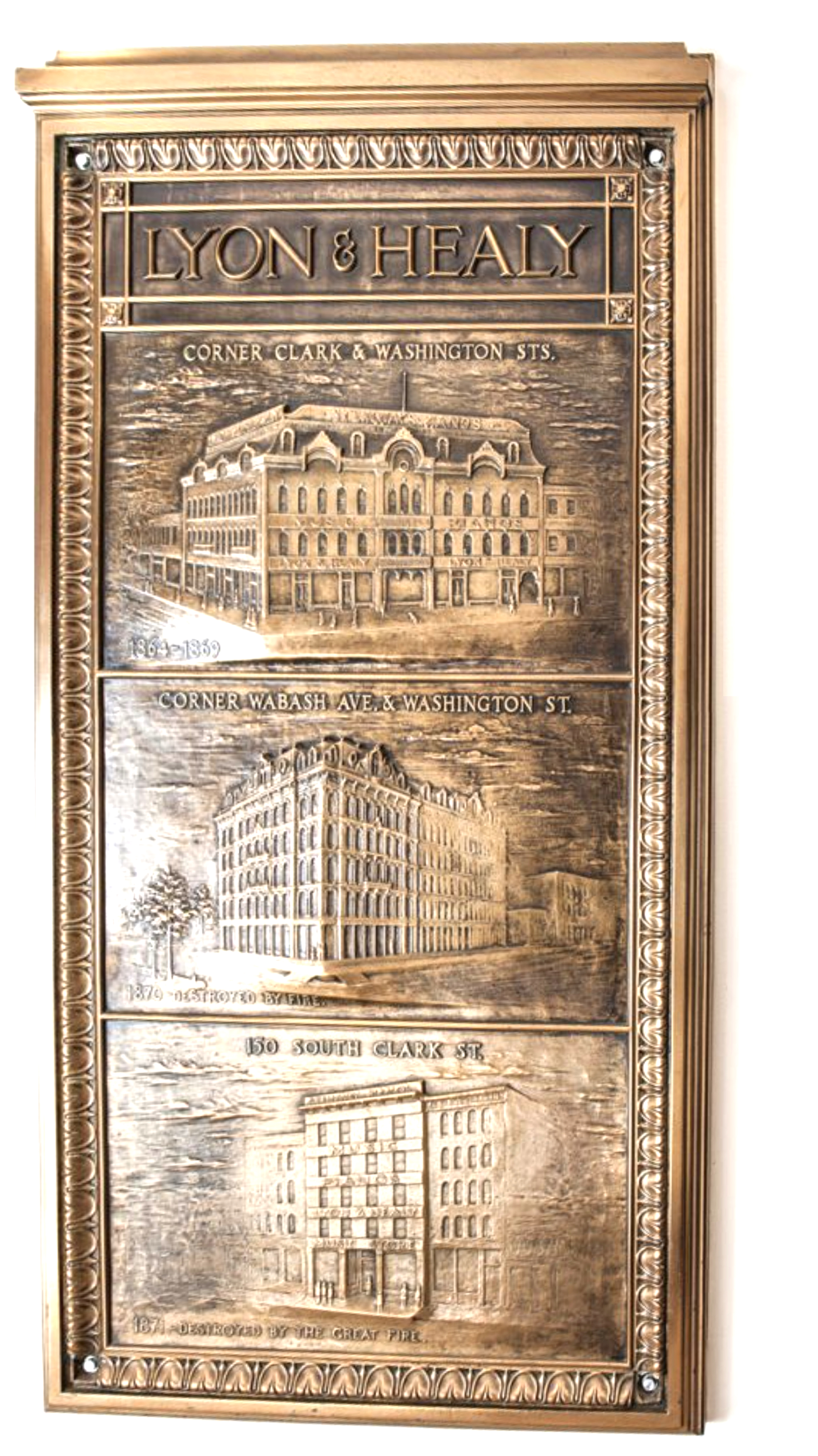
- Plaque Illustrating Pre-Fire Lyon & Healy Stores
Chicago Tribune, November 19, 1871
Lyon & Healy.
Lyon & Healy, music dealers are in the East selecting a new stock, preparatory so starting the third time. Twice has the fire fiend prostrated their business, which previous to the great fire, ranked in amount of sales as the second largest in the United States. The recent fire swept away everything, and their losses were enormous, but we are pleased to learn that they have an unimpaired capital and handsome surplus. Messrs. Lyon & Healy have paid all claims against them in full; and, as they enjoy unlimited credit, will soon recover from the adversities of fortune.—New York Musical Bulletin.
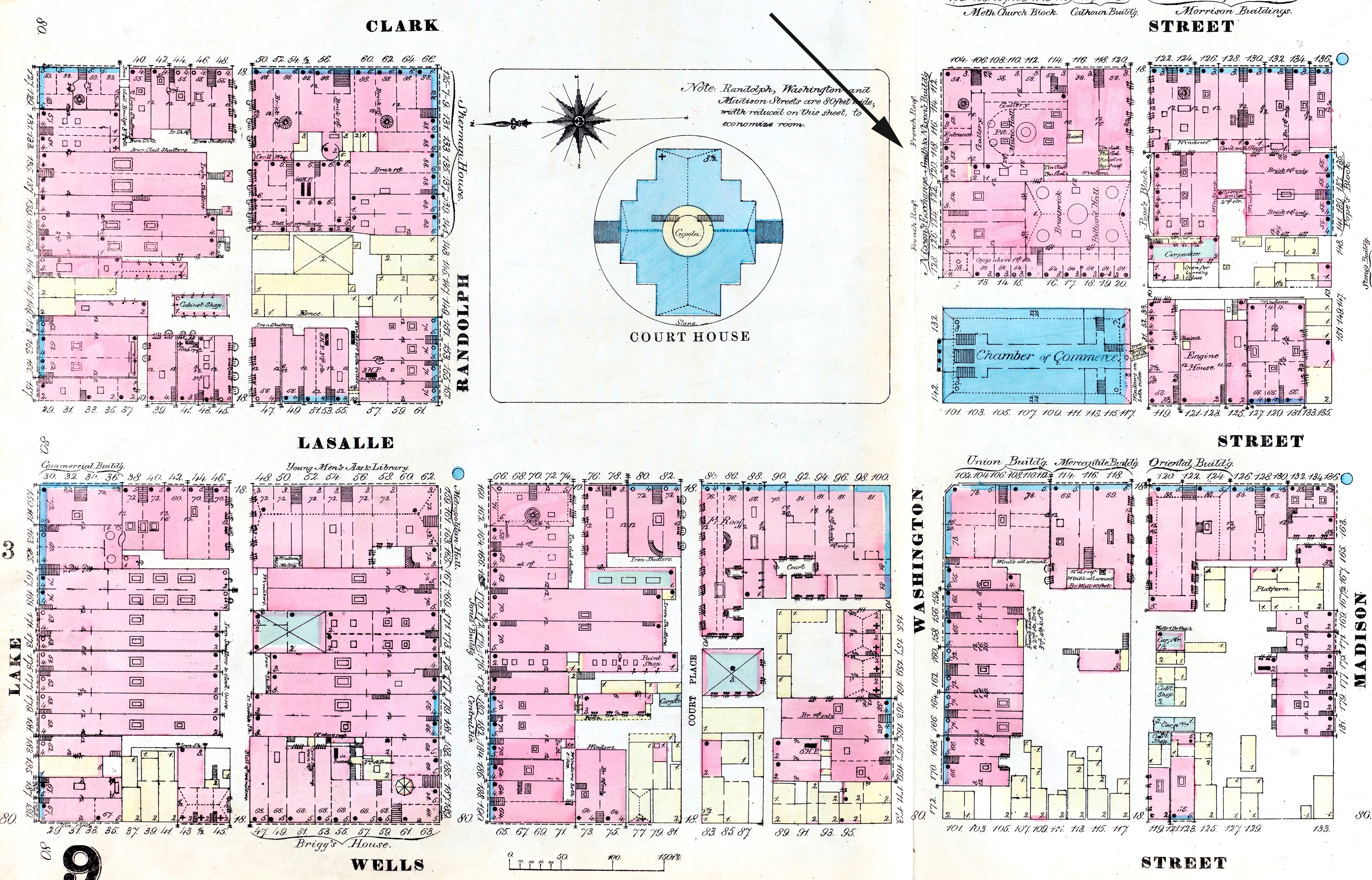
- Smith & Nixon Music Hall
Southwest Corner of Clark and Washington streets
Sanborn Fire Insurance Map
1869

The last photo of ruins in this amazingly comprehensive section is of the Republic Insurance building next to Nixon Building ( survived) located on east side of LaSalle St between Madison and Monroe, not on Smith & Nixon Block.
This site is endlessly entertaining, it would make a great book too.