Kingsbury Block, Kingsbury Hall, Chicago Museum, Col. Wood’s Museum, Aiken’s Museum
Life Span: 1859-1871
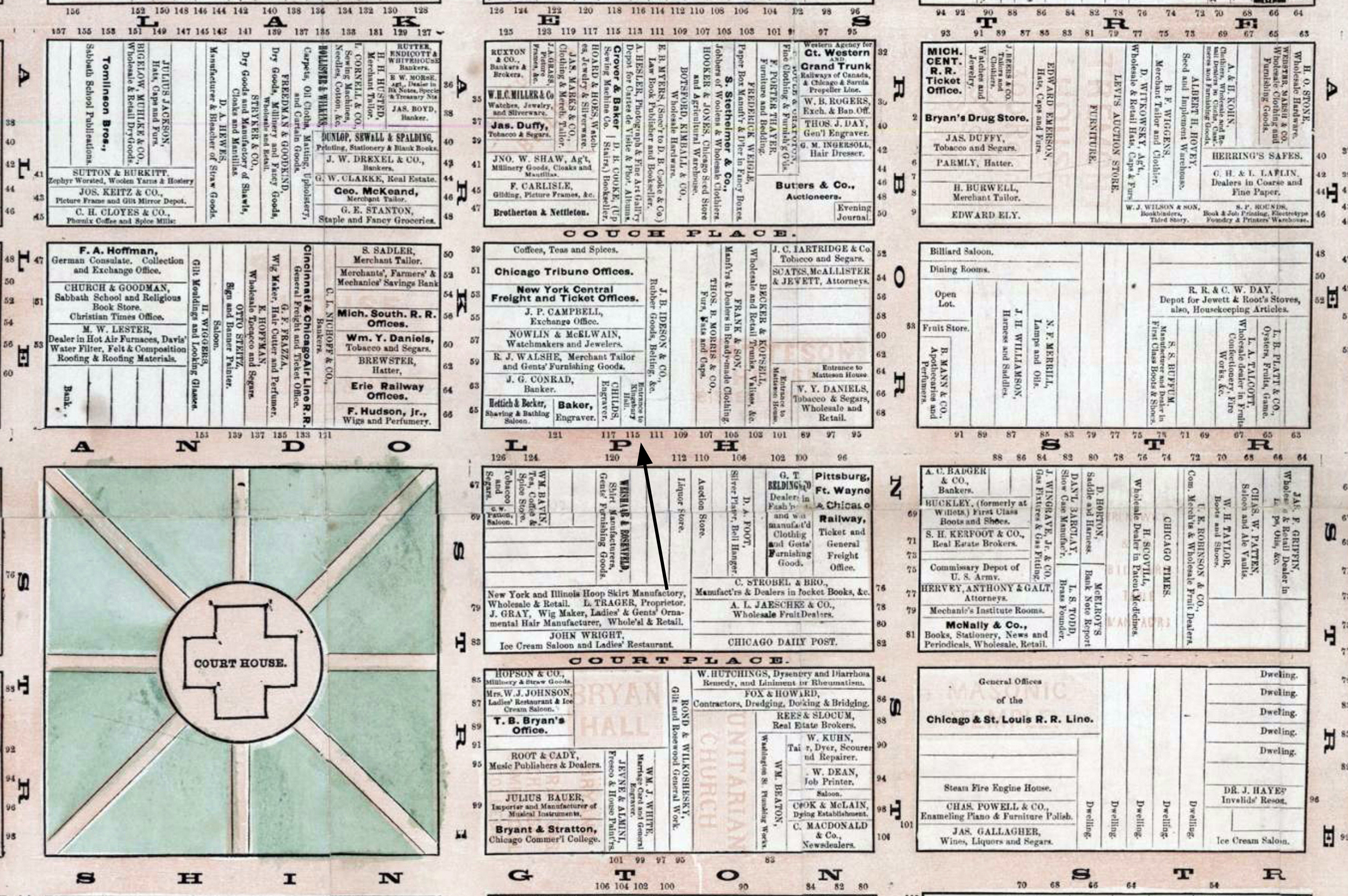
Location: Nos. 111, 113, 115, 117 Randolph street
Architect: Unknown
- D. B. Cooke & Co.’s City Directory for the Year 1859
Childs Shurael, D., engraver, 117½ Randolph, h. 216 Superior. (See adv front fly leaf.)
Halpin & Bailey’s City Directory for the Year 1863
Kingsbury Block, Randolph, bet. Clark and Dearborn
Halpin’s Chicago City Directory for 1864
Kingsbury Block, 100 to 115 Randolph
Wood J. H. & Co., (Joseph H. Wood and Benjamin F. Whitman,) proprs. Col. Wood’s Museum, 111 and 117 Randolph.
Edwards’ Annual Directory in the City of Chicago, for 1866
Wood’s Museum, Col. J. H. Wood, propr. Randolph, bet. Dearborn and Clark
Edwards’ Annual Directory in the City of Chicago for 1870-71
Aiken’s Museum—North side of Randolph street between Clark and Dearborn streets
Chicago Tribune, October 5, 1859

UNDERMINING A BUILDING.—In the course of the excavation for the foundation of the new Kingsbury Block on Randolph street, a two story brick building occupying a portion of the area in the rear of S. D. Childs & Co.’s engraving establishment, No. 117½ Randolph street, and by then occupied as a workshop, was undermined and fell with a heavy crash about 10 A.M. yesterday. Fortunately the alarm was given in time to allow the workmen to escape, and no person was injured. The wreck of the building and well nigh the loss of its contents was total and complete. The loss of Mr. Childs is heavy beyond the mere estimate of tools and material destroyed, from the interruption to his business at this season. The building was owned by Dr. Evans, who leased the ground from the Kingsbury estate. We learn that Messrs. Childs & Co. have made arrangements by resume work at once in a basement adjoining until a new building is completed on the site of the old one. Probably the full amonut of the damage will be from $3,000 to $5,000.
Chicago Tribune, December 15, 1859
The last touches are being put to the exterior of Kingsbury Block on Randolph street. It presents a noble front.
Chicago Tribune, June 13, 1860

Physical Culture.
The advantages to be obtained from a judicious and skillful training of the human muscular fibre, have lately been illustrated in some points connected with the brutal prize fight between Heenan and Sayres in England. In one direction, perhaps, this disgraceful proceeding may have a lasting and good effect. It may have called public attention to the fact that to become the perfect embodiment of vigorous, healthy manhood to have a sound mental as well as bodily organization, a person must pay more than ordinary attention to the physical system. A regular course of gymnastic training, persevered in through years of attendance at college, and kept up even after graduation, would insure us a more healthy minded, able-bodied clergy, a more intellectual and vigorous representation of all the professions. No one who haa paid the least regard to physiological research will dispute this.
In view of the facts in the premises, it is with pleasure that we announce the completion of the Metropolitan Gymnasium, Kingsbury Block, and also the opening of the first course of gymnastic instruction by Messrs. John C. Babcock and Wm. B. Curtis, the proprietors.
The Hall devoted to this school for the muscles, is of itself a beautiful representation of what Chicago architects and decorators can do when they set themselves seriously to work. The frescos are especially worthy of consideration. It is located in the third story of Kingsbury Block, with an easy entrance from Randolph street; the Hall is eighty by one hundred and eight feet in dimensions, twenty feet high, with a handsomely decorated dome over the center forty feet in diameter. The office ts sixteen by twenty feet bath room sixteen by twenty, dressing room sixteen by eighty. The following constitute a few of the fixtures and properties for the use of pupils:
- Parallel bars for adults, youths and experts; single bar, vaulting bar; suspended rings for adults and youth; tight rope, slack rope, suspended rope, plain and knotted; suspended inclined and perpendicular pole; peg pole, spool ropes, pulling weights, (four sizes); wrist weights (two sizes); dumb bells, assorted, from 5 to 145 lbs.; Indian clubs, two to ten inches in diameter; vaulting horse, lifting scale, spring board, leaping board, balancing spar, double trapeize, triple do, spirometer, and a running track, a perfect circle, well stuffed with saw dust and covered with canvas, twenty-two circuits of which constitute a mile.
It is undoubtedly the largest and most complete establishment of the kind in the United States, and aside from the healthful influence emanating from it, is well worthy the patron age of the public on the ground of convenience, comfort, and the skill and experience of the inceptions.
Western Railroad Gazette, June 23, 1860
The Delmonico of Chicago is Mat. Conley, and his International Dining Hall, Couch Place, rear of Kingsbury Block, is the best place in Chicago to Dine or Lunch. A large, cool, well regulated room, elegantly furnished—attentive colored servants—an unexceptionable Bill of Fare—charges moderate. Gentlemen go there.
Western Railroad Gazette, June 30, 1860
A FIRST CLASS RESTAURANT.—Chicago has long been notorious (next to its dilapidated pavements, “Lager Bier” dens and Long John eccentricities of City management) for having the meanest eating saloons, and places for lunch, and “down town” dining of any other city of its size east or west. Even “Wrights” (considered the “Taylor’s” of Chicago) to sell the plain truth, is by no means (ver cleanly or palatably attractive. The walls have a dingy, dirty, humid look, the marble tables are invariably sticky as if smeared over with a greasy dish cloth; the mirrors are measly with innumerable fly deposits; the paint and floor apparently receive judicious applications of soap and water none too often, while the slatternly, cream colored waiters affect a shabby genteel, don care a d——n mode of attendance far more satisfactory to themselves than pleasant to their customers.
If such blemishes are noticeable in this most fashionable place of resort, it is better to imagine than describe the majority of the less pretentious restaurants of our city. In fact Chicago has long needed just such a Restaurant as Matt Conley has quite recently opened in the rear of Kingsbury block on Couch Place. Its location renders it convenient of access to business men. The room is a neatly finished, large, cool, and well ventilated apartment, the tables are covered with linen of immaculate whiteness, fresh napkins are abundant, the victuals are admirably cooked and well served without bungling, noise or confusion, every thing looks and is clean, wholesome and inviting, while the scale of prices is very moderate. Though cheap, this place is by no means one of the nasty cheap kind as those who have once tried it can truly bear witness, We cordially recommend our friends to go, and see with what order, promptness, and system everything is there managed. It is by all odds the best restaurant in Chicago. We hope Mr. Conley will succeed beyond his most sanguine expectations, and we think he will, for he certainly has conferred a positive benefit upon the hungry lunchers and diners of our community in thus catering to their tastes and necessities, which they will not be slow to appreciate.
Western Railroad Gazette, July 21, 1860
CONLEY’S RESTAURANT.—Everybody should bear in mind that the new Restaurant of Matt Conley is in the rear of Kingsbury Block on Couch Place, and that no place in town offers greater inducement to epicures or business men in search of good, substantial, well cooked meals at prices exceedingly moderate. Gentlemen frequently take their wives and families there to dine or lunch as the case may be, the neatness, quiet, decorum, order, good attendance, &c., superadded to excellent fare, rendering this Restaurant particularly attractive to the ladies, who are criti. cal housekeepers and who can appreciate the superior management and taste with which this place is con-ducted. Mr. Conley gives his personal attention to Nshe details of his business, and nothing is too trivial to escape his notice. The consequence is a “FIRST CLASS RESTAURANT” such as our business men and down town merchants have long needed, and are beginning to thoroughly appreciate.
Chicago Tribune, August 17, 1863
Chicago Museum, No. 1.
The Chicago Museum, in Kingsbury Hall, was opened to the public this morning, in connection with ” Riley’s River Thames and Mirror of England.” It is, we understand, proposed, in the future conduct of this establishment, to give a regular series of theatrical representations, which, with the wonders of the Museum itself, and the pictures in the splendid room which is to be devoted to the purposes of a picture gallery, will constitute the regular attractions of this novel place of instruction and amusement.
We have not yet had time to inspect half the curiosities in the collection of the Museum, but we have made time to examine the pictures, come of which are both rare and good, and most of them worth looking at. We are very glad that an attempt is being made to establish an Art Gallery in this city, and we shall be happy to render it every assistance in our power. It is a thing which we have been advocating more or less for the past six or eight months, and if it is properly managed, we have very little doubt about its success. It will be a great boon both to the citizens of Chicago, and to the people of the West generally, to have an opportunity of examining pictures by some of the best modern, and a few of the ancient artists. We have long felt it to be a want of the city, and the prospect of haying it so well supplied is very inspiriting. People generally have no idea of the value of art to civilization, nor the influence which it exercises over social life, and manners. It has, however, a very important influence, which can scarcely be overrated. The Roman Catholic Church understood this well enough, and took care to enlist music and painting, and sculpture—the great trinity of arts by, and through which the imagination and the human soul can be most profoundly affected, and thus prepared for the reception of divine truth. To this end, they adorned their noble monasteries, abbeys, and other religious houses, with the grandest creations of pictural art, and employed in the execution of these, the highest genius of the ages during which they were the masters of the world.
We are all moved, far more deeply than we know, by the power of beauty; and it is the highest office of beauty to elevate and refine the human heart, and expand the imagination to the very verge of the infinite. It would hardly be possible for a man who was continually surrounded by painting and the plastic arts, to be otherwise than humane and gentle; and it is certain that nothing tames the ferocity of evil passions more suddenly than music, and the presence of beautiful objects. A man must reflect in his manners, and radiate in his person the graces, and proportion the beauties and the harmonies of these surroundings. Hence their civil value, and the refining influences which they throw over the household.
Goethe said, with great wisdom, that every day a man should see a beautiful picture, or hear a fine melody, or a noble poem, or look upon a beautiful woman, if he desired to krow the fullness and glory of life. We are quite sure that he was right in this saying and we hope the Chicago gallery upon private as well as public grounds, will meet with the support which so bold an enterprise in 80 young a city deserves.
The paintings already on exhibition will, as we said, well repay a visit. There are not many old masters in the collection, perhaps not more than two genuine ones; but this is no great matter, at present, as there are so many good ones by modern—and we are glad to say American painters. We assure the visitor, however, that the largest in size are not always the best in quality, and if he brings a pair of cultivated eyes to the work, he will, in all likelihood, find some real gems enclosed in a very small frame. We will, however, for the sake of a convenient classification, speak of some of the large ones first.
The Murder of Miss Jane McRae, by the German Muller, is a very striking picture, and is conceived in a bold, masculine, resolute spirit, without either poetry or imagination. Our readers may remember the story, which lies far back in the early history of the country. This young lady was engaged to an officer, who, dreading lest she should fall into the hands of the savages, sent for her to come from Vermont, where she was residing, to Albany, where he was, and where he proposed to marry her. On the way she was capturedif our memory serves us right–by savages, who fell into dispute about who should posseas her. To end the trouble, the Chief of the party stabbed the lady; and this is the point of the story which the artist has seized in his picture. The savages in the background are fighting, the one with a musket, the other with a tomahawk. In the foreground, the Chief, who with one hand grasps her hair, As she lies helpless and insensible, midway from the ground, and with the other hand, wields a tomahawk, with which he evidently designs to scalp her, is suddenly arrested in the attempt by a powerful Indian, apparently in pity for her fate. The head of the Chief is finely executed, and the face has the expression of one who has done a necessary act of cruelty, without being distorted by vengeful passion. It is savagely firm, but not cruel—whilst the face of the arresting Indian is animated with a fearful expression of rage—his knife in his hand, and murder in his eyes. The figure of the lady is cramped and far too small, when compared with her head and arms—these last, although very lucidly painted, and the hands well drawn and moulded—being thick and long, and look as if they did not belong to her. The hands, indeed, are more like those of a strong man than of a delicate, slender girl. Her head, face and neck are superbly painted, and are real flesh and blood—the features expressive more of a swoon than of death, with utter hopelessness and helplessness pictured in them.
Altogether, it is a powerful representationthe vast, tawny bodies of the Indians contrasting finely in their general effect- although the drawing and anatomy are very defective in parts- with the marble and moonlight beauty of the slaughtered maiden..
Chicago Tribune, October 13, 1863
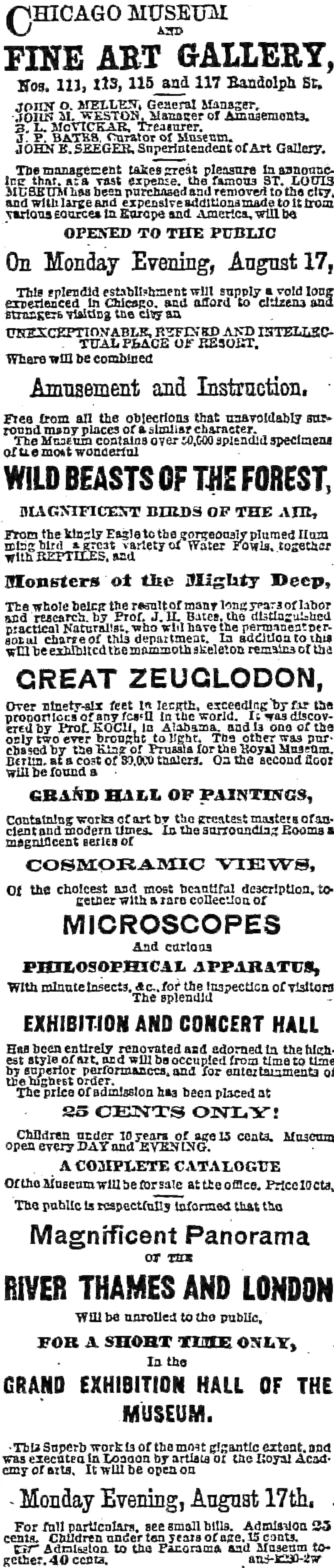
CHICAGO MUSEUM.—One of the most wonderful and instructive places in this city is the Chicago Museum; its curiosities are drawn from every country, and represent every age of the world. Art and nature have alike contributed to its wonders. Here the curious can gratify their marvelousness, and the scientific can pursue their researches. The naturalist will find here a grand collection to admire and study, embracing, in various stages of preservation, almost everything from the tiny insect to the skeleton of Zeuglodon—an antedeluvian monster of our own continent 96 feet long, and of such monstrous proportions as to throw into the shade the mastodon, the magaiherium, paleotherium, pterodactyl and other wonderful animals of a past age. This furnishes an evidence of the monsters of the past, which to argument can gainsay or no prejudice resist. But after all, its greatest wonders of are in the infinite variety of the lesser things collected from the fathomless depths of the ocean, the boundless expanse of the atmosphere, and the innumerable collections of human skill from our own and other nations.
This community is surely fortunate in having a museum which is in many respects the best in this country, and which would add to the attraction of any museum in the world.
Chicago Tribune, December 28, 1863
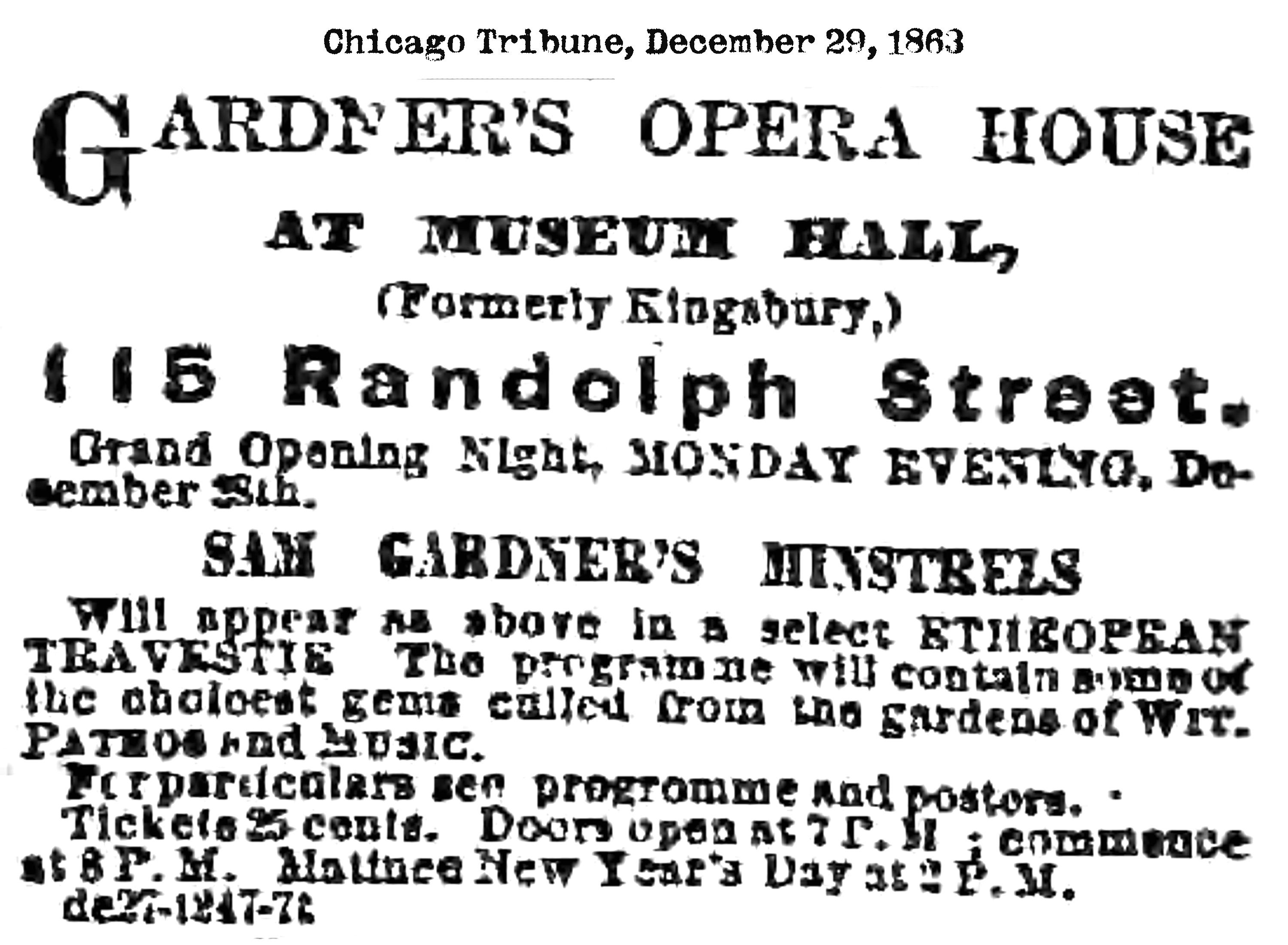
GARDNER’S OPERA HOUSE.—Sam Gardner, formerly of Arlington & Co.’s Minstrels, has organized a new company, and taken the Museum Hall, which will be known as Gardner’s Opera House. It will be opened for the first time to-night with a company which contains a large number of Chicago’s favorites. They ought to be greeted by a full house.
Western Railroad Gazette, January 16, 1864
THE CHICAGO MUSEUM.—We understand that thie establishment is to be resurrected under the management of Mr. Wood of New York, and that the lecture hall and picture gallery are to be metamorphosed into a first-class theatre.
We hope that Mr. W. understands his business and that we shall not again be obliged to chronicle the collapse of the institution.
If well arranged and conducted, it will prove a fortune to the manager.
The daily papers already make magnificent promises in regard to what is going to be done by the new manager, but as we read some of the articles we are forcibly reminded of the question of the elder Weller to his son: “Isn’t that rayther strong, Sammy?” Our fear is that the performance won’t fill the bill.
Chicago Tribune, January 23, 1864
MUSEUM—THE SEA LION.—The great Sea Lion arrived safely in Chicago yesterday, from Barnum’s Museum in New York. He will probably be ready to see visitors to-day, the tank fer his accommodation having been nearly finished last evening. His appearance at the depot created a perfect furore among the crowd in waiting. It was the most distinguished arrival of the season. The following letter accompanied it:
- Barnum’s American Museum, New York, Jan. 19, 1864.
Col. Wood: My Dear Sir—I am very glad to know that you have assumed the management of a Museum in Chicago. I have long been convinced that such an establishment, properly managed. in Chicago, would not only be a source of profit to its proprietors, but also form an important school of instruction, blended with innocent amusement, for citizens and strangers of all respectable classes.
I know that you not only understand the wants of the community in this respect, but from your long career as a public caterer, you have learned the fact, that in order to make money you must give the people double their money’s worth. Your knowledge of all the details of public amusements and of managers here and in Europe, furnishes you extra facilities for success, which I am sure you will not fail to improve. I am sure, also, that you will adopt my motto, “we study to please.” and live faithfully up to it. Your liberality, vim, and perseverance, are all that is required to make yours the most popular piace of public amusement in the West. I shall be but too happy, at any and all time, to furnish you with any attractions and hints that I can command. So “go ahead,” with my best wishes, and never be afraid of giving the people too much for their money. They will fally appreciate and liberally respond to all your efforts.
Truly yours,
P. T. Barnum.
Chicago Tribune, March 8, 1864
Museum.-Col. Wood’s Museum is one of the most attractive places in the city to spend an afternoon or evening. He has in his family now, Gen. Greens and Miss Amee, the Lilliputs, the Trained Monkey, the Invisible Lady, Albinos, &c. Visit the Museum.
Chicago Tribune, February 9, 1865
COL. WOOD’S MUSEUM.—It is now a little over a year since the term Museum was permanently attached to a public institution and resort in Chicago, and that interval has abundantly established the enterprise a success. Not indeed that it has not had the vicissitudes, but that it has now come broadly and solidly upon a basis alike satisfactory to the public and solidly upon a basis alike satisfactory to the public and to the proprietor. This has been due to the features of that portion of its history since the connection of Col. J. H. Wood with its control, a fact that makes all the more agreeable assurance of its future now that it is announced that he has become sole owner.
The art if pleasing the public by catering to its demand for suitable amusements is comparatively a rare one, and yet must be the endowment of any one who shall successfully make it his vocation. There is but one Barnum, and there is but one second to Barnum in the profession of the showman, and the latter is Col. Wood, who brought to Chicago a reputation and substantial proof success well earned in more than one country of the globe. In his hands the Museum, in Kingsbury Block, became at once an institution that challenged the pride of our citizens. Its cabinets of natural curiosities, its series of living and dead wonders, its novelties and art gems have a range that attract all ages and conditions among us, and it has been the art of Col. Wood so to vary his attractions as to keep his establishment continually fresh in the minds of amusement seekers. The savant, the citizen, the school boy and school girl have all been indebted to Col. Wood for months past for many hours of amusement and profit.
But it is in the Lecture Room, devoted to the Drama, that Col. Wood has not less thoroughly attested his skill as a manager. Originally of somewhat doubtful status in this department, in former hands, Col. Wood’s Museum audience room every every evening, and on the delightful matinee occasions, has been steadily growing in favor, until now commands the best audiences of Chicago, and it is no unusual circumstance to see the diagrams of seats largely taken up several days in advance of some promised attraction. The secret, or rather the no secret is this, that the management relies on the steady attraction of one of the best dramatic companies ever gathered in this country, avoiding the flickering and changeful “star” system. More an better than this, there is no catering to depraved and vicious taste, and an equally careful police system, preserving the materiel of the audience from contamination, and the matter on the stage from indelicacy and doubtful double entendre.
Thus much of the past of Col. Wood’s Museum, now in the full career of deserved prosperity. And it is a sufficient earnest of its future success, especially as the recent change makes it more than ever likely to bear the fruits of Col. Wood’s genius. We have been aware that he has been considering for some time past a most advantageous offer to become to Philadelphia what he is to Chicago and the Northwest, and Barnum to New York. The decision in our favor is made in the face of a strong monied appeal, and is itself the earnest that Col. Wood means still further liberal devices here. There are changes promised in the building itself, which have largely to do with the commodiousness and completeness. Personally Col. Wood has done well to identify himself largely with the growing interests of our city, and has won respect as a citizen by large-heartedness becoming his position. This has given great fitness to the selection of him as the Chairman of the Committee on Amusements at the forthcoming Northwestern Sanitary Fair in this city, and his antecedents and capabilities have well fitted him for an advisory position in such matters. In the name of the multitude whereof the institution is a prime favorite, we wish long continued prosperity to Col. Wood’s Museum.
Chicago Illustrated, May, 1866
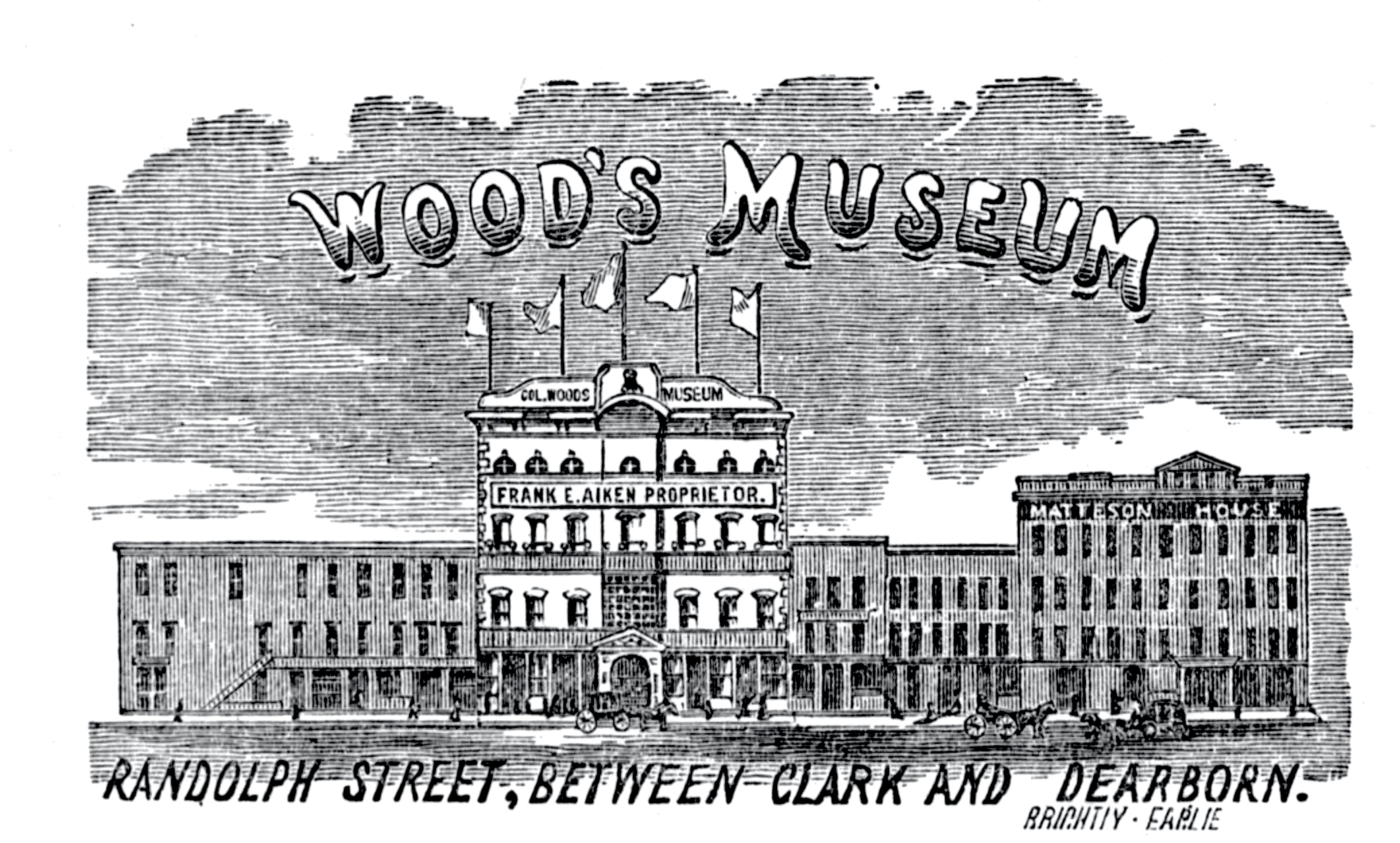
This view represents one of the busiest street scenes in Chicago. It is taken from the North front of the Court House, and takes in the North side of Randolph street from Clark to State street. The central point in view is Wood’s Museum. It has a front of about seventy-five feet. The stores are occupied by H. M. Higgins, the well-known piano and music dealer, and by Ideson & Co., for rubber goods, all of the building above these stores, in its height and depth, is occupied exclusively by the Museum, and the Lecture room. The signs and flags indicate that Col. Wood, the proprietor, knows he has a good thing, and that he does not hide it in the dark. Since the destruction of Barnum’s Museum in New York, the Chicago Museum stands without rival. It embraces all the objects of curiosity common to all first-class collections, and is remarkable for its specialties. It is the largest collection of such objects now on this continent, and the arrangement for display and for the convenience and comfort of visitors are admirable. Col. Wood puts down the 150,000 as the number of his curiosities of every kind. If any person doubts it, let him make the enumeration.
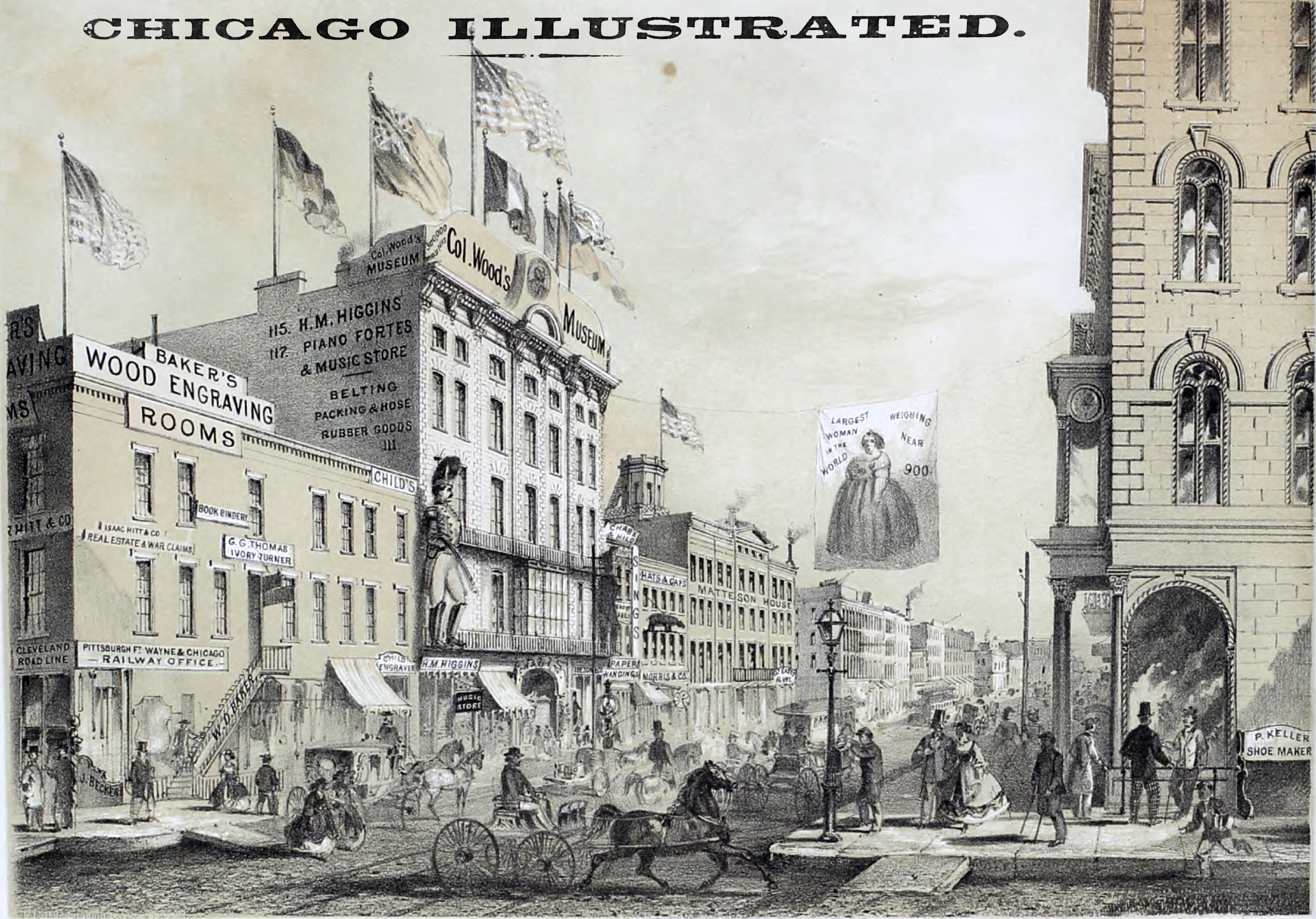
Until 1862, nothing of this kind had been attempted in Chicago, or west of New York, and in no place in the West, but Chicago, could such an enterprize have been matured in so short a time, and with such unequaled success. The tact and the ability of the proprietor, of course, had much to do, but it was eventually the liberal taste of the public that made it a success. The proper way to account for the success of such an extensive experiment, is probably give Col. Wood credit for the sagacity in discovering that Chicago was the only city outside of New York where people had the cultivation and liberality to encourage and maintain a Museum of such large proportions and heavy expenditures.
Connected with the Museum is a Lecture Room, which is nicely fitted up in the style of a Theatre, and where you produced sterling plays. The company engaged in the production of these plays include representatives of very branch of the dramatic profession, and in point of numbers and in excellence, will compare favorably with any similar company in the United States. The success of this part of Col. Wood’s Museum has been in keeping with that of his general enterprise.
On the corner of Clark Street is the well known general ticket office of the Pittsburgh and Fort Wayne Railroad, and all of its connecting lines. It is one of the railroad centres of Chicago.
To the right of the Museum, is the justly celebrated sign painting establishment of B. F. Chase, who for twenty years has been the sign artist of Chicago. The business of the establishment is now carried on by Chase & Hild.
The artist has made a very truthful copy of the various signs that indicate the business and occupation of the occupants of the several buildings adjoining the Museum. They can be discovered without any editorial reference. Three lines of horse-railway cars pass this corner, which, with one exception, is the most crowded crossing in Chicago.
James W. Sheahan, Esq.
May 1866
Handbook for Strangers & Tourists to the City of Chicago, 1866
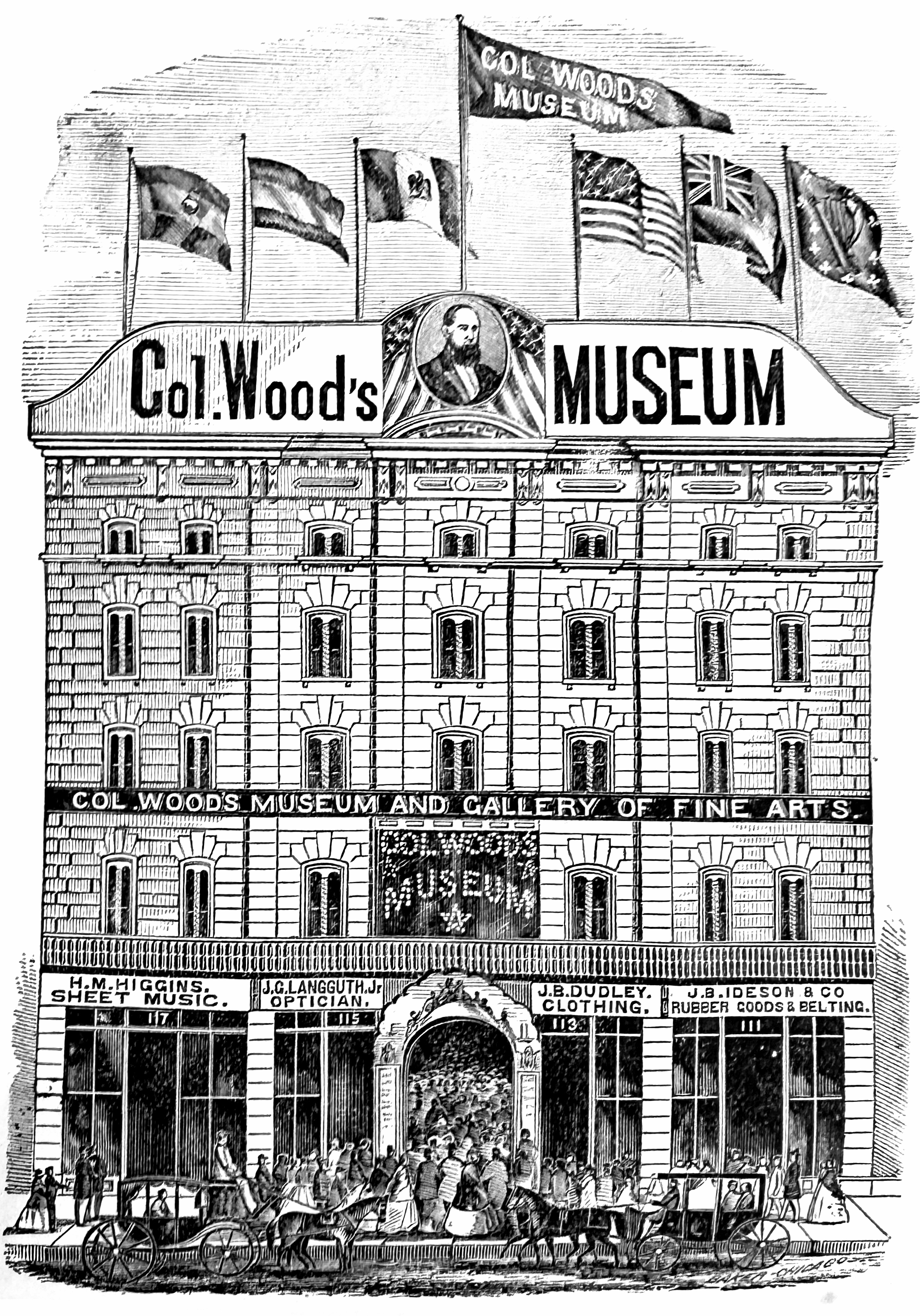
COL.WOOD’S MUSEUM,
Occupies a handsome four-story marble-front building on Randolph street, between Clark and Dearborn streets. The Museum is entered by a spacious stair case ascending directly from the street. It is divided into several large halls on the second, third, and fourth floors, filled with an immense number of curiosities of every description; galleries containing paintings, statuary, and works of art; an extensive ornithological collection—one of the most valuable in the United States; a cabinet of minerals and shells, besides numerous other objects of interest and wonder. The specimens of birds and quadrupeds in the department of natural history, for variety ,beauty, and faithfulness to nature, challenge comparison with any other in the world. But the greatest curiosity in the Museum is the great Zeuglodon, the largest and most wonderful fossil ever discovered. This wonderful relic of antediluvian times was discovered in 1848, in a lonely worn-outfield in Alabama, near the line of Washington and Choctaw counties. It was removed from thence (partly enclosed in the rock in which it was found) to Dresden, in Saxony, where it was articulated in its present form, after eight months’ labor, by distinguished naturalists. After its return to this country, it was purchased by Col. Wood, for this Museum. It was an amphibious animal, bearing some resemblance to the whale, the alligator, and the serpent. It was carnivorous, and is supposed to have struck its prey with its tail. Only a single other skeleton of this wonderful fossil, and that inferior to this one, is now known to exist. It is owned by the King of Prussia, who gladly paid for it the sum of 20,000 thalers. The Zeuglodon surpassesin size all other fossil remains of extinct animals yet discovered. The Mastodon attracted great attention when first discovered,and was for years the wonder of the world. Its length was only twenty feet, while the Zeuglodon measures ninety-six feet.
In connection with theMuseum is the Lecture-Room, where dramatic performances every night, and matinées every Wednesday and Saturday afternoons, are given by an excellent stock company. The members of this company are distinguished for their excellences, and it may truly be said that their performances are among the most enjoyable and entertaining given at any place of amusement in the country. Reserved seats for the Lecture-Room may be obtained at any of the first-class hotels.
- Kingsbury Hall
1862
Chicago Evening Post, December 20, 1867
The Museum.—Mr. Aiken’s Success.
Chicago is ever foremost to recognize genuine merit, and any one who doubts it can easily be convinced by a review of the Museum success under the management of Mr. Aiken. Frank E. Aiken was and still is, without doubt, the most generally popular actor who ever remained in Chicago. As leading man since the first opening, his various assumptions have won him hosts of friends, and made a national name for the Museum. There were, however, those who dubiously shook their heads when he undertook first the part of manager and subsequently that of lessee in addition. The result must certainly gratify him very much. The houses have been fuller under his auspices than ever before. He spared, in the first place, no expense to renovate the establishment, and it is now elegant and comfortable in all apartments. His greatest solicitude, of course, must have been untiring in his effort to make it reach the present standard of the best outside of New York certainly, and in the opinion of many the best in the Union.
Strangers visiting Chicago need scarcely any recommendation to make them visit the Museum. Everybody goes, and everybody is always pleased. The succession of popular and meritorious plays are expensive, but they will be kept up, and Mr. Aiken will undoubtedly fulfill his desire to make it more than ever the leading center of amusement in the West.
Handbook for Strangers & Tourists to the City of Chicago, 1869
COL. WOOD’S MUSEUM
Is on Randolph street, between Clark and Dearborn streets. It is a handsome marble front, four-story building. It is divided into several large halls, on the second, third, and fourth floors, which are entered by a spacious stair-case, ascending directly from the street. The museum is filled with an immense number of curiosities of every description; galleries containing paintings, statuary, and works of art; an extensive ornithological collection one of the most valuable in the United States ; a cabinet of minerals and shells besides numerous other objects of interest and wonder. The specimens of birds and quadrupeds, in the department of natural history, for variety, beauty, and faithfulness to nature, challenge comparison with any other in the world.
In connection with the Museum is the lecture room, where dramatic performances every night, and matinees in the afternoon, are given by an excellent stock company. These performances are most enjoyable and entertaining.
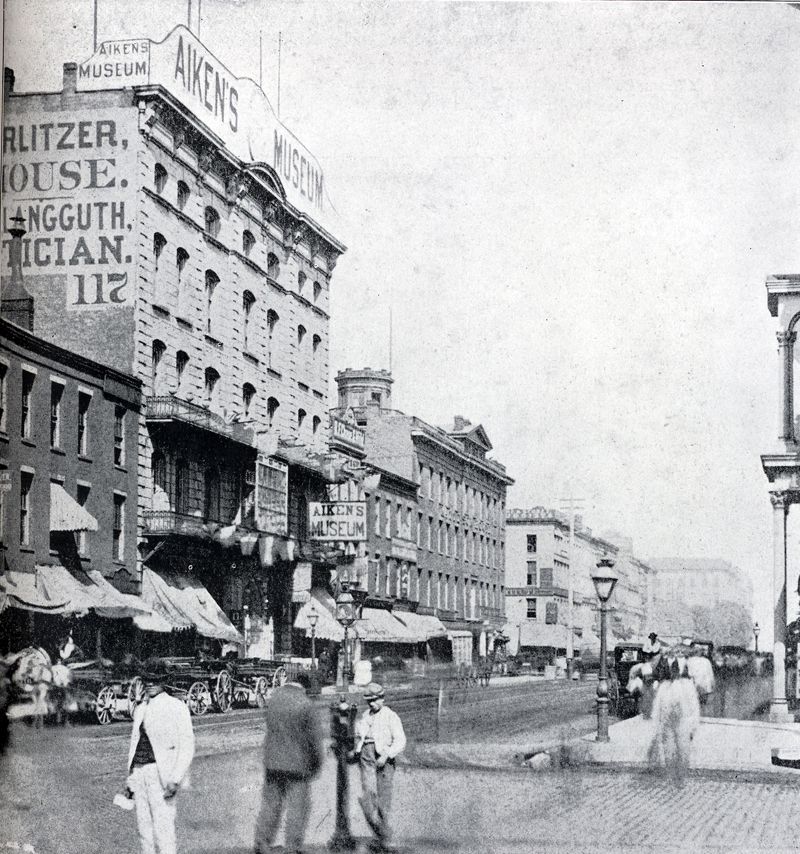
- Aiken’s Museum
Randolph, between Dearborn and Clark
Photographer, John Carbutt
Aiken’s Museum contained collections of natural history objects, a hall of paintings, a panorama of London, and occasional concerts held in the exhibition hall. Colonel John Wood became the proprietor of the museum in January, 1864, and realizing the importance of dramatic performances to attract visitors, he increased its equipment by annexing to the rooms already used the building called Kingsbury hall, in the rear of the museum, and added a stock theatre company to the attractions of the place. During part of the history of the museum, when Frank E. Aiken was manager, it was known as Aiken’s Museum, but the more familiar name was resumed when Colonel Wood became manager in June, 1871.
Chicago Tribune, October 16, 1870
The West Side Theatre.
The work upon Mr. D. R. Aiken’s Theatre on Desplaines street is rapidly approaching completion. It will probably be finished and ready for opening early in the ensuing month. The roof is about done, and the work on the stage is now in active progress. Present appearances indicate that it will be one of the best arranged theatres in the city. Mr. Allen is now busy organizing his company, and expects to open about the 7th with a well-selected dramatic corps. There is every reason to anticipate for the new theatre a successful career.
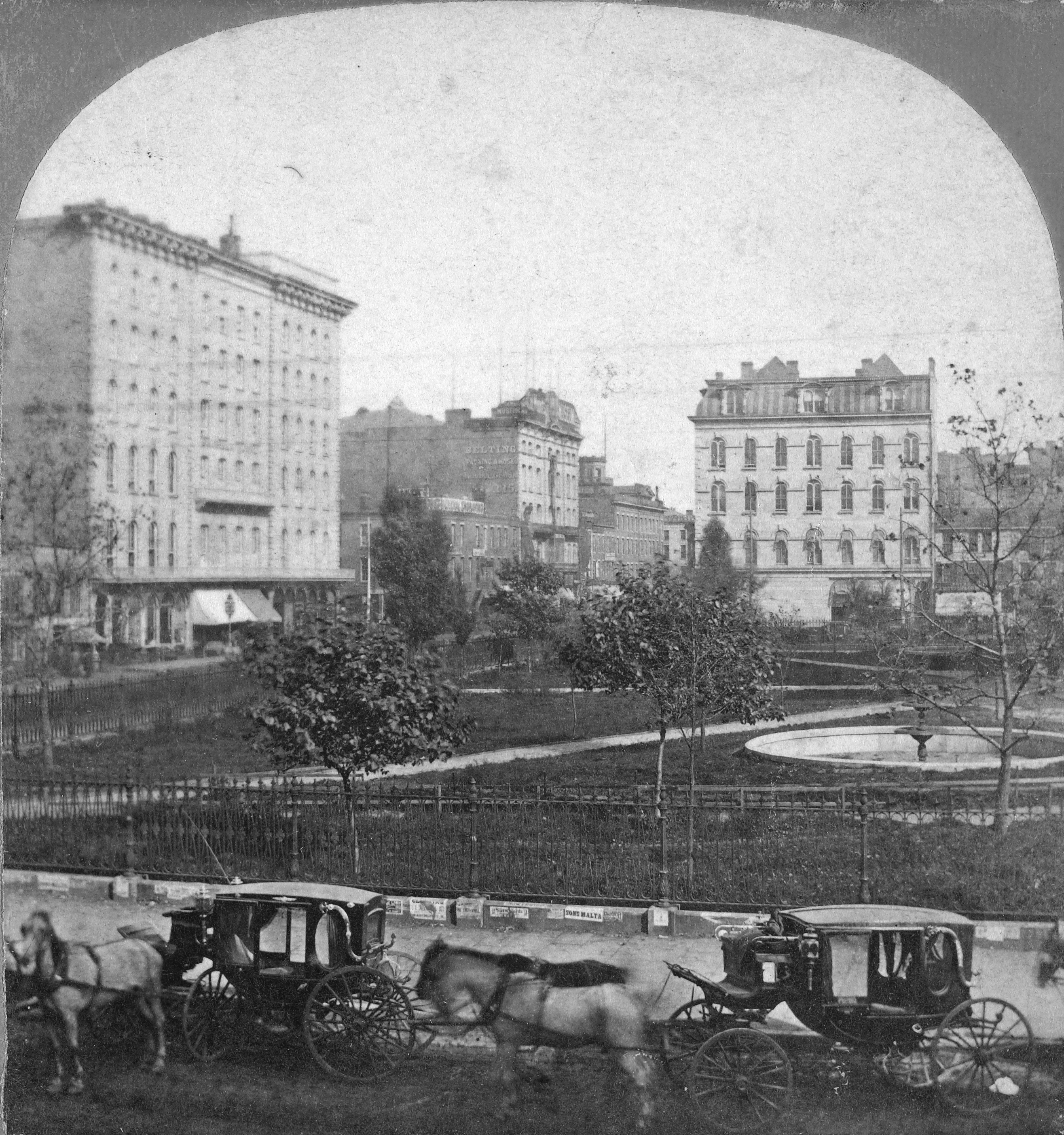
- Sherman House (left) and Wood’s Museum
Photographer: John Carbutt
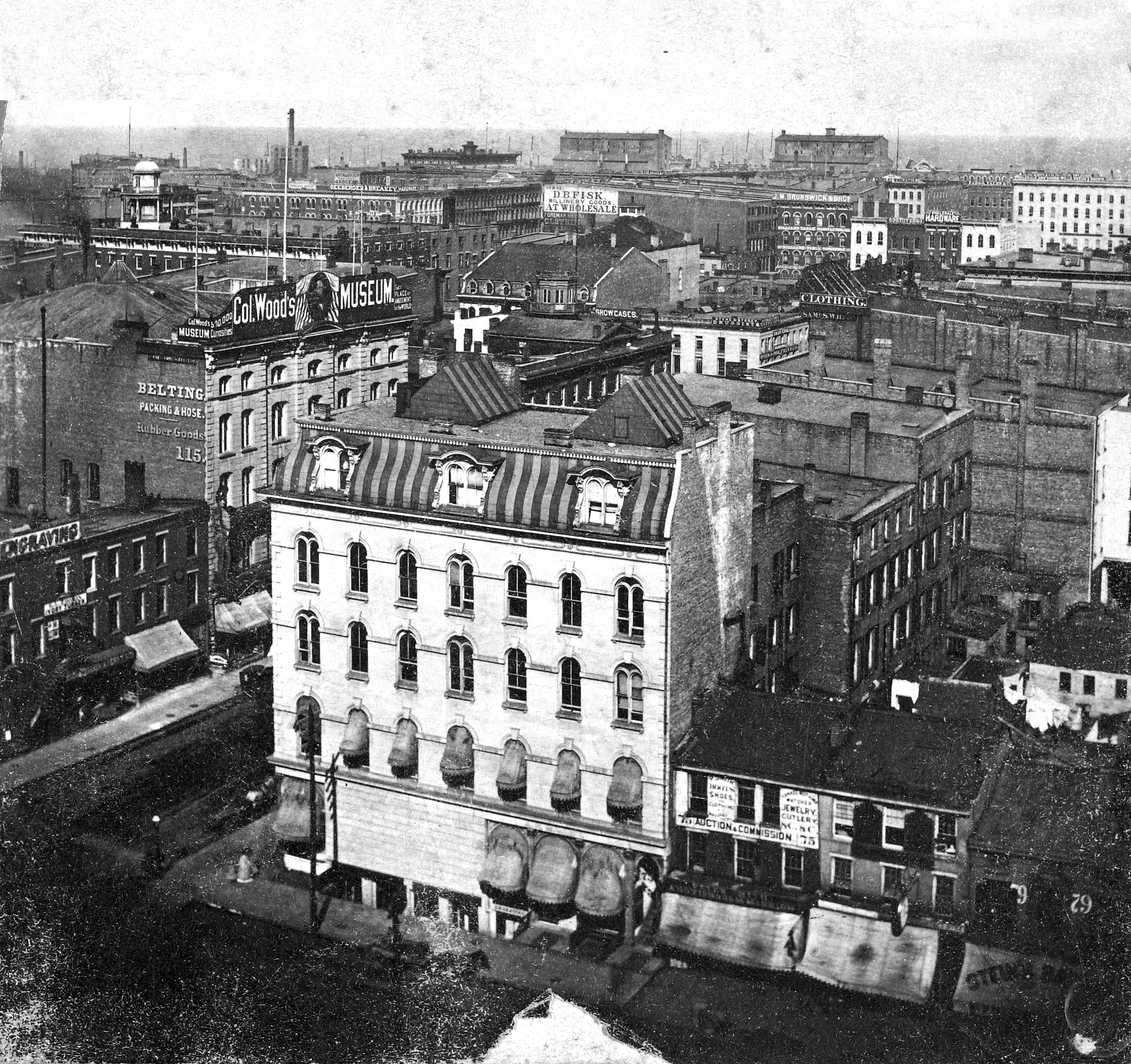
- Wood’s Museum
Photographer: John Carbutt
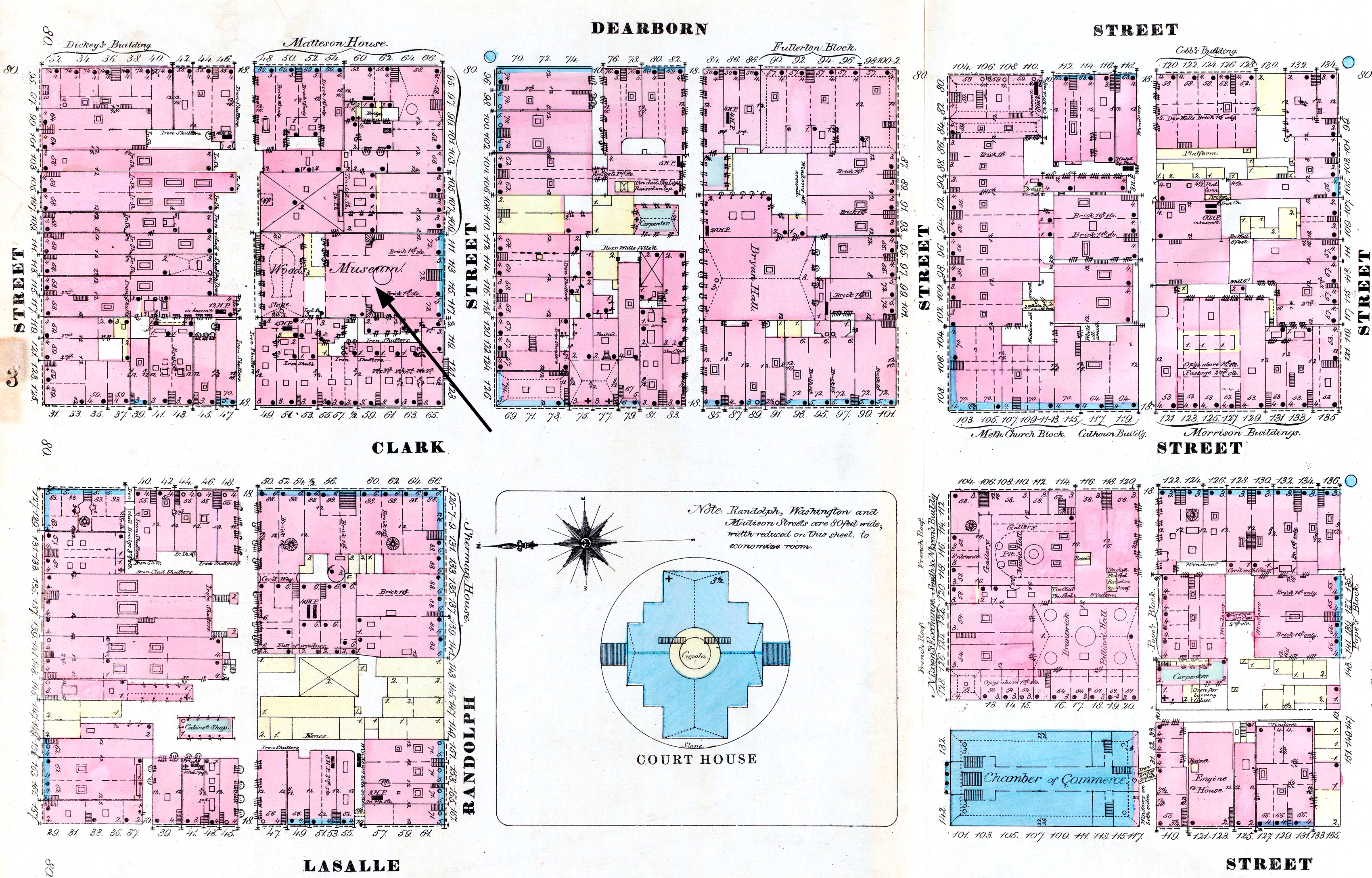
- Kingsbury Block
Colonel Wood’s Museum
Sanborn Fire Insurance Map
1869

In this picture :
Aiken’s Museum
John Carbutt
Randolph, between Dearborn and Clark
What does the sign say ?
Wurlitzer
house
Langguth
Tician
117
??
The sign says:
Wurlitzer House (sales office that opened in 1865)
J. G. Langguth, Optician, 117 (Randolph St)
After the fire, Langguth’s office was located on the SW corner of State and Madison (88 State Street).