Grace Methodist Episcopal Church
Life Span: 1868-1871
Location: Chicago avenue, NW corner LaSalle street
Architect: Messrs. Loring & Jenney
- Bailey’s Chicago City Directory for 1867
Grace Church, LaSalle, n.w. cor. Chicago
Edwards’ Annual Directory in the City of Chicago, for 1870
Grace Methodist Episcopal Church, Chicago av. nw. cor. LaSalle
Chicago Tribune, January 2, 1865
Grace Methodist Episcopal—A handsome building designed as the chapel of the Church of the Grace Methodist Episcopal congregation, which latter edifice will be erected at some future time, has been built on the corner of Chicago avenue and Lasalle street. The chapel is of the pure gothic type, composed of heavy cut stone. The entrance on Lasalle street is through an archway of massive hewn buttresses, the center being supported by stone pinnacles, the massive appearance of this front is relieved by a large finely painted window. The internal arrangements are of a most complete character. The main room is a fine gothic auditorium, seventy feet by forty, and fifty-seven feet from the floor to the ceiling. On the lower floor are eighty pews, and in an end gallery. twenty feet by forty, are twenty-four additional ones. Altogether the number of sittings is estimated at 528, and the total capacity about 600. The elevation for the chancel is encircled by a black walnut rail with carved oaken balusteres. The pul-pit platform is thirty-two inches above the door. It is smaller than the chancel platform and is one step above. All the windows are of stained glass, most beautifully blazoned with scriptural symbols and monograms.
Chicago Evening Post, June 13, 1868
The costly house building of Grace Methodist Church on the corner of North LaSalle street and Chicago avenue is nearly completed and it is to he dedicated about the first of July.
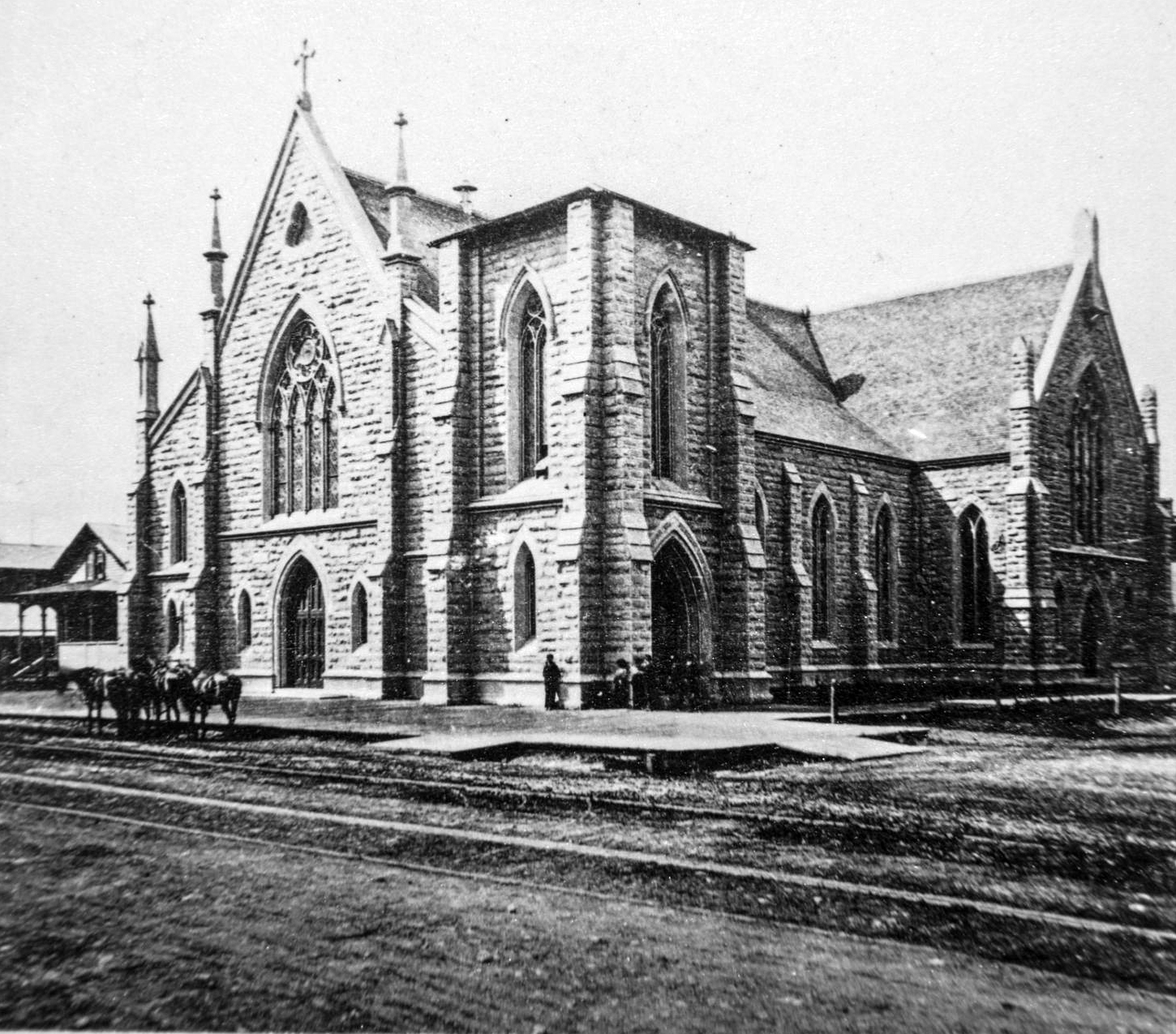
- Grace Methodist Church
Chicago Evening Post, July 11, 1868
Grace ME Church, at the corner of Chicago avenue and North LaSalle street is now completed and will be dedicated for public worship on Sunday, July 12th. It is a fine structure of stone in the Gothic style of architecture and will compare in design and finish with any church edifice in this city.
The plan of the building includes a chapel 45×100 which was erected and dedicated four years since and has been used up to the present for church purposes.
The present building, which is the completion of the original design, is 66×86 feet and has a gallery on three sides and affords seats for 1,000 persons.
All parts of the new building are now complete except the lower, which is now built only to a height of fifty feet above the sidewalk, and which it is intended to carry up to a height of 160 feet.
The interior of the new part has been most carefully treated as regards taste and fitness of purpose, and in many particulars may safely challenge comparison with any in the city.
The windows are of stained glass of uncommon excellence of design, and were made by Misch Bros., of this city. The wood work is of black walnut and butternut woods used in combination, and in addition to being in good taste and proportion is excellently well executed—the contractor for the work being Cyrall LaBeau. The painting of the church throughout is in excellent taste, the ceiling being colored ultra marine blue and thickly dotted with gold stains, and the side walls are colored in imitation of Caen stone and laid off in blocks. J. B. Sullivan has the contract for this work.
The organ, manufactured by Messrs. Hook of Boston, is a grand instrument and is pronounced by judges to be a most superior and powerful one. The case is of heavy black walnut, the pipes being illuminated in mediaeval style, the whole producing a fine effect. The location of the organ in the church is somewhat peculiar, being just in the rear of the pulpit and on the same platform, and is operated by the organist sitting in one of the front pews. The upholstery for the pews was furnished by Messrs. Phelps & Hollister of this city.
The total cost of the structure as it now stands, including organ, furniture and the lot on which it stands, is about $96,000. The lot cost $10,000. E. Burling 116 LaSalle street is the architect
Chicago Evening Post, March 27, 1869
 On the morning of Easter Sunday (to-morrow) the new and magnificent edifice of Grace Episcopal Church, located on Wabash avenue, near Fourteenth street, Rev. Clinton Locke, pastor, will be formally dedicated. The Right Reverend John Beckwith, Bishop of Kentucky, will conduct the services, both morning and evening, preaching the dedication sermon. In the morning one half of the seats will be free, and at evening all will be free. The singing promises to be a rare treat. The choir will be composed as follows:
Miss Susan Galton, soprano; Mr. Bischoft, tenor: Dr. Lord,. bass, and Mrs. Johnson,
(nee Whittock.) alto. Mr. A. Creswold will act as organist on the occasion.
This church is perhaps the most elegant and tasteful in the city, forming a great contrast to the plain frame strueture on the corner of Wabash avenue and Peck court, which the congregation has just left. It is highly creditable to the Church and the city, and merits a detailed description.
The lot is 82 by 172 feet in size, and the church will cover the entire ground, with the exception of a space ten feet wide on the south side, for passage to the Sunday school room, and another five feet on the north side for the admission of light only. The building is in the Gothic style of the l3th century, and exhibits a great variety of detail throughout, in the true spirit of Gothic architecture. The front is 75 feet high to the apex, which is surmounted by a 22-foot cross, of Iowa marble.
The interior is spacious and elegantly finished in hard wood. The auditorium is 100 by 66 feet, fitted with 174 pews, and will hold 1,000 people. The chancel is 30 by 25 feet. To the north of the chancel are the organ and choir, and to the south a vestry room. At the rear of the chancel, and to the east of all, is a Sunday school room, 25 by 85 feet in size. An ornamented paneled open timber roof, sixty-eight feet high in the center, is supported on carved stone brackets, twelve fleet above the floor of the church. The interior is lighted from the roof by fourteen gable windows of painted glass, and from the sides by fourteen windows of two bays each. The chancel window is 11 by 30 feet. A large corona hange from the center of the chancel dome, and chandeliers from pendants below the hammer beams over the center of the eide aisles. On either side of the chancel is an open work Gotbie screen, which separates the chancel from the organ room on one side, and from the room over the vestry on the other, to allow invalids to listen to the service while reclining at case. At the rear is a hay window protecting the chancel window fom cold and accident.
The church has two entrances, one in the centre of the main building, and the other through the tower. That to the main building is through a porch which projects several feet from the wall. The doorway is ten feet wide, with three polished marble columns on either side. The arch is ornamented with deeply cut mouldings, and a rich gothic vine in the hollow over the central column. The overhanging sides of the porch are sustained by two columns on either side.
The porch is eurmounted by a large stone Gothic cross of Iowa marble, and is 7½ feet high. The centre of the cross is on a line with the large rose window which lights the west end. The window itselfis 20 feet in diameter. On the northwest corner is a turret 30 feet high, sustained by two buttresses. All angles around the church and the tower are formed by chamfered columns. Under the vestibule window is a mural drinking fountain of polished Iowa marble, with two cups suspecded from it, and where the water will be continually flowing winter and summer. This is a new feature in church architecture, and one which cannot be too highly commended
All the heavy work on both tower and main building is of Joliet marble, the columns and ornamental work being all of Iowa marble. The shafts of nll detached colamns are polished. This marble is now for the first time introduced into Chicago. It is a light tinted granite, somewhat like the Scotch granite, but less positive in color, susceptible of a good polish, and a very pretty building material.
The tower entrance is through a beautiful arched doorway, with two polished marble columns on each side, with a Gothic vine cut in the hood mouldings over the door. Above the door are three little windows, with strong vereil, lighting the pastor’s study.
The gable is surmounted by a stone cross, seven and a halt feet lied, and four feet in width. To conceal the junction of the spire with the tower are four pinnacles, twenty-five feet high. In the spire are four little windows, with stone gables, supported by bracketed marble columns. The spire is covered with slate. The finial and cross at the summit, 170 feet from the ground, are of wrought iron. The cross is twelve feet high. All the gables, turrets and pinnacles are also terminated with iron finial ornaments, each of different design.
There is no sham about the work, all being of stone, and no wood work visible from the outside of the church except the doors and the window frames. Messrs. Loring & Jenney are the architects. Throughout the entire edifice a great variety of design prevails, no two ornaments being alike; under the coping on each alternate stone are cut some beautiful wild or garden flowers.
The decorations of the window, at the back of the chancel, are very tasteful. Over the centre is the dove, the emblem of the Holy Spirit, surrounded by the four evangelists, Matthew, Mark, Luke and John. In the central pane is a life-size figure of Christ nailed to the cross, with a view of Jerusalem in the distant background. At the right is St. John, and at the left, the Virgin Mary, the intention being to represent perfect manhood and perfect womanhood at the foot of the crose. Over the window in illuminated letters forming an arch, is the inscription, “He that livith on me hath everlasting life.” Frescoed upon the wall at either side are Mosaic ribbons, bearing scriptural inscriptions. At the left, under the Episcopal shield, is the Bishop’s chair, and at the right, under the cross and shield, two walnut “stalls.” A magnificent corona, with forty-five gas jets, hangs from the center of the dome. The floor is covered with crimson velvet carpet.
Three of the fourteen windows on the sides of the church are memorial windows; the first, at the right, commemorates the death of Dr. John Brinkerhoft, who died April 3, 1867. This window is the work of a German artist of New York, and in richness of color and artistic execution has seldom been equal-ed. Full-size figures of St. John and St. Lake are stained upon the double lights. Another window memorializes the death of two infant children of W. G. Hibbard, the main designs being, fac similes of Raphael’s cherubs; while a third, on the opposite side of the church, is in memory of Lucius Sherman, of Chicago, who died in New Orleans, March 2, 1866, the emblems being a fount and anchor. The remaining windows bear apostolic symbols and Christian emblems, each containing five designs.
The organ is a very fine and powerfal in-stroment, made by Hook, of Boston, and containing twenty-seven stops. The pipes are ornamented with blue and gold, surmounted with carved walnut work.
The following liberal donations have been presented to the church by members of the congregation: A solid silver communion service, worth $400, by Mrs. John Mayo; an eagle lectern Mr. De Castro; by pulpit by the children of the Sunday School; full set of service books by the Sunday School teachers; the altar, by the Misses Forsyth; altar rail by Messrs. W. & M. Thompson; altar cross by C. H. Brower; altar cloth of white moire antique by Mrs. Locke; crimson altar cloth by Mrs. Jas, Morgan; green altar cloth by Mrs. Locke and Mrs. Hancock; communion linen by Mrs. Judge Dickey; a splendid font representing a water-lily, in white Italian marble, by Chauncey Bowen: book marks of the four colors, by Mrs. Perey Hart, Miss B. Edwards and Mrs. Lawrence; a handsome inkstand for the vestry, by Cobb, Pritchard & Co.; credence table, by Miss Mira Moore; mirror and bracket for vestrs, by Mr. Douthith.
The building committee consisted of Messrs. Haddocks, Sidway and Lawrence. The masonry was by Mortimer & Tapper; the cut-stone work, Wilson & Gibson; carpentry, A. Grannis; plastering, John Sutton: oil-painting, J. T. Gettinge: polychromatic decorations, Jevne & Almini; gas-fixtures, H. M. Wilmarth; galvanized iron, H. M. Landers; upholstery, Hollister & Phelps; pulpit and lectern, Chas. Tobey; organ, B. and G. G. Hook, Boston; slating (roof) James Parker; Stating (spire), Robt. Griffith: plumbing, Loring & Button: chancel-furniture, J. & R. Lamb.
The cost of the structure and its site is as follows:
- Construction…$100,000
Furiture, carpete, etc…$25,000
Lot (present value)…$25,000
Total….$150,000
There are 175 pews, which are capable of seating 1,000 persons.

- Grace Methodist Church
1869

Leave a Reply