Occupants: George Pullman
Location: 1729 S. Prairie (Old 879)
Life Span: 1876-1922
Architect: Henry S. Jaffray
- Lakeside Annual Directory of the City of Chicago, 1874
Pullman George M. Pres. Pullman Palace Car Co. r. Prairie av. ne. cor. 18th
Lakeside Annual Directory of the City of Chicago, 1876
Pullman, George M. pres. Pullman Palace car Co. 156 Michigan av. house 879 Prairie av.
Lakeside Annual Directory of the City of Chicago, 1880
Pullman, George M. pres. Pullman pal. car co. 156 Michigan av. house 879 (old no.) Prairie av.
Lakeside Annual Directory of the City of Chicago, 1884
Pullman, George M. pres. Pullman palace car co. Adams sw. cor. Michigan av. house 1729 Prairie av.
Lakeside Annual Directory of the City of Chicago, 1885
Pullman, George M. pres. Pullman palace car co. Pullman bldg. house 1729 Prairie av.
Chicago Telephone Directory, 1892
Pullman George M. Prairie av. and 18th…South-228
Lakeside Annual Directory of the City of Chicago, 1904
Pullman, Hattie S wid George M h 1729 Prairie av.
Chicago Tribune, April 8. 1869
Daniel Thompson will soon erect a building on the corner of Prairie avenue and Twentieth street. The lot has a frontage of 150 feet. The house will be either brown stone or marble, and cost about $100,000.
Mr. Geo. M. Pullman is also about to build a handsome residence on the same avenue, which will cost about as much.
Chicago Tribune, October 7, 1870
HENRY S. JAFFRAY.
Mr. Pullman’s Residence.
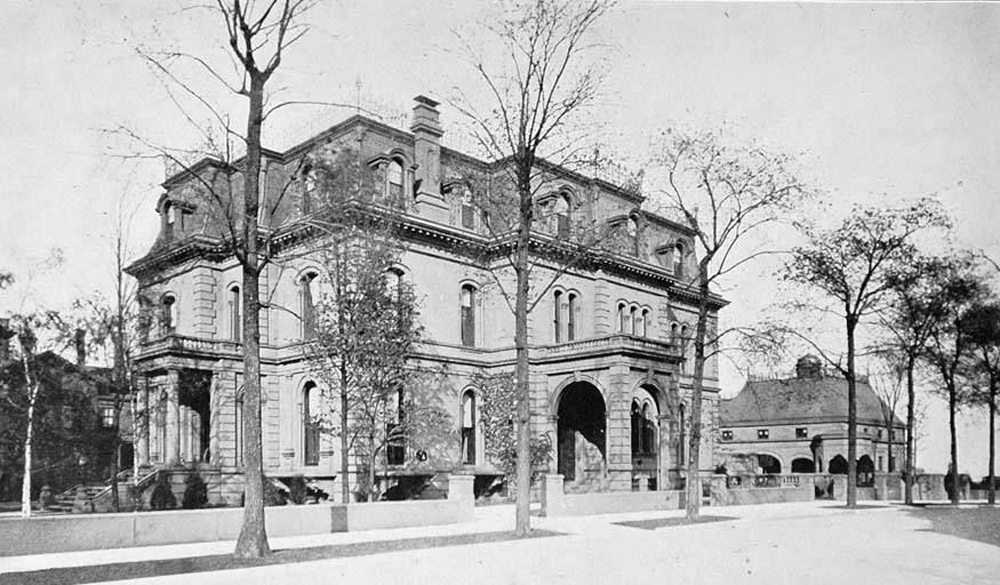
Mr. George M. Pulman of palace car fame, is erecting a residence ar the corner of Prairie avenue and Eighteenth street. It will be one of the best in the city. The front on Prairie avenue will measure 70 feet and the depth 108 feet. The fstyle will be French Renaissance, and the material brown sandstone, from the quarries of Portland, Conn. The exterior on the sides will be of sandstone, and no brick will be visible anywhere. There will be a grand entrance on Prairie avenue, and a side door on Eighteenth street. Handsome pillars will adorn the front, and over the main entrance be a porte cochère, which is French for carriage porch. The windows will be of plate glass, 13 feet high by 6 feet wide, much larger than an ordinary door. The exterior will not be elaborately ornamented, but will be admired for its harmonious proportions and the material of which it will be constructed.
Inside, of course, everything will be fitted up as handsomely and as neatly as wealth, guided by taste and judgement, shall dictate. Besides parlors, bedrooms, kitchens, and other apartments, there will be a billiard room and a bowling alley.
The foundations are already laid, and the remainder of the work will be finished in about two years. The cost of the palace will be somewhere in the vicinity of $100,000.
Chicago Tribune, October 20, 1897
The Pullman home at 1729 Prairie avenue is one of the handsomest and most comfortable residences on a thoroughfare noted for its fine houses The corner of the lawn runs almost to the spot where stood the once famous massacre tree which was removed to make place for the memorial group in bronze. The house is of brown stone and the interior is fitted up in a costly but unostentatious manner. It is filled with paintings rugs valuable bric-a-brac and art treasures gathered by Mr. Pullman and his wife in foreign lands. Mr Pullman was a near neighbor of Marshall Field and Armour the three men frequently spending their evenings together.
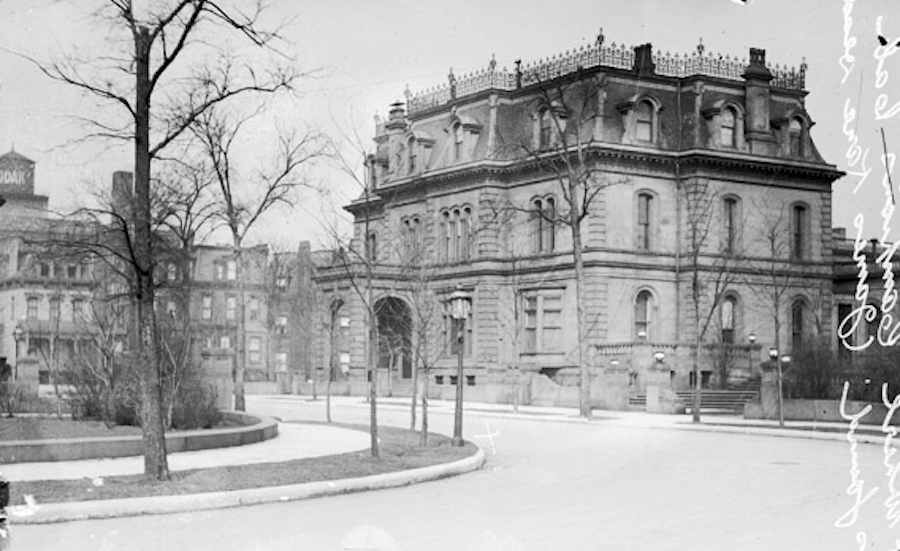
George Pullman paid $500 per square foot for the property on the northeast corner of Prairie and Eighteenth streets, the highest ever paid for a residential lot in Chicago.
The massive house measured 70 by 108 feet, containing more than 7,000 square feet per floor. The entire exterior was clad in Connecticut brownstone, including the large porte cochere along 18th Street. No expense was spared in its construction and only the finest woods and other materials were used in its decoration. Huge public rooms were constructed to house the elegant and large-scale entertainments the Pullmans planned. Amenities included a 200-seat theatre, billiard room, bowling alley, pipe organ and much more.
Newspaper accounts of the house and the events which took place there routinely referred to the house as the most beautiful on Prairie Avenue and in the entire city, lavishing praise on its interiors, said to be “more beautiful than the Gardens of Cashmere.” The Pullmans entertained frequently in their “palace” and it was not uncommon for 400 or more people to attend receptions, musicales, and theatrical entertainments.
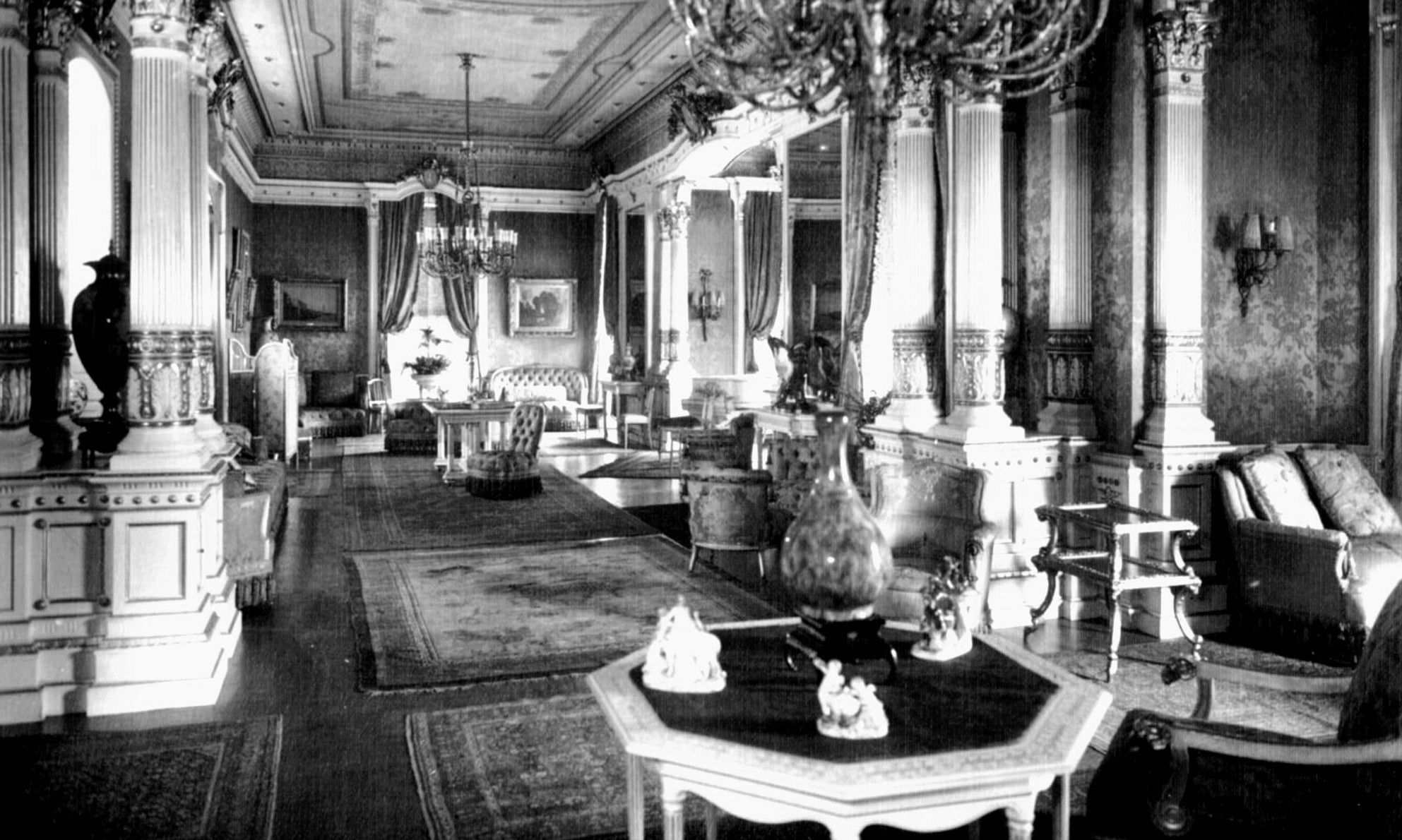
- The Chicago Tribune said of Mr. Pullman’s drawing room, “In point of location, size, and architecture it surpasses any room of its kind in Chicago, whether public or private.”
In preparation for the wedding of the Pullmans’ daughter Harriet to Francis Carolan in 1892, a huge addition was built onto the northeast corner of the house, and the entire interior was redecorated. The addition included a new library and billiard room, a huge palm room with a 40-foot leaded glass dome, outdoor terraces set with marble mosaics, and an enlarged and remodeled coach house. Across 18th Street, a huge conservatory was set into a private “park” with unobstructed views of Lake Michigan. The addition and remodeling, designed by architect Solon S. Beman, cost in excess of $100,000.
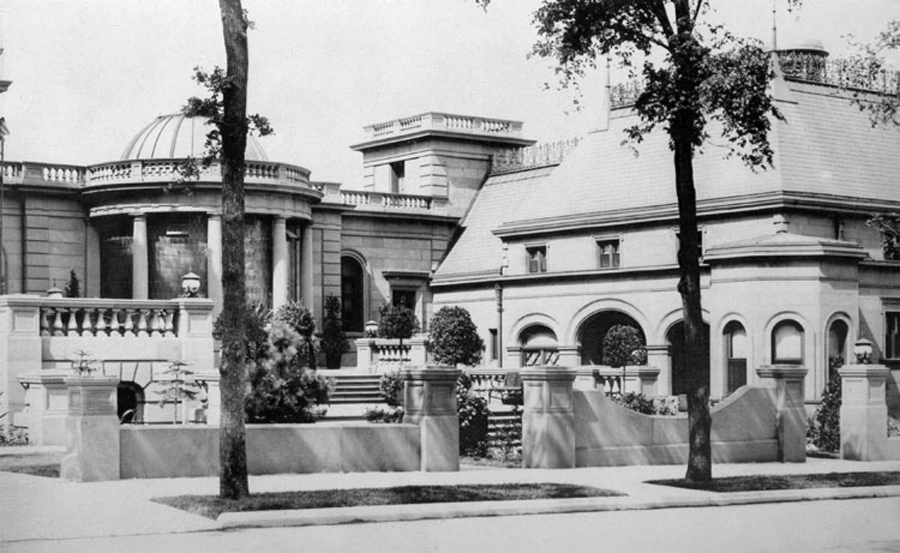
- 1729 Prairie Addition
Chicago Tribune, August 15, 1899
 Butterflies descended upon the Pullman residence at Eighteenth street and Prairie avenue in countless numbers last evening. They swarmed around the big house like bees around a hive, until the air was dark with fluttering wings. When night came they settled on the trees until the branches sagged with their weight and the foliage was half hidden from sight. Thousands will await there the warmth of the sun this morning to unfold their wings in flight.
Where the butterflies came from, when they came, and where they are going today are questions that were freely discussed in the neighborhood which afforded them a resting place last night. The rare sight of tens of thousands of fluttering visitors on wings of golden brown drew hundreds of interested and curious spectators to the scene, and afforded a topic of conversation that will not be exhausted for days.
The butterflies first attracted attention by their number at 5 o’clock. Their coming was heralded, however, the day before. when a small number was noticed hovering over a clump of sunflowers in the vacant lot at Twenty-second street and Prairie avenue. J. Wheeler, residing at 2125 Prairie avenue, then watched them dancing over the sunflowers, and the next afternoon was surprised to see them again in far greater numbers at the same spot.
Number at Least a Million.
John Algots, keeper of the Pullman green house, was at work on the lawn In front of the residence when the butterflies arrived there. He doesn’t pretend to be able to estimate their numbers, but claims that a million is a conservative guess. Within five minutes after he noted the first arrivals the air was alive with beating wings, and he sought a more comfortable point of observation on the steps of the house.
“They were as thick as gnats over a pool of water in the evening,” said Algots. “In all my experience as a gardener I never saw butterflies in such large numbers. They flew around the house like bees in a swarm for nearly an hour, then lit on the trees. I am not exaggerating in tne least when 1 say the branches were heavy with them. They were packed as closely as they could be packed along the limbs and twigs, in some places in bunches that looked as if the trees were fruit-laden and in other places in regular rows.”
Make Trees Look Like Velvet.
Several young birch trees in the corner of the lawn presented a curious sight after the butterflies had settled down on their slender branches. The bright green leaves showed faintly through the beautiful brown and black covering made by the butterflies, like a base for a rare piece of brocaded velvet.
On the large trees the visitors rested just as thickly, but were not so conspicuous because of their height above the ground. The vines on the side of the house wre chosen also as resting places by the butterflies, and large numbers of them folded their wings on the window copings.” At 9 p. m. the tree branches were heavy with them and a stream of water from the lawn hose, when thrown among the foliage, sent them fluttering to the ground like brown leaves in an autumn gale.
Residents Look and Admire.
While the butterflies still were flitting among the trees earlier in the evening residents of the neighborhood gathered in their doorways to look and admire.
From across the street the family of Hugh McBirney watched, the sight until darkness came. Ralph C. Otis, 1730 Prairie avenue; J. J. Glessner, 180O Prairie avenue, and many others were attracted also by the remarkable visitation.
The butterflies did not confine their presence entirely to the Pullman residence. They made themseires at home along the avenue as far south as Twenty-second street. In smaller numbers, and many were captured by the children of the neighborhood. In trying to account for their presence it was the opinion of many that the strong east wind had carried the butter flies from across the lake, and that, from sheer fatigue they had descended immediately on reaching land.
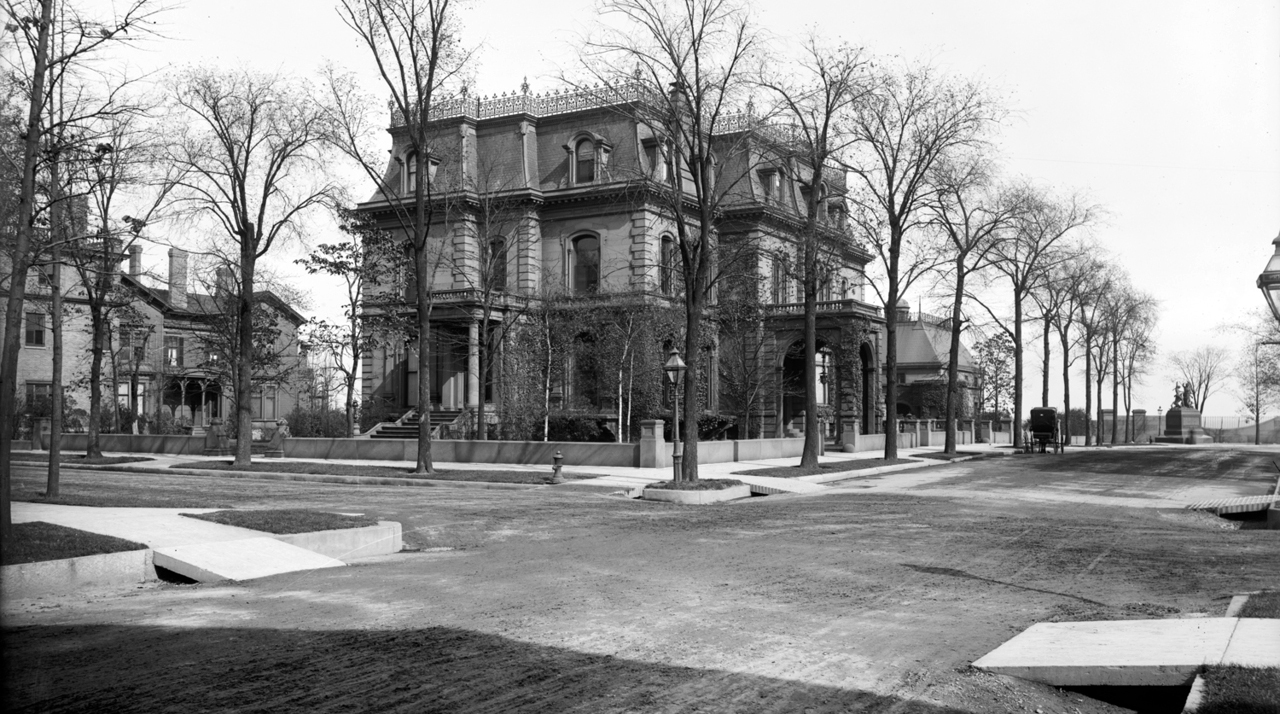
- Pullman Mansion
1901
- Pullman Mansion
1902
Chicago Tribune, March 29, 1921

 Mrs. George M. Pullman died yesterday in Pasadena of pneumonia. She was 82 pears old and had been feeble for some months. A cold which she contracted about ten days ago developed into pneumonia, and she sank rapidly.
Friends here were apprised early yesterday morning by telegram that physicians had abandoned hope for her recovery. She became unconscious soon thereafter, having sustained a sinking spell. She died at 4 o’clock in the afternoon.
Lowdens at Deathbed.
At the bedside were her son-in-law and daughter, former Gov. Frank O. Lowden and Mrs. Florence Lowden, and their four children. Mrs. Lowden’s secretary, who is at the family home at 1729 Prairie avenue. said Mrs. Pullman’s body would be brought to Chicago to be buried in Graceland, beside the body of her husband. The Lowdens went to Pasadena last fall to be with Mrs. Pullman.
Mrs. Pullman deeply regretted the attacks on Illinois war governor. She thought the fact that he had married into a family of great fortune had embarrassed his political career. A devoted admirer of her famous son-in-law, she is known to have suffered deeply when the Pullman connection was used to defeat his nomination for the presidency.
Daughter of Pioneer.
Mrs. Pullman was married to the car builder and founder of the city of Pullman in 1867. She was the daughter of J. Y. Sanger, a Chicago pioneer. Mr. Pullman died in 1898, and Mrs. Pullman I became virtually his sole legatee. She displayed remarkable business acumen in the handling of the great estate, now valued at about $18,000,000.
Two sons, George M. and Sanger. have been dead many years. Besides Mrs. Lowden there is another daughter, Mrs. Frank Carolan, who lives in California.
Although Mrs. Pullman wealth and the standing of her family would have enabled her to dominate Chicago society, she preferred a life of semi-retirement. She was essentially a home loving woman and was exceptionally devoted to her grandchildren, Florenee. Harriet, Frances, and Pullman. She had much to do in directing the course of their training, insisting that social achievement be subordinated to more homely accomplishments—sewing, cooking, and the like.
Noted as Charity’s Friend.
Her greatest source of pleasure was philanthropy. She annually donated thousands of dollars to charity and was a generous contributor to many Chicago hospitals. One of her gifts was that of $500,000 to St. Luke’s hospital. She was devoted to the interests of Pullman city, which her husband built at an original cost of more than $5,000,000.
Although she had a palatial summer home at Elberon. N.J., and, until a few years ago, a mansion at Washington, she preferred Chicago. It was only in later years that she lived for any length of time at Pasadena. She sold her Washington residence in 1913 to John Hays Hammond, the mining engineer, for $300.000.

- Mrs. George M. Pullman, widow of the car builder and founder of the city of Pullman, III., who died yesterday of pneumonia in Pasadena, Cal., at the age of 82, is here shown in a “three generations” picture with one of her daughters and a granddaughter.
Left to right—Florence Lowden, daughter of Illinois’ war governor; Mrs. Frank O. Lowden, and her mother, Mrs. Pullman.
Chicago Home Famous Spot.
Mr. and Mrs. Pullman occupied a foremost place in the ranks of the men and women who may be said to have built Chicago. Their home at 1729 Prairie avenue, built in the ’70s by the John M. Dunphy, when that street was Chicago’s gold coast, was one of the show places of the city. Mrs. Pullman was among the last of the old Chicago families to maintain a residence in Prairie avenue. It is still a palatial edifice. Of massive brown stone, it is surrounded with large gardens, shaded in spring and summer with trees brought from many climates.
D.A.R. Reception Last Fête.
A pretentious ball at the Pullman home was for many years an annual social event. This had not been given in recent years. The last notable occasion which Mrs. Pullman was hostess in her Prairie avenue residence was during the Republican national convention last June, when, with Mrs. John A. Logan, widow of Gen. Logan, as the guest of honor, she held a reception for the Daughters of the American Revolution.
Chicago Tribune, November 28, 1921
MRS. PULLMAN’S ART TREASURES ON SALE TODAY Works of the arts, including hand carved tables, ivory jewel cases, rich hangings and draperies, antiques objets d’art of all sorts—property of the late Mrs. George M. Pullman will be sold at auction today, tomorrow, and Wednesday at the old Pullman family home, 1729 Prairie avenue.
In the sale will be included all the furnishings of the magnificent home of the inventor of the Pulman car, and a number of the personal effects not disposed of by Mrs. Pullman in her will. The aggregate value of it all is said to be more than $50,000.
Only a few keepsakes and family heirlooms will be withheld. These have been taken by Mrs. Pullman’s two daughters, Mrs. Frank O. Lowden and Mrs. Francis Carolan.
Chicago Tribune, July 6, 1922

- PULLMAN HOME BEING WRECKED.
The George M. Pullman home at 18th street and Prairie avenue, facing the site of the Fort Dearborn massacre, is being torn down to make possible contemplated improvements along the lake shore.
THE MASSACRE MONUMENTS.
Inter Ocean, September 15, 1892
 “Fort Dearborn Massacre,” Chicago’s earliest historic tragedy, furnishes the theme for a great work on which Sculptor Carl Rohl-Smith is now engaged. He received his order for the execution of this heroic statuary group from Mr. George M. Pullman, who intends to add it to the city’s collection of monuments. It will rest on a polished pedestal of dark Quincy granite on the lake shore, near Mr. Pullman’s residence, at the junction of Eighteenth street and Calumet avenue. The spot which it is to occupy is the scene of the massacre which occurred on Aug. 15, 1812. The monument will be a gift to the city from Mr. Pullman.
Mr. Rohl-Smith executed the statue of Benjamin Franklin, fourteen feet high, which adorns the electricity building of the World’s Fair. One day iast fall Mr. Pullman, accompan-led by S. S. Beman, his architect, went out to the fair grounds, and he chanced to see the statue. It
struck his fancy. Franklin was represented with his kite and his head thrown back watching an approaching electrical storm. Learning that the statue was the work of Mr. Ruhl-Smith be called on the sculptor and suggested the group which is to perpetuate the Fort Dearborn massacre in bronze.
Before undertaking his ambitious work, the culptor held repeated interviews with Fernando Jones and President Masan of the Chicago Historical Society, and obtained the data necassary to his design. Then he made a sketch model. One day Mr. Pullman brought General Miles and a few other friends to see the sketch. During that vinit General Miles said that the sculptor might obtain Indian sitters for his figures at Fort Sheridan. This idea met Mr. Rohl-Smith’s
approval and was at once acted upon. General Miles furnished Chiefs Kicking Bear and Short Bull as sitters, and they found much diversion in the artist’s studio at the top of the Temple on LaSalle street. Kicking Bear, being the larger and more heroic in mold, was the main sitter. During his hours in the studio, Kicking Bear recounted his deeds in the Pine Ridge rebellion of 1890, and made with his own hands a very clever sketch model of the horse he rode in that war. In this work he indicated wounds on the horse’s body, with blood streaming down, and entertained the sculptor by describing how he rode on the animal’s side
to save his own were body from the bullets that flying about. By permission of General Miles, Kicking Bear has returned to Pine Ridge, and he was happy at the thought of riding free across the plains again. Busts of Kicking Bear and Short Bull may now be seen in the sculptor’s studio.
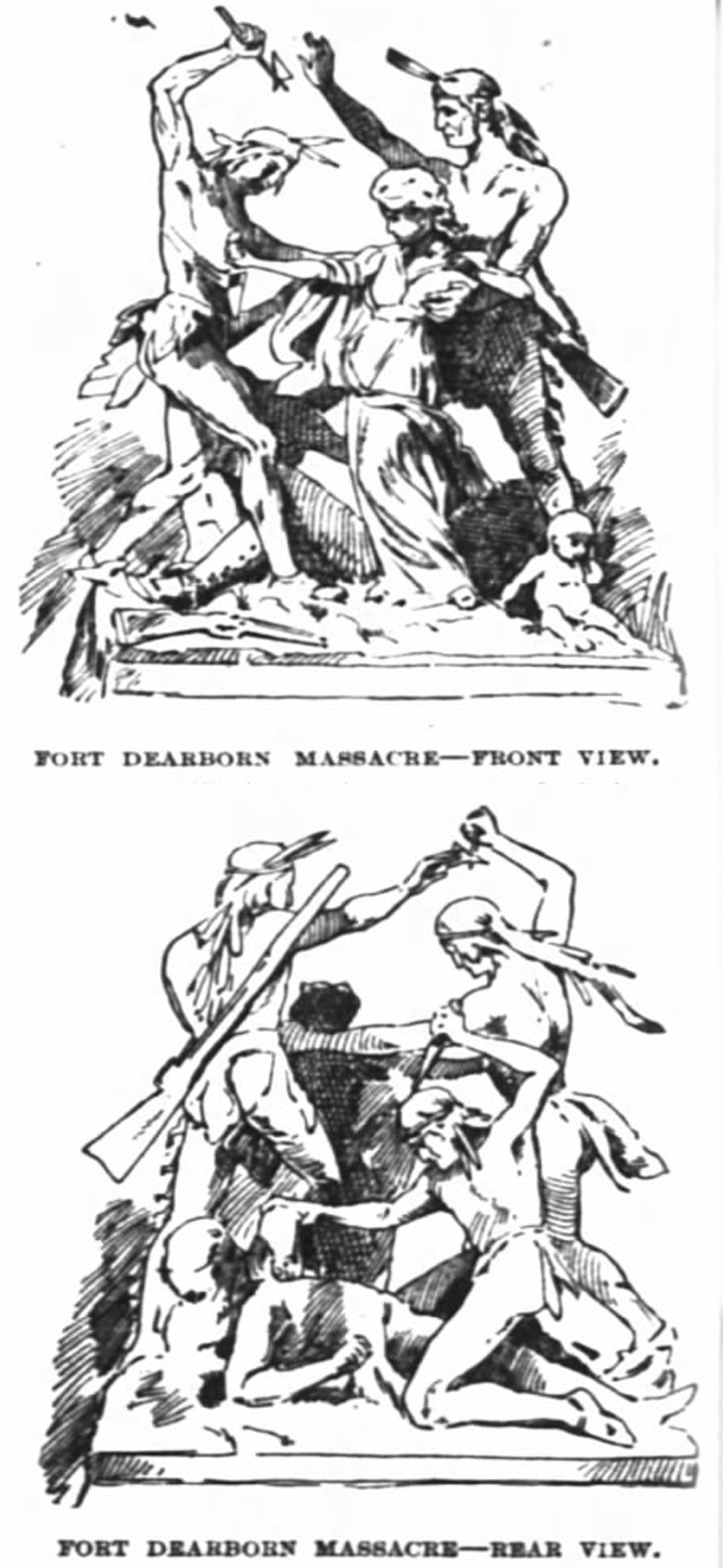
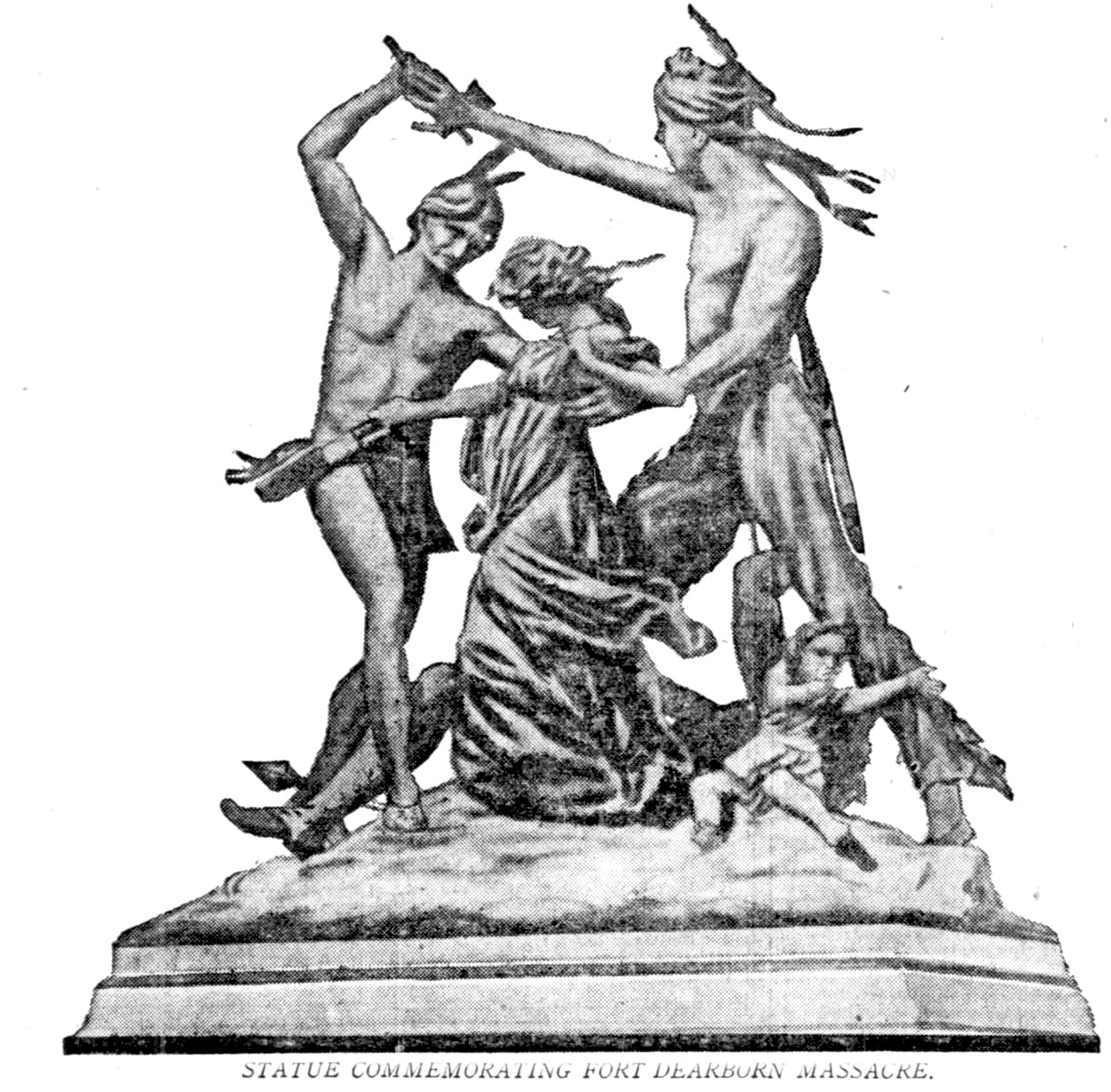
The group to be known as the “Fort Dearborn Massacre” contains six figures, the principal one being Black Partridge, the Pottawatomie chief, who was a friend of the whites. It was for this figure that Kicking Bear gave sittings. Black Partridge is represented in the act of saving the life of Mrs. Helm, the wife of Lieutenant Helm, who was attacked by a young Indian with uplifted tomahawk. The other figures are those of a young Indian in the act of murdering Dr. Van Voorhis, the surgeon of the ill-fated fort, who lies prostrate while the savage plunges a knife into his breast. A defenseless babe completes the group. It is strikingly life-like, and most of the figures are full of action. The following is a historic description of the rescue of Mrs. Helm by Black Partridge:
- Mrs. Helm, the daughter of Mrs. Kinzie, had a narrow escape from death. Assaulted by a young Indian, she aroided the blow of his tomahawk, and then seized him around the neck, trying to get possession of his scalping-knife. While struggling in this way for her life, she was dragged from his grasp by another and older Indian, who bore her struggling to the lake, into which he plunged her but with her head above the water. Seeing it was not the Indian’s object to drown her, she looked at him earnestly and found it to be Black Partridge, who was thus trying to save her. After the firing ceased she was conducted to a place of safety.
Lieutenant Helm was carried by his captors to a village on the Kankakee, where he remained two months before he was discovered by Black Partridge, who had saved the life of Mrs. Helm. That Chief at ones informed Thomas Forsyth, half brother of Mr. Kinzie, who was stationed at Peoria, and efforts were made to secure the release of the prisoner. Black Partridge was provided with a ransom, and dispatched to the Indian village. The amount he carried with him not being sufficient to satisfy the Indians, he freely offered them his pony, his rifle and a large gold ring which he wore in his nose. The offer was accepted, Lieutenant Helm was relegsed, and soon afterwards joined his wife at Detroit, where she had gone with her pareats.
On the evening of Aug: 14, 1812, Black Partridge went to the fort and entered Captain Heald’s quarters. “Father,” he said, “I come to deliver up fo you the medal I wear. It was given me by the Americans, and I bave long worn it in token of, our mutual friendship, But; our young. are resolved to imbrue their hands in the blood of the whites. I cannot restrain them. and I will not wear a token of peace while I am compelled to act as an enemy.”
The four sides of the pedestal will be embellished with bas reliefs, illustrative of various incidents of the massacre. On the front side there will be a representation of the Indian attack from behind sand banks on the troops and pioneers at what is now Eighteenth street and the lake shore. The bas relief on the rear side will show troops and settlers leaving Fort Dearborn, with Captain Wells at their head, on the morning of Aug. 15. They had an escort of thirty Miami braves, and women and children rode in wagons or on horseback.
On the third side the tablet will give a scene in which preparations for the fort’s evacuation are going on. In this scene Black Partridge delivers his farewell speech to Captain Heald. The tablet on tbe fourth side will represent the death of Captain Wells, the noted Indian fighter, who was surrounded and stabbed in the back.
The monument will probably be unveiled early next May. Tne group will be 9 feet high, and the pedestal 10 feet high, making nineteen in all. The Henry Bonnard Bronze Company, of New York, will make the bronze cast of the group.
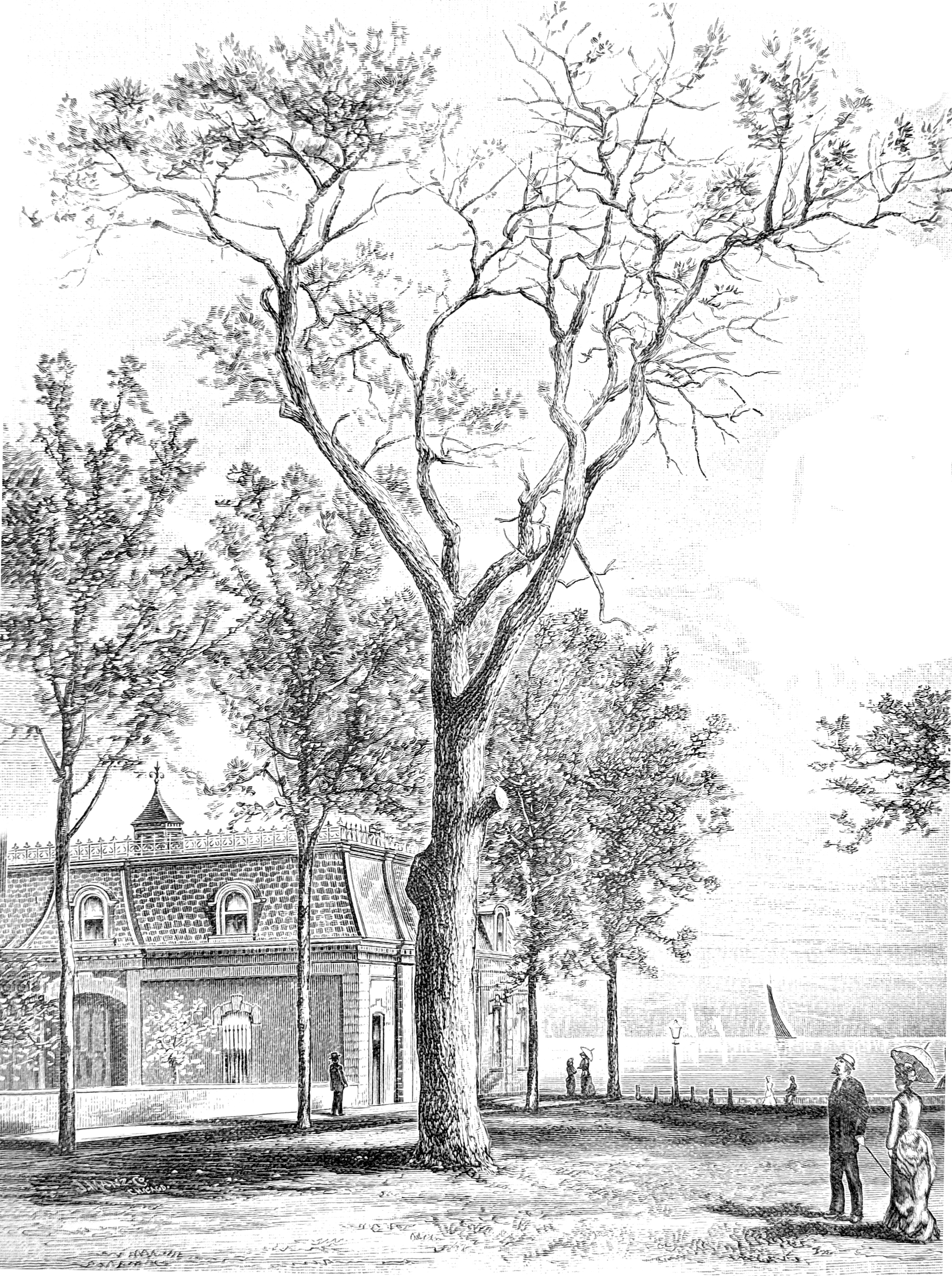
- Chicago’s Historic Tree
Chicago Tribune, May 20, 1894
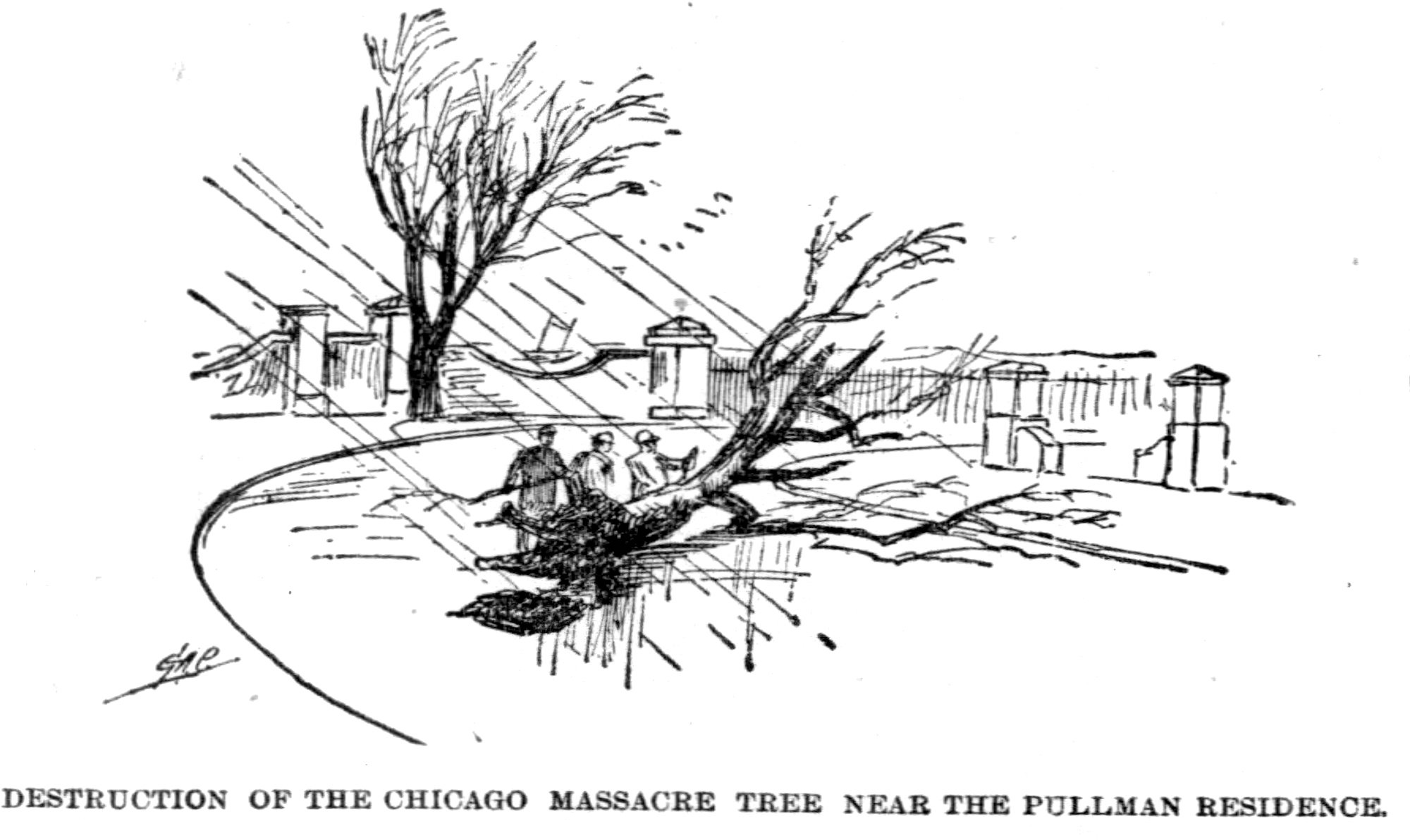
 Early yesterday morning a crowd of people collected on Eighteenth street, near the residence of George M. Pullman, and began digging through the asphalt pavement of the roadway. They were as excited and industrious as if they were a rescuing party, digging after entombed miners. The occupants of the Pullman mansion ran out to see what was the matter, and found the crowd was digging for the roots of the historic cottonwood tree, which after standing there for a century or more, and witnessing at short range the Fort Dearborn massacre Aug. 12, 1812, went down before Friday’s storm at 5:15 o’clock in the afternoon.
This celebrated tree might have lived another century if it had been let alone, but civilization killed it. Long after it had attained a great size the grade of Eighteenth street, where it stood, was raised six feet and the earth piled deep over its roots and around its trunk. Then the inevitable gaspipe, which is always death to trees, was laid near it, and finally the whole street as covered with asphalt close to the very bark of the tree. There was nothing left for it but to die, which it did several years ago, and the northwest wind did the rest. The howling of the blast prevented its fall being heard, so that it sank to rest apparently as noiselessly as a rose leaf falls to the ground.
A Rush for Souvenirs.
The significance of this event was fully appreciated in Mr. Pullman’s neighborhood. The venerable trunk had no sooner struck the ground than everyone within a quarter of a mile who had a saw or a hatchet came to hack a piece off it as a souvenir until the Pullmans got scared. It is probable the tree belonged legally to the city, but Mr. Pullman has been its protector so long that he seemed to own it, and as he was absent at the East his representatives begged the crowd not to carry the whole trunk away. As soon as they had scattered the trunk was sawed into two parts, and deposited in Mr. Pullman’s two gardens, one on each side of Eighteenth street, where they still lie. If any one thinks they are not watched let him try to whittle a piece off them with a jack-knife.
The greatest friend this tree ever had is Fernando Jones, who came to Chicago in 1833, and played baseball under its branches when he was a great deal younger than he is now. But for his veneration for this ancient relic and his constant watch-care over it the street officers of Chicago would long since have removed it as a nuisance. It was with a beautiful poetic justice therefore that he was in at its death. It had hardly touched the ground before he was by its side, declaiming its history, and offering to take the corpse home and embalm it. But that matter has been adjourned until Mr. Pullman’s return.
Traditions Cluster Round the Spot.
Mr. Jones is also the repository of the traditions concerning this tree. He says a similar tree used to stand 200 feet south of this one, and an Indian named Capt. Isaac, who participated in the massacre, often told him it was between these two trees the wagon was stopped by the Indians and Black Partridge rescued Mrs. Helm, as represented in the bronze monument erected near the spot by Mr. Pullman. Isaac mimicked the shooting and scalping in such a realistic manner that it left no doubt in Mr. Jones’ mind that he was a thoroughly reliable Indian on this point.
Mr. Jones delights in relating how he once did the same for the tree as Bmck Partridge did for Mrs. Helm. Many years ago the Street Commissioner, seized with a passion for improvement, made ready to lay this tree low, though covered with leafy boughs.
Mr. Jones resented this as he would the sacrifice of a human being, and never ceased his protestation until the relic was delivered and appropriately protected. Mr. Puliman furnished the iron railing which was placed around its base, and which still adheres to the prostrate trunk, and Mr. Jones, with a passion for scriptural quotations, hung on it a board, which was found dangling to one of its limbs when it fell, and on which was this inscription

Chicago Tribune, September 30, 1931
Here’s Another Proposal for Massacre Memorial
Another proposal for the relocation of the Fort Dearborn massacre monument, salvaged by the Historical society from its original setting at 18th and Calumet to save it from, Mayor vandals, Cermak. was received yesterday Tenants of the Medical and Dental Arts building and the Old Dearborn Bank building at Lake and Wabash joined in a petition to have the bronze group set up again in the plaza at the intersection of Wacker drive and North Wabash, which, it is pointed out, overlooks the site of the old Fort Dearborn.
AFTERMATH
It was originally placed near the intersection of Prairie Avenue and 18th Street, which was thought to be the site of the Battle of Fort Dearborn. In 1931 it was moved to the lobby of the Chicago Historical Society. In the 1980s or 1990s it was moved back to near its original location. Some time after that, the monument was removed and placed in a warehouse
Chicago Tribune, May 23, 1942
THE MASSACRE TREE.
H. A. Musham of Chicago, who has delved deep into the story of Fort Dearborn writes us about the cottonwood tree which tradition says sheltered the fighters of 1812. as they fought for their lives during the battle with the Indians: “It is my conclusion, after considerable study, that it not only could not have been standing at the time of the battle, but that the place where it stood was far removed from where the battle took place.
Reasons:
- ① Cottonwood trees seldom live as long a time as the so-colled “Massacre Tree” is reputed to have lived. … Its location was unfavorable to the attainment of that age. Its roots would have been bedded in loose sand and it would have been exposed to the fury of the gales on the lake.
② This tree must have been planted or have taken root at a later date, probably after this part of Chicago was graded and subdivided into blocks.
③ According to pictures of this tree (see Kirkland and Andreas) it was, in the year 1884. about 3 feet in diameter at the butt. According to statistics on cottonwoods, it was then about 30 or 33 years old. which would put its start in life about 1850, when the Prairie avenue neighborhood became a subdivision.
④ The battle did not take place where the tree stood, but about Michigan avenue and 13th street. This is clearly shown by a study of the numerous accounts of it.
⑤ The bullets in the tree probably came from the guns of wandering hunters.

- 1729 S. Prairie
Robinson Fire Insurance Map
1886

Leave a Reply