
The Inter Ocean, May 3, 1876
Mr. John Gregory, the well-known builder, launched a new tug in the South Branch yesterday afternoon. She possesses a very beautiful model, and is strongly put together. She is designed for the fishing service, and is well housed in. Parties in Green Bay are the owners.
Chicago Tribune, May 20, 1876
THE ALBATROSS.
The Albatross is the name of a new fishing-tug which John Gregory, the eminent shipbuilder, has constructed at Doolittle & Olcott’s ship-yard, near Van Buren street bridge, and which will be launched in a few days. She is of a beautiful model, and excellently adapted for the business in which she is to embark. Her owners are Messrs. Schultz & Stahl, of this city. The following are her dimensions: 50 feet keel, 14 feet beam, 6½ feet hold.
Daily Milwaukee News, December 10, 1876
PICKED UP ADRIFT.
The tug Albatross of Chicago, which by the way was yesterday morning erroneously reported to be tied up, the claim having been settled at once, on Friday night left lying at Meinecker’s coal doek. Between 5 and 6 o’clock yesterday morning she broke her lines, and drifted out into the lake. Her captain, J. O. Sullivan, got the tug W. K. Muir (US No. 26367) to go search of her, but the Muir after running down to the head of the pier turned back, there being thick fog on the lake, her captain saying that she had not coal enough. Capt. C. H. Sullivan, of the fishing tug O. B Green, although his boat was not adapted to face such weather, accompanied by his namesake of the Albatross, ran out in search of the missing. tug, and picked her up about 10 miles E.S.E. of the harbor, and towed her in again. The captain of the Albatross expresses himself under great obligation to the captain and crew of the O. B. Green, who deserve great credit for venturing out on the lake in a heavy fog, at this time of the year, with a small fishing tug.
Chicago Tribune, November 10, 1878
The tug Albatross was cut down to the water’s edge yesterday by the tug Butler, in the river, near Twenty-second street. The damage is on the port side.
Inter Ocean, January 6, 1879
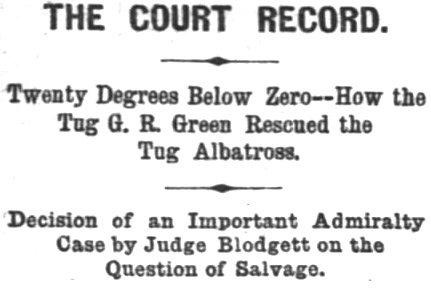 Judge Blodgett on Saturday confirmed the report of Commissioner Lawrence Proudfoot in the very interesting admirality case of Cornelius H. Sullivan, Geo. R. Green, and A. J. Langworthy. owners of the steam tug O. B. Green. against the steam tug Albatross.
Mr. Proudfoot Says:
This was a libel filed by the libelants to recover $150 for towage service in the nature of salvage. The facts, as claimed by the libelants, were that on Dec. 23. 1876, the tug Albatross while lying at a dock in the Milwaukee River at the Port of Milwaukee slipped her moorings and drifted down the river into Lake Michigan during a severe gale of wind. At about 7 o’clock in the morning the libelants, who were then the owners of the tug O. B. Green, were informed of the accident to the Albatross, and immediately ordered the tug Green to steam up and go to her relief. At 8 o’clock. taking a crew of five men. the Green started in search of the Albatross, and, when near the mouth of the harbor, met the tug W. K. Muir (US No. 26367), with Schultz, one of the owners of the Albatross, on board, who earnestly requested the libelants to proceed and endeavor to recover his vessel. Libelants did so, and found her her about six miles out, northwest of Milwaukee. still drifting toward the Michigan shore, and towed her safely into the port of Milwaukee. The weather on the morning in question was intensely cold, the thermometer ranging 24 degrees below zero; a dense fog prevailed, with a gale of wind from the northwest, and the lake was covered with floating ice. The powerful tig W. K. Muir had been employed by the owners of the Albatross to search for her, but owing to the severe weather she would go no further than the outer pier. The value of the Albatross was $4,000, and the libelants claim that she would have been a total loss only for their services. The amount charged was $150, which has never been paid.
An answer was filed by Richad Schultz for himself and as agent for J. S. and John Steele. the other owners of the Albatross. It is claimed that the Muir was obliged to return for want of coal, and that the tug Green, manned by the captain of the Albatross and a volunteer crew, went out at 8 a. m. and returned with the Albatross at 11 a. m., finding her in smooth water and in no danger of sinking or exposed to total loss, and fixing her value at $3,000; that the Green was a fishing tug and lying idle; that she was exposed to no peril, as she had a spirit compass on board. by the aid of which she could find the harbor at any time; that she having been employed to go after the Albatross, the pay for such service was not contingent. and that the libelants are not entitled to salvage, but to towage, which, under ordinary circumstances, would be $10 per hour; and that an offer of $75 was made to the libelants prior to the filing of the bill, which was refused
Several witnesses were examined in support of the libelants’ claim, and among them Cornelius Sullivan, one of the owners of the Green. He says that the Albatross was in imminent danger, and would have been a total loss but for the Green. No one was aboard, and she broke loose twice when being towned in. After getting into port with the Albatross, Sullivan saw Schultz, one of her owners, who expressed his thanks. Two or three days afterward a settlement was had with Schultz and another of the owners of the Albatross, and a month afterward a note for $150 was given in settlement. The Albatross men thought it rather high, but said the Green had earned it. The note was produced in evidence, and is as follows:
- Milwaukee, Wis., Jan. 11, 1877.
Due Cornelius Sullivan upon settlement for saving the tug Albatross in the month of December from total loss, one hundred and fifty dollars, payable in month of July, 1877.
R. Schultz & Co.
After stating the examination of several witnesses pro and con, Mr. Proudfoot goes on to say that the case was argued at length before him, and a large number of authorities cited as though it involved a question of salvage, and all of the authorities cited were such as pertain to cases of salvage remuneration. Salvage service he says, is such as is rendered voluntarily to a vessel found derelict; or under a contract made by the owner of a vessel to pay a certain sum, contingent upon success. There are cases in which services may be rendered, in the nature of salvage services, the amount of the compensation for which is to be determined by the circumstances surrounding the case, and it seems to me that this is a case of that nature; that it is a case of towage in the nature of salvage, where valuable and meritorious services were rendered under circumstances of great exposure and considerable peril. The evidence of both parties shows that it was not merely an ordinary towage service to be compensated for by ordinary rates of towage, but a valuable, meritorious service, rendered under extraordinary circumstances, and for which those rendering the service should be paid more than an ordinary compensation. I do not understand that under the law the Albatross could have been called “derelict” for her owners knew of her condition, and employed libelants tug to go after her. Neither was any contract made, contingent or otherwise, to rescue her. Hence it was merely a case of employment, and in the absence of any stipulated sum be paid for the service the amount of compensation will be fixed according to what would be fair, taking all the circumstance and the perils and exposures encountered into consideration. But her was a note given by the owners a month afterward, they having had plenty of time for reflection. All the questions at issue were then discussed. The only defense is that the price charged was too high. I an satisfied that Schultz did not at the tim of giving this note consider the compen sation excessive. Counsel for respondent cited a number of authorities, holding that where a contract entered into for “salvage” is unconscionable it will not be enforced as against the owner. I hav examined these cases carefully and find that the amounts charged were either upon a sum stated and demanded “before the service was rendered,” which was deemed to be unconscionable, or a sum agreed upon by agents without the assent of owners, but in, this case the amount of compensation was assented an agreed upon by the owners a month after the rendition of the service, as evidence by the note of Schultz & Go., and no compulsion was used against the owners. See the case of the barge Jenny Lind, 1st Newberry, pages 447 and 148.
It was further urged that the agreement to find the owners must be made by the captain as their agent. But Schultz is the only one of the owners who appears in this case, and he answers as the agent of the others. It is further urged that the tender of $75 precludes any further recovery, but I cannot see how that can prevail in the face of an admitted written indebtedness of $150. I therefore find that the tug Albatross is indebted to C. H, Sullivan et al., libelants, in the sum of $150, as claimed, and that a decree be entered accordingly.
Judge Blodgett on Saturday confirmed the report of Mr. Proudfoot, and a decree for $150 was entered in favor of the libelants. Mr. C. E. Kremer appeared for the libelants, and Wm. H. Condon for the defense.
Chicago Tribune, October 22, 1880
Capt. Joe P. Hubbard has been appointed Master of the canal tug Albatross, vice Richard Schultz, disqualified because of color blindness. Thomas McLaughlin temporarily succeeds Capt. J. M. Higgie in the command of the schooner Higgie and Jones.
Chicago Tribune, October 4, 1888
The Albatross May Have Been Lost.
Sheboygan, Mich., Oct. 3.-[Special.]-The steambarge Enterprise came in tonight and reports the loss of her consorts, the A. Muir and Albatross. The seas washed over the pilot house, some thirty feet above the water, and carried everything before them, and she narrowly escaped foundering. The seas broke in the port gangways, and the starboard bulwarks were knocked out on both sides. The hatch-bars were displaced and the cargo is said to be damaged. Seventy tons of coal between decks were washed away through the broken sides. The Albatross has not been heard from, and is thought to be lost. The Muir is safe in Milwaukee. The Enterprise lay at the Manitous and came from there this morning and reports over fifty vessels at anchor there. She will wait orders from owner before proceeding further.
Chicago Tribune, October 9, 1888
Bad Luck Following the Enterprise.
Sheboygan, Mich.. Oct. 8.-[Special.]-The steam-barge Enterprise, which lost her tow last week on Lake Michigan, left here Friday night to meet the Albatross coming down under sail to tow her and the Muir, which was coming here in tow of the tug Welcome, stranded on North Manitou with the Albatross early Sunday morning and jettisoned between 4,000 and 5,000 bushels of corn to save herself from going to pieces. She succeeded in getting off with some damage to her bottom. The Albatross also stranded, but was pulled off.
The Enterprise arrived here this morning, picked up her barges in the harbor, and after coaling left about noon for Kingston. The Enterprise’s cargo was 26,000 bushels of corn consigned by Robert Warren & Co. of Chicago to Kingston on through shipment to Montreal.
Green Bay State Gazette, August 6, 1890
The tug Albatross, of Two Rivers, came in here on Tuesday for the purpose of wooding up. She was on her way home from Garret Bay, near Death’s Door, where she spent several days assisting the tug Temple Emery, also of Two Rivers, in making up a raft of logs for the Two Rivers Manufacturing company. The Emery started with the raft for Two Rivers on Monday, and at last accounts had not yet arrived there. The raft is said to be one of the largest ever towed on the lake and scaled about one and a half million feet. As the logs average about fifteen to the thousand the size of the raft can easily be determined. The logs are all pine and basswood and were purchased near Death’s Door.
Last enrollment, PE 25, issued at Milwaukee, WI, on August 31, 1887, surrendered there on August 24, 1894, and endorsed “abandoned.”

Leave a Reply