Vaudeville Theaters of Chicago
Alhambra Theater
Life Span: 1890-1929
Location: State and Archer
Architect: Mr. George Garnsey
- Lakeside Annual Directory of the City of Chicago, 1892
Alhambra Theatre, Frank Bresford, mngr. State cor. Archer av.
Lakeside Annual Directory of the City of Chicago, 1904
Alhambra Theater, James H. Browne mngr State cor. Archer av.
Inter Ocean, August 24, 1890
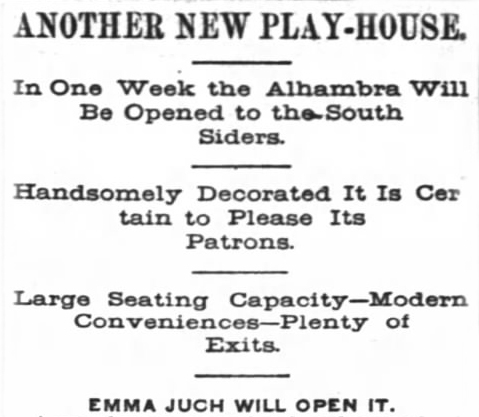 A new theater, a new hotel, and a new business block have been added to the city’s attractions.
This trinity of pleasure, comfort, and usefulness is almost completed. The theater is to be opened Sept. 1. The edifice is to be known as the Alhambra, a good name, attractive and rich in associations. The proprietor is Mr. A. J. Cooper, who has put up handsome block of buildings on State street, between Archer avenue and Twentieth street.
The structure on State street shows seventeen stores, three stories high. Above the stores is the hotel, containing 246 rooms. The building is Moorish in design, of red brick, with terra cotta trimmings. All this has cost about $350,000. The architect was Mr. George Garnsey.
The theater will prove to be one of the best in the city in the way of comforts, conveniences, and safety, alike for the people on both sides of the footlights.
There are altogether 2,535 seats. Of these there are 710 in the parquet and parquet circle, 625 in the balcony, and 1,200 in the gallery.
There are twelve boxes, containing two additional seats. It will thus be seen that the Alhambra Theater will be one of the largest in the city. The general style of architecture employed is Moorish, with some original additions in the way of treatment. The decorations employ all the Moorish tints except blue. The finishing is wholly in gold. The front of the gallery is covered entirely with Moorish characters for the public to ponder over.
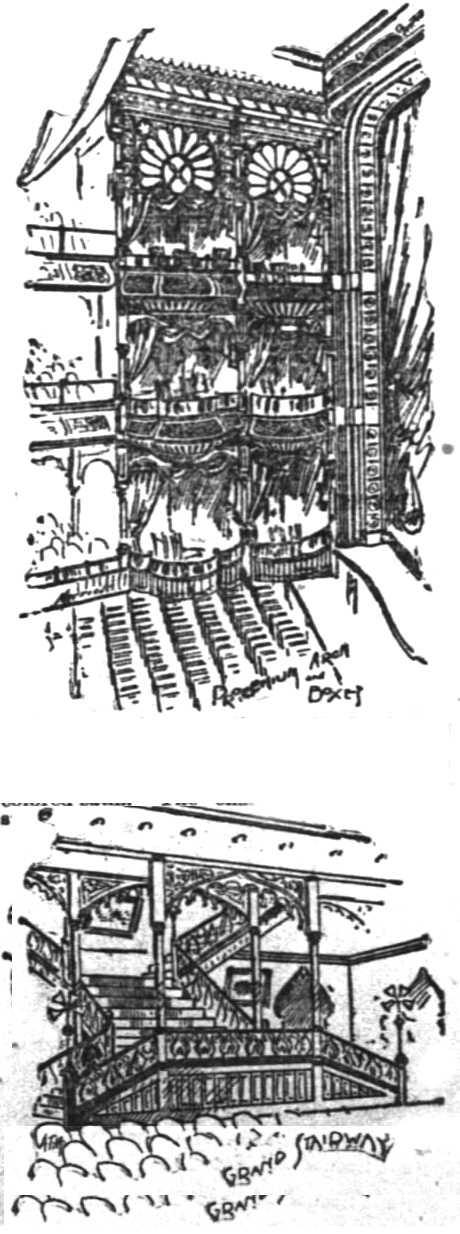
The decorations are all exceedingly pleasing and restful to the eye, there being no loud colors whatever. The draperies of the boxes are very light in weight, being wholly of corn-colored satin. The chairs are richly upholstered, larger than usual, and finished in old gold plush. The theater is lighted throughout by electricity, but supplied also with gas, which can be turned on at a moment’s notice. There are no boilers in the house, all the heat and steam being provided by engines placed opposite the theater on Twentieth street.
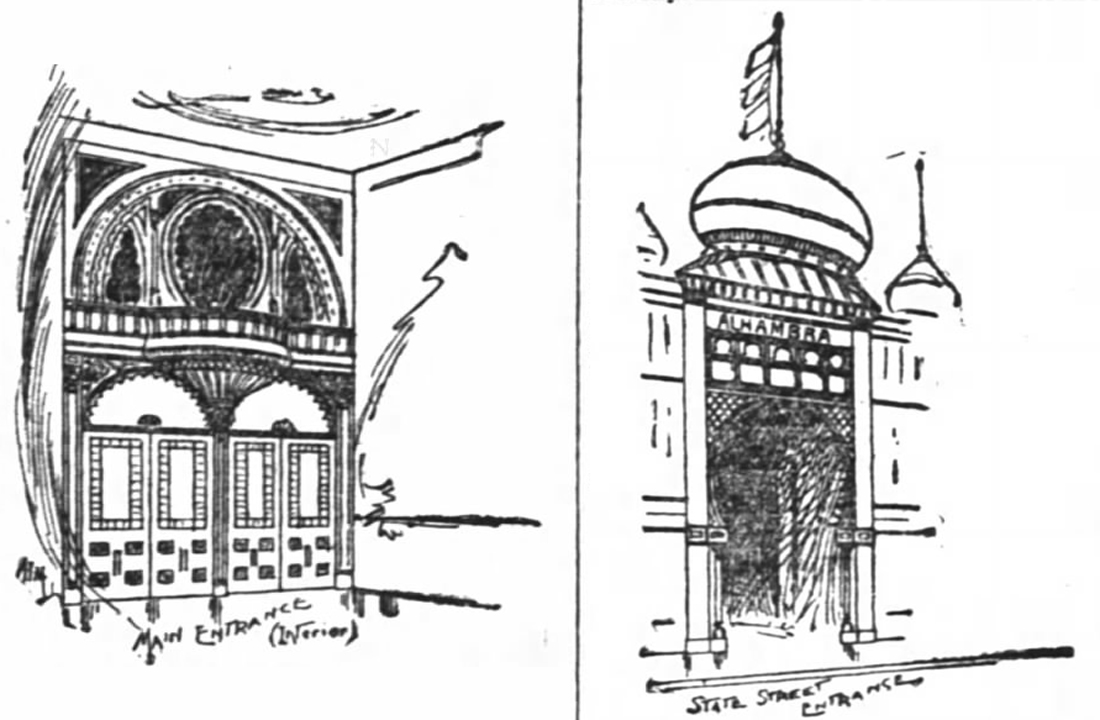
There are two entrances to the theater, one on State street, the other on Archer avenue. They both lead to an octagon-shaped rotunda, forty-five feet in diameter. At one side is the ticket office.
The State street entrance is finished in lincrusta, Walton, and Mexican onyx, while the Archer avenue entrance is lined with oak panels. The flooring is of French tiles. The wainscoting in the theater is of Mexican onyx.
There are no less than sixteen additional exits, the theater having streets on three sides and a courtway on the fourth. Iron stairways lead to the sidewalk from the galleries.
The stage has a proscenium opening 38 feet wide and 37½ feet high. It is 42 feet from the curtain line to the back wall while the stage is 67 feet wide from wall to wall. From the floor to the gridiron is 72 feet. There are double fly-galleries.
The stage has two star dressing-rooms on the main floor and twenty-six below, all provided with hot and cold water and plenty of light. The drop curtain shows the courtyard of the famous “Alhambra.”
Standard Guide to Chicago for the Year 1891, John Flinn, 1891
Alhambra Theatre.—Located at the corner of State st, and Archer ave.; H. R. Jacobs, manager. Take State st. cable line. This theatre was opened by Miss Emma Juch, the prima donna, in 1890. It is one of the handsomest in the city. The theatre has a grand entrance on State st. and another entrance on Archer ave., both leading inward through a business block to a large court from which a spacious lobby opens into the main foyer. Here a wide staircase leads to the balcony and branches into side flights of steps both at the top and bottom. The auditorium, constructed upon the most approved modern system, is wide but not deep, and has a seating capacity of 2,500 aside from the twelve boxes. The lower floor seats 750, the balcony 550, and the gallery 1,200. The ornamentation of the interior about the boxes, balconies and stage front and ceiling, is Moorish in design, and the colors are salmon and shrimp pink with intermediate shades. One feature of the new playhouse that makes its plan well-nigh a model one is the excellent system of fire-escapes and exits provided. From the various parts of the house are twenty-eight exits, those from the gallery and balcony reaching to iron staircases, spiral and straight, running down the exterior walls. The stage is forty-five feet deep and has an opening of twenty-five feet. There are twenty-four dressing-rooms, besides two large rooms for “supers,” a bill-room, and music rooms—all supplied with every convenience and arranged after the most desirable plans.
Rand, McNally & Co.’s Bird’s Eye Views of Chicago, 1893
The Alhambra Theater, telephone “South, 142,” is on State Street near
Archer Avenue, being reached by the cable on State Street, or by the Elevated road. Its bills are similar to those of other “outside theaters.” The house is large, seating 2,500 people, and while the balconies are wide, the stage is not far away. Prices are moderate.
Chicago Tribune, September 28, 1912
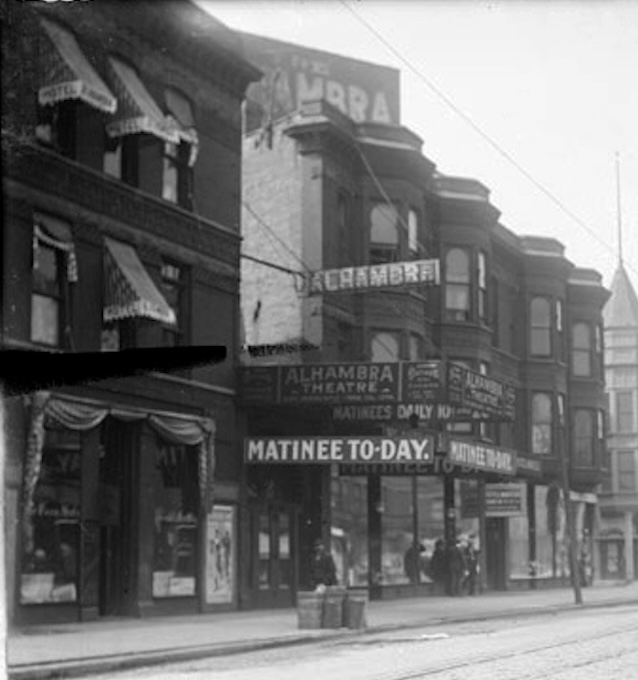
ALHAMBRA THEATER TO CLOSE: RESULT OF LABOR TROUBLES.
Owners Decide to Shut Theater After Long War with Unions Over “Open Shop” Proposition.
The Alhambra theater at State and Nineteenth streets will be closed after tonight, following five years of a labor war, during which an open theater has been maintained Max and David Webber, the proprietors, reached this decision yesterday to forestall further trouble with the labor unions.
“Before the season opened on the 1st of September,” said Max Webber yesterday, we were threatened by representatives of four different unions, the musicians, bill posters, stage hands, and moving picture operators, each of whom declared they would close the place unless we gave in to their demands.”
This the theater proprietors did by making short term contracts with the different organizations, but finally decided it was easier to lock the doors, so the curtain will be rung down tonight instead of a continuance of the season until May 1 of next year.
Chicago Tribune, July 11, 1919
LANDMARK IN SOUTH STATE ST. CHANGES HANDS
Alhambra Theater and Hotel Block Sold for $125,000.
An unusual number of important transactions in business, apartment and residence property figured in yesterday’s real estate news.
The most important of the business property deals was the sale by the Northwestern Mutual Life Insurance company to Israel R. Warshawsky, the head of a large automobile wrecking concern, of the Alhambra block, at South State, Twentieth streets and Archer avenue, a landmark in that section. It has a frontage of 293 feet on State street, 177 on Archer avenue and 151 feet on 20th street, with 200 feet of frontage on the thirty foot of Follansbee court in the rear. The improvements comprise two and three story buildings, containing fifteen stores, a 150 room hotel, in addition to a large theater on the ground floor.
The revenue stamps on the deed indicate a consideration of $125,000, the purchaser giving back to the insurance company a purchase money mortgage of $65,000, five years, at 6 percent. S. C. Iversen of Hibbard Porter & Bro., represented the purchaser, while William Scott Bond represented the insurance company.
Chicago Tribune, September 12, 1929
35 CONTINUANCES OF WARSHAWSKY ROIL FIRE CHIEFS
His Alhambra Building Is Called a Menace.
The case of the city fire prevention bureau against Israel Warshawsky, automobile accessories and junk mag” nate, which has been on the Municipal court dockets for sixteen months, was continued for the thirty-fifth time yesterday by Judge George B. Holmes.
The case concerns the old Alhambra theater and hotel building on State street between Archer avenue and Cullerton street. Warshawsky is the owner. City officials maintain that the building is a fire hazard which 1s a constant peril to 150 men, women, and children, all members of familles living in poverty in 48 flats there.
Son-in-Law of Morris Eller.
Warshawsky is the son-in-law of Morris Eller, Republican boss of the 20th ward, and the brother-in-law of Superior Judge Emanuel Eller. When the Ellers and sixteen of their henchmen were indicted as election terrorists, Warshawsky rated a millionaire, went on their bonds.
Warshawsky was not in court yesterday. He was not in court when the case was called for the first time and for the first time continued on April 14, 1928. Fire department officials say he has never been in court in connection with the case. Neither has he had any lawyers representing him, they say. According to the records, the case has always been continued on motion of City Prosecutor Frank J. Peska or his assistants.
Fines Given and Withdrawn.
Fines of $100 and then $300 have beer imposed on Warshawsky at times, but in each instance a motion to vacate was made There appears to be & mystery as to who made these motions to vacate the fines, in view of the fact that Warshawsky had no lawyer.
Patrick J. Egan, division fire marshal in charge of fire prevention, expressed indignation over the 35th continuance yesterday.
“That building is the worst fire trap in town,” Marshal Egan said. “If it ever caught fire at night not a soul in it would escape. The main floor is filled with automobiles with tanks full of gasoline. On the second and third floors there are forty-eight flats in which a lot of poor people live. The fourth and fifth floors are so heavily weighed down with automobile chains and other heavy material that they sag.”
Called Peril to Firemen.
“The place is not only a fire trap but a great danger to the firemen,” said Fire Marshal Michael Corrigan “If they should be called on to fight a fire there a dozen might be killed.”
This statement was corroborated by Frank J. Prindiville, fire prevention engineer, and by Lleut. Patrick Kelly and John E. Hartnett, both of whom have inspected the premises.
“It is a terrifying place, when one thinks of the danger of fire,” said Mr. Prindiville. “The basement 1s filled with debris.”
Marshal Corrigan’s statement about death to the firemen, he explained, referred to some of the conditions Warshawsky is alleged to have refused to set right. There are corridors running to bricked up windows; there is a fire escape leading to windows on the third and fourth floors that open on the inside into an elevator shaft, according to Mr. Prindiville.
History of the Continuances.
The case goes back to Dec. 10, 1927. Warshawsky was then first warned to put the building within safety regula-Lions. He ignored the warning, according to the fire officials. The case went into court on April 14, 1928, and Judge Holmes, who was the first, as he has been the last, to hear it, continued it until April 25. The other continuations have been as follows:
1928.
Judge Holmes—April 26, May 2, 6, 26, 23.
Judge Charle S McKinley—June 6 and 20., July 11 and 25.
Judge Philip J. Finnegan—Sept. 24, Oct. 19 and Nov. 14 and 21, and Dec. 5.
Judge Alfred O. Erickson—Dec. 19.
1929.
Judge Erickson—Jan. 9 and 23, Feb. 6 and 27, March 6 and 20, April 3 and 17, May 1, 15, and 29; June 12 and 26, July 17 and 31, Aug. 21 and Sept. 4.
Judge Holmee-Sept. 11.
The case yesterday was continued to Sept. 18.
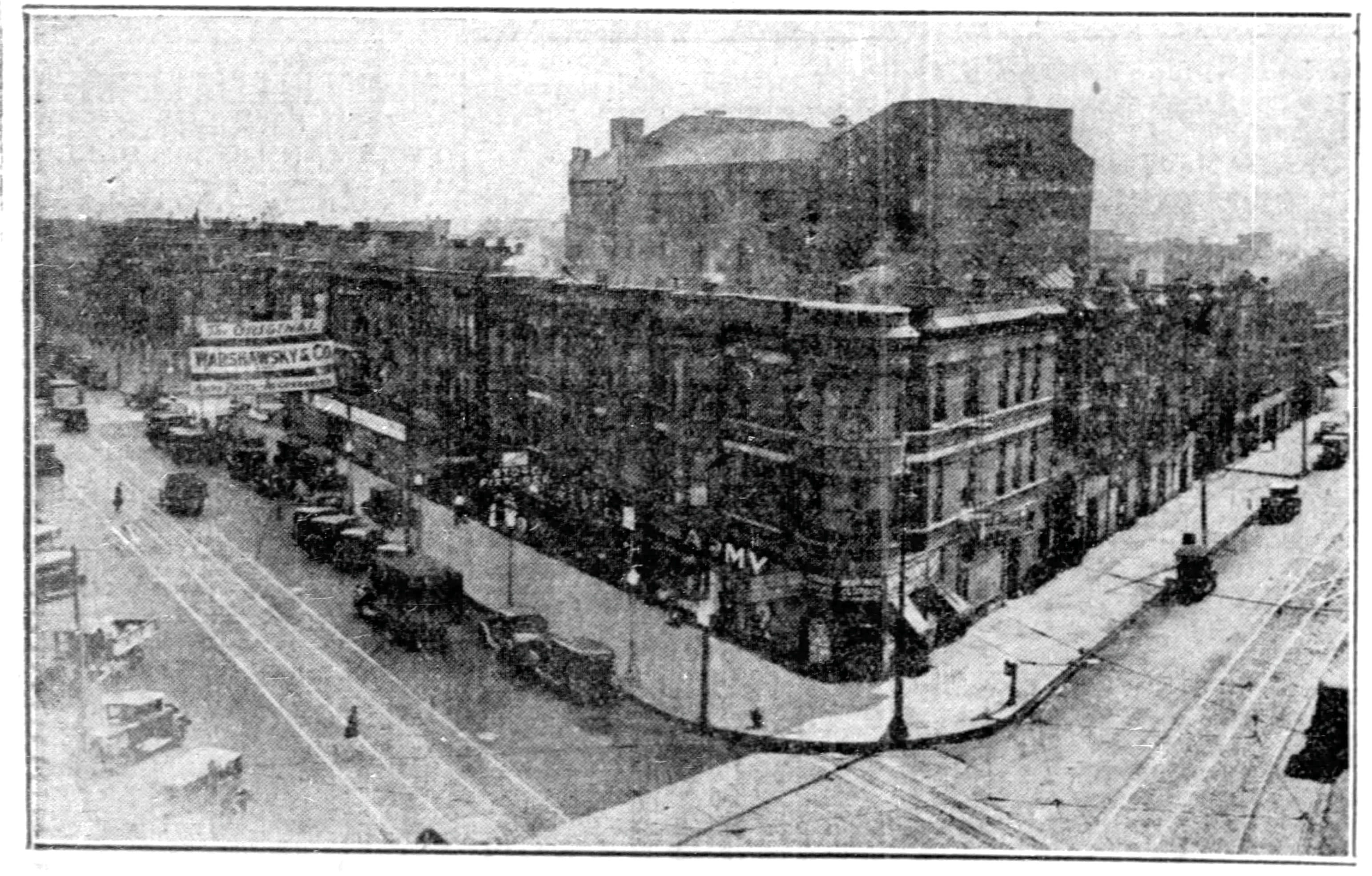
- FIRE DEPARTMENT FIGHTS IN VAIN TO HAVE BUILDING DECLARED FIRE TRAP. Old Alhambra theater building at Archer avenue, State, and Cullerton streets, owned by Israel Warshawsky, son-in-law of Motris Eller, proceedings against whom were continued for therthirty-fifth time-yesterday.
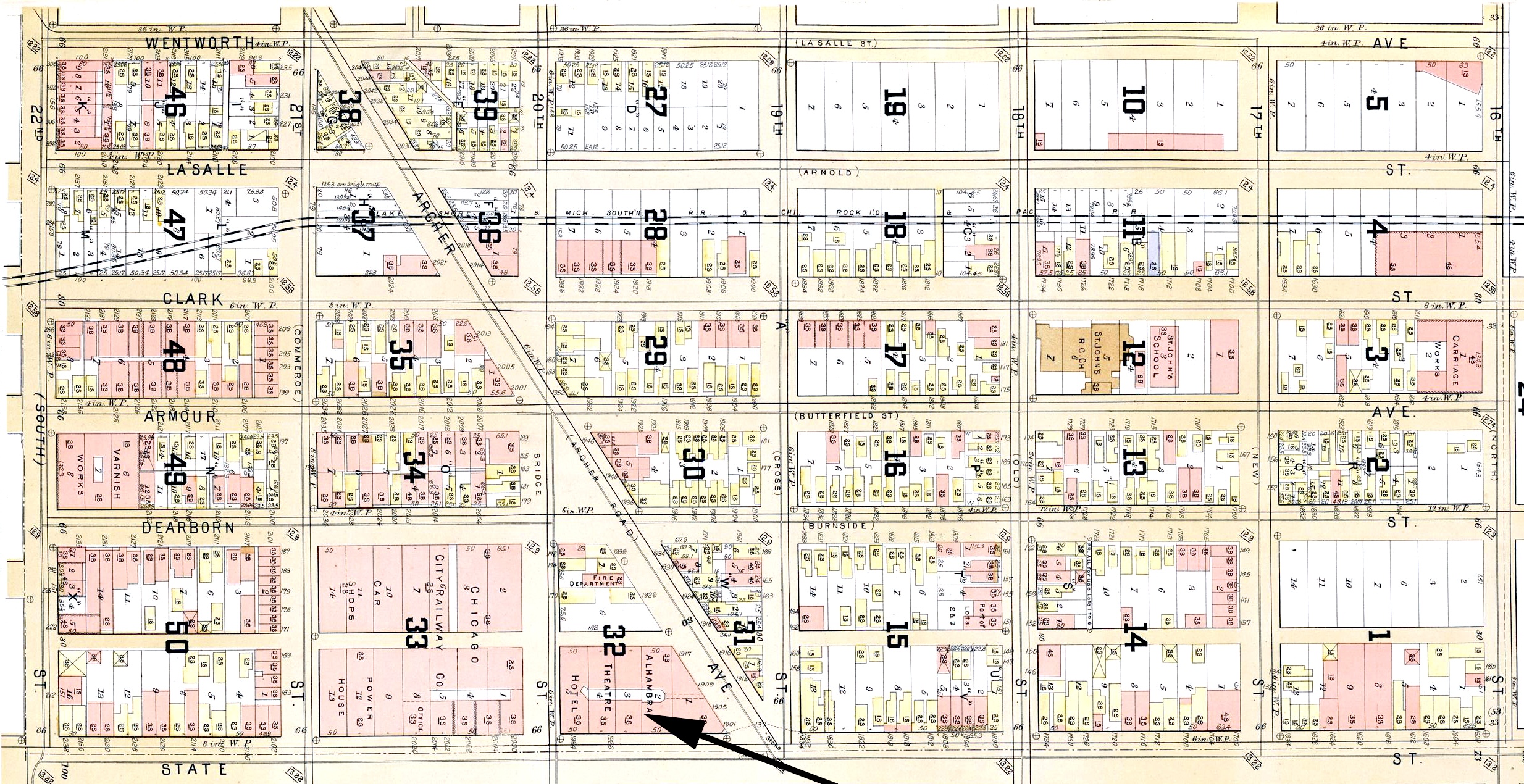
- The Alhambra’
Greeley-Carlson Atlas of Chicago
1891

Leave a Reply