Chicago Tribune, April 23, 1933
CONSUL TO TELL OF IRISH EXHIBIT AT FAIR TONIGHT
Daniel J. McGrath, Irish Free State consul in Chicago, will talk from W-G-N at 9 p.m. tonight on his country’s exhibit at A Century of Progress. Mr. McGrath is Ireland’s commissioner to the fair. The Free State exhibit will consist entirely of Irish arts and crafts. The arts section will include 40 paintings by contemporary Irish artists and an extensive collection of ancient gold and silver ornaments, most of them more than a thousand years old. The crafts exhibit will include products of the coöperative folk industries of the Gaeltacht, the districts inhabited by the, Gaelic speaking people of the Free State.
Chicago Tribune, May 20, 1933
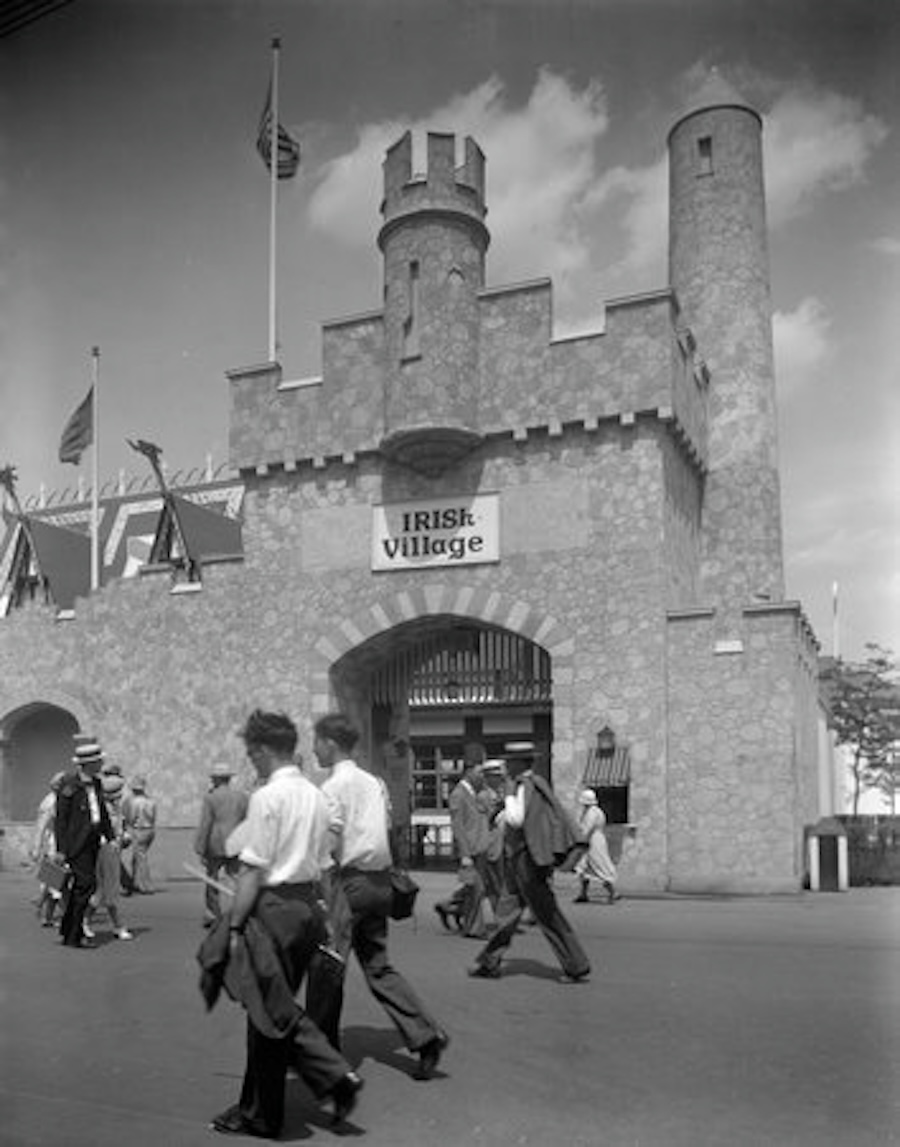
IRELAND AT THE FAIR.
Chicago, May 16.—I read with more than passing interest the extract from The Tribune of forty years ago relating to the so-called Irish village at the World’s Fair of 1893. There will be another Irish exhibit at A Century of Progress. Infinitely more than forty years separate it in spirit from the affair of 1893. It will have no “shillalah makers.” no earl and countess of Aberdeen to lend it the distinction of their patronizing interest. The 1933 exhibit will be typical of the new Ireland—Irish Ireland—the Ireland that has survived both the enmity and the kindness of the Aberdeens and their kind.
The exhibit at A Century of Progress has been arranged by the Irish Free State government. The Free State is one of the few countries exhibiting at the Fair through their governments. Mention of an Irish government forty years ago to his lordship of Aberdeen (and later, somewhat blasphemously, of Tara) would have caused that bewhiskered nobleman to indulge in a hairy snicker or perhaps to have sent for the constabulary. Shillalah making, never an organized Industry and of which there exist more stories than statistics. will be replaced in the 1933 exhibit by a display of Irish arts and crafts. It will include the most comprehensive display of paintings by contemporary Irish artists ever seen outside Ireland. In addition there will be displays of metal, glass and leather work. Characteristic industries will be represented by an exhibit of textile products.
The 1933 Irish exhibit will be one of which every one of Irish birth or descent will be proud, and one that will appeal to all lovers of the beautiful, regardless of race. It won’t be a side show catering to the old, moth-eater baloney about the Blarney Stone and the conception of the frish as a people who, when not engaged in rapping each other’s skull with shillalahs, spend their time dancing jigs or singing sad, sweet songs to the accompaniment of harps. The Irish exhibit at this World’s Fair will be as different from the affair of forty years ago as gold is from brass.—Eblana.
Chicago Tribune, May 26, 1933
SHOW PAINTINGS FROM IRISH FREE STATE AT FAIR
By Eleanor Jewett.
There is a formal exhibit of 69 paintings in the Irish Free State concession in the A Century of Progress Travel and Transport building which is of first importance. Ireland is the only country to have so honored her artists. The exhibit is under the charge of Daniel J. McGrath, Irish Free State consul to Chicago and commissioner to the Exposition.
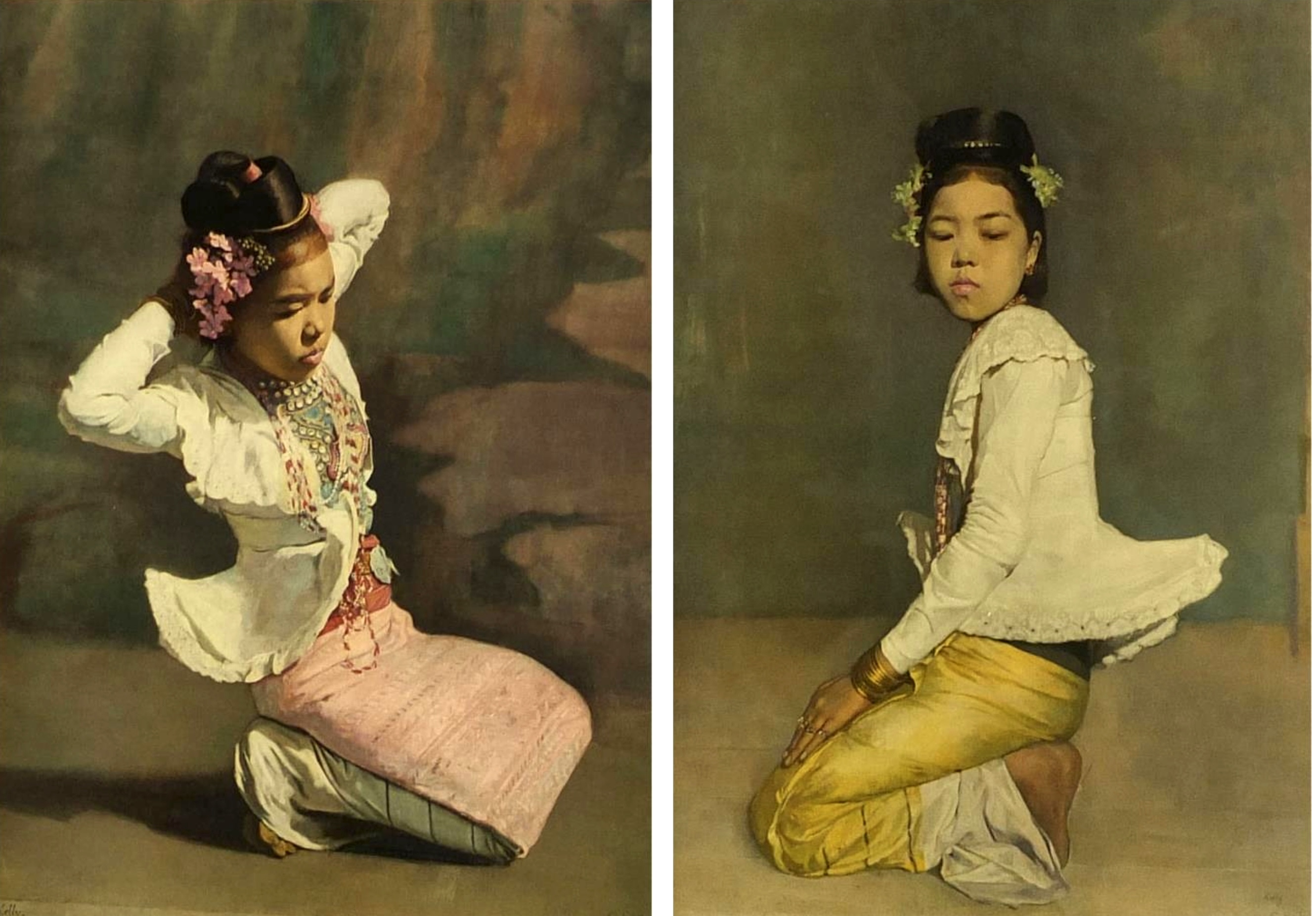
- Sir Gerald Kelly, study of a Burmese Dancing Girl.
The paintings are varied in manner and subject. Apparently modernism has not taken a strong hold upon the Irish imagination, for the majority of the canvases are intelligible and beautiful. One of the finest portraits is that of Lennox Robinson, director of the Abbey theater, whose players were recently here, by Dermot O’Brien. Mr. O’Brien is president of the Hibernia academy, an organization similar to the London Royal academy.
The portrait of Sir William Orpen in his studio by James Sinton Sleator is another stunning canvas. Below it is a more intimate portrait of Orpen by the same painter, a head treated in a direct fashion that is effective.
Gerald Kelly, whose portrait in this year’s Royal academy exhibit in London was acclaimed “The picture of the year,” shows two very fine studies of a Burmese dancing girl. They are beautiful paintings and place young Mr. Kelly as one of the most important of contemporary painters. So good are they that they would not be out of place beside Sargent, Whistler, or any other of the great names in portraiture.
Jack B. Yates, brother of the poet and playwright, W. B. Yates, is represented by an interesting study of two men watching the start of a race. It is a simple, sincere, and distinguished canvas. George Russell, the celebrated A. E. of literature, shows a slight and sentimental allegory, an angel appearing on a hillside to two children.
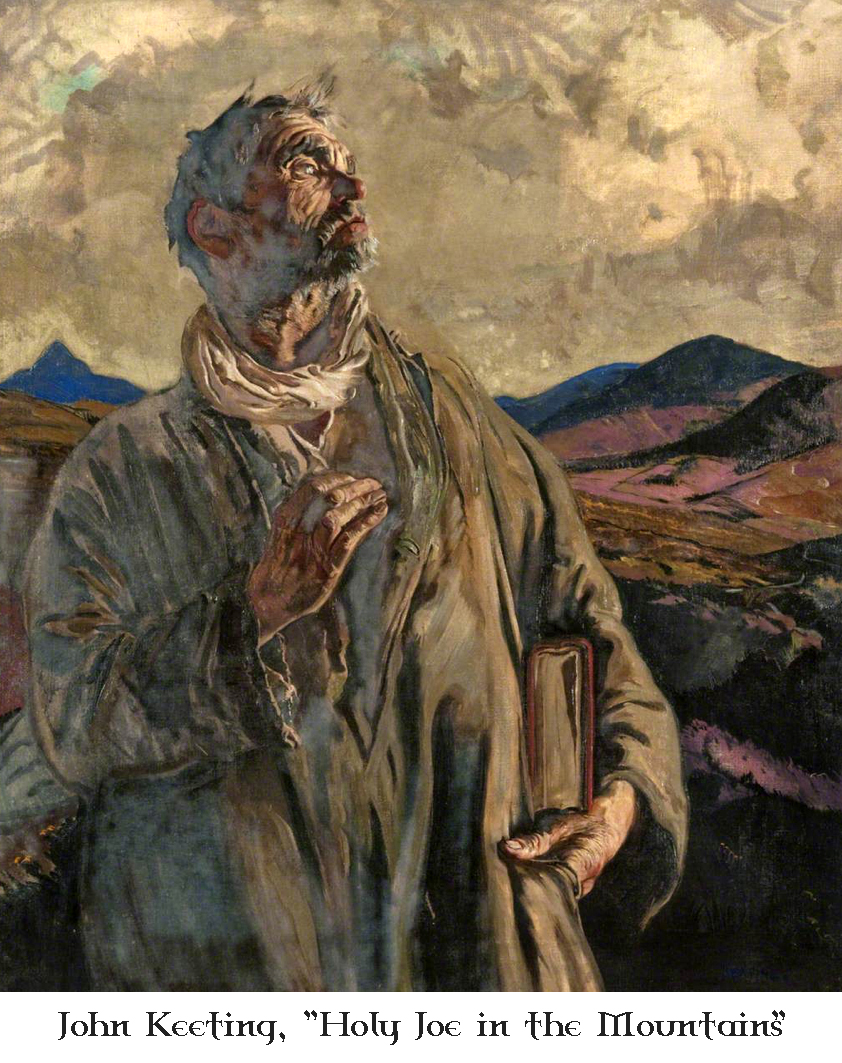
John Keeting is another strong factor in Irish painting and his “Holy Joe in the Mountains ” is a decidedly strong piece of work, curious and vigorous.
Among the other artists are Bridget O’Brien, J. Humbert Craig, Michael Whelan, Harry Kernoff, Sara Harrison, with a fine portrait of her brother, “Capt. Hy Harrison “; Letitia Hamilton, Michael Farrell, and George Atkinson.
Chicago Tribune, July 30, 1933
Wednesday Irish Day at Fair.
Wednesday will be Irish day at A Century of Progress Exposition. A program featuring the folk songs of Ireland will be rendered by the Society of Music and Drama of Chicago in the Hall of Science at 3 o’clock. D. F. Kelly, president of the Fair store, is chairman of the day. After the entertainment the visitors are requested to inspect the Irish exhibit in the Travel and Transport building.
Chicago Tribune, August 2, 1933
 The wearers of the green will take the center of the stage today when the Irish day program is presented at A Century of Progress. Irish music, speeches, parades, a survey of the Irish exhibit, and the Golden Gloves championship fights in the evening will be features of the Hibernians’ participation in the Fair.
Officials last night were completing preparations for the handling of large throngs of visitors, knowing the sons of Erin will flock to Chicago for the celebration.
The Irish program will center at the court of the Hall of Science, in the afternoon, where there will be a series of speeches and musical presentations. A chorus from the Society for Irish Music and Drama will open the ceremonies, after which there will be speeches by D. F. Kelly, Mayor Edward J. Kelly, D. J. McGrath, Irish Free State consul; Judge John P. McGoorty, and Tom Peet Cross, Irish scholar.
Parade to Golden Gloves.
Irish colleens will sing the songs of Erin. In the evening the Irish will parade to Soldiers’ Field for the Golden Gloves championship bouts, in which the champion fighters of Ireland will meet the ring champions of Chicagoland. The bouts are sponsored by The Chicago Tribune
Chicago Tribune, March 18, 1934
Tara Hall Will Be Feature of Irish Village.
The Irish village at A Century of Progress will turn back the pages of time a thousand or more years and show what Erin was like In days of old. According to Howard Doyle, president of a syndicate sponsoring this project, the center of interest will be Tara Hall, famous in poetry and song.
“After centuries of speculation as to what Tara hall might have been like, the Irish village now has full in. formation as to every detail of the structure,” said Mr. Doyle. “It will be a banquet hall, a place of assembly. as was the original structure, which a thousand years ago stood on Tara hill.
“The manners, the customs, the costumes and the language of that romantic era will be reproduced at the village. While the purpose of the Irish village is primarily recreational, it will, nevertheless, tell the true story of Ireland.”
The village will be enclosed by a Norman wall. Leaving Tara, the visitor can roam through Kerry, through Claddagh, past the leaning tower of Gort in Galway, through the old gate. way of Fore in Westmeath, past Long. ford and by the Shrine of St. Dolough, older than Dublin, and through a score of other reproductions that will take the visitor to nearly every section ot the Emerald isle.
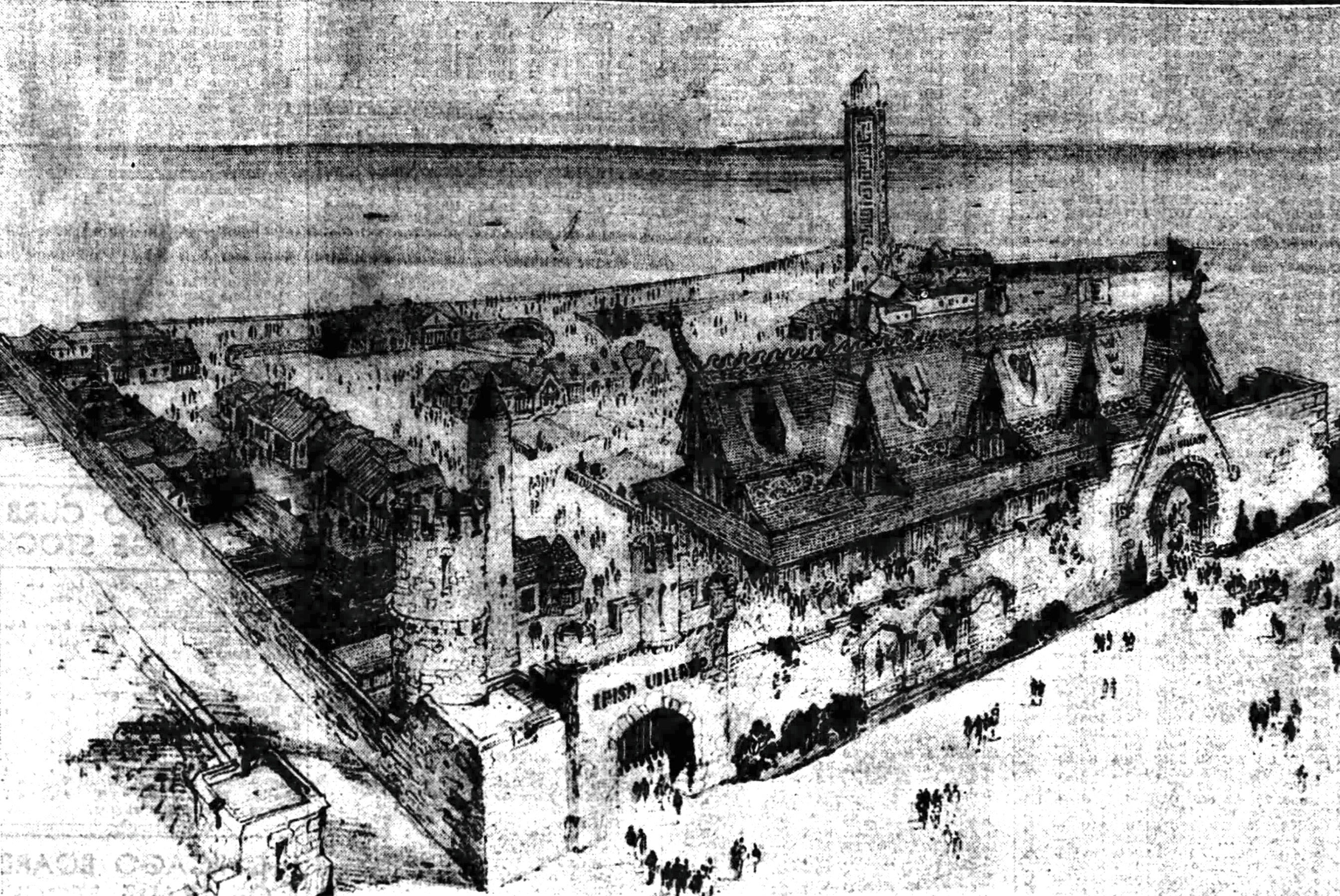
- This is the Irish village, to be erected on the east side of the old Midway, between the Midget village and Fort Dearborn. J. J. Murphy and W. I. Hooper are the architects. S. Chester Danforth made this sketch. Ground was broken yesterday and work will be rushed with the intention of getting it completed a few days before the World’s Fair opens A Chicago syndicate sponsoring the project is composed of Paul R. Simon, Edward I. Gerard, Howard Doyle, Georye G. Noonan and William E. Ray.
Irish Village Souvenir Brochure, 1934
The Irish Village—Concentration Point of All Irish Activities
The announcement that a Century of Progress would be reenacted in 1934 brought forth a barrage of publicity in the Press of the country heralding the assurance of an assorted group of old world Villages to add color and glory to the great American Spectacle on Chicago’s waterfront of 1934.
The virtues of these respective Villages were profusely sprayed across the front pages of the Press with characteristic old world charm.
Then the Irish people spoke up in characteristic Irish fashion. What about an Irish Village to represent the Irish people, they said. The suggestion had merit they thought. Then overnight, like the spread of a forest fire, the idea swept across the continent. From the sidewalks o f New York to the highest ecclesiastical dignitaries of the nation: from the farms and factories: from the editorial rooms of the greatest newspapers of the country: from the Irish societies and Irish organizations; from distinguished men and women of the Irish race everywhere—they spoke in a common voice for a common cause. The racial pride and patriotic impulses of the Irish people had been aroused.
The idea found an immediate and magnificent response in the patriotic and intelligent leadership of a group of noble, distinguished Sons of Erin who assumed the financial responsibility of giving their race a fitting memorial—The Irish Village at the Century of Progress, Chicago, 1934—a true, accurate and lifelike reproduction and deft blending of Old Ireland and the new, modern Ireland. Here in the Irish Village antiquity rises from its sepulchre of a thousand years and kisses warmly the flush roseblown lips of the new, youthful, buoyant Ireland. A never to be forgotten scene that will quicken your pulse with an amazing measure of Irish pride. Truly a magnificent picture o f incomparable beauty devoted to the glorification of a colorful race.
THE IRISH VILLAGE
A trip through the Irish Village will reveal innumerable exhibits and replicas of historic landmarks of the Emerald Isle.
The Village will be enclosed by a Norman Wall. Leaving Tara Hall, the visitor may roam through Kerry, Claddagh, past the leaning tower of Gort in Galway: through the old gateway of Fore in Westmeath; past Longford and by the Shrine of St. Doulough. Landscaping effects will recall to mind the Lakes of Killarney, the Giants Causeway and many scenic beauties of world renown. Not the least of the exhibits of appealing interest are the Blarney Stone, St. Patrick’s Chair, Robert Emmett Memorial and the Bride’s Well. A replica of the world renowned St. Patrick’s Bell and Shrine.
Ireland depicted in a resplendent, lovely setting not to be outrivaled by any attraction of the 1934 Fair.
Irish music and folksongs will bring back to memory the romantic era of Old Erin. Irish culture and Irish industry; the arts and sciences; last but not least, the proverbial rich humor and cunning amusements of the Irish people.
Visit the Irish Village—the concentration point of all Irish activities at A Century of Progress, Chicago, 1934.
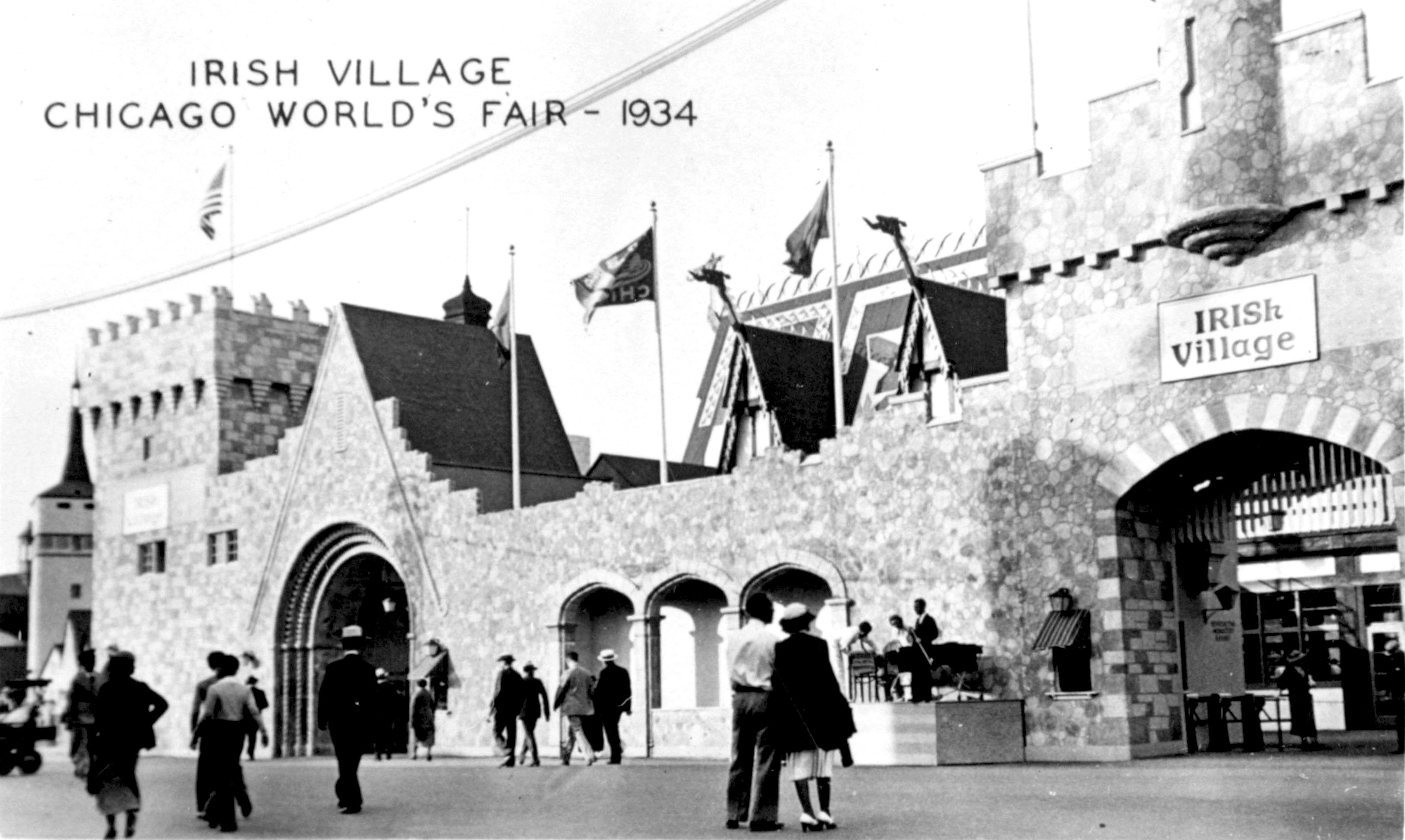
Chicago Tribune, August 15, 1934
IRISH TAKE OVER THE FAIR TODAY; EXPECT 100,000
Program Includes Music, Pageantry, Speeches.
By Earl Mullin.
There will be wearing of the green and singing of the glories of the “Old Sod” today when the sons and daughters of Erin assemble on the lake front to celebrate Irish day at the Fair. The Irish will take over the Exposition for the day, and they promise a larger turnout than that of any national group at this year’s Fair.
The program as completed yesterday is a transplanted part of Ireland, and is replete with speeches, music, jigs, reels, and ballads. Miss Margaret Me-Cormick, 19 years old, 613 North Trumbull avenue. was chosen last night at the Irish Village as Miss Shamrock I., and will act as queen for the day.
100,000 Attendance Expected.
“With the Irish-American population of Chicago estimated at close to a million there is no reason why we should not reach the goal of one hundred thousand attendance we have set,” said James C. Denvir, secretary of the committee.
Members of twenty-four Irish, Catholic, and labor organizations are taking part in the day’s events. The program will start with a ceremony honoring three Irish heroes who took part in the defense of Fort Dearborn at the time of the massacre in 1812. They were Ensign Ronan and Sergts. Hayes and Caldwell. A short commemorative program will be held at the Michigan avenue bridge at noon, followed hy a parade to 18th street and Michigan avenur, scene of the massacre. More than a ton of flowers will be distributed on the way.
Following the parade. Robert M. Switzer, county clerk, will make an address at the Illinois Host house. Another ceremony will be held at Fort Dearborn on the Fair grounds before a luncheon in Tara hall at the Irish Village.
Speakers on Formal Program.
The forma! pregram will be held from 3 p.m. until evening in the Court of States. Quin O’Brien of the corporation counsel’s office will make the principal address, which will be carried over radio station W-G-N.
Other speakers will include Rufus C. Dawes, president of the Fair; Daniel J. McGrath. Irish consul general: Mayor Kelly. Rei. Ambrose M. Griffin, and Albert J. Horan. The Rev. B. J. Shiel auxiliary bishop of the archdiocese of Chicago, will deliver the invocation.
A program of music, dances, and songs, participated in by a score of theatrical stars and radio performers will entertain visitors during the celebration in the Court of States.
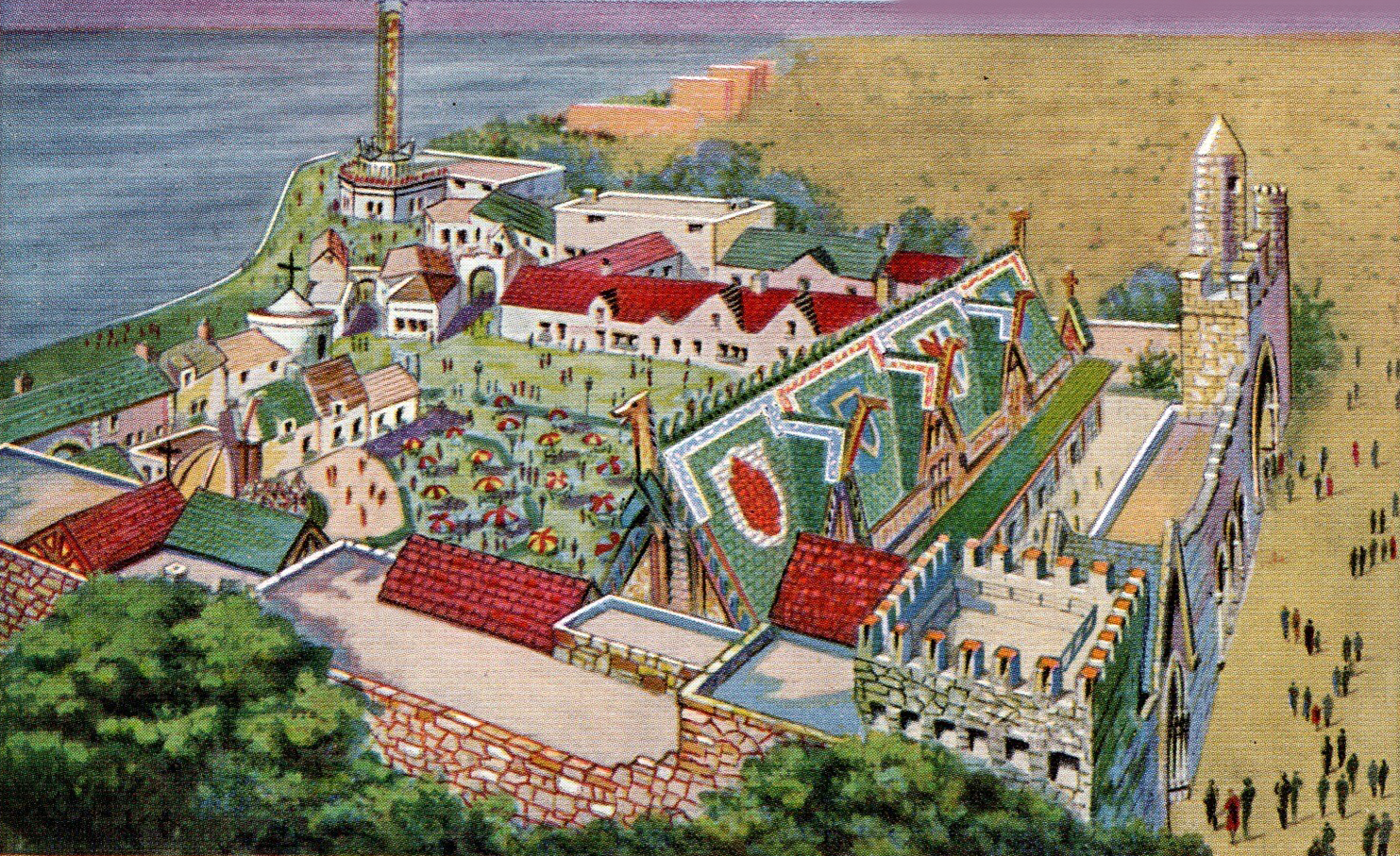
- Typifying the life and natural activity of all the 14 counties of Ireland, the Irish Village, composed of sixty buildings, is a high spot of interest at the Fair. Exhibits of Irish arts and crafts and imported Irish entertainers are featured.
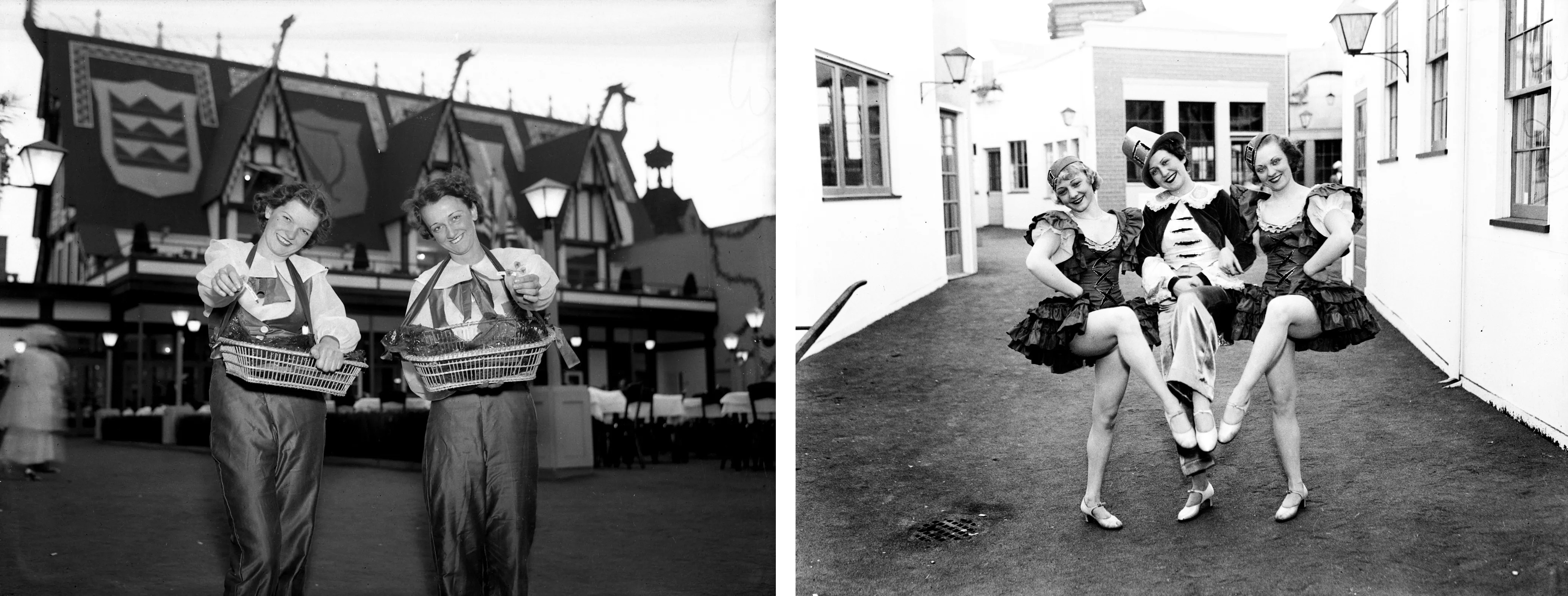
- LEFT: Louis O’Doherty and Julia Duzeski in the Irish Village at the World’s Fair in 1934 in Chicago.
RIGHT: Shirley Himmen, from left, Dorothy Lysaght and Virginia Dale are Irish “Colleens” in the Irish Village at the Century of Progress World’s Fair in Chicago in 1934.

Leave a Reply