Michigan Square Building, Time-Life Building
Life Span: 1930-1973
Location: 540 N. Michigan
Architect: Holabird & Roche
Chicago Tribune, January 12, 1930
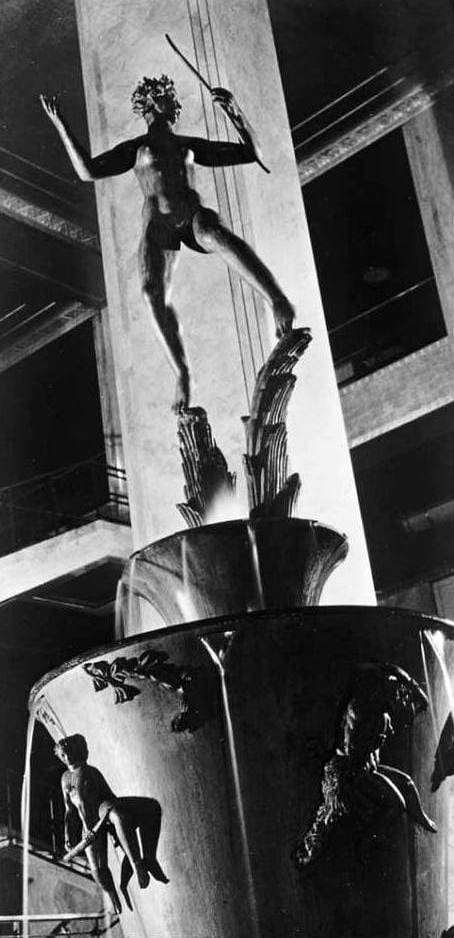
MILLES STATUE FOR MICHIGAN SQUARE BUILDING
An interesting example of contemporary design and ornamentation is to be found in Diana court—the large lobby of the Michigan Square building which was opened recently—with the annual Twelfth Night ball. Huge pillars are placed about a central court in which is to stand a fountain, with a statue of Diana the piece de resistance. Carl Milles, noted Swedish sculptor, is to do the statue.
Native marble, delicate iron work painted in magenta red and an extensive use of glass are used freely in the ornamentation the lobby about which levels of shops center. Among the leases closed for space in the building are the following: The O’Neill Linen Damask Shop, the Walden Book shop and Molly Kelly for ground floor space on Michigan avenue; Charles Moshos, tailor; A. Primack, haberdasher; Sage & Frank, cigars, and P. S. Diogenes, restaurant, cigars, for stores on Rush street, and with John B. Baumgarth, wholesale calenders; Conner & O’Connor, architects; the Western Railroad association, and B. Weiss for offices.
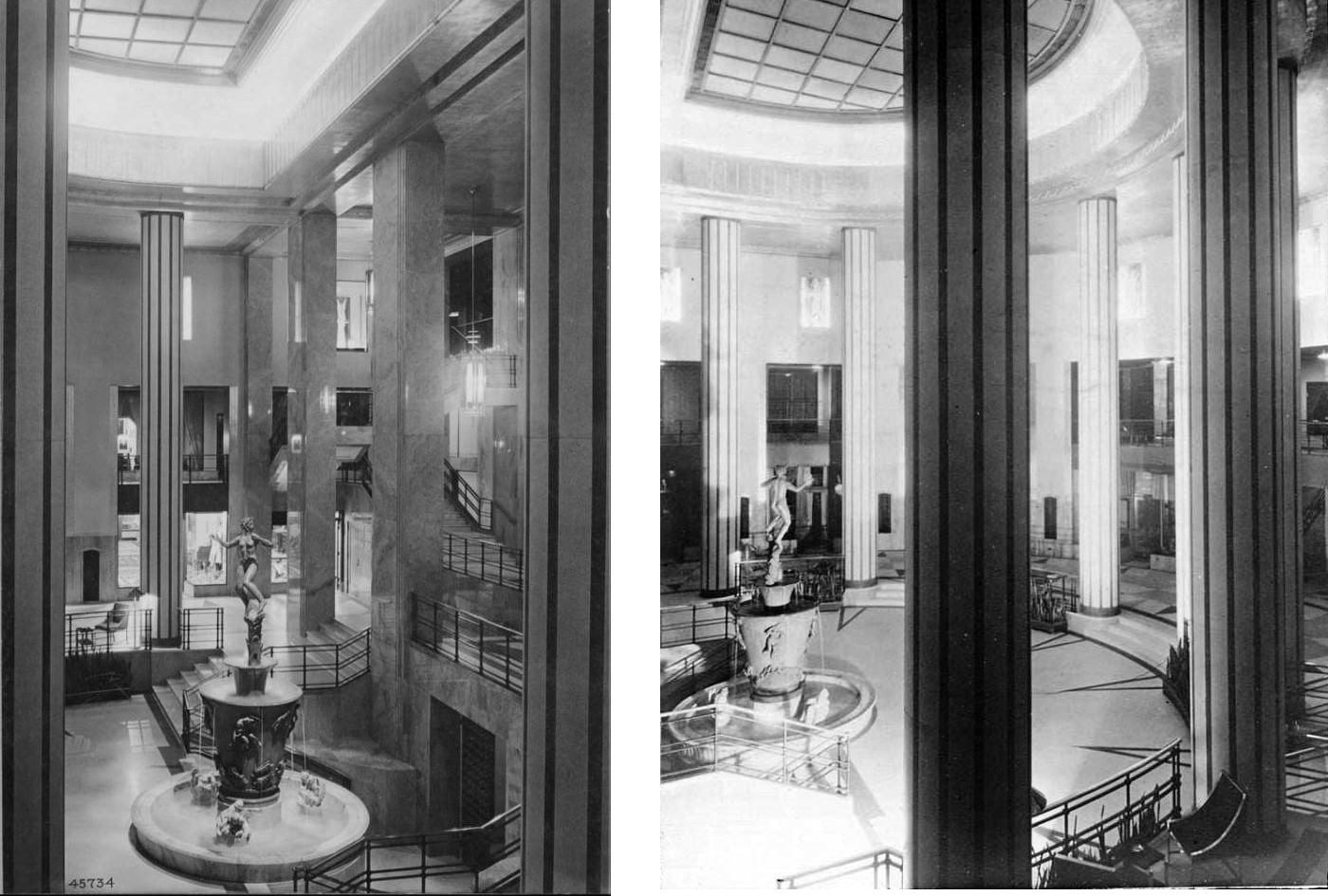
- Diana Court.
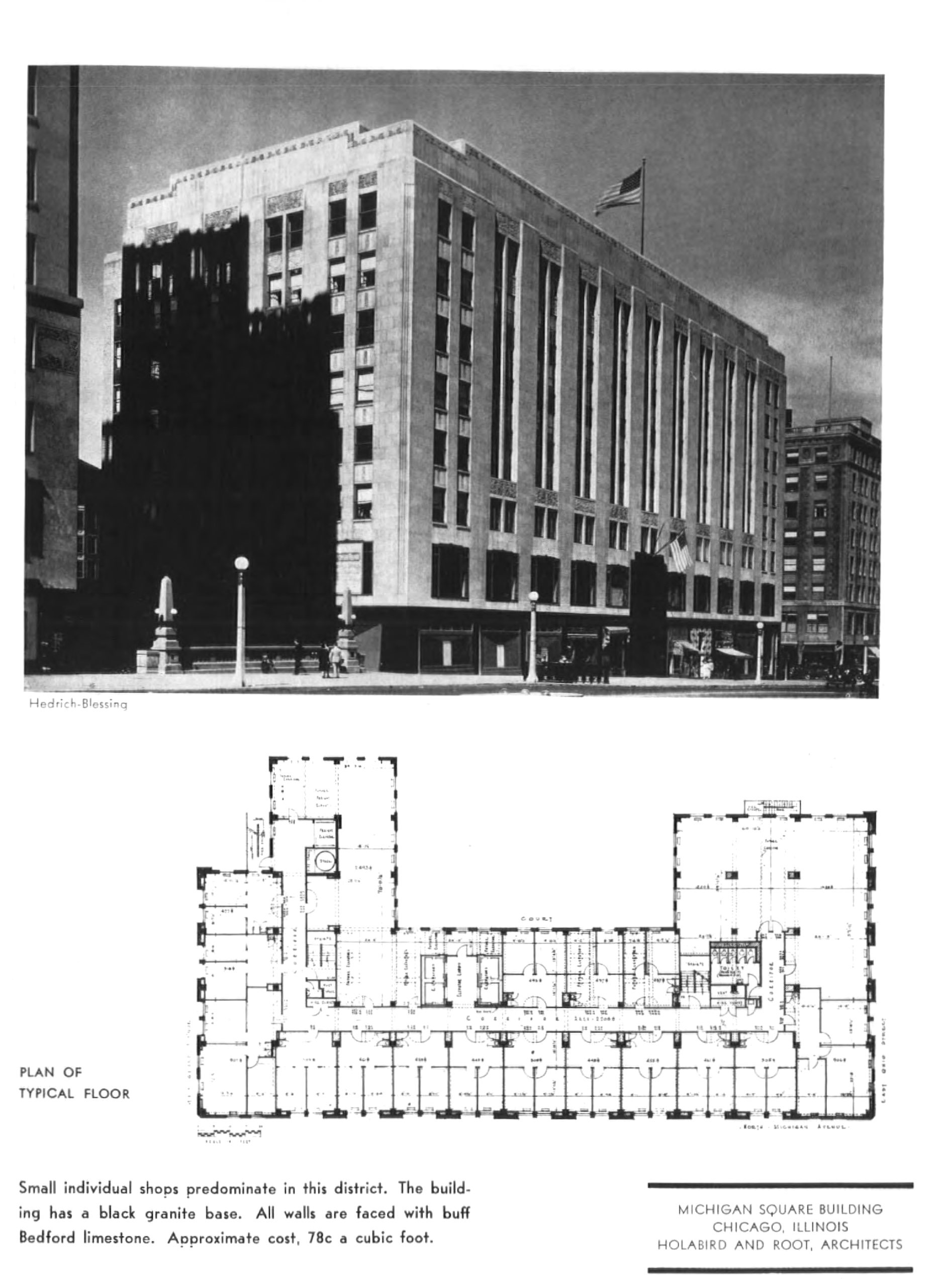
Architectural Record, October, 1931
Chicago Tribune, January 31, 1945
MICHIGAN SQ. BUILDING SOLD TO TIME, INC.
By Al Chase.
Time, Inc., publisher of Time, Life, Fortune, and the Architectural Forum, has purchased for 2¼ million dollars the Michigan Square building, 540 N. Michigan av., D. W. Brumbaugh, Time secretary and controller, announced last night.
Northwestern Mutual Life Insurance company, Milwaukee, was the seller. Time paid half a million in cash and gave a mortgage for 1¾ million.
Brumbaugh said Time is crowded in its quarters at 330 E. 22d st. and expects to move part of its subscription department to the Michigan Square building, one of the most luxurious shop and office buildings in the country. No decision has been made in relation to new leases with tenants, he said.
Notified to Move May 1.
Most tenants were notified they must move by May 1 under a lease clause which provided that if they were notified before Jan. 30 of any year the lease could be canceled the following May 1. A few Michigan av. shops whose leases run several years did not receive notices.
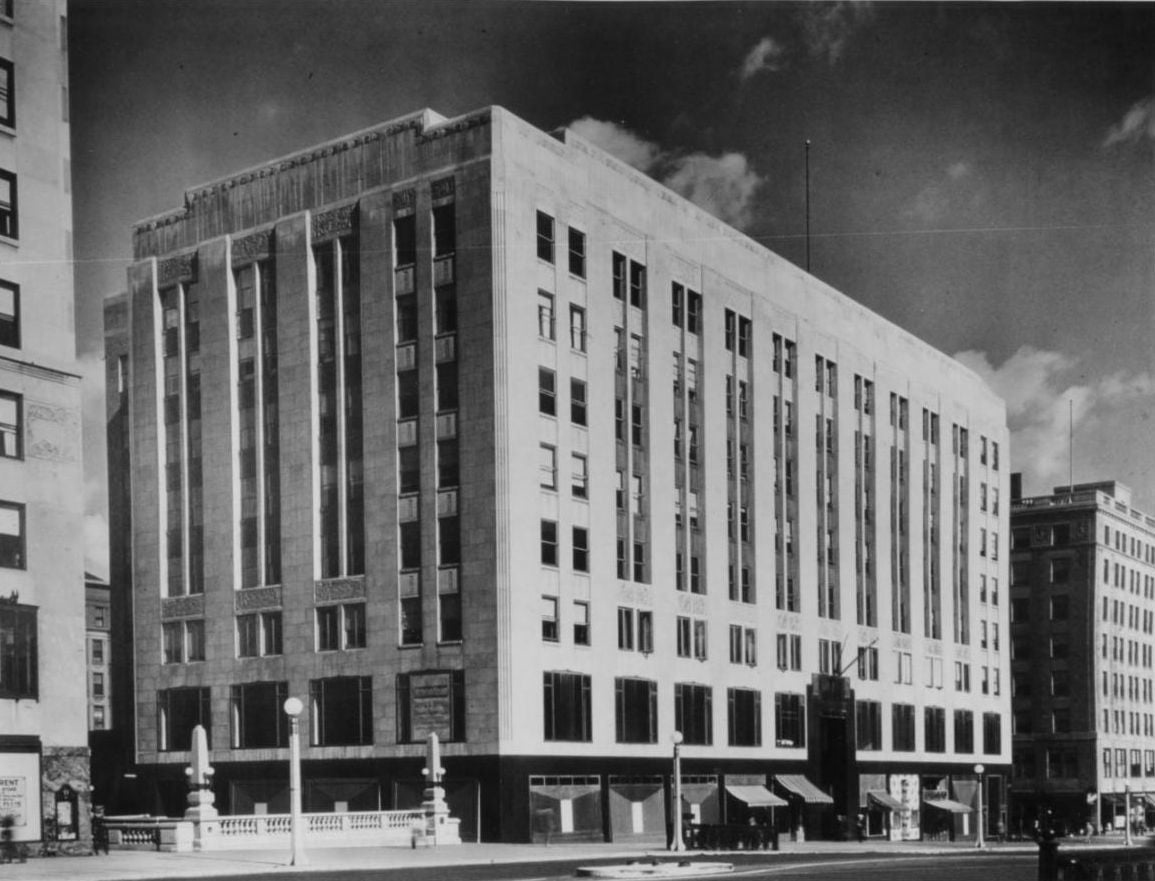
Brumbaugh said Arthur Rubloff & Co. was sole broker. Rubloff represented Webb & Knapp, New York realty firm thru which Time negotiated its occupancy of the Time and Life building in Rockefeller Center, New York. Built in 1930 by Murray Wolbach and associates from plans by Holabird & Root at a reported cost of $2,800,000, the Michigan Square building occupies land appraised at that time by Northwestern Mutual at 4 million dollars. The Michigan av. section, fronting 218 feet, is 10 stories high. The Rush st. section is only one story high and has a foundation for 15 more stories.
Location of Property.
The property occupies the block bounded by Michigan av., Ohio st. and Grand av., except the northeast corner of Rush and Grand, occupied building, by the four story Corona cafe building, 26 by 125 ft., which was also included in the sale.
The building occupies 50,000 square feet and contains about 200,000 square feet of floor space. Exterior walls are of Bedford stone. The main floor lobby, called Diana ct., contains shops and a restaurant, all of which have been notified to move.
Chicago Tribune, March 4, 1973
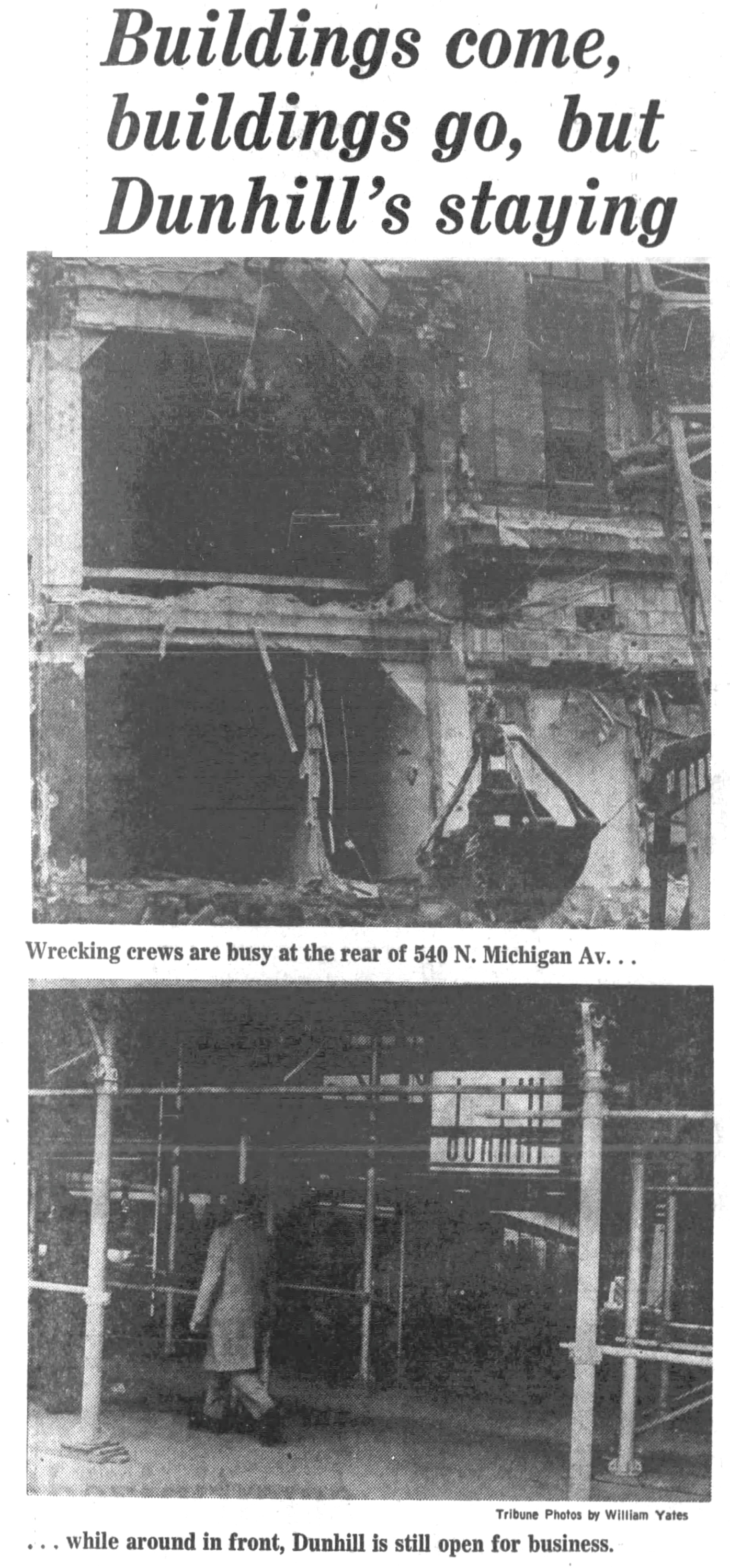 By Alvin Nagelberg Real Estate Editor
It seems to Harvey Goldberg that his company has wrecked most of Chicago, but there never was anything quite like the job at 540 N. Michigan Av.
Goldberg is vice president of Harvey Wrecking Co. which has been knocking down buildings for 51 years. His latest job is to wreck the eight-story building formerly owned by Time, Inc., without disturbing Dunhill of London, Inc., the tobacco and gift store that is the remaining tenant on the first floor.
“It’s not commonly done,” Goldberg said, understating the case a bit. “I hope no other job becomes as involved as this.”
Dunhill has a lease to occupy the space until 1978. The owners of the property, an investment group headed by R. J. Adelman, chairman of Arthur Rubloff & Co., would like to redevelop the site. They have asked Dunhill to leave and Dunhill has refused. And that’s all Rubloff officials can do.
Presumably, they have offered Dunhill a financial inducement to leave. Obviously, Dunhill has refused. Rubloff officials say they would like Dunhill to be a tenant of the new building. But it would be cheaper and easier if Dunhill were not operating a store in the building while the wrecking and rebuilding goes on.
Since Dunhill is in the building, special water and electrical lines had to be connected to the store. A small boiler had to be installed in an adjoining space to heat the Dunhill store and storage area when the main boilers in the building are turned off.
A special roof will be installed over the Dunhill store to keep it dry. The plan is to chop down the building to the second floor and then build a hotel over it and Dunhill.
Goldberg said that soon after the wrecking of the two-story section on the Rush Street side of the building has been completed, a 175-ton crane with a 200-foot boom will be moved to the site. The crane will be used to haul the steel columns and beams out of the eight-story building when they are out free.
A crew of about 20 men will dismantle the building starting at the top and going down floor by floor to the Dunhill store. Cables will hold the huge limestone blocks in the facade while they are loosened by the men. The blocks will be shouldered inside the building and lowered down the Rush Street side.
“We wrecked the Morrison Hotel from the top down and had to be careful because of the Loop traffic,” Goldberg said. “But the tenants on the first floor only stayed a couple of months after the wrecking started.” As far as he knows, Dunhill won’t go.
“We’re not overly happy, but we understand. It is one of the problems of the wrecking business,” Goldberg said. He acknowledged that it is a costly wrecking job, but wouldn’t disclose the cost. “Any wrecking job of this size is costly, especially in a congested area. Add to that the unusual fact that you have to wreck around a tenant. Let’s say it would cost much less to just take down the whole building.”
He hopes to have the job done by mid-May. Meanwhile, there is no further word from Rubloff officials about plans to build a new hotel on the site.
Negotiations are under way with officials of Sheraton Corporation of America to operate a 1,000-room hotel.
Suozzi said there has not been a drastic change in business.
“But we have lost a lot of business from the browser,” he said. “They see the scaffolding and think we are closed. We’re going to have some signs made to indicate we’re still open.” Suozzi wouldn’t estimate how much business has been lost.
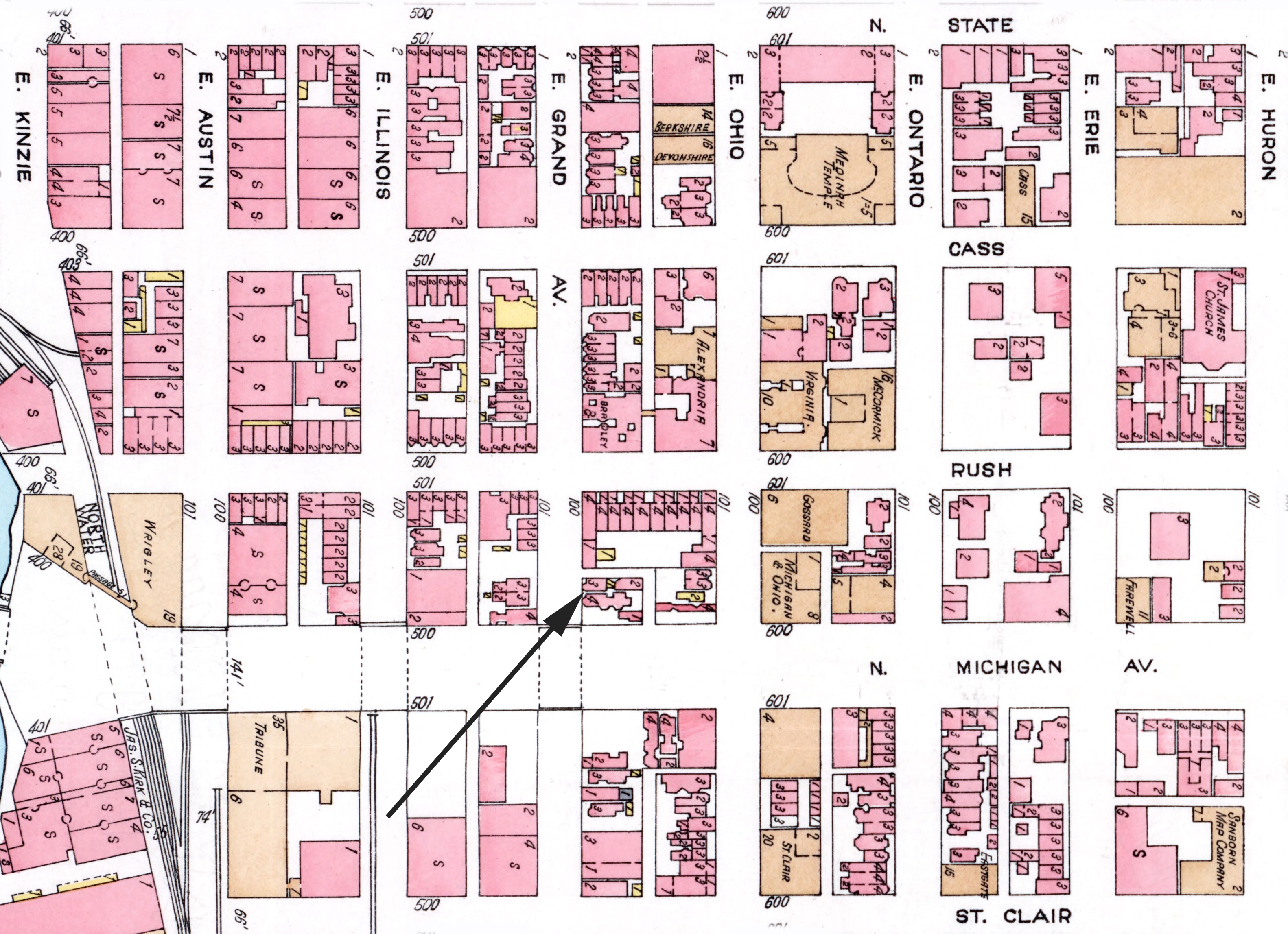
- Lot of Michigan Square Building
Sanborn Fore Insurance Map
1927

Leave a Reply