Vaudeville Theaters of Chicago
Illinois Theater, The Vic
Life Span: 1900-1936
Location: Jackson between Wabash and Michigan
Architect: Wilson & Marshall
- Lakeside Business Directory of the City of Chicago, 1907
Illinois Theatre 20 Jackson boul
Inter Ocean, January 16, 1900
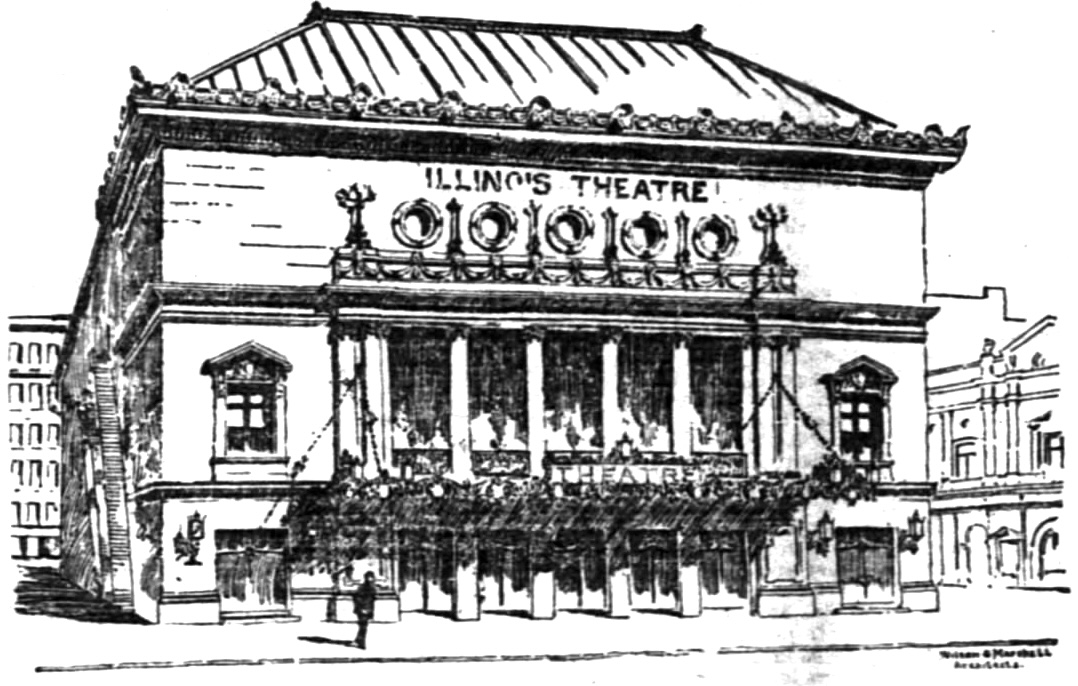
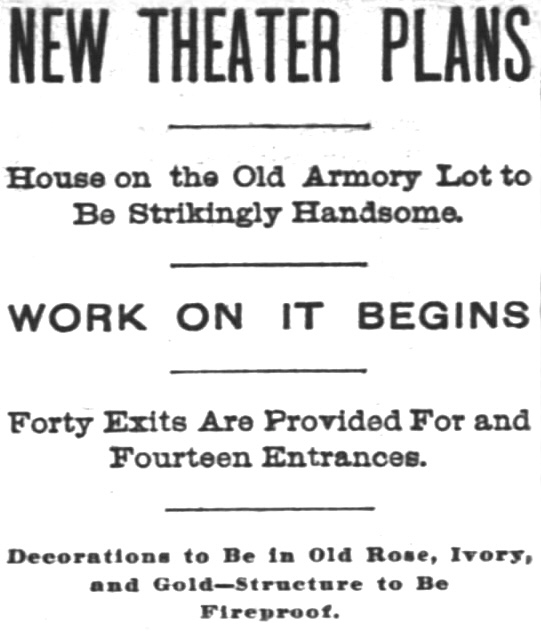 The designs for the new Illinois theater, which is to be constructed on the old armory lot on Jackson boulevard, have been accepted and the construction of the theater has been commenced by Wilson & Marshall, architects. The building will cost, when completed, $250,000. It is expected that it will be ready for opening by the first of next October, when Miss Julia Marlowe will inaugurate its career in Clyde Fitch’s play, “Barbara Frietche.”
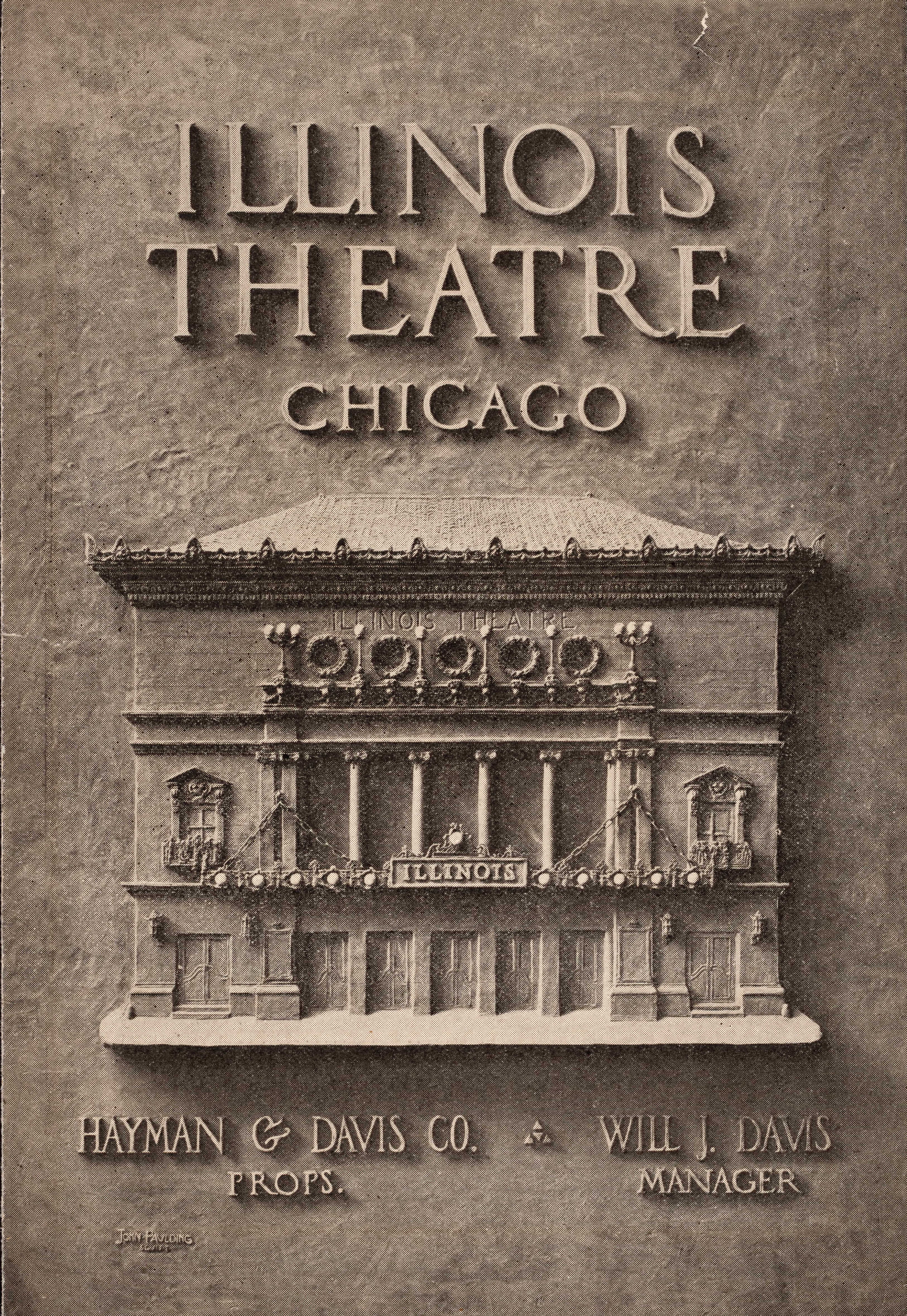
The new theater will be owned by Will J. Davis and Harry J. Powers of Chicago and Charles Frohman, Al Hayman, and Klaw & Erlanger of New York city. The building will be devoted exclusively to theatrical purposes and will be constructed entirely or stone, the first story to be of polished granite. The exterior is designed in the classic style, while in the matter of the interior draperies, carpets, and furnishings, a special design furnished by the architects will be adopted.
Will Be Fireproof.
The theater will be entirely fireproof and as it will be isolated, forty exits will be possible, with an open space around the walls, giving free passage from each exit to the street. The exit plans are further assisted by the fact that there will be only four seats in each row to every aisle and the aisles will be fifty per cent wider than the building ordinances require.
Much attention has been given to the entrances to the theater, which will be spacious. There are to be fourteen doors, giving an open space of at least thirty feet for passage to the theater proper. The entrance lobby will be 36×40 feet in area, with walls of white Carrara marble, and decorations inlaid with turquoise-blue mosaic. The ceiling of the lobby will extend up through two stories and will be thirty-five feet high. The balcony level will be reached from this lobby by the means of a marble staircase, having bronze rails, lamps, and statuary. The box offices will be located under the staircase off the main lobby. The foyer of the theater will be entered directly from the front lobby and will be twelve feet wide and seventy feet in length, bounded with a colonnade and decorated with a groined celling. The entrance to the auditorium will be reached through this foyer.
Plan of the Decorations.
The decorations of the interior of the entire building will be in the Louis XIV. period. The general tone of the decorations will be it old rose, ivory, and gold, with gilded and burnished woodwork. The proscenium arch will be decorated with ornamentation in-laid with mother of pearl. There will be four boxes on the auditorium floor which will be given the names of Lincoln, Douglas, Grant, and Logan, and be ornamented with bas-reliefs of these historic sons of Illinois. In the light and illumination of the auditorium the lamps will be so arranged that the direct rays will be thrown toward the stage. avoiding thereby the objection of a direct light in the eyes of an auditor, from any point in the theater.
At the right of the foyer parlors are to be provided for the convenience of ladies going to the theater unattended, and from these parlors there will be private exits to Jacksor boulevard, In such a manner that the streets may be reached without the necessity of mingling with the crowd that passes out of the main entrance. These parlors will be provided with check rooms for wraps, toilet rooms and other modern conveniences.
Smoking-Room Arrangement.
On the opposite side of the main foyer a gentleman’s smoking-room will be provided, finished in early Dutch style. The main balcony will be nearer the stage than that of any other theater in Chicago, and the staircases leading from this balcony are to be arranged so that the occupants can pass directly to the main lobby, thus lessening the crowd and equally distributing retiring patrons throughout the vestibule.
The gallery will have a separate staircase direct to the street. This division of the theater will also be equipped with a’ladies’ parlor and a gentleman’s smoking-room. On the gallery floor, and in front of it, there will be a music-room, or hall, which will be finished and decorated in the same manner as the auditorium proper.
Chicago Tribune, September 23, 1900
Illinois Theatre.
It has been decided to auction the boxes and seats for the opening performance at the new Illinois Theater. The auction will be held at Powers’ Theater on Tuesday aft-ernoon, Oct. 9, that day being selected because it is a holiday, with business generally suspended. Joseph Jefferson, who follows the Empire Theater company, will then be playing an engagement at Powers’, and it is the intention of Manager Will J. Davis to ask him to preside at the sale and to sell the first box, if not to conduct personally the entire auction. The auction method seemed the only feasible way of disposing of the seats. For six months mail orders have been pouring in on the management, but it did not appear that distribution on that basis would have much justice in it, while a regular box-office sale seemed equally out of the question.
The opening date of the Illinois remains at Oct. 15, and there is no prospect of post-ponement. Manager Davis even makes the statement that the house could be opened a week earlier. He says, however, that he wants no finishing touches put on after the house opens, and rather than take the smallest chance he would sooner have it idle a week. Miss Julia Marlowe will play ” Barbara Frietchie ” at the theater for five weeks after its opening, being succeeded after that time by Miss Anna Held in ” Papa’s Wife.”
Chicago Tribune, October 16, 1900
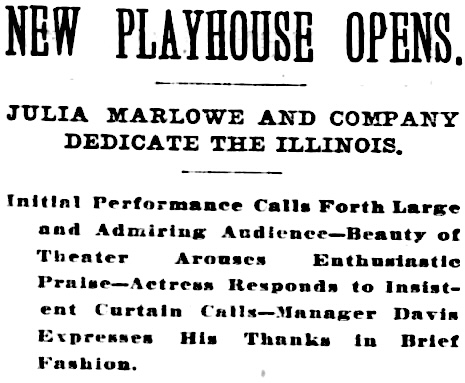 An audience which paid $9,000 for the privilege of being in an adulatory mood dedicated the Illinois Theater last night. Julia MarLowe aided in the rite by unfolding before the audience the picturesque and touching story of that Barbara Frietchte to whom Clyde Fitch gave dramatic existence. The actress and
the play, however, were incidents to the house—warming celebration, though both received liberal applause. For once the theater was the thing above the play performed under its roof. And the excuse was ample.
A theater like the Illinois is not opened once a year or once in a decade. No playhouse its equal ever has been opened in Chicago, and the entire country contains few of its peers. Miss Marlowe, whose honor it was to give honor to the house, has asserted that it is the finest theater in the land. She might not be an unprejudiced person, but there are many others who hold opinions which differ little. In every mind the preeminent merit of the theater is that it is a theater and nothing else. The sentiment was passed from mouth to mouth last night by those who promenaded between acts up and down the brilliantly lighted foyer. But it was heard most often at the entrance, where the carriages emptied their repeated loads. Inside there were other beauties to attract, but without the building itself did not have the rivalry of its contents. Chicago, indeed, can pride itself on having set an example which other American cities may follow. Its acceptance will make the theater the home of an art and not the odd space of an office building.
Praise was not lavished alone on the exterior. It found occupation in doing justice to the handsome foyer and beautiful audi-torium. White and gold and crimson were the colors which blended into the attractive scheme of decoration. Yet they hardly blended, for the white and gold did not leave the circle of the boxes and the line of the first gallery. Everywhere else the crimson ruled, from carpets to chairs, and from walls to celling. The red velvet drop curtain harmonized with the color arrangement, but scarcely as much could be said for the painted asbestos curtain, which was hurriedly raised when it was seen to be somewhat in conflict with Its surroundings.
Calls for Miss Marlowe.
The audience gave hearty curtain calls at the end of the first and second acts, but its determined efforts were reserved for the fall of the curtain after the third act. Miss Marlowe was bid forth, and when she only smiled, bowed, and retired she was summoned with renewed energy. After the lapse of several minutes, during which the hand-clapping was uninterrupted. the curtain was lifted again and she stood forth.
“I thank you,” she said; “I thank you deeply, and can assure you that I and my company feel more grateful than we can express for the honor of giving the first performance in your beautiful theater.”
Manager Davis Responds.
With a smile she ended. but the applause did not subside. There were calls for “Davis,” “Davis.” Manager Will J. Davis at length rose from the box he occupied but the criers in the gallery could not see him, and the noise did not subside. “Go on the stage.” some one shouted, and in obedience ton the direction he stepped from the railing of the box to the stage.
“For myself,” he said. “and the gentlemen associated with us here, I want to thank this audience. And particularly because this is more than a representative audience. I can feel that this audience knows what I want to say, but I cannot say it. I can assure you of this, however, we are grateful to you for this magnificent ovation. We have banked on you and you are good.”
The architect, Benjamin Marshall, was called for, and Mr. Davis almost dragged him from the box to the stage.
“I want to introduce to you,” said the manager, “the young man who has been with us from the start to his magnificent finish.”
Mr. Marshall did not want to say anything for himself, but he was able to blurt out, “I thank you very much.” Then he hurried to his box.
Chicago Tribune, March 11, 1936
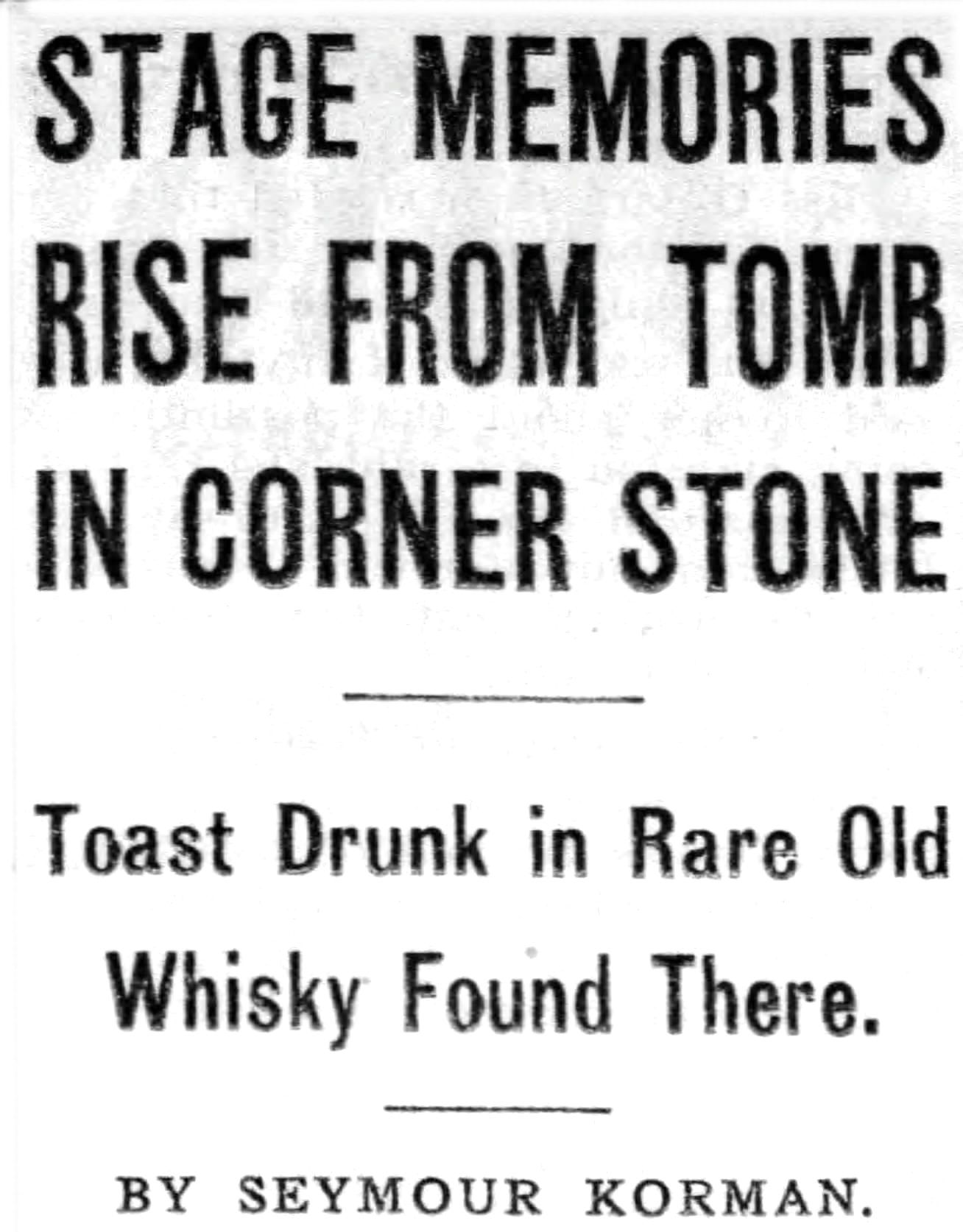
Memories of the theater in Chicago a generation ago were revived yesterday when a box containing papers, photographs, and other mementoes [including a bottle of whisky], was opened in the Union League club after it was taken from the corner stone of the old Illinois theater. The box was placed in the corner stone when it was laid May 22, 1900, and was removed early yesterday by workmen who are wrecking the old theater, which stood on Jackson boulevard near Michigan boulevard.
The box, made of lead, was a foot deep and about 14 inches square. The lead had corroded with the years but most of the contents of the box were intact. It had been placed in the corner stone by the late Will J. Davis Sr., who was the manager and one of the builders of the Illinois theater.
Builder’s Son at Ceremonies.
Among those present yesterday when the box was opened were Mr. Davis’ son, Will J. Davis Jr.; Harry |J. Powers, who was associated with the elder Davis in the operation of the theater, and Benjamin H. Marshall, the architect, who designed the building.
The box was opened in the “mil-lion dollar room” of the club, so called because the walls are papered with hundreds of stock and bond certificates, now worthless. The pre-depression opulence which the certificates represented was in a way symbolic of the vanished glories of the theater which were vividly recalled in the contents of the box.
Mr. Marshall broke open the box with a hammer and chisel and Mr. Davis peered anxiously inside.
“My father told me,” he said, “that there would be something here particularly for me. I don’t know just what it would be.”
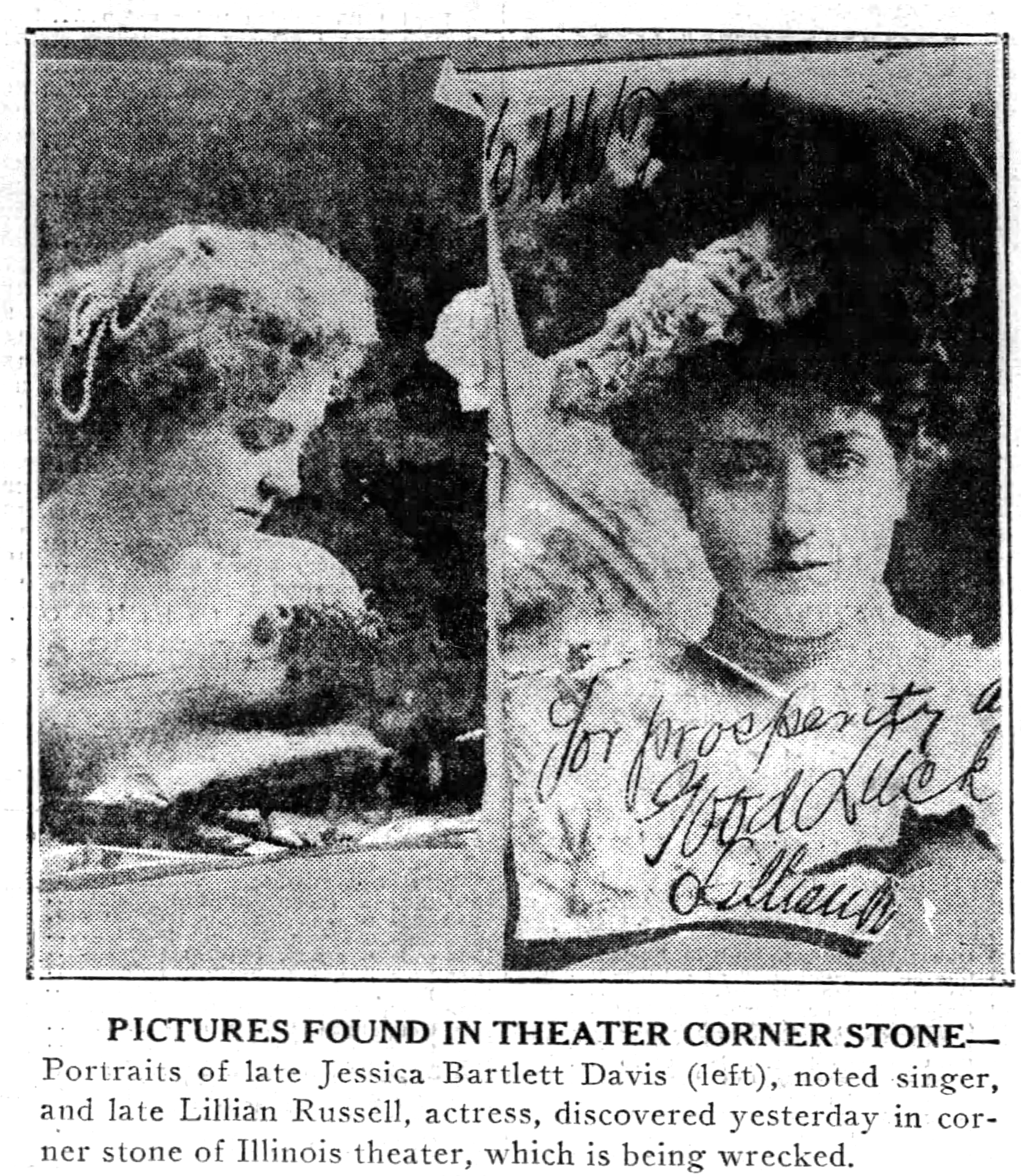
Some of the papers in the box had disintegrated and Mr. Davis could find nothing specifically addressed to him. There was, however, a picture of his mother, the former Jessie Bartlett, who died in 1905. She was one of the great American contraltos of her day and sang with “The Bostonians,” a famous light opera company oi the time.
Beneath the photograph of Jessie Bartlett was one of Lillian Russell, the noted beauty and foremost comedienne of the fin de siècle. Below the picture Miss Russell had written: “To Will Davis: Prosperity and Good Luck.”
There was a photograph, too, of Julia Marlowe, the great Shakespearian actress. The opening bill of the Illinois theater, on Oct. 15, 1900, presented Miss Marlowe in “Barbara Frietchie.”
Memories Throng Back.
As Mr. Davis and Mr. Powers fingered reverently all this lore of the theater, memories thronged back upon them. They spoke reminiscent-ly of the plays and the actors and actresses that moved across the Illinois theater stage. They remembered Sarah Bernhardt in her last appearance in a Chicago legitimate theater: they remembered Julia Marlowe and her husband.
The first night of “Ben Hur,” the dramatization of Lew Wallace’s novel, came back to the two men. They talked of Sir Herbert Tree, of Maude Adams, of Ada Rehan, of Otis Skinner, of M. Coquelin, the great French actor. They remembered, too, the first of the Ziegfeld “Follles.”
There were Chicago newspapers of May 21, 1900, in the box. The Tribune of that date told of the progress of the Boer war. There were old theater tickets and old coins. And in the bottom of the box, propped between two bricks, was a half pint bottle of bourbon whisky-the “Wellington 1888” brand. Mr. Davis, Mr. Powers, and Mr. Marshall took sips and ladled out spoonfuls to eager newspapermen.
“I can’t understand this, though,” Mr. Davis said. “I never thought my father would put anything less than a quart of liquor in the box.”
He gave a toast. “If the governor were here today—we always called my father the governor—he would say what I am saying: ‘Here’s to Chicago! God bless her!'”
Theater Built by Syndicate.
The Illinois theater was built by a syndicate headed by Will J. Davis and Al Hayman. Charles Frohman, the theatrical firm of Klaw & Erlanger, and also Mr. Powers were associated with the Hayman & Davis company, which acted as proprietors of the theater.
James O’Donnell Bennett, now a member of The Tribune staff, was business manager for Miss Marlowe when she opened at the Illinois theater.
The elder Davis and his syndicate built the Iroquois theater in 1903. On Dec. 30 of that year the theater was destroyed by fire with a huge toll of life. Mr. Davis, as one of the managers, was indicted with others on a charge of being a party to opening the theater before it had installed complete safety appliances. He was acquitted. Mr. Davis died in 1919.
Will J. Davis Jr., who succeeded his father as manager of the Illinois, lives on the old Davis homestead, Willowdale farm. Crown Point, Ind.
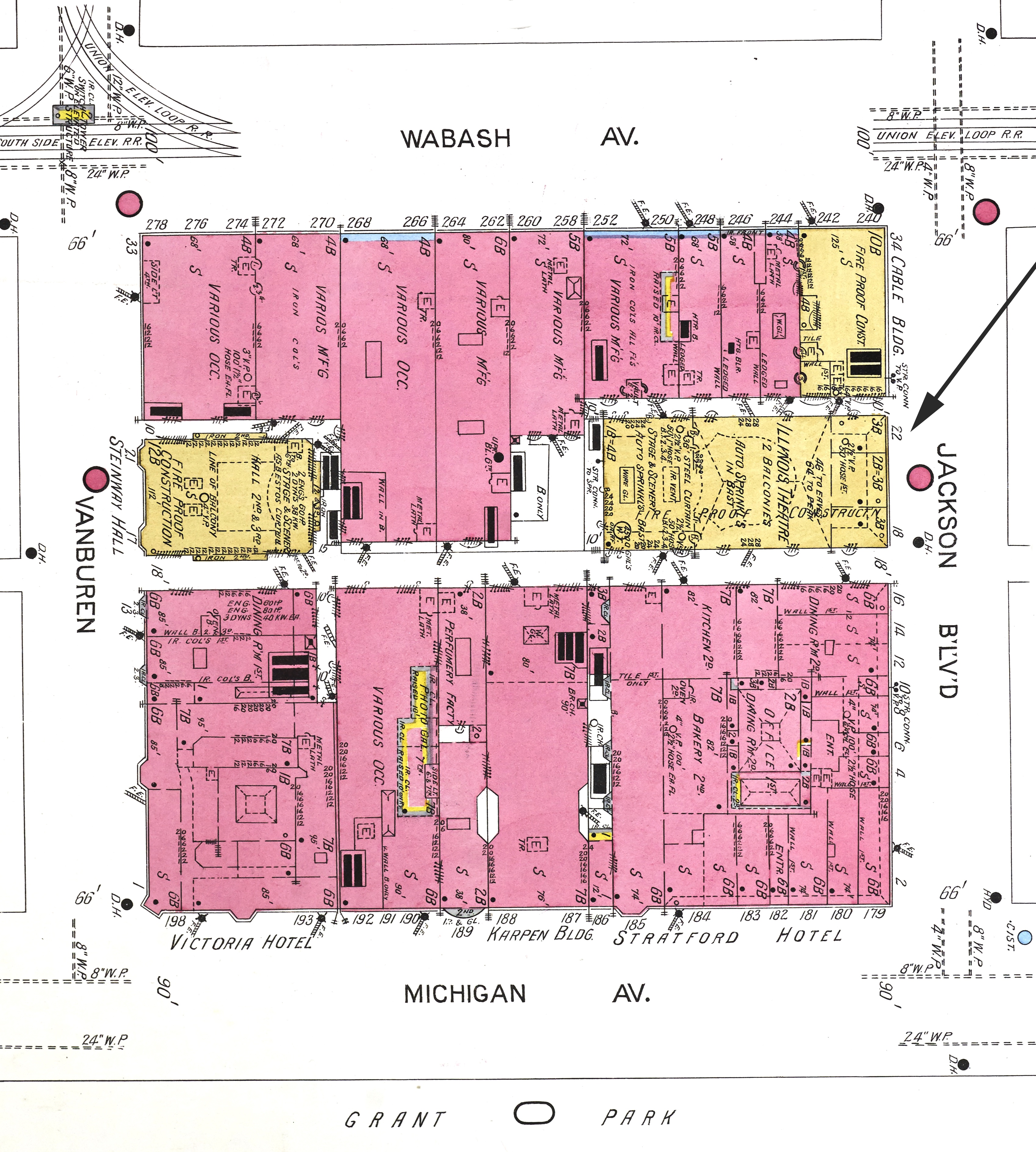
- Illinois Theatre
Sanborn Fire Insurance Map
1906

Leave a Reply