Dyche Building, State-Randolph Building
Life Span: 1873-1955
Location: 64 State (old), 150 N. State st. and 2-6 W. Randolph st., NW corner of State and Randolph streets
Architect: John M. Van Osdel, Two-story addition 1890
- Lakeside Annual Directory of the City of Chicago, 1874
Dyche D. R. & Co. (David R. Dyche and ————) druggists, State nw. cor. Randolph and 183 W. Madison
Lakeside Annual Directory of the City of Chicago, 1875
Dyche D. R. & Co. (D. R. Dyche and ————) druggists, State nw. cor. Randolph
Lakeside Annual Directory of the City of Chicago, 1876
Dyche D. R. & Co. (David R. Dyche and ————) druggists, State nw. cor. Randolph
Lakeside Annual Directory of the City of Chicago, 1880
Dyche D. R. & Co. (David R. and H. B. Dyche) drugs, 64 State
Lakeside Annual Directory of the City of Chicago, 1904
Dyche Building, Randolph nw cor State
Dyche D. R. Drug Co. Joseph Trienens pres; Albert Wert sec; druggists 64 State
Lakeside Business Directory of the City of Chicago, 1907
Dyche Building, 65 Randolph
Dyche D R Drug Co. druggists 64 State
Lakeside Annual Directory of the City of Chicago, 1911
Dyche Building—6 W. Randolph nw. cor. State
Chicago Tribune, February 2, 1873
The northwest corner of State and Randolph streets will soon be ornamented by a handsome building, to be erected by Dr. D. R. Dyche, the well-known druggist.
It will have a frontage of feet on Randolph by 52 on State,, and will be built of artificial stone. It is to be of four stories in height, with a high basement. There will be two stores, Dr. Dyche himself occapying the one at the corner. The plans are by Mr. Van Osdel.
Chicago Tribune, October 9, 1873
MESSRS. D. R. DYCHE & CO..
The first anniversary fittingly witnessed the return of the Board of Trade to its new building, while to-day is the occasion of the return of many merchants to the places of business occupied by them before the fire. Among these is the old and well-known firm of D. R. Dyche & Co., retail druggists. Two years ago, they were situated on the corner of Randolph and Dearborn streets, with a West Side store on the corner of Halsted and Madison streets. To-day they will reopen with an entirely new and large stock of druggists’ goods, in a new building, one block from their former place of business, on the northwest corner of State and Randolph streets. It is 44×52 feet, four stories high, with basement, and built of sandstone, with a richly ornamented front, and quite worthy of the conspicuous position it occupies on that corner.
The first floor, on which the store is situated, has been elegantly fitted up. The flooring is of English tile, and the counter of richly-carved wood, a work of art in itself. Special attention bas been paid to the dispensing department, the prescription case being a model of beauty and utility, unequaled by any in the city. Their assortment of like imported toilet-goods, perfumery, soaps, and the consists of the best and most popular articles to be found, It is very extensive, too much so for enumeration. Among other things, the firm has made a specialty of surgical instruments, a circumstance that will be of interest to those whose business is to use, and not to shudder over, glittering blades and distracting little curved and polished weapons. The opening of this store, well furnished and fitted up as it is, does not induce one to believe in a panic. The West Side store will still continue in active operation.
Chicago Tribune, June 27, 1875
D. R. DYCHE & CO.
The firm of D. R. Dyche & Co., whose location, corner State and Randolph streets,—the point of convergence of the street-car. system,—has the effect of rendering a modern drug-store of the advanced class available to remote points as a centre of metropolitan traffic, have been prominently associated with the interest for about twelve years, formerly Randolph and Dearborn streets, and, until recently, corner West Madison and Hasted streets. Leading items are the modern systems of dispensing soda and mineral waters, fine toilet goods, elaborate conveniences for dispensing medicines, etc.
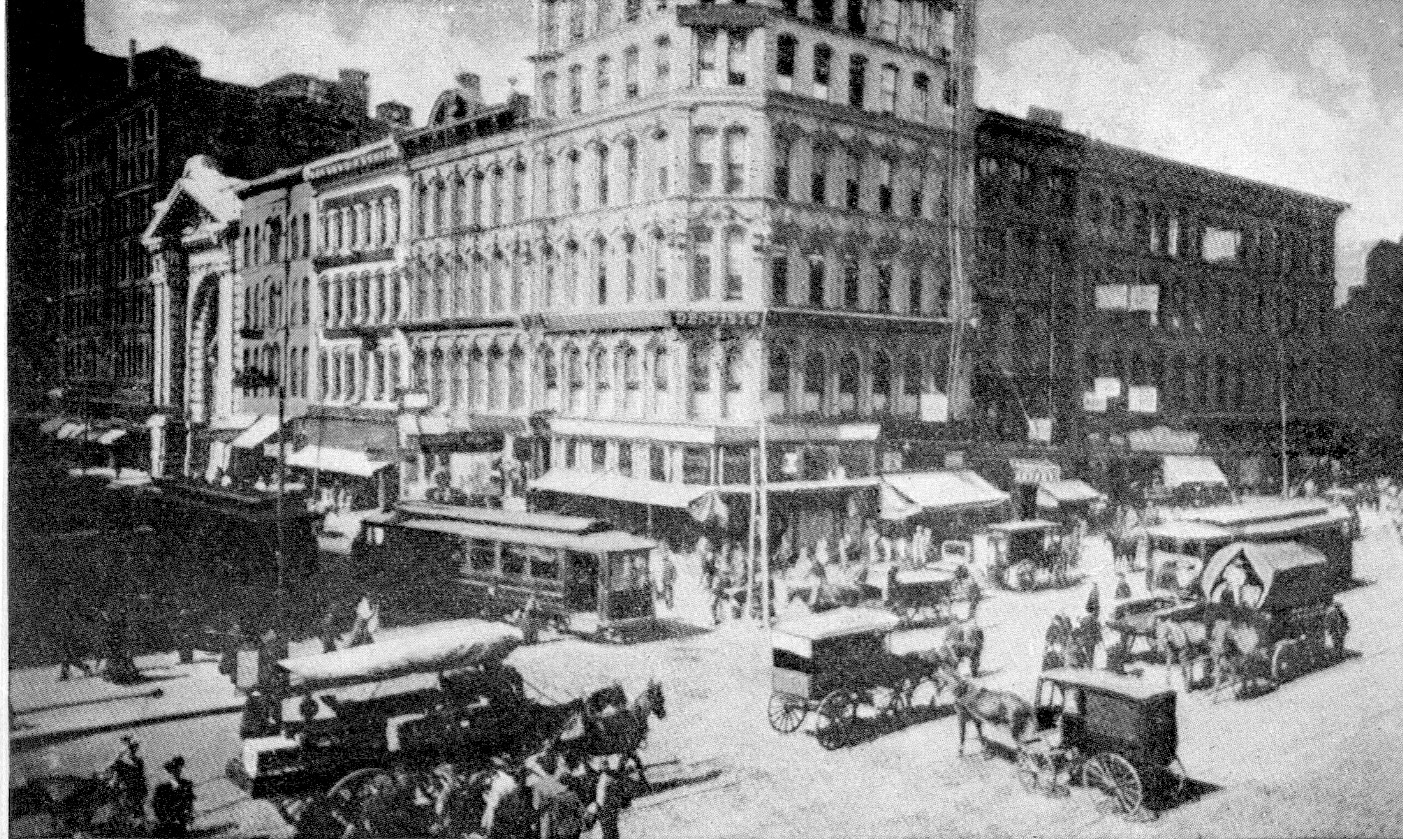
- Dyche Building
1900s
Fifth Anniversary Volume of The Chicago Veteran Druggists’ Association, 1904
WILLIAM ANDREW DYCHE.
Few druggists of Illinois are better known than Mr. Dyche, who is a native of the Buckeye state. He was born in Monroe, Butler county, Ohio, May 25, 1861. In 1882 he graduated from the Northwestern University, taking the degree of A. B. and has since taken the master’s degree. He is also a graduate of the Chicago College of Pharmacy, class of 86. His connection with the drug business began in June, 1882, immediately after his graduation from the university, in the store of D. R. Dyche & Co., which his father had founded, at State and Randolph streets, Chicago. Prior to 1882 he worked in the store during vacation times and continuously from June, 1877, to September, 1878, but his steady connection with the store began in 1882.
In 1893 Mr. Dyche became a member of the firm of D. R. Dyche & Co., which was at that time a co-partnership and so remained until 1894, when the firm was incorporated under the same name. In 1900 Mary S. Dyche, William A. Dyche and Geo. V. Dyche, widow and sons of D. R. Dyche, sold all their stock (being the entire amount thereof) in D. R. Dyche & Co., and the corporation was dissolved. Their successors incorporated in January, 1901, as D. R. Dyche Drug Company.
From 1892 to 1895 Mr. Dyche was alderman from the Seventh ward to the Evanston city council and was mayor of Evanston two terms, from 1895 to 1899. He is a trustee of the Northwestern University, a member of its executive committee, and member of the executive committee of the Northwestern University School of Pharmacy. He is also a member of
the Illinois Board of Pharmacy.
Mr. Dyche belongs to numerous clubs and societies, including the Chicago Retail Druggists Association. Illinois Pharmaceutical Association, National Association of Retail Druggists, Chicago Veteran Druggists’ Association, University Club, Chicago; Country Club, Evanston; and the Evanston Golf Club.
He retired from the retail drug business Jan. 1, 1900.
Mr. Dyche is a republican and a member of the Methodist Episcopal church. He was married in 1897 to Miss May Louise Bennett. Mr. and Mrs. Dyche have one son, David Bennett Dyche. His favorite diversion is golf.
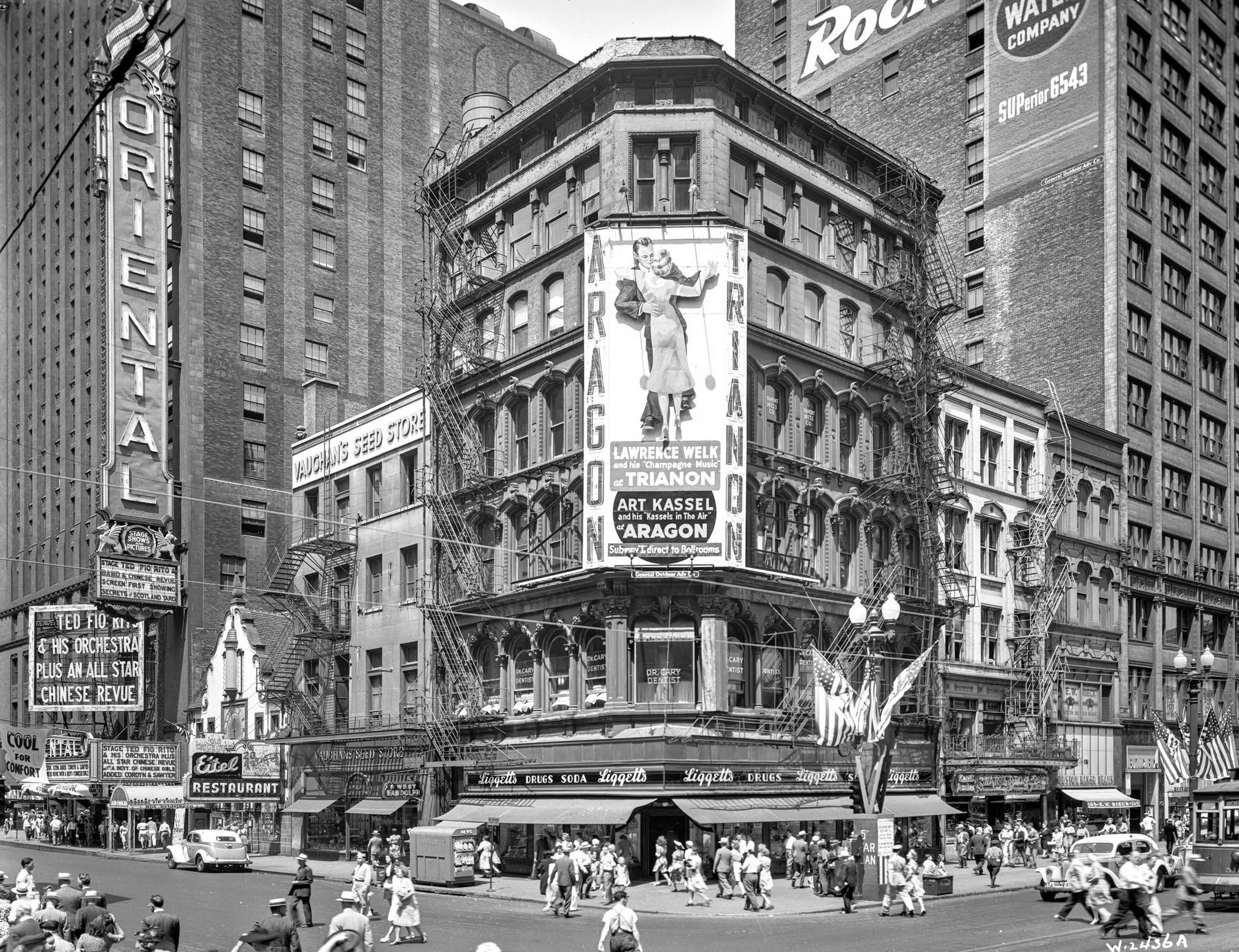
- Dyche Building
1930s
Chicago Tribune, July 29, 1954
LOOP ‘EYESORE’ AT RANDOLPH AND STATE HIT
Building Held Menace by Inspectors
By Clay Gowran
(Pictures on back page)
A dilapidated six story building on the northwest corner of State and Randolph sts. was surveyed by city inspectors yesterday on their first invasion of the Loop in the current drive against ” eyesore ” buildings.
Serious violations were found in the partly deserted, debris cluttered structure, located on Chicago’s greatest shopping street. The building has two addresses: 150 N. State st. and 2-6 W. Randolph st.
The inspection was ordered by Richard Smykal, acting building commissioner, who
said he is tightening up on inspection standards in the Loop “to stop the spread of the slum cancer to our greatest merchandising area.”
Act to Preserve Street
“Deteriorated buildings in residential areas lead to creation of slums,” Smykal said. “Similarly, deteriorated buildings in an area such as State st. encourage the establishment of cheap stores and other enterprises not ‘in keeping with the great merchandise houses of the street.
“It is these fast buck boys who would make a gypsy camp out of our leading economic artery. We hope that, by enforcing the building code, we can preserve the true character of State st.”
Notices listing results of the inspection and describing the building as “in a dangerous condition and a menace to pub-lie safety ” were sent to two firms which, building department officials stated, apparently were agents of the structure. They are the Ran-dolph-State Property, Inc., and Jewel Building corporation, both of 36 W. Randolph st.
A Mrs. Ellen Ahern was listed in city records as secretary of both companies. She was ” out” to telephone calls yesterday.
The notices called upon owners, who were not named, to begin ” necessary repairs to walls, floors, roof, and other parts” within 24 hours of receipt of the notices, or else to begin wrecking the structure within the same period.
Debris Six Feet High
Inspectors led by Ralph Markham, Loop district building inspector, found the main floor of the structure occupied by a store, the second by a restaurant, and the remaining floors deserted. Combustible debris was piled six feet high around the elevator shaft on the third floor, and trash and broken glass littered all the empty floors.
Lathing was exposed on all upper floors where plaster had fallen away. Markham found the building’s two fire escapes badly corroded., He said the most dangerous conditions were those of parapet walls on the roof of the structure.
“The brickwork is loose and ready to topple to the street below,” Markham stated.
The inspectors also surveyed another partly empty six story building at 126-132 N. State st., but found only minor violations.
Chicago Tribune, July 31, 1954
ACT TO COMPEL REPAIR WORK ON LOOP ‘EYESORE’
By Clay Gowran
The city’s fight for prompt repair of a dangerous “eyesore” building on the northwest corner of State and Randolph sts. will be carried to Probate court Monday in an unprecented legal maneuver.
Building department officials will seek a court order directing that the dilapidated six story structure be rehabilitated immediately. They will ask that the costs of the work be charged against the estate of the late operator of the property. He was Albert Martin, wealthy Loop restaurant owner, who died last year.
Calls Building Unsafe
“This is the first time that we have attempted to force the estate of a deceased person to repair a property, but we feel justified in the action because of the hazardous conditions in this building,” said Richard Smykal, acting building commissioner.
“This building is a menace to life, as well as a blight on Chicago’s greatest shopping street.”
Building inspectors surveyed the building Wednesday and found heavy stone ornamental facing and brickwork in the parapets ready to topple on pedestrians. The structure, which is at 150 N. State st. and 2-6 W. Randolph st., has only two occupied floors, with remaining floors cluttered with combustible debris.
U. S. Suing Estate
Probate court records showed that Martin’s estate, which includes the sublease-hold of the building, still is under court jurisdiction. Mrs. Ellen Ahern, a sister of Martin, is administrator of the estate.
The estate already is the target of litigation. The federal government is seeking more than $800,000 from the estate on the contention that Martin filed false information regarding his income from 1935 to 1945.
Meanwhile, other city experts charged slum property owners are perverting the true purpose of a recognized legal device to hide their ownership of such properties, thereby escaping prosecution and publicity. The device is the “land trust,” such as was found recently when the city sought to discover owners of a “pesthole” tenement at 1800-08 In- diana av.
Bank Holds Title
“Under such a trust, title is held by a bank as trustee, with the owners in everything but name listed as beneficiaries of the trust,” city attorney explained. “Such beneficiaries, who actually operate the property and collect the rents, can specify in the trust agreement that their names are to be kept secret.”
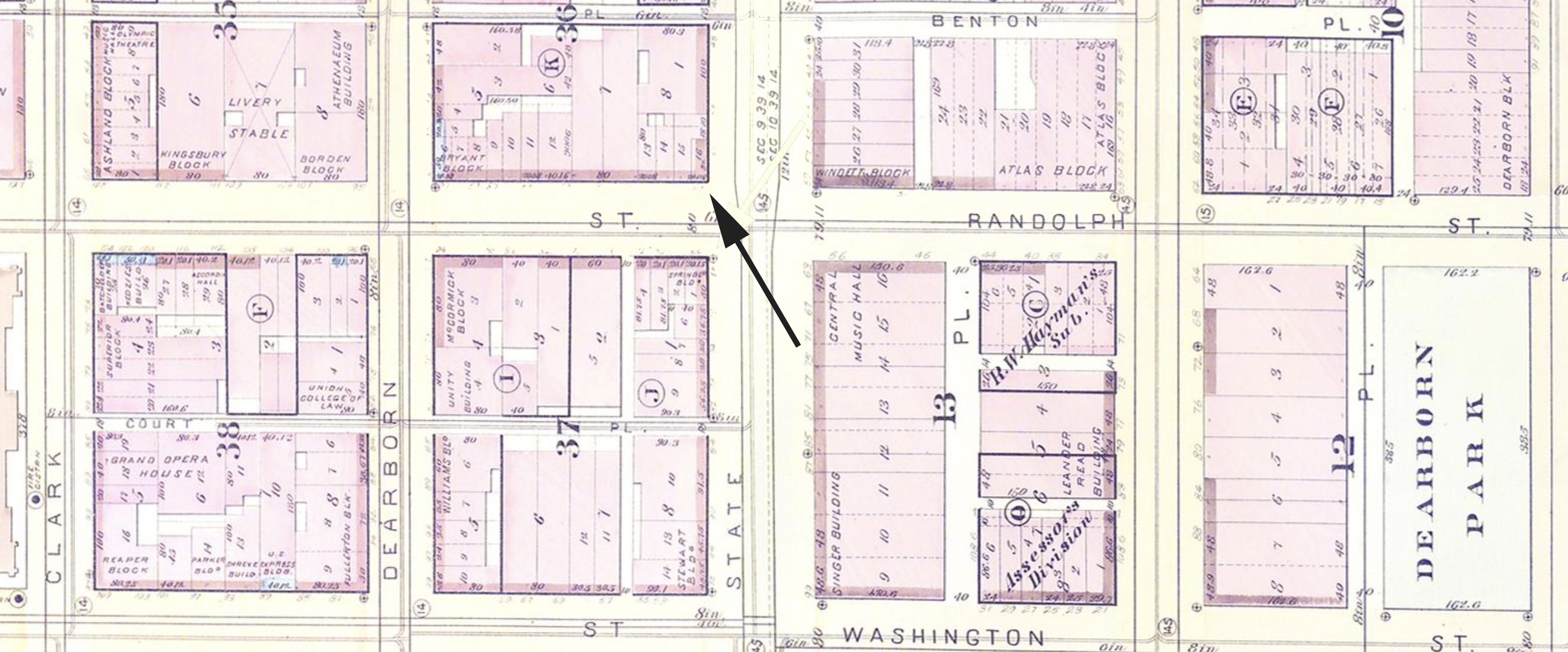
- Dyche Building
Robinson Fire Insurance Map
1886
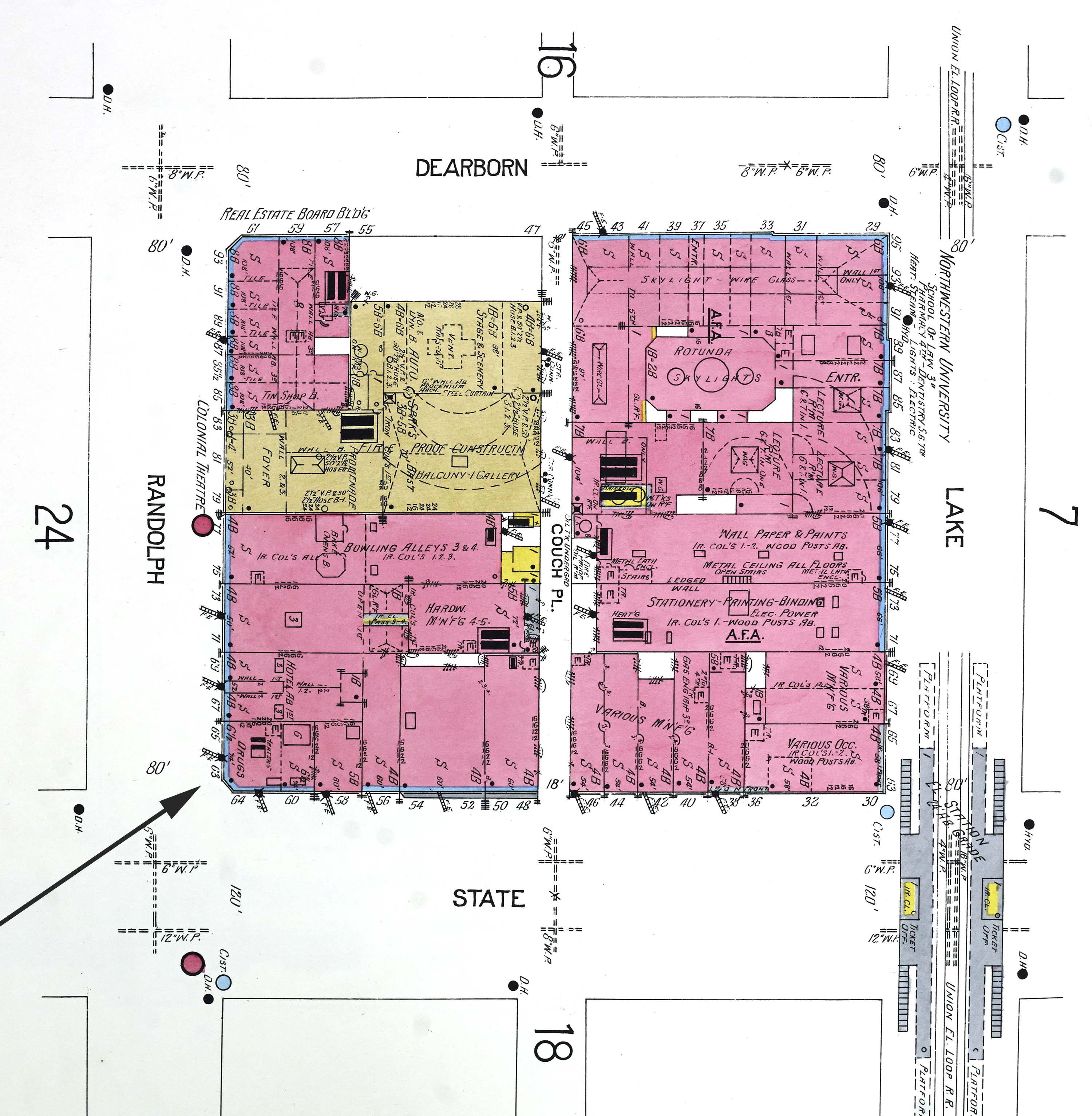
- Dyche Building
Sanborn Fire Insurance Map
1906

Leave a Reply