Green Door Tavern
Life Span: 1873-Present
Location: 161 N Market (old), 161 Orleans, 678 N Orleans, SW corner Huron
Architect: James McCole
- Edwards’ Annual Directory in the City of Chicago, for 1870
McCole James, engineer, Brown, Hunt & Winslow, r. 106 Huron
Edwards’ Annual Directory in the City of Chicago, for 1873
Elk Lawrence P. grocer, 162 N. Market
Edwards’ Annual Directory in the City of Chicago, for 1876
Casey John, grocer, 162 N. Market
Edwards’ Annual Directory in the City of Chicago, for 1877
Casey John, grocer, 162 N. Market
Lakeside Annual Directory of the City of Chicago, 1900
Chambers Charles meatmkt 161 Orleans h 154 Orleans
Lakeside Annual Directory of the City of Chicago, 1904
Chambers Charles meatmkt 161 Orleans h 151 Orleans
Lakeside Business Directory of the City of Chicago, 1907
Chambers Charles meatmkt 161 Orleans
Lakeside Annual Directory of the City of Chicago, 1910
Chambers Chas meatmkt 678 Orleans
Lakeside Annual Directory of the City of Chicago, 1911
Chambers Chas grocer 678 Orleans
Lakeside Annual Directory of the City of Chicago, 1914
Chambers Chas grocer 678 Orleans
Polk’s Chicago Numerical Street and Avenue Directory, 1923
Corsiglia Louis gro 678 Orleans h 1630 N Wells
Corsiglia Bros (August and Joseph) soft drinks 448 N Orleans
Polk’s Chicago Numerical Street and Avenue Directory, 1928
Corsiglia Louis restr 678 N Orleans
Tirio Kate Mrs 678 Orleans
Corsiglia Bros soft drinks, 448 N Orleans
Chicago Classified Telephone Directory February 1934
Huron-Orleans Restaurant 678 Orleans DEL awar-0984
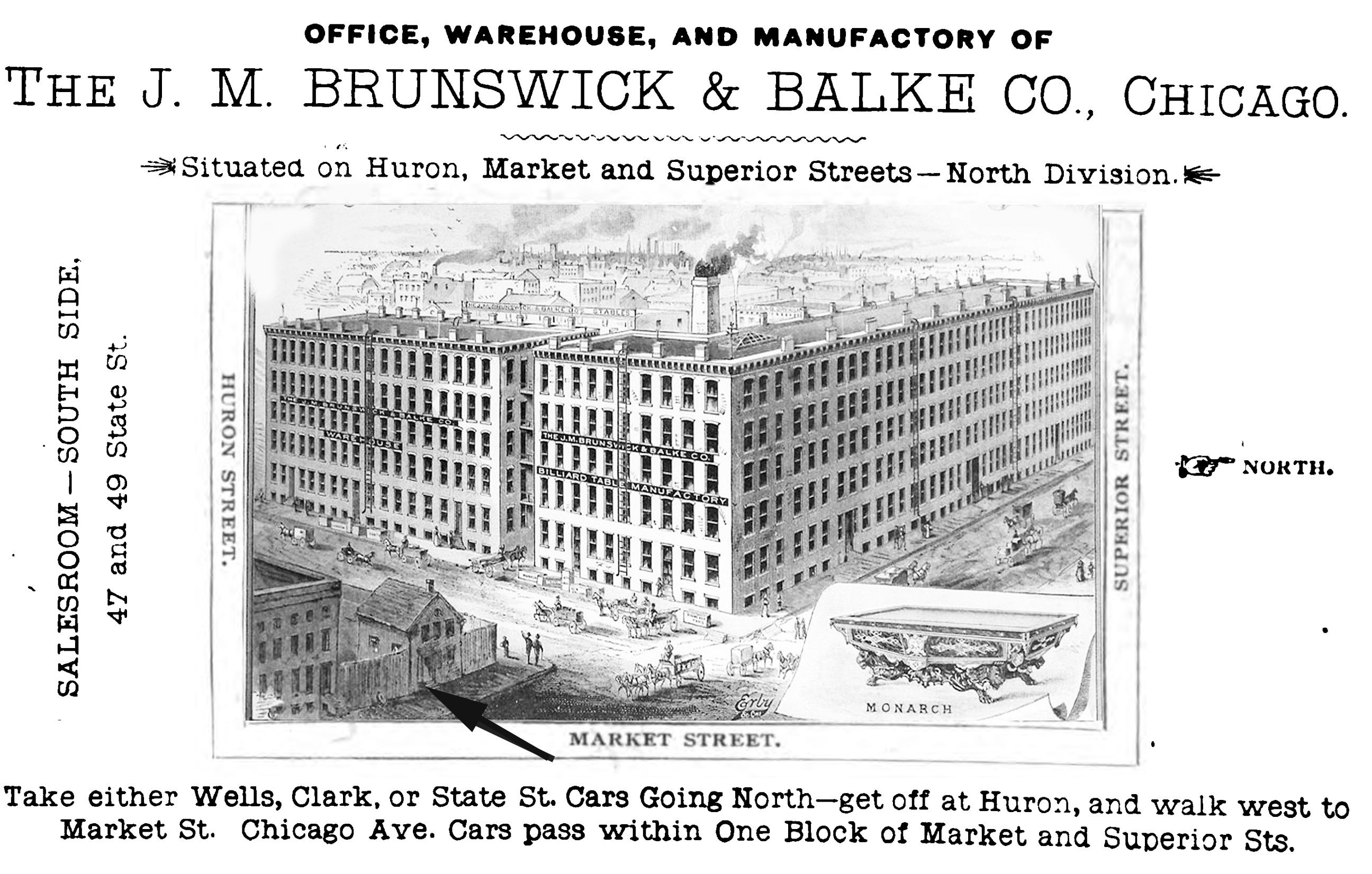
- Southwest corner Market and Huron
Glossop’s Stranger’s Guide to Chicago
1884
Chicago Tribune, January 20, 1911
ROBS DAY AFTER JAIL ESCAPE.
Policeman Shoots at Butcher Shop and Grocery Robber Nine Times Before Overtaking Him.
After shooting nine times at Thomas Roach, alias Gorman, 22 years old, Policeman John Houlahan of the Chicago avenue station, at 12:30 o’clock this morning, overtook and arrested the fugitive for stealing butter and other supplies from the grocery and butcher shop of Charles Chambers, 678 Orleans street. Gorman escaped Wednesday night from the county jail, where he had been awaiting trial on charges of holding up a woman.
Chicago Tribune, March 8, 1914
CHAMBERS—Patrick Chambers, March 7, 1914, native County Mayo, Ireland, son of the late Thomas and Ann Chambers, nee Mrs. Kilroy, beloved brother of Michael, Charles, Mrs. Freehan, Mrs. Gary, Mrs. P. Murray, the late Mrs. T. Lynch, and James Chambers. Funeral from late residence, 678 Orleans-st., Sunday, March 8, at 9:30 a.m., to St. Dominick’s church, where solemn high mass will be celebrated; by autos to Mount Carmel.
THE CORSIGLIA FAMILY.
Chicago Tribune, November 2, 1915
HUGE MAFIA BOMB WRECKS HOUSES
Aimed at Restaurant at Illinois and Orleans, Shakes Up Whole District.
A sofa on which Mrs. Teresa Mareno, aged 70, was seated in her rooms at Illinois and Orleans streets last night suddenly withdrew its support and danced across to the opposite wall. Mrs. Mareno received a slight sprain of her wrist in falling to the floor.
That was the only personal injury resulting from a Black Hand bomb, placed to destroy the saloon and restaurant of the Corsiglia brothers, Joe and Gus, at Orleans and Illinois streets. Windows, table china, glasses, and mantel ornaments for a half block up each diverging street from that corner were shattered by the terrific explosion, which was heard in the loop.
Man Blown Across Room.
The street was covered with shattered | glass and houses trembled with the shock. *A big hole was blown through the side of the Corsiglia restaurant, and Joe Christopher, who was sitting at a table in the bar, was blown clear across the room.
Joe Corsiglia said a year ago he had received a Black Hand letter demanding $500, which he ignored. Two days ago he received another demanding $1,000. This he ignored also.
Six Italian Families.
The upper stories of the building in which the restaurant is located is occupied by six Italian families, totalling more than thirty residents. All these were shaken up by the explosion and their beds so littered with glass that they were unable e to return to them.
The factory building of the R. M. McCurdy Cork company was blown hollow-eyed. Every window was broken.
Chicago Tribune, February 9, 1926
Seize Gin and Alky in Rogers Park Drug Store
Prohibition: agents under Capt. R. Q. Merrick, assistant administrator in charge of enforcement, conducted two raids yesterday which netted three truck loads of liquors. The first was at the Rogers Park pharmacy, 1447 Morse avenue, where a quantity of gin and alcohol was seized. The second was at 678 Orleans street, said be a depot for kinds of bootleggers. All grog was seized.
Chicago Tribune, April 8, 1926
DRY LAW HARD ON CIDER FIRMS, SUITS DISCLOSE
Folks have turned from cider to moonshine and gin the last few years, according to revelations in bankruptcy petitions filed yesterday against three Chicago cider manufacturing concerns.
According involuntary petitions presented in the United States district court here, the Barrett Cider and Vinegar company, 361 West Ontario street. did a thriving business for many years after its establishment more than 20 years ago. Then, it was said, prohibition came and destroyed a great part of the market among formerly temperate beverage users until the liabilities for the organization grew to $100,000, the amount set out in the petition yesterday.
Action was precipitated by the Pioneer Cooperage company St., with a claim of $13,827; the Chicago Cartage company, $1,632, and the Redlich Manufacturing company, $48.
The other cider concerns hit by petitions were the Bangor Cider company and Barrett & Barrett Co. The principal claimant against the two organizations is Louis Corsiglia, who listed indebtedness of $17,380,
Chicago Tribune, January 3, 1929
CORSIGLIA—Louis Corsiglia, husband of Rose Casazza Corsiglia, father of Palmira, Louis Jr. and Dante Joseph, son of Teresa and the late Gianbattista Corsiglia, brother of Joseph, Gust and Antonette Searo, Catherine Tirio, and Teresa De Francesco. Funeral from chapel, 708 N. Wells-st.,. Saturday, 9 a.m., to Church of Assumption. Interment Mount Carmel.
Chicago Tribune, December 25, 1933
POLICEMEN DON’T FRET OVER THIS KIND OF MURDER
(Picture on Back Page.)
A telephone report to the East Chicago avenue station that there was a murder in the tavern at 500 North Franklin street, sent three squads of policemen to the scene this morning.
On a table lay a prostrate figure. Gingerly one of the policemen turned it over. Then he grinned. The other policemen looked and grinned, too, and so did Gus Corsiglia, owner of the place, and several patrons.
The figure on the table was an effigy of “Old Man Prohibition.” It was Corsiglia’s way of celebrating repeal, and the police told him that this kind of a “murder” was all right with them.
Chicago Tribune, October 12, 1986

By Paul A. Camp, Restaurant critic
It was bound to happen. The boom in the River North area of the city already has led to the yuppification of many a more humble place. Still, one had hoped.
Then Roger Greenfield opened up his new Cucina Cucina restaurant across the street, and Greenfield’s places are to trendies what catnip is to cats.
Greenfield’s overflow discovered the Green Door Tavern back across the street, and when a place gets discovered it changes. Good lord, now they’ve got a daily pasta and cashew butter sandwiches.
It used to be the only rule of the house was that you had to be able to stand up and walk out at closing time, an imposing enough challenge for those who staked out their turf early and spent the day swilling beer and telling tales until last call brought their yarns to an untimely conclusion. The Green Door was a saloon in the truest sense of the word.
Now there are rules: “Minimum charge at tables—$4.50 per person, parties of 6 or more add 15% gratuity, extra plate sharing charge—$2.50, please no separate checks with groups of 8 or more.” Then, “Please note: Cash or American Express only.” American Express? No self-respecting saloon takes American Express.
It took a long time for this to happen to the Green Door, a long, long time. The building at 678 N. Orleans St. was constructed by James McCole in 1872, immediately after the Chicago Fire. A few months after the fire the city outlawed construction of frame structures in the central business district, so the Green Door Tavern is one of the few frame buildings still standing in the area.
The building looks like it might not last all that much longer. It lists noticeably, but not to worry. The place. has leaned that way for more than 100 years.
Opened first as a grocery, the first floor of the building was refitted as a bar and restaurant in 1921, when Vito Giacomoni christened it the Huron-Orleans Restaurant. Eventually ownership passed to Vito’s sons, Jack and Nello Giacomoni.
No one knows for sure when the Huron-Orleans Restaurant became known as the Green Door. It just sort of happened as the fortunes of the neighborhood declined and the layers of dust accumulated.
Likewise, no one is quite certain of how the Green Door began its slow slide into obscurity. But by the late 1970s it was not the kind of place one would go with a proper lady. Then a curious thing started to happen. Increasingly men in business suits showed up among the regulars at the bar, sometimes with proper-looking ladies in tow.
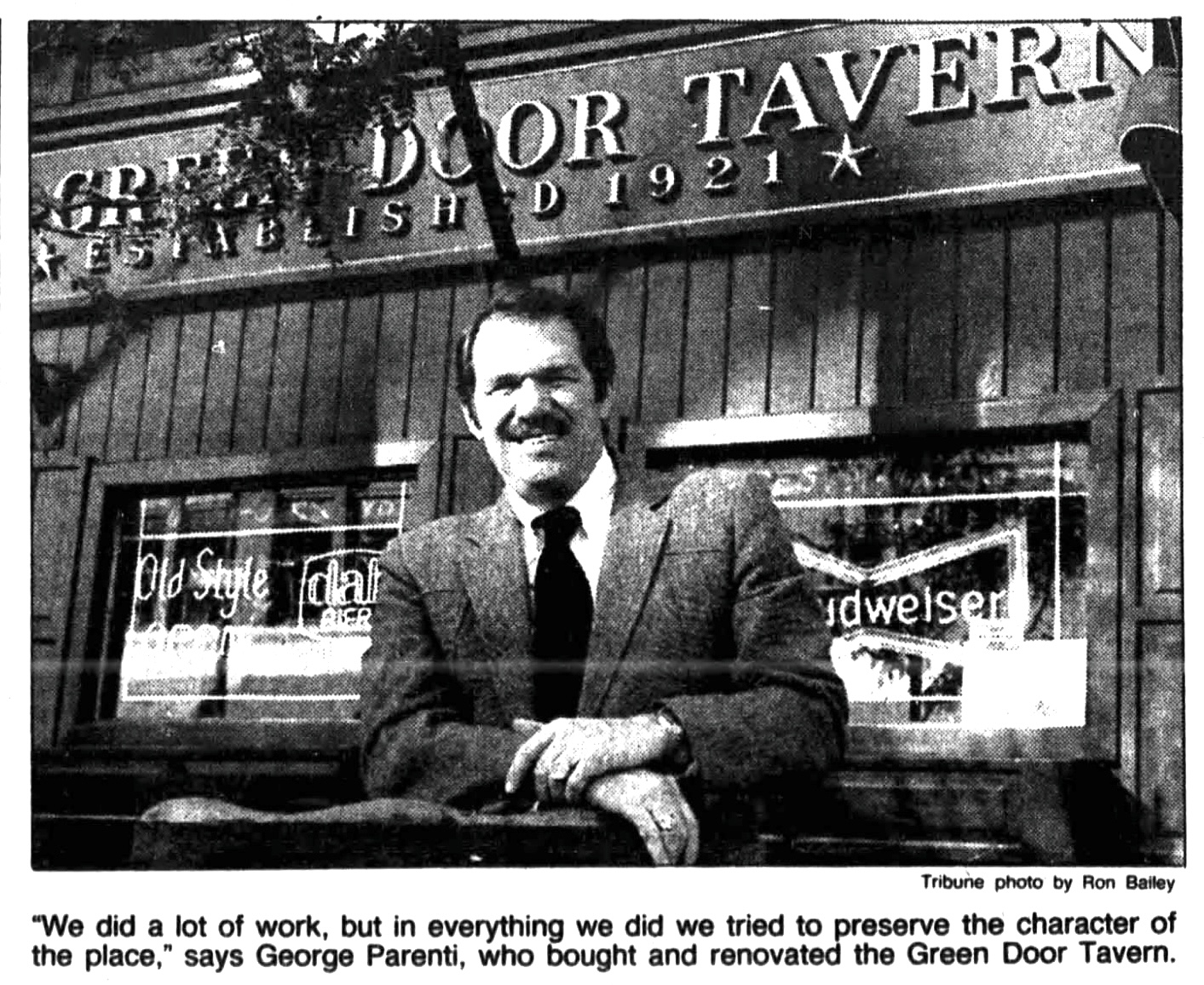
By then the Green Door had the kind of patina that only decades-old layers of grime can give a place. It was the kind of saloon where a guy could escape for a couple of hours in the middle of the day. The dirt blocked out all light. You didn’t have to worry much about being noticed.
These days a fella sneaking off for a pop at the Green Door likely will come face to face with his office mate, and the blame for this goes to George Parenti, an advertising executive with Design Corp., who bought the restaurant from the Giacomoni brothers in August 1985.
He set about correcting some of the architectural problems with the building. “You used to be able to set a marble on the bar and it would roll right through the wall,” he says. He also decided to wash off all of that genuine grime. That’s when he discovered the long since obliterated words, Huron-Orleans Restaurant, stenciled on the windows. It was the least of his discoveries.
In the attic, in the basement, under the vaulted sidewalks was junk, all sorts of junk, wonderful junk. Much of it now covers the walls, hangs from the ceiling and fills every nook and cranny of the restaurant.
The 48-year-old Parenti says that he wanted the feeling of a classic bar like P.J. Clarkes in New York or the Washington Grill in San Francisco. He kept prices low and visual appeal high to attract the artists and creative types in the area.
“I guess we have yuppie-ized the place some,” he admits. *We don’t mind the yuppies, but I like to think that we appeal to the “muppies—middle aged urban professionals.” To that end the Green Door opens at 11 a.m. and makes last call at 11 p.m.
Despite the changing specials listed on a blackboard, the mainstay of the menu is a decent burger, sandwiches and terrific Texas-style chili. Prices average $5 per item. “We’re never going to be anything like a fine dining establishment,” Parenti says. “We don’t want to be.’
It was bound to happen… but now where does a guy or a gal go to get away from them all?
Chicago Tribune, April 17, 1989
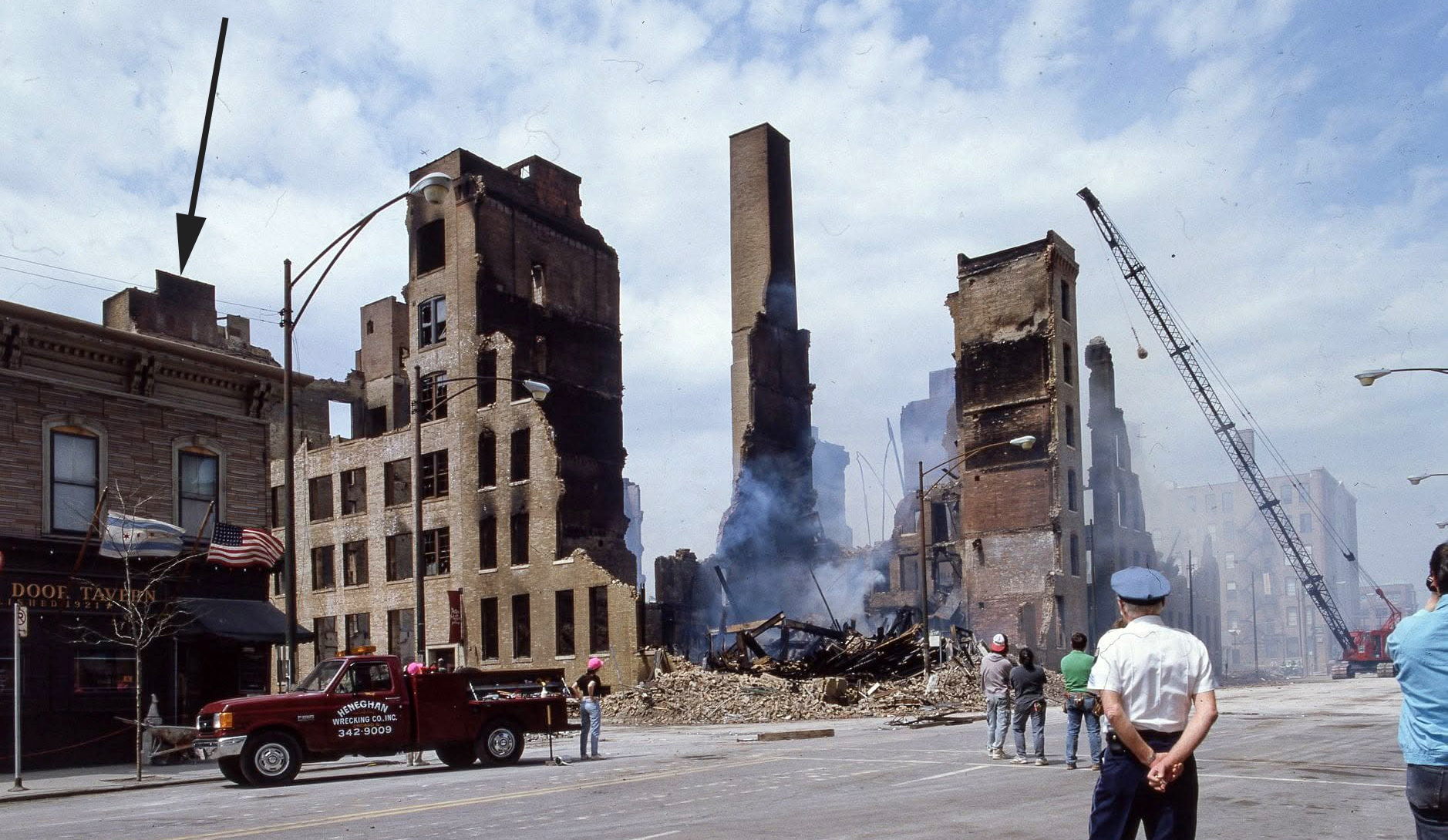
- Artwork estimated to be worth millions of dollars was turned into ash Saturday as fire destroyed a historic brick loft building, site of the largest- redevelopment project to date in Chicago’s trendy River North district. At one point during the fire, a portion of a ten-story wall toppled like a pillar, slicing through the wall of a two-story tavern across the street.
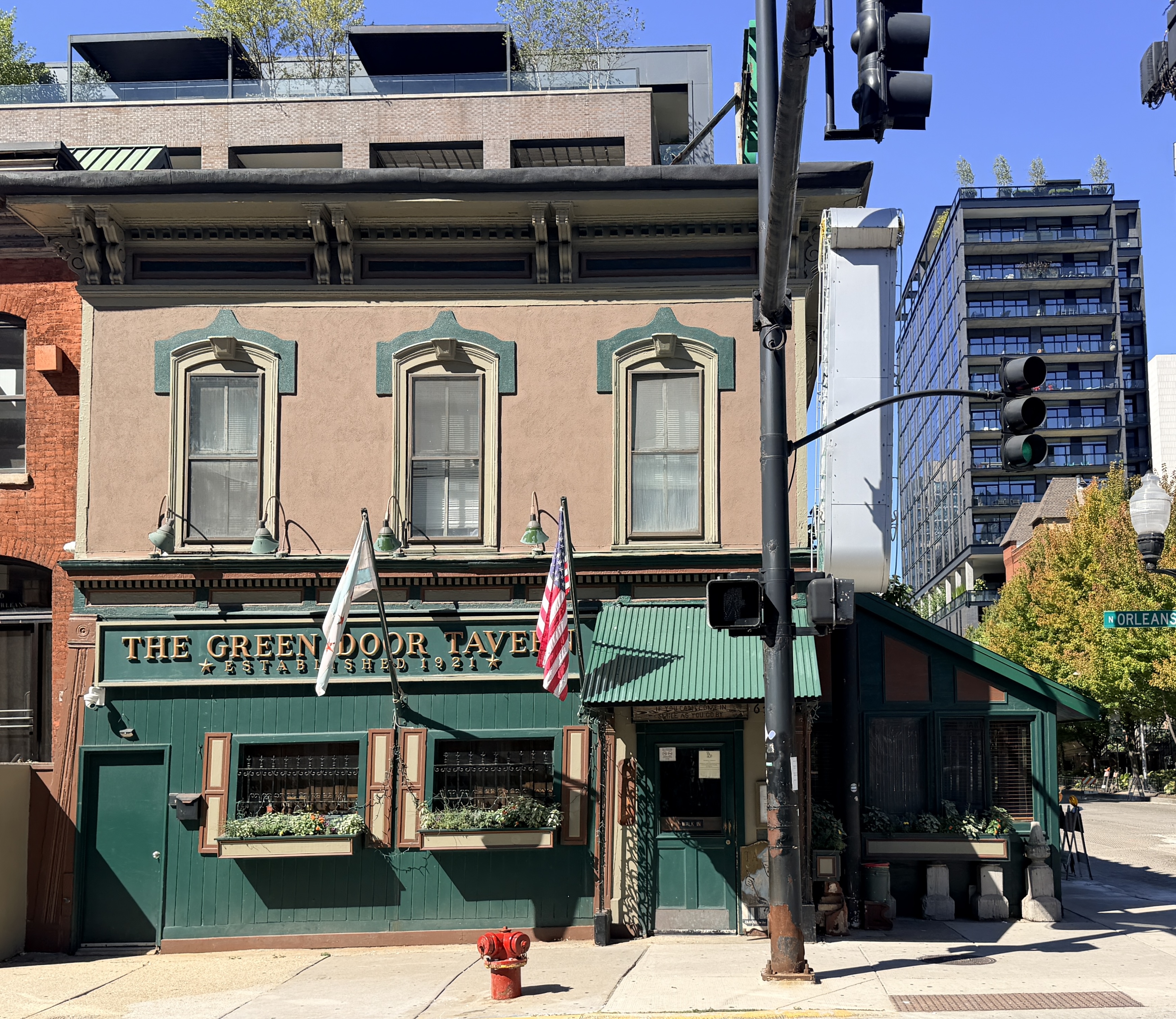
- Green Door Tavern
September, 2026
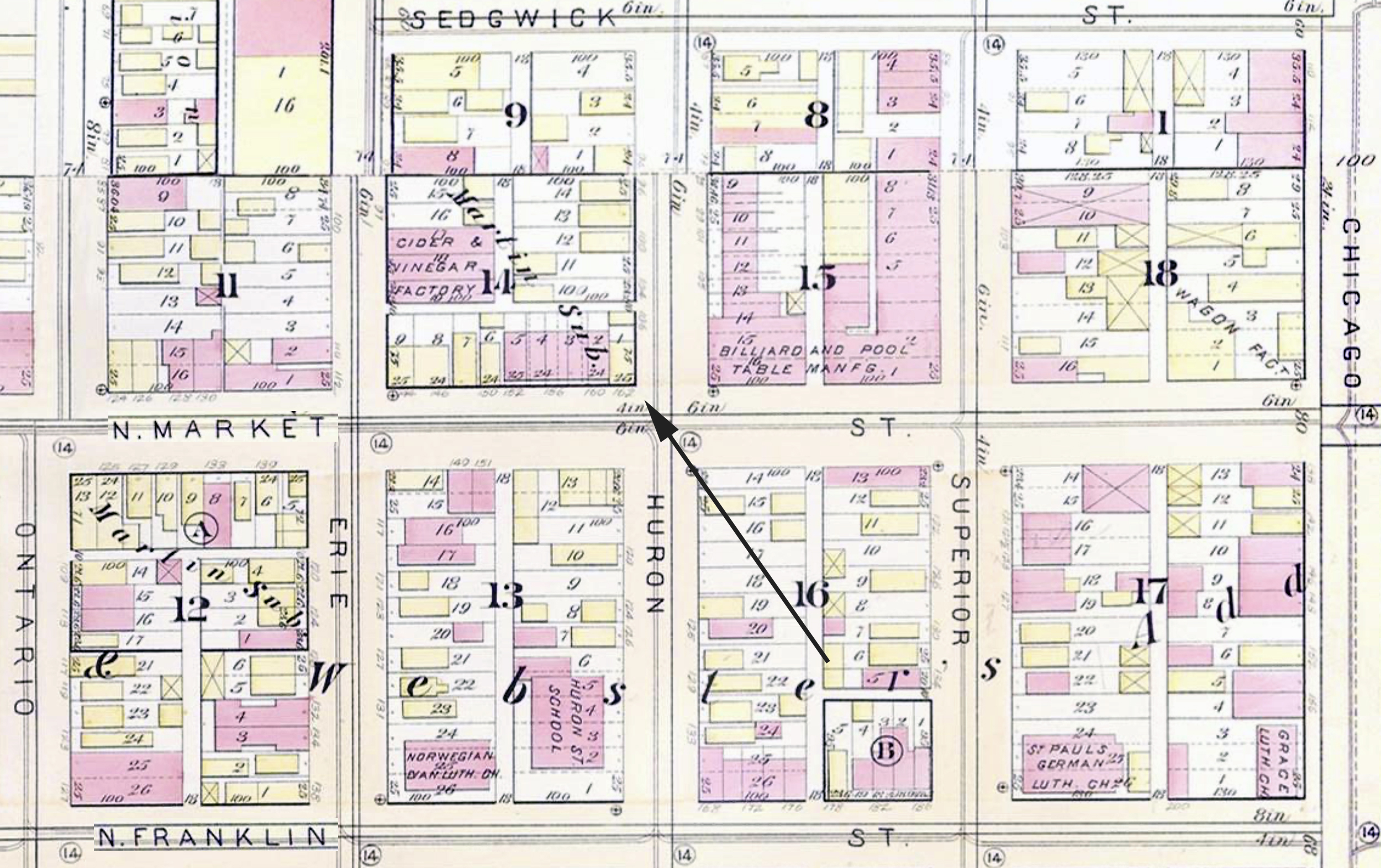
- SW corner Market and Huron streets
Robinson Fire Insurance Map
1886
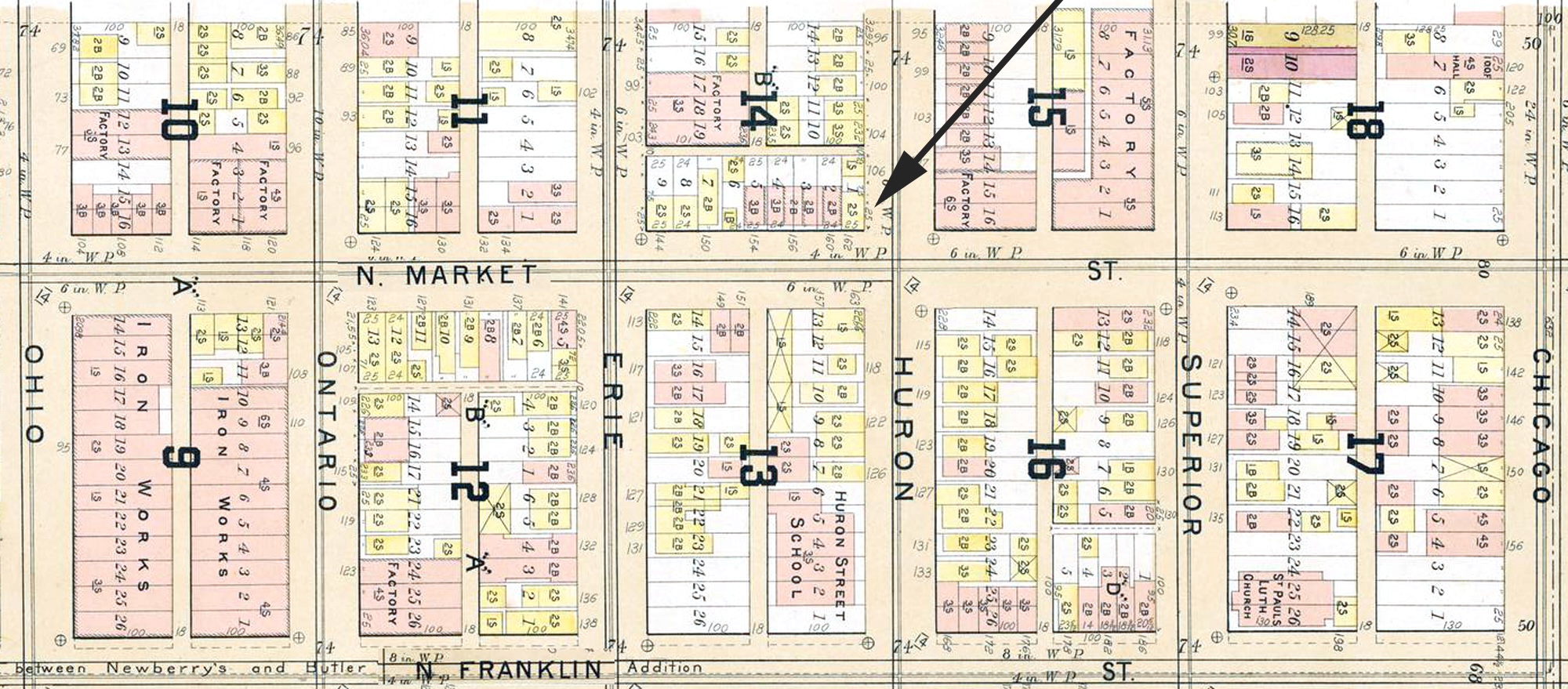
- SW corner Market and Huron streets
Greeley-Carlson Atlas of Chicago
1891
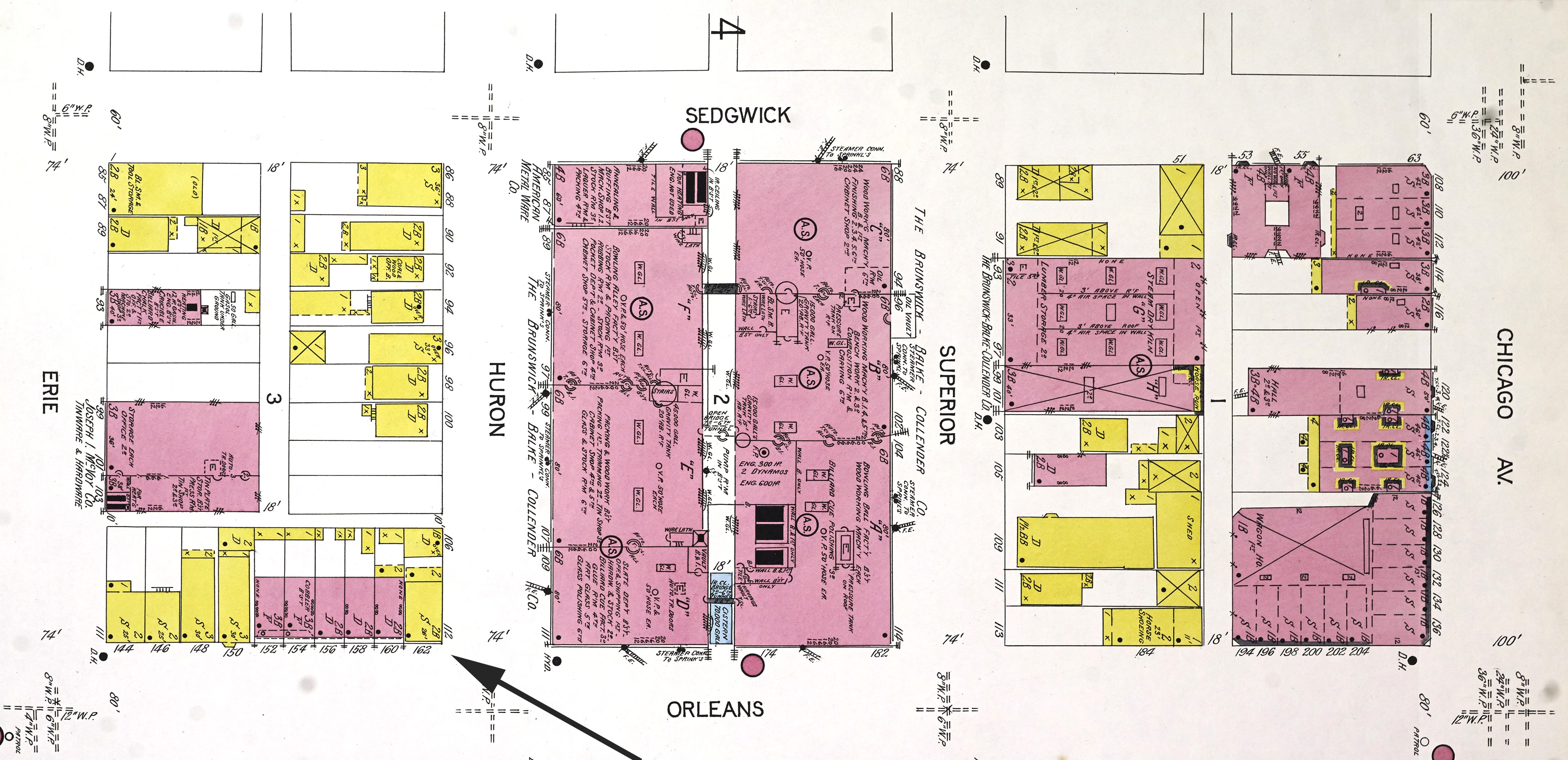
- SW corner Market and Huron streets
Sanborn Fire Insurance Map
1906

Leave a Reply