Chicago History Magazine, Spring, 1948, Volume I, Number 11
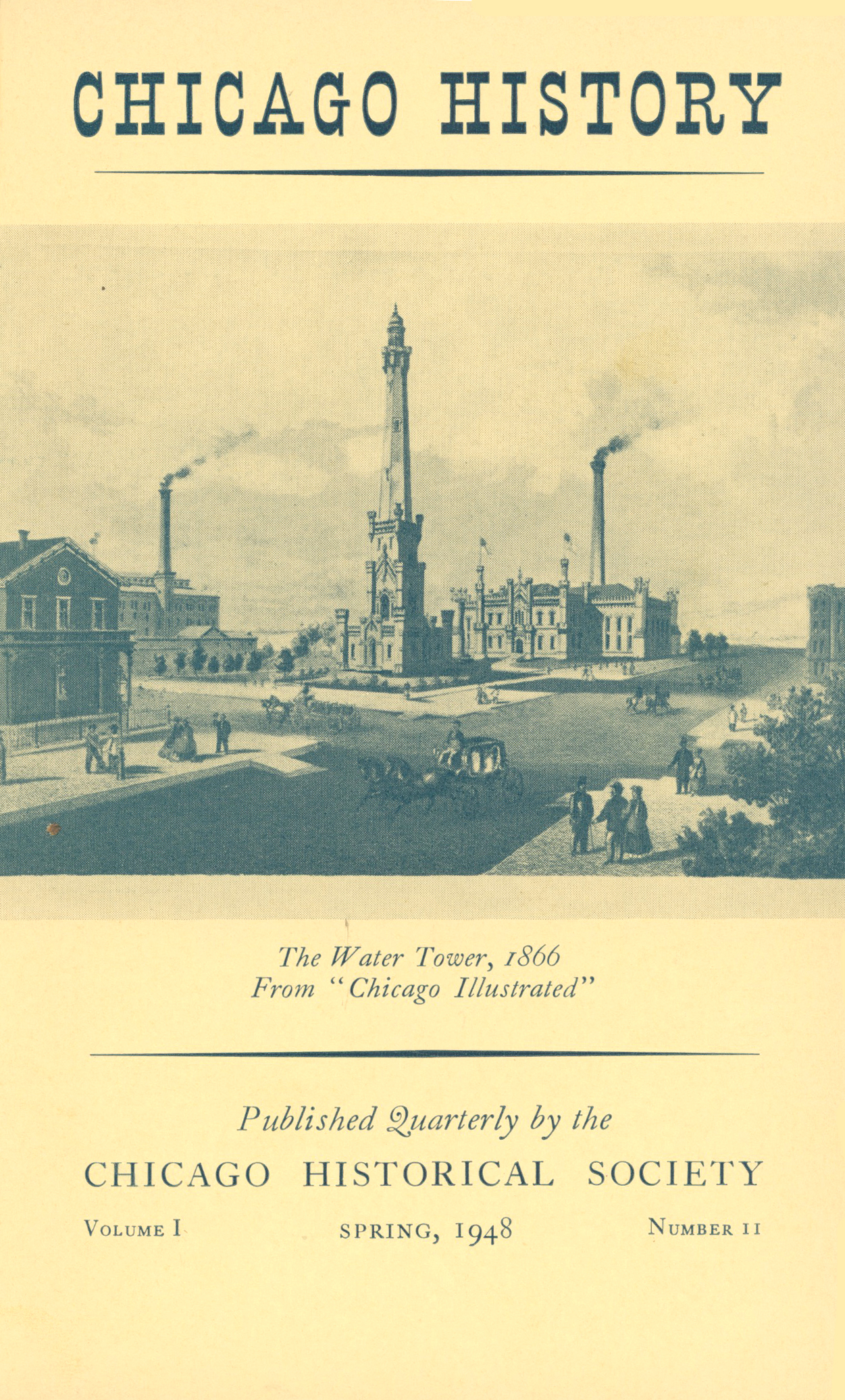
Jevne and Almini
If we were asked to name our favorite Chicago book, we wouldn’t have to hesitate a split second. Chicago Illustrated, more commonly known as “Jevne and Almini,” would be our answer. As the saying goes, the book has everything. It was written, drawn, produced, and published by Chicagoans; it is the best source for the physical appearance of the city that the Great Fire destroyed; it is rare enough to cost a pretty penny, but not so rare as to be unobtainable. Of course, strictly speaking, it isn’t a book, but that is a technical quibble which we are not going to allow as a disqualification.
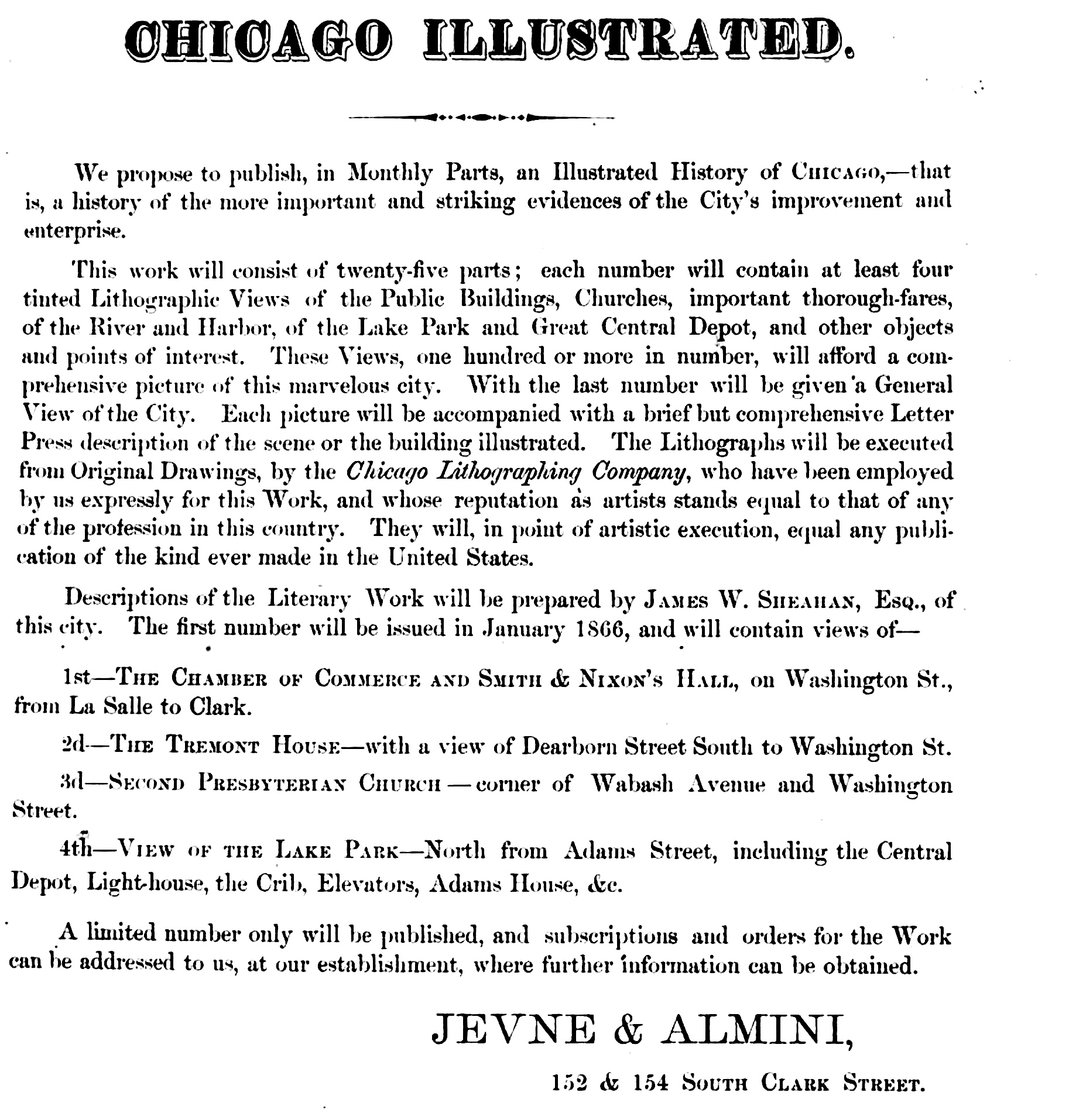
Chicago Illustrated is best described by the publishers’ preface, which is even rarer than the book itself. That we quote below:
- CHICAGO ILLUSTRATED
We propose to publish, in Monthly Parts, an Illustrated History of Chicago,—that is, a history of the more important and striking evidences of the City’s improvement and enterprise.
This work will consist of twenty-five part, each number will contain at least four tinted Lithographic Views of the Public Buildings, Churches, important thoroughfares, of the River and Harbor, of the Lake Park and Grand Central Depot, and other objects and points of interest. These Views, one hundred or more in number, will afford a comprehensive picture of this marvelous city. With the last number will be given a “General View of the City.” Each picture will be accompanied with a brief but comprehensive Letter Press description of the scene or the building illustrated. The Lithographs will be executed from Original Drawings, by the Chicago Lithographing Company, who have been employed by us expressly for this Work, and whose reputation as artists stands equal to that of any of the profession in this country. They will, in point of artistic execution, equal any publication of the kind ever made in the United States.
Descriptions of the Literary Work will be prepared by James W. Sheahan, Esq., of this city. The first number will be executed in January, 1866:
A limited number only will be published, and subscriptions, and orders for the Work can be addressed to us at our establishment, where further information can be obtained.
Jevne & Almini,
152 & 154 South Clark Street
From later prospectuses we learn two additional facts: that the lithographs were made from original drawings by Louis Kurz, of the Chicago Lithographing Company, and that the subscription price of each issue was $1.50.
For thirteen months, beginning with January, 1866, Chicago Illustrated came our as promised. Each issue contained within its highl;y ornamented paper covers four beautifully executed lithographs and eight pages of descriptive text. Then the series stopped. Why, the record saith not, but it is easy to believe that the publishers were losing more money than they could afford.
This hypothesis is supported by the fact that many more copies of Chicago Illustrated were printed than were sold. After the series was stopped these extra copies were stripped of their paper covers and bound into single volumes. Thus, today, the publication exists in thirteen original parts and also a bound book.
Although Chicago Illustrated lasted only half as long as its promoters intended, and came to comprise fifty-two plates instead of the one hundred or more that were originally promised, it stands as a remarkable achievement. The lithographs, which measure approximately 8½ by 12 inches without margins, depict much of the city as it appeared immediately after the Civil War. Here are the principal buildings—the Post Office, the Court House, the Chamber of Commerce—the two great railroad stations, five of the hotels, a dozen or more churches, Crosby’s Opera House and McVicker’s Theater, the old Chicago University, the Douglas Monument, the Water Tower, and the Union tock Yards. There are numerous street scenes, either by themselves or as settings for other pictures, and views of the bridges, the river, and the lake front. Animated in treatment, the lithographs show the river crowded with boats, the streets jammed with traffic, and many people in the costumes of the time.
The text hardly compares with the lithographs in interest, yet it has its merits. Sheahan, a veteran newspaperman, disdained any literary effect, and confined himself strictly to facts. Such an approach does not make for absorbing reading, but it is a godsend to the person who wants to know exactly where a particular building stood, when it was built, what it is made of, and how much it cost.
Chicago Illustrated is important enough in the historiography of the city to call for at least some mention of the men who produced it. Jevne and Almini were interior decorators whose specialty was fresco painting. Examples of their skill were to be found in many of the city’s structures built between 1855, when their partnership was formed, and 1871, when the fire burned them out. At their establishment they also sold artists’ supplies and conducted art exhibits. Doubtless the location of the Chicago Lithographing Company in t he same building had something to do with their decision to publish a pictorial record of the city.
Otto Jevne was a Norwegian by birth; Peter M. Almini was a native of Sweden. Jevne came to Chicago in 1853; Almini, one year earlier. Both men had learned the fresco painters’ trade in their native countries, so their association in Chicago was a natural one. After the fire, the partnership was not resumed, each man preferring to establish his own business.
The artistic merit of Chicago Illustrated was due largely to the choice of a capable artist and lithographer. Louis Kurz was an Austrian who made his way to Chicago in 1852. For eight years he worked as a “scenic artist,” and then turned to lithography. In 1863 he joined with several others (Otto Knirsch, and Edward Carqueville), to form the Chicago Lithographing Company, which quickly made a name for itself. Like Jevn and Almini, the company came to an end in 1871. After the fire Kurz established the American Oleograph Company at Milwaukee. There he remained until 1878, when he moved the company to Chicago. Two years later he formed a partnership with Alexander, and spent the last years of his life turning out hundreds of gorgeously garish chromolithographs of by which the firm of Kurz and Allison is know today.
The Varin Aquatints.
Our fondness for the Jevne and Almini lithographs is rivaled only by our feeling for the Varin aquatints of Chicago. And why not, since so many of the Varins are simply enlarged renderings, in aquatint, of Jevne and Almini subjects? In fact we confess freely that the Varin prints are more attractive than their prototypes; our preference for the latter is based on the fact that they are of the period which they depict.
The Varin aquatints, we hasten to explain, are the delicately executed, beautifully colored views of Chicago that one sees in a good many of the city’s offices and clubs. One may identify them readily by the distinctive type of captions, readily recognizable in our illustration, and by the signature, “R. Varin,” at the lower right hand corner of the plate.
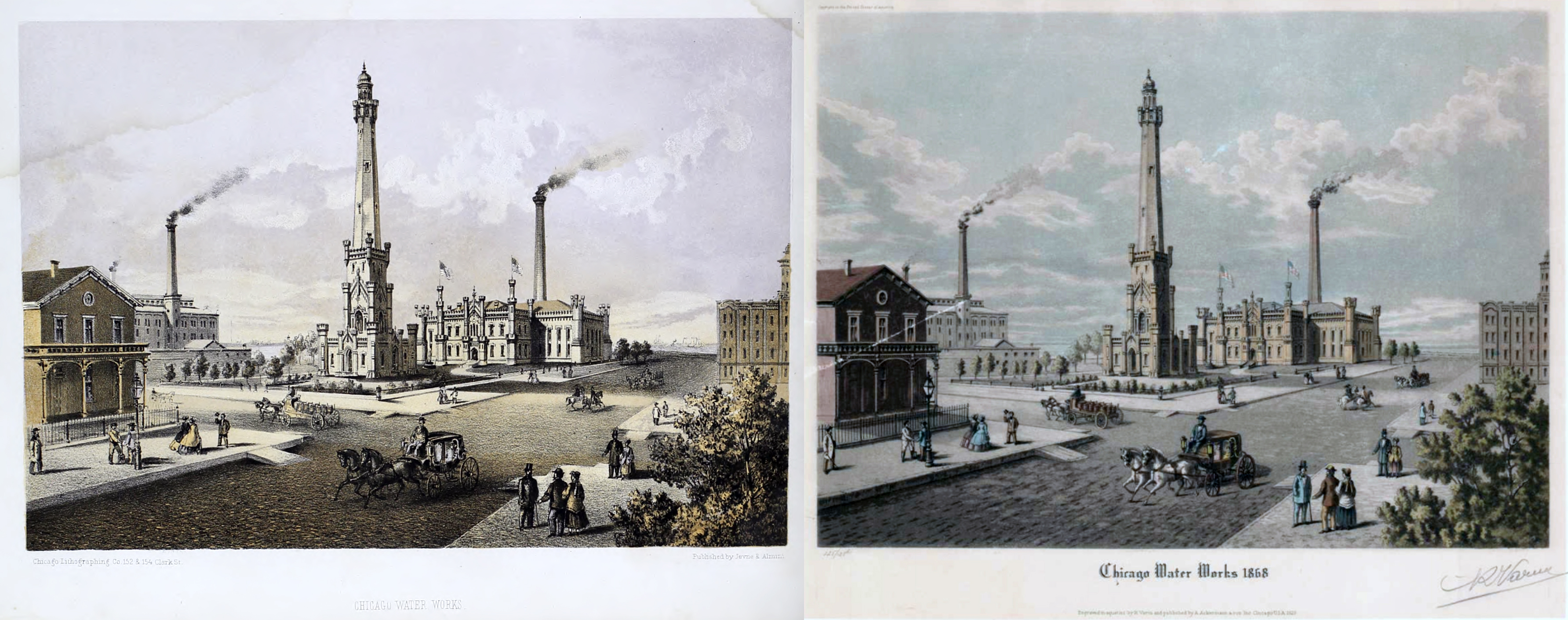
- Comparison of an original Chicago Illustrated lithograph print (Left) versus a Raoul Varin aquatint. (Right)
One may also notice, on some of the prints, the line, “Engraved in aquatint for Mr. Ernest Byfield by R. Varin.” Despite Mr. Byfield’s reputation for versatility, this line has always interested us. Not long ago we took the obvious course, called at his office, and asked him how he happened to become a print publisher. He gave us a detailed and interesting account that we asked him to write it out. Here is the story:
- In 1926 I took about twenty of the Jevne and Almini prints to London. In those days the hotel business was relatively uncomplicated, and for diversion I though I might have the lithographs reproduced in aquatint in the manner of the early Ackerman prints. It did not occur to me that there would be any difficulty about it since the art of etching still flourished in England. I was innocent of most of the facts about etching and innocence is always a blissful condition in which to begin an enterprise.1
I bought a few street scenes of the sort I wanted in London and set forth to the British Museum and the Victoria and Albert. I recall my surprise when I was permitted to look through collections of priceless engravings by Goya and others without more than casual and occasional supervision by an attendant. The authorities in the museum took a very friendly interest in my project, and directed me to Sir Frank Short, then president of the Royal Society of Paint-Etchers, I believe it was called.
Sir Frank heard me with patience and courtesy, and when I had explained my mission he told me that aquatint was no longer used as a medium for illustration. ‘Most modern aquatinters work in monochrome,’ he went on. Aquatints of the period that I wanted reproduced were not art, and he doubted very much that I could induce any well known engraver to attempt the task.
I told him that I wanted the reproductions for their historical and decorative value, and not particularly as works of art. He thereupon directed me to Ralph Exley, a famous craftsman in many of the fields of engraving.
I located Exley in a dismal house in Chelsea. He was in his living room, which he used as a studio, and was at work on some mezzotints to be used as designs for medals. Exley had painted the pictures for the Queen’s Doll House, amongst other achievements, using one strand of a camel’s hair brush, he told me. He still had one or two microscopic landscapes, which he had rejected after their completion because their detail was little ‘too coarse.’
Exley listened with interest to my idea and was nearly as dubious about it as Sir Frank. After some discussion he said to me, ‘I’ll undertake a plate, but I’ll have to charge you 200 guineas (when guineas were worth about $5.00), and I don’t guarantee that it will be successful.’ I told him that I would consider his gloomy proposal, and went on to interview other English experts in acids on copper; one of them a famous woman etcher whose name I can no longer recall. Thew result of the entire experience was that I decided to give up the effort.
Some weeks later I happened to be walking along the Rue Rivoli in Paris and saw an excellent aquatint in the window. I purchased it, noted that it was published by Gallery Lutetia, and decided to have another try at my idea. My commissionaire in in Paris, Maison Kiefe, located the engraver and we met in an office in the Kiefe establishment.
The artist turned out to be a man named Varin, who looked like an engraver; that is, impecunious and prematurely aged by his difficult calling. Aquatint was one of the laborious of all the engraving processes, I learned. Done in the traditional manner, very little of the etched line was used; outlines were obtained by manipulation of the rosin and the acids. Color was applied by painting the plate and pressing it on paper with great care to secure the delicacy of tint.
My French is not fluent, and our conversation was carried on through an interpreter. Varin listened with quick understanding and as I recall it, asked only one question. ‘What materials were used in these buildings?’ I explained that the common building building materials of Chicago in the 60’s were red or painted brick, gray stone, and wood, and that he would have to use his best judgement in determining which of these were used in the buildings shown in the lithographs.
The next day he sent the word that he would undertake the commission and set a price of 10,000 francs for the first plate and 100 impressions. I believe the franc was then 4¢. Varin also told us that he was certain he could achieve a very satisfactory reproduction.
A few months later I received the plate and the prints. The scene he chose was Michigan Avenue from Park Row, and I was truly delighted with Varin’s accomplishment. However, I did not know what my next procedure should be and so I took a print to Mr. Button, then manager of the Ackermann branch on Michigan Avenue.
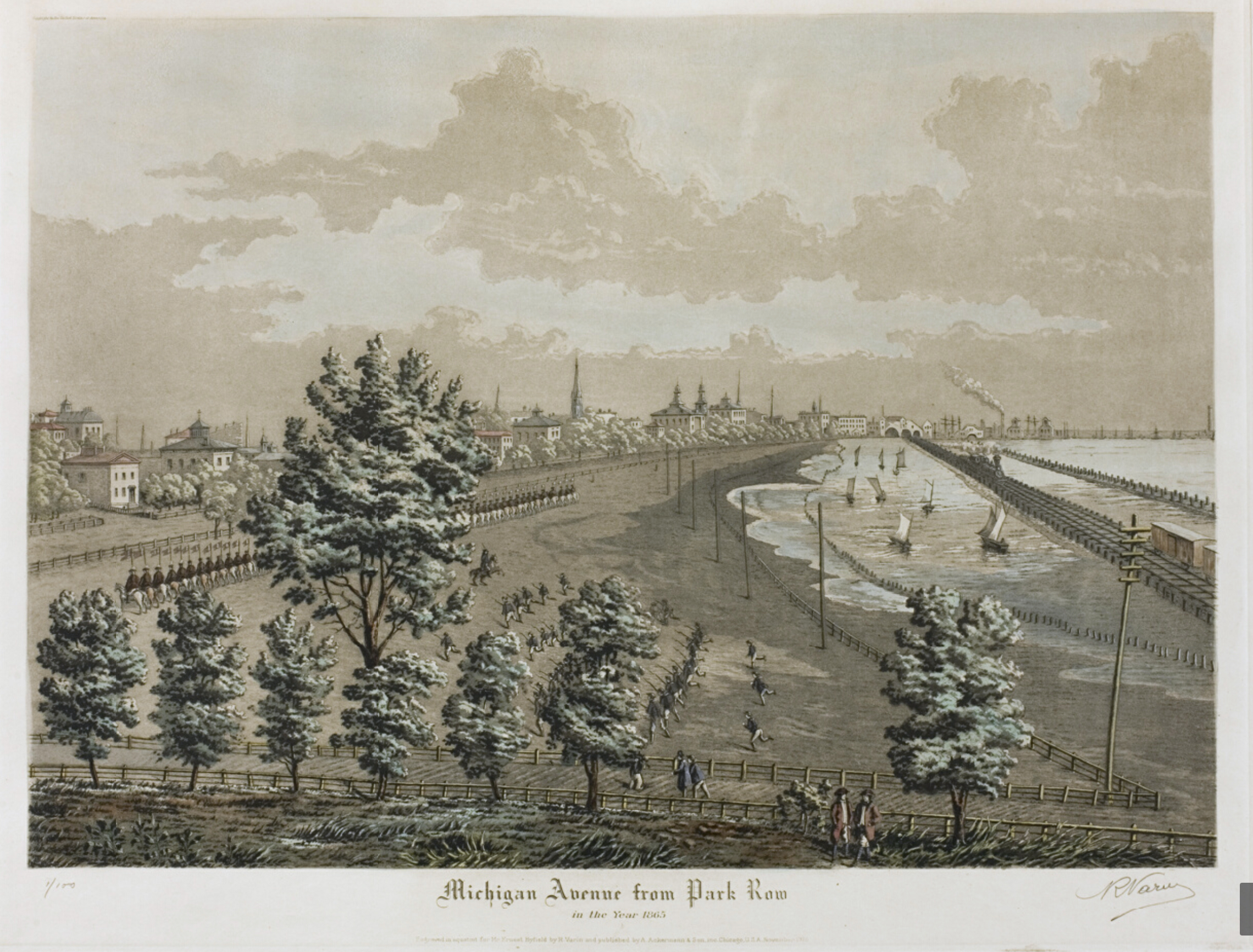
- Michigan Avenue from Park Row
“Engraved in aquatint for Mr. Ernest Byfield by R. Varin”
1926
‘Where did you find this man?’ Button wanted to know. ‘We have been trying to locate an aquatinter for years.’ I told him the story and added that hotel men had to be versed in a number of diverse and sometimes conflicting explorations. ‘We have to be good at locating things,’ I said.
I wanted to have the prints published under the proper auspices and quickly made a deal with Mr. Button. Ackermann was to publish twelve plates, which were to be destroyed after 100 impressions were taken from each. For compensation, I was to receive nos. 1 to 10 from each plate, and Ackermann would take the succeeding ninety and pay Mr. Varin for his work. The issue of the prints created quite a stir, and was a very successful financial venture for Ackermann…
The prints soon commanded a premium over the issue price of $40.00 and the most interesting subjects sold up to $80.00 and even $100.00 each. Ackermann went on to publish more Chicago views, from other Jevne and Almini subjects; and then Varin was commissioned to do engravings of old New York.
I had suggested to Varin that the ‘Engraved by R. Varin for Ernest Byfield’ be executed in Georgian script and ornament under each title. Varin was a modest man and the result of his modesty was that his name and mine appear almost invisibly in those first plates, and it takes a magnifying glass to reveal the fact that I ever had anything to do with them.
As Mr. Byfield has stated, Ackermann and Son continued the Varin series, producing nineteen additional prints. Some followed Jevne and Almini, others were new subjects. A number were smaller in size than the first plates. In quality, however, there was no change.
Altogether, the Varin series is a notable one, and any one having the full set should be excused for ragging about it. If anyone with a partial set wants to try and complete it, we will gladly supply a list of titles, recently supplied for us by Mr. Russell Button, successor to Ackermann and Son.
Chicago Tribune, June 1, 1948
A LINE O’ TYPE OR TWO
The City Invisible
For years the editor of this column has wondered how it happened that early Chicago—the city invisible that was swept away by the great fire of 1871—left such a rich record of its views and street scenes in the form of lithograph prints. The antiquarians have a habit of speaking of these pictures as the Jevne and Almini prints without comment on their origin, altho they form a notable album, envied by other cities. We are delighted, therefore, to find the story told in full in Chicago History, quarterly publication of the Historical society, and will proceed to pass it on.
Otto Jevne, & Norwegian by birth, and Peter M. Almini, & native of Sweden, established themselves in Chicago as interior decorators in the 1850’S. Their specialty was fresco painting, & craft they had learned before immigration, and their business flourished. In 1866 they announced a plan to publish & work called Chicago Illustrated in 25 monthly parts, each to contain at least four tinted lithographs of Chicago scenes, with descriptive text. Citizens were invited to subscribe at a rate of $1.50 per number.
The project was continued faithfully and to general applause for 13 months, and then dropped. Apparently the subscription receipts did not cover expenses. But at any rate, 52 prints were issued, and they covered the major points, of interest. They form a valuable historical record of Chicago’s architecture and life at the close of the Civil war, and are also respected for their art values.
The artist who deserves recognition for these fine lithographs was Louis Kurz of the Chicago Lithographing Co., founded in 1863. He was an Austrian who had settled in Chicago in 1852, and had worked here as a “scenic artist,” which probably means that he designed and painted stage settings. (Many & more famous artist has done likewise.) After the fire he moved to Milwaukee, where he established an oleograph company. He returned to Chicago in 1878 and formed a partnership with Alexander Allison. The firm produced hundreds of chromo-lithographs.
The Jevne and Almini lithographs begot the Varin aquatints, whose art values are higher because of their fine use of delicate color. In
1926 Ernest Byfield, hotel director, & collector of the old prints, took 20 choice specimens abroad in the hope of getting them reproduced in aquatint. In London he was told that aquatint engraving was an extinct art, and so he went on to Paris. There he saw a fine new aquatint in a shop window, and his hopes revived. He found the artist, R. Varin, who immediately undertook the commission at & reasonable price—$400 per plate with 100 prints. His first subject was the lovely view of the old Chicago skyline, called “Michigan Avenue from Park Row.” In small letters below the title of this picture you will find the legend, “Engraved by R. Varin for Ernest Byfield.”
Chicago Tribune, January 28, 1934
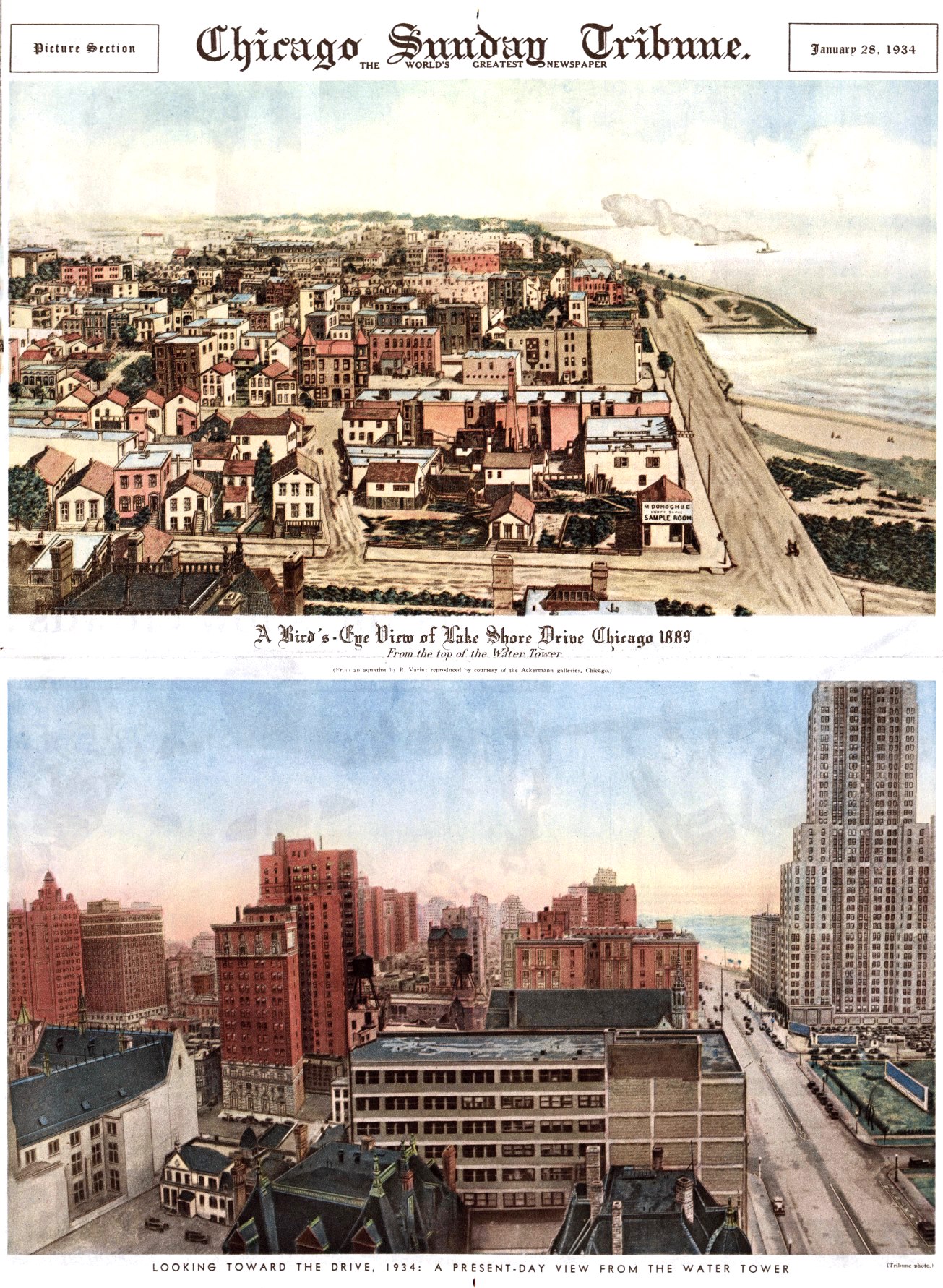
- A Bird’s-Eye View of Lake Shore Drive Chicago 1889
From the Top of the Water Tower
(From an aquatint by R. Varin, reproduced by courtesy of the Ackerman galleries, Chicago)
NOTES:
1 Ernest Lessing “Ernie” Byfield (November 3, 1889 – February 10, 1950) was a hotelier and restaurateur from the 1930s through the 1950s in Chicago. Byfield operated the Hotel Sherman Co., including the Ambassador East and West, the Sherman House Hotel, the Fort Dearborn and the Drake Hotels and The Pump Room and College Inn restaurants. Byfield is most famous as the creator and owner of The Pump Room, a restaurant and bar frequented by the luminaries of the stage and screen from the 1930s to the present.
