Building Name(s): 104-110 Lake Street
Life Span: 1856-1871
Address: 102-110 Lake Street Between Dearborn and Clark Streets,
Block and Subdivision:, 17, Original Town
Architect:
- Gager’s Chicago Directory for the Year, 1856
Barnum Bros., fancy goods, 110 Lake st.
D. B. Cooke & Co.’s City Directory for the Year 1859
Brand Edwin L., ambrotype gallery, 110 Lake, bds 328 State
Prince George A. & Co., (George A. Prince and Thomas Stephenson), melodeons, 110 Lake (See advt p 298)
Halpin & Bailey’s City Directory for the Year 1863
Brand Edwin L., photographs, 108 and 110 Lake, bds 34 Washington
Peugeot Peter, toys and yankee notions, 108 Lake, h. Buffalo, N. Y.
Halpin’s Chicago City Directory for 1864
Wheeler & Wilson Mnfrg Co., Arthur Farrar, agt 106 Lake
Chittenden George R., general agt. for Wheeler & Wilson’s sewing machines, 106 Lake, r. 364 Michigan av.
Brands E. L., photographer, 108 Lake, r. 17 Dearborn
John C. W. Bailey’s Chicago City Directory for 1867
Wheeler & Wilson, sewing machines, George R. Chittenden, agt 106 Lake. (See adv. outside cover.)
Stettheimer J. & Co. (J. Stettheimer, H. Goodman and S. Seltz,) whol clothiers, office 108 Lake
clothing and cloths, whoL 108 Lake
Vergho, Ruhling & Co. (Charles Vergho, Adolph Ruhling), yankee notions and fancy goods 104 Lake
Brand E. L., photographer 108 Lake, h same
Edwards’ Annual Directory in the City of Chicago, for 1869
Durham James & Co. (James Durham and DeWill E. Wood), mnfrs. and dealers in bedding and upholstery goods, 110 Lake
Edwards’ Annual Directory in the City of Chicago, for 1870
Vergho, Ruhling & Co. (Charles Vergho, Adolph Ruhling), toys, fancy goods and baskets, 104 Lake
Wheeler & Wilson’s Sewing Machines, Arthur Farrar & Co. gen agts. 106 Lake
Clapp William B. & Bro. jewelry and plated ware, 108 Lake
Edwards’ Annual Directory in the City of Chicago, for 1871
Vergho, Ruhling & Co. importers, 104 Lake, will remove 1st Jan. to 138, 140 and 142 State
Chicago Tribune, September 2, 1858
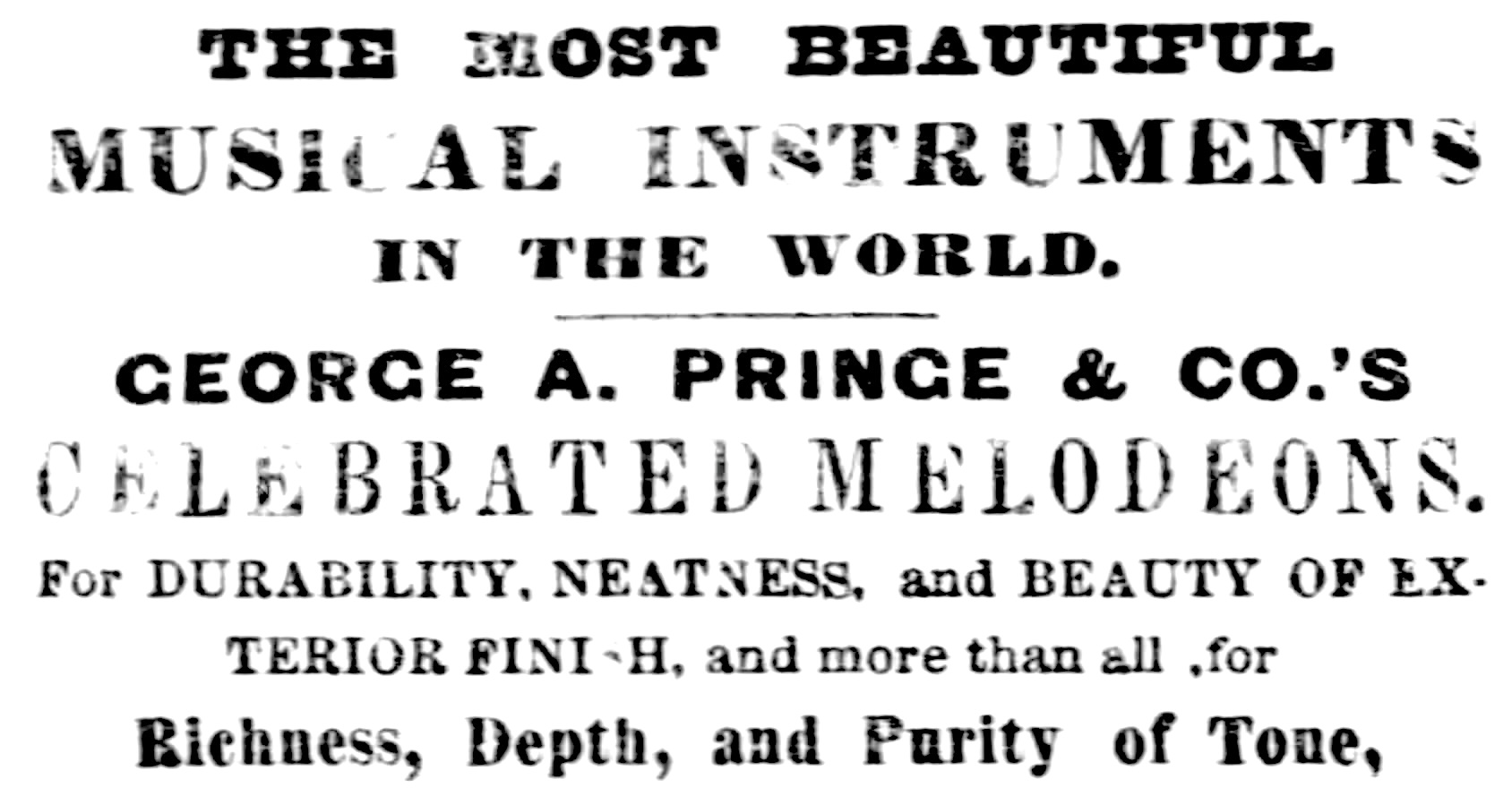 A very desirable feature, and secured to us by Letters of Patent, can only be obtained in Melodeons of our own manufacture. By means of this improvement Tenor and Treble Solos and Duets may be played with the full power of the instrument, while the Bass can be performed in a soft subdued one, not otherwise attainable. Our reeds are so constructed that the Melodeon remains in perfect tune.
Thousands of them have been in use for many years that have never needed any repairs whatever, and we believe there is no musical instrument that requires less expense to keep it in perfect order.
Our Melodeons are all cased in Rosewood and finished as smoothly as the best Pianos. They are compactly boxed for shipping, and the cost of freight is but little to any part of the United States. They are so arranged that any one can unpack and put them up without difficulty.
We have been awarded First Premiums for our Melodeons wherever we have exhibited them in competition with others, and we have the satisfaction of believing that Our Constant Aim to Excel is appreciated by the Musical public.
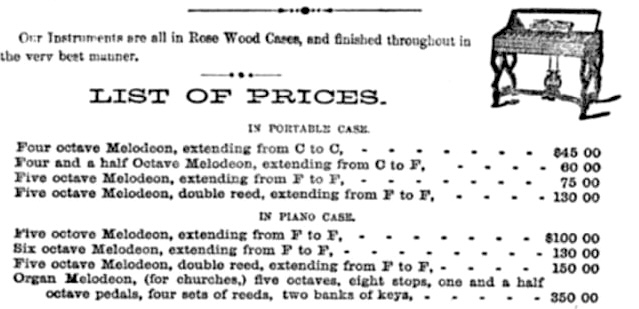
This last is a most magnificent instrument for Churches, Halls, and Concert Rooms. It has two banks of Keys, five set of Reeds, eight Stops, one and a half Octave Font Pedals, and one set of Reeds in Pedal Bass independent. It has all the power and volume of a $800 Organ, at less than half the cost, and is much less likely to get out of order.
We have recently established a
Wholesale Depot at 110 Lake street, Chicago,
For the purpose of enabling our Western customers to replenish their stock of Melodeons in the shortest possible time and upon the same terms as they have hereto fore been furnished from our Manufactory at Buffalo. We shall, at all times have on hand at this depot, a full assortment of all the different sized Melodeons of our manufacture, and respectfully solicit the orders of the trade.
Orders promptly filled, and each Melodeon warranted perfect, Address Geo. A. Prince & Co., 110 Lake street, Chicago, Illinois.
Western Railroad Gazette, November 21, 1863
The Wheeler and Wilson Sewing Machine.
So much praise from public and private sources, from World Fairs and State Fairs, from machinists and inventors, from the highest aristocratic class to the lowest mudaill stratum of society, has been written, spoken and sung of the Wheeler & Wilson Sewing Machine that it seems superfluous in us to add our little mite to the overwhelming verdict of the civilized world. Every country can testify to its fame, and every language has syllabled its praise. As the Monitor and Merrimac fight at once overthrew all preconceived notions of building war vessels, so has this wonderful invention created a complete revolution in the economy of every household. To the hard working family, It has come like an angel laden with unnumbered blessings. Health, happiness, a competence, and even wealth, it has brought to many a weary mother or wan seamstress, struggling through adversity to secure their daily bread. It has relieved many an aching head, soothed many & breaking heart, and made radi-ent with hope, eyes dim with weeping and forms bent down with poverty and toil. Hood’s desolate portrait of the seamstress has been superceded by one that does not offend the eyes or grieve the heart. Here It is:
- With fingers nimble and fine,
With features handsome and gay,
A lady sat in her pretty boudoir,
Joyfully working away.
Click! Click! Click!
In comfort she sat—like a queen,
And sang to the music merry and quick
Of a Wheeler & Wilson Machine!
If he “who makes two spires of grass grow where before but one existed,” has not lived in vain, what praise is too extravagant or honors too lavish for the man whose inventive genius crystallized from the realm of floating ideas and dim conjecture, a perfect work of Art like the Wheeler & Wilson Sewing Machine! Most assuredly he deserves with Whitney, Morse, Fulton and Ericsson, a place in the front rank among those whose God-given facultles have proved to mankind the perennial source of incalculable benefits.
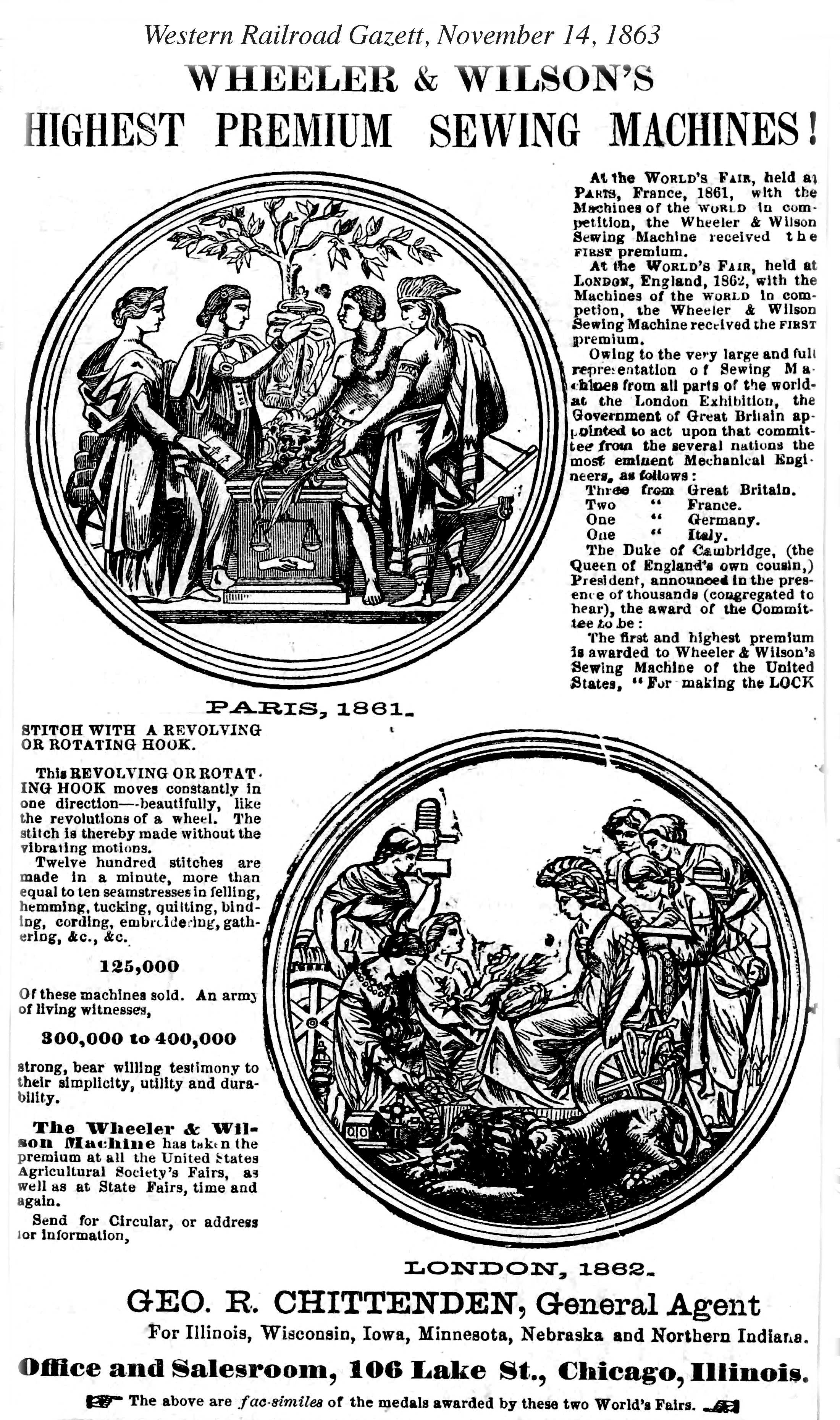
The universal adoption of this machine in all the mechanical, manufacturing and industrial departments of life, has rendered the public sufficiently familiar with its more prominent features. Over 125,000 have been sold, and the demand instead of abating, is perpetually increasing. Wherever used it has given perfect satisfaction. The “rotating hook” which is peculiar to this machine alone, revolving like a wheel without any vibratory motion, and making twelve hundred stitches a minute, is the most beautiful in design and effective in operation of anything we ever witnessed. In felling, hemming, tucking, quilting, binding, cording, embroidering and gathering, it ls equal to ten nimble-fingered sewers, and will do the work of a hundred in as many consecutive hours. An intelligent examination of this machine in comparison with others, will best illustrate its superior value, and this can be done nowhere in the West to so great an advantage as at the elegant rooms of the Western Agency of the Wheeler & Wilson Machine, No. 106 Lake Street. It is so simple in its construction that the most inexperienced can soon learn to regulate and run it with the skill and precision of a veteran operator.
It is imposalble to speak of the Wheeler & Wilson Machine anywhere in the West without mentloning its General Agent here, George R. Chittenden, Esq., who for so many years past has identified himself with its gradual onward and upward course, and staked every effort of mind and energy of body upon Its final triumphant success. That he is able while still in the youthful prime of life, to see and enjoy the ripe fruit of his labors, we do not attribute to good luck, but to good management, a thorough, general supervision and unremitting attention to the smallest business details. Uninfluenced by the jealousies or animorities of rival interests, he never swerves from the main object, but keeps it steadily in view. Of strict business habits, always just and honorable in his dealings, with a private character unblemished, he has earned by his own unaided efforts a position and standing in this community which is attained by few. With a dignity softened by uniform courtesy of manner, encouraging with large-handed liberality every patriotic or philanthropic work or noble and worthy charity, he aims ever to do his duty both as a business man and member of society in all the relations of life. As a model Agent, estimable man and valuable citizen, we cite Mr. Chittenden, therefore, as one of a thousand, and next to the surpassing beauty and intrinsic merit of the invention itself—the Wheeler & Wilson Sewing Machine, (we say it without fear of contradiction), owes its unparalleled success more to its General Agent, Mr. Chittenden, than to any other one man, or dozen men lying.
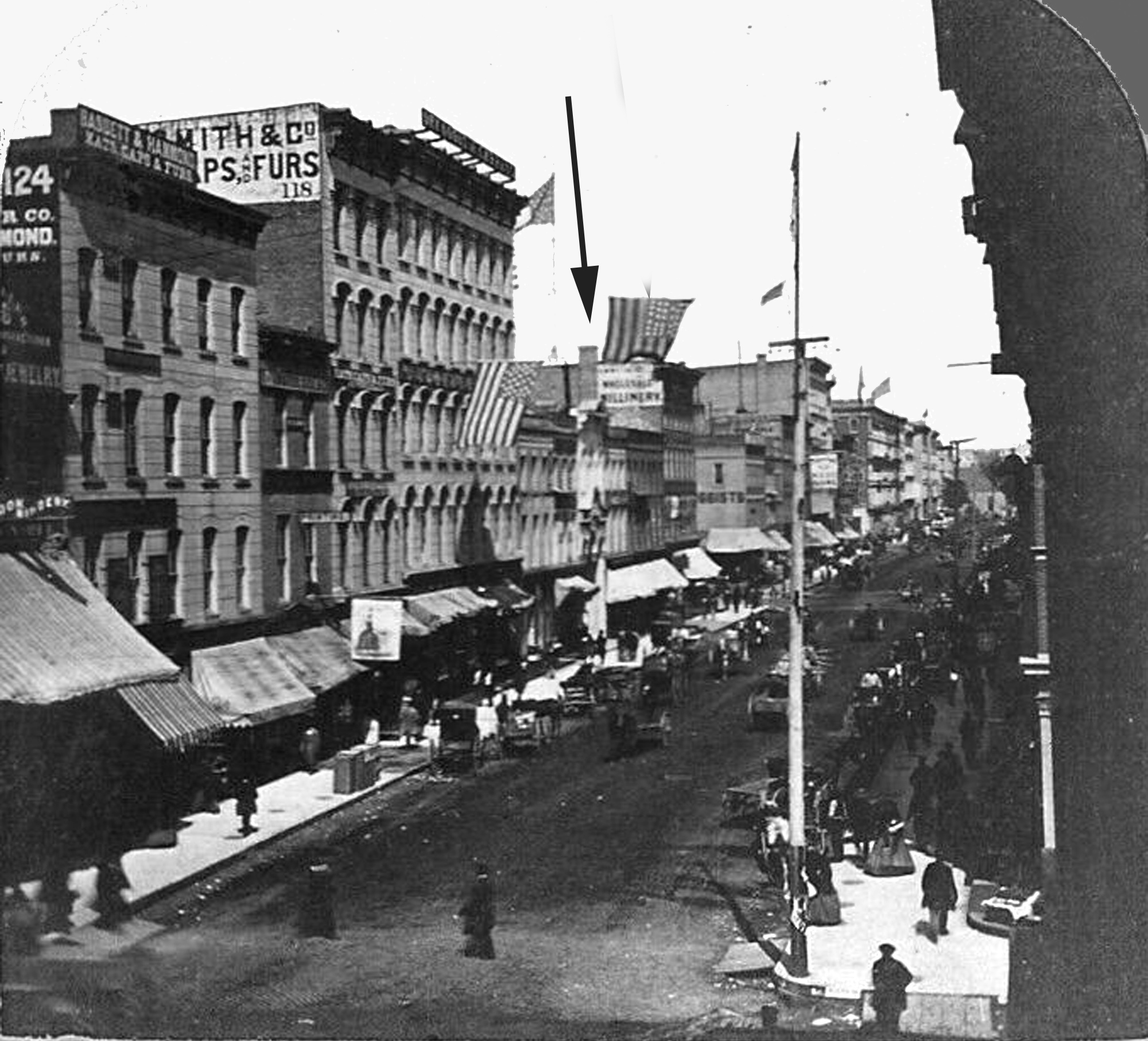
- Lake Street Looking East from Clark Street.
Arrow indicates approximate location of the Wheeler & Wilson building.
John Carbutt, 1866
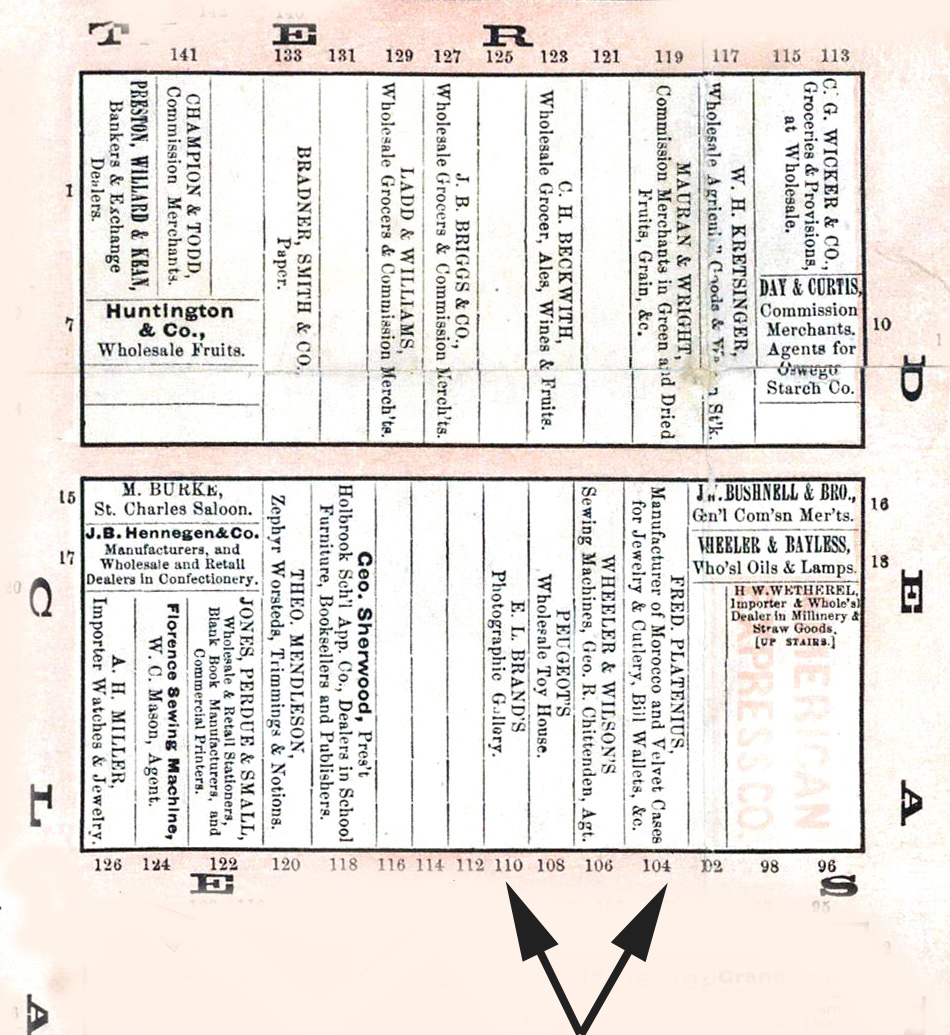
- 104-110 Lake Street
1862
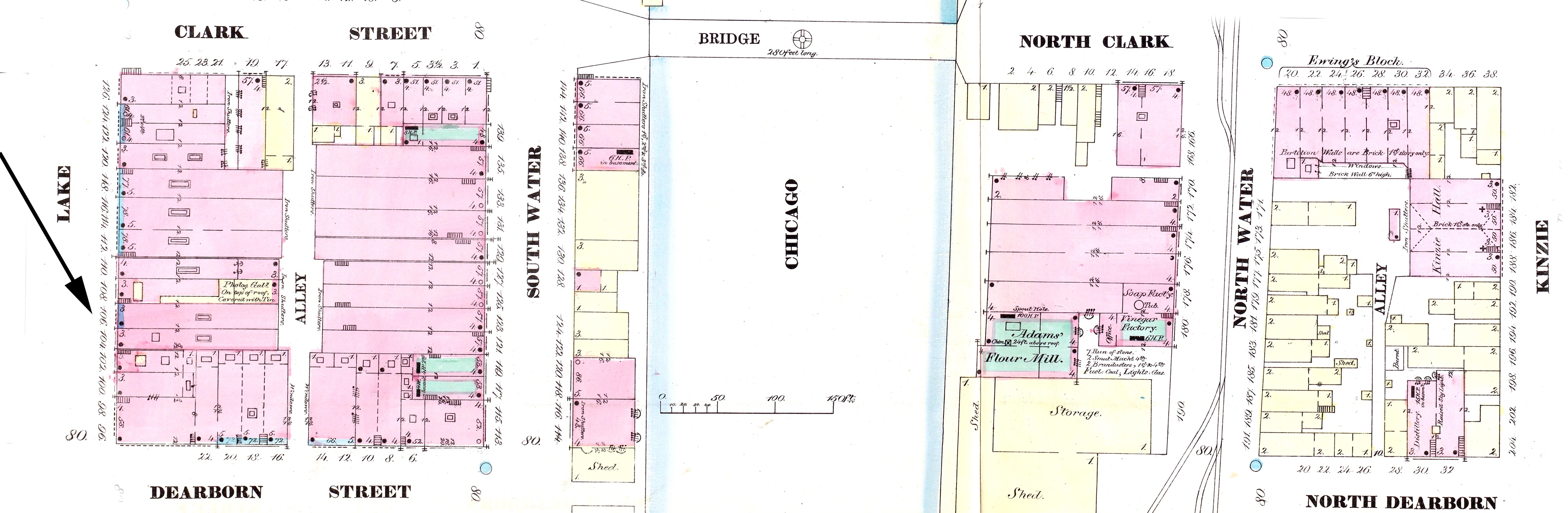
- 104 to 110 Lake Street
Sanborn Fire Insurance Map
1869

Leave a Reply