Building Name(s): Hall, Kimbark & Co.
Life Span: 1866-1871
Address: 80, 82 and 84 Michigan avenue, between Lake and Randolph
Block and Subdivision: 9, Fort Dearborn Addition
Architect: John M. Van Osdel
- Lakeside Annual Directory of the City of Chicago, 1867
Hall, Kimbark & Co., (Elbridge G. Hall, Seneca D. George M. and Daniel A. Kimbark), importers and dealers in iron, steel, nails and heavy hardware, 80, 82 and 84 Michigan
Lakeside Annual Directory of the City of Chicago, 1870
Hall, Kimbark & Co., (Elbridge G. Hall, Seneca D. George M. and Daniel A. Kimbark, and Benjamin W. Underwood), iron, steel, nails, hardware, &c., whol., 80, 82 and 84 Michigan
Chicago Tribune, September 19, 1866
New Improvements.-We notice that that portion of the city lying on Michigan and Wabash avenues, near Dearborn Park, is being rapidly improved in a most substantial manner, Messrs. Hall & Ayers, Hall, Kimbark & Co; J. Y. Scammon and Messrs. Bowen brothers and others are building stores there, fully equal to the best in the city. We call attention to the advertisement of four of these to rent. Early application will probably be requisite to secure a choice.
Chicago Tribune, November 10, 1866

A block of stores, five-story, on east side of Michigan avenue, fronting 190 feet on the avenue and extending 130 feel deep, the rear fronting Central avenue, six stories high. The store on the corner of Lake streets owned by Hale & Ayer, is 72 by 130 feet, the first floor supported by 119 iron columns. It will be occupied by the proprietors with their extensive business in irons. The adjoining building, 60 by 130 feet is owned by Hall, Kimbark & Co., and will also be occupied for an iron store. Washington Smith’s two stores, 20 by 180 feet complete the block, which is of the most substantial character, for wholesale business, and cost $172,000.
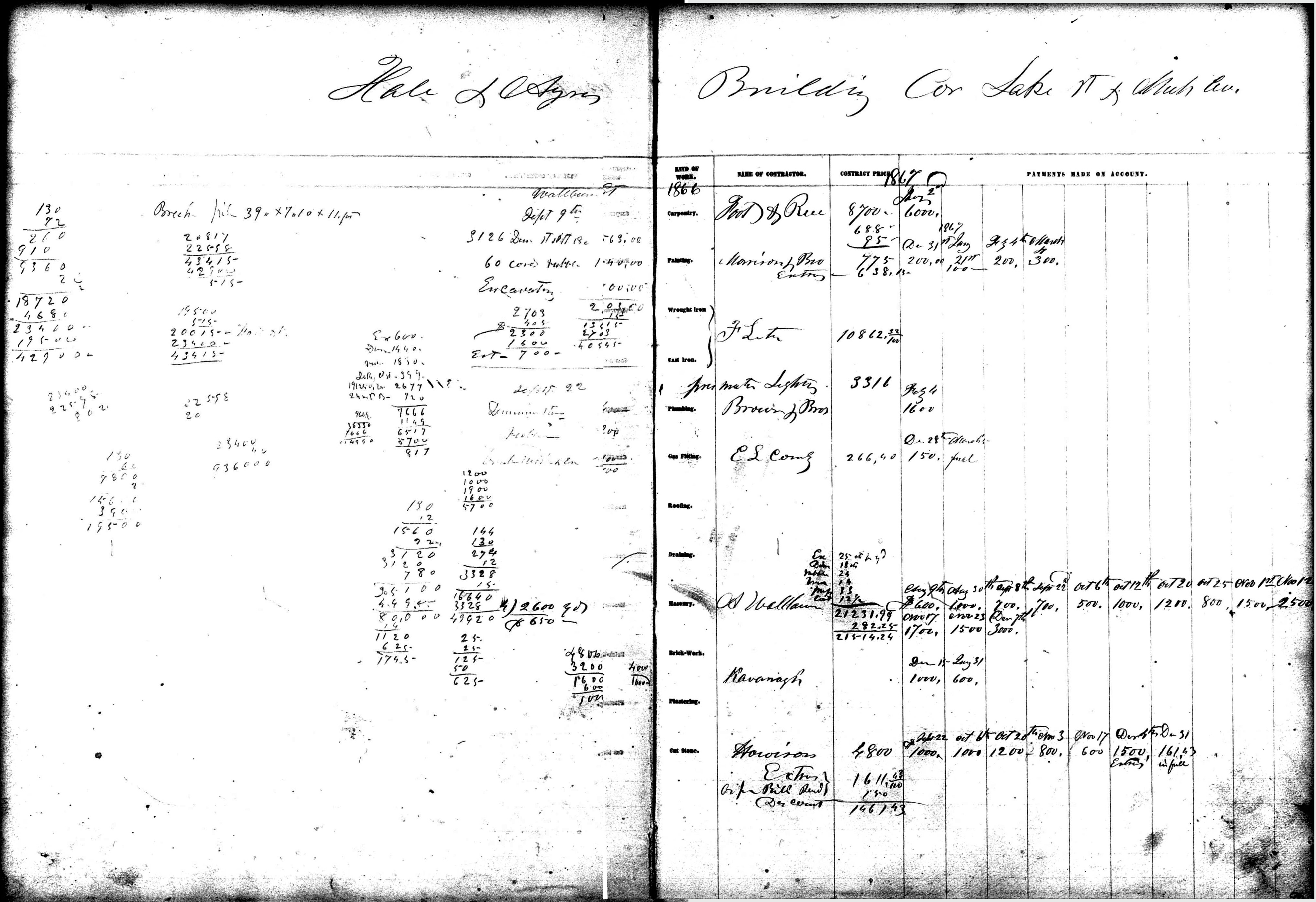
- Hale & Ayer Building
Van Osdel Accounting Books
1866

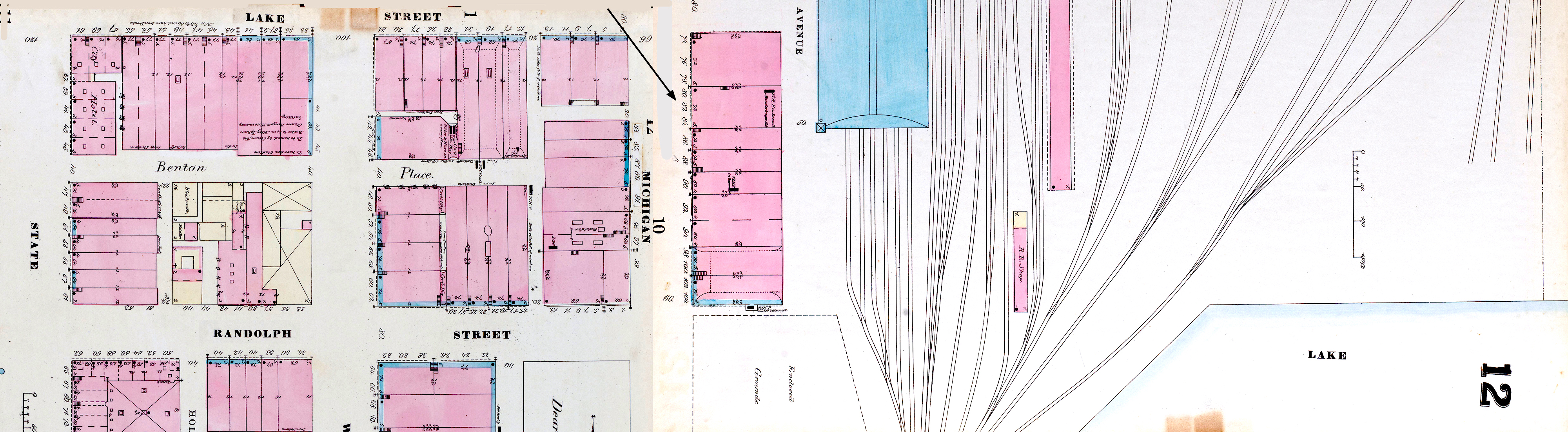
- Hall, Kimbark & Co.
80-82 Michigan Avenue
Sanborn Fire Insurance Map
1869
Chicago Tribune, October 10, 1870
It is one of the best evidences of the commercial success of the well-known heavy hardware firm of Hall, Kimbark & Co., that they have issued a Descriptive Catalogue of their stock in an elegant bound volume of over three hundred pages, profusely illustrated, printed on tinted paper, and published in the very best style of book-making. In addition to the space devoted exclusively to their own business, an appendix accompanies the work, giving various prominent facts connected with the metals, directions for seasoning and preserving timber, tables of the weights and values of metals, and money and measures of all countries. The work has necessarily been a very extensive one, but it will be a very welcome gift to the patrons of the house, as it will enable them to select from their stock without the expense of travel or the delay of correspondence.
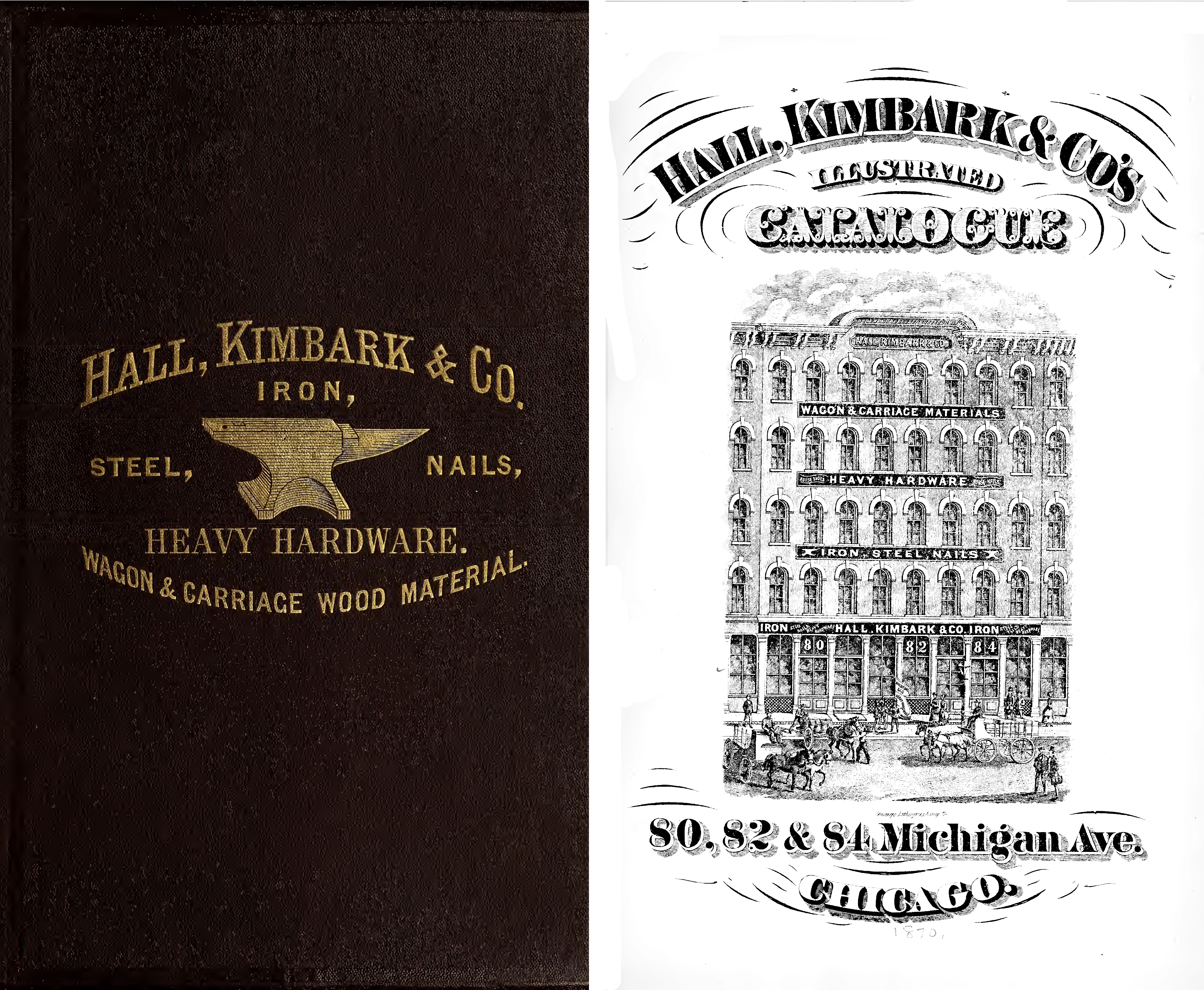
- 1870 Hall, Kimbark & Co. Catalogue.
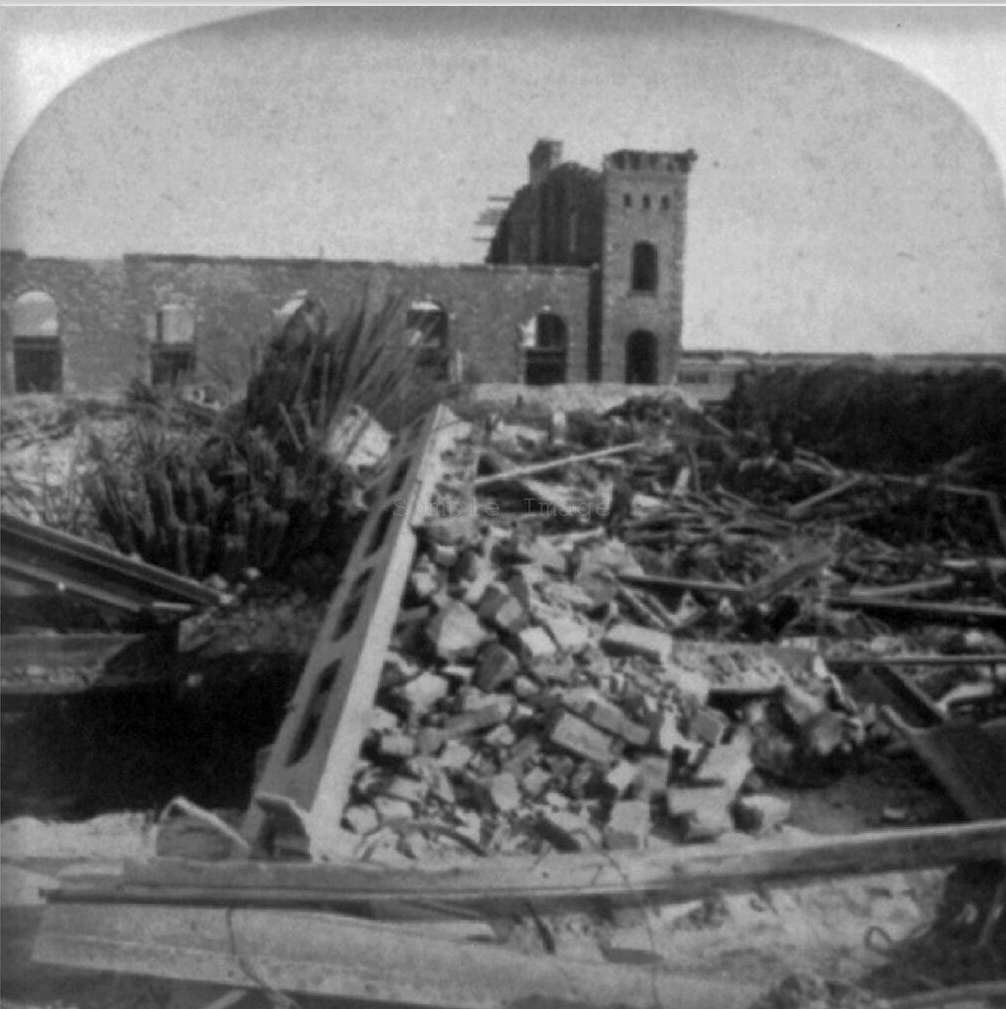
- The Ruins of Hall, Kimbark & Co.
80, 82, 84 Michigan Avenue
1871
A Biographical History With Portraits, of Prominent Men of the Great West. Illustrations in Steel, 1894
SENECA D. KIMBARK
Seneca D. Kimbark is one of the pioneers of the great iron and steel trade in Chicago, having been actively engaged in that business since 1853.
Mr. Kimbark is a native of New York State, born at Venice, Cayuga county, March 4, 1832. His education was a thorough one for those days, and was obtained by his own efforts. After graduating from the district school he attended the Geneseo and Canan daigua academies, and at the age of seventeen paid his tuition with money earned by teaching in the country schools. When he was eight years old, his parents moved to Livingston county, N. Y., and four years later he was set to work on his father’s farm . With the exception of the time spent in attending and teaching school in the winter months, he worked on the farm until he was twenty -one years old, or in the autumn of 1852, when Mr. Kimbark celebrated the event by removing to Chicago, where be engaged in the iron business, and soon became junior partner of the firm of E. G. Hall & Co. in the iron trade. In 1860 the firm name was changed to Hall, Kimbark & Co. In 1873 it was changed to Kimbark Bros. & Co., and in 1876 S. D. Kimbark became the sole proprietor of the im mense business. In the great fire of 1871 he was a heavy loser, but his business energy and tact brought him through difficulties that would have permanently hampered men of less courage and sagacity, and to-day his establishment is one of the largest of the kind in Chicago. During all the years since its founding, in 1853, its commercial integrity and high standing have been preserved. Some years ago Mr. Kimbark estab lished a large factory for carriage woodwork in Michigan, which was, in 1891, removed to Elkhart, Ind., where conditions were more favorable. It is now one of the largest and most successful factories of its kind in the United States. The factory proper is two stories high, 400×80 feet, and the engine house and bending room is 180×40 feet. Both are equipped with the finest machinery in the trade, most of which is original. In all his business career Mr. Kimbark has worked hard for the best interests of the iron trade, and his voice is potent for good in national assemblies where the iron interest is made a subject for investigation. His notions of business honor are so broad that never makes a distinction between commercial and moral integrity and the “tricks” of the trade have never found a place in his transactions.
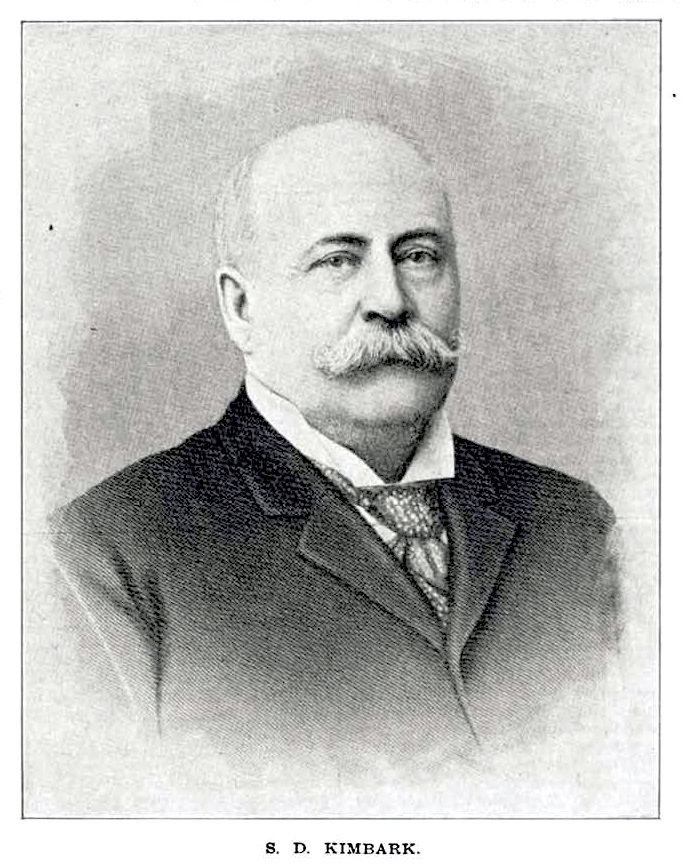
Mr. Kimbark was one of the three commissioners appointed to locate the South Park system, and it was fortunate for the future of Chicago that such a man was embraced in the commission. The park was located upon his notions of future necessity, though it is just to state that the other commissioners were in full accord with his views.
Mr. Kimbark is in no sense a politician, but takes an active interest in every question of municipal reform. While he is a Republican he is not a partisan. In his early life he was a Democrat, and was a warm advocate of the annexation of Texas. The repeal of the Missouri Compromise, however, made him an ardent aboli tionist, and on the formation of the Republican party he became actively identified with it . While one of his partners was in active service in the field, during the civil war, his brother, George M. Kimbark, at that time also a partner, was engaged in the organization of volunteer companies, notably the “Kimbark Guards.” The business of the firm of Hall, Kimbark & Company was meantime conducted by its senior members, Elbridge G. Hall and Seneca D. Kimbark, and furnished its full share of the sinews of the war which saved the Union and the Constitution . Mr. Kimbark has always refused all tenders of political preferment, and declined many nominations offered him .
He is a man of kindly and hospitable impulses. He has a charming home circle, and is also prominent in Chicago’s club history. He has been identified with the Union League Club almost since its organization, and has taken a lively interest in its affairs and advancement. He was one of the original members of the Chicago Club, a charter member of the Washington Park Club, and an influential member of the Calumet Club.
Mr. Kimbark was married September 25, 1856, to Miss Elizabeth Pruyne, daughter of Peter Pruyne, at one time State Senator of Illinois, and a colleague of Stephen A. Douglas. Mrs. Kimbark’s mother is a widow of the late Thomas Church, one of Chicago’s pioneers, and a man of great personal worth. Mrs. Kimbark is one of Chicago’s oldest daughters, whose birthday was inauguration day of its first mayor. She is a woman of good attainments, genial presence and engaging manners. Her name but seldom appears in current society news or in connection with public institutions; but her charities have been generous and con tinuous, and bestowed by her own hand. Four children have been born to Mr. and Mrs. Kimbark—two daughters and two sons. The eldest son, Charles A. Kimbark, is now financial manager of his father’s business, and a young man of great promise in the business world . The younger son, Walter, of equal promise, is at the head of the carriage goods department of his father’s establishment. Mr. Kimbark’s younger brother, Daniel A., who was a member of the firm of Kimbark Brothers & Company, died March , 1836. He came to Chicago at the close of the civil war, and up to the time of his death was identified with the above named house. Prior to 1882 he held office in the Apollo Commandery, Knights Templar , of Chicago, in which he had a host of warm personal friends; but ill health forced him intu comparative retirement. He married, in 1861, Miss Eliza Underwood, of Auburn, N. Y., who, with five sons, survives him .
The history of Seneca D. Kimbark is not an unusual one in Chicago, and yet it can be read with profit by all young men. It is a record of a poor country boy, who by pluck, integrity and steadfastness of purpose and business ability has become one of the most influential and successful merchants in a great city. He has attained wealth and position, and is honored and respected wherever his name is known.

Leave a Reply