Wheeler’s Building
Life Span: ~1849-1871
Location: SE cor South Water and Clark
Architect:
- D. B. Cooke & Co.’s City Directory for the Year 1859
Wheeler Hiram, prod and com mer, Clark se cor S. Water, h. 137 Michigan
Halpin & Bailey’s City Directory for the Year 1863
Wheeler’s Building, S. Water, se cor Clark street
Preston, Willard & Kean, (David Preston, Josiah F. Willard and Samuel A. Kean,) bankers, 1 Clark
John C. W. Bailey’s Chicago City Directory for 1867
Wheeler’s Building, S. Water, se cor Clark street
Edwards’ Annual Directory in the City of Chicago, for 1869Wheeler’s Building, S. Water street, southeast corner Clark.
Edwards’ Annual Directory in the City of Chicago, for 1870
Wheeler’s Building—South Water street, southeast corner Clark.
Edwards’ Annual Directory in the City of Chicago, for 1871
Wheeler’s Building—S Water street, se. cor. Clark.
Chicago Tribune, June 14, 1859
HIRAM WHEELER, PRODUCE COMMISSION MERCHA.
Corner Clark and South Water-sts,
Wheeler’s Building, (Up Stairs,) Chicago, Ill.
Chicago Tribune, November 23, 1892
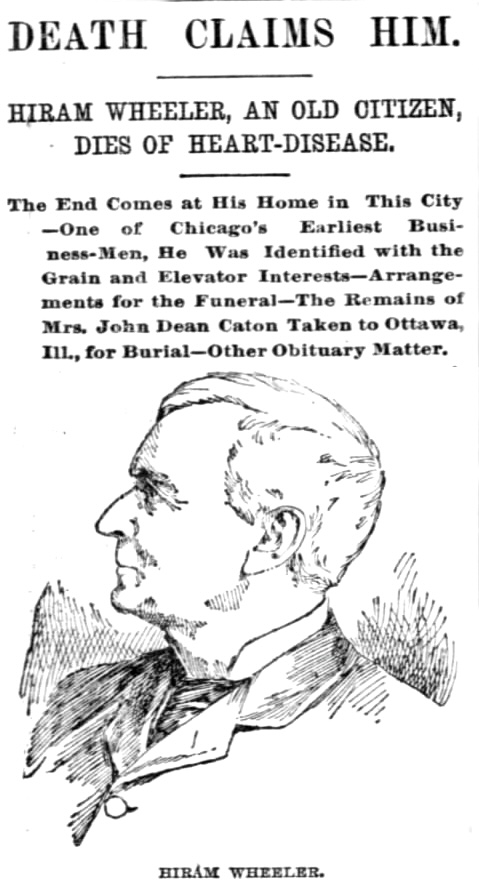 Hiram Wheeler, one of the best known residents and one of the oldest representatives of the grain interest, although he severed active connection with it years ago, died yesterday morning at his residence, No. 2962 Michigan avenue. Mr. Wheeler was 83 years His death was due to heart disease. The circumstances of his death were pathetic. He returned home last Friday complaining of what he supposed so be an attack of ayspepsia. The following morning he did not rise from his bed, but his illness seemed to yield to medical treatment and Monday it was said that he would soon be well. Yesterday morning at 8 o’clock he grew suddenly worse. A maid servant was dispatched for Dr. Frank Carey, the family physician. He was not at home and Mr. Wheeler’s son, Arthur, went for another physician. He found Chamberlain, but the latter could reach house Mr. Wheeler was dead. He passed away quietly and peacefully. Mrs. Wheeler, Arthur Wheeler and the nurse were the only persons in the room.
Half an hour of later the news was telephoned| to the Board of Trade the Chicago club and within a short time the wide circle of Mr. Wheeler’s friends had heard of his death. All day yesterday messages of condolence were sent to the family residence. George H. Wheeler, one of Hiram Wheeler’s sons, took charge of the funeral arrangements. A telegram was sent recalling Charles W. Wheeler, the second son, who with his wife was in New York and about embarking for a winter’s tour of Europe. Messages were also to Frederick A. Wheeler, the eldest son, who resides in Baltimore, and Eugene Wheeler, the fourth son. He is in California and it is doubtful if he can return in time for the funeral.
Sympathy of Friends.
Mr. and Mrs. George Henry Wheeler had issued cards for a reception at their residence last night, on which occasion their daughter, Mabel, was to make début in society, an event to which her grandfather had looked forward with great pleasure. Messengers were of course sent in all directions bearing the sad news which necessitated the abandonment of the reception.
In the afternoon many friends of the family called and expressed their sorrow at Mr. Wheeler’s death. One of the callers was a representative of the Chicago Grain Elevator companies, the corporation to which the Wheeler elevators were sold. His mission was to announce that on the day of the funeral all of their elevators would be closed and that the foremen of the different houses tendered their services as active pall-bearers. This offer was accepted. The funeral was appointed for Friday. The services will be held at the family residence by the Rev. Clinton Locke of Grace Episcopal Church.
The list of honorary pall-bearers will be aunounced today or tomorrow. The interment will be at Graceland.
Hiram Wheeler had long been a familiar figure in the commercial life of Chicago. He withdrew from active business years ago, yet his habits of industry formed in his youth and love for business pursuits sent him nearly every day to the neighborhood of the grain market, with which he became identified as an elevator man in the earliest days of the Board of Trade. He was born in New Haven, Vt., in 1809. He came of a long-lived family. Three of his brothers lived to ages between 75 and 80. Two of them, like Hiram Wheeler, died suddenly. At the age of 14 Hiram Wheeler left school and became a clerk in a village store. Four years later he went to New York City, where he was in the employ of Stephens, Lippincott & Co. and later in that of J. W. & R. Leavitt. In 1832 he came West, locating at Niles, Mich., where his brother, Tolman Wheeler, was engaged as a general merchant.
After a short time Hiram Wheeler became his brother’s partner. They both removed to La Porte, Ind., in 1834, continuing in the general merchandise business. In 1836 Tolman Wheeler withdrew from the La Porte business, which was afterwards carried on by Hiram Wheeler alone. Seven years later the latter became a partner in the firm of Tolman Wheeler & Porter. This house had been established in 1839 and it was engaged in the forwarding, transportation, and commission business at St. Joseph, Mich. The house was successful. lt owned a line of boats and shipped grain from the country around. The building of the Michigan Central railroad put an end to the firm’s business in St. Joseph. The members sold their boats and removed to Chicago.
A warehouse had been secured by the brothers on South Water street, just east of Clark street. In July, 1849, they founded the firm of H. and T. Wheeler. Up in the top story of the warehouse was a windlass around which marched an old horse. When a farmer drove to the warehouse with a load of wheat to sell and the price had been agreed upon a bucket was let down from the windlass and the old horse hauled it up loaded. George Henry Wheeler, President of the Chicago City railway company, tells how on days when school “did not keep” he earned a silver quarter by acting as driver of the horses.
Joined the Board of Trade.
Hiram Wheeler of course joined the Board of Trade. He became one of its prominent figures. In 1855 he was elected President of the body.
A year prior to that time Tolman Wheeler withdrew from the warehouse business. Some time after this Hiram Wheeler abandoned the business for the lumber trade, but he subsequently returned to the elevator business.
Chicago made tremendous strides as a grainshipping point in the next few years and the development of the elevator interest was correspondingly rapid. In 1863 Mr. Wheeler formed a partnership with Wesley Munger. The firm controlled the Munger & Armour, Galena, and Hiram Wheeler elevators on the North Side. These were burned up in the fire of 1871. The Galena elevator was rebuilt, and a new structure known as the Air Line elevator was erected. The firm controlled the six elevators formerly owned by Munn & Scott, and besides it built some years after the fire two more enormous houses, known as the Iowa and St. Paul elevators. The capacity of these eight houses was 6,000,000 bushels.
Mr. Wheeler withdrew from active participation in the business after the great fire. He visited the office frequently, but affairs were managed by his sons. In 1889 the elevators were sold to an English corporation known as the City of Chicago Grain Elevators (Limited) and all of the sons stepped out.
Hiram Wheeler in the last twelve or fifteen years of his life was accustomed to spend a few hours daily around the Board of Trade. His manner was uniformly genial and affable. He was a great favorite about the board. His constant companion of late years was his son Eugene, and between them existed a strong affection.
Mr. Wheeler was a member of the Chicago club and the Washington Park club. He was fond of home life and loved to have his family about him. His oldest son, Fred A. Wheeler, manager of the Baltimore and Ohio elevator system, lives in Baltimore. His other sons live in this city.
Mr. Wheeler was married in 1833 to Miss Julia Smith in New York City. His widow survives him and he leaves seven grandchildren one great-grandchild. The amount of his estate is understood to be large.
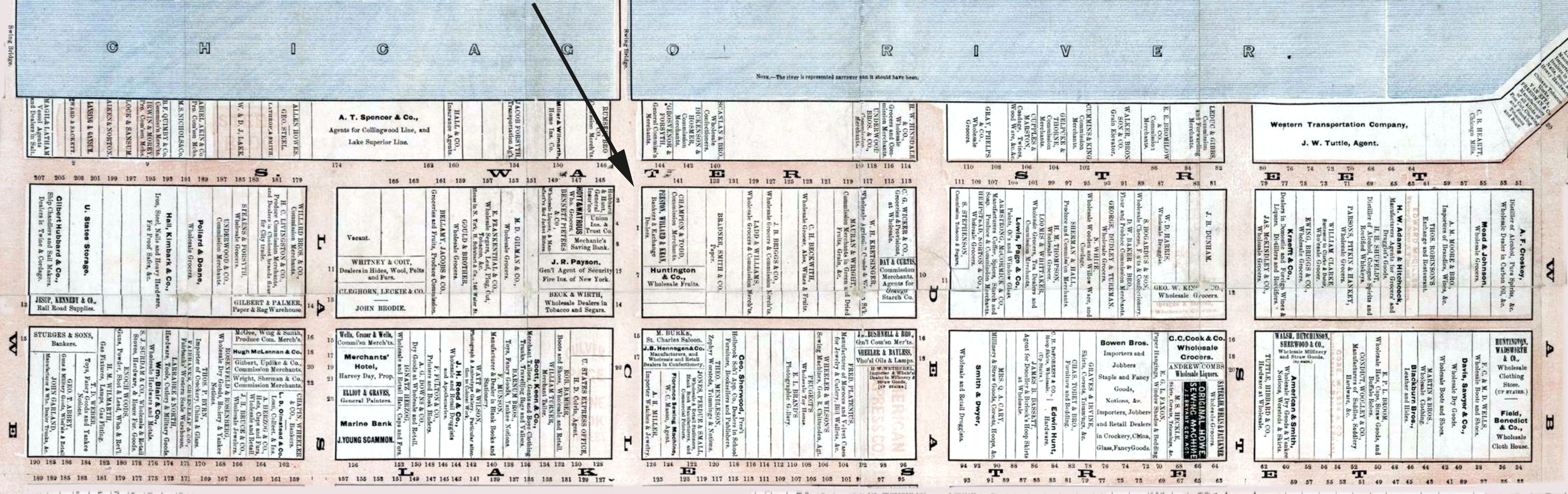
- Wheeler’s Building
1862
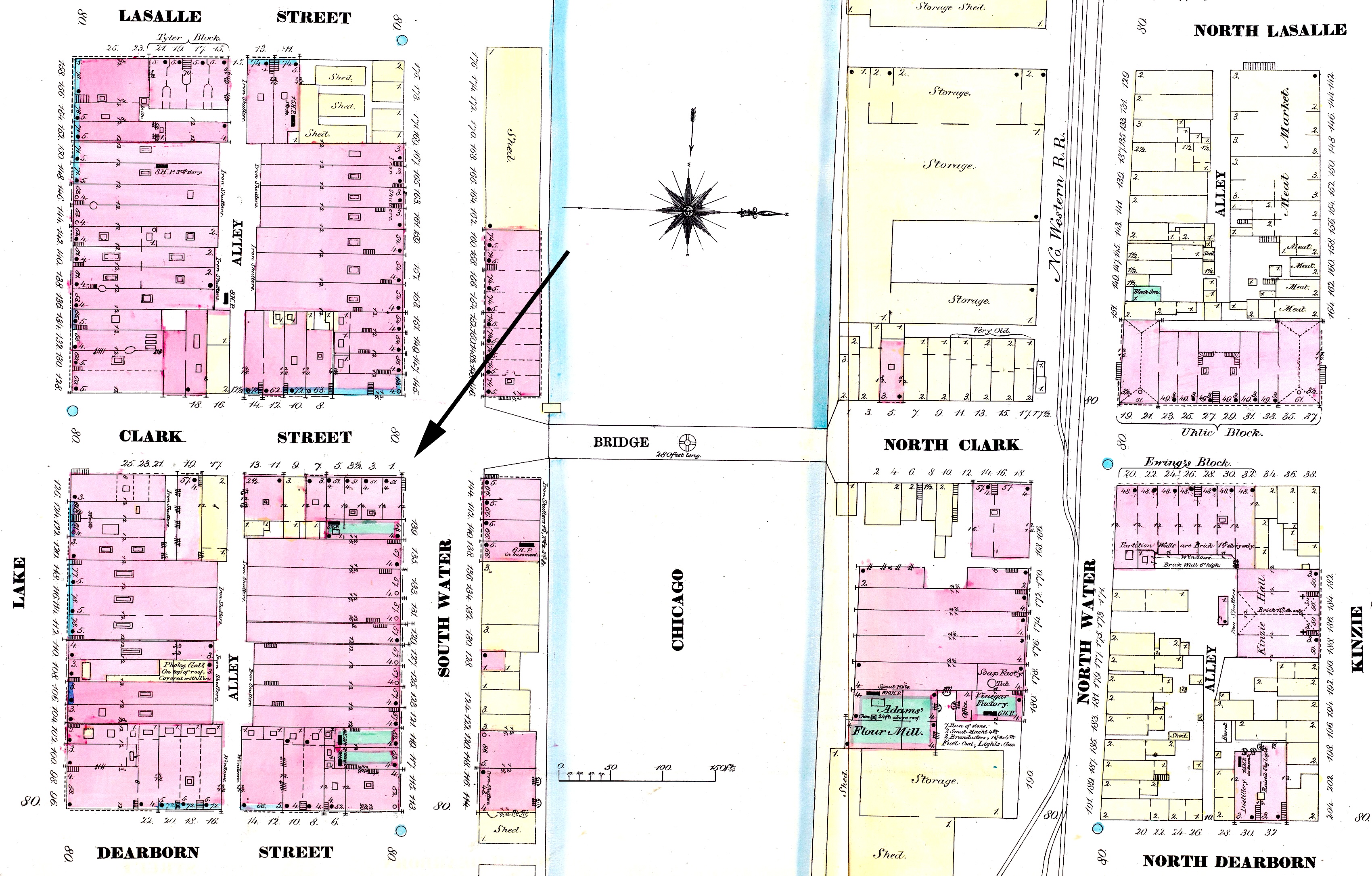
- Wheeler’s Building
Sanborn Fire Insurance Map
1869

Leave a Reply