Chicago Tribune 25, 1857
SEEKING FOR SIGNS WHERE THEY MAY BE FOUND.—It is stated that Nero fiddled while Rome was burning. A few nights ago the police force was employed in tearing down signs, removing boxes, rolling away barrels, and dragging off chains from the premises of the owners at midnight, while scores of burglars on adjacent streets were pursuing their work of house-breaking unmolested. The next morning, the plunder of the police was piled up on State street, north of the market-house.— Where the burglars deposited their plunder is not known, to the police, at least. Instead of one force being employed to prevent the other from stealing, both were busy as bees in molasses, in carrying away the property of our citizens under cover of the night.1
Yesterday there were the following articles on State street not recovered by their owners:
- A three cornered sign belonging to Stinson & Hamilton, real estate agents.
A sign marked “Offices Rooms to let, enquire at Gold Pen Manufactory.”
A three cornered sign, belonging to Gestenberg & Westerman, importers of English, French and German goods.
A. C. Oretel, German real estate dealer, with numerous papers pasted upon a flat board sign, about 16 inches wide.
A three cornered sign, belonging to S. Rattle, shoe dealer, on Clark street-about two feet high and eighteen inches wide.
A high three cornered sign, marked Books for sale.”
A small over-head sign board, marked Hardware.” The bulletin sign of the Western Despatch and U.S. Express Co.
Spaulding & Toby’s Job Printing, three cornered sign, a little one, about “Minion” size.
Wells & Adams’ Job Printing sign, “Agate” size.
C. C. Kelsey’s little four cornered daguereotype sign.
Staple & Chamberlain, board sign of Forwarding & Commission business.
Lewis & Page, wholesale dealers in oils, &c., a very beautiful three cornered sign.
Parmlee, hat manufactory, little four cornered sign, about two feet high, quite harmless.
J. Moore’s three cornered Tobacco and Cigar bulletin.
Galloway & Co.’s swing sign, a very small one.
A little swing sign, marked “Dentist.?
Fay & Co’s manufactory–two board signs.
Mrs. Barson, hair dressing and shampooning, four square box sign. Also two barber’s poles-owners not known.
Sherman & Cole, Attorney’s tin shingle.
A flag marked “Auction this day”
Besides the the above were several dray loads of boxes, barrels, kegs, firkins, grindstones, counters, car wheels, cable chain and ship tackle, and a one horse wagon.
If there are any of this wicked generation seeking for a sign, they will know where to look for it after reading the above.
Frank Leslie’s Illustrated Newspaper, July 11, 1857
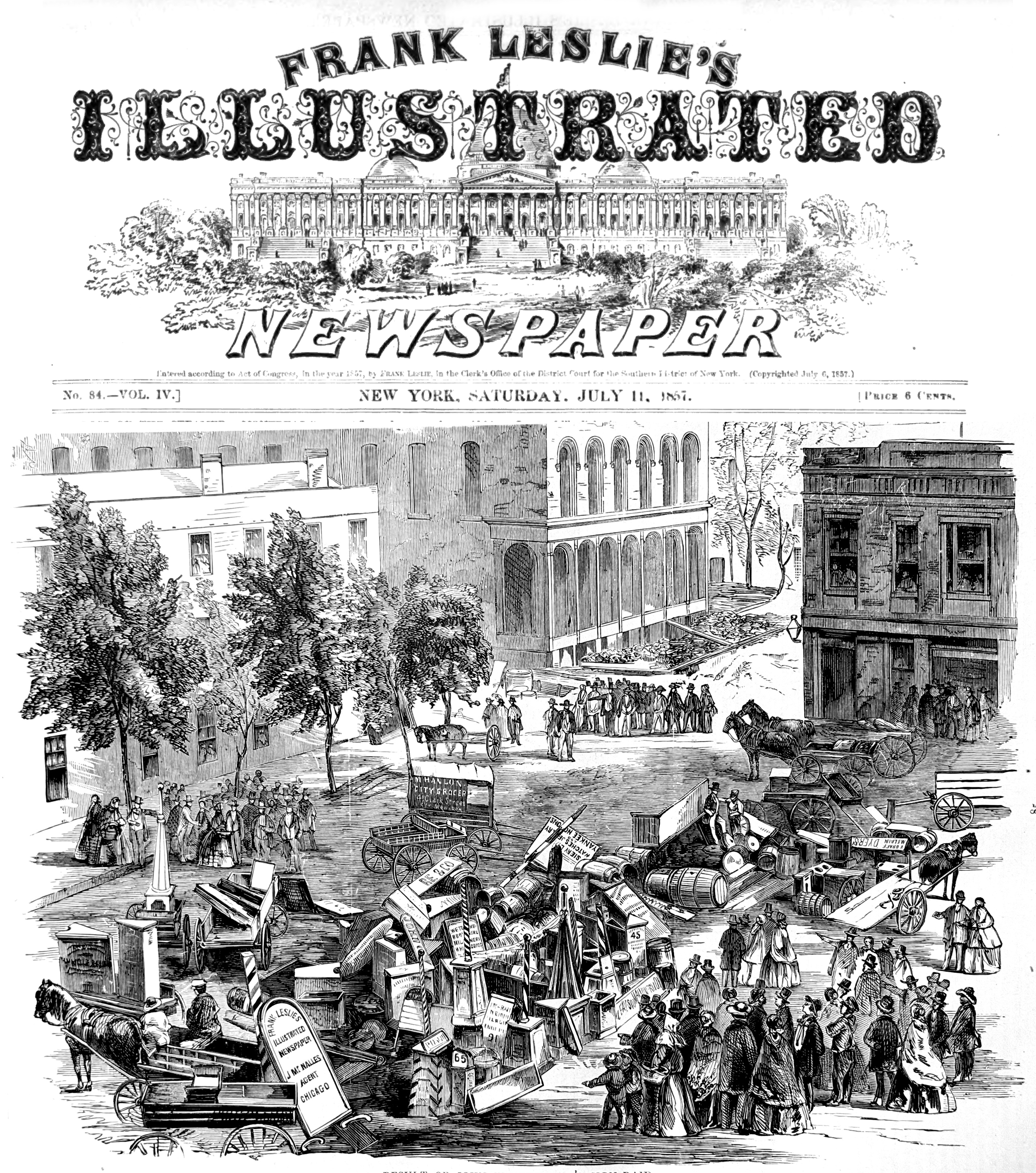
- The “pile” of prisoners guilty of obtruding on the sidewalks, arrested in the streets of Chicago, on the night of June 18. Photographed by C. H. Lillibridge, Chicago.
GREAT EXCITEMENT IN CHICAGO—ARREST OF INTRUDERS ON THE SIDEWALKS.
The Common Council of Chicago a short time since, with an eye to the just rights of the mass of the citizens of that city, passed an ordinance divided into four sections, the spirit of which was, that hereafter people occupying stores, and consequently receiving merchandise, or erecting awning posts, or otherwise using the sidewalks for especial purposes, should remember that foot-passengers had rights, and were to be considered. Now the good people of Chicago affected by the law, as is the case elsewhere, paid not the slightest attention to its requirements, but considered it as “tinkling brass and sounding cymbal.” Unfortunately, however, the chief magistrate of Chicago, from the proclivities produce by the neglect of his early education, considered that a law on the statute book should be enforced, and under this old fogy delusion he issued orders that all articles obstructing the sidewalks, contrary to the statute made and provided, should forthwith, as were harlots, robbers, drunkards, and vagrants, be arrested, and, this being accomplished, should be “deposited in the open street at the north end of Market Hall.”
Our admirable picture represents the group of prisoners as they appeared at daylight after their arrest. Taken by surprise, they were, without exception, caught in the very act of “treason,” and, conscious of guilt, they permitted themselves to be marched off without opposition to durance vile. As morning dawned, and the good citizens whose property had been seized comprehended what had been done, then went up a how! of dissatisfaction such as was never before heard among the Chicagoans. The friends of the Mayor were delighted, his enemies, as in duty bound, declared that he had violated the constitution, and committed rape upon their most sacred rights; while some more desperate declared that he had, by this last atrocity, done enough to “damn any man who had sufficient character to be reached ;” “that he had put his foot in it;” and “got the wrong shout by the ear.” On the other hand, the cry rose, trumpet-tongue above the din, “If the laws are wrong, repeal them,” and with this war cry they manfully maintained “the ground.”
The noise and confusion supposed to be peculiar to the siege of Troy, the conquest of Grenada, the battle of Buena Vista, and the fall of Sebastopol, it is justly said, will, in literary importance, hereafter have to “vamose the ranche;” in the expressive language of poetry, being “no whar,” eclipsed, snuffed out, leaving not a lingering look behind, when compared with the ever-to-be-remembered onslaught and consummate victory of the Chicago “perlice,” on the glorious night of the 18th June, a night most remarkable in coincidence, following the day after the gallant triumph of our forefathers on Bunker Hill!
It is stated that on the night ever to be immortalized in song, the Mayor, with his army of police, who acted as infantry—his draymen, who flanked the invading column as flying artillery—and drivers, who performed the part of voltigeurs, all duly uniformed, labelled and numbered, with banners flying and determination in every eye, deliberately charged on the complained-of “street encumbrances” and, with rare exceptions, “carried the enemy” as chaff before a hurricane. One division of the army, the artillery carts, attacked a platoon of big-bellied East Indians (in the shape of sugar barrels), and without a struggle, they surrendered themselves prisoners of war, and off each man marched with a hogshead, and the cry of “To the Forum—to the Forum” rent the air. Another party, the infantry “perlice,” bore down on the barbers’ poles, and a barbar-ous piece of work it was. The victims were made prisoners of war, and as they moved along the bloody stripes were plainly visible. Then followed a body of Syracuseans (who were found concealed in saline casks), and as they trudged along their paths were strewed with the “salt” tears they shed. But this was not all! Our valiant army, not content with such a conquest as we have recorded, besieged the stronghold of the ancient and venerable “John Barleycorn,” and despite the genuine “spirit” displayed, it fell, and by its very fall made its brave conquerors to reel and stagger! Even the dangerous and thorny paths of the “law” were violated—the laboratory was invaded, and those regions where “vile drugs and compounds” are dealt out had to “cave in.” In truth, the privilege which the softer gender claims of mankind was here denied, and the domains of muslindom were most effectively stormed, and crinolines, from necessity and not from choice, swept the dust.
One old dray-horse taken into custody strongly objected to the humiliating position in which he was placed. It was in vain, however, that he shook his formidable ears, elevated his heels, or switched his magnanimous tail—he was consigned to the ignominious group of rebel sugar barrels, treasonable molasses casks, including cable chains and heavy-hearted grindstones; there he stood, his ribs advertising for oats, and his eyes dropping tears that hay was worth fifty dollars a ton; but he occasionally indulged in a “horse laugh” as he beheld the multitudinous group of show-cases, milliners’ bonnet-blocks, merchants’ boxes, grocers’ barrels, barbers’ poles, saloon signs, literary depot advertisers, and other articles too numerous to mention—all higgledy-piggledy, suggesting to his mind, so full of horse, that the world had been kicked into a “heap” by the insane heels of a monster jackass.
It was an interesting scene to witness the “mourners” as they assembled around the dead, wounded and captured, for the purpose of recognising “the remains” and conveying them to a secure resting-place. Some were frantic with grief and indignation, and vented their feelings in sobs, moans and threats. Others appeared more resigned, and seized upon the lost and wounded and exultingly bore them away.
“Here’s my blessed pole,” shouted a barber with ecstacy; and my blessed sign,” echoed a pawnbroker; “and my shingle,” announced a shystering lawyer, adding at the same time, in a loud voice, that he was ready, if any injured party desired it, to sue the city for a small fee in advance. “By the howly jabers, but that’s me swill-tub,” shouted an Irishman, who was delighted because things looked like a “rebillion.” “Thunder an’ ouns! who heaved my anchor?” inquired a sailor. “Who stole my wagon ?” And robbed me of my ash-box?” asked a couple of small grocers. “And may the devil take the sowl of the mare for robbin’ my spalpeens of their pertatees and shirts!” prayed a scrawny Irishwoman, who knelt on the pavements, the very picture of indignation and despair. “Fetch out John Long for Mayor, he’s the man for eakal rights and the constitution!” shouted vociferously a discharged policeman. Alas! and strange to tell, McNally’s Frank Leslie’s Illustrated Newspaper sign did not escape the general arrest.
As the day wore on, the rich lawyers, the hundred thousand dollar merchants, and the exemplary church members, got together in back parlors, and expressed their surprise that Wentworth would treat them just the same as he did poor milliners and petty shopkeepers. They dreaded that things had come to a pretty pass, when their dry goods could no longer occupy the sidewalks and crowd common people into the gutters. They wanted to know what was to be expected of a city government that made no distinction in favor of such respectable men, but treated all people alike. They declared that they wouldn’t stand it, and that their grindstones and molasses, their grist mills and soft soap, their whiskey casks, bales and moral pocket handkerchiefs, their pure syrups and vitriol bottles, their hand-saws and green cheese, their anvils, their white beans and tracts, should be on the sidewalks, or they’d know the reason; whereupon they all groaned. and went out to encourage the low people to openly break the laws, which they would only do in an underhanded way. Meanwhile the ladies who tear their silk dresses on dry goods boxes, the tall sons of York and other places whose intellectual bumps have oft collided with lawyers, doctors’ and brokers’ sign-boards, and a vast concourse of “the peple,” bless Long John and his army.
NOTES:
1The State Street market-house contained twenty stalls and was located on State and Madison streets. In 1853 a new omnibus line ran along Madison street from the State Street market-house to the Bull’s Head Tavern on the southeastern corner of South Western plank road (Ogden).

Leave a Reply