Steel’s Block
Life Span: 1858-1871
Location: 178-184 South Water street, Northwest corner LaSalle and South Water
Architect: Unknown
- D. B. Cooke & Co.’s City Directory for the Year 1859
Steel’s blk, S. Water nw cor La Salle
Steel George & Co., (George Steel, William Clark and Solomon McKichan), packers and com mers., W. Randolph nwc. Jefferson, office 2 Steel’s blk
Halpin & Bailey’s City Directory for the Year 1863
Steel’s Block, LaSalle, nw cor S. Water
Steel George & Co., (George Steel, Soloman McKichan, and James Steel,) prod. com. mers., and pork packers, W. Randolph n.w.c. Jefferson; office 1 Steel’s blk., 180 S. Water.
Lathrop & Smith, (George A. Lathrop and J. Willard Smith,) com. mers., room 3, Steel’s blk.
Lake W. & D. J. (Wells and David J.,) com. mer., 182½ S. Water. and proprs. hay press W. Madison, n.w. cor. Morgan, and 3 Market
Halpin’s Chicago City Directory for 1864
Steele’s Block, LaSalle, nw cor S. Water st.
Steel George & Co., (George Steel, Soloman McKichan, and James Steel,) prod. com. mers., and pork packers, W. Randolph nw cor. Jefferson; office 1 Steel’s blk., 180 S. Water.
Howes Allen, com. mer., 178 S. Water, r. Halsted, sw. c. W. Washington
Edwards’ Annual Directory in the City of Chicago, for 1866
Steel’s Block, LaSalle, nw cor S. Water st.
John C. W. Bailey’s Chicago City Directory for 1867
Steel’s Block, LaSalle, nw cor S. Water st.
Edwards’ Annual Directory in the City of Chicago, for 1867
Steel’s Block, LaSalle, northwest corner South Water st.
Edwards’ Annual Directory in the City of Chicago, for 1870
Steel’s Block—LaSalle street, northwest corner South Water st.
Edwards’ Annual Directory in the City of Chicago, for 1871
Steel’s Block—LaSalle street, northwest corner South Water st.
Chicago Tribune, January 11, 1854
Petition of George Steel and others, owners of property on south side of the River, between Clark and Wells streets, desiring that no action be taken on widening the River at that point for the present: Referred to committee on wharfing privileges.
Chicago Tribune, April 3, 1860
Shipments of Lumber to St. Louis,
Messrs. Editors:—”Shipped by John Allen’s St. Louis and Chicago Lumber Merchants’ Line (office No. 178 South Water street) thirty-two canal boat loads of lumber from March 12 to March 31, twenty days.” This almost seems incredible for one single line, but our lumber merchants will sustain its truth. One may go up and down the creek more or less every day, canal open, and find with a very few exceptions that John Allen is the only man loading boats. If one asks a captain who is losing his boat, the answer immediately is, “John Allen.” If we go into a lumber merchant’s office, and if otber parties are trying to get loads, the answer generally is, “We have some, but go to John Allen and see about it.” On inquiry of a lumber merchant from St. Louis a few days ago, who did the larger share of their shipping, the same old answer, “John Allen.”
After making so many inquiries and always getting the same answer we came to the conclusion that we were getting humbugged, or John Allen was doing more business than we supposed it was possible for one man to do, and to satisfy ourselves we called on Mr. Allen yesterday and got a correct statement of the name of each shipper’s boat and the consignee of 32 boars loaded by him. We don’t pretend to say that John Allen’s line is the only line of canal boats on the canal, but we do say that thus far this season he has shipped more lumber by one-half than all the rest of the lines put together, and to show that we mean what we say, we will pay for the insertion of a card in this paper gratis for each separate line, if they all combined together can show one half the shipments in the same length of time. Than John Allen no man stands better among the lumber merchants generally, and a more industrious, accommodating and sociable man can’t be found in the business, and his line bears the same reputation on the Illinois river that it does in Chicago and St. Louis. We have just seen a letter from Beesley Brothers, Bath, one of the largest corn shippers on the Illinois river, saying that they were loading all of John Allen’s line of boats, as fast as they came, at a price one cent higher freights than any other boats were getting. This statement may be doubted by some; the documents may be seen at No. 178 South Water street that will satisfy all. This is comparatively a new line of first class canal boats, just commencing on their second season, and from the way it takes the lead we think there is no danger but what it will have its share of business. We certainly think Mr. Allen has a right to feel proud of his line from the many warm friends he has gathered around him in so short a time.
C. Y. T.
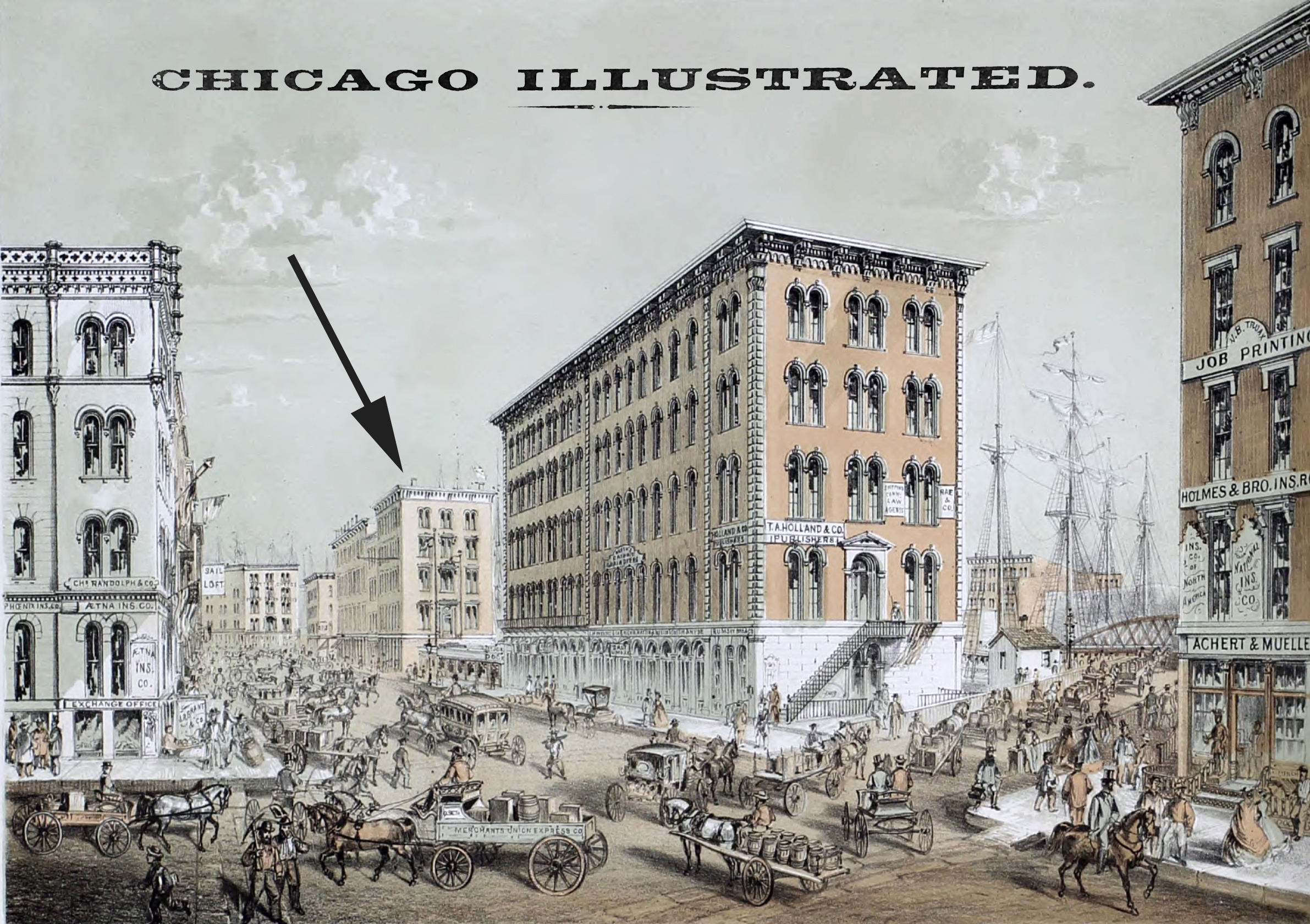
- Chicago Illustrated, August, 1866
The view is taken from South Water Street, east of Clark, looking west. It exhibits the southern approach to Clark Street bridge being open and travel suspended. The block west of the approach to the bridge is devoted to commercial business, and is occupied by insurance agencies, forwarding and commission merchants, brokers and others. The view extends westwardly to Franklin Street. Steel’s Block is indicated by the arrow at LaSalle, followed by Aiken’s block and the Board of Trade building on the northeast corner at Wells.
Chicago Tribune, March 23, 1865
DEATH OF GEORGE STEEL, ESQ.
Another of the early pioneers of Chicago greatness has gone from among us, departed to that home whence the emigrant never returns, George Steel, Esq., ever since 1837 identified with Chicago interests, died at noon yesterday, at his residence on Michigan avenue, near Madison street, of general debility, aged sixty-eight years.
The deceased was born in the year 1797, near Dundee, Forfarshire, Scotland, where his father owned and operated a small mill. At an early age he was apprenticeundee banker, with whom he remained, enjoying the confidence and esteem of his employer, until his twenty-seventh year, when he emigrated to Canada, and resided in Montreal and vicinity thirteen years. The first year after bis arrival in Canada he was employed on a steamboat plying between Montreal and Quebec, in the capacity of purser; he was afterwards one of the contractors tor the building of the Cornwall canal, and also was engaged for many years in the manufacture of iron. In 1838 he removed to Massena, New York, established and carried on the manufacture of water lime; removed to Lockport, Illinois, about the year 1837, and, in company with Mr. Hiram Norton, erected cement mills in Lockport and Utica: he also became contractor on the Illinois and Michigan Canal, built the Sag Feeder, and was first to introduce steam dredges the Chicago River. He removed to Chicago in 1841: and thence forward up to his death he was engaged in the grain, packing, and shipping business in this city.
Mr. Steel was emphatically a lever in urging forward the car of progress in our city; ever among the first to move forward. His name appears on the list of the “old thirteen” who signed the call for a meeting on the 13th of March, 1848, to establish a Board of Trade in Chicago, and he was one of the most active members of the Board when organized. He was chosen President at the first meeting of the Board, held in their new rooms on the corner of Clark and South Water streets, in April, 1852, and bore the honors and responsibilities of the office for two years. He was also prominently engaged in pushing through that great work—the Galena and Chicago Railroad, and was a member of its first Board of Directors. He was also President of the Chicago Mutual Insurance Company. His business enterprise did not diminish with his advancing age; scarcely two years ago he built one of the largest and best elevators in the world. He was a member of the St. Andrew’s Society in this city; was elected President at one time, but declined to serve. The Society will attend his funeral.
The deceased was married twice. The first time in the year 1829, and again in 1863; nine children were born to him, eight of whom are still living; one of his sons, James, served as an aid in Gen. McClellan’s staff till that officer was relieved; one of his daughters is the wife of Mr. Wilkins, British Consul for Chicago. He leaves a property valued at $450,000.
Mr. Steel was a business man of rare ability and unimpeachable integrity; he was a true patriot, and none more than he longed and prayed for the speedy restoration of the Union. He lived scarcely long enough to see the fulfillment of his aspirations. He will be sadly missed in the social and business circles of which he was at once an ornament and an invaluable member.
Chicago Tribune, March 24, 1865
DEATH OF GEORGE STEEL, ESQ.
Action of the Board of Trade-Resolutions?
The death of George Steel, Esq., was made the subject of appropriate action yesterday by the Board of Trade, of which the deceased was an old and highly valued member.
Colonel Hough spoke briefly of the decease?, and passed a glowing enlocy on the man and his virtuee. He offered the following:
- Whereas, Providence, in its wise purpose, has removed from our midst by death, George Steel, Esq., one of the fathers of this Board, and
Whereas, By the death of Mr. Steel this Board has lost one of its ancient landmarks and one of its most respected and influential members; therefore be it
Resolved, That the members of this Board, while they bow with submission to the decrees of Providence, tender to the friends and relations of the deceased their heartfelt sympathy in their bereavement.
Resolved, That we, as a Board, feel that we have lost by the death of George Steel, Esq., one of it: brightest ornaments, and whose commercial integrity and honor is worthy of emulation by all.
Resolved, That the members of this Board will attend his funeral from bis late residence, No. 116 Michigan avenue, to-morrow.(Friday) at 2 o’clock, and that a copy of these resolutions be sent to the family or the deceased, and entered upon the records of this Board.
W. D. Houghtelling, Esq., in seconding the resolutions, spoke as follows:
- Gentlemen of the Board of Trade:
I do not propose to occupy your time by making any lengthy remarks, but I feel that it is good for us, and most especially due to the memory of our late respected associate—once President of this Board—that we stop for a short time the excitement of trade to commemorate the virtues of him who, since our meeting yesterday, has left us for that land from whence no traveler returns. As for myself. I would say that should feel as if I had left something undone that I ought to have done, were I to remain silent at this time. When the sands of life have run out—when all that is left of mortality is returning to the dust from whence it came, there is a sorrowful satisfaction still left us, and that is to bear testimony to the high character and superior qualifications of him who, having gone before, has left us an example by which we may be stimulated to higher purposes and objects. My acquaintance with Mr. Steel dates back almost to my youth, and in all that time, whether the skies were bright with promise, or clouds of commercial disaster threatened, he was always my steadfast friend. His counsel to the younger members of the Board was far from any selfish consideration. His advice was founded upon large experience and to follow it was wisdom. Some fifteen years ago I was connected with Mr. Steel for a short time in carrying out a commercial enterprise, involving for those days a large amount of means and responsibility. It was then that l became more intimately acquainted with those admirable qualities of head and heart, which, perhaps, were known best to those with whom he was the most intimate. From that day to this very hour there never has been any abatement of my high estimate of his character. As a commercial man, he was in an eminent degree possessed of all the essential qualities necessary to the attainment of position, and the respect of his fellow men. His standard of commercial excellence was a high one. A man of unbending integrity himself, he demanded the same of others, and nothing short of this would correspond with his idea of principle. In his business intercourse with men he did not know, his first consideration was, Is he honest and capable? When his mind was satisfied upon this point, he had faith in that man so long as his confidence was not abused. I have known him to loan money to aid men whom he considered worthy, and in other cases to give his signature for thousands without one dollar of security, and that, too, when he knew such investments would be a total loss, should he be mistaken in the integrity and truthfulness of the borrower. Principle, not money, was the standard by which he estimated his associates, and by this rule he was willing to be judged himself. All honor to such men?
Mr. Steel was one of the originators of this Board of Trade, and was also one of its first Presidents. He discharged the duties of the office creditably to himself, and in a manner greatly conducive to the best interest of this Board. To him, as much as to any other man, may be ascribed the happy distinction of having, by his honorable exertions and influence, brought this Board up to its present high position. In later years, many of us have noticed his course as an arbitrator in important cases upon which be reluctantly served. In all such matters he was the Ajax or this Board—his example in this should be particularly kept before us. His judgment was never swerved by friendship or prejudice. Firm as adamant against every influence excepting right, justice and equity—guided by sound discretion and commercial knowledge—he swept away all disreputable agencies and sharp practices, and gave decisions that were seldom appealed from and never set aside. But Mr. Steel’s works were not confined to the business circles that center in this hall. Noted for his interest and liberality in nearly all the movements that have taken place, having for their object the advancement of the prosperity of our city, his name is honorably connected with many important enterprises so familiar to all, that it is unnecessary to dwell upon them here. In his social relations he was distinguished for the beauty of his character; an earnest friend, possessed of a warm heart and a kind and genial disposition, he greatly endeared himself to those who came closely within his influence, and by them his memory will be warmly cherished. I have but little more to say. To us on Change—a commercial veteran, full of honors and years, ripe in the respect and veneration of his associates, has balanced his earthly books, and now hie final account is made up. But little is left for us to do. Men die, but their deeds live after them. Let his example in all that is good be a guide for us who are left behind, and all will be well.
The resolutions were then adopted unanimously, and the meeting adjourned in respect to the memory of the deceased.
Chicago Evening Post, November 13, 1867
City Postographs.
—The Northern Transportation Company has already arranged for quarters at No. 1 Steel’s block opposite tbe dock, recently destroyed by fire.
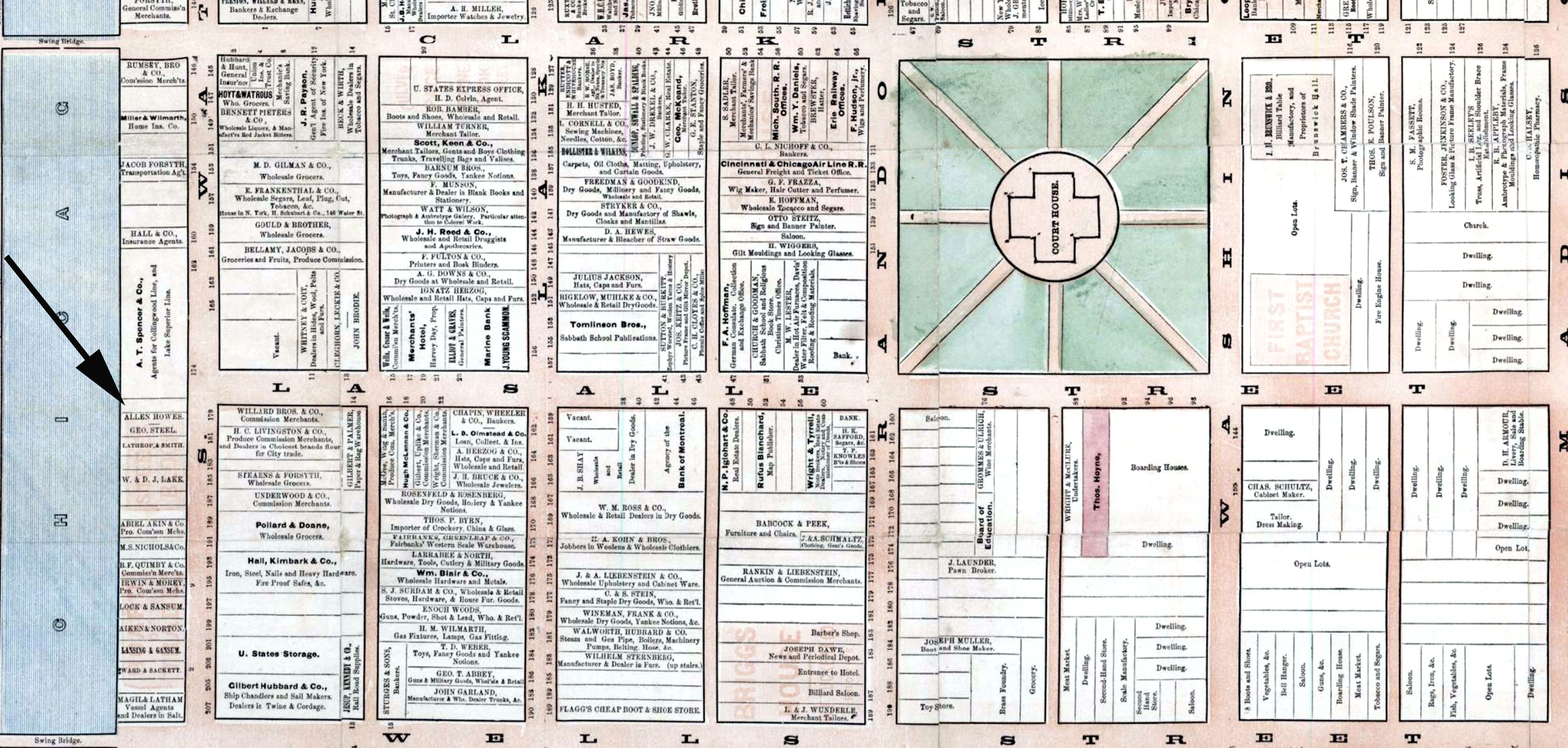
- Steel’s Block
1862
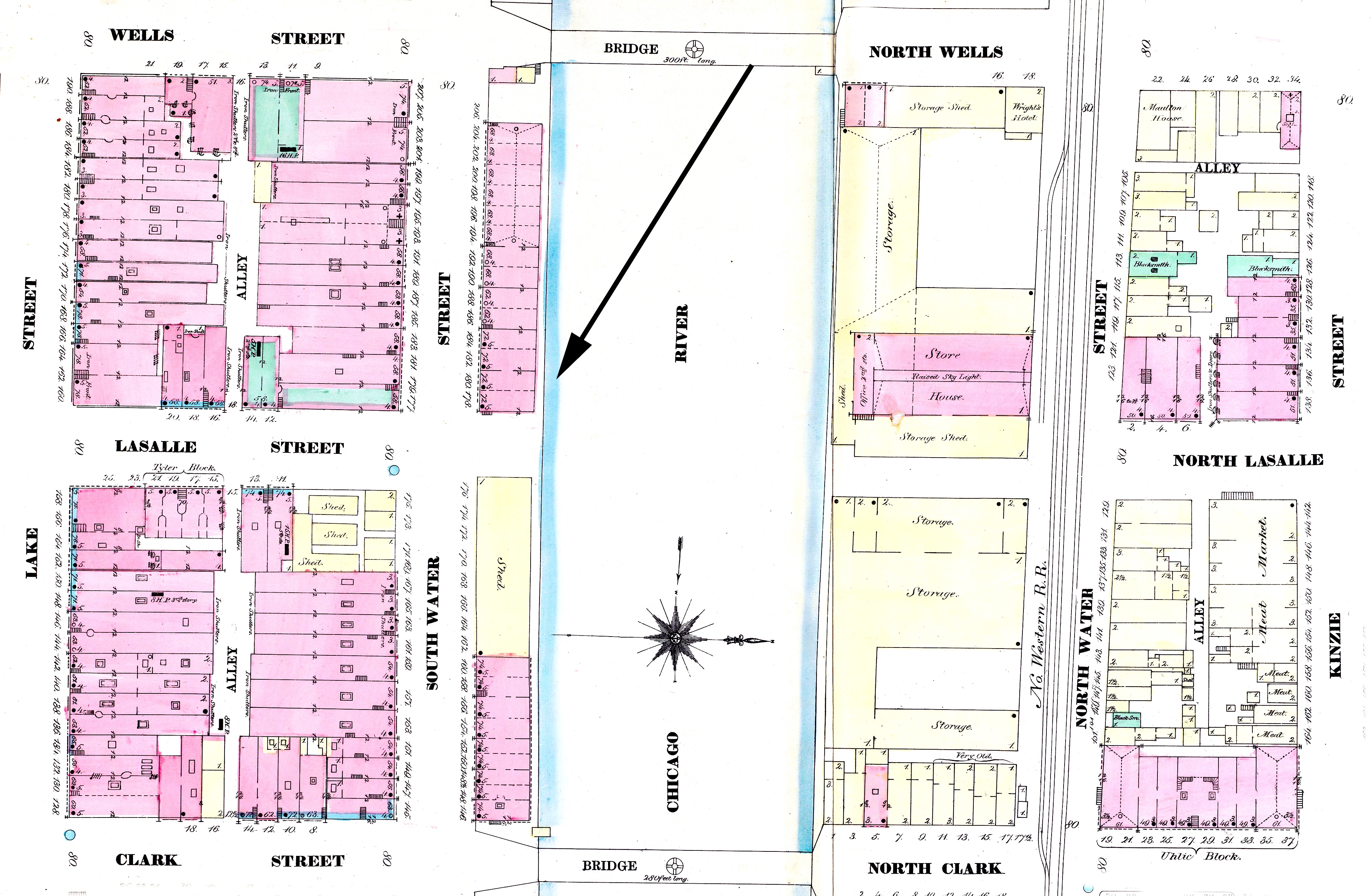
- Steel’s Block
Sanborn Fire Insurance Map
1869

Leave a Reply