Intelligence (Employment) Office, Hiram Higgins Pianos, Lyon & Healy
Life Span: ~1862-1871
Location: 150 Clark street, between Monroe and Madison streets
Architect:
- Halpin & Bailey’s City Directory for the Year 1863
Pratt David, carpenter, h. 150 Clark
Pratt Mrs. Sarah, intelligence office, 150 Clark
Halpin’s Chicago City Directory for 1864
Pratt D. Mrs., intelligence office, 150 Clark
John C. W. Bailey’s Chicago City Directory for 1867
Pratt David, intelligence office 150 Clark
Edwards’ Annual Directory in the City of Chicago, for 1870
Higgins Hiram M. pianos, 150 Clark
Edwards’ Annual Directory in the City of Chicago, for 1871
Lyon & Healy, music and musical goods, 150 Clark
Chicago Tribune, February 8, 1864
Tuesday, Feb. 26, 1864, A. R. Williams.
The funeral will take place from his late residence, 150 South Clark street, at 2 o’clock this (Saturday) afternoon. Friends of the family are invited to attend.
Chicago Evening Post, October 2, 1869
Removal.
H. M. Higgins will move, on or before the first of November next, to his new and commodious store, 150 South Clark street, near the centre of the block on the west side, between Madison and Monroe streets, where will be found a very large and splendid stock of his far-famed and highly appreciated piano fortes, which he will rent, and apply the rent money as part of the purchase, if bought within one year. The store which he now occupies, 122 South Clark street, together with the basement, can be rented.
Chicago Evening Post, October 27, 1869
H. M. Higgins.
Over four years ago, the veteran dealer whose came heads this article began the manufacture of pianos for the Chicago market. He designed to and did produce an instrument first class in every respect, and, as a consequence, the “Higgins” stands to-day with hardly a rival among pianos. The judgement of skilled musicians, who have expressed themselves in our hearing, is that neither the Steinway nor Chickering surpasses it in tone and durability. With such an instrument, and under the live management of an energetic man, it is not to be wondered that the trade has outgrown all calculation, demanding to-day greatly enlarged quarters for its accommodation. The new rooms are just being occupied at 150 South Clark street, where our musically inclined readers will find by all odds the most elegant piano hall in the city. There is 30 feet width and 120 feet depth, with 16 feet ceilings, giving a splendid area for the exhibition and trial of instruments. The floor is of walnut and ash, 1¾ inch strips alternated, being both exceedingly desirable and handsome. The large windows are single plate French glass, that cost $400 each. In the rear, elegant offices are fitted, one for the use of the establishment, the other as an instruction room for that accomplished artist, Prof. Louis Meyers. This skillful performer, by the by, after thorough trial and investigation, adopts the Higgins piano, giving it in all cases an unqualified endorsement to his pupils.
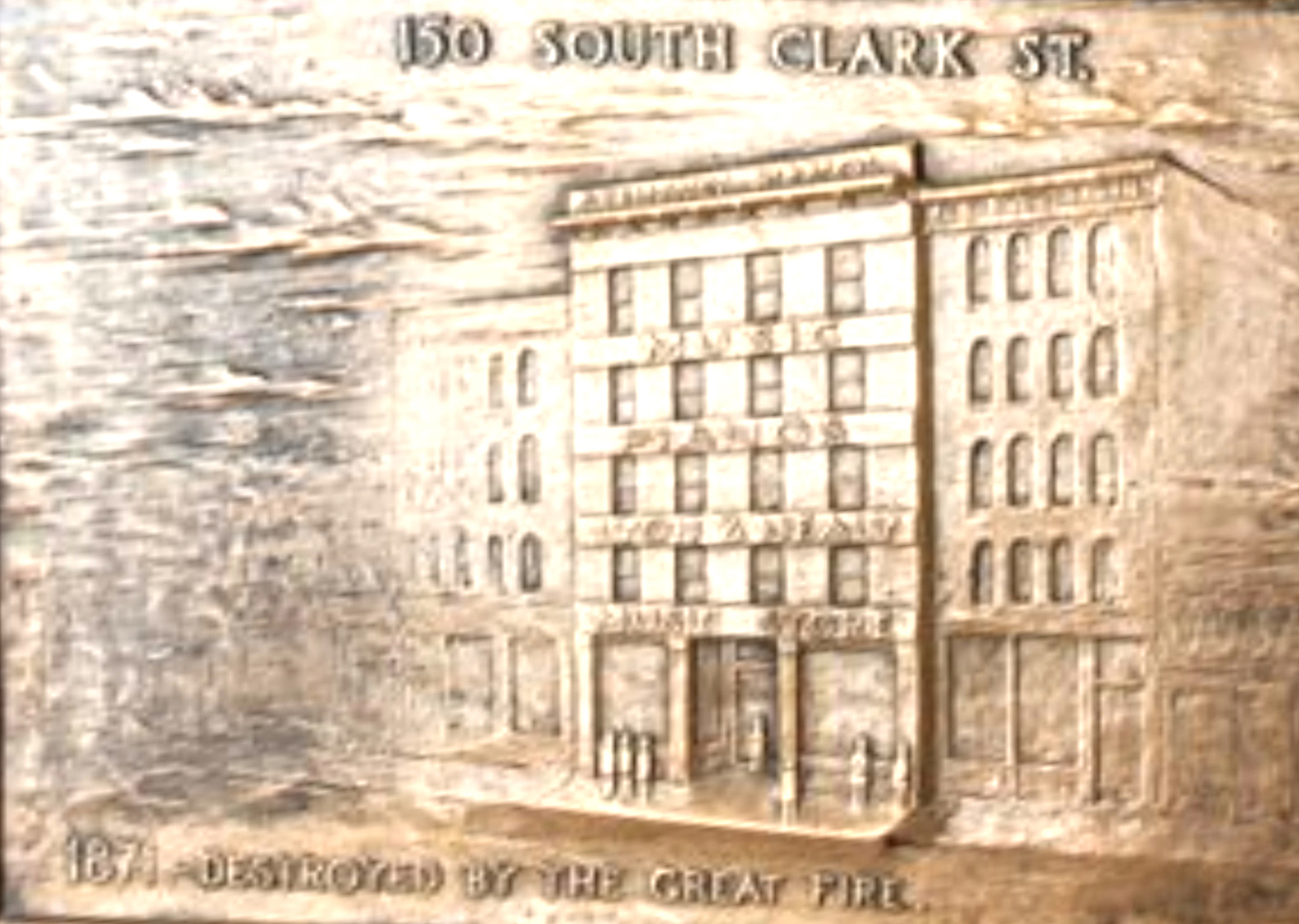
It is the aim of Mr. Higgins to supply the demand in this city for first-class pianos, and to that end be guarantees to furnish instruments at from one to two hundred dollars less price each than other dealers dare make on goods of the same quality, Furthermore, he will lease his pianos for a fair monthly payment, stipulating that at the end of one jeer, if the lessee desires, the instrument maybe taken on purchase, less the lease money paid. We were shown beautifully toned instruments to be rented as low as eight dollars per month. The veteran tuner, Mr. L. Amman, is still in Mr. H.’s employ, backed by fifteen years’ constant, satisfactory service. Mr. A. is perhaps the best tuner in the city, and those having fine instruments to be taken care of, will consult their own interest by leaving their orders with Mr. Higgins. Remember the place, 150 South Clark street.
Chicago Evening Post, October 9, 1869
Progressive.
It is most gratifying to observe the well-merited success that has overtaken so many of the old pioneer business men of our city. In this connection we have to notice the ensuing removal of H. M. Higgins, our old established and universally known music dealer, to a most commodious and imposing store—one of a truly palatial block of marble buildings lately completed, on Clark street, between Madison and Monroe. Mr. Higgins has long been cramped for room at his present establishment, 122 South Clark street, and the removal is necessitated by the extent of his rapidly increasing business, caused no less by the wide spread popular appreciation of the superb qualities of the beautiful instrument he manufactures, than by the extraordinarily easy terms offered by the “rent with the privilege of purchasing” plan, which he was the first to inaugurate, and which are undoubtedly the best and easiest terms upon which a first-class instrument can be obtained. We understand that the new location, 150 South Clark street, will be occupied during this week, and, as no expense or pains have been spared to make the interior arrangements worthy the extraordinary dimensions and imposing character of the new store, which, when stocked, as it soon will be, with a large number of superb new instruments, will, we predict, make a music room worthy of the prestige of its proprietor and in every way unequaled in the city. Mr. Higgins will also prepare an elegant and convenient room in his new store for the use, as a teaching room, of Mr. Louis Meyer, whose pianoforte playing, both here and in Cincinnati, has caused such & profound sensation in musical circles, and whose remarkable execution has been so highly eulo. gized by the leading organs of the Western press. In such hands the “Higgins piano” will gain fresh laurels.
Chicago Tribune, September 11, 1870
Lyon & Healy.
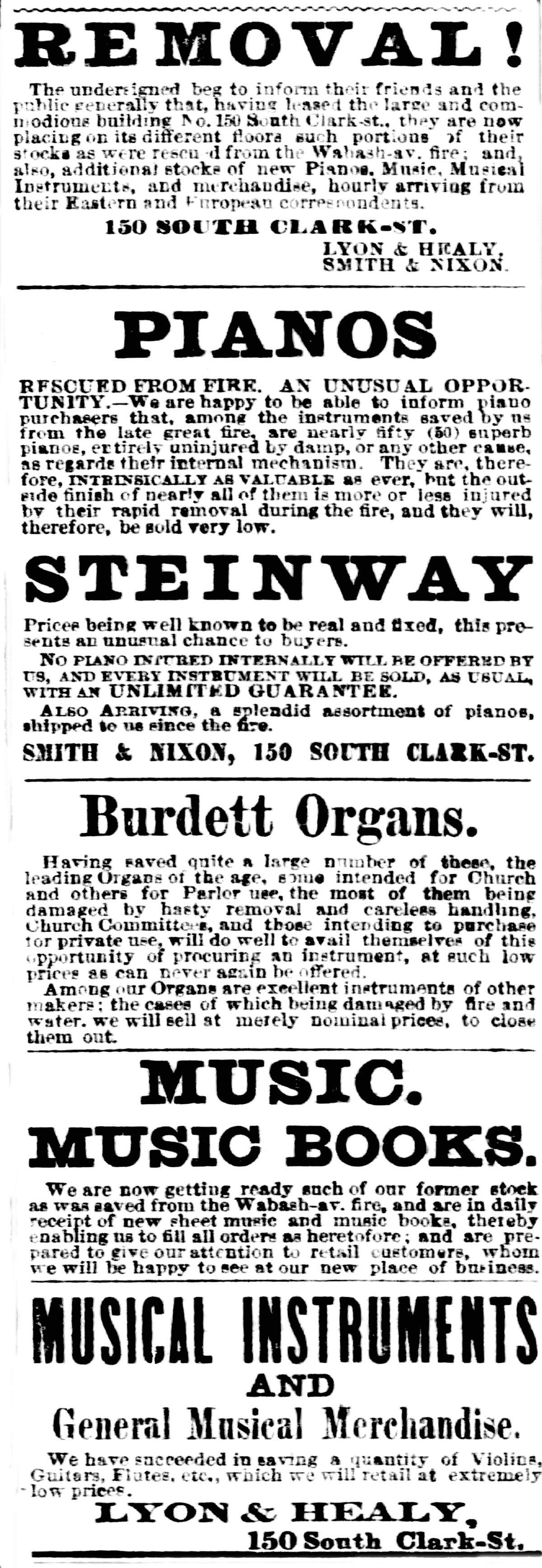
The recent fire occurred at a very unfortunate time for this firm, as both partners were indisposed, and one of them (Mr. Healy) had scarcely been at the store at all during the previous two weeks. Yet such was the emergency, that while the fire was raging, telegrams were sent to Boston and New York for new stock, and diligent search made for new quarters. This latter problem promised to be even more serious than that of replenishing the stock. But after some consideration, it was thought best to close with Mr. Hiram M. Higgins’ kind offer, who proposed to relinquish to them the lease of his commodious store at No. 150 Clark street. The new store is 50×120 feet, and Lyon & Healy occupy four stories, including the basement. In point of space, the present quarters are even superior to those in Drake’s Block. This place will be occupied until a more suitable one can be found, or the old store is rebuilt.
The goods orderd by telegraph are arriving even faster than they can be stored, and in a few days more Lyon & Healy will be able to fill all orders for musical merchandise as promptly as ever. Meanwhile, by the kindness of city dealers, orders have been filled with very little delay.
Many of the prominent music dealers in the East express their sympathy and offer all assistance in their power. Oliver Ditson, one of solid men of Boston, and the largest music-publisher in the world, in his usual laconic style, closes a letter to Lyon & Healy wuth this assurance:
If you want money you know where to come for it.
Lyin & Healy desire us to express their obligation to the enterprising houses of Root & Cady and their clerks, and to A. Reed & Sons, for valuable assistance rendered; and to many friends, both residents to the city and visitors, who spared no efforts and avoided no risks in the attempt to rescue property from the flames.
They were also particularly gratified at the self-sacrificing efforts of their own employes, who labored night and day in complete devotion to Lyon & Healy’s interests.
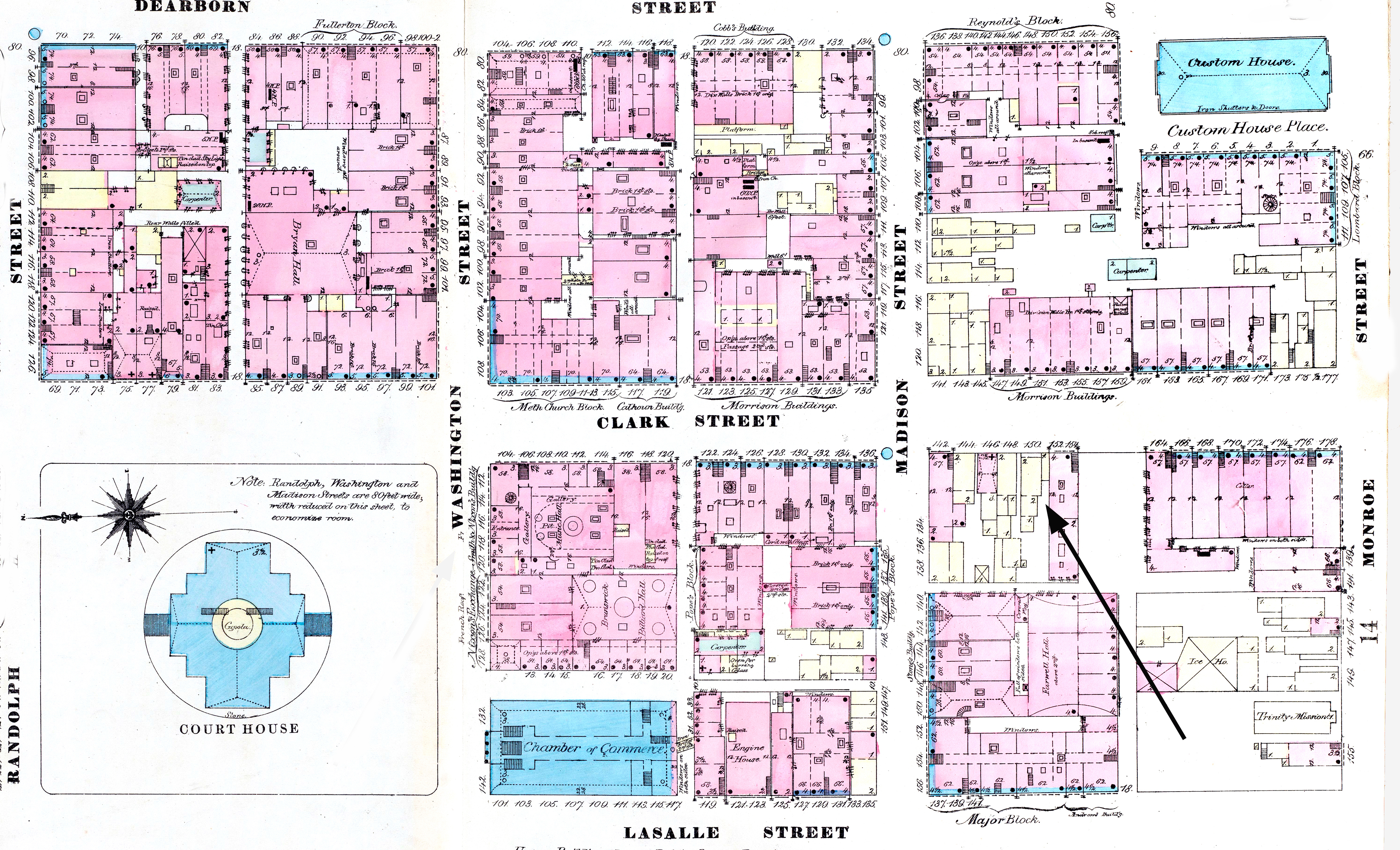
- Nixon’s Building
150 South Clark
Sanborn Fire Insurance Map
1869
NOTES:
An “Intelligence Office” is a place where well-to-do families find domestic help (cooks, chambermaids, servants, etc.) Later called Employment Offices.

Leave a Reply