Chicago Daily Times, 1929 – 1948 (merged with Chicago Sun)
Chicago Sun, 1941 – 1948 (merged with Chicago Daily Times)
Chicago Sun-Times, 1948 – Present
Associated Press, September 2, 1929
CHICAGO DAILY TIMES STARTS AS TABLOID PAPER
The Daily Illustrated Times, Chicago’s first tabloid, hung its name on newspaper row today.
Owned and published by the reorganized Journal, former publishers of the Chicago Daily Journal, which now is merged with the Chicago Daily News, the new half-size, picture newspaper will put a first edition, of 48 pages, on the street Tuesday.
Entering the afternoon served by The Evening American, The Evening Post, and The Chicago Daily News and Chicago Daily Journal, The Times will print three editions a day.
Principal stockholders of the publication will be S. E. Thomasen, of the Bryan-Thomasen Newspapers, Inc., and former principal stockholder of the old Chicago Journal.
With Mr. Thomasen will be associated John Stewart Bryan, part owner with Mr. Thomasen of The Tampa (Fla.) Tribune and The Greensboro (N. C.) Record, and publisher of The Richmond (Va.) News-Leader; R. J. Finnegan, managing editor and former part owner of the Chicago Journal, who will remain managing editor of the new tabloid: Joe Foley, former sports editor of The Journal, remaining with The Times, and several Chicago business men.

The Daily Worker, December 6, 1941
Tribune Sales Hit As Chicago Greets ‘Sun’
25 to 50% Slash in Pro-Nazi Paper Seen; New Press Flays Smith Bill
By Carl Harris
CHICAGO, Dec. 5.-A slash of 25 to 50 percent in the circulation of the pro-Nazi Chicago Tribune was indicated here today, as Chicago’s new morning paper, The Sun, settled into stride.
The new paper sold more than 800,000 copies today, breaking through the morning monopoly held by the paper of Col. Robert R. McCormick, arch appeaser.
A check of the newsstands revealed that the Tribune has suffered its drop in the biggest circulation outlying neighborhoods, and particularly in working class areas, where the Tribune is thoroughly despised.
A drastic slash in the sales of the Colonel’s sheet was felt on the South Side, in the Negro community.
The clamoring demand for the new paper, which has a pro-Roosevelt slant, was seen here as the explanation for the fact that the Tribune has not resorted to the anticipated “rough stuff.” However, stand keepers predicted that the Tribune’s goon squads will “cut loose” before long in an effort to win back the paper’s dwindling circulation.
The Tribune is known to be especially concerned with losses in out-of-town sales in the five-state area which the pro-Hitler publisher considers as his private “Duke-dom.”
In Gary, mainly steel workers populated by workers, Tribune circulation managers sought to keep the Chicago Sun off the news stands. The possibility is that the new paper will have to install its own stands.
On the eve of the appearance of the new paper, founder of which is Marshall Field, the Tribune aroused national indignation by exposing a confidential government report on defense plans.
This climaxed a string of similar disclosures by Tribune agents many of which have been considered as acts of enemy espionage.
Turner Catledge, Chicago Sun’s Washington correspondent, wrote today that “all departments concerned with the armed defense of the United States” were investigating the leak through which the Tribune was able to secure this in-formation, considered highly important to the Nazis.
‘SUN’ FLAYS SMITH BILL
The new paper, which has come out strongly behind the Roosevelt program, today indicated its labor policy in an editorial on the Smith anti-strike bill. The paper charged that the measure would allow employers to challenge every past, present or future decision of the Labor Board merely by charging Communism against a union officer. It would open the most conservative union in the country to destruction if a federal judge found that failure to discover secret communist connection in one person constituted negligence.
“The provision regarding a person convicted of a felony would have the same effect. Besides its ostensible legitimate purpose, it would enable enemies to destroy a union by planting or finding one ex-convict among its officers.”
Pointing to the bill’s clause which forbids mass picketing, the editorial stated: “Who does not know that in mass production industries a strike without mass picketing is broken before it starts?”
Nationwide sentiment against the Nazi-dominated Tribune was indicated by the flood of greetings sent to the Sun, many of which carried pointed barbs against the Tribune.
New York Times, January 29, 1948
CHICAGO SUN QUITS AS SEPARATE PAPER
Started by Field in December, 1941, It Will Be Issued With Times Beginning Monday
Special to THE NEW YORK TIMES.
CHICAGO, Jan. 28—Richard J. Finnegan, editor of The Chicago Sun and The Daily. Times, announced today that the two papers would merge, effective Monday. The new publication will be known as The Chicago Daily Sun and Times. It will publish both morning and evening editions.
The merger marks the end of The Chicago Sun, which published its first issue Dec. 4, 1941, as a separate entity. Although there was no official statement by the management, it is understood that the merged publication will have a single executive managing editor, a single executive city editor, and a single head of the circulation and advertising departments, and that Times employes would have preference for these posts.
It was reported that between 200 and 400 employes would be dismissed with double severance pay. Marshall Field 3d, founder of The Sun, is understood to have told Sun editorial employes that many of them “would have to go.”
The Chicago Sun, in tomorrow’s issue, will say:
- The Daily Sun and Times will combine the news and picture facilities of the morning Sun and afternoon Times. It will print the most popular features, columns and comics of both papers.
The merger will provide a better newspaper to more readers by focusing latest news and pictorial coverage on editions timed to match the morning and afternoon reading preferences of the community.
The ’round the clock Sun and Times also will permit the more efficient use of production and distribution facilities necessary in a period of higher costs for -news-print, increasing wages and other economic pressures.
The Sunday editions of both papers have been combined since September. The most recent circulation statements gave the circulation of The Daily Sun as 340,487; that of The Daily Times, 471,137.
The announcement by Mr. Finnegan came on the sixty-sixth day of the strike of 1,500 printers, members of Local 16 of the Chicago Typographical Union, an affiliate of the International Typographical Union, AFL, against the city’s six daily newspapers. As a result of the walk-out, each of the six dailies adopted a time-consuming method of photoengraving typewritten stories and advertisements, thus by-passing the composing rooms.
CHICAGO SUN-TIMES
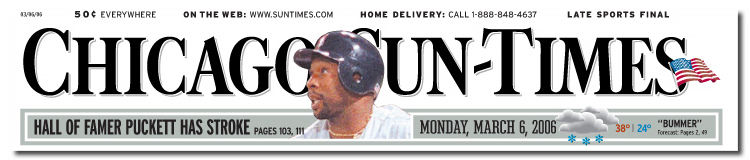
The modern paper grew out of the February 1, 1948 merger of the Chicago Sun, founded on December 4, 1941 by Marshall Field III, and the Chicago Daily Times. Before Rupert Murdoch’s 1984 purchase, the newspaper was for a time owned by Field Enterprises, controlled by the Marshall Field family, who also owned WFLD channel 32 since it’s inception in 1966. During the Field period, the newspaper had a populist, progressive character that leaned Democratic but was independent of the city’s Democratic establishment. Although the graphic style was “urban tabloid”, the paper was well-regarded for journalistic quality and did not rely on sensational front-page stories.
On the first day of the Murdoch ownership, film, critic Roger Ebert described the day in detail:
- On the first day of Murdoch’s ownership, he walked into the newsroom and we all gathered around and he recited the usual blather and rolled up his shirtsleeves and started to lay out a new front page. Well, he was a real newspaperman, give him that. He threw out every meticulous detail of the beautiful design, ordered up big, garish headlines, and gave big play to a story about a North Shore rabbi accused of holding a sex slave.
The story turned out to be fatally flawed, but so what? It sold papers. Well, actually, it didn’t sell papers. There were hundreds of cancellations. Soon our precious page 3 was defaced by a daily Wingo girl, a pinup in a bikini promoting a cash giveaway. The Sun-Times, which had been placing above the Tribune in lists of the 10 best U.S. newspapers, never took that great step it was poised for.
Murdoch sold the paper two years later.
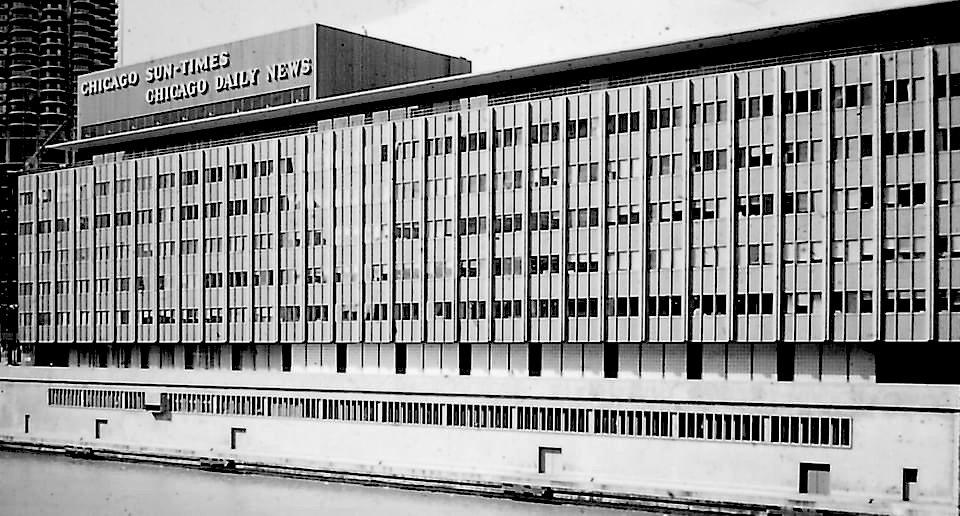

I delivered the times in 1950 on thanks giving and could not collect payment. Mr hornless thought I was kidding when I pronounced his name wrong ( gobble go lea).