Assumption School for Italian Children, Gamma Photo Labs, Pallas Photo, 319 W Erie Condos
Life Span: 1899-Present
Location: Erie street, between Orleans and Franklin streets
Architect: Frederick Foltz
- Lakeside Annual Directory of the City of Chicago, 1904
Assumption School for Italians 120 Erie
Lakeside Business Directory of the City of Chicago, 1907
Assumption School for Italians 120 Erie
Lakeside Anual Directory of the City of Chicago, 1911
Assumption School 315 W Erie
The Inland Architect and News Record, November, 1898
The Assumption School for Italians, situated on Erie street, between Franklin and Market streets, Chicago, Fritz Foltz, archi-tect, is to be used as a parochial school in connection with the Church of the Assumption, Rev. Father Thomas Moreschini, rector. This building contains twelve schoolrooms, accommodating six hundred pupils, and has an entertainment hall containing about seven hundred seats, and a small theatrical stage, with a gallery, on the top floor. The building is to be finished entirely in oak, and is to be supplied with modern plumbing, steam heat, ventilating apparatus and school seatings. The price of the whole building is about $27,000, complete.
The Times-Picayune, May 27, 1899
Mother Cabrint Will Go to Chicago to Found a New Mission.
Rey. Mother Cabrini, of the Salesian Missionary Sisters of the Sacred Heart, will leave on Monday for Chicago, where she will found a new mission for the children of Italian emigrants. Mother Cabrini has been in New Orleans for the past six weeks, and has made many friends during her stay. She has been Invited to come to Chicago, where all is in readiness for the home she will open. It will be a school and convent for Italian children, and will be conducted on the same lines as the very successful free school that this noble sisterhood conducts in the Italian quarter In this city.
From Chicago Mother Cabrini will go to Buenos Ayres and other points in South America, where the order has flourishing mission schools.
Completing her work there, she will return to home, where the mother house of her order is situated. It will be some years again before this devoted religious and foundress of one of the most zealous working congregations of sisters in the church will return to the Uhited States.
Inter Ocean, August 27, 1899
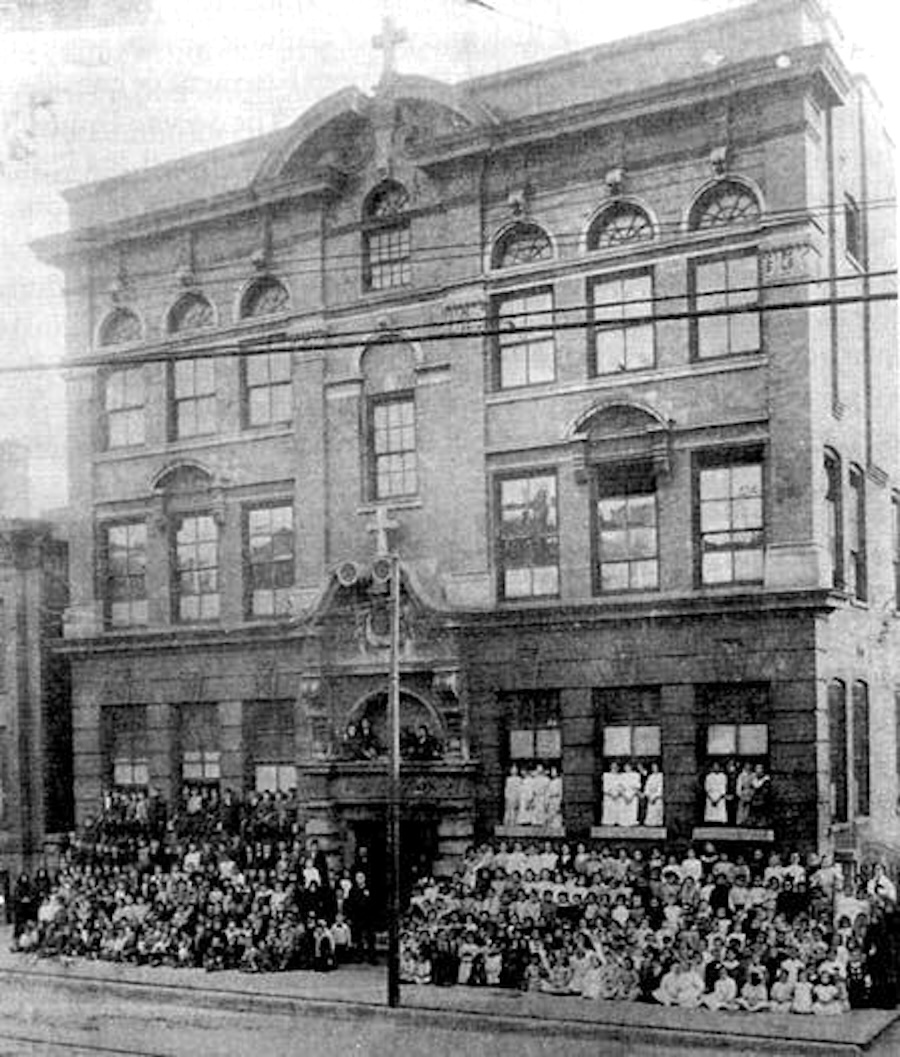
For years Father Moreschini has been saving money for this purpose, and finally secured a piece of property on Erie street, between Orleans and Franklin.
Here he has just erected a building for school purposes at a cost, for land and structure, of $50,000. It contains twelve school rooms, besides six rooms in the basement for playrooms, and a commodious school hall at the top. It has a capacity of 600 scholars, and will open with over 300 pupils, under the charge of eleven sisters of the mission of the Sacred Heart. The teaching will be in both English and Italian.
The schoolhouse and sisters’ house con-jointly cost $30,000 more than Father Mores-chini had on hand, and this sum remains as a debt. To pay this off a bazaar and festival will be held in the school hall of the new building from Oct. 11 to 21 inclusive. Father Mores-chini will gratefully accept donations of either articles or money from all those who may feel a kindly interest In his work in behalf of his people. He is a firm believer in the effect of education in elevating his race and bringing them in touch and accord with American institutions. The just pride that he feels In his new school is only clouded by the burden of its debt, but this, he hopes, the people of Chicago, when they learn of the great work this school has before it, will help him to clear off.
Chicago Tribune, August 12, 1997
Mickey Pallas, Gamma Photo’s founder
By Kenan Heise
Tribune Staff Writer
Mickey Pallas, 81, the founder and owner from 1959 to 1972 of Gamma Photo Lab Inc. in Chicágo, was also a preeminent photographer of the city’s people and its events during the 1940s and 1950s.
A resident in recent years of Palm Springs, Calif., he died Friday in a hospital in Scottsdale, Ariz.
“Mickey was a real Chicago treasure,” said Janet Ginsburg, a friend. “His fascination extended to every part of photography, from shooting and developing pictures to collecting and promoting the work of others.”

His interest in photography began when he was living at the Marks Nathan Jewish Orphans Home in Chicago. He and a buddy chipped in together and purchased a camera for $1.26.
His career began in the 1930s while he was an auto worker working for Studebaker. He started taking individual pictures of union members, musicians and other performers, the city’s blacks, and a wide spectrum of workers as well as events ranging from strikes to weddings.
He became a union organizer and a member of the Anti-Dis-crimination Committee of the United Auto Workers and his camera went where he did.
Studs Terkel said of him, “Ever on the go, Mickey, with the gait and build of a fighter, was deceptively good. So good that he cap-tured, indelibly, a piece of history. Mickey Pallas, like Kilroy, was there.”
His client list expanded to include Standard Oil of Indiana, the Globetrotters, Ebony magazine and ABC television. His pictures of Hula-Hoops, Windy City softball from 1950s and “Morris B. Sachs’ Amateur Hour” are placed next to classic photos of black sugar workers on strike in Louisiana and performers such as Mahalia Jackson and Edith Piaf.
Seeing a need for a high-quality photo lab to serve professional photographers, he created Gamma and saw it grow from a two-per-son operation to a business with 125 employees 13 years later.
In 1986, his work from the 1940s and 1950s became the subject of a retrospective at the Chicago Cultural Center. The show toured nationally, including an exhibition at the International Center for Photography in New York.
Survivors include his wife, Patricia; a daughter, Gail Missner; a son, Rusty; three grandchildren; and a great-grandson. Services were held in Arlington Heights.
Chicago Tribune, January 10, 2003
2 buildings take step to become landmarks
By Sufiya Abdur-Rahman
Tribune staff reporter
The Chicago Commission on Landmarks granted preliminary landmark status Thursday to Assumption School and the Art Deco Trustees Systems Service Building.
The commission also gave its final recommendation to landmark the Chicago Harbor Lighhouse.

Assumption School, 319 W. Erie St., was considered an endangered structure by advocacy group Preservation Chicago because it is being renovated into condominiums. But the building’s owners agreed to preserve the historical aspects of the architecture and to support landmark designation.
“We’re happy that the developers are so conscientious of the history of the building and are going above and beyond the call of duty to preserve it,” said Jonathan Fine, president of Preservation Chicago.
The school was founded by St. Frances Xavier Cabrini and the Missionary Sisters of the Sacred Heart. Built in 1899, the three-story brick school served an Italian immigrant community on the Near North Side.
Jack Guthman, an attorney who represents the building, said he wished he had known sooner of the commission’s plans to seek landmark designation.
“We went through months of buying the building, designing a condo for the site… filed for the permit and were frankly stunned that a landmark process was about to be unveiled at the site after having worked with the city’s knowledge for many months,” Guthman said.
Preliminary landmark status protects the building from major alterations or demolition while the commission determines if landmark status should be recommended.
The 28-story Trustees Systems Service Building, 201 N. Wells St., is one of the Loop’s few Art Deco office skyscrapers. It was designed in lavish fashion, with rare blood-red African marble in the lobby and a stepped pyramid design on top, before the stock market crash in 1929 and completed in 1930.
Chicago Tribune, May 11, 2003
School may be converted to condos
By Jeanette Almada
Special to the Tribune
The Chicago Landmark Commission has approved landmark designation for the former Assumption School building at 319 W. Erie St., advancing a developer’s plans to rehab the building and convert it to seven condominiums.
The City Council still must approve the designation and an ordinance is likely to be introduced next month, according to Pete Scales, spokesman for the Chicago Department of Planning and Development.

Skokie-based builder Robert Levin paid $2 million for the building two years ago. His RAL and Associates in Skokie has partnered with numerous investors over the years to build condos, lofts, townhouses and houses in Chicago.
“When my wife and I saw (the building), it was a little more than we wanted to spend, but we fell in love with it,” said Levin of the Beaux Arts, brick and limestone building, which stands amid a commercial district of restaurants and active night life. It was built in 1899 and was designed by Frederick Foltz. City officials who supported landmark designation of the building said it reflects the character of urban elementary schools built in the last half of the 19th Century, which in Chicago had very compact site plans.
The former school had been used as commercial space for years before Levin bought it and is vacant. “The facade has ornate detail; you have to go to Europe to see” detail that includes arched windows and copper cornices like that. It is a 12- to 14-minute walk from Michigan Avenue, near the on and off ramps of the Kennedy Express-way,” Levin said in a phone interview this month.
Levin plans to preserve the three-story building’s facade in his rehab, designed by Park Ridge-based Lance Shalzi of LAS Design Group. The interior will be demolished and a recessed fourth level will be added and will not be visible from the street.
The seven condos will range from 2,500 to about 5,300 square feet. “I haven’t decided how bedrooms will be built in those units but I am a custom builder; buyers will probably have as many bedrooms as they want,” Levin said.
The units will be priced at $325 to $425 per square foot, or about $850,000 to more than $2 million, according to Levin. Each unit will have 12- to 18-foot ceilings, and two to three balconies, Levin said. The building will include a common roof-top deck.
Levin hopes to begin construction by the end of summer and expects completion by next spring.

- Assumption School for Italian Children
Sanborn Fire Insurance Map
1906

Leave a Reply