- Halpin’s Chicago City Directory for 1864
Arnold Isaac N., Member of Congress, first district, r. Erie, nw. cor. Pine
Fuller Henry, pres. Chicago Ice Co., r. 15 Dearborn
John C. W. Bailey’s Chicago City Directory for 1867
Arnold Isaac N. (Arnold, Payson & Gregory,) h. Erie bet Rush and Pine
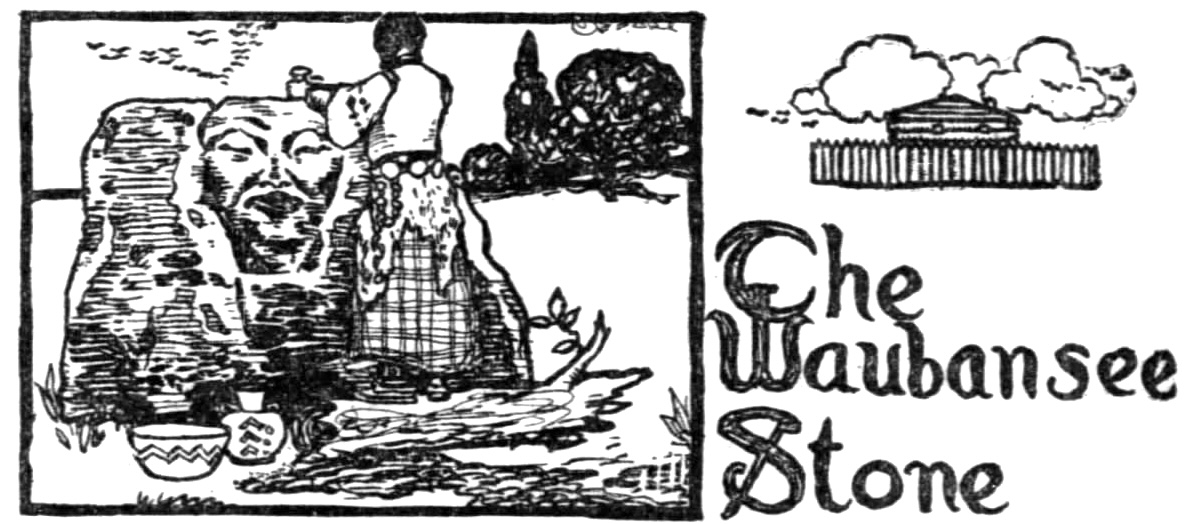
Chicago Tribune, April 22, 1900
The First Ward in 1900
- How many people have seen one-tenth of the 2,000 miles of streets in Chicago?
How many people seen the Waubansee stone or know what it is?
How many people who boast of citizenship in the most cosmopolitan city in the world have ever visited one-half of the twenty-four distinct foreign quarters within the city limits?
How many people know that the Green Tavern, built in 1833, is still standing?
How many people know that the churches of Chicago would fill both sides of an avenue six miles long?
How many people know that Father Marquette, who died in 1675, was the first resident of the Eighth Ward?
Few citizens of any great city know much about it. They go to Europe to see what they might find within an hour’s ride of their own houses. They grow enthusiastic over the picturesque Ghetto of Amsterdam, but are entirely ignorant of the greater Ghetto in the Seventh Ward of Chicago. Few Americans who have made the “grand tour” have seen as much of foreign life as may be found in Chicago. Within the city limits one may find the atmosphere and see the local customs of Palestine, Greece,. Servia, Croatia, Lithuania, Poland, Bohemia, Hungary, Russia, Italy, Arabia, and a dozen other equally interesting countries. The American abroad lives chiefly in hotels, which are essentially the same the world over. He gets practically no idea of the life of the people, which is the essence of the country and which the Chicagoan may study without leaving home.
Most people are even more ignorant of the fact that Chicago has a history. They look upon the city as a mushroom sprung up over night. On the contrary, it has a history stretching back for more than 200 years. For instance, the Drainage Canal, the last and greatest achievement of Chicago, was first suggested by Joliet, who foresaw what the country is just beginning to realize—that here was the proper location for a waterway connecting the great lakes and the gulf. Within sixty years of the first landing of the Pilgrim Fathers at Plymouth Rock the present site of Chicago had already been recognized and pointed out as the future gateway to the great West.
Since Chicago became a city and began its growth men have been too busy making history to set up monuments to mark its progress. But the town is full of historic sites and localities. Business-men pass them every day on the streets and are ignorant even of their existence. But every Chicagoan should feel it a duty as well as pleasure to become acquainted with at least a few of the more important. Such an acquaintance will lend a new interest to a walk about town or to a ride on the wheel. It will help him to realize that he is “a citizen of no mean city” from whatever standpoint it may be regarded.
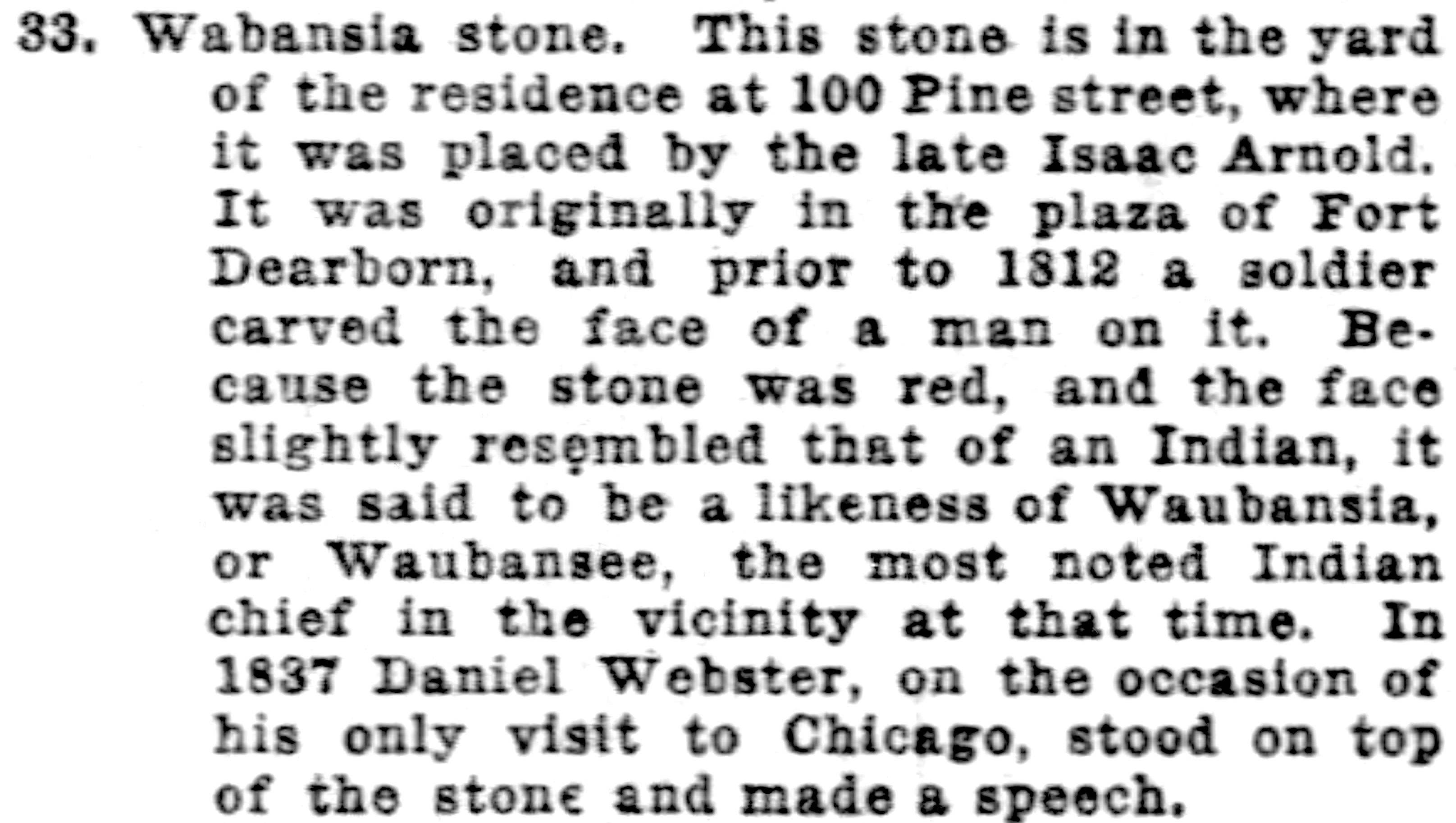
The places of historic and of present interest are scattered all over Chicago. Because they are unmarked they are most often overlooked and neglected. An intelligent man, for instance, might pass up and down Lincoln Park boulevard for a lifetime without having his attention called to the historic Waubansee stone, which was carved by a soldier in Fort Dearborn prior to 1832, and which now stands in plain sight in the private yard at No. 100 between Erie and Huron streets. While this stone was still lying in the plaza of old Fort Dearborn it was used as a platform by Daniel Webster, when, in 1837, he was lifted up to the top of it to deliver a speech in which he phophesied the future greatness of the frontier village.
Because old Fort Dearborn was located in what is now the First Ward, and because it contains the business center of the city, there are more points of the historical and present interest within its limits than in any other ward. The value of the property in the First Ward makes it easily the richest ward in the city and one of the richest in the world. At the same time its resident population is largely made up of the poorer classes. The men who own the property live outside the down-town district, while a large part of the vote which controls the politics of the ward comes from the lodging-houses and dives of South Clark street.
Inter Ocean, May 6, 1900
“Old Resident” Points Out Errors in Recent Publication.
Many Dates Wrong.
Tells the Unromantic Story of Famous Waubansee Stone.
Was a Prairie Bowlder, Drilled and Used as a Fountain at a Fair During the Civil War.
To the Editor,-Under the caption of “Chicago at a Glance‘ a page of the Chicago Sunday Tribune of April 22 was devoted to the history of Chicago. There was a map of the city with the places of historic interest numbered, and a “key” explaining the numbers and giving information as to dates, names, and places. The whole represented a great deal of painstaking work, and if it was accurate it would be valuable for reference as well as interesting, but unfortunately it is not. There are so many errors in dates, places, etc., that as an old resident who has spent much time in gathering and compiling facts concerning the early history of our city I feel constrained to ask you to call attention to a few of them in the columns of your paper. which circulates so largely among the “old timers.”
To begin with, the Waubansee stone1, which stands in a private yard at No. 100 Lincoln park boulevard, has a rather interesting history, but not a romantic one, by any means. It was not carved by a soldier at Fort Dearborn in 1812, nor did Daniel Webster use it for a platform from which to prophesy the future greatness of the Garden City. The facts about the Waubansee stone are these:
During the civil war there was a sanitary fair held at Fort Dearborn park, and a prairie bowlder was dragged there. Workmen chiseled the outlines of a face on one side and a hole was drilled from the top and through the mouth. This was used for a fountain during the fair. It stood in the center of Michigan avenue. After the fair it passed into the hands of Henry Fuller, and to attract attention to it he made up a story about Indian carving or something like that.
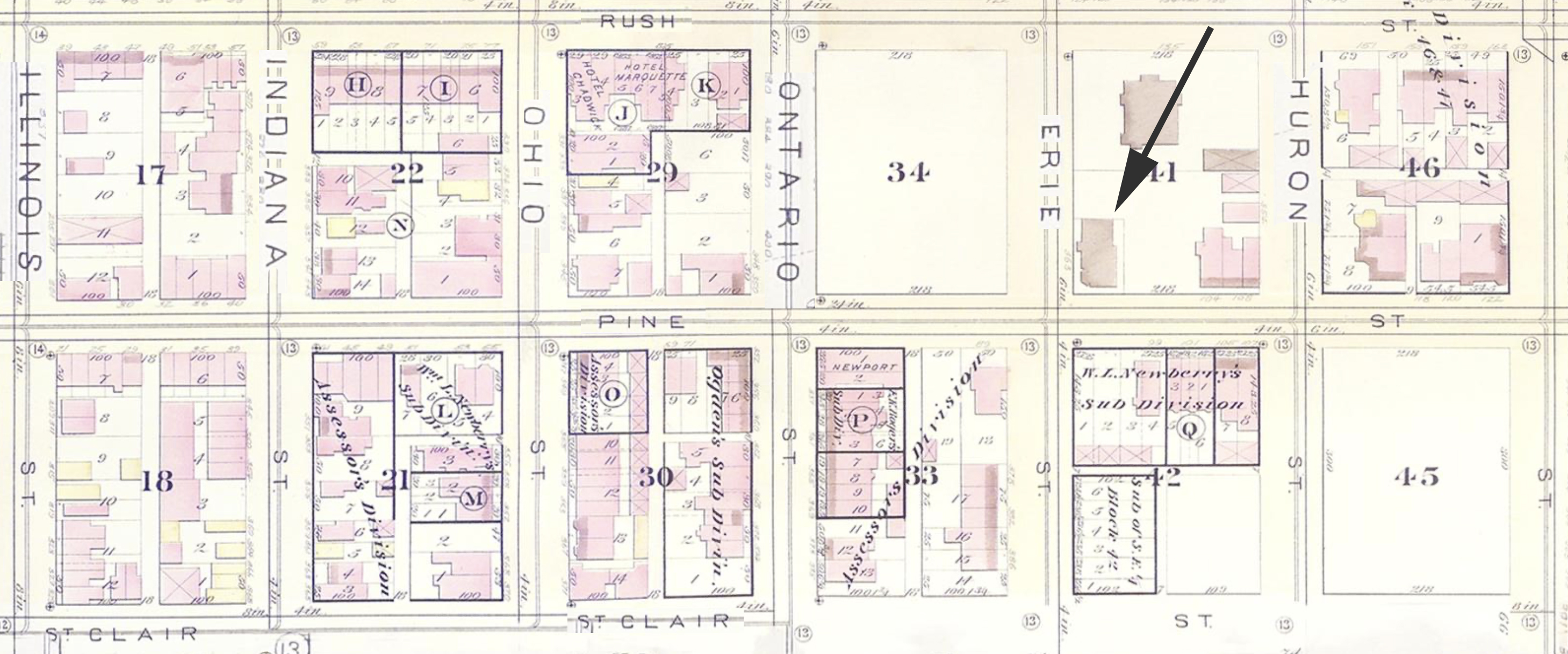
- Isaac N. Arnold’s home on the NW corner of Pine and Erie streets.
Among those who believed the tale was Isaac N. Arnold. Fuller owed Arnold, who was an attorney, $25 for professional services, and when Arnold asked him to pay the bill Fuller told him he could take the Waubansee stone if he would call it square. The bargain was made and the bowlder was removed to No. 100 Pine street, or Lincoln Park boulevard, where it now lies. This is the true story of the Waubansee stone.
But to come to the more important errors in the Tribune story. I will consider them by the numbers in the key. In paragraph No. 1, relating to Fort Dearborn, which was built in 1803-4, General Hull did not surrender the poet as stated. He did, however, order it evacuated, and the following day surrendered Detroit. Referring to. paragraph No. 2, the first agency was never used as a fort by civilians, nor vas It ever used as a military storehouse. it was taken down in 1857. The fort was used by civilians in time of danger from Indians.—Old Resident, Chicago, May 3, 1900
THE TALE REMAINED WITH THE ROCK.
Chicago Tribune, September 22, 1903
Did you ever hear of the Waubansee stone?
Do you know what the Waubansee stone is?
Do you know where the Waubansee stone is now located?
If you are a native or even a resident of Chicago and find yourself compelled to answer any of the above questions in the negative, you may as well admit at the same time that you are poorly informed about the early history of the city.
The Waubansee stone is certainly the largest as it is ore of the few authentic relics of Fort Dearborn. It is a granite bowlder, something more than six feet tall and three feet square, and bears on one side of its top a rudely carved portrait of the Indian chief Waubansee, who in the earliest days of the frontier fort often showed bimself a good friend of the whita man.
It you want to see the Waubansee stone, go over on the north side, walk up North State street to Huron, turn to the east and go as far as old Pine street, row Lincoln Park boulevard; then turn to the south, and about three doors from the corner, in the yard at the side of the house numbered 101 Lincoln Park boulevard, you will see a fountain built up of big pieces of carved stone, piled in a rough pyramid. In the center of this pyramid and projecting for some distance above it is the Waubansee stone, the same great bowlder which lay inside the stockade when Fort Dearborn was built, and from the top of which Daniel Webster, the “godlike Daniel,” predicted, in 1837, the future greatness of the swampy village which he was then visiting for the first time.
On one side of the great stone is still plainly visible the carved likeness of Waubansee, the chieftain, if indeed it be his portrait, for some historians are inclined to the belief that the stone is much older than that.
In fact, around the ancient and long neglected bowlder has raged an historic controversy which divided local antiquarians into a number of opposing school. As to the authenticity of the stone there has never ben a question. The difference is as to its origin and the uses to which it was originally devoted.
In the top of the Waubansee stone is a deep and rounded hollow. One school of historians holds to the belief that this hollow was originally made by the Indians, and that it was used for years before the white men came to raise a rude log fort as a mortar in which the patient Indian squaws, using another smaller stone as a pestle, ground the maize, or Indian corn, into flour for the baking of cakes.
This same school is also of the opinion that the rough carving of the head of Waubansee was made by one of the early regular soldiers at the fort, with the idea of pleasing the old chief-and there seems to be some reason for taking this view of the situation.
On the other hand, the second school of historians and antiquarians is convinèed that the so-called Waubansee stone dates back hundreds and perhaps even thousands of years before even Father Marquette first visited the site of Chicago in 1673. They see in the tall bowlder, with its deeply hollowed top, a sacrificial altar on which perhaps the mound builders of prehistoric America offered even human sacrifices, and they are ready to believe that the face carved on one side of the stone is a representation of an ancient idol-one of the far off gods to whom that mythical people poured libations and offered the sacrificial blood of animals.
However that may be, there is no question of a doubt that in the early days of Fort Dearborn, and as far back as we have any record, that identical stone, practically the same as it is today, lay inside the stockade of old Fort Dearborn. On its top, doubtless, soldiers of the ancient garrison basked in the sun or sat as they listened to the talk of the visiting Indians-allies or foes. It was, or seems to have been, a sort of a common rostruma common meeting place for the gossips of the little frontier post.
When, in 1812, Fort Dearborn was burned and its garrison practically wiped out by the savages, the Waubansee stone was left untouched. As it weighs something like 4,000 pounds it is easy to see why the Indlans did not disturb it.
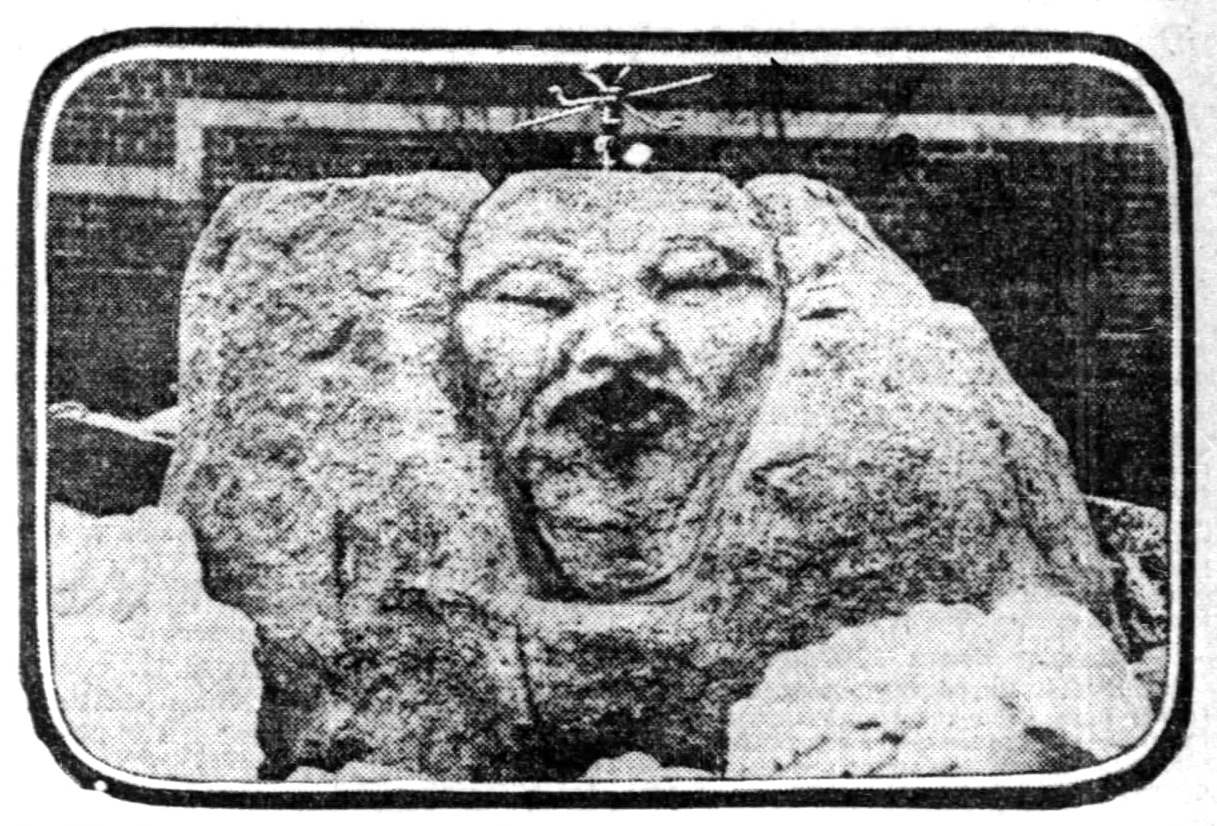
Through the years from 1812 to 1837 it seems to have been left to sink deeper and deeper into the soil outside the log fort. Certainly there is no historical happening during that period with which it is conneeted. But in 1837 the Waubansee stone was made to serve a new purpose.
In that year Daniel Webster, already a famous’senator of the United States, had started to make a tour of the then almost unknown west. He came to St. Louis and there he received a magnificent welcome. At Alton, Ill., he was received with the ringing of bells and the blowing of whistles. The little’ village of Chicago evidently felt that it must do its best to impress the great man with its potential importance. So, as the chroniclers of the time relate, a great concourse of people, in wagons, on horse-back, and on foot, went out ten miles to the south to meet the stage in which Webster was journeying.
One may imagine the picture! The motley crowd of hunters, real estate speculators, farmers, small boys, Indians, and settlers of all kinds riding and driving pellmell down the long dirt road. And Daniel the great sticking his “Jove like front” out of the stage window, perhaps, to see what was approaching.
And even then Chicago people were determined to make a good showing. Never should Daniel Webster be allowed to rid into town in a stage coach. No, indeed!
They met him with a barouche, drawn, as the early’writer says, by “four splendid creams,”‘ and so they hauled him into town in mighty state. One may hope that Lake street, then the principal thoroughfare, had been especially made ready for the occasion, for, if one may believe the contemporary chroniclers, the Chicago streets of those days were almost as filthy as they are now.
Daniel Webster, so say the historians, was accompanied on this triumphal journey by his son and daughter. He was taken into town, and, one may take it for granted, prep-erly wined and dined. Then, later in the day, he was escorted to a platform made ready for his feet and lifted up on top of the Waubansee stone, and from that perch he delivered a speech, the eloquence of which still seems to dimly linger in the memories of first settlers, and in which he prophesied the future greatness of the present metropolis.
Again for a number of years the Wauban-see stone seems to have dropped, if not out of sight, at least into obscurity. But always the stern and rugged face carved on one side made it easy of identification, and there is no record that during these years its position was changed.
Finally, about the time of the war, Isaac N. Arnold, then a congressman from Chicago, took possession of the ancient rock and had it moved from its old position to his residence on the north side, where it still remains. It stood in Arnold’s yard when the great fire of 1871 swept the city and Arnold’s house went down in ruins with the rest. But the Waubansee stone safely came through the fire, suffering nothing more serious than & coating of smoke and dust.
After the great fire a collection of fragments of ruined cornices and carved cap stones, themselves now historic relics, was made and they were piled about the Waubansee stone, which stood, as it still does, in the center of the pyramid and projecting some little distance above the top. Also a hole was bored through the old rock and pipes inserted, so that now it serves as the capstone of a rough fountain.
Surely there are few, if any, such authentia and undisputed relles left to bind the Chicago of today to the Fort Dearborn of a century ago. Whether the carving on its face be the work of some long forgotten soldier in the frontier army of the United States, or whether the stone was eut by a mound builder of prehistoric times, does not at all affect its value as a historical relie which should be of interest to Chicago people.
Perhaps, even, it might be thought worth while to give the old stone a more protected resting place, where it would not, as it does now, face yearly the rains, the wind, and the disintegrating force of the frost and cold. And in a centennial parade surely nothing now in existence deserves a float all to itself.—H. M. H.
Chicago Tribune, November 16, 1910
RELIC OF THE EARLY DAYS.
Waubansee Stone, Granite Bowlder, Harks Back to Time Chicago Was in Infancy.
One of the most interesting relics of the days when Chicago consisted only of Fort Dearborn and a few scattered cabins along the river is the Waubansee stone, a granite bowider, some think more than six feet tall and three feet squire, that now reposes in the yard at the side of the Isaac N. Arnoid bouse, 104 Lincoln Park boulevard.
This stone is one of the few authentic relics of the early military post. On one side of its top it bears a rudely carved portrait of the Indian Chief Waubansee, who in the earliest days of the fort proved himself a friend of the white man.
More than a century ago this stone lay inside the Fort Dearborn stockade, and from its top Daniel Webster, In 1837, delivered a speech. About the time of the civil war Mr. Arnold, now deceased, removed the stone to his yard.
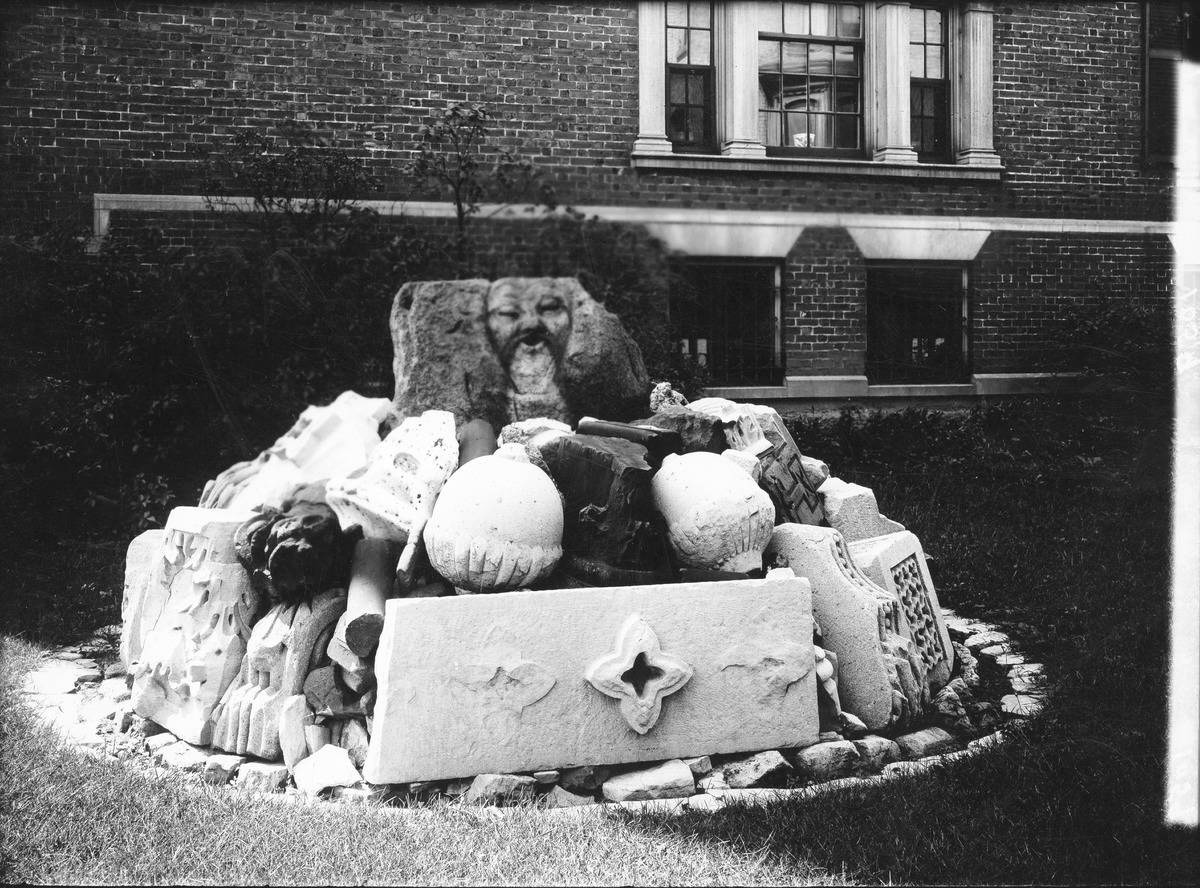
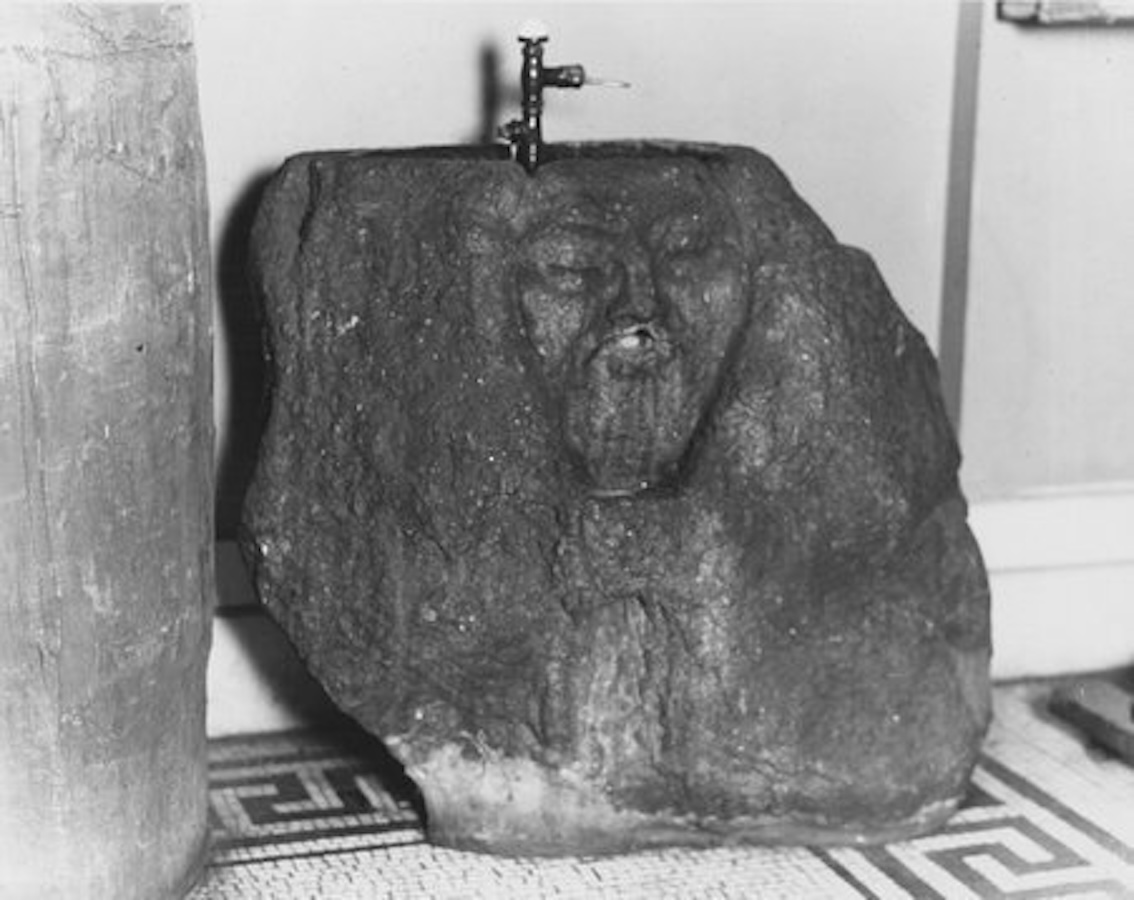
- Waubansee (Wabansi) Stone surrounded by relics from the Chicago Fire of 1871, Chicago, Illinois, September 3, 1911. This granite boulder features a carved image of a Native American Indian believed to be Chief Waubansee (Wabansi). It lay inside the stockade when Fort Dearborn was built in 1803. Daniel Webster stood on the Waubansee (Wabansi) Stone to make a speech while in Chicago in 1837. In the 1860’s the stone was removed from its original location and put in the yard of the Isaac N. Arnold residence located on the northwest corner of Lincoln Park Boulevard (later Michigan Avenue) and East Huron Street. It came to the Chicago Historical Society in 1914.
HISTORY OF WABANSIA AVENUE (1700 N).
Street not mentioned in D. B. Cooke & Co.’s 1859 City Directory.
- Halpin & Bailey’s City Directory for the Year 1863
Wabansia Av., from Milwaukee av. east and north-east to the river, W.D.
Wahpanseh St., from Halsted east to Vincennes, S.D.
Halpin’s Chicago City Directory for 1864
Wabansia Av., from Milwaukee av. east and north-east to the river, W.D.
Wahpanseh St., from Halsted east to Vincennes, S.D.
John C. W. Bailey’s Chicago City Directory for 1867
Wabansia Ave. MapLocation: 2 B
Wah-pan-seh Ave. Map Location: 14 E
Edwards’ Annual Directory in the City of Chicago, for 1870
Wabansia Av., fr. the river to Milwaukee av W.D.
Wahpanseh St., fr. the lake w. to Halsted. S.D.
Edwards’ Annual Directory in the City of Chicago, for 1873
Waubansie Av., n. the river w. crossing Milwaukee av. at 1013 to Western av.
Lakeside Annual Directory of the City of Chicago, 1876
Wabansia av. (W.D.) fr. the River w. to Milwaukee av. and fr. Western av. w. to Washtenaw av.
The River…1
McHenry…47
Wright…
Elston av…99
Coventry…111
R.R. crossing…
Holt…123
Dickson…149
Ashland…167
Edgar…199
Paulina…225
Commercial…251
Wood…277
Girard…303
Elkgrove…329
Dudley…355
Robey…381
Milwaukee…389
Lakeside Annual Directory of the City of Chicago, 1904
Wabansia av. E. (N.D.) fr. the river n.e to 527 Clybourn av. Even Nos. n.s. N22
The river…1
Hawthorne…21
Marcy…31
Clybourn av…41
Chicago Tribune, July 14, 1929
WABANSIA AVE. NAMED IN HONOR OF INDIAN CHIEF
Befriended White Men in City’s Infancy.
This is the fifth of a series of articles telling how west side streets and suburbs acquired their names.
Wabansia avenue, 1700 north and running from the Chicago river west into Elmwood Park, was named after the Indian chief, Waubansee, who, in Chicago’s frontier days, showed himself a good friend of the white man.
Today, in the main hall of the Chicago Historical society building Dearborn and Ontario streets, is to be found the historic Waubansee stone, the relic having been transformed into a drinking fountain.
For many years, the granite boulder, weighing more than a ton, graced the side yard of the late Isaac N. Arnold’s residence on the near north side. Mr. Arnold has brought the boulder from the parade ground of Fort Dearborn sometime during the 1860s. On one of the stone’s rugged surfaces, the face of Waubansee is skillfully carved.
Resembles Aztec Art.
The sculptor of the Indian chieftain’s features was reputed, among early settiers, to have been a soldier at the fort, but archaelogists who have examined it say the face has a decided resemblance to the Aztec art. However, a depression at the top of the stone some eight inches in depth and a foot in diameter—which is utilized as the basin of the fountain, has every appearance of having been originally an Indian mortar.
The Waubansee stone is one of the few authentic relics of Fort Dearborn. It lay just inside the stockade when the fort was built. From its top, in 1837, Daniel Webster, paying a visit to the spot, predicted the great future of the swampy village.
The stone seems to have been a sort of common rostrum. It is said that sol diers of the old garrison sat on it and listened to the talk of the visiting Indians-friendly and otherwise. When the fort was burned in 1812, the stone was left unscathed. It weighted too much for the Indians to attempt to disturb it. During the years between 1812 and 1837, it sank deeper into the soil.
Withstands Second Fire.
The Waubansee stone was standing in Isaac Arnold’s yard when fire swept the city in 1871. The Arnold house went down in the ruins. The stone features of Chief Waubansee remained unchanged. They are not handsome features, as will be noted by visitors to the fountain in the Chicago historical society building today, but their owner did his best to aid this city’s first white residents at a troublesome time. The city, in turn, has honored the good Indian by giving his name to one of its streets.
HON. ISAAC NEWTON ARNOLD.
Chicago Tribune, April 24, 1884
The Hon. Isaac N. Arnold is lying at the point of death at his residence on Pine street. Mr. Arnold has been ill about six weeks, but has been confined to his bed only since Sunday morning, when he complained of feeling very bad. Since then he has been attended constantly by Drs. H. H. Johnson and R. N. Isham, but despite the best medical attention he has been gradually sinking. Last night Mr. Arnold was yet alive and retained his consciousness. While he would possibly live through the night, his physicians and family had given up all hopes of his recovery, and he himselt recognized that the sands of his long life were fast running out. His physicians say that he may possibly linger for a day or two longer. Overexertion of the mental faculties is said to be the cause of Mr. Arnold’s illness. At the time he was forced to take his bed he was engaged on a work which he was trying to complete at an early date.
The Story Of His Life.
Isaac Newton Arnold was born in Hartwick, Otsego County, N. Y., Nov. 30, 1815. His parents—Dr. George and Sophia M. Arnold—were natives of Rhode Island, whence they emigrated to New York about 1800. In his earlier years he had such advantages as the district and select schools of the county and the academy of the village afforded, and he improved them to such an extent as to acquire a very fair education for the duties of practical life. Thrown upon his own resources at 15, he found himself face to face with the stern realities of life, and the struggles which his self-dependent circumstances obliged him to undergo served to develop intellectual and moral characteristics which in after-time made him a man of influence and mark in the community. From 17 to 20 he taught school a part of each year, earning enough money to enable him to study and read law the remainder. He first entered the office of Richard Cooper, in Cooperstown, N. Y., and subsequently that of Judge E. B. Morehouse. He soon made his services valuable, and by trying cases occasionally in a Justice court was able to pay his expenses.
Admitted To The Bar.
He was admitted to the bar in 1835, when only 20 years of age. Entering at once into partnership with Judge Morehouse, he practiced there for a year. His first important case was that of a negro named Dacit, who was charged with murdering his brother in a fit of jealousy, the two having been rivals for the affections of the same woman. Mr. Arnold, who was satisfied of the negro’s innocence, volunteered to defend him, and secured his acquittal. This was the beginning of an extensive criminal practice, during which he never lost a capital case. Mr. Arnold came to Chicago in 1836, having only only a few hundred dollars and some law books. He opened an office, and a few months afterwards formed a partnership with the late Mahlon D. Ogden. The next year Chicago having been incorporated Mr. Ogden was elected Mayor and Mr. Arnold City Clerk. His business, however, increased so rapidly that he resigned before his term was out in order to attend to it properly. The State was then thinly settled and little improved, and nothing gave Mr. Arnold more pleasure than the relation of incidents in his early experiences, his long and perilous journeys on foot and on horse-back over the wild prairies, his escapes from wolves and Indians, and his getting lost during storms. It was not until 1842 that he began to take an active part in general politics. In that year the question of finances was the exciting one. The State was deeply in debt, in consequence of having entered extensively upon a system of public works. Some of the people favored repudiation.
His Appearance In Politics.
Mr. Arnold took a bold position against this course, and, as a delegate to the Democratic State Convention in 1842, sought to commit that party to his views. As the recognized champion of anti-repudiation he was elected to the Legislature, and in the session of 1842-‘3, made the “Canal bill” a specialty, embodying in it a scheme which he had made public in an address on “The legal and moral obligations of the State to pay its debts, the resources of Illinois, and the means by which the credit of the State may be restored.” His plan, which had been devised in a conference with Arthur Bronson, William B. Ogden, and others, was adopted, and the canal and its lands were pledged to the holders of the State canal bonds in order to raise the necessary funds, and under it the Illinois & Michigan Canal was finally completed. During that session he vigorously opposed the enactment of laws providing that no property should be sold upon execution or judicial process until it had been appraised, nor unless it should sell for twothirds of its appraised value. After their passage he carried the questions to the Supreme Court of the United States, which sustained his view that the laws were unconstitutional and void. Mr. Arnold was in favor of Van Buren for President in 1844, and, although one of the Electors, he supported Polk and Dallas very reluctantly. In 1848 he entered with great earnestness into the “Buffalo Platform’ Free-Soil movement, being a delegate to the convention and helping to organize the new party.
The Free-Soil Movement.
He, with William B. Ogden, Thomas Hoyne, Daniel Brainard, and George Manierre called a Free-Soil convention at Ottawa, which nominated Van Buren and Adams Electoral ticket and opened the first formal anti-slavery movement in Illinois. Mr. Arnold took the stump, and Cook County was carried for the ticket, Van Buren getting 2,120 votes, Cass 1,622, and Taylor 1,708. This was the starting-point of the revolution in American politics which made Lincoln President in 1860 and finally abolished slavery. From 1848 to 1858, although taking an active part on the anti-slavery side of politics in every campaign, State or National, Mr. Arnold devoted himself closely to his profession, being engaged in many important civil and criminal cases, and rapidly achieving a leading place among the great and successful lawyers of the West. In 1855 he was again sent to the Legislature, and lacked only three or four votes of being elected Speaker. One of his most noteworthy performances during the session was an elaborate and effective argument in reply to those who contended that Gov. Bissell, who had just been inaugurated, was constitutionally ineligible for Governor in consequence of having accepted a challenge from Jefferson Davis while in ConThe Hon. John A. Logan was on the other side. In 1858 Mr. Arnold was an unsuccessful candidate for Congress in the then Second District, John F. Farnsworth beating him by a few votes. Two years later, however, he got the nomination.
The Friend Of Lincoln.
The 26th of September, 1860, he spoke in a wigwam at Springfield for “Lincoln and Liberty.” The next day in parting from Mr. Lincoln. with whom he had for years been personally intimate, Mr. Arnold remarked: Goodby, Mr. Lincoln; next time I see you I shall congratulate you on being President-elect.” And I you,” replied Mr. Lincoln, “on being Congressman-elect,” whereupon Mr. Arnold rejoined: “Well, upon I desire to go to Congress chiefly that I may aid you in the great conflict with slavery that is before you.” “I know what lies before me,” said Mr. Lincoln; “and, if the conflict comes ‘thrice is he armed who hath his quarrel just.'” Mr. Arnold was elected, receiving seventy-six more votes than were given the Republican Electors. Among the first for men who arrived in Washington during the latter part of February 1861 was Mr. Arnold, and from that day on until Mr. Lincoln’s assassination Mr. Arnold devoted all his time and energies to the support of the cause time Union and the efforts of the of the to preserve the Republic. He retired from his profession and gave himself up to his public duties. He was a radical Republican, had great confidence in Mr. Lincoln, and believed from the beginning that he would use all the power that he felt himself constitutionally possessed of to destroy slavery; and Mr. Arnold and his colleague, Owen Lovejoy, did much to neutralize the opposition of the more intense radicals.
In Congress.
His obituary of the Hon. Stephen A. Douglas was his first speech in Congress. He was Chairman of the select committee on the defenses of the great rivers and lakes, and in a report discussing the best means of protection strongly recommended the conversion of the Illinois & Michigan Canal into a ship-canal. He introduced a bill with this in view, but it was lost. He was reflected to Congress, and secured the Chairmanship of the Committee on Roads and Canals. He got through a bill appropriating $6,000,000 to aid the State in enlarging the canal, but it failed to pass the Senate. His career in Congress, which ended with his second term, be declining a renomination, was entirely satisfactory to his constituents. He introduced and urged through the act making all foreign-born soldiers who after service in the army should be honorably discharged, citizens of the United States; and what will stand to his credit forever in the record is the fact that he was t the first to offer a resolution for the emancipation of the slaves and the abolition of slavery entirely in all parts of the country.
In Private Life.
On his return to Chicago he was enthusiastically received, and was escorted to Metropolitan Hall, where he was formally welcomed and thanked in the name of the people, Col. C. G. Hammond, who died the other day, being Chairman of the meeting.
In 1863 Gen. Burnside, then commanding this military department, issued an order for the suppression of the Times on account of its disloyal utterances. Mr. Arnold, who was then in Chicago, with other citizens united in a request to President Lincoln to revoke the order, SO that a threatened outbreak might be averted. Mr. Lincoln revoked it. Mr. Arnold was severely censured for his course in the matter, but neither the President nor himself ever regretted it. In a letter to him on the subject the President said: “The small part you took in it is no proper ground to disparage your judgment, much less to impugn your motives.” Mr. Arnold performed good service after Mr. Lincoln’s renomination, making speeches in several States, and no man was happier over Mr. Lincoln’s reflection. During the last year of the President’s life Mr. Arnold began a history of Mr. Lincoln’s career and of the overthrow of slavery. To facilitate his work, which had to be performed in Washington, he was tendered the position of United States District-Attorney for the District of Columbia and also that of Auditor for the PostOffice Department. Before the appointment was made, however, the President was assasinated, and Mr. Johnson gave him the Auditor ship. He, however, afterwards wrote the President a letter, in which he told him he was not following in the footsteps of his “illustrious predecessor,” and resigned bis place: and then he came back to Chicago, where he completed his labors. The book he wrote is the most complete and faithful record of the subjects yet given to the public.
Literary Work.
He resumed again the practice of his profession, but of late years devoted a good deal of time to literary work, his last production being a “Life of Benedict Arnold.” He was engaged on another book, and too constant application brought on the illness. He took a great interest in the Chicago Historical Society, having been its President for several years. No name is more conspicous in the annals of Chicago than that of Isaac Newton Arnold, who achieved distinction as an able lawyer, an upright politician, a patriotio statesman, and faithful historian.
NOTES:
1The diagram and notes was actually published in the Chicago Tribune, July 8, 1900 issue about the 24th Ward.

Leave a Reply