Chicago Tribune, September 9, 1890
Trial Over a Skipper’s Home.
There is a civil suit in Justice Going’s court which is both novel and interesting. George Streeter, an old sea captain, was arrested on a writ of forcible detainer sworn by N. K. Fairbank. It seems that Streeter was the skipper of a schooner which three years ago stranded near the shore directly off the foot of Superior street and the lake. All efforts to get the boat to float again proved futile, and the heavy surf scraped its keel upon the rocks and sand until it spring a leak and floundered. It was allowed to remain where it was, and Streeter took up his abode on it with his wife and family. But soon the need for new land necessitated the filling in of the lake to widen the possessions of N. K. Fairbank, who now wishes through the aid of the law to dispossess the defendant of his property. Streeter demanded a trial, and a jury was selected. The case was continued until this morning at 10 o’clock.
Inter Ocean, September 9, 1890
HIS NOVEL ABODE
George Streeter, on old sea captain, was arrested on a writ of forcible detainer sworn out by N. K. Fairbank. Streeter was the skipper of a schooner which three years ago stranded near the shore directly off the foot of Superior street in the lake. All efforts to get the boat to float again proved futile, and the heavy surf scraped her keel upon the rocks and sand until she sprung a leak and floundered. She was allowed to remain where she was, and Streeter took up his abode on her with his family. The ice and snow of two winters have been fairly well resisted by the old hull and the old couple were comparatively contented in their novel home. But soon the need for new land necessitated the filling in of the lake not for World’s Far purposes, but to widen the possessions of N. K. Fairbank, who owns the land fronting on the lake shore for quite a distance along there. At least it was filled in quite up to the sunken home of the Streeter family. N. K. Fairbank now wishes through the aid of the law to dispossess the defendant of his property.
Streeter was in court yesterday and appeared to take a peculiar delight in telling of that awful night when his vessel went down. He demanded a trial and a jury selected. The case was to have been tried at 4 o’clock, but was continued until this morning at 10 o’clock.
Streeter claims that he does not trespass upon the riparian rights of Mr. Fairbank. His boat is directly at the foot of Superior street, and therefore, he maintains, the riparian rights belong to the city of Chicago.
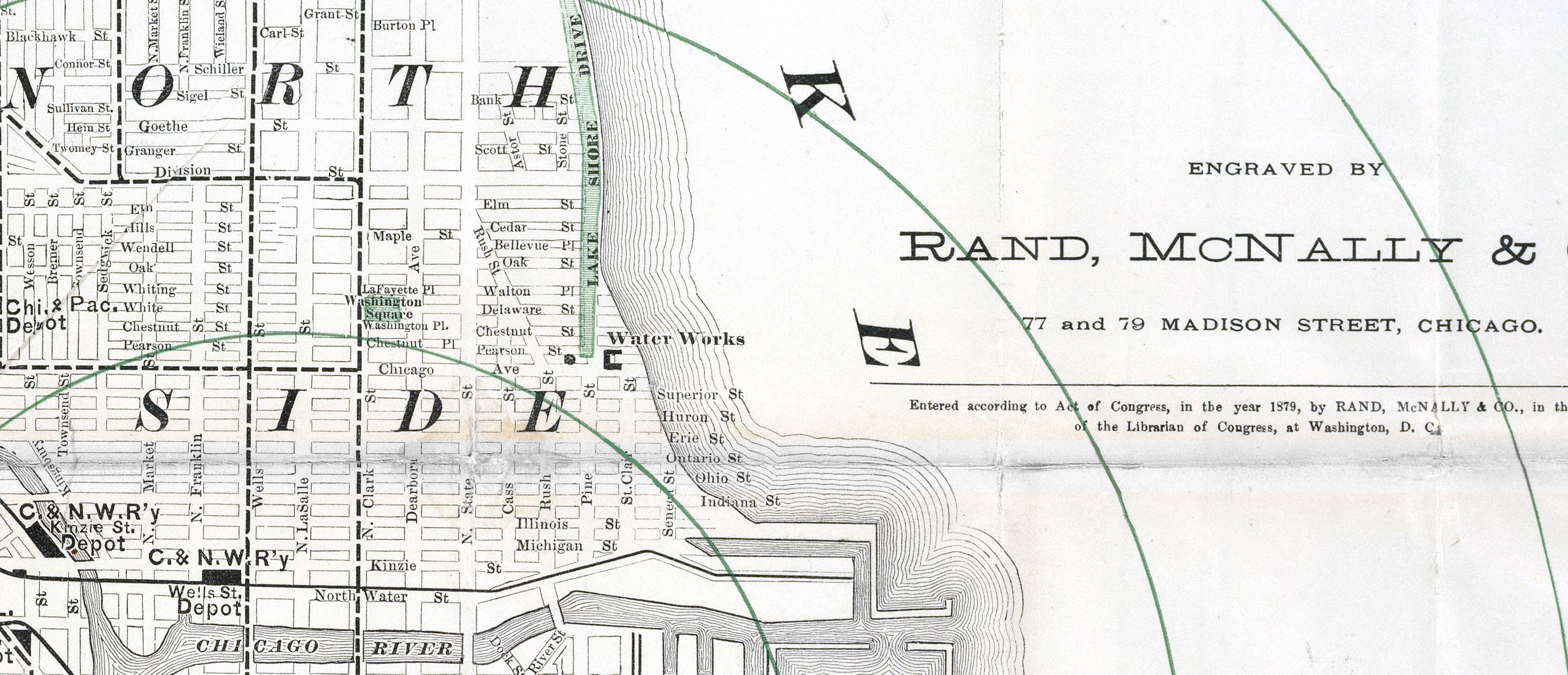
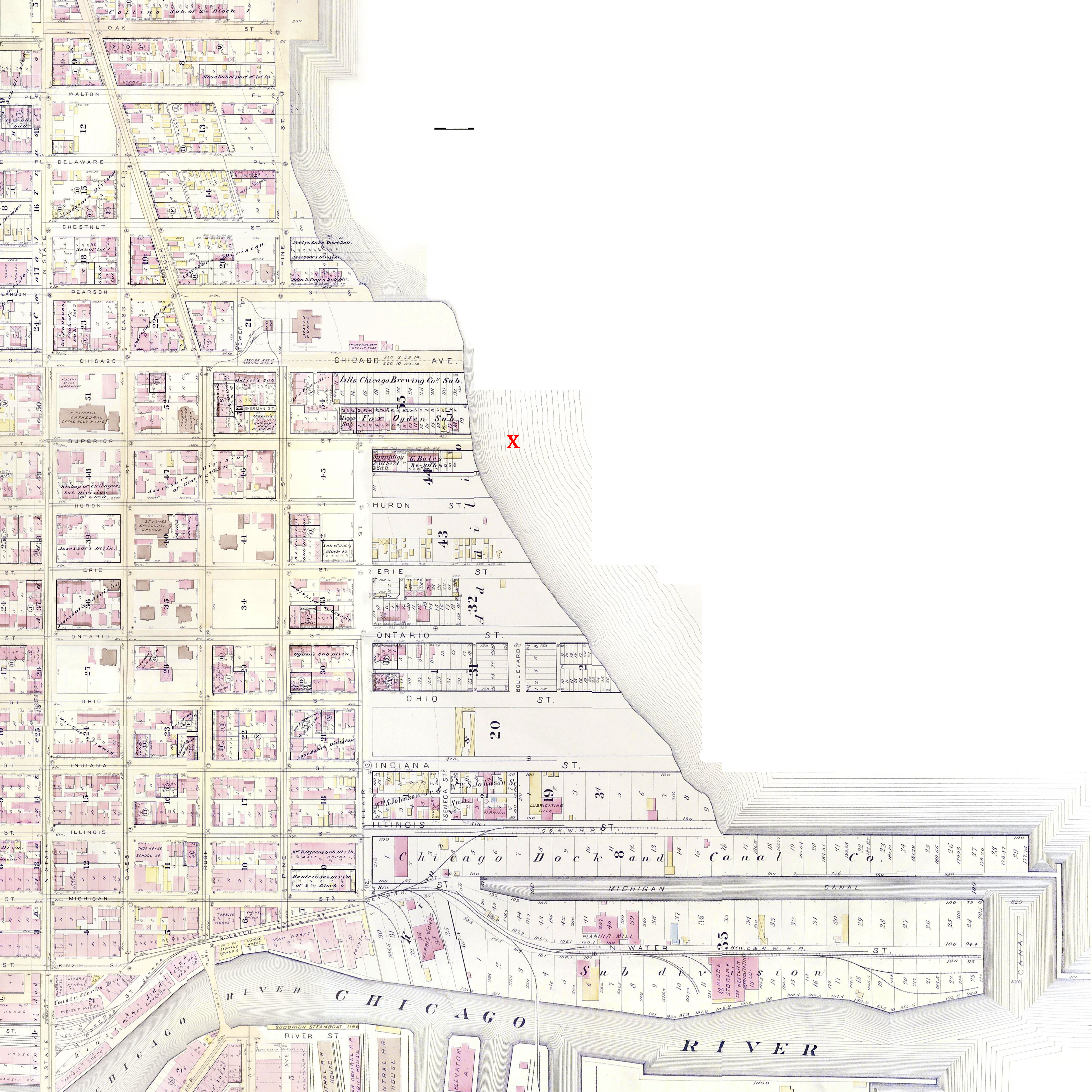
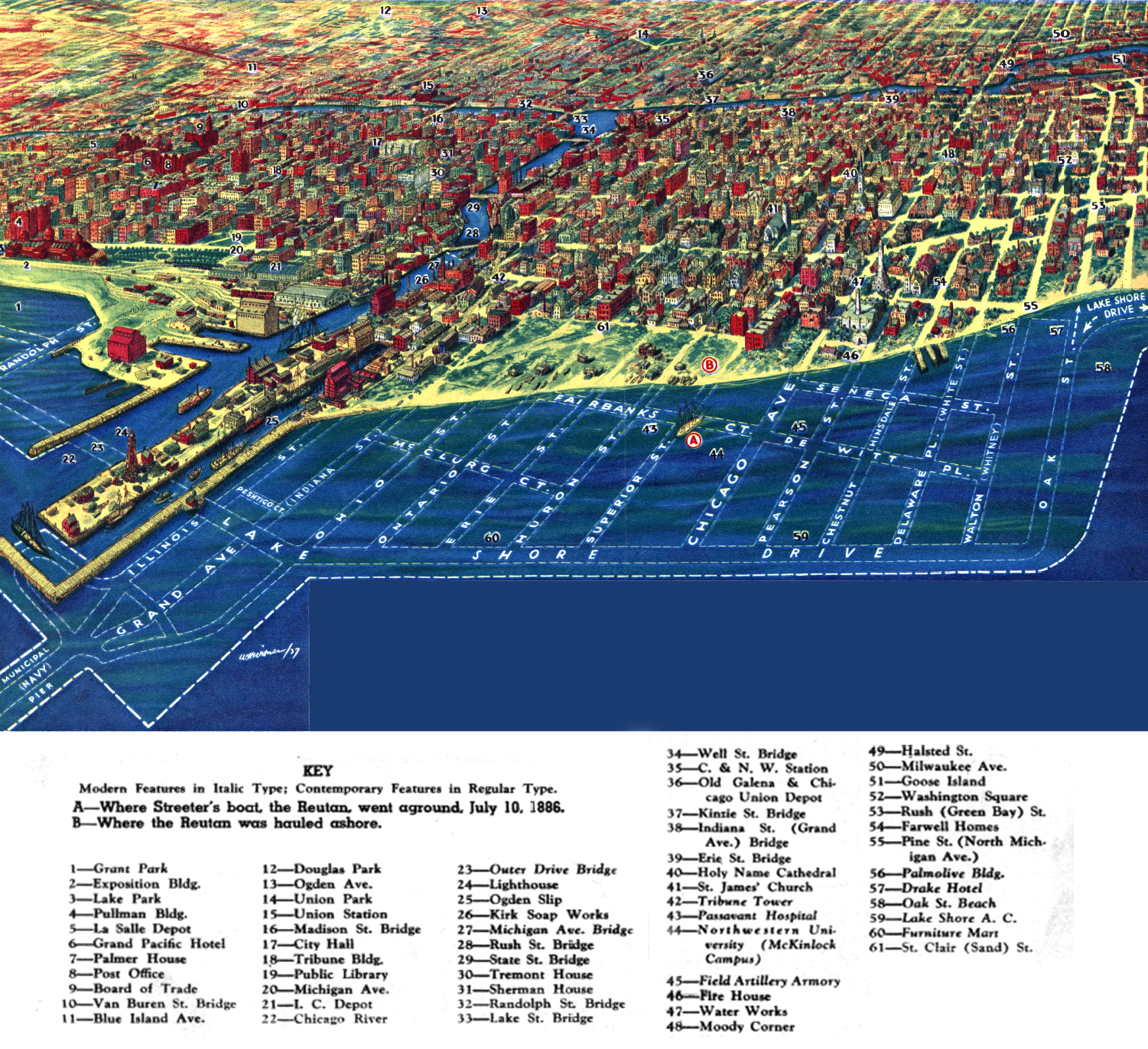
- Top map shows the shoreline in 1879. Below, the 1886 Robinson Fire Map showing approximately where Streeter’s boat went aground on July 10, 1886, which would be the corner of Fairbanks and Superior streets today. In 1907 the tiny street called Fairbanks Court was named after Nathaniel Fairbank, the original owner of the land where Streeter’s boat landed. The neighborhood Streeterville consists of about 186 acres.
Chicago Tribune, September 10, 1890
Nathaniel K. Fairbank won his suit of forcible detainer against Capt. George Streeter yesterday afternoon, but Capt. George W. Streeter was still detaining the shanty at the foot of Superior street last night. He intends to detain it lawfully until the Superior Court of the State of Illinois undertakes to put him out, and then he will detain it otherwise—namely; with a shotgun, with a white bulldog, and a stout heart withal.
“If the State ever puts me out,” says Capt. Streeter, “I’ll make the Government put the State out.”
“Faith we’ll do worse nor that,” said Mrs. Streeter, “we’ll sit Shpot on it.”
Spot is the white white bulldog. If Spot ever fastens his teeth in the leg of the State of Illinois, the State of Illinois will limp forever afterward.
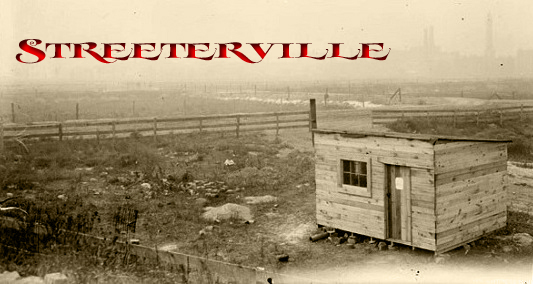
Spot lay asleep under the table in Capt. Streeter’s home last night. It was thick outside, and The Trbune reporter who was sent over to the North Side to talk to the bold mariner who has been fighting millionaires and is only waiting for bigger game stumbled into the cabin before he knew he had arrived. In the daytime the shanty is not so hard to find. Anybody who wants to go down to the foot of Superior street by daylight in summer can see the shanty of Olaf Larsen. In the winter, they are so deep under snow that the pieces of stovepipe which serves the chimneys are just visible. Mr. Larsen’s has the street front. In fact, it has the street itself, for it projects clear out onto the roadway. Capt. Streeter’s is next door. It is a good-sized scow about thirty feet long. It has the ground for a foundation, and it is roofed in with oak planks well tarred by the Captain’s skillful hand. There is a back porch where the prow of the scow used to be, and the front entrance, which will overlook Sheridan drive, is reached through a hole in the stern. This is no caprice of the Captain. It is the way the boat landed when a storm rolled it ashore two years ago. That is where the story comes in.
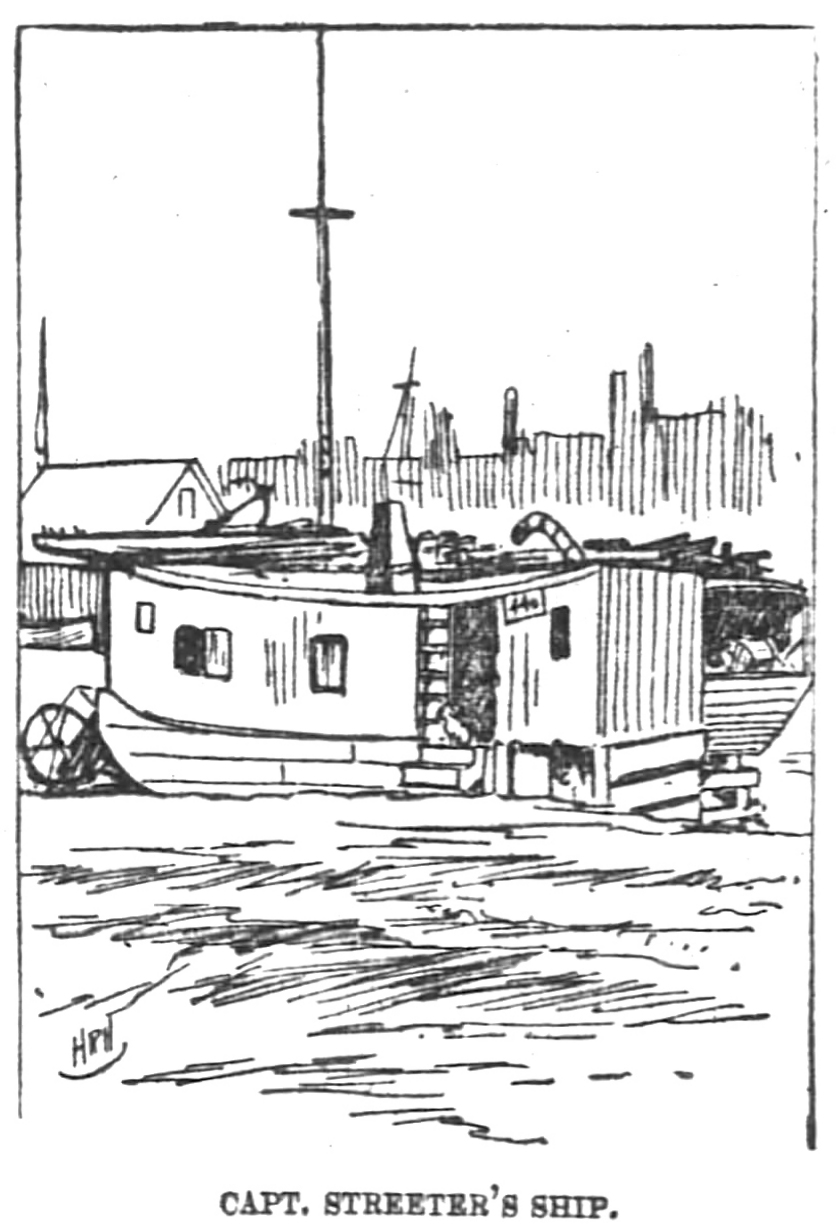
“I’ve been a sailor man for twenty-five years,” the Captain said last night. He was in the one living room of the scow and his wife was frying sausage on the stove. Some friends of the Captain were sitting about smoking corn-cob pipes, and a lamp withiut a chimney was also smoking. Capt. Cuttle might have lived in this room. It smelled deliciously of tar and oakum, not to speak of the sausage, which was no small item, and it was hung around with yellow sou’westers, and canvas jackets, and long rubber boots. The dog was asleep under the chair.
“I’ve been a sailor-man for twenty-five years,” said the Captain, jamming his tobacco into his pipe with his thumb, which is a trick all seamen know, “an’ my name is G. W. Streeter.”
“George Wellington Streeter,” said Mrs. Streeter.
“But I’m no Englisher.”
“‘Dade ye ain’t, or ye’d niver ‘v marrid me,” said Mrs. Streeter.
“‘Vast,” said the Captain. “I’ve been a sailor-man for twenty-five years. I sailed the steamer Catherine to South Chicago until she went ashore at Grosse Point. I was in the Missi’ppi until I sold the boat to a man in Kans’ City, who never paid me.”
“The thafe,” said Mrs. Streeter.
He Likes the Location.
“Vast,” said the Captain.
“I allus lived ‘board a boat. I ain’t used to livin’ nowhere else. I built the Routan—shw was sloop-rigged—an’ sailed her round for a sort of pleasure yacht for people till she was div’ ashore by nor’east blow about three years ago this time. Blowed me into four feet of water and pounded me into the sand. When the wind fell I looked around me and sez I: ‘I’ll stop here,’ I sez. I didn’t have money enough to get the boat off, an’ I liked the location. It was ten or fifteen rods from shore an’ I had a small boat to pull in an’ do my tinkerin’ aland. Nobody raised no objections then an’ we lived quite comfortable an’ easy. About two years ago there was another blow, an’ one night it comes this here old tub an’ stuck about one hundred an’ fifty feet from shore. She was bigger’n the ‘Routan,’ an’ I moved into her.”
“More commodious,” said Mrs. Streeter.
“Vast,”said the Captain. “I put on a roof an’ tarred it, an’ me an’ the girl lived here since. When they began to fill up the lake I didn’t say nuthin’ until it come they had filled 400 feet from the old water line. Then the dudes said I had their ripearian rights. They ordered me off. I wouldn’t go. They asked the Health Department to fire me, an’ I fired the Health Department. They sent the Harbor-Master to put me off an’ that didn’t work. Mr. Fairbank, he said he’d burn me down and I said I’d shoot Mr. Fairbank’s whiskers off if he tried it. I would, too. Then Mr. Fairbank came in his carriage one day an’ he was howlin’ mad. I sez, sez I:
“Mr. Fairbank, you look here. I’m an American citizen an’ you can’t come no British Lord business me. An’ moreover, Mr. Fairbank, you can’t work no Johnny Bull on me, because I was born in Michigan, an’ your ripearian rights is nothin’ to me, Mr. Fairbank.”
“Our rights is more riper than his; more by token that we was here first,” said Mrs. Streeter.
Is Going to Defend His Rights.
“Vast,” said the Captain. “An’ I’m goin’ to defend my rights. I’m goin’ to carry it up to the Circuit Court an’ to the App’late Court an’ to the Soopreme Court, an’ if the Soopreme Court tries to hist me there’s my Government papers to run a boat, an’ if Uncle Sam don’t fight ’em off this ain’t no land of freedom.”
“It’s unconstitutional,” said a man with earrings, rising to spit into the cook-stove.
“It ain’t roight,” said Mrs. Streeter.
“Vast,” said the Captain, snd he rose and took down from the wall a long-barreled shotgun unpleasantly loaded with ten-penny nails and aroused the dog.
He Has Aristocratic Neighbors.
The home is situated in an aristocratic neighborhood. Many prominent men are neighbors of the Captain, From his front window he can hear the boom of the lake and see the breakers piling in ashore. From his back stoop he can watch the carriages of the haughty in the distance. He has only to turn over in bed to hear the chimes of St. James’. The Newberry library will stand within hailing distance of his cook-stove. Moreover, the made land which he lays claim to is worth many hundreds of thousands.
No wonder he doesn’t want to move.
Inter Ocean, March 30, 1892
 Forty acres of the choicest residence property in Chicago, embracing 10,400 feet of frontage on parks, boulevards and connecting streets, of a total value of more than $8,000,000, have been purchased and otherwise acquired by Chicago and outside capitalists by concerted action.
The land is bounded as follows:
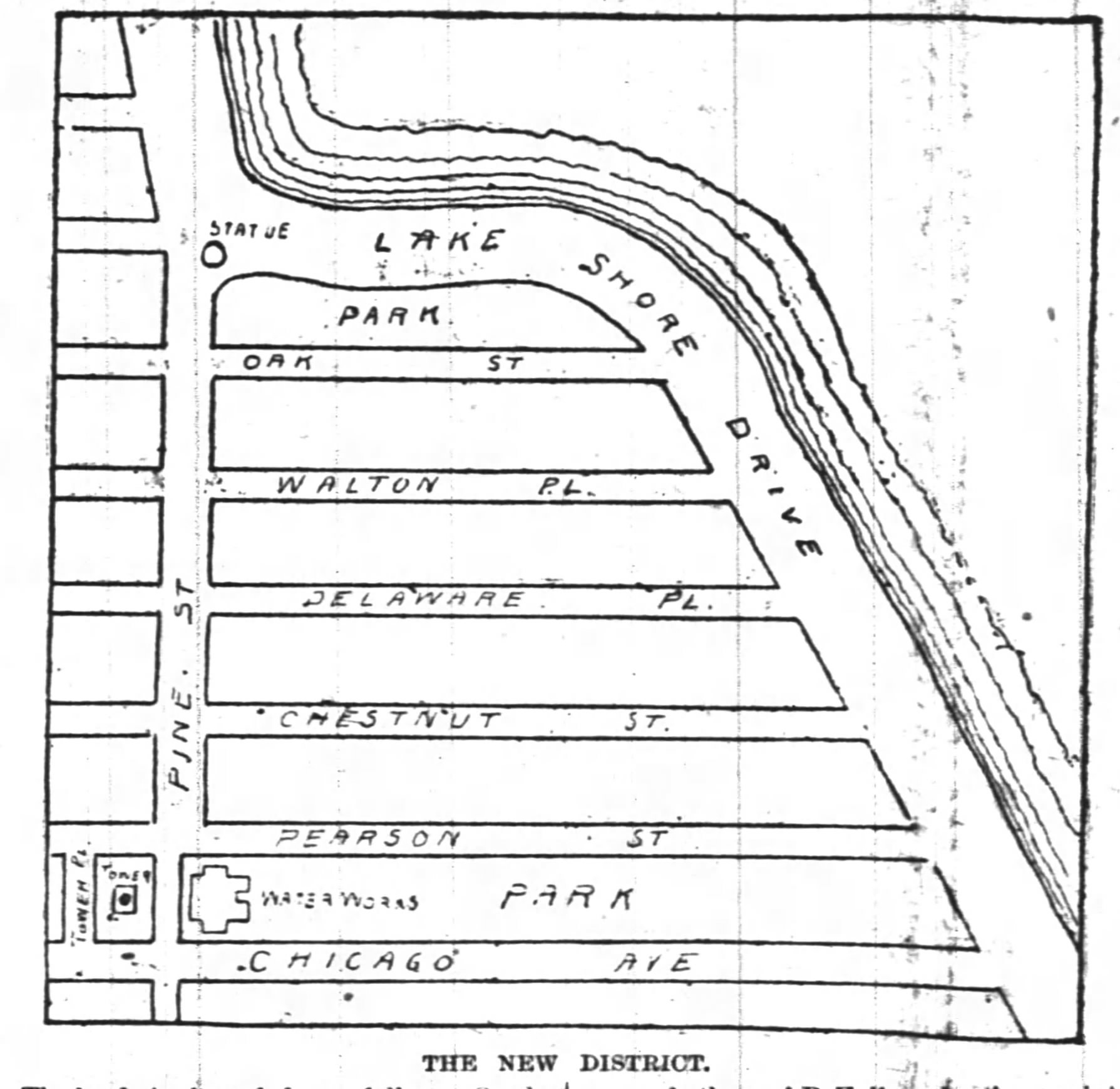
- On the west by Pine street, on the south by Pearon street and what is to be Water Works Park, on the eat and north by the extension of the Lake Shore drive. About one half of the property is now under water. It is rapidly being filled in, however, and will all be ready for improvement in the course of a few months.
The securing of this great tract of land has been the work of many months. Every now and then a transfer has gone on record, showing that something was happening. Others will follow. One, involving the sale of $350,000 worth of the property noted, will be filed for record tomorrow. Two weeks ago The Inter Ocean published an article detailing the operations of the Pine Street Land Association, a syndicate formed to purchase and sell land in this locality. It is this syndicate, another since formed, and private parties acting with these three associations, that have secured control of the property described.
Some Weeks Ago
the North Park Board, acting with owners of property having the riparian right on lake shore frontage between Oak and Indiana streets, completed negotiations whereby the Lake Shore drive was to be extended in a southeasterly direction, on a line about 1.000 feet east of the then shore line. By the terms of the agreement between the park board and owners, the board acquired 202 feet of right of way, wit the riparion right outside of the outer line. The property owners, in addition to donating the right of way, agreed to the following:
- To do all the filing between the shore line and the outer line of the drive and construct the breakwater; to pay an assessment of $100 per running foot for the surface improvement of the drive, and deed fifty feet in width, from Oak to Pearson street, for the widening of Pine street.
For these concessions the board, on its part, deeded to the property owners the right of the State if Illinois to be submerged land between the inner line, thereby perfecting titles in this territory. The board further agreed to maintain the drive as a part of Lincoln Park; to improve as a park the land lying between the water-works, and the drive; to boulevard Pine street as far south as the water-works, and to improve certain property opposite Oak street as a part of the drive.
By These Agreements,
reference to the map to the map will show that a tract of land containing about forty acres is isolated absolutely from anything but the choicest surroundings. Parks and boulevards bound tye land on all sides. That the best use might be made of this property and everything objectionable nature be barred, what amounts to one management has secured control of the entire property.
Two syndicates have been formed to handle property in this territory with the Chicago Title and Trust Company as trustee. A third is in process of formation. An executive committee handles the affairs of each syndicate, and these committees will act together in whatever relates to the improvement of the land.
Such land as is not owned by the syndicate is principally owned by General Charles Fitz Simons and Henry N. Cooper, who are members of the executive committees and largely interested in the syndicates.
The ownerships in the tract, representing the result of all recent purchases and trades, are as follows:
- Oak street, between Pine street and the drive—Pine Street Land Association, 253 feet; Henry N. Cooper, 328 feet; Charkes Fitz Simons, 348 feet.
Walton place, between Pine street and the drive, south front—Pine Street Land Association, 409 feet; Charles Fitz Sinons, 250 feet; Henry N. Cooper, 398 feet.
Block bounded by Walton and Delaware places, Pine street and the drive—Parker & Co., exclusive agents.
Delaware place, north frontage—Pine Street Land Association and Lake Shore Drive Association, 1,345 feet.
Chestnut street, south frontage—Henry N. Cooper, 1,465 feet.
Chestnut street, north frontage—Charles Fitz Simons, 841 feet; Colonel Laing, 333 feet; H. N. Cooper, 833 feet.
Pearson street fronting on Water Works Park, 1,410 feet, owned by H. N. Cooper.
The ownership of Lake Shore drive, corners as follows:
- Charles Fitz Simons, Oak and Chestnut streets corners; Lake Shore Drive Association, Delaware place corners; Henry N. Cooper, Walton place and Chestnut and Pearson streets corners.
Never before in the history of any American city has such an opportunity been offered as that now before the management of this property. Forty acres of a absolutely the choicest residence land in the city will be brought into existence as virgin territory. With no present improvement, either good or bad to hinder development, the opportunity offers to create a residence district which will be the pride of the city. Among the features which the management of the property should introduce will be such restrictions as will completely bar every thoroughfare to trade traffic. There should be no alleys. A uniform building line should be established for every frontage. No house should be built to cost less than a minimum sum. No cross streets should be allowed. For the convenience of residents one or two paved lanes mighht be run through the center of the long blocks. All streets should be asphalted, and all other street improvements should be uniform.
It may be stated that while the management of this propert has not fully formulated a scheme of improvement, the importance of preserving the high character for the land is recognized. Prompt action will be necessary, particularly in regard to whatever restrictions are to be placed on purchasers. A number of persons desiring to purchase lots for building have been asked to wait until the plan of improvement
Has Been Decided Upon.
No sales will be closed until all details have been perfected, but from present inquiry it is doubtful if any land will be unsold three months from now. The values of the property when improved with houses of the cost designated by such as have expressed a wish to purchase will be largely above and $10,000,000.
These operations present an object lesson in Chicago values that should educate any doubting Easterner. The land a few years ago was comparatively valueless. It would still be of minimum worth were it not for the amicable arrangement with the Park Board. This means warring interests have been harmonized, and titkes, elsewise defective, perfected.
The Inter Ocean, November 18, 1892

Nathianel K. Fairbank filed an answer before Judge Collins yesterday to the suit involving a controversy over land bordering on Lake Michigan at the foot of Superior street. Capt. Streeter is seeking to enjoin Mr. Fairbank from interfering with his possession of the land. Mr. Fairbank says that in the sporing of 1889 Streeter called upon him and stated that he had been notified by the city authorities to remove his boat from Superior street; that he was repairing his boat and getting ready to go away. He asked Mr. Fairbank for permission to move his boat on his land until he could get ready to move. This permission was granted, but Streeter declined to move. Neighbors complained that Streeter and his wife were disorderly, and that the residence there was a nuisance. Finally he ordered, says Mr. Fairbank, his agents to begin litigation to oust Streeter from the property.
In an affidavit Henry Russer, of 214 Rush street, says:
- In the summer of the year 1890 Streeter came to me and asked me if I had any money. He said he knew of a scheme which would make himself and myself worth $1,000,000 each. I asked him what the scheme was. He then told me, and requested me to regard it as confidential, that he intended to claim the land by reason of squatting upon it. He said he intended to fight it out; that he was a lawyer himself and that if I would furnish the money with which to fight it we would share equally. I told Streetr that I regarded the scheme crooked and upbraided him fior repaying Mr. Fairbank kindness to him in allowing him to remain on the land, After that time I refused to have anything to do with Streeter.
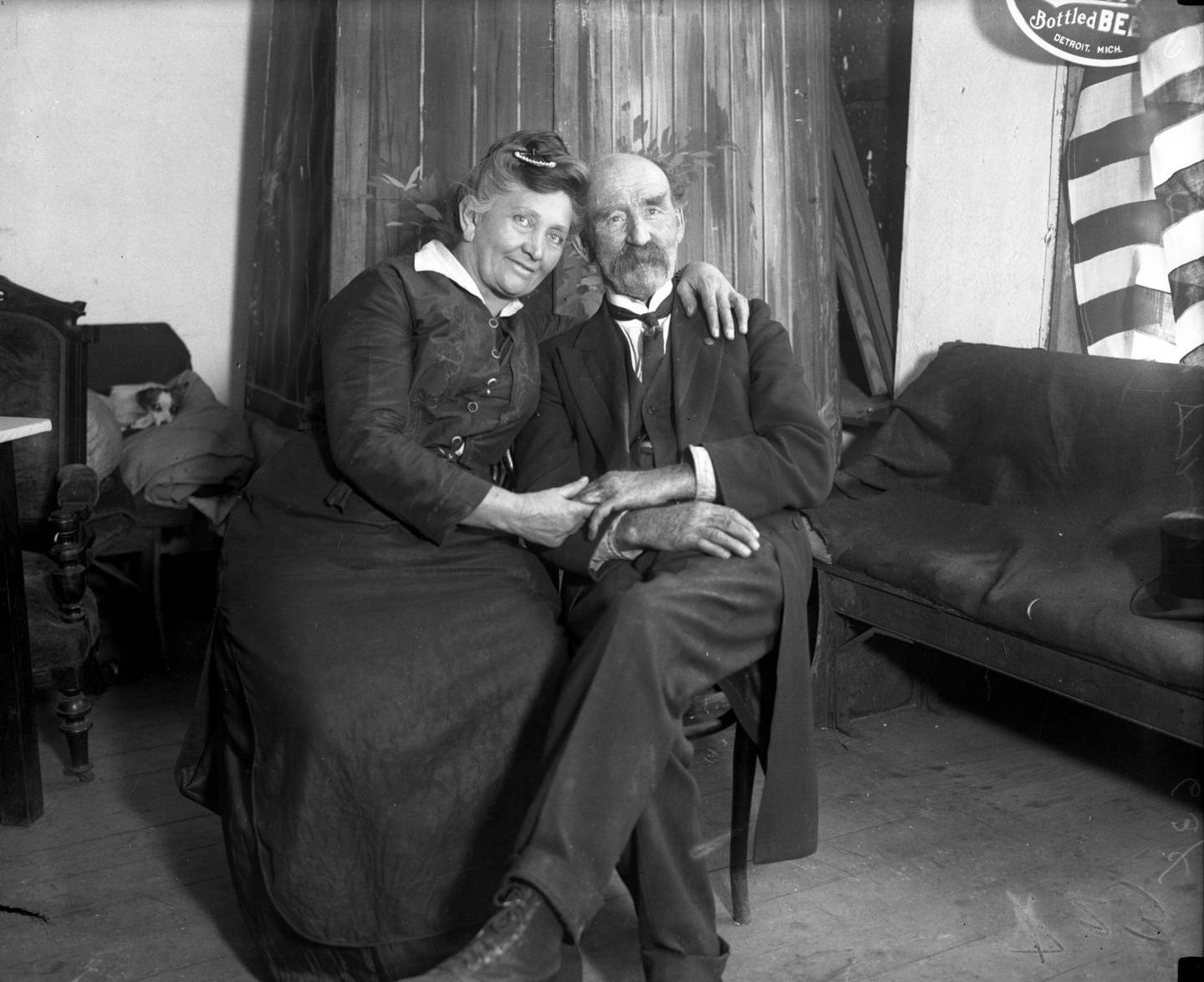
- Captain George and Ma Streeter
Chicago Tribune, April 30, 1894
 Attorney-General Moloney Monday morning will be asked to add a few more defendants to the list named in his bill to restrain the building of the Lake-Shore drive and the reclamation of submerged lands adjacent. Attorney Francis E. Burton, who will preside the reasons for such action, will name among the additional defendants is the United States of America and a number of persons to whom Capt. George W. Streeter of Lake Shore fame has transferred lots. In the maps, plats, abstracts, and other papers which Mr. Burton will show copious references to Capt. Streeter and Peter J. Johnson will appear; for not withstanding his long litigation in courts, the Captain stil claims a big chunk of property adjacent to the drive. In fact, he says, he and Johnson claim all the land from Chicago avenue to the North Pier lying east of a line east of St. Clair street. The Captian has located the land in soldiers’ warrants issued for fighting in 1812. He wants to be one of the defendants, he says. He doesn’t care for the suit, he declares, nor the Attorney-General, nor the courts, the City of Chicago, nor anybody else as far as his claims to the land are concerned. He is outside of Chicago, he says, and gets his title from the United States Government.
Attorney Burton’s Claim.
Attorney Burton, who represents persons to whom Streeter has conveyed lots, says his clients are only seeking to have cognizance taken of all interests. In real estate circles the assertion is made that the move means that a new party plans to join the forthcoming fought for lands worth millions and in it Ed Partridge, the Board of Trade speculator is interested.
Nov. 6, 1893, Capt. Streeter recorded a soldier’s warrant issued to John Scott, private in a Maryland regiment, April 1, 1832, for his services in the early wars of the republic. The warrant entitled Scott to locate forty acres of land. It appeared to have been transferred to Streeter by Lewis H. Van Diver, administrator of Scott. It was a seamed and battered document, full of erasures, and dim with age, but the Recorder recorded it and the Captain, it develops, immediately proceeded to locate that forty acres of ground 451 feet east of St Clair street, between Chicago avenue and Erie street. The Captain got another warrant or two and under them located the rest of the land between these boundaries, basing his claim on the early maps of the government, showing the meander line of the lake.
Peter Johnson has lived south of Erie street near the lake shore for many years, and he, it is said, has laid claim to the ground south of the line Streeter fixes in his map and north of the north pier. Johnson has had some litigation, but has not figured to the extent that the Captain has in the courts. Not withstanding the celebrity that the latter has attained through suits, the transaction above described appears not to have attracted extensive notice.
Has Already Sold Lots.
The Captain has platted his land and he says he sold 200 lots. One of the buyers is a man named William H. Cox. He wrote to the General Land Office at Washington in October, 1893, making application to purchase 130 acres of land, which he described as lying on the lake front in front of the government meander line of fractional sections 3 and 10. Twonship 39, North, Range 14, East. The particular parcel of land he wanted, he said, had not been surveyed, and he inclosed $162.50 as the price of that 130 acres and asked the government to direct an official survey.
Commissioner Lamoreaux wrote Cox a coldly informal letter, setting out that the official plat on file, approved March 16, 1831, showed no such unsurveyed land and that any land formed in front in front of the meander line since the survey did not belong to the United States. He sent Cox back his $162.50 and referred him to the decision of the Supreme Court in the Illinois Central case, reported in No. 146, United States Reports. The syllabus of that decision, he wrote, was that the ownership of lands covered by tidewaters within the several States belonged to the respective States in which they were found with the right to dispose of any portion thereof, when that can be done without the impairment of the interest of the public in the waters. The same doctrine as to dominion and sovereignty over an ownership of land under the navigable waters of the great lakes applied which obtained at common law as to tidewaters.
Notwithstanding this letter, Attorney Burton says that there has not been anything produced to show that the lands do not belong to the United States.
Burton speaks for Streeter, said he:
- Capt. Streeter. I understand, has a soldier’s warrant and has located his land and had it recorded. The decision of the Supreme Court in his case, I am told, is not a final disposition of his case. But whether it was or not the Captain now claims to have a title directly from the United States. I represented parties who have bought lots from him and we contend that the United States is interested in this Lake Shore drive matter. The maps of 1818 fix the boundary line of Illinois on the western shores of Lake Michigan. The State of Illinois has no right to any land added to that on the lake side by the action of the waters otherwise. The United States has absolute control of the land under the waters of the lake. The title is still vested to the United States; the State has nothing to do with it. I have suggested to the Attorney General that all the parties interested should be made defendants, the United States included.
“Your clients don’t want to get into the case to get a quasi recognition of their claims, do they?
- No, sir, nothing of the kind. I had a long talk with the Attorney General. He doesn’t think that the Pine Street Land Association people have any right to the property, and he wants to hear what claim Streeter has. In the interest of justice all should be included.
Capt. Streeter has an office on the thirteenth floor of the Title and Trust Building. He sat in it yesterday the center of a group of seven or eight men.
Capt. Streeter Independent.
“Are you going into this Lake Shore drive litigation, Captain?” he was asked.
“No, sir. I don’t care for a cent for this litigation. I care nothing for Moloney or anybody else. I and Johnson are the only people owning that property, and we’ll hold it. I have already sold 200 lots in my subdivision.”
“Is your map on file at the City Hall, Captain”
“I have all the maps there I need or am going to have. I am outside the City of Chicago. I got my title from the government, The city has got nothing to do with me and I don’t want to have anythibg to do with the city.”
Representatives of the Pine Street Land Association ridicule the claims of Streeter and Johnson. Streeter’s claim, they say, has been settled by the Supreme Court. The Scott warrant, under which he located forty acres, they say, is full of flaws and will never stand a judicial examination. H. N. Cooper says that Streeter has been making transfers, but he alleges no great amount of money has passed. A man very well informed in the whole matter said yesterday:
- I have the best reason for knowing Ed Pardridge has become interested with these people. He thinks enough of their case to get hold of immensely valuable property to put up money fpr them. This he has done and plenty of it.
Chicago Tribune, May 10, 1894
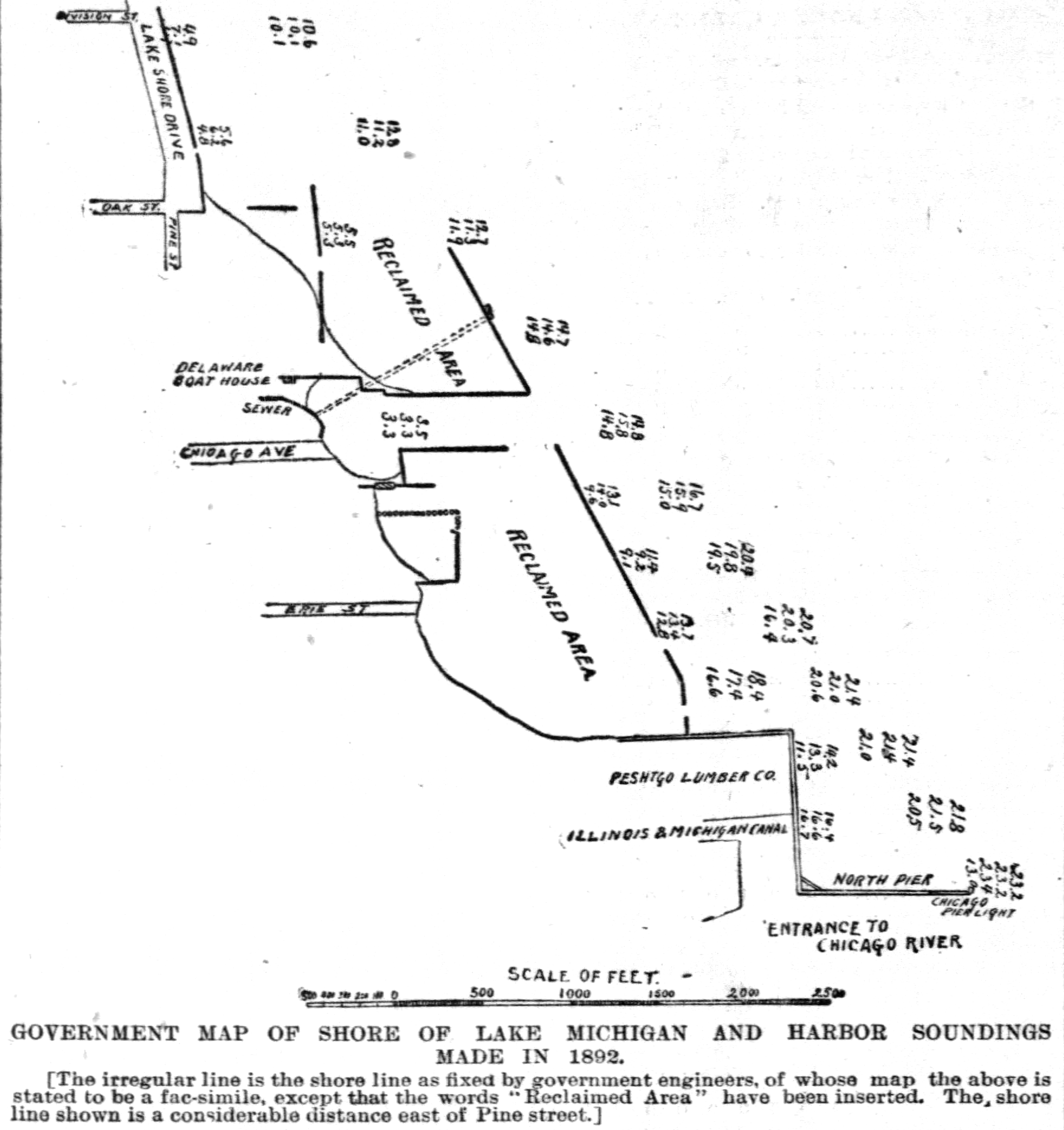
- The Government Map of Shore of Lake Michigan and Harbor Soundings Made in 1892.
The irregular line is the shore line as fixed by government engineers of whose map the above is stated to be a fac-simile, except the words “Reclaimed Area” have been inserted. The shore line shown is a considerable distance east of Pine street.
Chicago Tribune, May 6, 1899
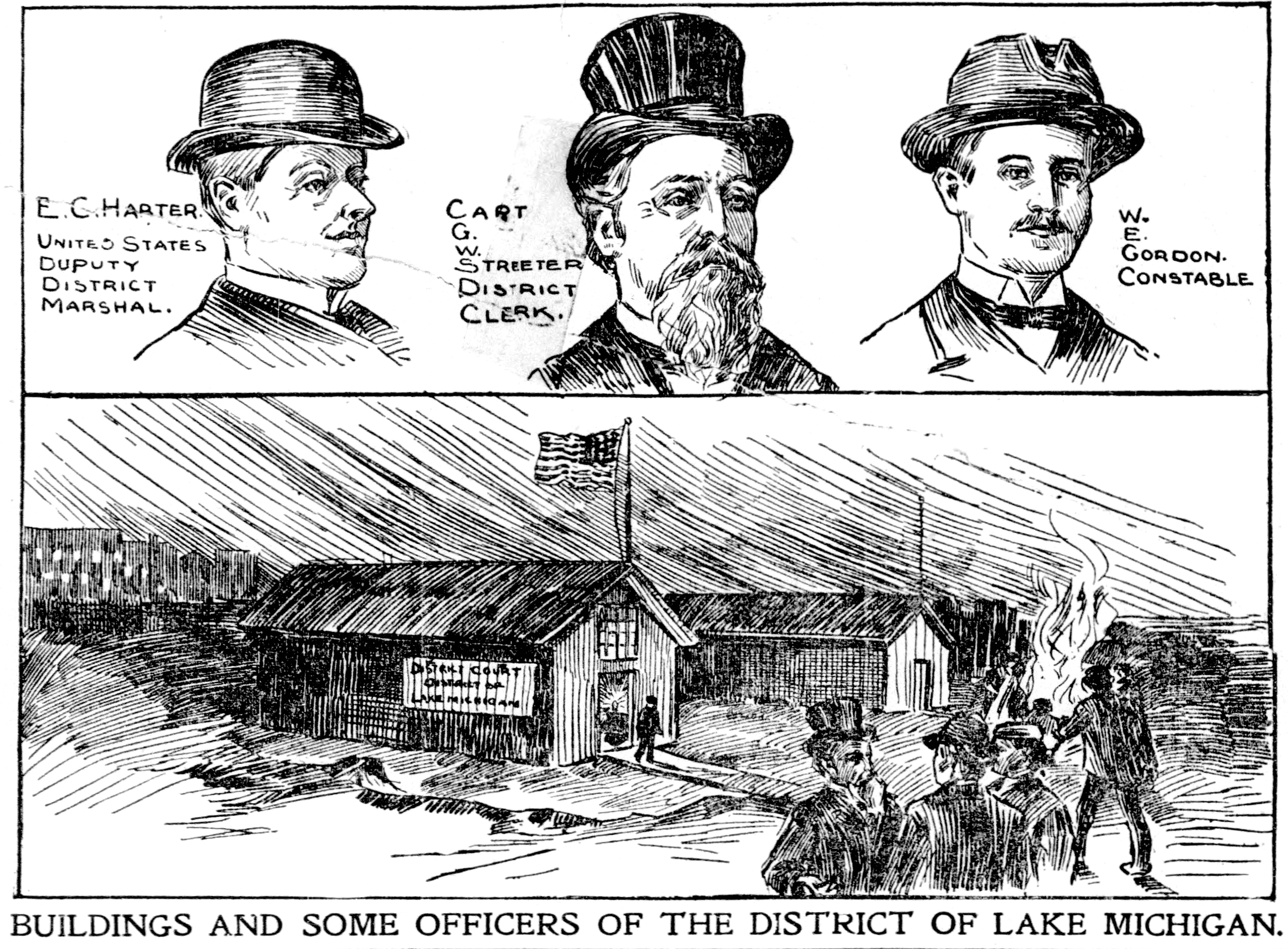
On the afternoon of May 8, 1899, the capitol of “the District of Lake Michigan” was ruthlessly razed to the ground by the employees of N. K. Fairbank. Not only the capitol building itself, but all Streeterville was utterly destroyed, and one shingle was not allowed to rest upon another. This was done under guard of Chicago police officers and private watchmen employed by the Newberry library. N. K. Fairbank and John V. Farwell, who claim to own the land and who have paid taxes on it for many years.
Chicago Tribune, July 8, 1900
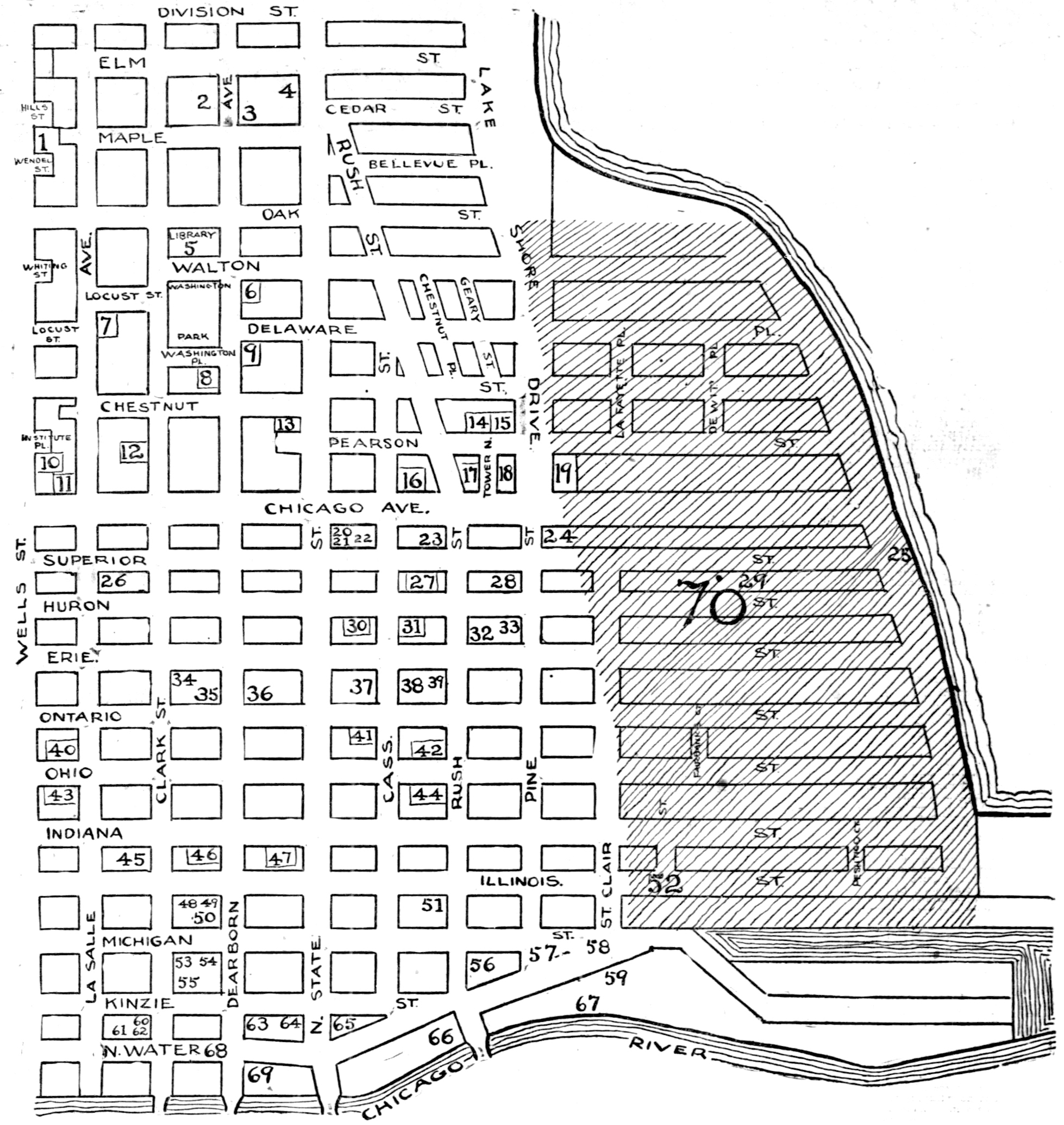
- A map of Chicago’s Twenty-fourth Ward depicting the District of Illinois formed by Captain Streeter’s lodged boat.
Chicago Tribune, December 21, 1901

Armed with a permit signed by Building Commissioner Kiolbassa and Cornelius O’Shea, Captain George Wellington Streeter erected a shack in the District of Lake Michigan on Thursday night, and now the residents of the Lake Shore drive are wondering whether Captain Streeter will move into the building, which is between Walton and Delaware places, where they end at the Ohio street boulevard extension.
This flank movement of the Captain was explained yesterday by the police, who said, “somebody” had a regularly signed permit, which had been applied for by Alderman Cullerton.
The house was occupied yesterday by Billy McManners, one of Streeter’s lieutenants. The furniture consisted of one cook stove, three sections of rusty stovepipe, and two wooden kitchen chairs. According to McManners, the house was erected in two hours and ten minutes, having been brought to the site selected in six sections and then hastily thrown together. Later it was learned it was the same house which Captain Streeter attempted to erect at Superior street two months ago.
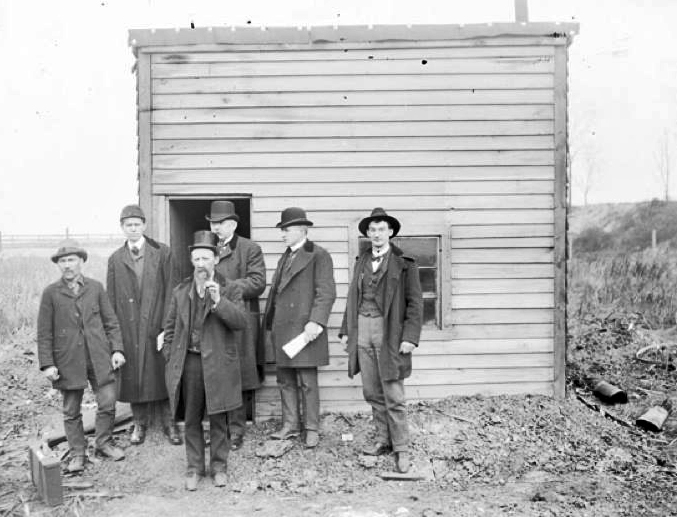
- The first house to be erected in Streeterville.
Chicago Sunday Tribune September 5,1937

The shore line of Chicago’s near north side was approximately where it is shown in the above drawing on July 10, 1886, when Cap’n George Wellington Streeter’s pleasure boat, the Reutan, went aground to mark the birth of a real estate controversy that raged for forty years, an aftermath of which still is pending in court.
• Streeterville, or, as Cap’n Streeter called it, “the Deestrict of Lake Michigan,” over which the dispute was carried on, contained approximately 186 acres, and is shown in the drawing as that part of Lake Michigan that has boundaries and streets outlined in broken white lines.
• Every one familiar with the latter history of Chicago remembers the doughty old Cap’n Streeter and the lake front property, which he contended, on the basis of a number of claims, was rightfully his. Streeterville now is built up largely with costly and imposing structures, such as Northwestern university’s McKinlock campus buildings, Passavant Memorial hospital, and the Lake Shore Athletic club, and Cap’n Streeter has been dead more than sixteen years. But heirs of the old man still have a suit pending in the United States District Court in Chicago. They are trying to collect damages from present owners of property in Streeterville, an area the value of which eight years ago was estimated as high as 800 million dollars.
Streeter was a picturesque old fellow. He served in the Civil War, became a showman, a steamboat operator, and a country fair faker. In the spring of 1886 he built and launched in Chicago a small boat which he called the Reutan. He had planned to employ this vessel in river passenger service somewhere in the west with the idea of obtaining as a reward land grants from the government. As his plans were taking form, however, he put the craft into service on Lake Michigan, making trips to Milwaukee and other nearby ports. On July 10, 1886, according to his own story, he took a private party to Milwaukee on the Reutan. A storm blew up and his passengers decided against the return trip to Chicago. Streeter, his wife, Maria, and his crew started back without the passengers. Years later Streeter’s experience on that eventful day was described in the following words:
- By the time we reached Racine we encountered a terrific storm which did not abate its fury for many hours, and by that time the Reutan was a badly damaged wreck lying on a sandbar off Chicago harbor, behind the breakwater on the north shore.
It was about 10 o’clock at night when we drifted near the breakwater…We were then at the mercy of the wind and waves, helplessly drifting about. Fortunately or unfortunately, just as you may choose to judge by subsequent events, the wind drove us behind the breakwater, narrowly missing a collision with the pier. Just as soon as we were clear of this danger I cast anchor overboard, hoping to prevent the vessel from running aground on the beach. But the sea was so strong that it not only broke over the boat in tremendous waves, but it also dragged the anchor across the bottom of the lake, which at that point was not very deep.
The boat finally stranded in a shallow body of water when 451 feet from the shore.
Although reports have varied as to the exact spot where Streeter’s boat went aground, some placing it as far north as the foot of Oak Street and others near the pier just north of the mouth of the Chicago River, it is generally believed that the actual spot of the grounding was off the foot of Superior Street, just east of St. Clair Street.
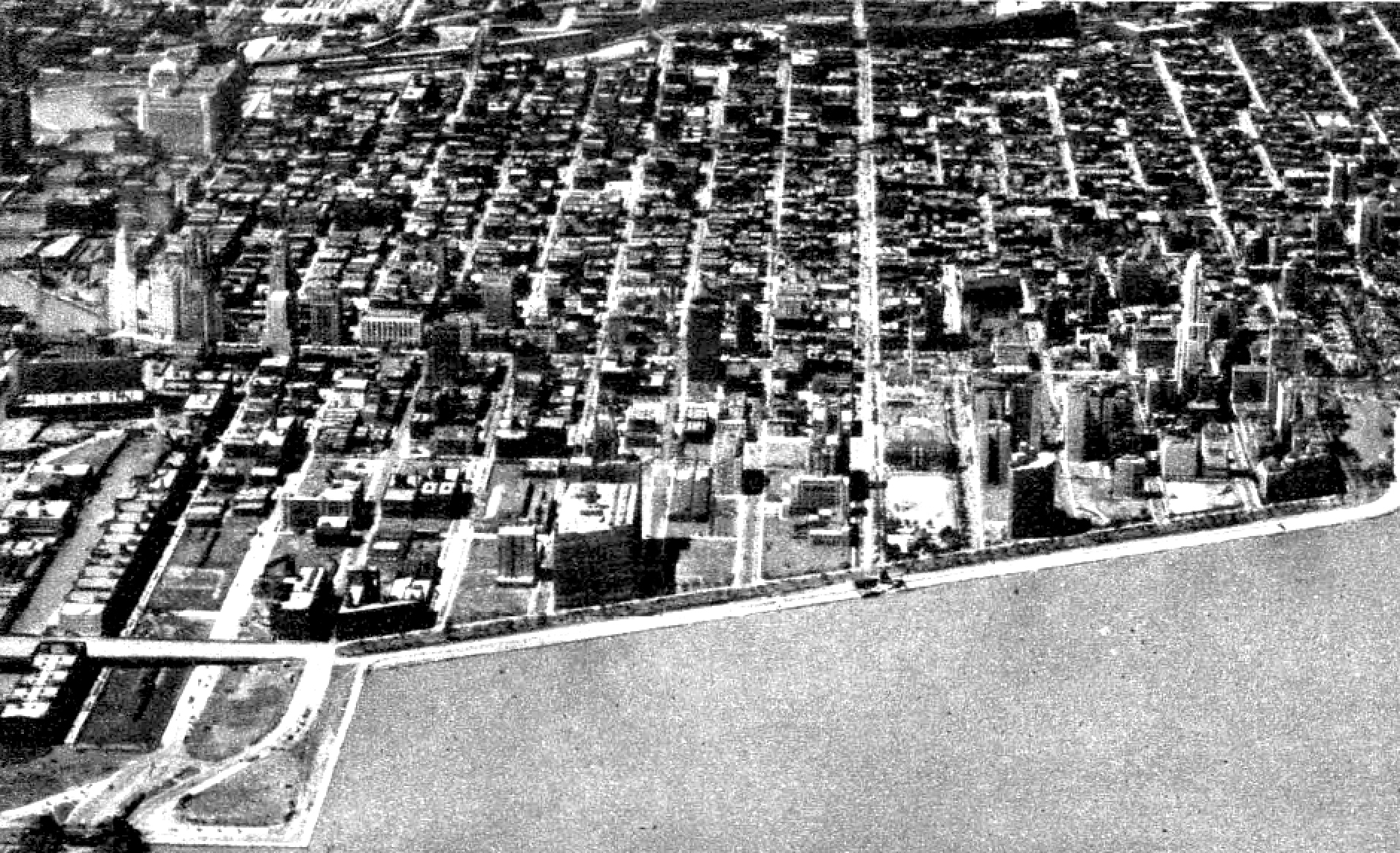
- In the foreqround is Streeterville as it appears today (1937).
It always was Streeter’s contention that his vessel sank in very shallow water and that the action of the waves built an island around the craft, but another story is to the effect that he had his boat dragged into shore upon property owned by N. K. Fairbank, who, according to testimony at subsequent hearings in the controversy over the ownership of Streeterville land, ordered the Cap’n off time and time again.
At any rate, here was Streeter and his wife, living on a stranded boat in the fall of 1886, near the foot of Superior Street, the waves piling up sand around his curious dwelling. Land grew so rapidly that it was not long until a hundred acres of white sand had sprung up around the stranded boat. Streeter called this stretch of beach “District of Lake Michigan.” He pronounced it “Deestrict.” It was no part of Illinois, he said. “No, sir! It was a separate commonwealth under the direct jurisdiction of the federal government.” It was not until 1889 that physical efforts were mad to evict Cap’n. In July of that year Streeter and his valiant Maria, with loaded rifles, drove five constables out of the District of Lake Michigan.
According to the Cap’n’s story, he repaired the Reutan, refloated her in 1893, rechristened her the Maria, and used her in carrying passengers from the downtown district to the fair grounds on the south side. By that time he had converted an abandoned scow into a house, and in that he and Maria lived.
As this was transpiring a great building boom struck Chicago. There was much excavating necessary and contractors anxious to find dumping grounds close at hand. The waste of sand around Streeter’s scow was inviting, and lierally millions of tons of refuse, earth, and gravel were hauled to the spot. In fact, the Cap’n himself later said that a number of contractors paid him for the privilege of using the section as a dumping ground. Streeter combed the refuse for old iron, copper, and other junk. While the waste material piled up, the waves of the lake, trapped by the pier at the north of the river, brought in more land to add to Streeterville.
Property owners along the original lake shore saw Streeterville taking large proportions. On the basis of the fact that their deeds entitled them to their land to the very water’s edge, they held that this newly added land rightfully was theirs. Among these property owners were wealthy men, such as the previously mentioned Mr. Fairbank, Potter Palmer, and Gen. Charles Fitz-Simons. It should be borne in mind, however, that the Potter Palmer mansion in Lake Shore Drive, to the north, was not involved.
The controversy between Streeter and the property owners took on the form of prolonged warfare. To the banners of the Cap’n flocked an assortment of folk who wanted to see his wealthy opponents beaten. Streeter even organized an association and sold and leased lots. One William N. Niles was given by Streeter, or assumed on his own initiative, the title of “military governor of the District of Lake Michigan.” The belligerency of the Cap’n and his wife, Maria, began to share space in the newspapers with the legal aspects of the case. The property owners engaged batteries of lawyers, and Streeter marshaled his own legal corps. As attorneys wrangled over points of law, Streeter and his wife held forth with lethal weapons, ready upon a moment’s notice to pounce upon anyone found “trespaaaing” upon Streeterville. It was in 1899 that five policemen captured the Cap’n in an unguarded moment. As the bluecoats began to gloat over their feat a shower of boiling water descended upn them. Maria had seized a kettle and dashed to the rescue. In the confusion Streeter freed himself and grabbed his rifle.
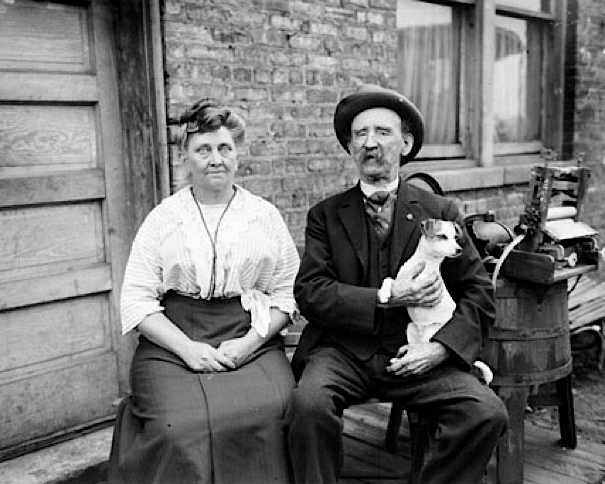
- Captain and Ma Streeter.
During the following year several shots were fired within the dangerous precincts of the District. Once Samuel Avery tried to build a fence across the Cap’n’s deadline and was peppered with bird shot. A month later the military governor objected to the presence of Police Captain Barney Baer and two bullets were sent through the top of the policeman’s buggy. The next day 500 policemen surrounded the District. There was much maneuvering and skirmishing, and finally one lone Lincoln Park policemen captured Streeter’s entire army. All were acquitted.
The killing in Streeterville in 1902 of a man by the name of John Kirk brought Streeter and others before the courts to answer for the man’s death. Streeter finally was found guilty of manslaughter in connection with the case and, starting in February 1903, actually served several months in Joliet penitentiary before he was freed on habeas corpus proceedings. In the meanwhile, his wife, Maria, had died.
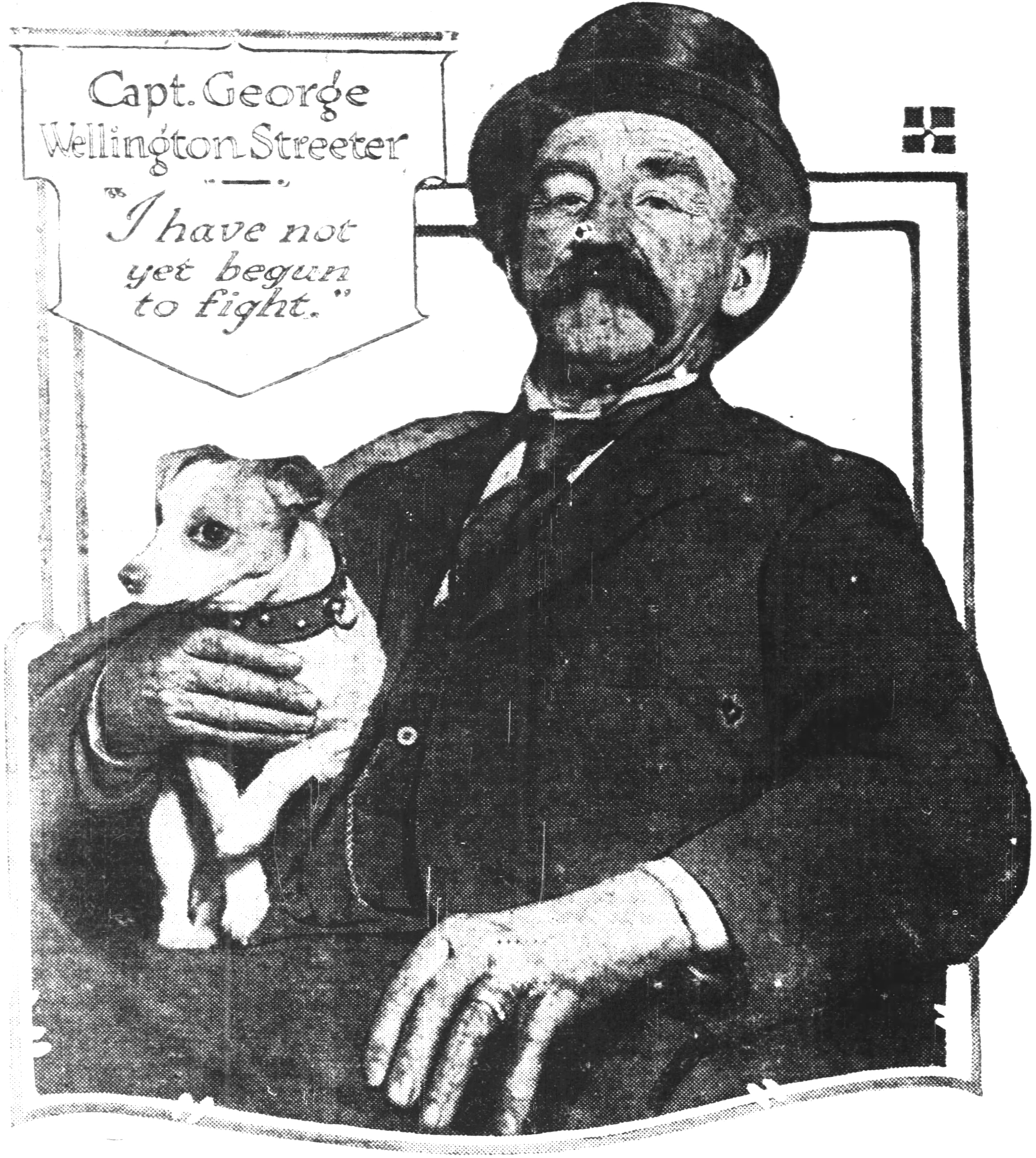
In April, 1906, according to the Cap’n’s statement, he married Elma Lockwood, who ever after was known as “Ma” Streeter. He took her to live in a brick house that he had erected not a great distance from the site of the old scow.
Three years later the old fellow once more broke into print. Marching down to the foot of Chicago avenue and discovering a gang of workmen engaged in civic improvements, he doffed his aged plug hat and said:
- I warn that you are trespassing upon my property and that I will have you all arrested and punished.
For his efforts, the Cap’n found himself once more briefly behind the bars.
Streeter saw a chance to make money selling beer on Sundays to thirsty pilgrims from across the border in Illinois. Business started off briskly, but it was not long before the authorities heard about it. So one Sunday, some time in 1915, the invaders descended in force, raided the Cap’n’s place, his castle near the foot of Chestnut Street, seized hundreds bottles of beer, and carried Streeter and “Ma” off in a police ambulance.
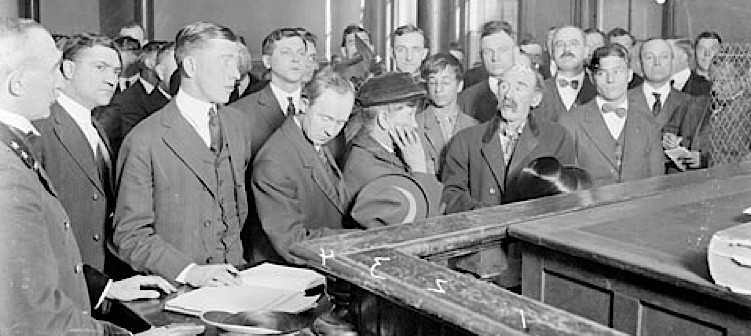
- Cap’n and Ma Streeter in a 1915 court appearance.
This marked the beginning of the the end of the old man, although he still was full of fight. In 1918 he and “Ma” returned one day to their home to find it in ruins. He took to life afloat again. His houseboat went up the north branch of the Chicago River, then out and down the lake near East Chicago, so that he might establish an Indiana residence and get proper jurisdiction for renewed legal action. While living on the north branch of the river, he stepped from his houseboat one evening to address the Dill Pickle Club. He said:
- The courts tried to get me on everything but adultery, and I beat them every time.
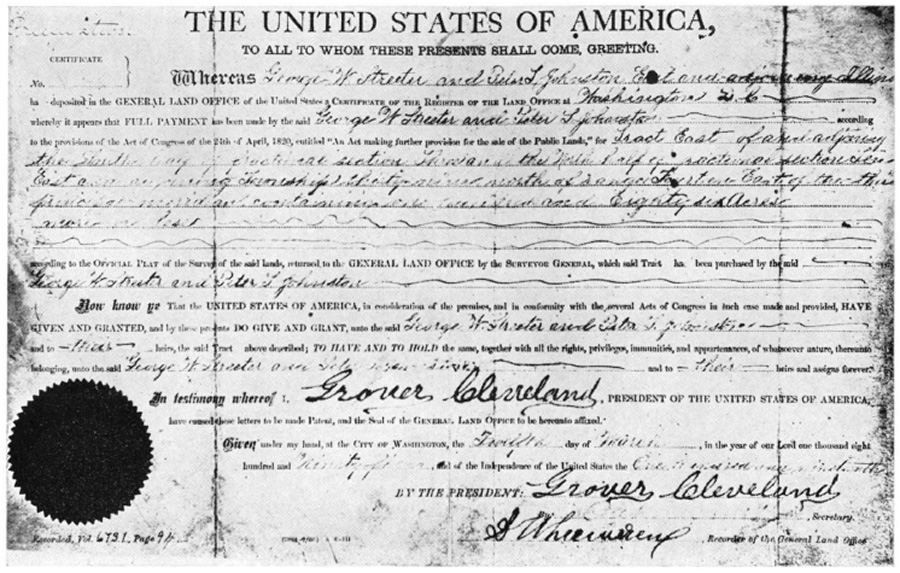
- Facsimile of document which, with other claims, was the basis of Cap’n Streeter’s contention that he was the owner of the property comprising Streeterville. The document was declared a forgery on August 9, 1895, due to the fact that the signature below Grover Cleveland’s is spelled “Oak Smith,” referring to Hoke Smith, Secretary.
This statement, of course, was a gross exaggeration. Although he had appeared innumerable times in state and federal courts, he never had been able to obtain a title to the land lying within the District. His claim was based upon squatter’s rights, upon old old documents bearing the signature of President Cleveland. These last, in the form of grants from the government, were discussed as follows in a master of chancery’s report as far back as 1918:
- Streeter claims title since 1886 by virtue of two alleged land warrants, recorded and purported to be signed by President Grover Cleveland, by Hoke Smith, secretary, and S. W. Lamereaux, recorder in the land office. Hoke Smith never was secretary to the President, but at the time was secretary of the interior, and Lamereaux never was recorder.
The name of Hoke Smith was written as “Oak Smith.”
Most of Streeter’s battling was done with him in the role of a defendant, but on Sept. 5, 1920, he took the offensive, when he filed his famous suit against the Chicago Title and Trust company and a number of other defendants. The case had scarcely gotten under way, however, when the old fellow gave up the ghost on Jan. 24, 1921, at the ripe age 84. Death came to him on his houseboat as is it lays moored off East Chicago.
Upon the passing of the aged battler an effort was made to substitute “Ma” Streeter as the plaintiff in the case, but it was shown that she had not been legally married to the Cap’n and therefore could not be considered as his widow. When the heirs of Streeter discovered that there was a judgement standing against him for which they would be liable if they entered the case as plaintiffs, they elected to keep clear of that particular bit of litigation, preferring to file their own suit later.
The battle, as far as the old man was concerned, therefore, came to an end shortly after his death, leaving the property owners of Streeterville still in possession of their various parcel of land. Their titles were based upon old deeds, accretion (land formed in the laje at the water’s edge of their properties) and old contracts with the Lincoln Park commission.
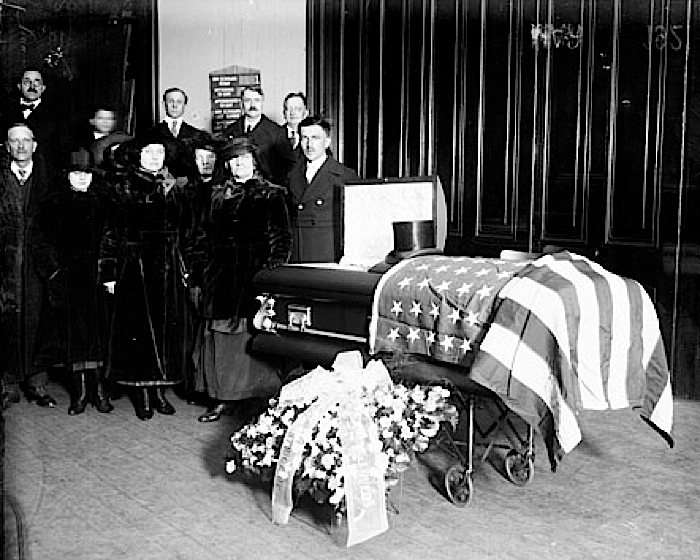
- A scene at the Cap’n’s funeral. Note the flag and the plug hat atop the casket.
“Ma” Streeter lived on until the autumn of 1936, when at the age of 65 she breathed her last in the County hospital. After the Cap’n’s death she had made good her promise to carry on his fight for ownership of the land in Streeterville. Despite court efforts to remove her, she continues to live aboard the houseboat, the Vamoose, until it finally rotted to the water line. It was burned by the city in 1928. In 1924 “Ma” filed suit for a billion dollars against the Chicago Title and Trust company and some 1,500 lake shore property owners. She ceased to be active as a court principal, however, when Federal Judge James H. Wilkerson, ruled that her marriage to Cap’n Streeter was illegal. It was proved that the Cap’n had married one Mary Collins by South Bend, In., in 1905 and had never taken the trouble to obtain a divorce.
In 1923 twenty-three heirs of Streeter filed a declaration by federal court asking $5,000,000 damages of 3,500 individuals and corporations, The tract involved in the suit was the famous Streeterville district. Among the defendants were Stanley Field, Potter Palmer Jr., Kellogg Fairbank, the Drake hotel owners, the Furniture Mart, the Palmolive building, the Ogden T. McClurg estate, Northwestern university, the University of Chicago, the city of Chicago, the state of Illinois, George W, Dixon, Grank J. Loesch, Honore Palmer, the Chicago Title and Trust company, the Illinois Merchants Trust company, the Northern Trust company, Charles H. Swift, Joseph Leiter, Silas H. Strawn, George A. McKinlock, and Augustus S. Peabody.
This is the suit that was remanded to the federal District court after an appeal by the Streeter heirs in 1932 to the federal Circuit Court of Appeals. It still is pending in the District court.
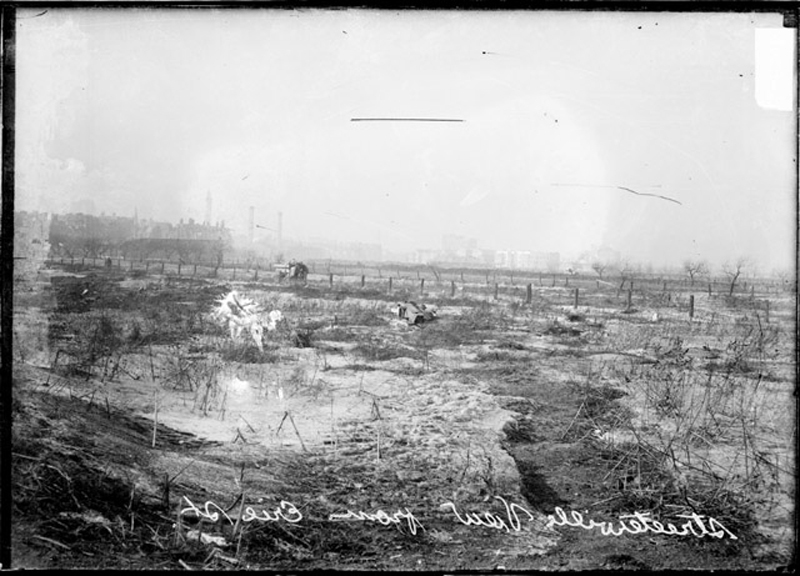
- Streeterville View from Erie St., 1909
The Water Tower and the Pumping Station’s smoke stacks are visible at the hazy horizon line to the left.
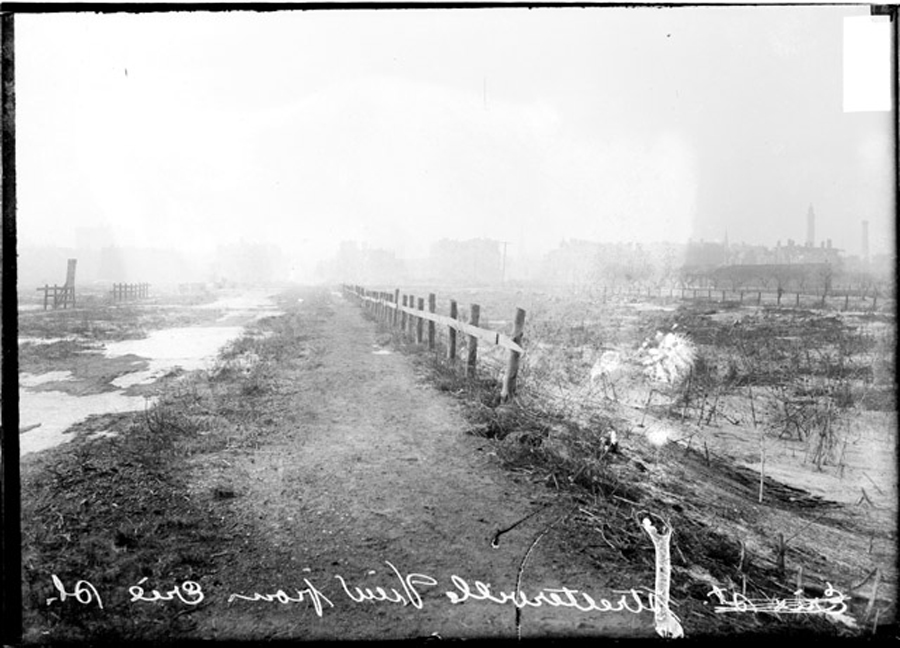
- Streeterville View from Erie St., 1909
Dirt paths formed along fence lines leading towards the lake.
The Water Tower and a smoke stack from the Pumping Stationis visible along the right edg
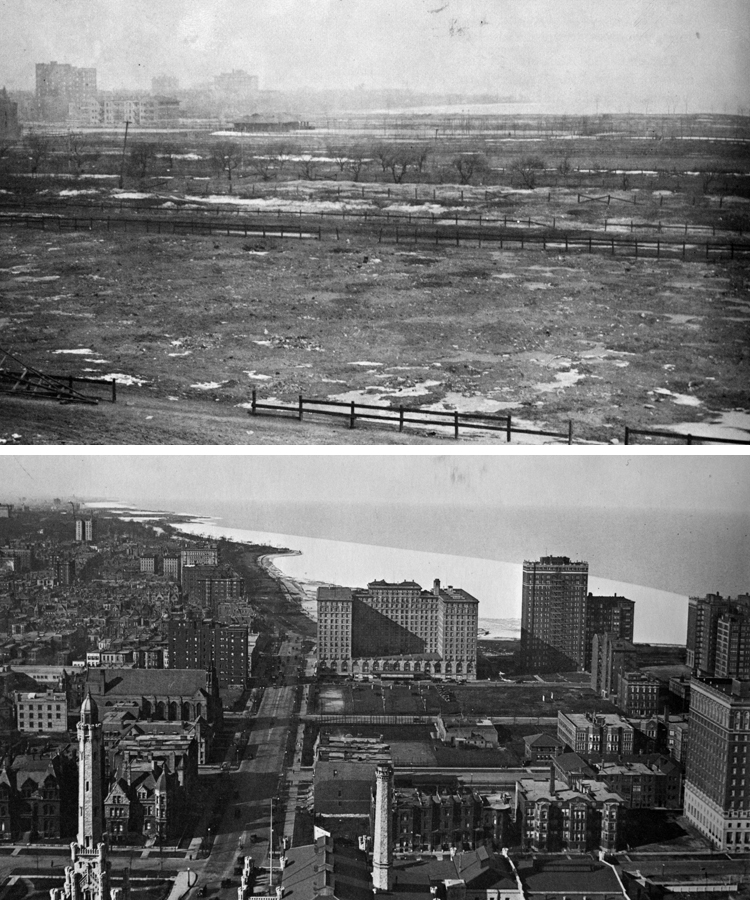
- In 1909, the District of Lake Michigan, was a very desolate place (top).
Same view, looking north, only fourteen years later (bottom).
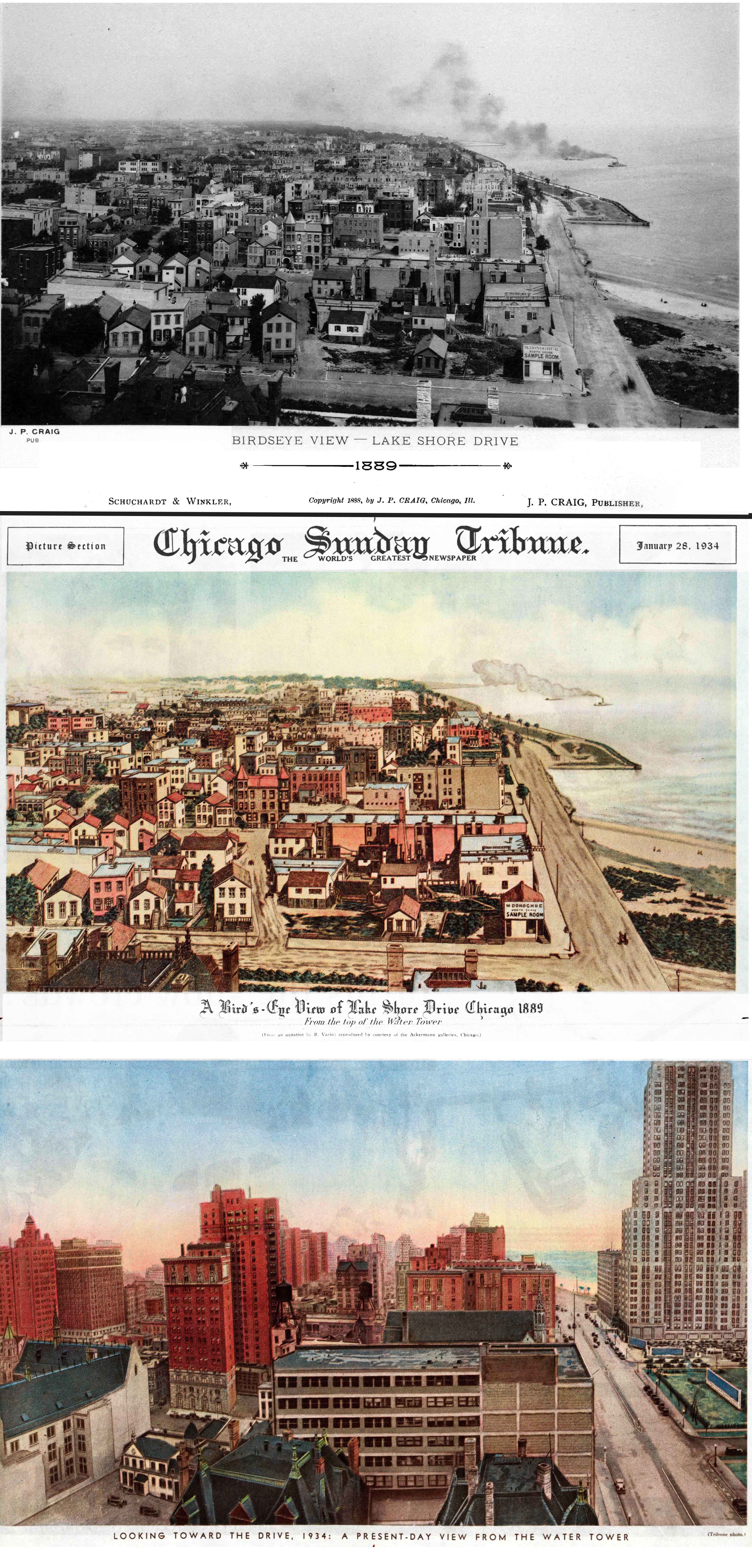
- View of Lake Shore Drive from the Water Tower in 1889 and 1934. The landfill caused by contractors dumping debris in the lake around Captain Streeter’s boat can be seen in the 1889 photo.
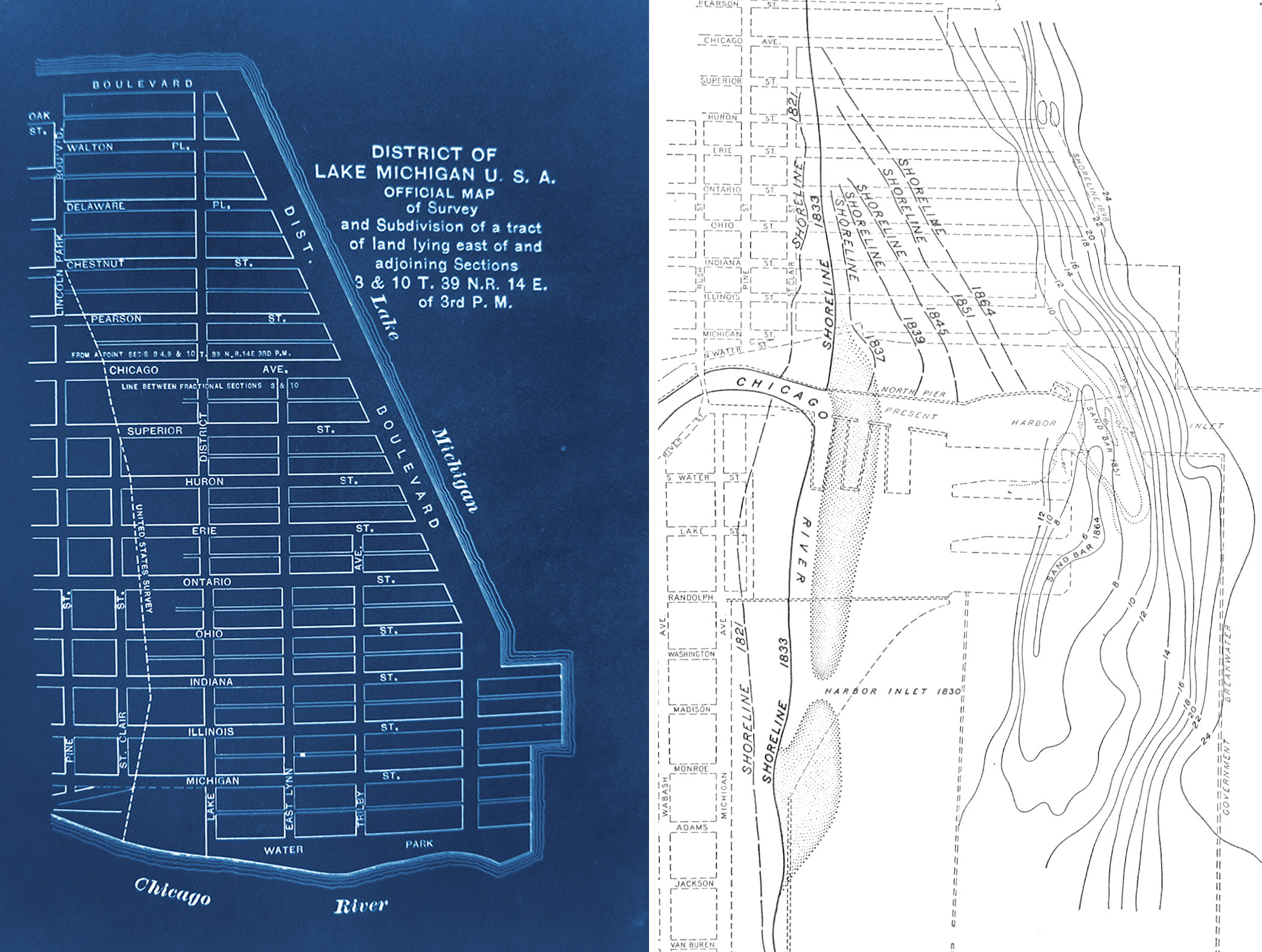
- Left: The District of Michigan
Right: Changing of the Shoreline Over Time
The Chicago Examiner, April 16, 1915
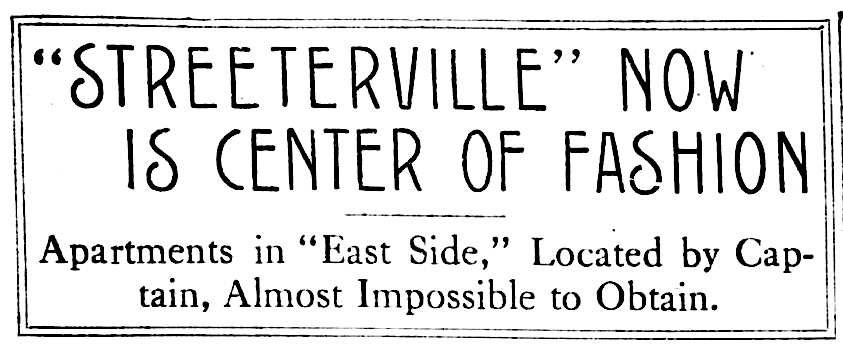
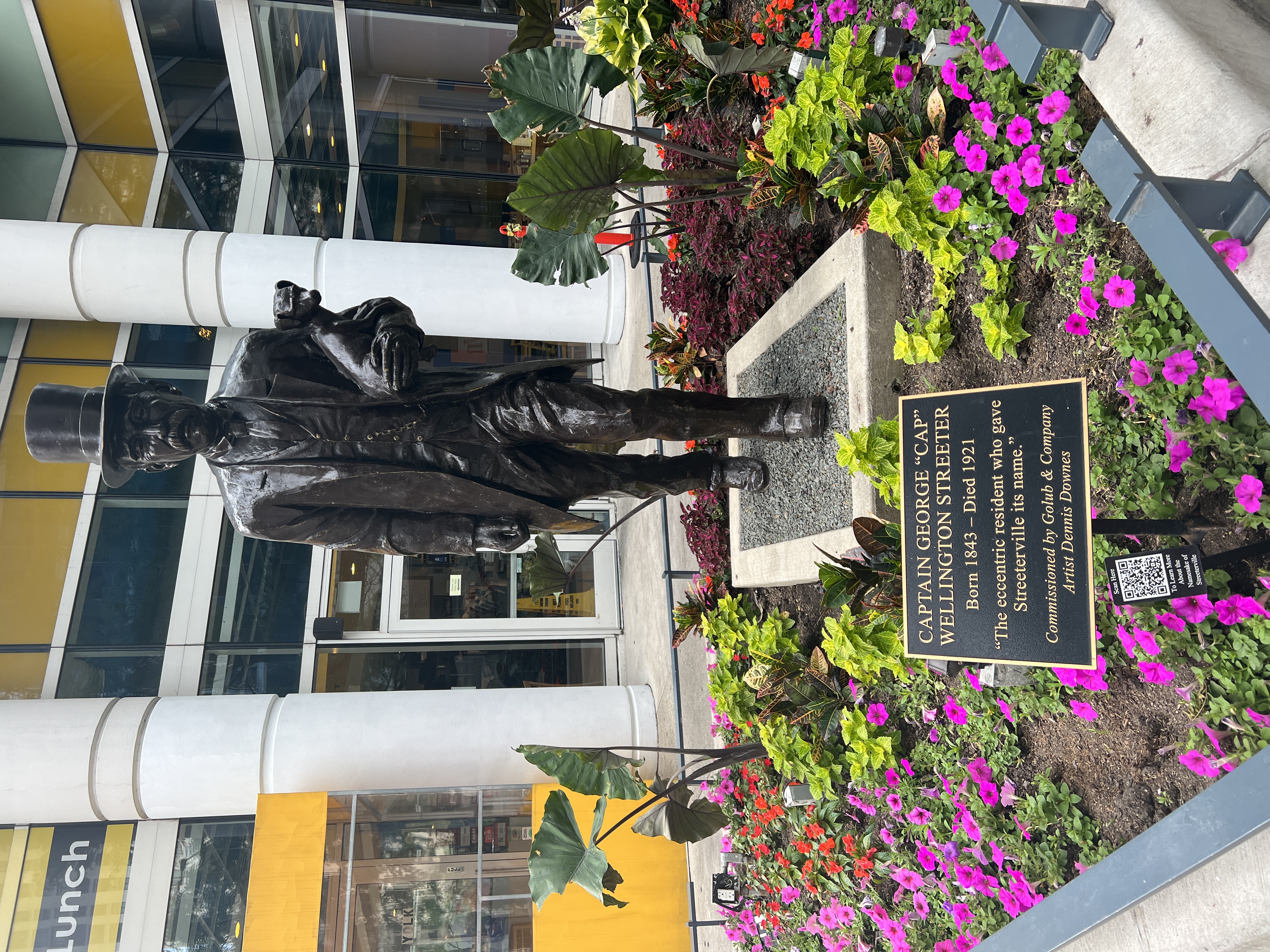
Only a few years have passed since the founder of “Streeterville,” who gave his name to the strip of bleak lake shore, contended for possession, yet in that time we have acquired an “East Side.” Previously we might walk north or south or west, but to go east we must sail or swim.
Now that little patch of ”made” land that lies in the sweep of the outer drive, with East Pearson street defining its southern edge, has become the very center of fashion. Not a vacant apartment is ever to be had of either the most costly ones or the simpler quarters m the “Bridewell,” where live the newlyweds.
Some of the older tenants of the stately 999 Lake Shore drive have furnished with the choicest things brought from old homes. Mrs. Henry M. Bhepard’s apartment is filled with lovely colonial mahogany, every piece of which has a history. The walls of ihe McCormick apartment are hung with good pictures, among which are some rare old English prints of the hunt, and the furniture is very fine, French and Italian.
The Secor Cunninghams have a fortune in paintings, rugs and hangings, many from the old Paris home of Mrs. Cunningham’s mother, the late Mrs. H. P. Stone. Among the younger folk the Donald Forgrans have one of the loveliest homes, but there are scores of them.
Among the early settlers in this new quarter are Mrs. Winterbotham, the Louis Swifts, Dr. and Mrs. George V. Marquis, the Rosecranz Baldwins. the Ernest Walkers, Springer Brookses, Emil Wettens, E. G. Shumways, David Thompsons, Edward Clarks, Dr. and Mrs. Cary, S. M. Paines, Oren Tafts, L. O. Meechams, Elmer Fosters, Huntington Henrys and the Milton Kirks.
Chicago Tribune, July 14, 1919
 No. 18 Tooker place, the home of the Dill Picklers, was dignified last night with the presence of Cap’n George Wellington Streeter. The cap’n was due to address the bohemians at 8:30, but it was not until an hour later that he arrived in the hovel of the intellectuals.
“I’m glad to see you all, ladies and gen’lemen. I haven’t made up my mind what I’m goin’ to talk about, but—”
The Thirty Years’ War.
Before he had finished amid the plaudits of the highbrows, the cap’n had discussed everything but girth control and the ethical code of the antediluvian dinosaurs. Riparian rights, likker, the constitution, Germany, class conflict, money hogs, George Washington, cops, judges, Ireland, lawyers, Joliet, free speech, etc., etc.—the cap’n mentioned ’em all.
He was especially eloquent, however, on the subject of his thirty years’ war with the state of Illinois. With great gusto he described his battles with the Chicago coppers especially his capture of Capt. Heidelmeyer.
The cap’n was dolled up in a plug hat and Prince Albert and a standup collar, wide enough not to interfere with the jurisdiction of his Adam’s ap-ple. The cap’n is very touchy on the subject of jurisdiction.
The Capn’s Observations.
A few of his bon mots follow:
“It’s hard for any poor man to get any redress in this here country because the judges is controlled by capitalists.”
“The courts tried to get me on ev. everything but adultery, an’ I beat ’em every time.”
“The constitution says that any president who participates in any foreign wars must be arrested, impeached an’ hung.”
“If pro’bition ain’t the dirtiest imposition ever happened upon this country, then I haven’t got nothing to say.”
“People oughtn’t to be dragged off to prison for arguin’. That’s what they done in Ireland, an’ what is the result? The Irish is just as bad as ever.”
Chicago Tribune, April 18, 1926
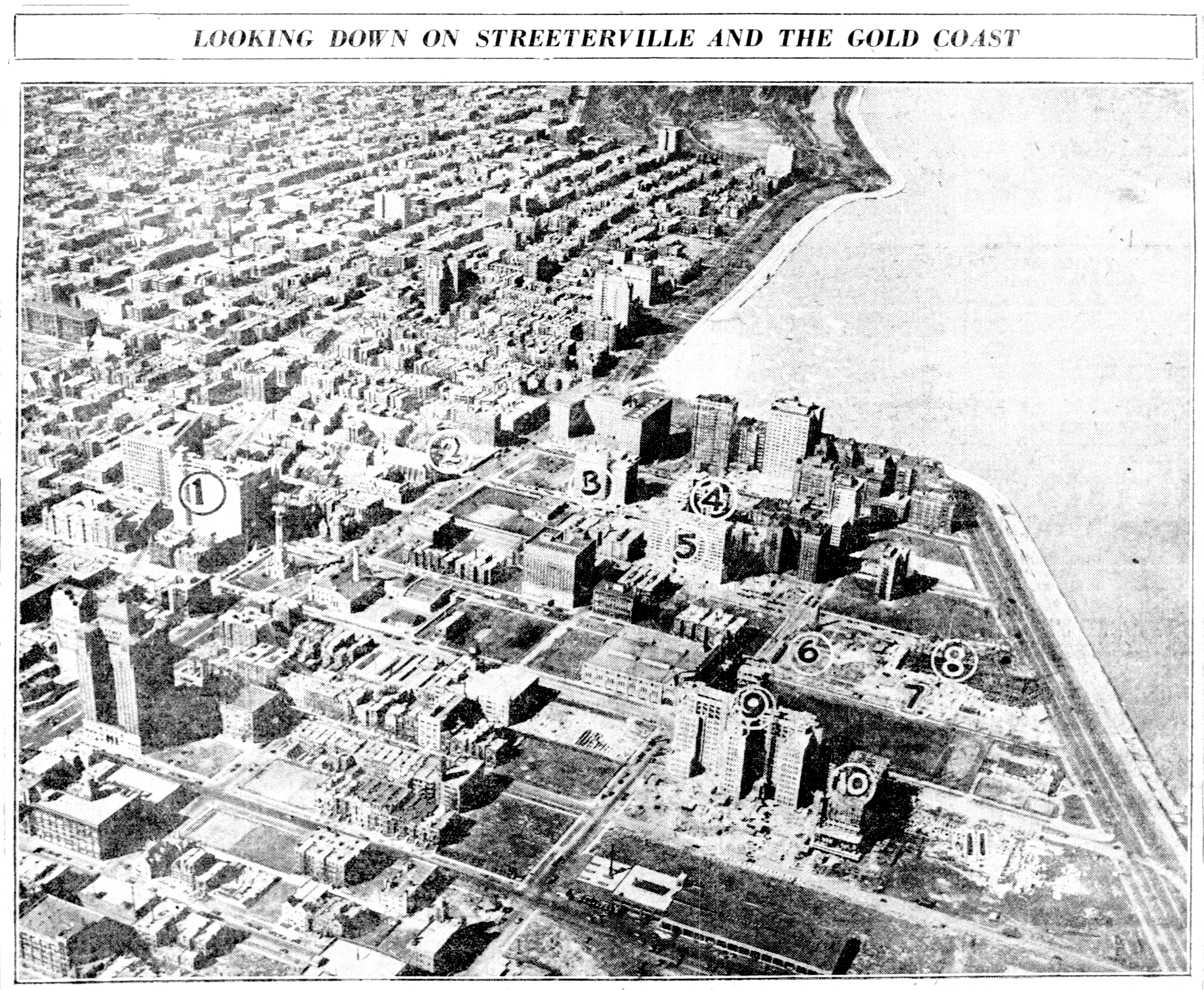
- Number ① shown above is the Illinois Women’s Athletic Club, nearing completion; Number ② is the Jarvis Hunt cooperative project, just getting well under way across from the Fourth Presbyterian, Number ③ is B. Leo Steif’s “180 East Delaware Place” apartments; Number ④ at the southeast corner of Delaware and Seneca, the Charles F. Henry apartments; Number ⑤ at the northeast corner of Chestnut and Seneca, the Seneca apartment hotel; Number ⑥ northeast corner of Pearson and DeWitt, eighteen story apartments; Number ⑦ Jarvis Hunt $7,000,000 cooperative apartment project; Number ⑧ Lake Shore Drive Athletic club; Number ⑨ Montgomery Ward memorial, housing the school of commerce of Northwestern, and Number ⑩ where work is just starting on the Levy Mayer hall and the Elbert H. Gray library of law, a structure of two units.
No attempt has been made to point out every project in Streeterville, and only a couple on the west side of Boul Mich have been given, because they are practically in Streeterville. Excavation has started or soon will start on several big projects in Streeterville; for instance, the Chatclaine Tower, a hotel for women, and several big apartment buildings.
Chicago Tribune, August 30, 1928
The last chapter in the long story of the late Capt. George Wellington Streeter’s struggle to claim some of Chicago’s most valuable property was written yesterday by Corporation Counsel Samuel A. Ettelson. He ruled that the ancient Streeter houseboat was a menace to navigation at the mouth of the river and could be removed.
The old boat has been tenantless for some time. Its last occupant was Ma Streeter, the captain’s widow, but she disappeared some time ago and is believed to be dead.
Capt. Streeter claimed the district now known as Streeterville because after he first set foot on Chicago’s shore the waves did the rest, for years adding sand , but as long as thirty years ago other interests were filling in, “making land,” and Streeter had a losing fight in the courts.
Chicago Tribune, March 28, 1903
Nathaniel Kellogg Fairbank, for thirteen years president of the Chicago club and for nearly a half a century a leading figure in the charitable and business life of Chicago and the west, died at 4:30 o’clock yesterday morning in his home, 1801 Michigan avenue. His death was due to a paralytic stroke which he suffered a year ago.
Owing to his advanced age, 73 years, all hope for his recovery had been abandoned and his death was not unexpected by his family. He began to fail a week ago and it was soon apparent that the end was near. Arrangements for the funeral have not been completed, but it probably will be held on Monday. The Rev. Robert Collyer of New York will be asked to conduct the service, and the pallbearers will be selected from his friends among the membership of the Chicago club, of which he practically was the founder.
Mr. Fairbank, as the founder and active head of the N. K. Fairbank company and the Fairbank company, a benefactor of Newsboys’ home, St. Luke’s hospital, the Thomas orchestra, and other public institutions, had long since taken front rank among Chicago citizens. He leaves an estate estimated at $2,000,000.
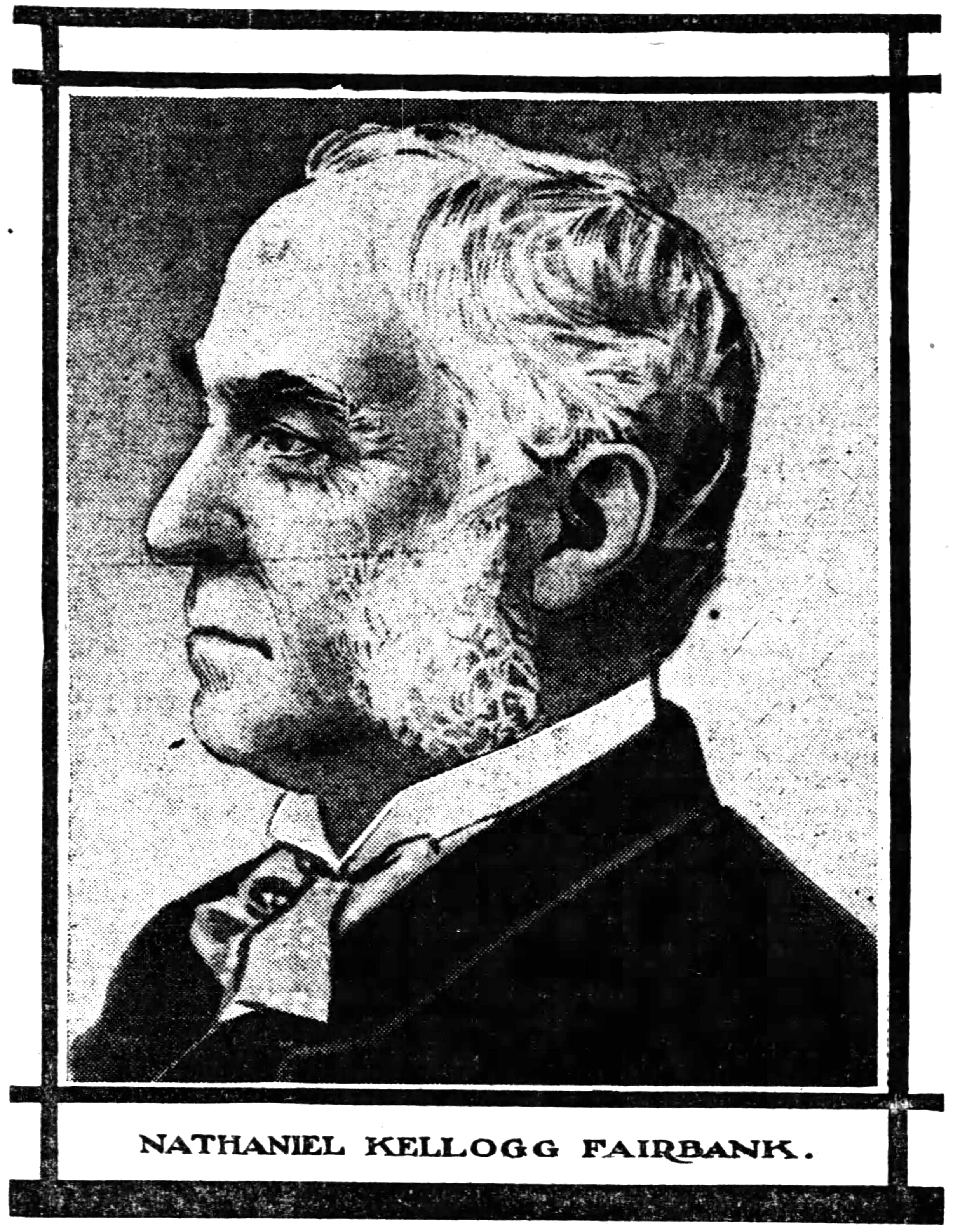
Starts as Bricklayer’s Apprentice.
Born in Sodus, Wayne county, N.Y., in 1829, of parents who were able to give him a start in life, he was kept in school until he was 15 years of age. Then his parents met with financial reverses and he was forced to start out for himself. His first employment was an apprentice to a bricklayer in Rochester. He served out his time and then became a bookkeeper in a flour mill. He soon acquired an interest in the business.
Attracted by the opportunities in the west he came to Chicago in 1855, after a short time spent in Buffalo. In this city he became the western representative of David Dows & Co., a New York grain and commission house. He joined the board of trade in that year, when that institution was only seven years old, and remained one of its leading members for nearly fifty years.
Big Deals on Board of Trade.
The board of trade was housed at that time in what was called the “shanty,” a frame building abutting on the south branch of the Chicago river not far from Madison street. B. P. Hutchinson, Sidney Kent, Asa Dow, and Mr. Fairbank, were among the largest operators on the exchange. Mr. Fairbank’s first big deal was in September wheat in 1872. The price reached $1.60, the second highest price ever known on the board. The deal was a failure, but those concerned in it paid up in full. In the year following and in still other years Mr. Fairbank took part in successful deals.
Mr. Fairbank became interested in the making of lard and cottolene through buying into the firm of Smedley, Peck & Co. This firm became in time N. K. Fairbank & Co., Joseph Sears and W. H. Burnett being taken into the concern. The firm did an extensive business for years and until it was sold out to the first cotton seed oil trust. In order to keep his name, however, the company paid Mr. Fairbank $1,000 a month as nominal president of thr concern.
Aids Public Building Projects.
Just after the Chicago fire George B. Carpenter went to Mr. Fairbank with plans for a new music hall, which was badly needed. Mr. Fsirbank started the subscription with $25,000 for himself, and personally secured many of the contributions which finally built the Central music hall. A few years later, when another musical need of Chicago developed, he personally offered to subscribe $100,000 of $900,000 more should be raised. This offer stood for several years and was finally dropped before the project for the present Auditorium was started.
Mr. Fairbank was a director in the Commercial National bank and of the Chicago and Northwestern railroad company. He was also interested in the construction of a railroad in Arizona, now part of the Santa Fè system.
When the Chicago club was looking for a permanent home, in 1874 he practically built the structure opposite the Palmer house, in Monroe street, where this club and subsequently the Columbus club were housed. Of the total cost $85,000 was borne by the members and $50,000 by Mr. Fairbank himself. In recognition of his efforts the Chicago club elected him its president for thirteen successive years.
Mr. Fairbank was married in 1866 to Miss Helen L. Graham of New York, who died several years ago. He left four sons and three daughters. They are Mrs. Benjamin Carpenter, Misses Margaret and Nathalie Fairbank, and Kellogg, Dexter, Wallace and Livingston Fairbank. Mr. Fairbank was a member of Grace Episcopal church, and one of the supporters of St. Luke’s hospital. He was a member of the Calumet, Chicago, Union League, and Washington Park clubs.

Thank you for your research and for posting this. It’s the best study I have seen on Streeterville and my great grandfather N K Fairbank..
Wow. Great research. I came across the following article about a sheriff’s sale of land in Streeterville in 1911 and the resulting court case being settled in 1914 in favor of the plaintiffs. I believe many were African American. https://idnc.library.illinois.edu/?a=d&d=TBA19140328.1.1&srpos=16&e=——-en-20-TBA-1–txt-txIN-blackburn———%2F
Here is another article about the original (?) sheriff’s sale in 1910 (not 1911) – https://www.newspapers.com/article/the-broad-ax/47492918/
I would be curious if you are aware of what became of those claims.
I was researching one of the buyers, Gayland Blackburn when I came across the article. I mentioned your post here: https://www.wikitree.com/wiki/Blackburn-8185.