Three Arts Club, Renovation Hardware
Life Span: 1914-Present
Location: NW Corner Dearborn and Goethe, 1300 N Dearborn
Architect: Holabird & Roche
Chicago Tribune, January 14, 1912
Entertainment to Found Fund of New Three Arts Club Home.
The young women who are studying art, music, or drama in Chicago will soon have a clubhouse of their own. This is the plan of the Three Arts club, which is now taking the necessary steps toward providing such a clubhouse.
At a meeting of the board of managers of the club recently it was decided to give an entertainment the proceeds of which are to go to the clubhouse fund. This entertainment will probably be at the home of one of the members of the board of managers or in the ballroom of one of the large hotels. Rosina Galli of the Chicago Grand Opera company will give a series of special dances and an orchestra of special music will be a feature of the program. Later on in the season, theatrical performances will also be a part of the entertainments for the benefit of the clubhouse.
About thirty girls will be housed at the club and accommodations for many more girls who wish to take their meals there will be arranged. The clubhouse will also be arranged so it can be used as a social center for all girls who are studying the arts in Chicago, for it is planned to make the club fit into the life of the girls and add the artistic element needed by students, an element that is so hard to find in a large city.
Art Student Neglected.
At present, although there are many homes for working girls in the city, there in no home especially for the girl student who is obliged to stay in uncongenial surroundings among uncongenial people, and wha therefore loses much that is valuable in her studies.
The Three Arts club is a nonsectarian organization. Its object is to provide, under the auspices of the Episcopal church in the diocese of Chicago, a home and club for young women engaged in the study of music, painting, and the drama in the city.
There are thirty-five active members of the Three Arts club. The associate members consist of those who desire to assist in the work, and they may pledge as much as they desire toward the maintenance of a clubhouse. Eight members of the club have already announced that they would furnish rooms in the new clubhouse. These rooms that are promised are bedrooms and lving rooms. Mrs. J. Ogden Armour, one of the active members of the club, will furnish the drawing room and the reception room. Mrs. Armour is the chairman of the furnishings committee.
The clubhouse has not yet been decided upon, although several buildings are being considered. The executive committee has charge of the selection and leasing of a house. This will be on the north side, within walking distance of the downtown studios and theaters, and will be situated so that it will be convenient for the music students who are living on the north side. Many informal affairs will be arranged during the year for students, both for those living in the clubhouse and those who board in town.
Club New Organization.
The Three Arts club is a new organization. Two years ago Miss Grace Griswold, while playing in one of the Chicago theaters, saw the need of a club of this character and interested several in her plans for a Chicago club. At first Miss Griswold thought of starting a Charlotte Cushman club, similar to the one in Philadelphia. Some of the members of this first organization were Harry Powers, Mrs. Charles Henrotin, Will J. Davis, Dean Walter T. Sumner, and Miss Jane Addams.
On Oot. 31, at the Blackstone hotel, a meeting was held at which it was decided to establish a Three Arts club, similar to the clubs in New York and London, This is a copyright name, and the Chicago cub will be incorporated and will be affiliated with the Three Arts clubs of New York, London, and Philadelphia. It will be similar to the Art Students’ club in Paris.
All plans will be made for a home here in Chicago that will be safe and congenial and that will protect the girl students from the dangers of a large city, just as the other clubs are protecting the girl students in the other cities. Some one of experience who is in sympathy with girls will be placed in charge of the clubhouse, perhaps a woman who has had similar experience as head of one of the Paris clubs for students.
Officers of the Club.
The officers of the Three Arts club are: The Rev. C. P. Anderson, honorary president; Miss Gwethalyn Jones, president; Mrs, J. Ogden Armour, vice president; Mrs. Arthur T. Aldis, vice president; Mrs. George A. Beaverns Jr., secretary; W. T. Abbott, treasurer; Dean W. T. Sumner, chaplain. The executive committee is composed of Miss Gwethalyn Jones, Mrs. J. Ogden Armour, Mrs. Arthur T. Aldis, Mrs. George A. Seaverns, W. T. Abbott, Dean W. T. Sumner, Mrs. Joseph T. Bowen, Martin Ryerson, Samuel Insull, and John W. Scott. The advisory committee is composed of A. A. Carpenter, N. M. Carpenter, Charies D. Dawes, Harry L. Hamlin, President A. W. Harris of Northwestern university, Charles L. Hutchinson, President Judson of Chicago university, H. H. Kohlseat, Bryan Lathrop, Mrs. J. Medill Patterson, Mrs. Jullus Rosen-wald, Edwin 8ims, and Frederick Stock
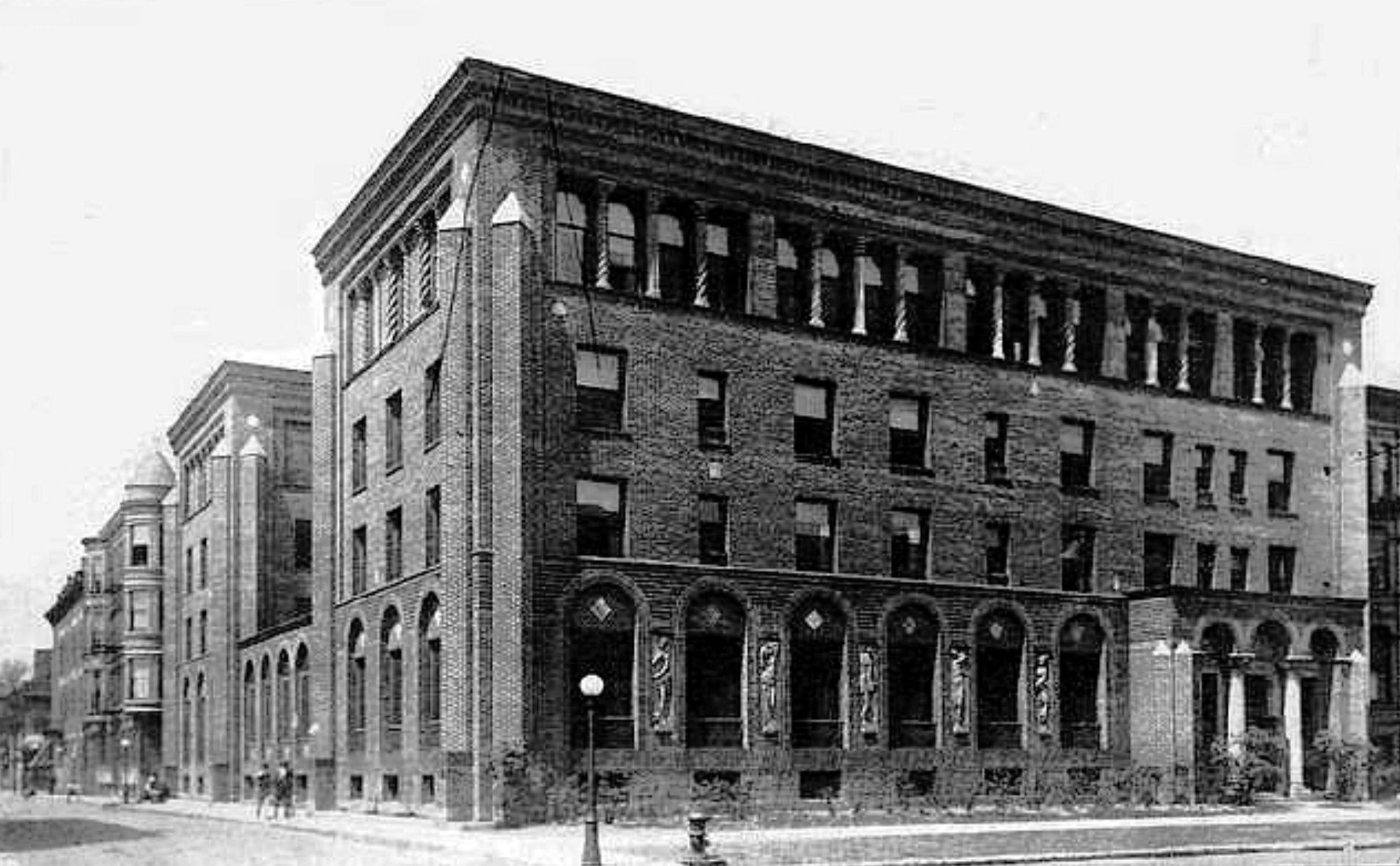
- New Building of the Three Arts Club.
Chicago Tribune, January 19, 1915
THREE ARTS CLUB FOR WOMEN SOON TO READY TO OCCUPY.
Women Students of Music, Painting and Drama to Have Large North Side House.
By Henry M. Hyde.
With the completion of the splendid new building of the Three Arts club at Dearborn and Goethe streets. on the north side. the growing importance of Chicago as a center of music, painting, and the drama will be emphasized.
It is expected that the last work of mural and other interior decorations—which probably will be done by a leading Chicago painter as his contribution to the cause—will be completed in April, and the club house will be opened to members shortly afterward. The building will cost about $175,000, the money being furnished by a Chicago business man—who remains anonymous—and leased to the club.
There will be living quarters and studios in the club for ninety young women who are students or practitioners of one of the arts represented in the membership.
Affiliated with Other Clubs.
An especially attractive feature of the club is its afiliation with similar Three Arts clubs in Cincinnati. New York, London, and Paris. Every member of one of these clubs is entitled to the use of the club house and other privileges in all the cities, so that an art student or a young actress or musician going from Chicago to New York or Paris, for instance, may be sure of finding without trouble a congenial and pleasant place to live, at rates within her means.
The new Chicago building, designed in the Byzantine style by Holabird & Roche, is built about three sides of a central court. On the fourth side, facing Goethe street, is a low winter garden and tea room. The rest of the first floor is occupied by reception and drawing rooms, kitchen and dining rooms, and a music room. The second and third floors are given up to bedrooms, while the whole of the fourth floor is filled with studios.
Friends Furnish Rooms.
The bedrooms are to be furnished by various friends of the arts, who have also undertaken the work of fitting up the larger living and dining rooms and the studios. Several landscape architects have volunteered to lay out the inner court and the parkway in front of the building.
Inserted on the long Dearborn avenue front of the building are five large bas reliefs in white marble, the figures being copies of five of the eight similar de signs which ornament the Fountain of the Innocents in Paris.
The new club is an outgrowth of the movement which was started in Chicago three years ago by Grace Griswold, the actress. Largely as a result of Miss Griswold’s enthusiasm, an old fashioned house on La Salle street, near Lincoln was rented, and in September, 1912, it was opened as the first home of the club. There was room for only sixteen members in the house, which has been full practically all the time since its opening. Even during the summer months the art students, taking a short course during the vacation, have filled the building.
Unable to Meet Demands.
As word spread over the country west and south of Chicago that a Three Arts club had been opened, applications came in from many young women whose families were not willing to let them come to the city altogether unchaperoned, and it has been necessary, because of the lack of accommodations, to refuse at least a hundred such.
With the opening of the new house there will be room for about ninety. In the old club house, which has been practically self-supporting, the charge for a ingle room, with three meals a day, has been maintained at $8 and $8.50 a week. It is hoped and expected that accommodations in the new building can be provided at the same figure, though the New York club has been compelled to raise its prices slightly above those figures.
Only Unmarried Eligible.
Membership in the club is restricted to unmarried women, under 30 years of age, who are studying music, painting, or the drama, with a view to self-support, or who are supporting themselves by the practice of one of the three arts. There is also a class of nonresident members, who live in rooms near the club house, and to whom the restaurant and all the privileges of the club are open.
For the benefit of dramatic members who may be playing in the city the restaurant serves a light supper after the theater.
The clubhouse is in charge of a directress, whose policy is to make as few rules possible. Each case which seems need attention is taken up and decided individually.
Chicago Tribune, May 18, 1915

Chicago’s new Three Arts club at 1300 North Dearborn strest was opened with an informal but distinctive housewarming for a gathering that included most of the city’s representative personages in the circles of arts, civics, and society.
The entrance hall, with its soft gray plaster walls, leading on the west into the ballroom and on the south into a most beautiful living room, hung with orange curtains, was filled with constantly arriving groups, who were almost at once carried away by various young women, eager to show the beautles of the new establishment.
These young women, all members of the club, which now holds forty-five house guests on its roster, assisted the board of managers in entertaining the several hundred guests who called, and served tea and delicate ices throughout the various rooms.
Fireplace Attracts Many.
There were two huge divans, covered with soft purple velvet, before an exquisite fireplace of tapestry brick that attracted many. The Italian chandeliers with their Byzantine colorings, gave a vivid touch.
Opening off the living or assembly room, all across the front of the clubhouse, are little dens, filled with unique bits of furnishings; gate legged tea tables, Windsor chairs, Jacobean writing tables, and distinctive vases filled with unusual flowers, arranged in effective groupings.
Everywhere there seemed an artistic blending of comfort, beauty, and utility and Mrs. Paul Welling and young John Holabird, to whom go the decorative and architectural glories, were lionized at every turn.
Visitors Inspect Rooms.
Upstairs every one wandered to look upon the finished products of the various outfittings that have gone into the individual rooms for the residents.
Mrs. A. A. Sprague and Mrs. Finley Barrell led a group of friends up the broad stairs to view the room that they had furnished jointly with its English chintz curtains and soft gray rugs.
Farther down the hall was the suite furnished by Mrs. A. Watson Armour, who has taken a warm interest in the club for some years, and here there was a piano for the fortunate occupant and warm yellow silk drapes at the windows.
Mrs. P. A. Valentine has furnished a room with rose silk curtains and dull mahogany and gray rugs and on all the doors of the rooms are small name plates of the donor of the room’s furnishings.
There were huge bowls of flowers, which had been sent by Mrs. J. Ogden Armour, Mrs. Watson Armour, and Mrs. Charles E. Kohl, and from the ballroom came the strains of orchestral music throughout the afternoon.
Some of Those Present.
Among the society women present were Mrs. Henry Dibblee, Mrs. A. A. Sprague, Mrs. T. B. Blackstone, Mrs. Charles Chapin, Mrs. Finley Barrell, Mrs. Roy McWilliams, Mrs. Victor Elting. Mrs. George Isham, Mrs. Clyde Carr, Miss Gwenthalyn Jones, who is president of the board of managers; Mrs. Edward H. Bennett, Mrs. A. S. Peabody, Mrs. Luther Bodman, Mrs. A. G. Mason, Mrs. E. L. Lobdell, Mrs. Frank Fuller, Mrs. Philip Schuyler Done, Mrs. H. H. Chandler. Mrs. John S. Spry, Miss Cornelia Conger. Miss Caroline Dudley, and Mrs. Arthur Aldis.
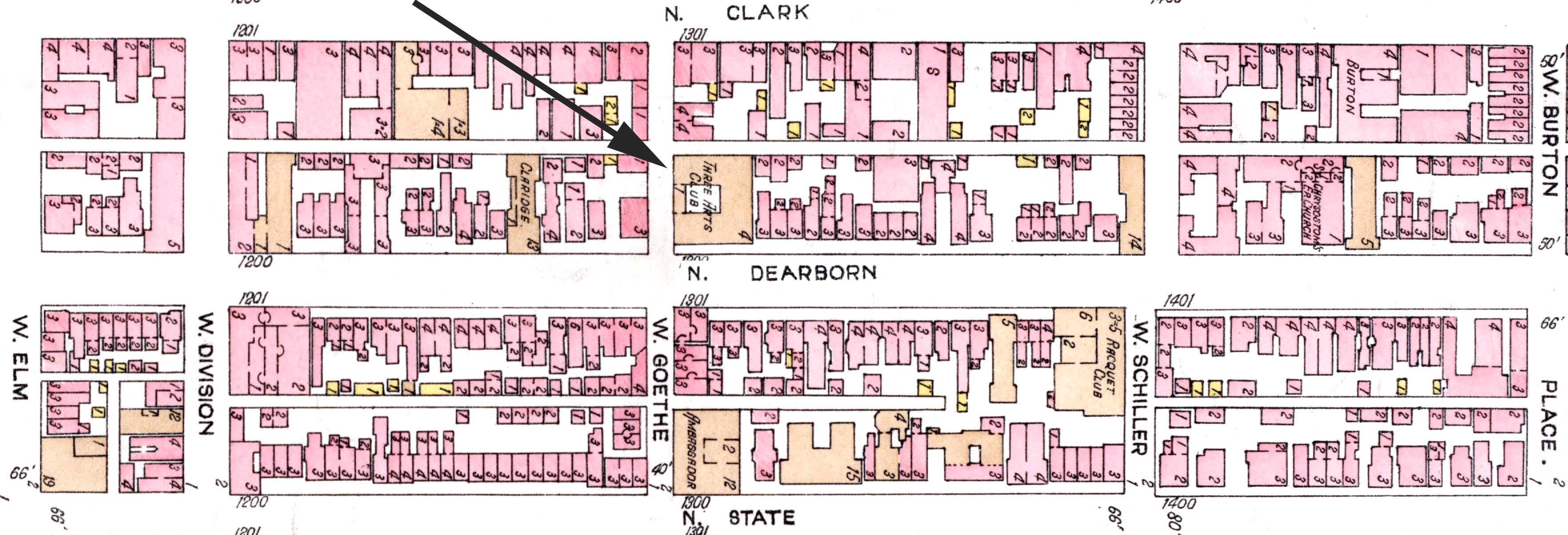
- Three Arts Club
Sanborn Fire Insurance Map
1927
Chicago Tribune, June 20, 2006
FEMALE ARTISTS’ HAVEN TO GO ON MARKET
By Josh Noel and Susan Diesenhouse
Tribune staff reporters
A nearly century-old Gold Coast residence that has attracted thousands of female artists from around the world is closing its doors for good, three years after officials vowed to remodel and reopen the building.
Officials of the Three Arts Club said Monday that they plan to sell the four-story U-shaped brick artists’ residence, which is recognized by the National Register of Historic Places, because they don’t have enough money to remodel.
Selling the home would start a new chapter for the club, an international beacon that has drawn an estimated 12,790 women—from professionals to students, actors to photographers, painters to musicians. In its place The Three Arts Club plans to become a foundation and issue grants to artists, primarily female.
But some former residents said money can’t replace the fellowship and inspiration they felt in the dormitory-style setting.

“It’s irreplaceable,” said Sue Basko, a member of the Friends of the Three Arts Club Association, a collection of former residents who want the facility to reopen. “It was a way to share with other women and really spark your creativity.”
Operators of the club told about 60 tenants in 2003 that they had to move out of the 1300 N. Dearborn Pkwy. building because their presence was draining the organization’s financial reserves and the building was in need of repair.
Officials began planning a massive remodeling that stirred opposition from former residents and architectural preservationists. The final plan called for fewer residences—38 low-income artist apartments instead of 91 dorm rooms—but expanded artistic spaces, including a small theater, two art galleries and rooms for performance and art classes.
The estimated tab of $24 million was to be paid with $17 million in public funding, through tax credits, and $7 million in private money, said Cynthia West, president of the Three Arts Club board of directors.
Since October, board members have raised only $1 million in private funds. Pledges of public funding from the city and state fell about $5.5 million short of what was needed, she said.
She would not say if a cheaper remodeling plan was considered, but said the board unanimously voted June 8 to sell the building and use the proceeds to endow a grant-making foundation.
“We looked at different scenarios, but this was the one we really wanted to pursue,” West said. “The other projects wouldn’t have been right for the organization.”
A city landmark since June 10, 1981, and a part of the Gold Coast Historic District, the building is zoned for residential use and is likely to become condominiums, experts said. It could fetch anywhere from $4 million to $10 million, depending on the square footage and redevelopment restrictions the city Landmarks Commission might impose.
“It’s one of the best locations in the city, in the heart of the Gold Coast,” said James R. Loewenberg, co-chairman of Magellan Development Group, a multifamily residential developer. “The question is what will zoning allow.”
“With today’s crazy real estate prices, $10 million wouldn’t be unreasonable to pay for the building,” he said.
The stately building opened in 1914 as a residence and refuge for “young women engaged in the practice or study of the arts in the city of Chicago.” Residents would stay from three days to a year in what was less of a tenant-landlord relationship and more like getting into college, with an application, artist’s statement and recommendations.
Esther Grimm, executive director of the Three Arts Club, said the shift to becoming a foundation leaves most people affiliated with the organization with mixed feelings, but a sense that the right decision was made.
“We’re in a very fortunate situation because this new vision is important and wonderful and that’s not always the case with organizations at turning points like this.”
But Friends of the Three Arts Club Association Monday derided the suggestion that the grants will be as important to female artists.
“These people have very different priorities and principles than what the mission of the club was,” said Colby Luckenbill, a former 6-year resident of the club, who owns and operates Colby Gallery in Pilsen. “It’s not a question that it (was) a vital resource to women all over the world and a magnet for women in Chicago.”
Chicago Tribune, November 9, 2009
Who said real estate market was dead?
Chicagoans dying for a Gold Coast address may finally get their chance. A developer is proposing to turn the Three Arts Club, a former arts dormitory and landmark building, into a storage facility for the ashes of up to 15,000 deceased residents.
For between $1,000 and $10,000, the dearly departed can spend eternity in one of the ritziest neighborhoods in the city, albeit cremated and tucked inside cubbyholes. Billed as the Midwest’s largest col-umbarium, a mausoleum for cinerary urns, the unusual redevelopment plan is a fitting sign of the moribund real estate market.
Built in 1914, the Three Arts Club, 1300 N. Dearborn St., served as a residence for young women studying music, painting and drama. Designed by noted Chicago architect John Holabird, the four-story building features a Byzantine-style entrance, ornate mosaics and a central courtyard. It was designated a Chicago landmark in 1981.

Vacated in 2003, the building sold for about $13 million in 2007 to a developer planning a private club and boutique hotel. That plan fell through.
With a letter of intent for upward of $7 million, architect Bill Bickford’s idea recently bested rival proposals for a school and a senior living facility—much to the horror of some neighbors.
“There are obviously some people who are outraged at the concept of it and feel that this use would be totally inappropriate in this neighborhood,” said Bob Newman, president of the North Dearborn Association.
Bickford plans to restore the facade to its original glory. The first floor would remain intact; the top three floors would house the 15,000 very quiet residents.
“I understand the concerns where the idea of a columbarium is … creepy,” Bickford said. “When you think about it as … a celebration of life through great art and architecture, it is easier to see the columbarium as a history of Chicago and its great citizens.”
While the use is permitted by zoning, as a landmark, any proposed changes to the building must pass muster with the city.
“I think it’s a credible proposal,” said 42nd Ward Ald. Brendan Reilly. “We’ll just have to see how it’s received by the community.”
Chicago Tribune, October 5, 2015
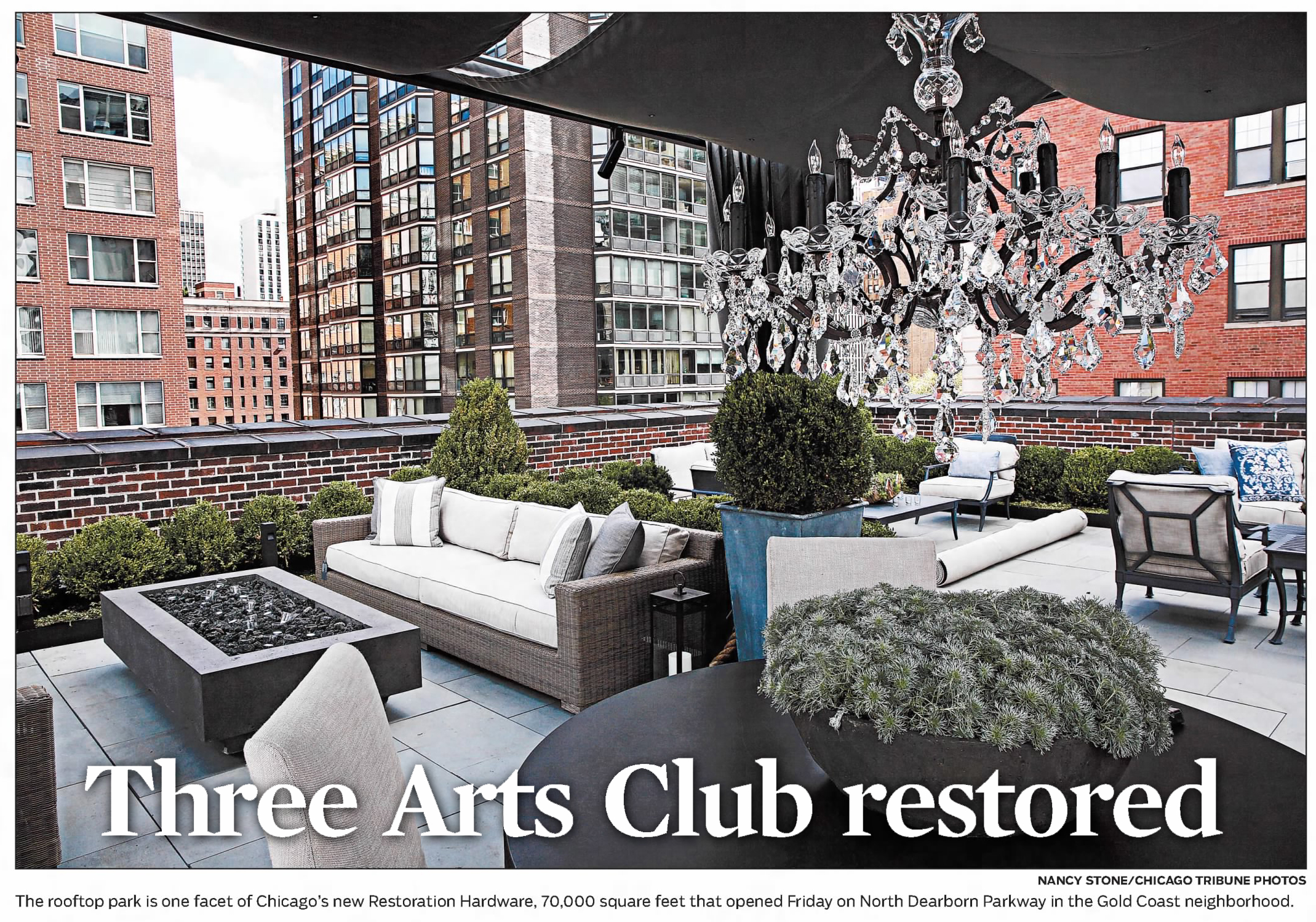

Gary Friedman, chairman and chief executive of California-based Restoration Hardware Holdings, calls his company’s newest store, which opened Friday in Chicago, his “field of dreams.”
It’s in a formerly run-down building, built in 1914, in a quiet, largely residential area in the Gold Coast neighborhood.
“I don’t think many retailers could ever pull this off because there’s no traffic,” he said. “In my mind, I thought we could build a ‘field of dreams’—if we build it, they will come.”
His home furnishings company on Thursday took the wraps off a new concept that blurs the lines between retail, home and hospitality.
RH Chicago opened Friday in the Three Arts Club at 1300 N. Dearborn Parkway, and its 70,000 total square feet over six floors includes not only retail but also a coffee and pastry shop, rooftop park, performance stage, a wine bar that can be a “super sexy place at night,” and a new glass- and steel-enclosed garden courtyard cafe that, for the first time in the building’s history, will be open year-round. Friedman said the center courtyard now reminds him of a similar “magical” amenity in his favorite Paris hotel, Hotel Costes.
The store also introduces two of the retailer’s newest brands: RH Modern, which incorporates contemporary art into its lines of furnishings and lighting, and RH Teen.
The store also includes RH Baby & Child, a rug showroom, a design atelier with a library of fabrics, leathers and furniture finishes, and complimentary valet parking.
The food operations are a collaboration between Friedman and Brendan Sodikoff, the Chicago restaurateur behind Doughnut Vault, Gilt Bar and Au Cheval.
Friedman said he had been looking for a location for a new Chicago store since 2011 and had been in touch with Chicago trader Don Wilson, the building’s owner.
“I was in a big meeting on this one trip, with developers and Don Wilson, who had owned the building, and he had his team, and we our team and some retail brokers, probably 12 to 15 people in the room,” Friedman recalled. “We like to say we’re obsessed with great architecture, and we either find it and readapt it, or we build it.”

During the meeting, one of Wilson’s associates, Hans Pusch, suggested the Three Arts Club. Many in the room, including members of Friedman’s own team, pooh-poohed the idea, saying there was no retail in the area. That day, they looked at eight to 10 possible sites.
None of them gave me goose bumps,” Friedman recalled. “I looked at my watch, and there was an hour before we had to fly out Friedman thought about the Three Arts Club, learned it was only about five blocks away, and asked to visit it.
“We drive up, and I immediately said to the team in the car with me, ‘I think this is it, ” said the immediately enamored Friedman. “It’s such a beautiful, majestic building.” He said he ended up taking a later flight.
Most retail stores are “archaic, windowless boxes” that have little natural light and no fresh air, Friedman said. “No one ever says they want to live in a retail store—until now.” Windows in the new store can be opened.
Other retailers have restaurants, but there’s typically a demarcation between the store and the restaurant, including different entrances, Friedman said. “They’re almost separate experiences,” he said. But RH is in the home business and is “trying to blur the lines between home and hospitality and residential and retail.”
RH is also planning its first “guest house,” a 12-room hotel, in New York. Friedman said he considered incorporating 12-room lodging in the Three Arts building but eventually decided against it due to concerns about zoning delays.
Below is an edited transcript.
Q: You mentioned that you considered incorporating a guest house into this property. Are you looking in Chicago for a place to build a guest house?
A: I think we might be. We haven’t decided yet. But we’re thinking about it and talking about it.
Q: Is this your first store with a restaurant?
A: Yes. This is our first foray into hospitality.
Q: If you could buy only one item in this store, what would it be?
A: I’m currently most enamored with our latest work, RH Modern, on the fourth floor, and one of the sofas up there is one of the most beautiful sofa sectionals I’ve ever seen. It’s the tufted one.
Q: If you were going to have the last meal of your life, what would you order at the cafe in the store?
A: It’s probably the truffled grilled cheese.
Q: Might we see any more RH Chicago stores like this in the Chicago area?
A: Possibly. We’re thinking out in the Oak Brook area. We have a very productive store out there. I don’t know if it will be as big as this. We’re basically closing all of our legacy stores, including Lincoln Park, and transforming them into these new experiences.
Q: Your annual shareholder report says your traditional retail stores display less than 10 percent of your product as-sortment. What percentage of your assortment does the new store display?
A: Our goal is to display 50 percent or more.
Q: How much selling space is in this store vs. legacy Restoration Hardware stores?
A: Traditional stores would have 6,000 to 7,000 square feet of selling square footage, and this has 54,000 square feet.
Q: In fiscal 2014 you spent $110 million on capital expenditures, and your annual report said you’d spend $140 million to $160 million in fiscal 2015. How much was spent on this store?
A: It’s classified.
Chicago Tribune, December 15, 2015
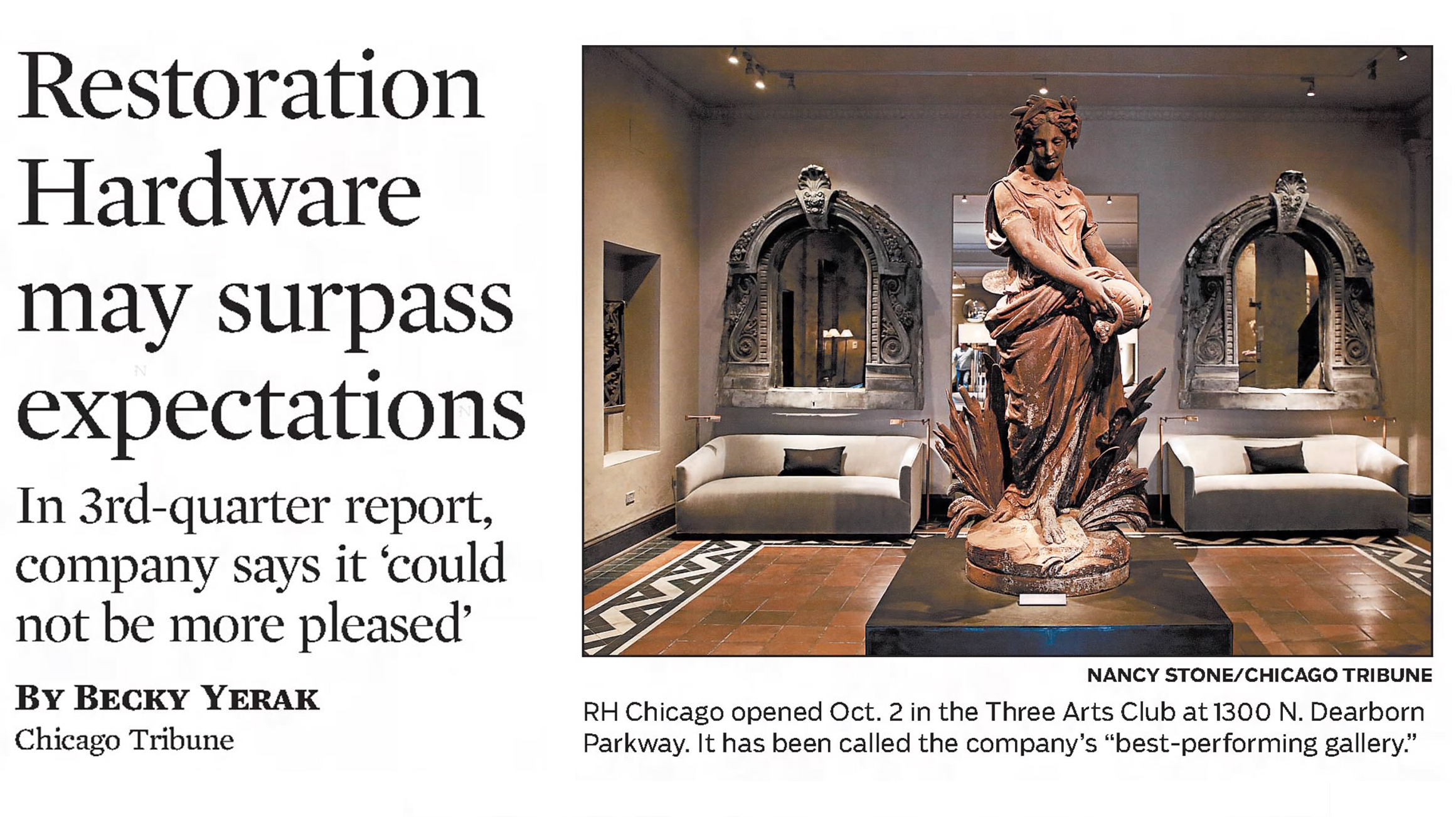 Restoration Hardware said its 2-month-old Chicago flagship, which blurs the lines between retail, hospitality and home, is “well on track to exceed” expectations, with its food and beverage operations doing particularly well and serving more than 450 people a day.
The California-based home furnishings retailer gave the update when it released third-quarter financial results Thursday for the period ended Oct. 31.
“We could not be more pleased with the early results out of our recently opened next-generation design galleries in Chicago, Denver and Tampa – each well on track to exceed our expectations,” Gary Friedman, chairman and chief executive, said in a statement.
RH Chicago opened Oct. 2 in the Three Arts Club at 1300 N. Dearborn Parkway, and its 70,000 total square feet over six floors includes not only retail but also a coffee and pastry shop, rooftop park, performance stage, a wine bar and a new glass- and steel-enclosed garden courtyard cafe that, for the first time in the history of the now-renovated 1914 building, is open year-round.
The Chicago store, located in a largely residential area in the city’s Gold Coast neighborhood, also was discussed in an earnings call with analysts Thursday.
During the call, Friedman said the Chicago store was Restoration’s “best-performing gallery.”
Friedman characterized the Chicago store, in a historic but formerly run-down building, as “probably the most debated real estate deal in the history of our company because people thought, You’re going into a residential neighborhood? There’s not a retail store for five blocks. Are you crazy?”
Friedman attributes the store’s standout success to two factors.
“One, the gallery is located in a residential neighborhood, not in a retail district or center,” he said. More important, “the gallery has our first foray into hospitality,” and its food-and-beverage operations are on pace to do $5 million a year in business, Friedman said.
“We’re feeding about 450 to 1,200 people a day,” he said. The food operations are a collaboration that includes Chicago restaurateur Brendan Sodikoff
People line up outside the store on the weekends to get a seat in the cafe, Friedman said in a video posted on the company’s website.

Leave a Reply