Edwards’ Annual Directory in the City of Chicago, for 1873
CITY RAILWAY ROUTES.
Chicago Horse Railway—Office, State, nr. Randolph. Time Table—Cars leave cor. State and Randolph, via State to 22d every minute, and to Cottage Grove av. and Egan av. every four minutes. Leave southern limits every four minutes for 22d.
Leave 22d every minute, and Archer av. every six minutes, Indiana av. every eight minutes, for cor. State and Randolph.
North Chicago Railway—Office, at barn, N. Clark. Cars leave foot of N. Water for city limite every twelve minutes; for Sedgwick every twelve minutes; for Clybourne av. and Larrabee every twelve minutes; for Chicago av. every fifteen minutes; for Graceland every hour. Cars leave city limits for Lake every twelve minutes; leave cor. Larrabee and Center for same every twelve minutes; leave cor. North av. and Sedgwick for same every twelve minutes; leave Graceland for Lake. every hour.
West Division Railway—Office, State, nr. Randolph. Cars leave cor. of State and Randolph, along Randolph to Robey, every five minutes, and to Western limits every ten minutes. Leave cor. State and Randolph, westward along Madison, every for minutes.
Leave cor. State and Randolph for Blue Island av. every six minutes. Leave cor. State and Randolph for Milwaukee av. every twelve minutes. Leave cor. State and Randolph for Clinton and Jefferson to C. B & Q. R. R. Depot every twelve minutes. Leave cor. State and Randolph for Clinton, south to Van Buren, Van Buren westward to Wood, every fifteen minutes
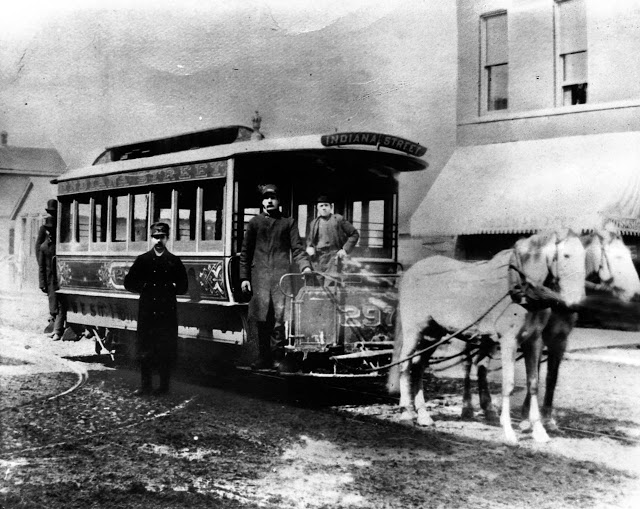
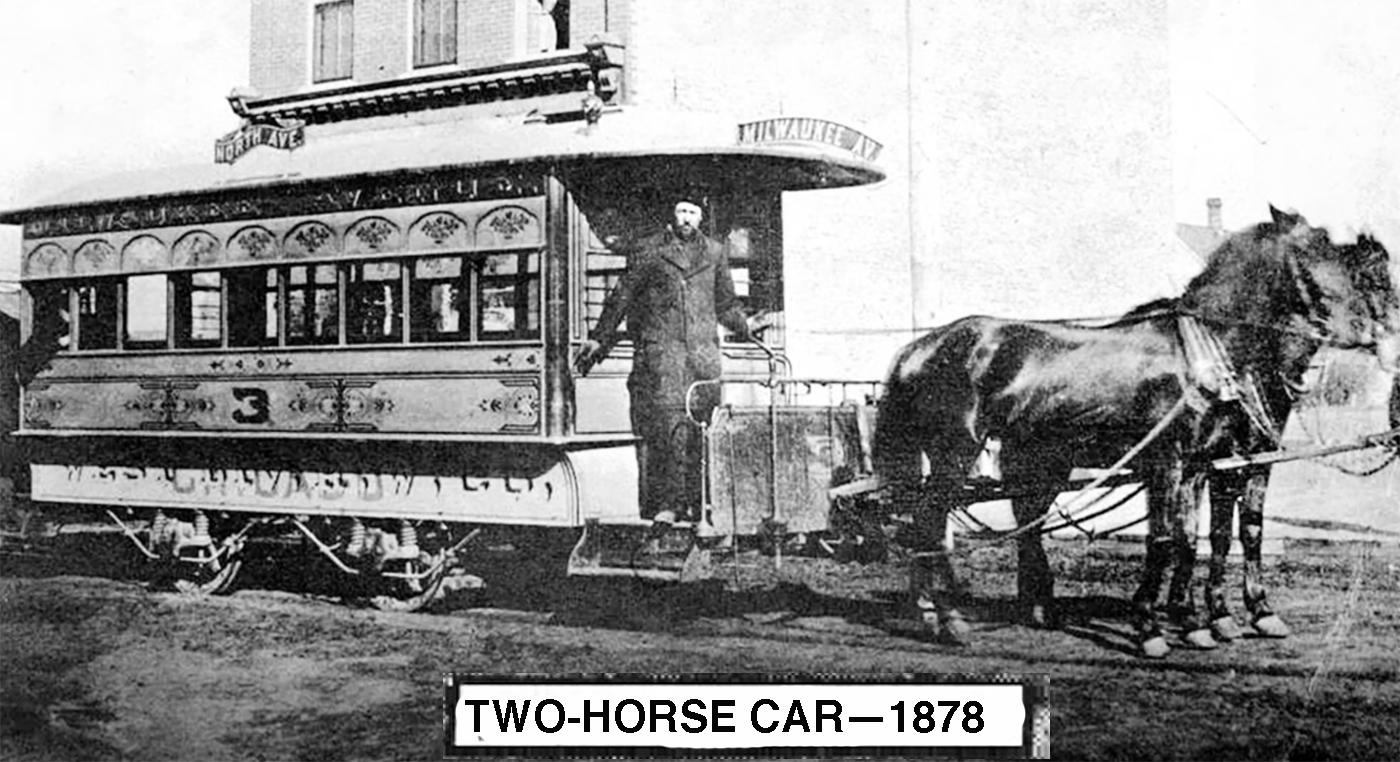
Two horse street car used 1872-1906.
Chicago Tribune, September 5, 1880
CHICAGO HORSE-RAILWAYS.
The general advantage and convenience of horse-railways are not more conspicuous in any city in the country than they are in Chicago. They have become a public necessity. This necessity is shown by the fact that, though the lines are already numerous, they are still too few for present purposes, and that the increase of routes must continue for many years to come. The men who supposes that all the routes needed for horse-cars have been taken up greatly mistakes the present and future wants of the city. The time is rapidly coming when the number of lines must be quadrupled, or there must be some other means of transportation supplied.
The steam transportation on the lake-shore roads may furnish for a time a means of reaching that part of the South Division near the lake. But an elevated railway on a line nearer State street is as much needed at this time as was the first horse-railway when constructed on State street in 1859.
The South Side, however, is but a small portion of the city. It contains but a fraction over one-fourth of the whole population. The great spread of population is in the West and North Divisions. Between the central part of the city and these divisions the river interposes an insuperable barrier to the construction of elevated railways. Such improvements, when constructed, as they undoubtedly will be, must have their down-town termini at Canal or Kinzie street. An elevated railway with branches may yet, and within a short time, become indispensable to furnish the rapidly-increasing population now living in that part of the city west of Canal street. This district, ten years hence, if it be furnished with the means of rapid communication with the oher parts of the city, may contain a half million inhabitants, and the greater number will be the necessity for speedier transit than can be furnished by
horse-railways. In like manner the North section of the city will need something faster and something capable of moving more people than horse-cars; and LaSalle or Franklin street may yet become the route of an elevated railway extending even into the suburban villages, and rendering Lake View in point of time as near as is Chicago avenue at present.
But, however remote may be that day for lines of elevated roads to meet the pressing wants of city travel, nothing is so much calculated to make them an immediate necessity as an insufficient supply of horse-railways. However numerous may be the cars now employed, their insufficiency on the North and West Sides is shown whenever travel is interrupted by the opening of a bridge. In a few years, to accommodate the travel on Clark street and on Madison and Randolph streets, there will have to be continuous double processions of cars occupying those streets exclusively by day and by night. There must be more lines of travel opened for horse-cars, or living west of Halsted street and north of Chicago avenue will become intolerable to persons doing business in the southern part of the city. To open these additional streets for horse-railway travel would be a simple thing were it not for the necessity of crossing the river. The cars now are so crowded that they greatly incommode all other vehicles. All the bridges crossing the main river, except that at Rush street, are now used by horse-railways, and there are now pending applications by several companies to establish a line on Lake street; and we do not see why lines may not also be put on Adams street, Harrison street, and Twelfth street. The additional lines are all needed, and the want of them is positively a great inconvenience.
Just here it is probably the time to suggest that, while the city has been heretofore most liberal in its dealings with horse-railways, the City Government should remember that the general public have some rights and interests which might now be as well asserted. The horse-railways are not struggling for existence; they are all able to maintain themselves, and to declare dividends that are so large, no matter what proportions their capital stock may be increased. Without saying anything as regards the past, and without raising any question as to disturbing vested rights, would it not be well for the Council to withhold any further franchises unless there be some compensatory consideration made to the city? There is not a dray, a truck, an express-wagon, or a hack, or any other vehicle, used in this city for hire or gain which does not pay into the City Treasury a license-fee. We except the cars of the horse-railways. The bridges used by the horse-cars are are occupied one-half the time by the cars, which in like manner have the right of way, to the exclusion of other vehicles, on both bridges and streets. Has nit the time now arrived when the City Government, before extending these privileges and these franchises, or granting them to new lines, should stipulate ① that the horse-railway companies using any bridge shall be compelled to keep the same in repair, and when thereto required shall build a new bridge in place of the old one; or ②, that the company shall be allowed to use its additional privileges upon condition of paying an annual license-fee for each car run by it in the city; or ③, in lieu of these considerations, that the company shall pay monthly into the City Treasury one cent, or one-half cent, or even a quarter cent, for each passenger carried by it during said month, not only on the newly-authorized lines or routes, but on all the lines operated by said company in the city?
It is possible that within the next few years there will be many miles of new horse-railway opened in the city as there are now operated. Such additional service has or will become a public necessity; and it is for the City Government now, and before it enlarges existing or grant new franchises, to consider that if these franchises are worth granting at all they are worth paying for, and that now is the time to make them contribute to the City Treasury and to the benefit of the general public. We submit this suggestion to Mayor Harrison, to the City Controller, to the Railway Committee of the Council, as well as to the City Council generally, and to the public.
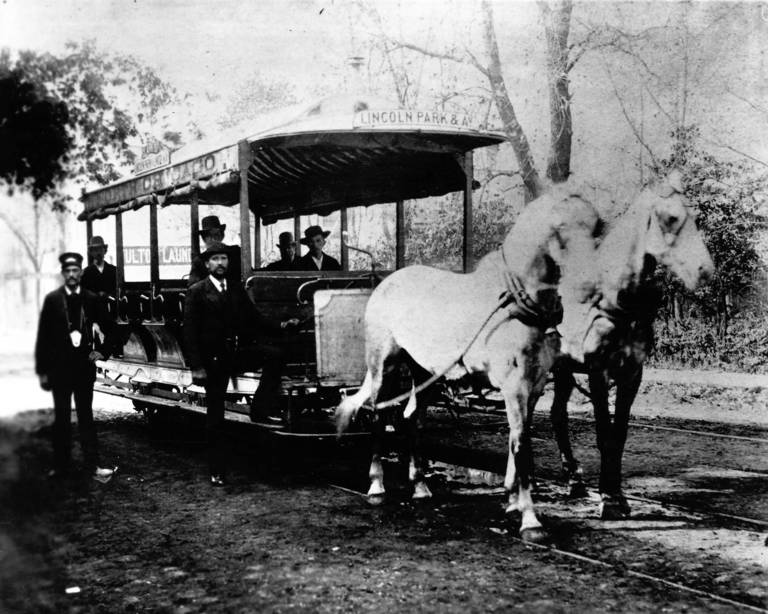
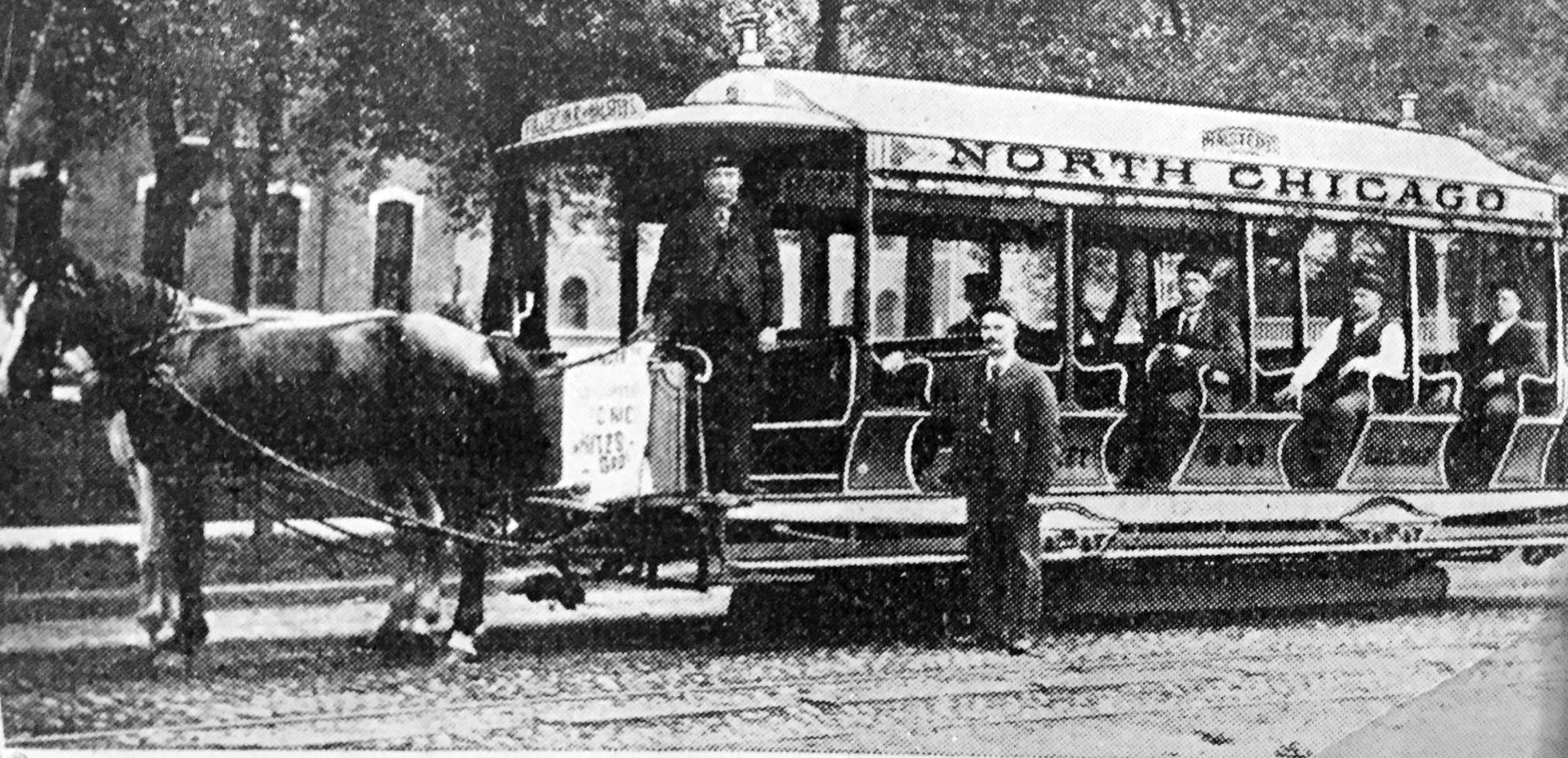
- Horse-drawn streetcars operated by the North Chicago City Railway Co.
About 1875
