Williams Building—Fifth Avenue I
Life Span: 1874-1897
Location: Southwest corner Fifth avenue and Monroe
Architect:
- Lakeside Annual Directory of the City of Chicago, 1874
Williams Bldg.—Monroe st. sw. cor. Fifth av.
Lakeside Annual Directory of the City of Chicago, 1876
Williams Bldg.—Monroe sw. cor. Fifth av.
Lakeside Annual Directory of the City of Chicago, 1880
Williams Bldg.—Monroe sw. cor. Fifth av.
Lakeside Annual Directory of the City of Chicago, 1887
Williams Bldg.—Monroe sw. cor. Fifth av.
Rand, McNally & Co.’s Bird’s-Eye Views of Chicago, 1893
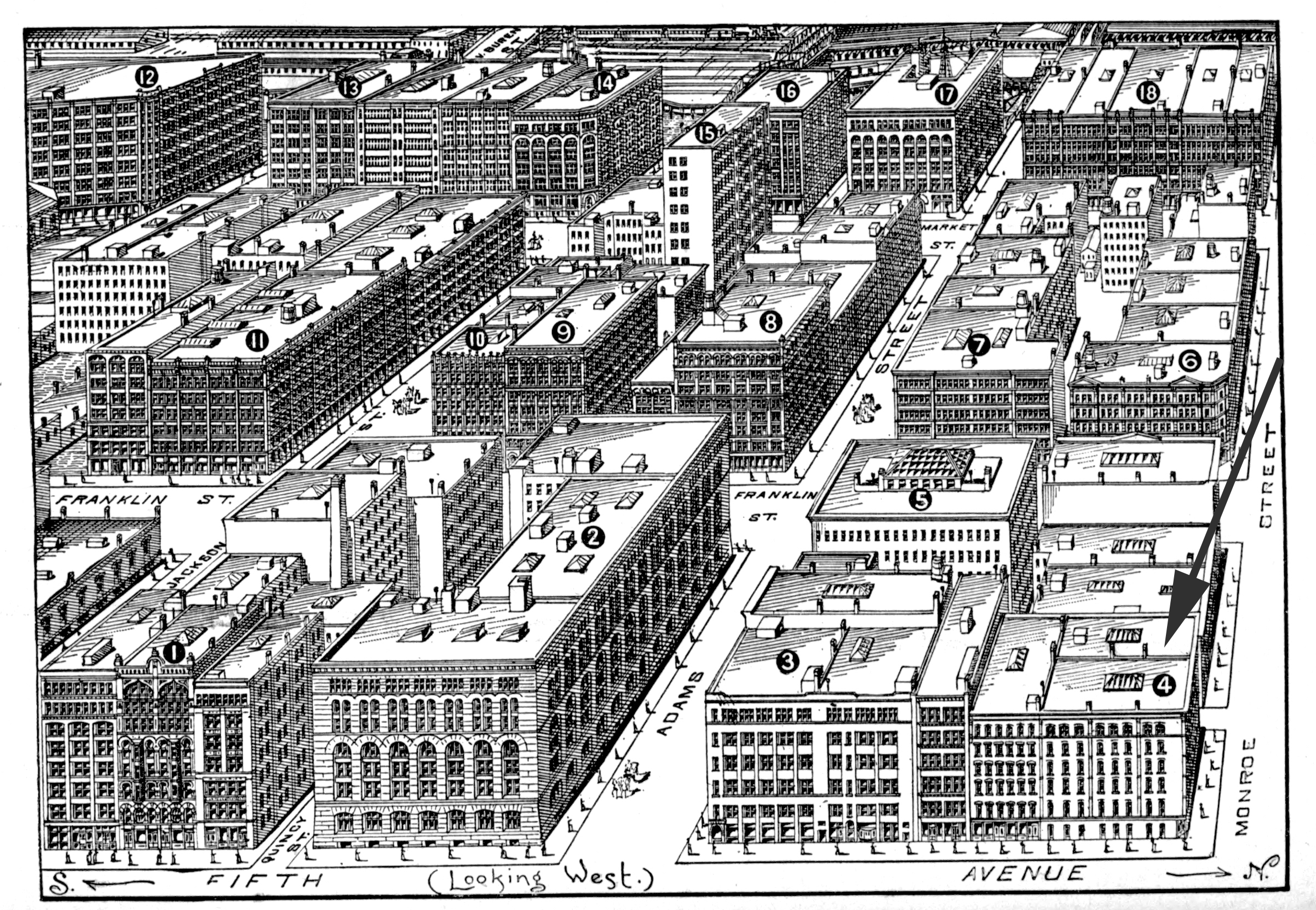
④ The Williams Block
Fronts 180 feet on Fifth Avenue and 100 feet on Monroe Street, at the southwest corner. It is 95 feet high, with 6 stories and basement. There are 3 freight and 2 passenger elevators, brick and cut-stone exterior. The structure is occupied by wholesale jobbers of clothing and woolen goods. Erected in 1874.
Chicago Chronicle, January 27, 1897
 Three firemen were fatally hurt, three seriously injured and half a dozen others cut and bruised by the falling of a wall during the destruction by fire of the Williams block, Fifth avenue and Monroe street, at 7:15 o’clock last evening. Another fireman scorched by the flames and three boys hurt by a falling iron shutter and burning brands sum up the list of the casualties at the fire, which did an estimated damage to building and contents of $530,000. Following is the list of the injured:
- O’Rourke, Jerry, engine company 6; injured about the abdomen and rendered unconscious by flying debris; taken to the county hospital; cannot recover.
Quinlan, Sherman J., engine company 6: bruised and crushed by bricks and timbers from a falling wall; taken to county hospital: cannot recover.
Workman, W. J., engine company 6; erushed Vand bruised about the abdomen and chest; taken to his home, 93 Miller street; cannot recover.
Barker, Captain, truck 9; burned about the hands and face; not serious.
Bohannon, John, engine company 7; cut and bruised about body by falling bricks.
Campion, Frank, engine company 7; cut and bruised about the face and body; not serious.
Garry, John, engine company 6; injured about the abdomen.
Geohegan, Henry, engine company 18; leg broken by falling over hose in the street.
Hanley, William, engine company 5; cut and bruised about the body; injuries serious.
Murphy, J., engine company 34; badly bruised about the head and body by falling debris.
Peterson, Patrick, truck 6, struck by falling bricks; leg broken; taken to county hospital.
Redcroft, Jeremiah, engine company 5: both ankles broken by falling wall; taken home.
Row, Peter, engine company 7; cut and bruised about the body.
Rice, R., engine company 5; badly bruised about the body and head by bricks.
Ross, John, aged 12 years; injured by a falling shutter; removed to his home in West Twelfth street.
Ross, Willie, aged 14 years; bruised and burned by flying brand.
Supple, Sergeant, lake front police station; nose frozen while superintending the police at the fire.
Watson, Charles, 17 years old; injured severely by a falling shutter.
Wall, John, engine company 34; hurt about the abdomen by falling bricks and debris.
Loss Is $530,000.
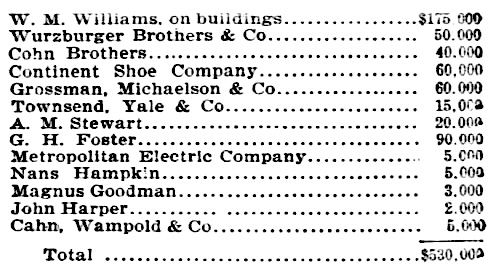
The last four named firms occupied the building at 186-8 Fifth avenue, and their damage was caused by water. Other firms who had desk room or small stocks in the two burned buildings are included in the toial loss. Cahn, Wampold & Co.’s loss was to their building and stock caused by the falling wall.
Distribution of Insurance.
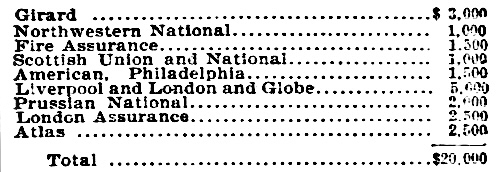
W. M. Williams, owner of the building at 200-202 Monroe street, carried $20,000 insurance on this place, which was placed in the following companies:
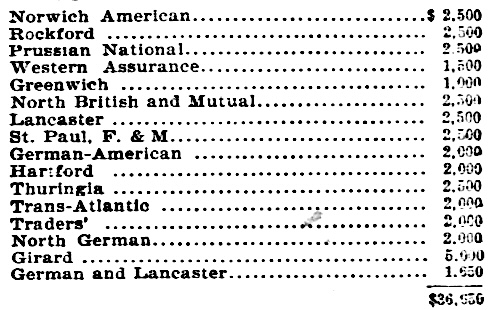
Wurzburger Brothers & Co., men’s furnishing goods and woolens, carried $36,650 insurance, placed in the following companies:
The National India Rubber Company, W. E. Hermnoyer, manager, carried $20,000 insurance, placed in the following companies:
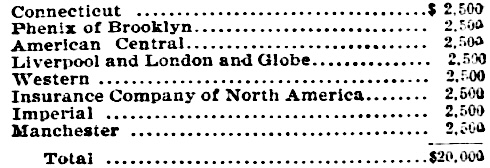
G. H. Foster & Co., carried $50,000, placed in the following companies:

The fire was discovered at 6:25 o’clock by Watchman Golden. The flames were then bursting through the roof of the building at 200 and 202 Monroe street. By the time the first companies of the fire department had responded to Golden’s alarm the flames had reached the elevator shaft and communicated to the six floors of the structure. The building was a huge bonfire, whose light was visible for miles.
A general alarm was sent out and twenty engine companies were soon throwing water on the building. Fireboats lined the water front several blocks away, prepared to act if the fire spread to the westward. Marshal Swenie soon saw that the building was doomed and devoted the efforts of his men to saving the adjoining buildings. The burning structure, owned by W. M. Williams, comprised two large storerooms on the Monroe street side and the same number on the Fifth avenue front. Between Nos. 196-198 and 200-202 the building is divided by a fire wall, through which doors had been eut on the upper flors. Through these the fire communicated to 196-198 and, reaching the elevator shaft, soon had the eastern side of the brick building ablaze. West of the building a narrow private alley runs the length of the structure and turns toward Franklin street. On the Fifth avenue side the building joins the massive brick structure occupied by Phelps, Dodge & Palmer. The six feet of brick wall prevented a spread of the fire to the six-story building of the shoe firm, but the tenants in the portion next the burning building suffered damage by smoke and water. The alley and the efforts of the firemen prevented the fire communicating to the building next to the Williams block on the west, occupied by Cahn, Wampold & Co.

- Williams Block Fire. During which nineteen persons were injured and $530,000 in property destroyed.
How The Accident Happened.
This building is lower at the rear than at the front elevation, an upon this lower portion the firemen of engine companies 5, 6 and T were stationed, throwing streams into the windows and upon the roof of the Williams block. The wall along the alley had bulged and Fire Marshals Swenie and Campion had taken their forces from the alley. The men on the roof had been warned of the danger of the wall falling, but calculated that it would give way about the middle and sink into the alley. They were therefore close to the edge of the Cahn-wampold building when the wall suddenly fell outward. Captains Lynch of 7, Ward of 6 and Lieutenant Ehret of 34, who were directing the operations from the roof, shouted to the men, but the frost-covered pipe-men could not get out of the way quickly enough and were caught under the mass of brick that fell on the roof.
Great difficulty was experienced in getting the injured men from the roof down to the first floor, where they were cared for until the ambulances arrived. The three boys, John and William Ross and Charles Watson, had gone into the alley just before the upper part of the wall fell. A big iron shutter and a piece of burning timber dropped from above, injuring the boys. They had just been dragged into Monroe street by several police officers when the wall fell outward.-
Captain Barker of truck 6 was hurt early during the fire. He had gone up a ladder to the fifth floor of the Fifth avenue side. As he reached the fifth story the flames burst out of the windows of the third floor. The captain was thus between two long barriers of fire, the flames from beneath darting up in long tongues. There was a shout of horror from the spectators as one of these enveloped the fireman. Streams of water were poured about the man in the perilous position until he could make his way down to others who had been sent up to help him in his descent. The rubber coat which Captain Barker wore was melted until but a fragment hung about his neck when he reached the ground. He was not seriously burned. Under the helmet the captain wore a knit cap that protected his head and neck and his clothing and arctic shoes protected his feet and big mittens his hands, but he was blistered about the legs, neck and face. Presence of mind saved him from serious, if not fatal, injury.
Rapidity of the Fire.
In twenty minutes after the first alarm of fire had been sent in by Golden the entire six floors of the structure were ablaze. The flames spread with remarkable rapidity. Marshals Swenie and Campion soon saw the futility of attempting to save the Williams block and concentrated their efforts toward confining the fire to the one building. All along the elevated railway structure in Fifth avenue the firemen were stationed pouring water into the windows of the burning block, preventing the flames from getting across the street. In Monroe street two standpipes and half a dozen hose streams prevented communication to the buildings opposite. From the roof of the Cahn-Wampold building and the roof of the Phelps-Dodge-Palmer structure other companies ot firemen kept the blaze from catching those buildings, while on the floors of each the brigades of the fire insurance patrol cared for the stocks of goods and, with the firemen also stationed on each floor, prevented the heat from igniting any of the material on the different floors.
Dangers of the Blaze.
A strong northwest wind increased the danger of a spread of the fire and drove the smoke into the streets, hampering the movements of the firemen around the building. Burning brands carried by the wind aiso contributed to the danger and added to the discomfort of the firemen at work on the elevated framework in the streets and on the roofs of the neighboring structures. After an hour of hard fighting the fears of an extension of the fire had subsided, but the interior of the Williams block was a mass of fire from the roof to the basement.
Great difficulty was found by the firemen in getting a free flow of water. Ice formed so quickly that in some instances several engines were employed in getting a stream from one fire plug, and at Fifth avenue and Monroe street six engines were engaged in this service. Networks of hose blocked the traflie of downtown streets in the neighbor-hood, and long lines of west side street cars were prevented for two hours from going to or coming from the west division. Until nearly morning several streams were kept at work upon the still burning interior of the Williams building.
A month ago a fire broke out at 200-202 Monroe street, doing damage to several of the tenarits of the building, who thereafter moved into the block burned last night. Some
“of those who suffered in the Williams building have not yet had their losses adjusted from the fire of a month ago in the Cahn-Wampold building.
Closter’s restaurant, in Monroe street near Fifth avenue, was about to close when the fire broke out. The proprietor, however, turned his attention to making coffee and sandwiches for the firemen, and sent word through the police to the captains and lieutenants to send their men into the restaurant. Many of the firemen were chilled and the heads of the companies gladly accepted the offer, sending the men in details as they could be spared for a few moments. Most of the firemen were tired, as the majority had answered twenty-two alarms of fire since a little before midnight Sunday evening, and had had little rest.
Trolley Wires Fall.
Early in the progress of the fire the street car company sent two of its wrecking wagons to protect the trolley wires. Notwithstanding the active work done by the men at 8 o’clock the wires under the Union Loop elevated road came tumbling down at Adams street and Fifth avenue, scattering the crowd on this corner. The sparks from the wires as they struck the ground started a panic among the spectators, and they ran in all directions. After a half hour of work the wires were replaced. Both the telegraph and telephone wires were also damaged by the falling walls. A number of the wires were strung along the side of the burning building and were carried down when the walls fell. The police and firemen, along with the telephone employes, soon had the dangerous live wires out of the way of the crowd.
Cars Are Stalled.
Spray from the water thrown against the walls of the Williams building formed a ridge of half congealed slush several feet deep at 11 o’clock last night. Several of the firemen engaged in throwing streams into the basement were stuck in this and had to be assisted out of their predicament. Marshal Swenie himself was one of the number who had difficulty in extricating himself. One of the pipemen could not extricate himself and had to be chopped out with axes. The water in the street at Monroe street and Fifth avenue formed into ice several inches thick, burying the street car tracks and preventing any traffic along these lines. Several electric cars were caught and the motormen and conductors remained in the cars all night. Forces of men will be put to work this morning clearing away the ice so that the cars can move. Traffie on the Halsted and Blue Island cable line, which runs along Adams street, was abandoned and the cars could not be moved until toward daylight.
Thrilling Escape.
One of the most thrilling incidents of the fire was the escape of a company of the fire insurance patrol, under direction of Superintendent Shepherd, when forty men were attempting to save stock on the fifth floor of the building at 196-198 Monroe street. The flames had fought their way around into the Fifth avenue side of the building and were crawling downward. There seemed to be an opportunity to preserve some of the stock of A. M. Stewart, dry goods manufacturers’ agent, and Superintendent Shepherd ordered his men up the fire escape, armed with chemical extinguishers and oiled covers. Up the side of the building twenty or more of the men sealed, and the remainder managed to get up the stairway in the adjoining building and to make their way through into the rooms where the others were at work.
The superintendent was ordering his men to work with speed and encouraging them as best he could, when some fireman gave the alarm that the roof was about to fall in and that they would all be killed. Superintendent Shepherd abandoned all the stuff his men had carried up and ordered them to a place of safety. They looked about for a moment and were completely lost, as was their commander. Shepherd tried to make his own way through to the adjoining building, but found that avenue of escape eut off. There was nothing left but to take to the fire es-capes, and by them to the roof, in the hope of being able to make their way to an adjoining building. For a moment the superintendent paused, and the flames burst in upon him and his band of men through a window, forcibly reminding them that there was no time to be lost.
All Escaped the Flames.
The fire was above them, and the hope of getting to an adjoining building was small. Still it was the only hope left, and, as one of the men afterward remarked, the moments seemed like hours. A dozen of the men appeared at the window, and at their side was their chief, who waited until the last of his subordinates was on the fire escape that led to the roof. Flames were bursting from the windows they must pass, and the throng on the pavements below was quick to see the danger in which the band of men stood. Spectators stood breathless as the first of the firemen stepped out on the ladder and began to climb upward. He was quickly followed by others, ard then the flames began to come down through the ceiling of the room in which they were. Shepherd urged his men to make haste, and. all tried to climb out on the ladder at the same time.
The first of the living stream reached the window above, and as he was about to run past the opening a tongue of flame shot out and threatened to wipe him oft the iron support, but he was plucky and rushed past, landing on the roof. He paused for a moment, and then turned to shout to his companions that they must make haste or their only avenue of escape would be cut off. And every member of that salvage corps obeyed as he had never done before. At last the whole company was on the ladder, including the superintendent, who gallantly brought up the rear. They streamed out of the window like rats fleeing from certain death, and as they hastened up to the roof and the last one disappeared over the edge the spectators in the street below heaved a sigh and wondered if there was a chance for them to reach an adjoining roof in safety. This seemed improbable, as the flames were rising on all sides. Then the roof on which the band of men had disappeared fell in, and it seemed certain that all had gone down to certain death. But the entire corps, including Superintendent Shepherd, was soon seen in Monroe street, near Franklin, hard at work saving other property.
Barker’s Company Routed.
As soon as the prospect of a spreading of the flames became apparent the marshal ordered Captain Barker of truck No. 9 to the Fifth avenue side of the building, with instructions to get a lead. of hose on the roof to protect the adjoining strueture. In a few seconds Captain Barker with six men was on the roof and had gotten the stream on the dangerous point. The captain stood at one side of the group, whose attention was fixed upon a spot in the roof through which the fire had broken a way. The commander of the company swung his lantern toward the new danger, and as he did so he was suddenly enveloped in a sheet of flame that quick as a fash burned away his rubber coat and scorched his face and hands. The blaze had come from underneath, having eaten away the roof where the little company stood and exposing them to a danger of which they had rot known. Without waiting for orders, and as soon as they saw their captain was not in more danger than they, all dropped the hose and ran for the adjoining roof. Captain Barker was assisted to the ground.
As the danger of the fire spreading to the west became apparent Chief Swenie directed that a number of men be sent to the building across the alley, and that all streams that could be spared be directed toward saving the other buildings. A special call was sent in for more engines, in order to furnish more force to the streams. At Fifth avenue and Monroe street a battery of six engines was formed on one hose line, and that directed to the phalanx on the building that fronted on Franklin street. The water was freezing in the pipes so fast that it seemed impossible at first even with so strong a force to force the stream to the top of the six-story structure, but extra steam finally had the desired effect.
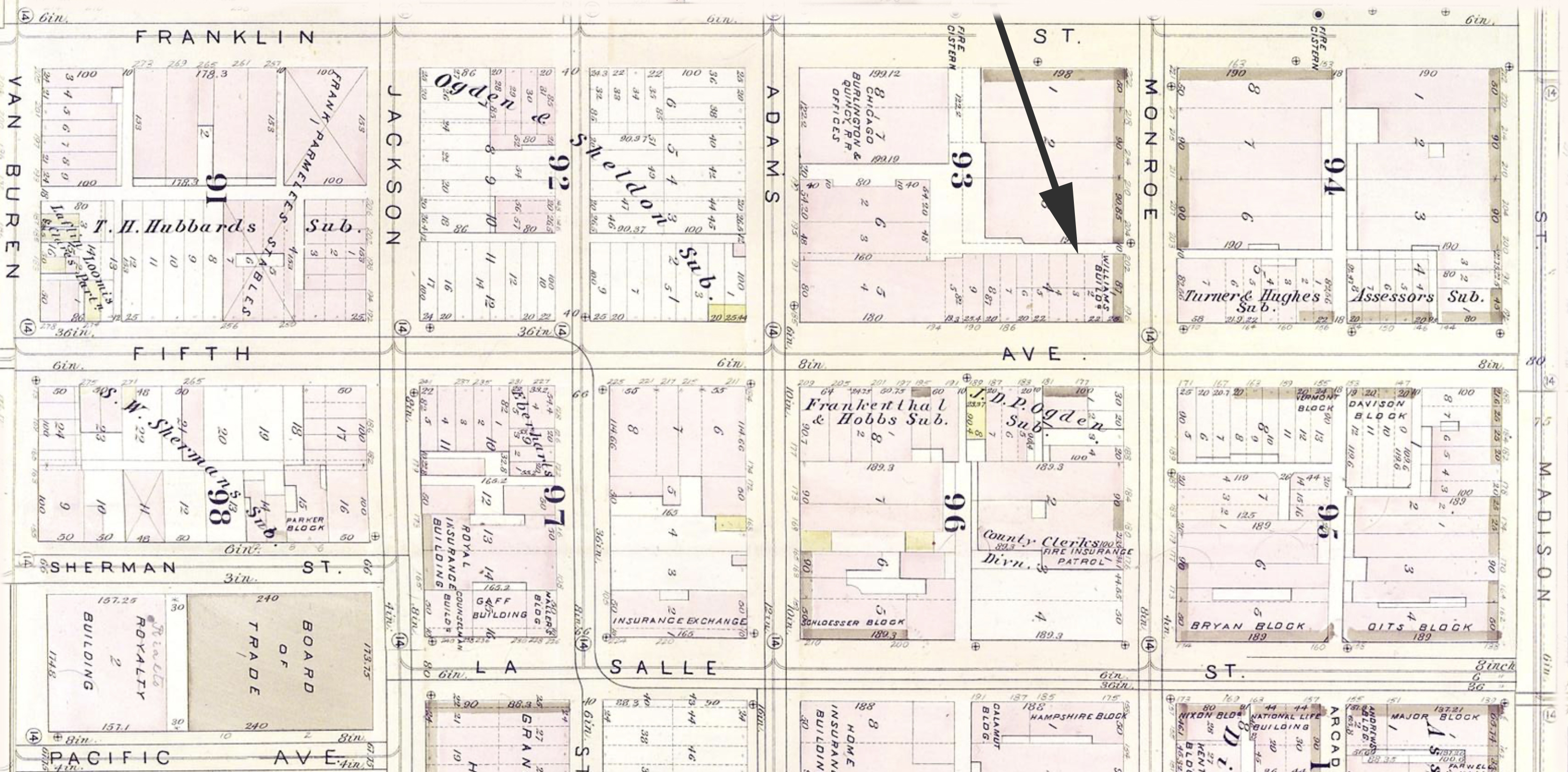
- Williams Building
Robinson Fire Insurance Map
1886

Leave a Reply