1865—Lake & Franklin Streets Fire
Life Span: December 1865
Location:
Architect: NA
- Halpin’s Chicago City Directory for 1864
Austin & Boal, (Henry W. Austin & Charles T. Boal,) whol. staple hardware, 221 amd 223 S. Water.
Fairbanks, Greenleaf & Co., (Erastus, Thaddeus, Horace and Franklin Fairbanks, of St. Johnsbury, Vermont, Luther L. Greenleaf and Charles H. Morse,) scales, trucks, etc., 172 Lake (See adv. back of cover and op. title.)
Gilbert, Updike & Co., (Charles J. Gilbert, George W. Updike and E. O. Stanard,) gen mers., 244 Lake and 265 S. Water.
Jones & Price, (William A. Jones and Robert P. Price,) wire workers and manufacturers of wire cloth, 206 Lake, up stairs
Whipple R. M. & Co., (Rodney M. Whipple,) whol. dry goods, 226 and 228 Lake.
Chicago Tribune, December 16, 1865
 At 9 o’clock this morning fire was discovered in the third story and center of the large commercial block corner of Lake and Franklin streets, and the alarm sounded for the fire department, alroady wearied from the extraordinary calls upon them within the past few days. The response was prompt on their part, but unavailing. The combustible pature of the contents, and the fanity construction of the building, which presented no dividing wails behind which to fight the enemy, made it a hopeless battle from the outset. Added to this was the intense cold weather, in which the raging element gave only a genial heat to spectators, and the picture of disability under which the firemen labored is complete.
At this hour it is only possible to give the outline of the conflagration, the loss by which may safely be estimated at half a million dollars.
The corner building, brick and four stories, is owned by J. Y. Scammon, and we understand is valued at $45,000, The third floor, where the fire began, (as also the second,) was occupied by Whipple, manufacturer and dealer in Yankee Notions. The upper floor was occupied as a trunk factory, and its contents included a lot of varnish. The stores were occupied by Gilbert, Updyke & Co., dealers in four and grain; McQueen, commission merchant; Olcott Lash & Co., commission; Jones & Price, wire sieves and enameled cloth. Here was stored in this building $80,000 worth of dry goods and clothing, whole heaps of produce, and a cellar fall of onions. The locality may be better remembered by some as including “Lincoln Hall,” name still borne in letters of stone.
Next west on Lake street was the six-story stone-front building owned by the Commissioners of the School Fund, which caught fire from the roof. This building may be roughly valued at $50,000, E. Richardson occupied the first store, No. 230, dealing in scythes and farming implements. Next, Sickels, Preston & Co., hardware; and next, Charles J. L. Meyer, sash, doors and blinds. The height of this building made it almost impossible to get a stream of water to the top, and when we left the scene the prospect was not promising. Time was allowed, however, and being employed to save books, papers and small stuff from the lower floors.
Backing to the block last named and fronting on South Water street, was the store of William Scott (No. 245,) wholesale grocer, in a wedge shaped building owned by Ogden, Fleetwood & Co. This store was rapidly entered and as rapidly finished by the devouring element.
A larger block to the west, occupied by Cady & Beach, (No. 247.) wool dealers; Winans, Northrop & Van Valkenburgh, (No. 249,) and Lewis, Smyth & Co. This building was on fire when we left.
East of Scott’s, on South Water street, were the stores of J. W. Bushnell & Bro. (No. 248,) and L. Barber & Son, liquor dealers, standing on the corner of Franklin street. The fire had not yet communicated to them, and it is a singular coincidence that Barber has been in almost equal danger several times, escaping unscathed.
As we go to press the fire “is raging with great fury, and seems almost incontrollable, the peculiar wedged-shaped character and blind connections of the buildings rendering it exceedingly difficult to get at the fire, and the inadequate head of water hardly forcing the streams above the second story. The loss in buildings and contents must. reach already nearly half a million of dollars, as not a box or bale of any description has been saved. The destruction has been complete, and on three streets only charred and blackened walls stand to tell the story of disaster.
Chicago Illustrated, October, 1866
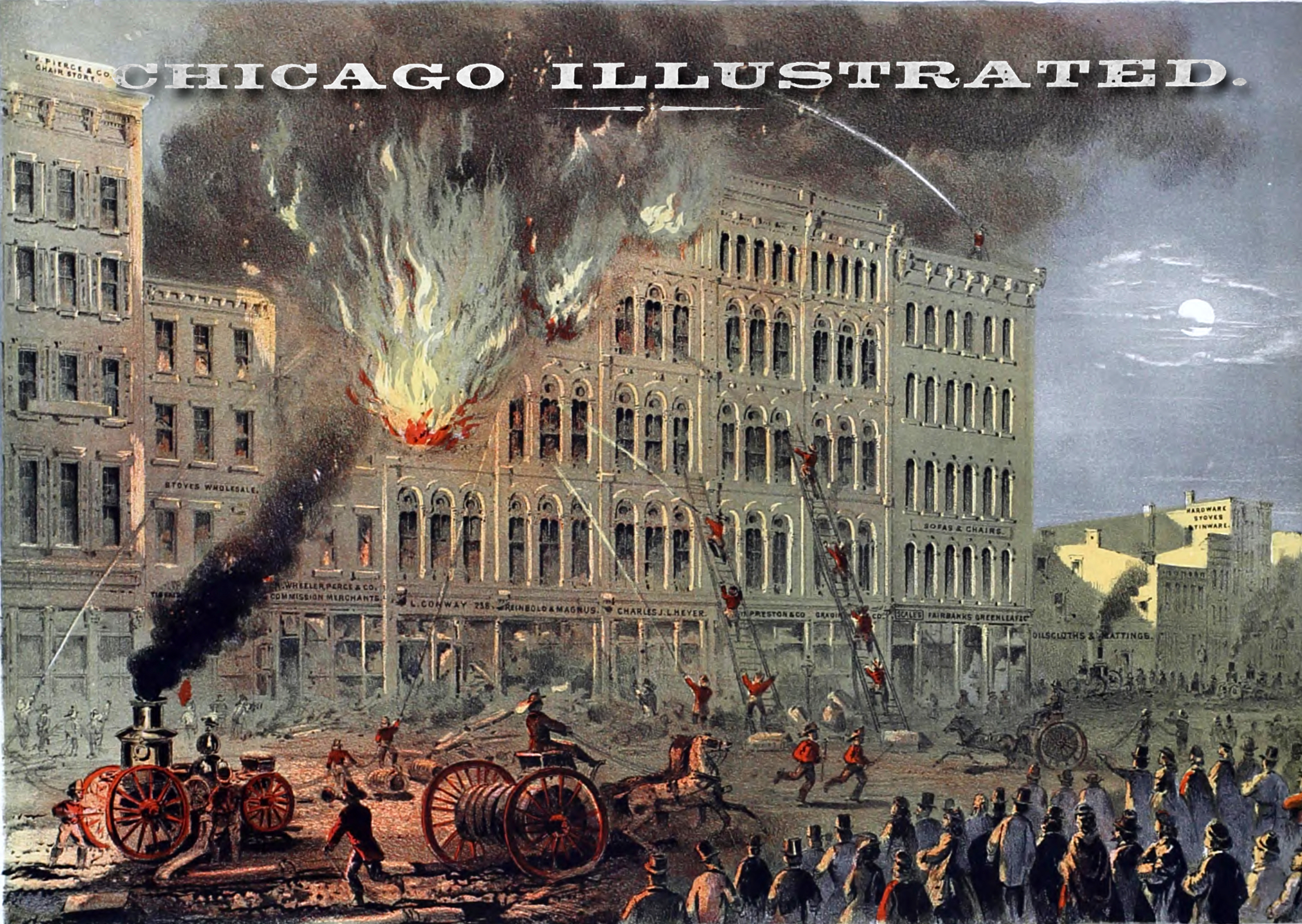

This scene represents the burning of the marble front block on Lake street. west of Franklin street, in the Fall of 1866. The fire was an obstinate one. It originated in stores on Water street, and burned through to Lake, and presented difficulties of no ordinary character. The Fire Department, however, was equal to the work; they confined the destruction to the premises actually on fire when they reached the scene.
Buildings depicted: Fairbanks, Greenleaf & Co. (172), Einstein & Schlesinger, trunks, 173 Lake
Chicago Tribune, December 18, 1865
The Great Conflagration on Lake Street
Our city has recently been very unfortunate with respect to fires, but the most severe one which we have experienced in many years was that which occurred on the corner of Lake and Franklin streets at an early hour on Saturday morning, the particulars of which, so far as could possibly be ascertained, were published in yesterday’s issue of the Tribune. The total loss will not, it is believed, fall short of a quarter of a million dollars, and may, when more facts are ascertained, amount to a larger sum. Squads of workmen were engaged all day on Saturday removing rubbish and recovering goods that were buried by the falling of the walls. A large quantity of apples stored in the corner basement were gotten out in a damaged condition, as also: a few barrels of flour.
That the metamorphoses effected by the fiery element are as complete as its power is great, one glance at the ruined block will most satisfactorily prove. The edifices, which on Friday proudly reared their heads as great mercantile centres of a prosperous city, are now a picture of ruin and desolation. Their trail proportions are charred and blackened by the fire, while from the diemantled windows and jagged corners depend long icicles -a fit type of the fragility of the strongest of man’s works. The merchandise is scattered over the sidewalks and roads, or piled among the ruins in the most indescribable confusion, mixed up with the debris of the building, and sodden by the volumes of water which rushed through every story.
For hours after all signs of active combustion had ceased, these chaotic heaps continued to emit ominous clouds of smoke, promising to the wearied firemen that though broken, the power of the fire king was not destroyed, and only waited the opportunity to burst out again with redoubled fury. Upon these smouldering masses the engines were playing during the entire morning and afternoon of Saturday before the fire was completely extinguished, and it was considered safe to withdraw from the ruins.
Nothing but the roughest estimates of losses can be obtained as yet, but almost all the victims of the conflagration appeared to have been well insured. The following are losses as far as could be ascertained on Saturday:
Lincoln Hall, which was owned by Hon. J. Young Scammon, was worth $50,000, and was completely destroyed. It was insured for $25,000 in the following companies: Mutual Security of New York, $5,000; North American of New York, $5,000; Continental of New York, $5,000: Equitable of Chicago, $5,000, and Citizens of Chicago, $5,000. This building brought Mr. Scammon an annual rental of $8.500.
The following firms occupied the front portion of Lincoln Ball on Lake street:
Nos. 226 and 228, ground floor and basement were occupied by Messrs. Gilbert, Updike & Co., dealers flour, etc, whose loss will aggregate about $10,000. They were insured in the following Companies: Garden City of Chicago, $11,000; Merchants, of Chicago, $1,500; and Peter McQueen, who occupied a portion of No. 224, lost about $600 worth of office furniture, which was insured for $900 in the Providence, or Washington.
Messrs. R. M. Whipple & Co., who occupied the second and third floors over Nos. 226 and 228 as a dry goods and notion establishment, sustained a loss of about $70,000. upon which they had the following insurance : Market, of New York, $5,000; City Fire, of Hartford, $5,000; Equitable, of Chicago, Lafayette, of Brooklyn. N. Y., $10,000: North American, of New York, $15,000; Continental, of New York, $5,000-total, $45,000.
No. 230 Lake street, in the six-story marble front building adjoining Lincoln Hall block was occupied by G. E. Richardson, dealer in agricultural implements. This store was completely gutted. It was owned by the Commissioners of the School Fund, who succeeded in saving their books and papers on the lower floor. Mr. Richardson is insured as follows: Firemen’s, of Chicago, $6,000, and Merchants’, of Chicago, $6,000.
Messrs. Lindauer Co. who occupied Nos. 226 and 228 as a manufactory or trunks and valises, are insured as follows: Ætna, of Hartford, $1.500; Home, of New York, $1,500; Citizens’, of New York, $2,000; Arctic, of New York, $2,000; International. of New York, 81,500; Illinois Mntual, of Peoria, Ill., $3,000; North American, of Hartford, $1,500; other companies, $1.500;—total, $14,000.
No. 28½ Lake street, occupied by Messrs. Sickle, Preston & Co., as a hardware, stove and tin plate store, was not badly damaged. The firm’s loss will not be more than $5,000, on which they have an insurance of $60,000 in the following companies: Underwriters’ Agency, $15,000; Resolute, of New York, $5,000; Lorillard, of New York, $5,000; Mercantile, of New York, $5,000; Home, of New York, $10,000; Lumbermen’s, of Chicago, $10,000; Packers’, of Chicago, $5,000. This building was owned by a Mr. Taylor, of Cincinnati, and is insured as follows: Hartford, of Hartford, $5,000; Equitable, of Chicago, $5,000; Springteld, of Springfield, Mass, $2,000;—total, $12.000. The store was damaged to the extent of $500.
The basement under Lincoln Hall was occupied by Messrs. Austin & Boal as a warehouse for stoves and hollowware. They are not as yet able to state their loss, but are inured to the amount of $10,000 in the North American and the Ætna companies.
Messrs. Cushman & Lash, who occupied an office on Frankin street, in Lincoln Hall, sustained a loss of about $5,000; insured in the Buckeye of Cleveland for $2,000.
Messrs. Winnans & Co., whose office was next door north from Cushman, Lash & Co.’s, sustained a loss of $2.000; fully insured. Jones & Price, wire workers, lost about $2,500 worth of material, on which there was a small insurance.
Traverse & Russell, dealers in lumber, lost all their office furniture and $2,500 in cash. Their total loss is $3,000, on which there is no insurance.
On Water street the following firms sustained injury: William Scott, wholesale of grocer, No. 245, stock damaged to extent of $4,000; fully insured. In this building there was stored a large quantity of wool, which was insured as follows: International of New York, $1,000; Arctic of New York, $3.000: Mutual Security, $6,000; Packers of Chicago, $4,000; Home, $5,000; Merchants of Chicago, $6,000. This building was owned by Hon. J. Young Scammon, who is insured in the following companies: Mutual Security Chicago, $5,000; Security of New York, $5,000.
In the adjoining building Cady & Beach, wool dealers, lost $2,000 worth of stock; Lewis Smith & Co. lost $1,000 and Winans, Northrup & Co. lost $1,500, all of whom were fully insured. The building was damaged to the amount of $2,000—covered by insurance.
The building occupied by T. W. Bushnell & Co., on the corner of Water and Franklin streets, was not heavily damaged, the total loss on building and stock, amounting to about $1,500, which was fully insured. A large number of other persons, whose names we could not ascertain, lost goods and furniture. The total loss will aggregate abont $850,000.
The origin of the fire is still cloaked in mystery. The statement that it commenced in the store of Messrs. R. H. Whipple & Co., is denied by those gentlemen, as they had no fire nor light in the establishment within three days of the time of the conflagration.
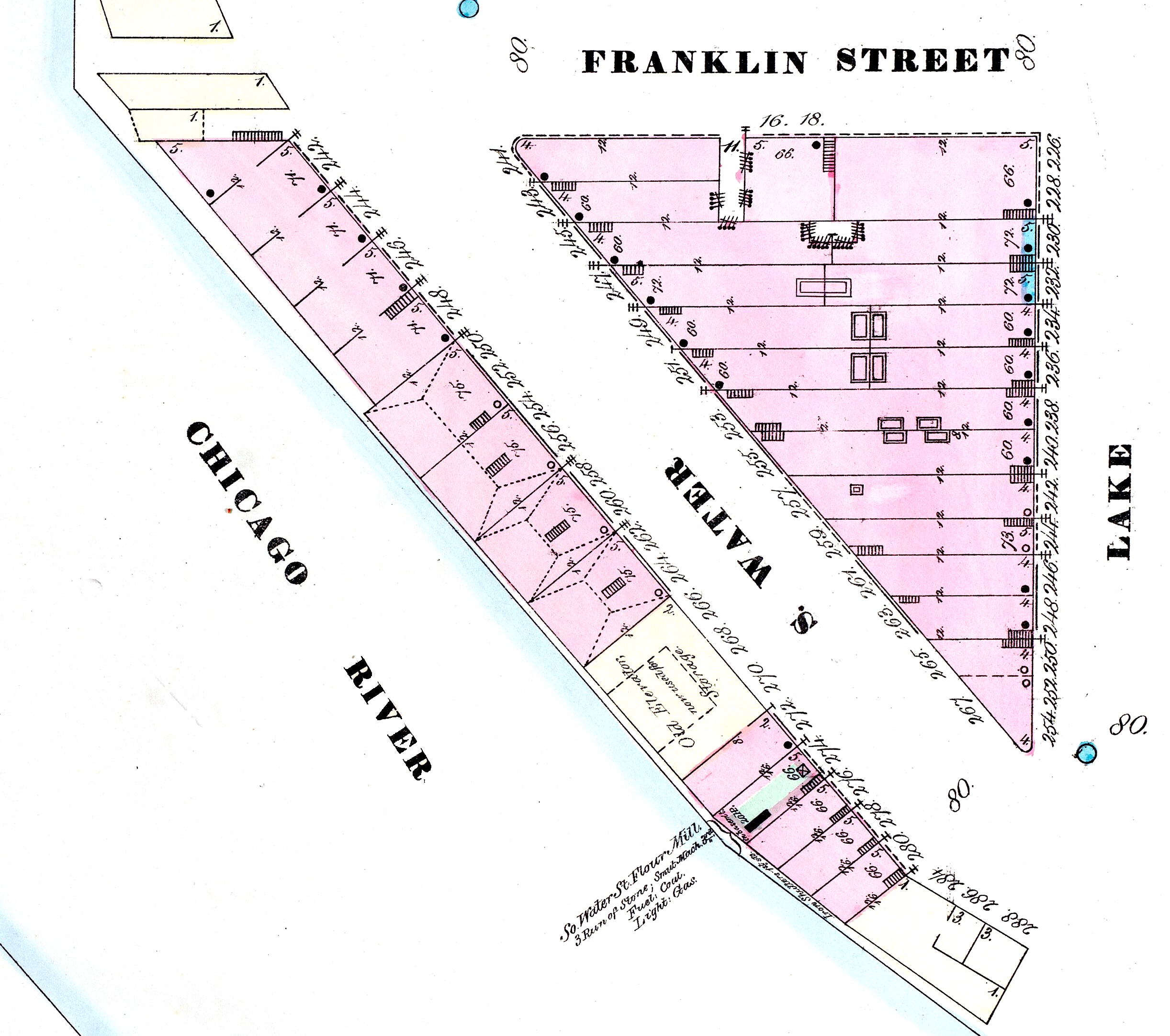
- Sanborn Fire Insurance Map
1869
Western Railroad Gazette, May 9, 1863
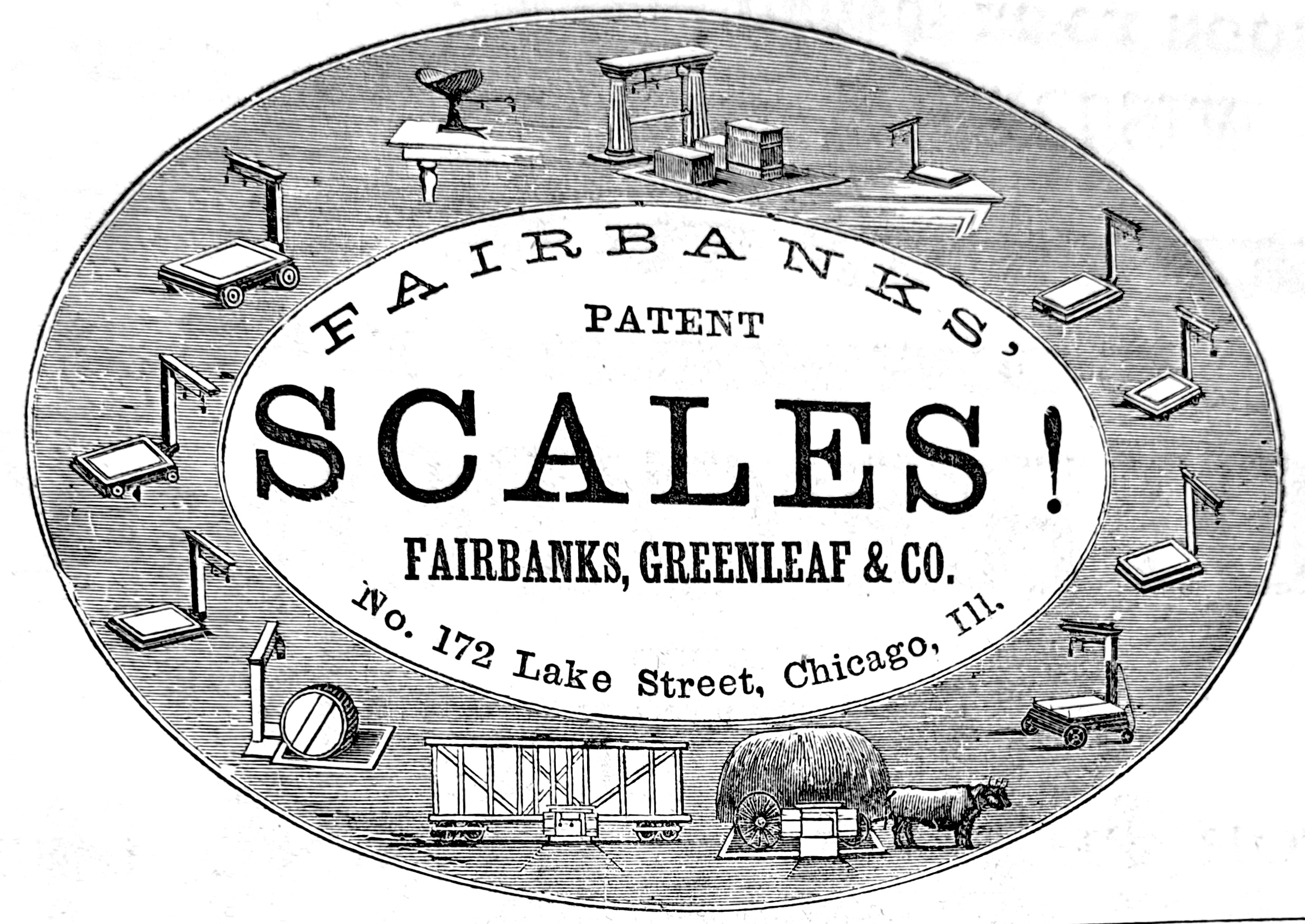
Fairbanks’ Scales.—Having learned that in some cases, persons with whom we have no connection whatever, have been traveling through the country representing themselves as our agents, or as selling scales made from Fairbanks’ patterns, &c., we deem it proper to say that the genuine Fairbanks’ scales are made only at Saint Johnsbury, Vermont, where they have been made for thirty-three years or more, by E. & T. Fairbanks & Co., the original inventors, and that others represented as such are only imitations.—If the agents for such other scales have confidence in their merits, they would have no occasion to resort to such means which to sell them, or avail themselves of a reputation which the Messrs. Fairbanks themselves have of a honestly earned. All our traveling agents will be furnished by us with certificates of agency, which will be happy to show to purchasers with whom they may not be personally acquainted.
Fairbanks, Greenleaf & Co.
Chicago, April 23d, 1863..

Leave a Reply