DeGraff’s Clothing
Life Span: 1864-1871
Location: 64, 66 and 68 Randolph
Architect:
- Halpin’s Chicago City Directory for 1864
DeGraff & Poole, (L. DeGraff and Sheridan Poole,) retailclothing, State cor. Randolph.
John C. W. Bailey’s Chicago City Directory for 1867
DeGraff L., clothing and furnishing, 64, 66 and 68 Randolph
Chicago Tribune, May 13, 1863
Young America Ahead.-A few months ago Messrs. DeGraff & Poole ventured to establish in this city, an emporium for the sale of boys’ and youth’s ready-made clothing. They have made it a point to keep the very best quality of goods, substantially made in the latest styles, which they sell in suits or single articles suit purchasers. The rising generation articles can be supplied with a fall outfit, on short notice, The success of this firm maybe estimated from the fact that their rapid increase of business has induced them to remove from 86 Randolph have to the southwest corner of State and Randolph streets, where they fitted up one of the finest store rooms in the city, and offer to the little folks and youth’s one of the largest and best stocks of clothing ever offered in the Northwest.
Chicago Tribune, October 25, 1864
The Tailors’ Occupation Gone.—The extravagantly high prices which for the last few months have prevailed in every branch of trade, have especially wrought a revolution in the subject of wearing apparel generally. The tailors’ proper have demanded such esormous prices for suits of clothing “made to order,” that wags asserted that tailor’s like lawyers were in the habit of charging consultation fees. A necessary result of this course of action was that people turned to the establishments for the sale of ready made clothing finding them more economical by nearly 50 per cent, while the articles procured from them were as tasteful in cut and as durable as those for which the Knights of the scissors demanded twice the money. In fact it was speedily seen that ere long the processes practiced in custom work must yield to the large Ready Made Clothing Marts which line our principal streets. To sew the large amount of business now transacted in these stores we cannot quote & better example than Messrs. DeGraff and Poole, whose princely establishment on the corner of State and Randolph streets, is a sort of pleasurable wonder to all who have patronized it. Their stock is so extensive and varied for its character that a wide selection is offered to every purchaser. In every branch of their trade, Messrs. DeGraff and Poole can suit the most fastidious taste, whether it be in the lightest article of haberdashery or the heaviest garmente for winter use.
This firm have large separate departments for the sale of Boys’ and Youths’ clothing, so great in extent and varied in style that no one can turn away dissatisfied. We earnestly advise all to call at this establishment before purchasing elsewhere.
Chicago Illustrated, April, 1866
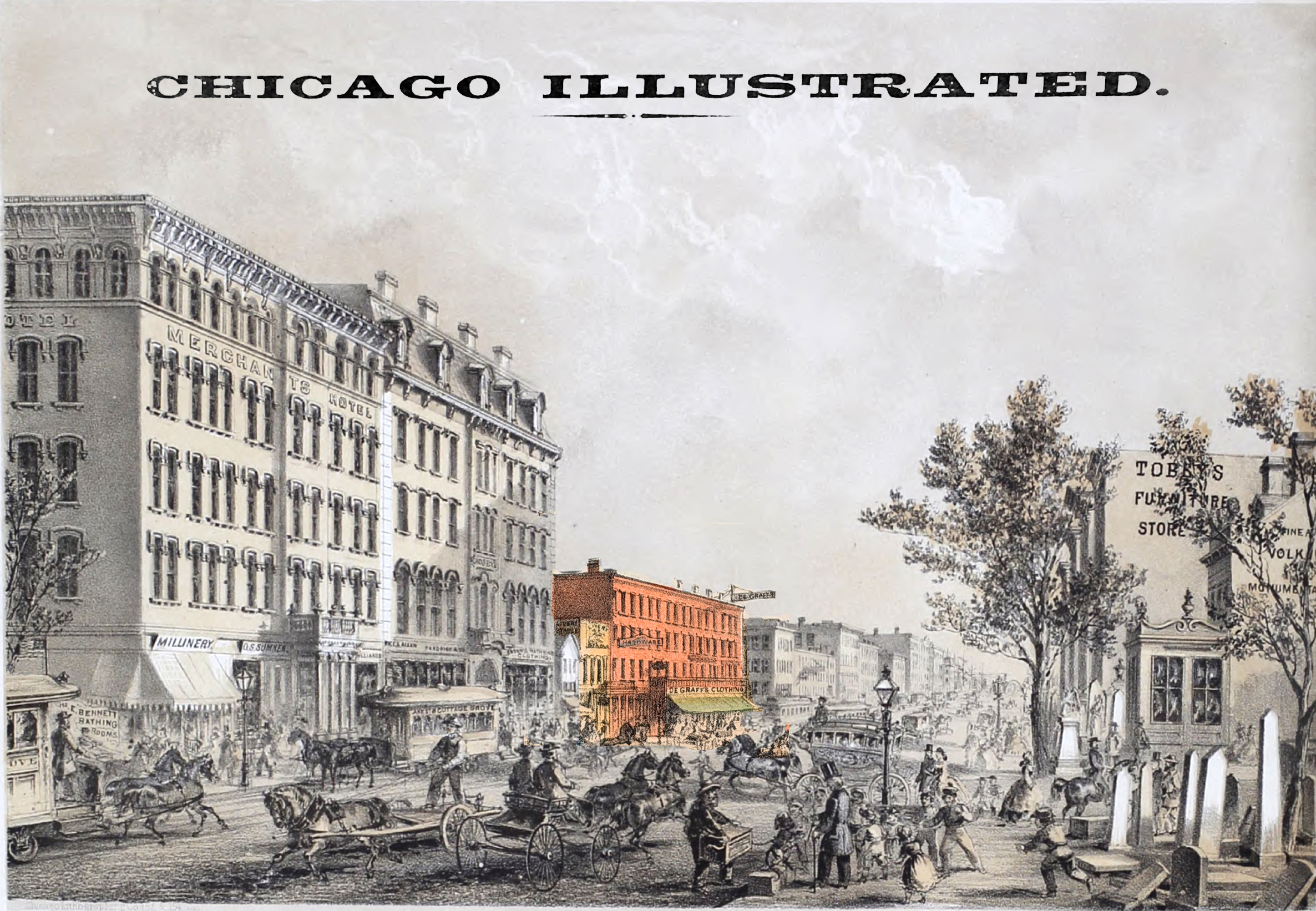
South-east of the corner of Washington street, looking north, is the point we have selected for our view of the north end of State street. On the left hand is the Merchants’ Hotel (formerly the Stewart House), adjoined on the north by Crosby’s Building, the latter of which connects at the rear with the Opera House building, a view of which has already been given in this work. This building is of brick, and finished in very fine style. The main floor is occupied by Rice and Allen, print publishers; Pardridge, dry goods; Brown and Mathews, merchant tailors. In this building is a very commodious and well arranged music hall or concert room, fifty by ninety feet. It is connected with the Opera House, to which persons can enter by a wide and convenient entrance from State street. It constitutes part of the Crosby Building, and is appropriately finished throughout. North of the edifice is the four-story building, the central point of whose interest is DeGraff’s mammoth clothing store, situated at the south-west corner of Randolph street.
The Irish Republic, January 11, 1868
No Irish Need Apply!
The heading of this article, some years ago used to be a favorite mode of emitting the venom of senseless bigotry against our race, even here in America. It reached its culmination in the days of “Know Nothingism,” and was buried on the battle-fields of the Union. It is an English importation, transplanted from English soil, and carefully cultivated here by English gardeners. A nation like Ireland, that has the audacity to protest against being trampled beneath the car of English progress-laden as it is with bastard princes, bloated aristocrats, bald-headed shopmen who ape their betters and lay their souls at the foot of the throne, bibles, gibbets, famines, poorhouses and impudence—must be calumniated. In England, where their own working girls are treated like slaves, our Irish countrywomen are treated like dogs—they will not become slaves. Hunted from the land that should be their own, and from the demolished homesteads that should give them shelter, they come to America, and this hatred and spite of England rises up here in respectable newspapers, in such paragraphs as “No Irish need apply.” Apply for what? To work honestly and virtuously for a miserable pittance, subject to the contumely of men and women, who, for the most part, were lackeys to me lud Puddington, in Yorkshire, and who by chance find themselves elevated to the position of whip holders, even while their own persons show the marks of the master’s hand or boot.
The worst feature of the whole matter is, that America, the child of liberty and liberality, gets the credit or disgrace of this “no Irish need apply” nuisance. John Baldy Pudge wants a victim. He immediately advertises in some respectable American paper that, “A girl is wanted at No. 8, Victoria Place. American, English, Norwegian, German, French, Negro, Hottentot, Chinese, Japanese preferred. No Irish need apply.” Now, Baldy Pudge is careful to conceal his name, and, of course, it looks as though some Yankee, with the blood of three generations of freedom throbbing through his heart, is the advertiser. Pudge has had his revenge, he has cried “mad dog” to the Irish, and thrown the onus on the Yankee. Our race is insulted, and America is disgraced, for it would be a disgrace for an American man or woman to insult a whole people and injure a virtuous and industrious class of girls such as our Irish girls are.
When we say that we are not afraid to champion our Irish girls for virtue, honesty, industry and filial affection against the girls of any other nation on earth, we do not wish to hurt the feelings of others. Heaven knows we look upon the working girls of all nations with the greatest respect, and would not insult the humblest cheek that blooms with honest labor in the kitchens and workshops of the land. How heartless and brutal scoundrels can outrage the common feelings of humanity by insulting our whole race—for we are all insulted when the humblest girl who toils to live a virtuous life is insulted with such inexcusable and intentionally vicious bigotry as tacking on to their advertisements “no Irish need apply,” baffles our comprehension.
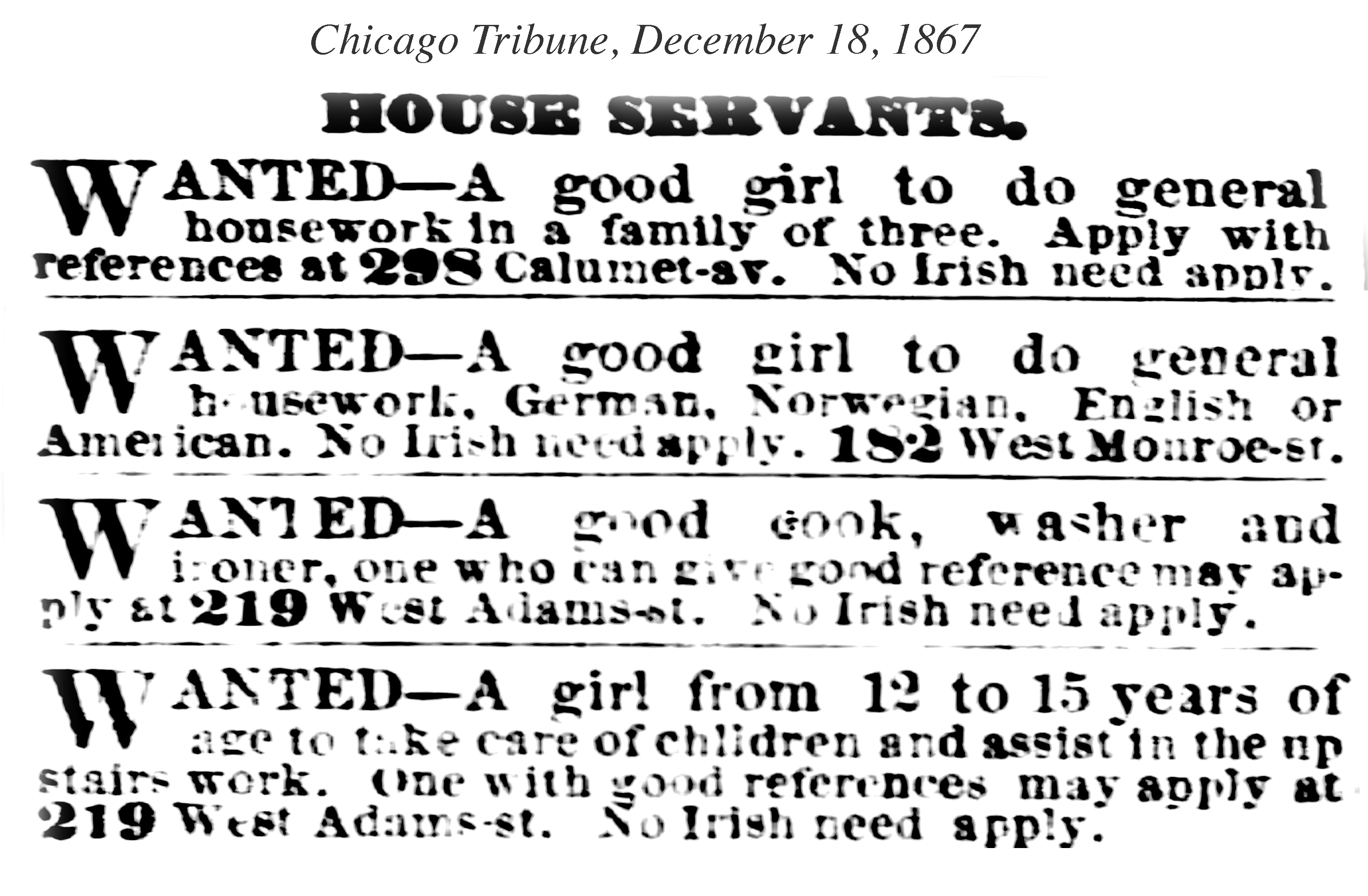
Last week a correspondent drew attention to a few of these advertisements from the Chicago Tribune of the 18th December:
- WANTED—A good girl to do general housework in a family of three. Apply with references at 298 Calumet av. No Irish need apply.
WANTED—A good girl to do general housework. German, Norwegian, English or American. No Irish need apply. 182 West Monroe st.
WANTED—A good cook, washer and ironer, one who can give good references may apply at 219 West Adams st. No Irish need apply.
WANTED—A girl from 12 to 15 years of age to take care of children and assist in the upstairs work. One with good references may apply at 219 West Adams street. No Irish need apply.
We have gone to some bother to find out who these advertisers were. We have the pleasure of assuring our Irish readers that, as we before surmised, those “no Irish need apply” style of people are not Americans. The “Calumet” establishment we have not visited as yet, but the other two are peopled as follows: 182 West Monroe street is kept by C. E. Lowell, a book-keeper; 219 West Adams street, by one Liverius DeGraff, who keeps a clothing store at the corner of Randolph and State streets. Liverius DeGraff, Esq., we believe, is an Englishman, and so is the book-keeper. As DeGraff does not keep the sign of “no Irish need apply” over his clothing house we trust our Irish friends will look on it as | though it was there. We are going to open a column in our paper where we will publish the name, business and nationality of every “thing” who insults our country with such advertisements. We are sorry that newspapers of respectability, such as the Tribune, will sully their pages with such advertisements. They become a party to the insult, unintentionally, of course. We know the gentlemen who are connected with the Tribune too well to impute any anti-Irish feeling to them. Their advocacy of Ireland’s cause during the last year or two is proof enough of their liberality. We trust they will prohibit any further use of their columns to insult and traduce our Irish girls.
We shall pursue this question by all means in our power until we silence those venemous vipers who would poison the American mind against our poor country girls by such advertisements as we allude to.
Is it not enough for those requiring help to say who can apply, without winding up with this British fling, “no Irish need apply?” Everybody has a perfect right to hire whom they please; but they cannot insult our race with impunity any longer, and we now give them timely notice to that effect.
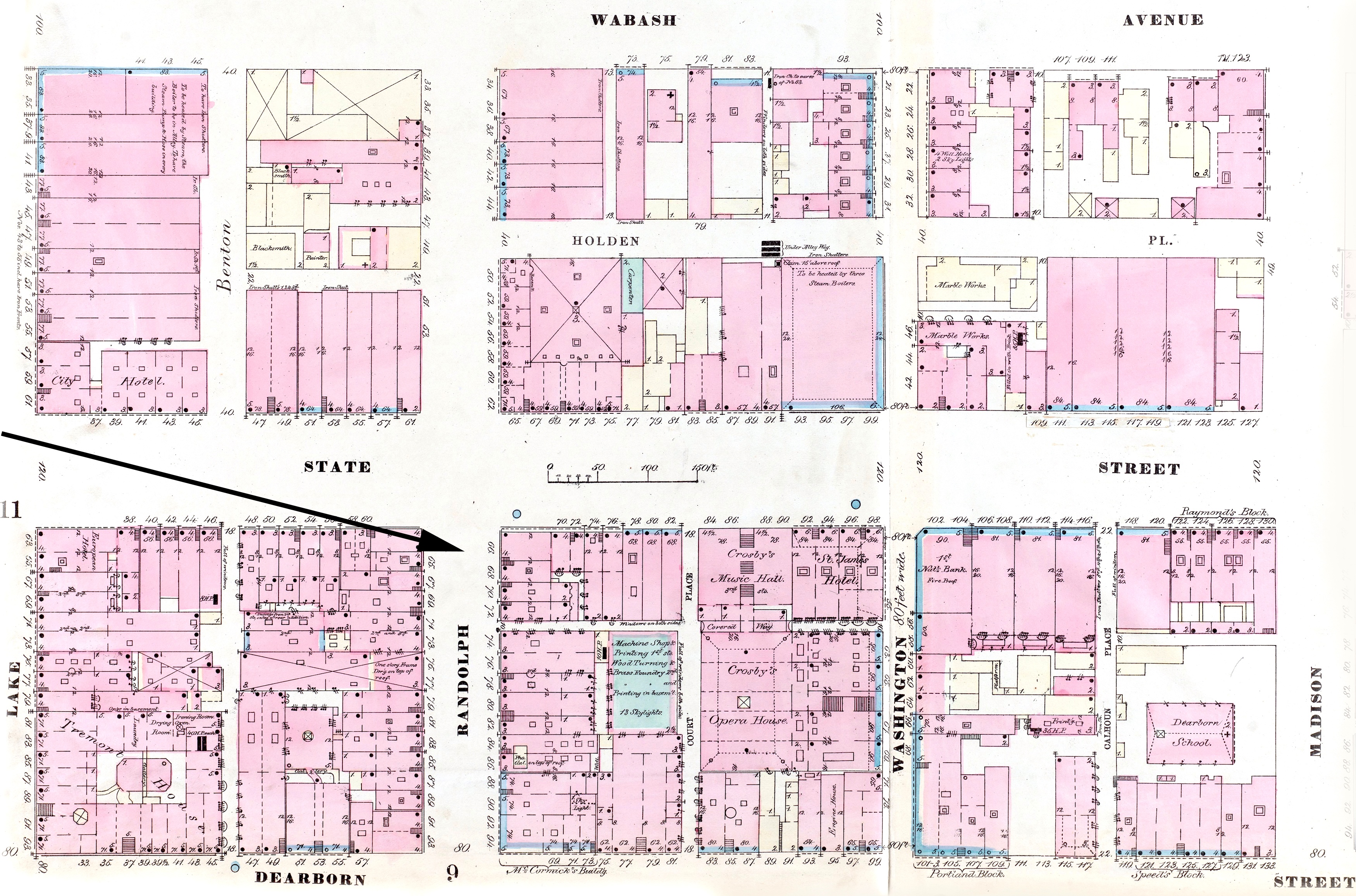
- DeGraff Store
Sanborn Fire Insurance Map
1869>

Leave a Reply