Occupants: Joseph Sears, Arthur Meeker, D. C. Heath & Co.
Location: 1815 S. Prairie
Life Span: 1882-1937
Architect: Burnham & Roots, reconstructed by Arthur Heun
- Lakeside Annual Directory for the City of Chicago, 1884
Sears, Joseph (N.K. Fairbank & Co.), 59 Wabash av. house 1815 Prairie av.
Lakeside Annual Directory for the City of Chicago, 1911
Meeker Arthur, (Armour & Co) stk yds h 1815 Prairie av
Inter Ocean, March 28, 1902
The residence property at 1815-1817 Prairie avenue, 76×140 feet, with three-story stone building of fifteen rooms, has been sold by Joseph Seers to Mrs. Grace Murray Meeker for $50,000, the purchaser conveying in part payment the residence at 2016 Calumet avenue, with 25×177 feet, for $20,000.
Chicago Tribune, May 31, 1914
Mr. and Mrs. Arthur Meeker and family of 1815 Prairie avenue have moved out to their country place, “Arcady farm,” at Lake Forest, to remain during the summer.

- 1815 S. Prairie Avenue

- John Sears’ dining room at 1815 S. Prairie.
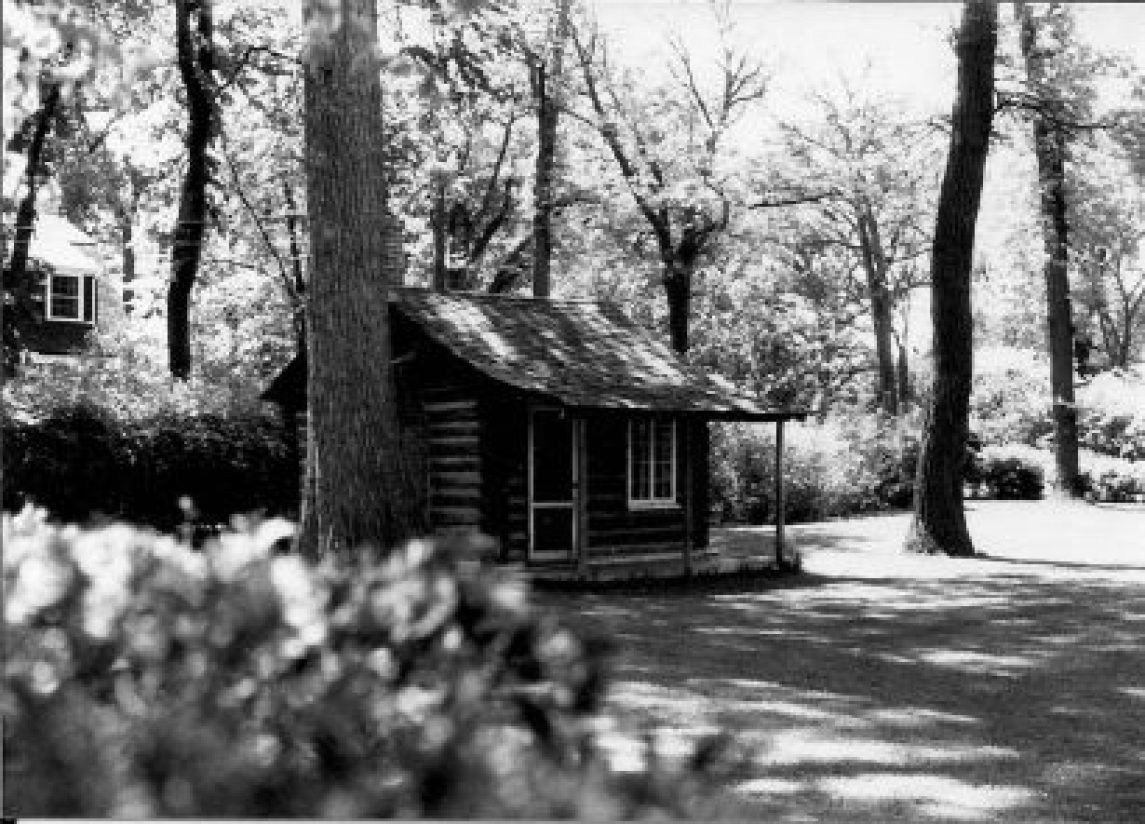
- Log Cabin Playhouse at 1815 S. Prairie. In 1892, the log cabin was moved to Joseph Sears’ home in Kenilworth. The log cabin continued to be a playhouse for his children and their new Kenilworth acquaintances.
Chicago Tribune, May 1, 1915
 Another of the old exclusive homes in the one time fashionable block on Prairie avenue, between Eighteenth and Nineteenth streets, is to be given over to business uses, the Arthur Meeker residence at 1815, which has been purchased by D. C. Heath & Co., school book publishers. The conveyance was made by Mrs. Grace M. Meeker, and a consideration of $35,000 is named in the deed, which was filed for record yesterday.
The house, which is a large, attractive three story stone structure, was erected by Joseph Sears about thirty years ago and about ten years ago was purchased by Mr. Meeker and extensively remodeled by him. It contains twenty-one rooms. It occupies a lot 75×140 feet to a twenty foot alley, and there is a large garage in the rear.
Will Move March 1.
The Heath company, which is the third largest school book publishing house in the country, and is now located in the Studebaker building on South Wabash avenue, will locate their business at their Prairie avenue purchase about March 1, using the house for their general offices, and the garage, which will be enlarged, for their stock room. The sale was negotiated by Eugene A. Bournique & Co.
Another interesting feature of the transaction is the fact it marks the location of another large publishing house in this locality, the American Book company being located at Twenty-second street and Calumet avenue and Ginn & Co. at Twenty-third street and Prairie avenue.
It is reported that several other concerns, including printing and engraving houses, are also figuring on locations in that vicinity, which has become attractive to this class of business.
Chicago Tribune, April 4, 1949
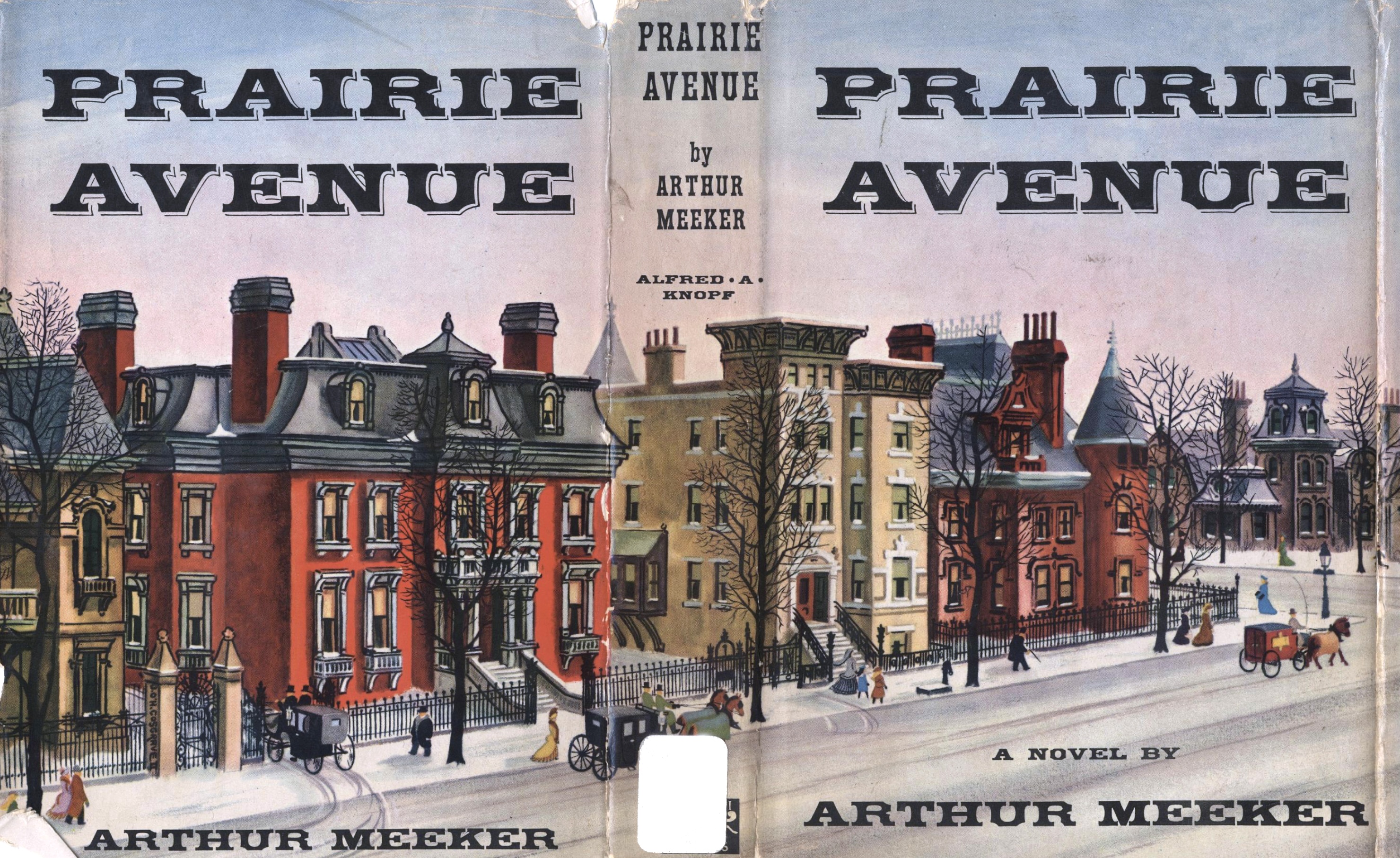
 “It took me three novels to learn how to write a novel; we have to see our mistakes in print before we realize what is wrong,” Arthur Meeker told the Society of Midland Authors’ March luncheon at Ricardo’s Studio restaurant. He spoke from experience. He started writing at the age of 7, but it was not until his Ivory Mischief was selected by the Book of the Month Club that he began climbing toward the top. That one achieved a sale of 400,000 copies. Now his Prairie Avenue is about to be published, it has been selected by the Literary Guild, and another huge sale is in prospect.
Remarking that he had been asked to talk on the literary life of Europe, Mr. Meeker said he knows nothing about it. “I go to Europe to get away from the literary life.” In his hillside chalet above Lucerne he shuts himself in behind a padded door, and works all morning. Afternoons are devoted to walking, and evenings to the theater. It took him two summers to do Prairie Avenue. “It would have taken three years over here.” His new opus, depicting Chicago’s gaudy social world at the turn of the century, is, he said, an attempt to recreate life—”which is what a historical novel is, or should be.”
Mr. Meeker was born on Prairie avenue, but not until 1902, and by that time the avenue had seen its hey-day. So his story is more of his father’s and mother’s time than of his own. His father was living there at the time of the great fire in 1871—”and 30 relatives moved in afterwards.” The rattling of the trains and the fog-horns on the lake were the things you lived by on the near south side. . . “Even Marshall Field walked to work.” People stayed home evenings, and in the summertime they sat on the front porch, and played the guitar or chatted with their friends. But, with the arrival of the 20th century, things got so that “we didn’t bow to all of our neighbors when we passed them on the street.”
The speaker recalled that his parents amassed enough money “so that they could pay not to see us children. Mother said it gave her indigestion to watch us eat. If somebody reported to her that Mary or Arthur had done this or that, she would answer: ‘Never mind; I’ll see about it tomorrow.’ If we could cough long enough—keep it up till Christmas—we were sent to California on Florida for the winter.” He also recalled the winged pigs and gargoyles on the top of the houses, the angle-worms on the sidewalks after the rains, the lamplighters, the Sunday balloon man, and the fact that his father had the first auto on Prairie avenue. “Dad sent a boy ahead on a bike to warn people to get off the street.”
Eventually the new boulevard pushed the lake far away, the avenue became “dirtier and dismaller,” and the Meekers moved to the north side. But the memories lingered. “I’ve been asked how I came to write this book. At first I didn’t want to do it; I put it off; I felt I was too close to the subject. Then it occurred to me that I might write something worthwhile if I made it, not either biografical or autobiografical, but out of a composite of memories, with no characters drawn from real life. I did a lot of research. I went thru the files of The Chicago Tribune from 1885 to 1896. My aunt (known to thousands of Chicagoans as the former Mrs. David C. Cook) had six trunkfuls of memorabilia. I induced my parents to reminisce, and I took notes as they talked. I returned to the old home (now occupied by D. C. Heath & Co., textbook publisher), and took notes on the oak paneling, the renaissance balcony, the melancholy air, the secret compartment where my folks used to keep the silver reserved for formal affairs. Then I went to Lucerne to write it.”
He didn’t figure that the book would have popular appeal. But Alfred A. Knopf accepted it, and Mr. Meeker’s agent, Paul Reynolds, cabled him that the Literary Guild had picked it for May. The first printing will be half a million copies. “It’s nice to win fame with something purely of Chicago. The east thinks that we’re ‘way out in the sticks, and that we have to write of the stockyards and the cornfields, because we don’t know anything else.”
In 300 years, he said, no Meeker had ever written a book, or wanted to. In the early days the sons craved to be merchants, bankers, brokers; so this scion of a pioneer family startled the relatives by insisting on writing. Then one day the phone rang, and a girl at the Houghton Mifilin office in Boston was trying to suppress her excitement long enough to announce that “Ivory Mischief” had been made a Book of the Month Club selection, and his mother declaimed: “Undoubtedly it’s a mistake; tell no one, Arthur.”
In introducing the speaker to his fellow authors at the luncheon Franklin J. Meine quoted George Ade as saying: “You don’t need me to write about Chicago any more; you have Arthur Meeker now.” In accepting the compliment the novelist related that he had signed a contract for another book, due in 1951, and that he was starting on it immediately. “I’m leaving Chicago before April 25, the publishing date of ‘Prairie Avenue.’ There’ll be no autografing parties, no radio talks, no personal appearances. I’m not even waiting to see what the literary critics say regarding the novel. I don’t read the press notices. I know what I can do, and what I can’t do; I don’t need a critic to tell me. And now I bow myself out, close the padded door, and go to work.”
Chicago Tribune, April 24, 1949
 It is strange that we have had so few novels dealing with the Chicago scene of the 1890s and early 1900s. To any person who remembers those days they have a charm that can never be replaced by the gauds and glitters of our present chrome-plated, streamlined elegance. The clip-clop of horses’ hooves on the asphalt streets and cobble-stones; the pallid, are lights glimmering thru the murky haze of an autumnal rain; the plushy decorations of the hotel dining rooms and fashionable restaurants where bemused midwesterners were introduced to such fabulous viands as breast of guinea hen; the barnlike, gloomy sheds of the railroad stations-these are well remembered scenes, tho their counterparts were found in other American cities of the period.
But what distinguished the Chicago of that day were its institutions and its people: its great department stores, its colossal wholesale houses, its merchant princes and its financiers. Some few of these survive; among the institutions there has been not so much a change as a develop-ment, and only the other day Henry C. Lytton, the last of the pioneer merchants of State street, left the scene forever.
For the most part, however, the people who belonged to the period are gone, and tho some of. their descendants carry on, we shall never see again the like of those men and women Arthur Meeker calls the “strong old roosters and their spectacular wives,” who formed, by their forceful character, a pageant of progress and power.
It is of these people that Mr. Meeker writes in “Prairie Avenue,” making of his material a stirring chronicle of Chicago’s coming of age. He has taken the days when Prairie avenue was the most fashionable address in the city, and has carried his narrative into the second generation afterward, when the proud mansions of that street were deserted or torn down, and all but a few old dowagers of its smart set had gone to live in the newly fashionable regions of the north side and the north shore.
These are not ghosts that the novelist has evoked from the gaslighted past; they are living, breathing men and women: men with strong appetites, strong wills, and a thirst for power; women of beauty and passion, delighted as children with the luxury brought to them by their Chicago-made wealth. The ugly old Victorian mansions are filled once more with their ebullient life.
It is not disparaging to say that the plot of “Prairie Avenue” is not important. The actors in its scenes are all subordinate to the story, which is Chicago. Tho a good part of it is autobiografical, and its author has been extremely successful in recreating the life of a boy on the avenue, its great success is its over-all effect. And tho many readers may take pleasure in matching some of its incidents to the known history of Chicago people, it is, to Arthur Meeker, a synthesis of many incidents and many persons, not a reproduction of known facts. It is the people as a whole who are im-portant. “In a way, one saw, since the city would not have been what it was without them,” the author says, “Chicago was their monument -vast and vigorous, rude and crude, its virtues and vices close copies of the men who’d made it.”
Chicago Tribune, May 6, 1949
PRAIRIE AV. FOOTNOTES
The greatest houses of the Prairie av. district in the year when Arthur Meeker’s novel of that deserted “gold coast” of Chicago’s social life begins (1885) were those built by Pullman, railway equipment manufacturer, Armour, stock yards magnate, and Field, department store merchant. They were, perhaps, Chicago’s richest men of the period, altho many others were challenging them as front runners. Their establishment of homes close together on a street already attractive fixed Prairie av.’s reputation as a patrician neigh-bornood and kept it in tat envable position, in spite of the growing fame of the N. Michigan av. area fostered by Potter Palmer, for 25 years.
None of the Prairie av. millionaires, how-ever, were pioneers in that area. Middle class families in comfortable circumstances were their predecessors, and were also substantial contributors to the social and business life of the growing city. This section of the near south side, including Calumet, Prairie, Indiana, Michigan and Wabash avs., quiet and well shaded with trees, has a social history that began before the Civil war. We can put a finger on one of its survivors, an eminent architect still in practise, whose rearing began in a home on Wabash av. near 18th st. in 1866.
The first Prairie av. house, our search for footnotes to Arthur Meeker’s novel discloses, was built in 1836, when Chicago was only a huddle of shacks around the Fort Dearborn reservation. In the Chicago social saga, that date, 113 years ago, is high antiquity indeed, but the most surprising thing about this house, considered a mansion at its birth, is that it still survives. It is the so-called Widow Clark’s house, famous among Chicago archeologists, which is now standing and in use at 4526 S. Wabash av.
When Henry B. Clark, pioneer hardware merchant, built this large frame residence, he chose a remote location close to the lake shore, now 16th st. and Prairie av., because he wanted to live out in the country. He owned a tract of 20 acres there, and after wearing out a log cabin he housed his family in a style that rivaled William B. Ogden’s manor on the north side. In 1836 there were no other houses in Chicago that equalled Ogden’s and Clark’s, and the latter had the advantage of being visible for miles across the flat, vacant vistas of the south side’s shore line.. . . The removal of the Clark house by another owner happened shortly after the Chicago fire of 1871. The latter citizen, a prosperous tailor, wanted to escape from fire hazards, so he transplanted the domicile to another site in the country, beyond the city limits.
Chicago Tribune, May 8, 1949

New York Times, May 1, 1949
 This is one of those novels which end with the hero striding “on in the gathering dusk” as he resolves to write the novel one has just finished reading. Here the device is used to tell of Prairie Avenue’s decline and fall”‘ in Chicago. Making his last-page resolution to tell that story, the narrator, Ned Ramsay, wonders why the Prairie Avenue way of life had failed.
Whether his answer is sound sociology is perhaps irrelevant to the purposes of fiction, yet it is not irrelevant to point out that the answer plays a very small part in the book itself, where cultural analysis never seriously gets in the way of light and colorful entertainment.
The narrator reveals his preference for social manners without adult insight into the sources or quality of those manners by telling the first half of his story from his point of view at the age of eleven. At eleven, Ned sees Prairie Avenue at its full tide, a street of enormous houses built in bad taste by grocer kings and lumber princes.
He observes the infidelities of his charming, complacent Aunt Lydia, in whose house he lives. He is able to catalogue social occasions such as an absurd picnic with many servants in attendance, and tell us about his problems at dancing class and his skill on the skating rink.
In the second half of the book Ned has grown up and continues to report on Prairie Avenue in much the same bland way. He has an unsuccessful love affair with a girl who marries a French noble-man; he manages the elopment of his cousin; he notes that the first of the great families moves away; he observes that now artists are acceptable guests at dinner parties, and that adultery is getting out of hand. Prairie Avenue is on the way down.
In a brief epilogue, dated 1918. Ned returns once more, sits with Aunt Lydia, the last of the faithful in a ruined street, buries her, inherits her money, and reflects, as above, that she and the others thought too much about money.

- 1815 S. Prairie Ave.
Robinson Fire Insurance Map
1886
Belle Ogden Armour abandoned the house in 1921 and gave it to his chauffeur, rent free, in 1921. The house was demolished in 1937 and R. R. Donnelley eventually bought the property to expand their facilities.

Leave a Reply