Phelps, Dodge & Palmer Building
Life Span: 1887-1984
Location: Northwest corner Fifth Avenue and Adams Street
Architect: Burling and Whitehouse
- Lakeside Annual Directory of the City of Chicago, 1887
Phelps, Dodge & Palmer (Erskine M. Phelps and George E. P. Dodge) boots and shoes whol. Adams, cor. 5th av.
Lakeside Business Directory of the City of Chicago, 1899
Phelps, Dodge & Palmer Co boots and shoes 185 Adams
Chicago Tribune, December 13, 1887
A BIG SHOE-HOUSE ROAST.
PHELPS, DODGE & PALMER’S STOCK GOES UP IN SMOKE.
Biz Hundred Thousand Dollars in Boots, Shoes, and Rubbers, and a Hundred Thousand Dollar Building Destroyed—Falling Walls Make It Perilous for the Firemen—-An Immense Crowd Attracted by the Brilliancy of the Fire-Scenes and Incidents.
The complete destruction by fire of the large boot and shoe establishment of Phelps, Dodge & Palmer, corner of Fifth avenue and Adams street, early last evening created great excitement and attracted the largest crowd which had attended a down-town fire for rears. The five-story brick block occupying Nos. 192 to 208 on Fifth avenue and Nos. 185 to 191 on Adams street was a handsome building with rather lightly built trouts. and occupied entirely by Phelps, Dodge & Palmer with a mammoth stock of rubber goods and boots and shoes. The stock is a total loss, though well insured: the building stands with the Adams street wall intact, while the long Fifth avenue front is a jagged ruin.
The few bookkeepers who were finishing their day’s work at their desks on the first floor were first apprised of the fire by the excited appearance of one of their number, who had caught a whiff of the burning leather near the elevator shaft. As he rushed out of the building to give the alarm the wagon of Fire Insurance Patrol No. 1 dashed up to the door. At 7:31 o’clock the automatic alarm connected with the insurance patrol house gave the first intimaton of the fire, which the dial plate at the front of the building indicated to be on the fourth floor. The patroi company rushed up the stairway with taeir chemical extinguishers, but the flames had made such rapid progress that they were driven back. As they hastily descended the first battalion of city engines were arriving. The tire had made its appearance through the windows at the top of the Fifth avenue front, and box No. #S had barely started to reel off the number in the fire alarm office before box No. 37, two blocks north, was pulled. Assistant Fire-Marshal Musham turned in a second alarm at once, and when Marshal Swenie arrived a third alarm was sounded, only eight minutes after the still to the insurance patrol. Eleven minutes afterwards a special call for ten engines was made.
The successive alarms brought twenty-five encile companies, with a score of other ap-paratus, hurrying to the fire from all directions. The whole top of the building had become a seething furnace, and the flames belching forth were given a strong reflection by the low-hanging clouds, and so diffused as to be visible for miles around, and if the clatter of the fire-apparatus rushing in from all directions had not served to throng the streets leading to the scene the brilliant light would have done so. Every avenue leading to the corner was soon cut off by cordons of police, reinforced by the detectives from the Central Station under Lieut. Slayton. The intense heat soon drove the curious throng back and enabled the police to establish a line.
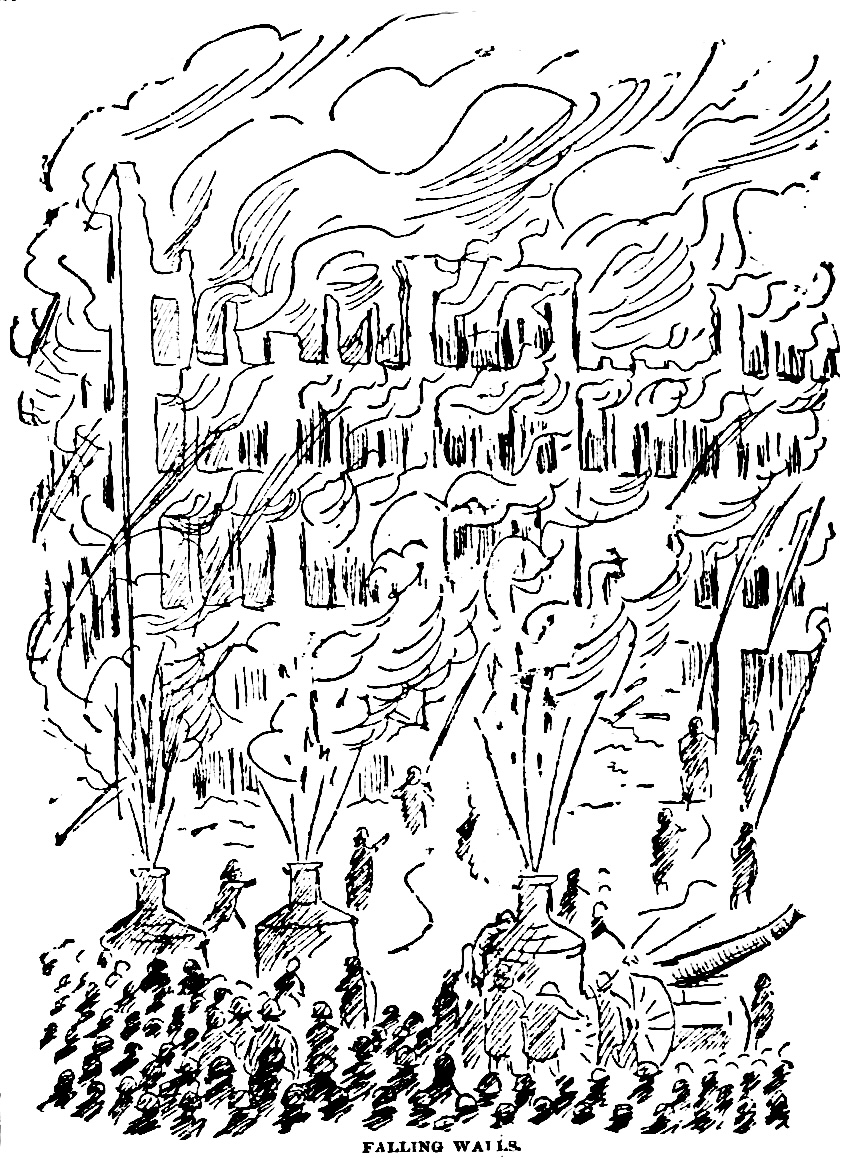
There was hardly room for the large number of fire apparatus to work, as the building could not be approached easily except from the two street fronts. Trucks with extended ladders. on which were perched single engine companies, were strung closely together around the building almost under the walls, while in between stood groups of firemen, double companies, with Siamese streams, playing upon the third and fourth story windows. The tall stand-pipe occupied the middle of the street on Fifth avenue, out the usual difficulty was experienced in getting it to work. The heat was growing momentarily greater, when the dull crash of a falling floor was heard. followed by an increased rush of fanes in the air. The fire still seemed to be confined to the two top floors, while the three lower floors presented unbroken black rows of windows. The caving in of the roof and top feor left the heavy mass of brick at the top of the Fifth avenue front unsupported, and it soon became evident that it must fall into the street. Marshal Swenie stood at the corner of the building with his face upturned, watching the long wall, which began to lean perceptibly. The companies which had been placed on the ladders had already descended, and the streams were all directed from the ground. Engine Company No. 10 had just been ordered to retire, when the wall bulged outwards. The firemen stuck to their lead and with difficulty dragged it to the side-walk, when a hundred tons of masonry lurched forward and descended into the street with a crash that shook the ground for squares around and shattered the glass in buildings close by. The standpipe was struck by some of the débris and nearly wrecked. The trucks had previously been cleared away and were uninjured.
The greatest excitement followed the falling of the wall. The immense crowd had been watching for it, and when it came the nervous shock was terrific. Those on the edge of the throng turned to run and the crowd gave way before them. Even the intelligent horses, who were tethered just inside the police lines, felt the sympathetic influence of the panic and nearly all of them broke their lines and started into the crowd. The police grabbed them by their bits and brought them to a halt just when it looked as though they were going to trample down the crowd.
The scene then underwent a rapid change. A long line was tied to the pole of the standpipe and a hundred ready hands helped drag it through the crowd. The streets on both sides were then entirely cleared of apparatus. Three companies stood at regular intervals in the middle of the street of the Fifth avenue side, their heavy boots seeking a secure foothold in the hot débris. They were double companies, and each held a “siamesed” stream—i. e., several lines leading to a single discharge pipe. Engine Companies Nos. 1 and 40 stood near the corner with Marshal Redell in charge, and fifty feet further north was another group of Nos. 4 and 16, in command of Marshal Campion. At the north end was the third group, composed of Company No. 11 with a few of No. 1’s men. Three more groups were similarly disposed on the Adams street side. It was exactly 8 o’clock when the wall fell, and ten minutes later other floors were heard going through. The rear of the building near the elevator shaft was floorless from roof to basement, while at the front and side the fire maintained for a moment its original boundaries, the two top floors. The firemen were still directing their streams upon the front of the building, when suddenly the flames burst trough the sidewalk at their feet. The fire bad dropped from the fourth floor to the basement, and spread beneath the doomed building with lightning rapidity. A heavy fringe of flame forced its way from the basement through the sidewalk, girting the whole building.
The picture presented was a remarkable one. The three lower floors were yet black and dark. Above was the fire, fierce and intense, and burning itself out. Through the ragged break where the wall had fallen long burning timbers hung in and out. Occasionally one of them would break off and perhaps float half a block, carried by the hot current. and blazing brightly. Around the ground edge the fringe of tame grew rapidly in volume. It burst through the first floor. It had barely time to spread through the entire length of the building when the fire appeared through the second-story windows. The third floor was the last to go. It was filled with rubber goods, which did not furnish very ready fuel, and, with the floors above and below a mass of fire, the third floor still showed & black belt around the two sides of the immense furnace. At last the third floor went, and the fire set to work steadily to burn itself out.
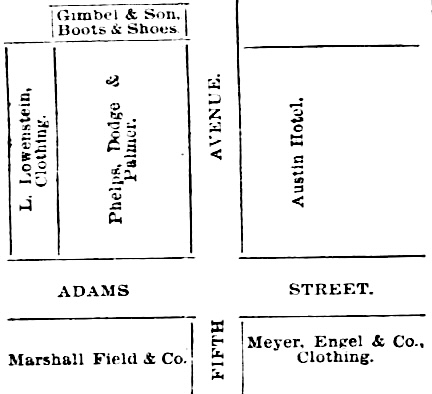
The heat became greater than ever. At first the north wind beat the flames to the south toward Marshall Field’s new building. Some of the glass in this magnificent building was cracked by the heat, and it seemed at first as if the fire might ignite some of the stock through the windows. But luckily the wind suddenly shifted to the southwest. As it shifted the building at southeast corner, occupied by Meyer, Engel & Co., clothiers, was badly scorched and all of the glass broken. The fronts of the buildings on the east side of Fifth avenue were all badly damaged. Hardly a single glass was left unbroken, the paint curled up and fell off in flakes, and the doors and window frames were charred black. The firms occupying the damaged buildings are M. H. Mayer, saloon, corner of Adams street and Fifth avenue; Merrick Thread Company, No. 205 Fifth avenue; S Harris, clothing manufacturer, Nos. 199 and 201 Firth avenue: Howard & Hayward, boots and shoes, M. F. Hunt, lace goods, Hefter & Witkowsky, pants manufacturer, all at No. 199 Fifth avenue; Beiermeister & Spicer, dealers in Anchor Brand Collars, No. 195 Fifth avenue; and the Pinkerton Detective Agency at No. 193 Fifth avenue. The buildings adjoining the one destroyed were separated from it by eighteen-inch fire walls and were uninjured. Gimbel & Sons, hats and caps. No. 190 Fifth avenue, on the north, and L. Lowenstein, clothing, on the west, were carefully watched by the firemen and the roofs protected from the heavy showers of burning brands, which were deposited several inches deep.
In the Austin House, at the northeast corner of Adams street, and Fifth avenue, there was a panic among the female occupants when the front windows began to crack and the building was blown full of stifling smoke. and many of them, shouldering the trunks containing their wardrobes, struggled downstairs and into an adjoining and apparently safer building.
The Origin A Mystery.
Marshal Swenie was still at the fire directing the work of the companies at 1:15 this morning. He expressed a great deal of curiosity about its origin. “It is as quick a fire as I ever saw,” he said. “The Insurance Patrol with its mercurial alarm had hardly got around the corner of Monroe street before we got the alarm. When I came out of my house on the West Side I could see it looming up across the river. It had a terrible headway not to be discovered sooner, as there were people in the building at the time. It’s the biggest down-town fire we’ve had since the Belford, Clarke & Co. fire at Congress and Wabash avenue nearly two years ago.
“The reason I didn’t get the stand-pipe to working was that there were so many points to be covered that the streams couldn’t be spared. The fronts of the buildings across the street were en fire, and the roofs of both buildings adjoining north and west were blazing. The fire-boat was at the Adams street bridge, but that was too far away.
“I had five companies on the roof west of the building and four on the roof at the north There was a hot-air explosion which lifted the roof while those companies were attending to the fire on the edges of the roofs adjoining the Phelps, Dodge & Palmer Building that
made it interesting for them.”
No more wall had fallen at this time, but there was still a great deal of fire within the building which half a dozen streams were wetting down. All the floors had fallen through with the exception of a small portion at the rear, where the timbers still furnish slight support to a small section of it. The origin of the fire is a mystery.
The Loss And Insurance.
The total loss, as near as could be learned from trustworthy sources, was about $750,000. Of this amount $650,000 was on stock and machinery, and $100,000 on the bullding. It is the dull season in the trade. The firm is said to do the second largest manufacturing business in that line in the city, and unlike most of the houses had considerable machinery and manufactured largely in their warehouse. Most of the firms do their manufacturing in separate buildings or at other points, having been forced to do so by the insurance companies, who advanced the rates on warehouse buildings in the business portion of the city in which manufacturing was done, so that most of the firms found it more profitable to move their manufacturing. Phelps, Dodge & Palmer, however, continued, it is said, to manufacture on the two upper floors of their house. Their stock, which at some seasons is said to reach $1,600,000, is estimated to have been at the time of the fire not in excess of $600,000, and this is considered a liberal estimate. The stock included about $150,000 worth of rubber goods. The machinery is estimated at about $50,000. The firm employ about 400 hands of both sexes, and is said in the busy season to turn out 2,000 pairs of shoes a day.
The building, was erected in the fall of 1881 by Edwin H. Sheldon, the present owner. The building was red brick with stone trimmings. had five stories and a basement, covered a space of S0x130 feet, and cost $115,000. The principal front was on Fifth avenue. The building was insured for $85,000, as follows:
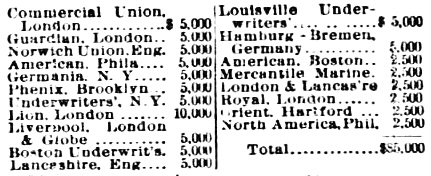
There was an insurance on rents of $24,000, in addition to the above.
The insurance agencies were unable to make anything but an approximation of the total amount of insurance on the stock and machinery. The insurance offices on La Salle street were filled with anxious agents, who were apprehensive that the fire could not be confined to the building in which it started. The most reliable and best informed insurance men placed the total amount of risks at $700,000, of which $85,000 was on the building, $500,000 on the stock carried by the firm and $115.000 upon the immense rubber stock owned by the New Brunswick Rubber Company, of which Erskine M. Phelps is the Western agent. The estimates made by the different agencies varied widely from the above figures. some placing the total $200,000 above this figure and others at as much below. This is accounted for by the lack of information relative to the amount of stock on hand. The building and property were considered a first-class risk. The firm has the reputation of carrying a full line of insurance, which was placed by the cashier instead of being given to an insurance broker, as is the general custom. In the latest report made by the official inspector appears the following item:
Phelps, Dodge & Palmer: Second floor, cleaning samples; third floor, rubber stock; fourth and fifth floors, storage and manufacturing; 102 steam machines, fifty hand machines; 312 hands employed; two and one gallons of rubber cement on fourth floor and one barrel of rubber cement in fire-proof vault. Night watchman with watch clock: electric alarm: stand-pipe and forty-eight pails of water; building excellent and premises very good.
The Mutual Fire-Insurance Company of New York, the Fire Association of New York, and the Commonwealth ef New York are said to be the heaviest losers. Among the agencies able last night to state the amount they were carrying were the following:

The Mutual of New York is said to have fully $30,000 upon the property. The loss will be distributed among over 100 companies, whose individual losses range from $1,000 to $30,000.
Business-men say that the firm may be able to resume business in ten days or a fortnight. Suitable buildings are to be had, and it is merely a question of adjusting losses and receiving certain consignments.
Edwin H. Sheldon, the owner of the building, is now at Florence, Italy, with his family and will not be home before next summer, but his agent, E. H. Fishburn, said he considered it a total loss, and cabled Mr. Sheldon to that effect last night. He also said that just as soon as possible work would be commenced to rebuild and he hoped to have the new building, ready for Phelps, Dodge & Palmer early in the spring. That firm had a lease on the building that runs until Jan. 1, 1889.
Incidents.
The firm has been engaged for several days taking account of stock, and when Mr. Phelps heard of the fire he was on his way from his home to the store to finish the last of that work.
William Dix, who was standing at the edge of the crowd looking at the fire was forced back y a police officer, and ta stepping backwards slipped and fell and was trampled on by the crowd. His arm was broken and he was taken by the Harrison Street Patrol to the Mercy Hospital. He is a clerk, and Lives at No. 2143 Wabash avenue.
Engine Company No. 1 was directly underneath the falling wall, but a shout from Chief Swenie and the bystanders warned them in time, and, dropping their hose, the pipemen made for the opposite side of the street, crashing through glass door into a wholesale house near the corner. The falling brick completely severed the hose in four different places, but it was soon replaced and the good work of the company continued.
A stupid driver on a orriage at the corner of State and Washington streets was so intent watching the crowd cunning to the fire that he did not see Engine Company No. 11 coming up the street from the North Side, nor did he hear the gong. Martin Simons, the driver of the engine. tried to turn aside and stop in time. He avoided the collision, but one of the horses fell on the shaft and snapped it in two, the accident throwing the driver into the air. Simmons fell on his head and shoulder, striking part of the engine with his leg in his fall. He was hurt a little about the neck, and a deep gash was cut in his thigh, but his wounds were not at all dangerous, and he was able to work during the fire. One of the engine horses had its hoof torn off in the accident and was shot
The faint glimmer of a street light on Fifth avenue, directly opposite the sea of fire, shone for a time in a ludicrous contrast to the brilliant illumination. When the flames burst through the basement windows and forced the firemen back to the edge of the sidewalk the glass of the lamp-post cracked in a hundred pieces and the modest little flame flared for a moment and blew out. There was still light enough, however, for the firemen to continue work. When the lower floors burst into flames the police forced the crowds that blocked Fifth avenue and Adams street back fully 100 feet. A pickpocket on Fifth avenue relieved a man of his pocketbook. The victim discovered his loss and the thief at the same time. He grabbed the fellow by the coat sleeve and secured a firm enough grip to detach that part of the garment but the quick-footed thief managed to escape. The amount of money was not sufficient to pay for the coat, which fact was highly appreciated by the plundered individual, carried the captured sleeve away as a memento.
In February, 1864, the Arm of Phelps & Dodge. boots and shoes, was formed by Erskine Phelps and George E. P. Dodge, at the corner of Lake and State streets. The following year N. B. Palmer was taken in, and in 1867 the present firm name was adopted. They occupied the premises street at No. 50 Lake street till 1869, when they removed to Nos. 48 and 50 Wabash avenue, where they were burned out in the great fire. Two days afterward they started in at Mr. Phelps’ house on Indiana avenue, and then moved to temporary quarters on the Lake-Front. Later they put up a building on the old Wabash avenue site, and in 1876 took in Nos. 52 and 54. Mr. Palmer died in 1877, and Messrs. Phelps and Dodge purchased the estate’s interest leaving the firm’s title unchanged, according to Mr. Palmer’s wish. They remained on Wabash avenue till January, 1882, when they moved to the building at Adams street and Fifth avenue. Their sales in 1884 were $90,000; in the present year nearly $3,500. Their building was 180×80, the largest front being on Fifth avenue.
Mr. Phelps is well known in politics in this city. He is a prominent Democrat, has long been a leading member of the Iroquois Club, in which he held the office of President and has taken an active part in the movements of that organization.
Rand, McNally & Co.’s Bird’s-Eye Views of Chicago, 1893
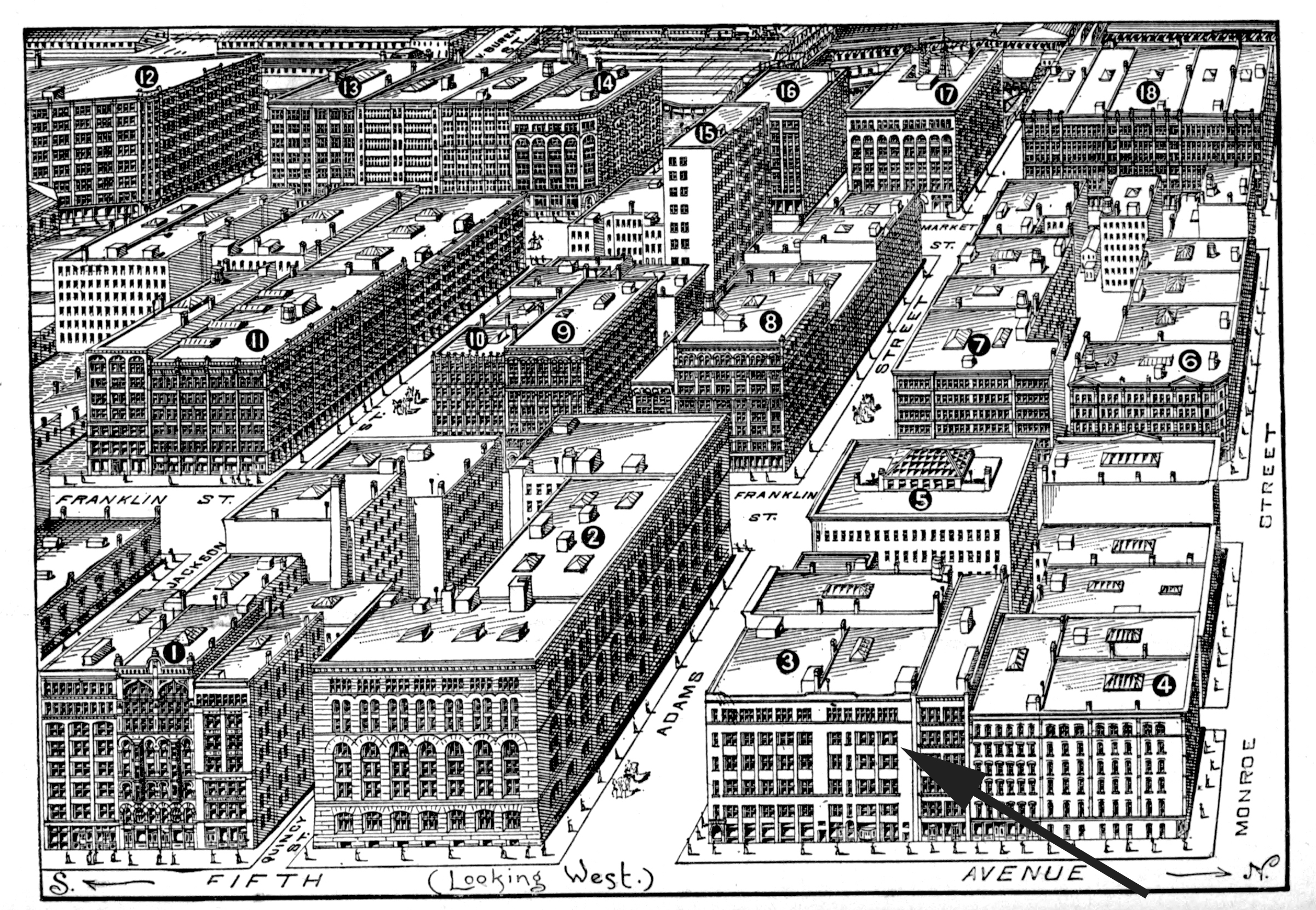
③ Phelps, Dodge & Palmer Building
Fronts 80 feet on Adams Street and 180 feet on Fifth Avenue, at the northwest corner. It is 95 feet high, with 6 stories and basement; pressed-brick and terra-cotta exterior; 2 passenger elevators and 3 freight elevators. It is occupied by Phelps, Dodge & Palmer, wholesale jobbers and manufacturers of boots and shoes, and by wholesale jobbers of clothing. Erected in 1888 after a destructive fire.
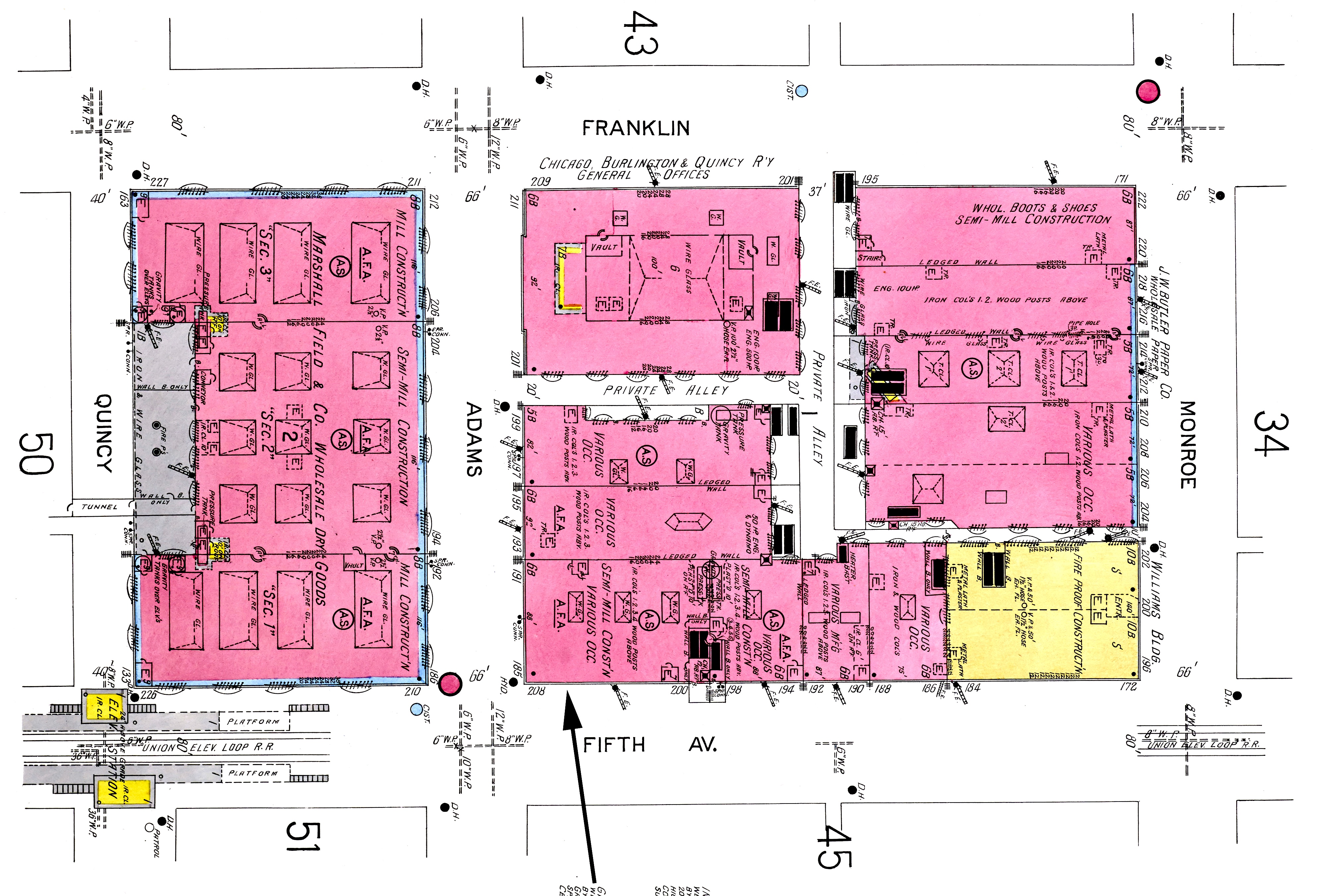
- Phelps, Dodge & Palmer Building
Sanborn Fire Insurance Map
1906

Leave a Reply