Oscar Mayer & Co.
Life Span: 1883-1993
Location:
333 Sedgwick (Sedgwick and Siegel)
285 Sedgwick (Sedgwick and Beethoven place)
Architect:
- Lakeside Annual Directory of the City of Chicago, 1877
Mayer Oscar cutter 225 N. Clark
Kohlhammer Frederick meatmkt. 225 N. Clark
Lakeside Annual Directory of the City of Chicago, 1880
Mayer Oscar butcher, house 80 Sedgwick
Lakeside Annual Directory of the City of Chicago, 1884
Mayer Oscar F. & A. (Oscar F. and Gottfried Mayer) meatmkt. 333 Sedgwick
A. N. Marquis & Co.’s Business Directory of Chicago, 1886-1887
Mayer O. F. meatmkt. 333 Sedgewick
Lakeside Annual Directory of the City of Chicago, 1887
Mayer Oscar F. & Bro. (Oscar F. and Gottfried Mayer) meatmkt. 333 Sedgwick
Lakeside Annual Directory of the City of Chicago, 1892
Mayer Oscar F. & A. (Oscar F. and Gottfried Mayer) meatmkt. 285 Sedgwick
Lakeside Business Directory of the City of Chicago, 1899
Mayer Oscar F. & Bro. meatmkt. 285 Sedgwick
Lakeside City Directory of the City of Chicago, 1904
Mayer Oscar F. & Bro. (Oscar F and Gottfried Mayer) meatmkt. 285 Sedgwick
Lakeside City Directory of the City of Chicago, 1911
Mayer Oscar F & Bros (Inc) Oscar F Mayer pres; Gottfried Mayer sec; pork packers 1241 Sedgwick
Polk’s Chicago Numerical Street and Avenue Directory, 1928
Italo-American Sausage Mfg Co 1240-42 Sedgwick (Beethoven pl intersects)
Mayer Oscar & Co meat packers 1241 Sedgwick
Mayer Oscar & Co whol provisions 1240 Sedgwick
Chicago Classified Telephone Directory February 1934
Mayer Oscar & Co sausages 1241 N Sedgwick DIV ersy-1200
Chicago Tribune, November 11, 1878
A butcher named Fred Kohlhammer, residing at 235 North Clark street, was taken suddenly ill early yesterday morning, and died in a couple of hours, despite the efforts of three physicians. Supposed cause is apoplexy. Kohlhammer is a German about 47 years old, and leaves a wife and six children.
Chicago Tribune, August 29, 1884
Chicago.
The building at Nos. 333 and 335 Sedgwick street, owned by George Collins and used as an ice-house and store by George Meyer (sic), a butcher, was damaged $300 by fire. The loss is covered by insurance. Meyer’s loss is $700, with no insurance. Cause unknown.
Chicago Tribune, February 23, 1886
The Secretary of State today issued licenses of incorporation to the following stock companies:
- The Boguin Placer Mining & Cattle Company, at Chicago: capital stock. $600.000; for placer-mining and cattle-raising in the Republic of Honduras, Central America; incorporators, Thomas Armour, Oscar T. Mayer, and William G. Miller.
Chicago Tribune, May 16, 1888
BUILDING PERMITS.
The following building permits were granted yesterday:
Oscar Mayer, two-story butcher shop, 54×100 ft. No. 285 Sedgwick st.
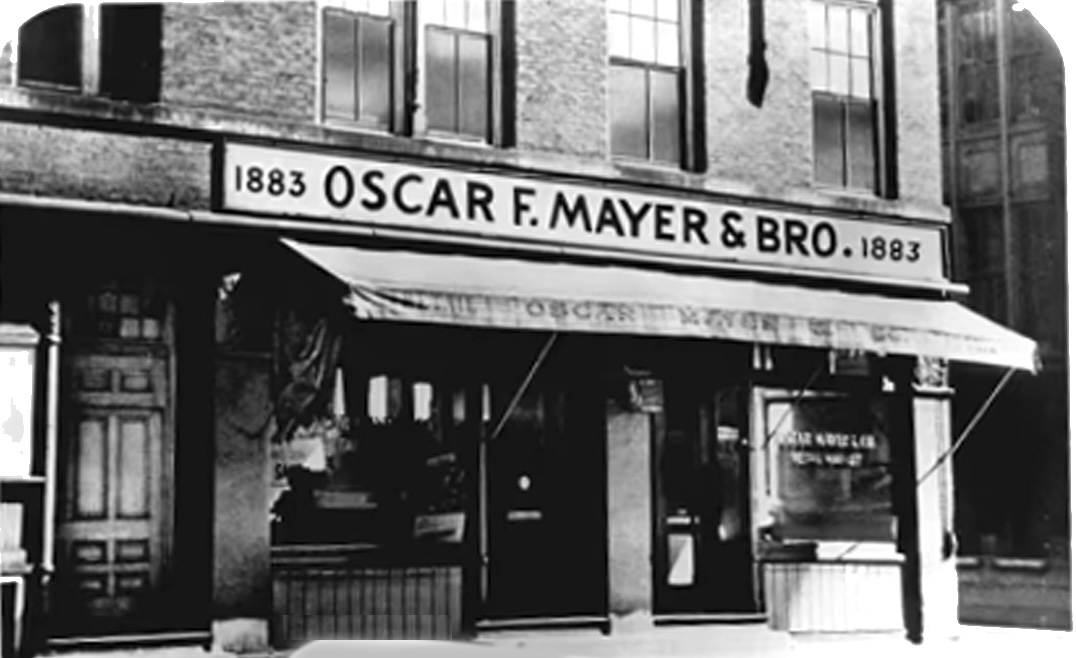
- Oscar Mayer Meat Market
285 Sedgwick (1241 Sedgwick today)
Chicago Examiner, January 14, 1912
Real Estate Transfers.
Goethe st., No. 12 (old), n. fr., 20×68—Wm. P. Harrison to Oscar F. Mayer & Bro., 1241 Sedgwick st; Dec. 22, 1911
Chicago Tribune, May 6, 1952
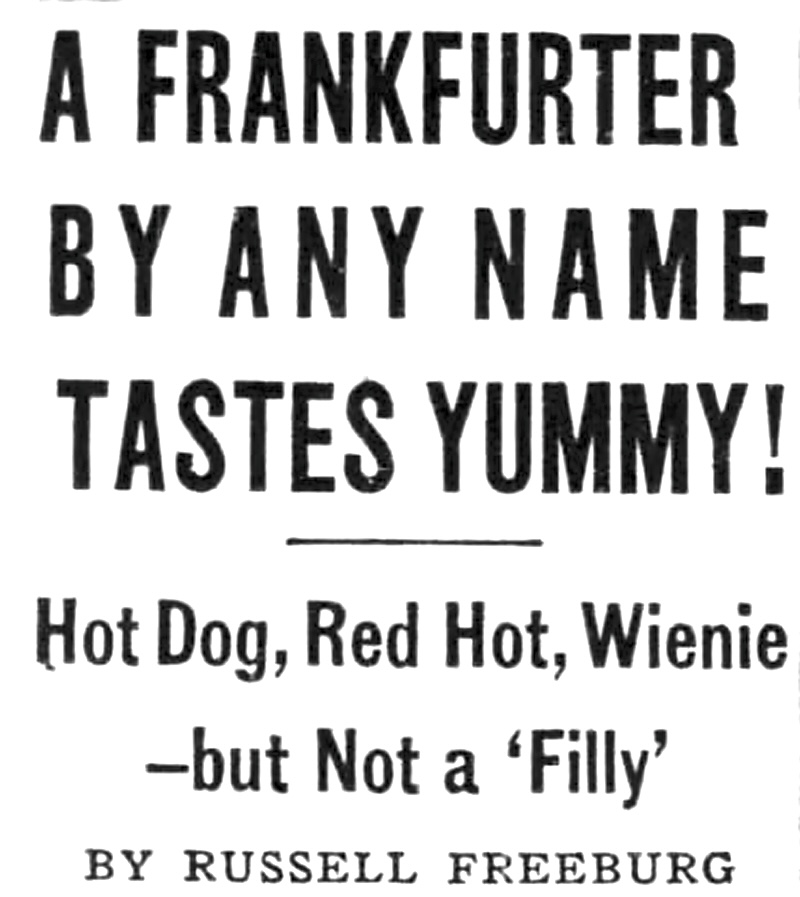 It’s predicted more than billion hot dogs will slip down American gullet this year.
The range will be from cocktail wieners wrapped in bacon to those a foot long at roadside stands. At sports events the rabid fan will down his “dog” in direct proportion to the excitement.
What’s in a hot dog anyway? Before it is eaten, it has to be made. At Oscar Mayer & Co., 1241 Sedgwick st., about half a million a day are turned out on assembly lines.
50,000 Pounds a Day
Louie Kerscher, 624 Shakespeare av., sausage department supervisor, said the half million dogs amount to about 50,000 pounds of meat. The first step is to grind the meat in the preparation room.
There are tubs of pork, beef, and veal. Meat is weighed according to a formula and placed into large, circular meat, chopping bowls. Salt, sugar, spice and a cure are added, along with enough water to keep the meat from burning.
As the meat rotates in the chopper for 10 to 15 minutes, 12 inch knives, turning like a fan, cut it until it looks like a mass of taffy. It is then put in a vacuum mixer which takes the air out.
Coming out of the mixer the meat, in the case of the skinless wiener, is stuffed into a cellophane casing by air pressure. The casing, in 40 foot lengths, is wrapped around a stuffing horn” thru which the meat is moving.
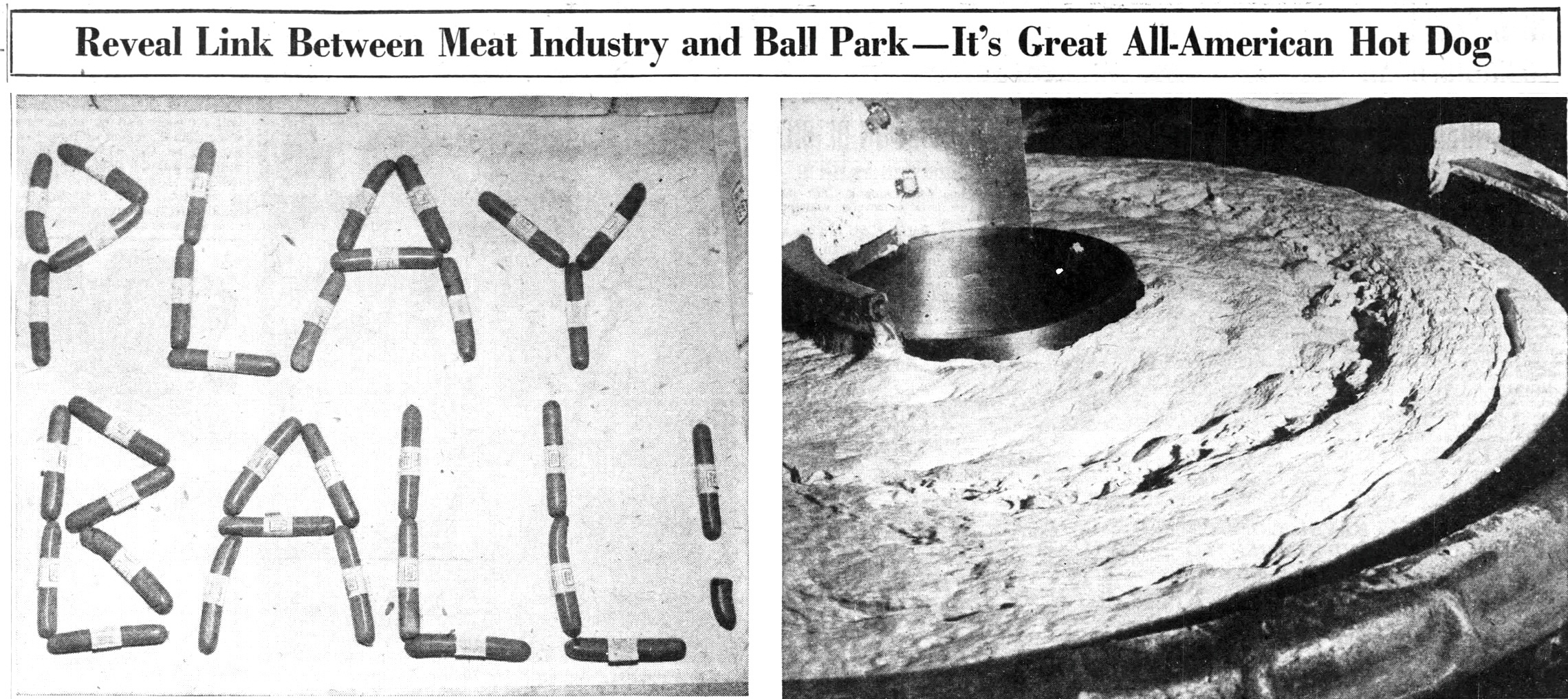
- LEFT: It takes 33½ hot dogs to spell out “play ball.” It takes a lot more to watch a ball game. One day in 1950 at Wrigley field 40,000 rabid fans ate 65,000 of the (as Webster defined them) mildly seasoned beef and pork sausage stuffed in sheep casings, linked and smoked.
RIGHT:The hot dog is strictly Americana. It is still linked and smoked, but on some the sheep casings are no longer used. At Oscar Mayer & Co., 1241 Sedgwick st., one of the first steps in making a “skinless wiener” is to grind up the meat in a chopping machine.
A 40 Foot Hot Dog!
The 40 foot sausage then is sized into approximately 5½ inch lengths by a linking machine, wrapped around smoke sticks, placed in steel supporting frames, and moved toward the smokehouse. As the cages move along the conveyor chain they pass thru a 15 second hot water bath.
If the wieners are not skinless, they probably will be inclosed in sheep’s casing. The ends of the casings are tied shut with string.
When the sausage comes out of the smokehouse, where it has been for three hours at 165 degrees Fahrenheit, it is red for the first time. Until it hits the smokehouse, its color is cream.
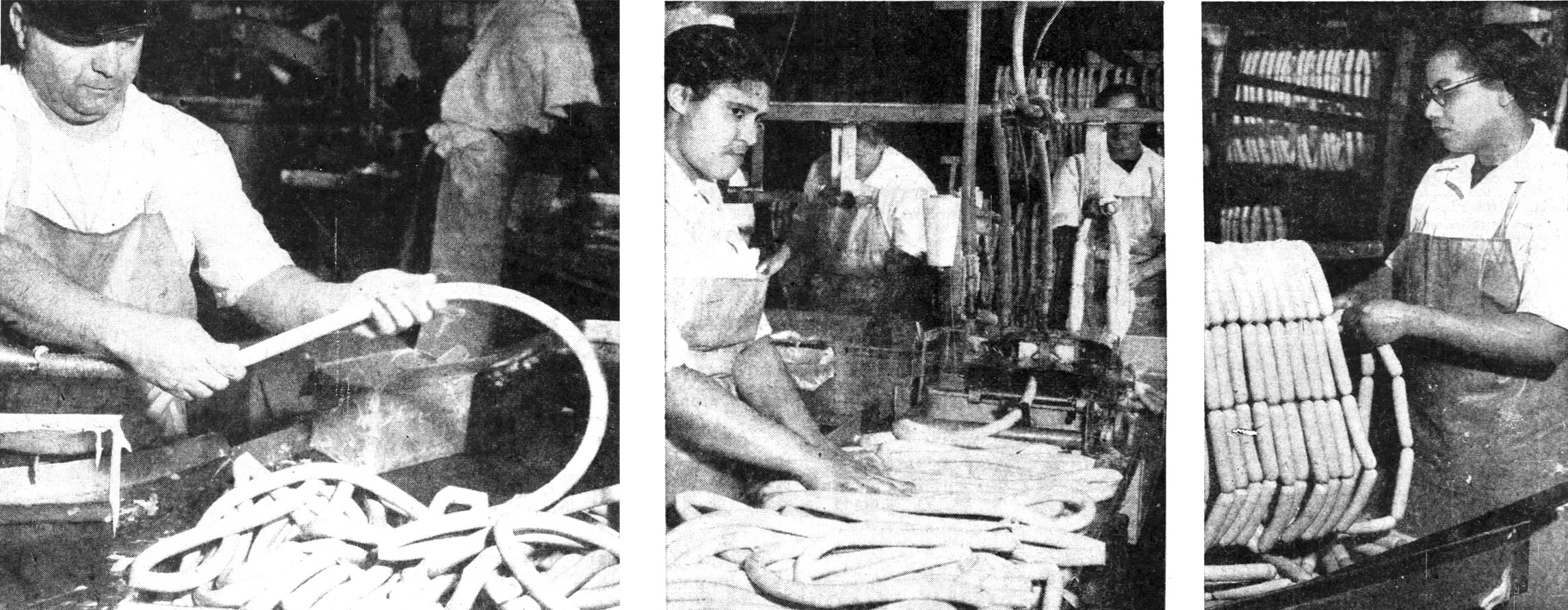
- LEFT: Oscar Parenti, 1325 Mohawk st., uses air pressure to stuff ingredients, now a cream color, into temporary cellophane casings 40 feet long. Later the cellophane is removed.
MIDDLE: Another step is to feed the 40 foot lengths into a linking machine as Lillian Davis, 6456½ Ingleside av., is doing.
RIGHT: When the sausage comes out of the linking machines in 5½ inch lengths, it is wrapped around smoke sticks, The worker is Carrie Davis, 5914 S. State st.
Oscar Mayer & Co. has 14 smokehouses in the Sedgwick K st. building, all with brick floors and insulated tin walls. Hickory, burned in stokers, is used for the smoking. From the smokehouse, the sausage goes into cooker for 10 minutes, where thoroly cooked this in 170 degree hot water shower.
Reach Market Next Day
The next stop is the chiller, where the sausage hangs in a water shower at a 45 degree temperature for 10 minutes. The hot dog now is just about like it will be when ready to buy—and ready to eat.
After the chiller, the hot dog is cooled for three hours, then inspected, wrapped, packed, and weighed. The cellophane casing is peeled off and the wiener becomes skinless.
Robert D. Nelson, sales promotion manager, said most of the wieners are in meat market show cases the day after they are prepared.
Nelson said umbrella stands that mushroom at street corners on hot summer days might sell as many as 2,000 hot dogs over a week-end.
The invention of the hot dog is attributed to Anton Ludwig Feutchwanger, a Bavarian sausage maker in St. Louis in 1883. At his small stand Feutchwanger supplied a white cotton glove with every sausage so customers would burn their fingers. The sausages sold well but the gloves didn’t stand up. Feutchwanger’s solution was to substitute the bun for the glove.
The first person to heat the bun and add condiments—it was about 1900—was supposed to have been Harry Mozley Stevens, caterer at the New York Polo Grounds.
But the sausage and the roll at that time were called simply “wienies” or frankfurters.
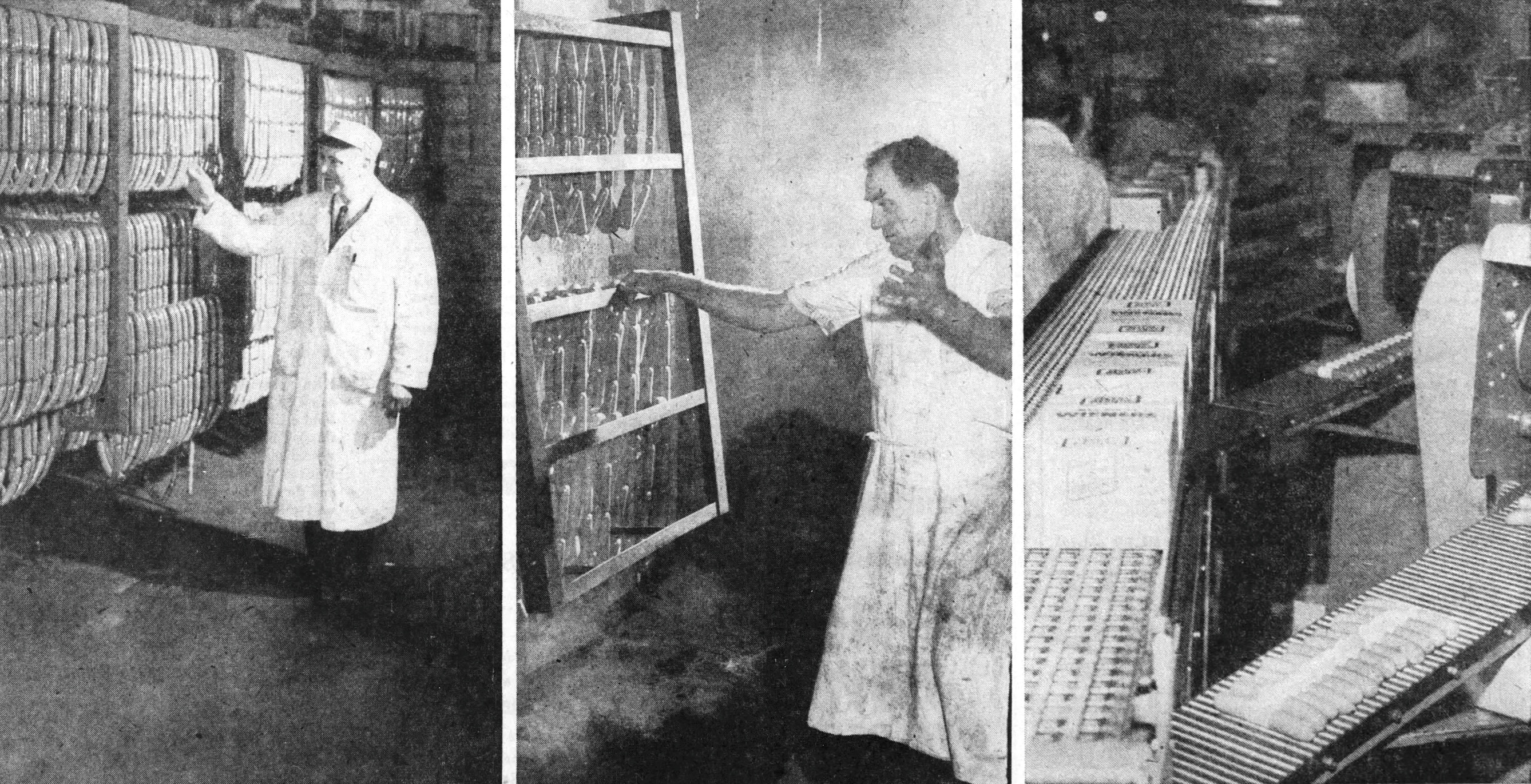
- LEFT: Louis Kerscher, 624 Shakespeare av., sausage department supervisor, inspects future hot dogs hanging in cages ready for smokehouse.
MIDDLE: When the sausage has been smoked it is red for the first time. Removing a cage from a smokehouse is Thomas Malzl, 3753 N. Hoyne av., smokehouse foreman.
RIGHT: After the hot dog comes out of the smokehouse it is banded and packed. Between the smokehouse and packing however, there are cooking and chilling processes.
25 Different Names
Stevens said the late T. A. Dorgan, a sports, cartoonist, coined the word “hot dog.” The date is uncertain. In 1913, however, the Coney Island, N. Y., Chamber of Commerce passed a resolution against using the name on advertising signs.
The name suggested, of course, the folk belief that wienies were dog meat.
The hot dog today is known by at least 25 different names from “red hots” to “Coney Island bloodhounds.” They have been served to European royalty as a great American custom.
Even legal recognition has been given to the hot dog. A Supreme court justice in New York in an opinion described them “as those plebeian, but popular elongated commodities technically denominated as frankfurters, but in resort idiom characterized as ‘hot dogs.'”
Chicago Tribune, February 7, 1953
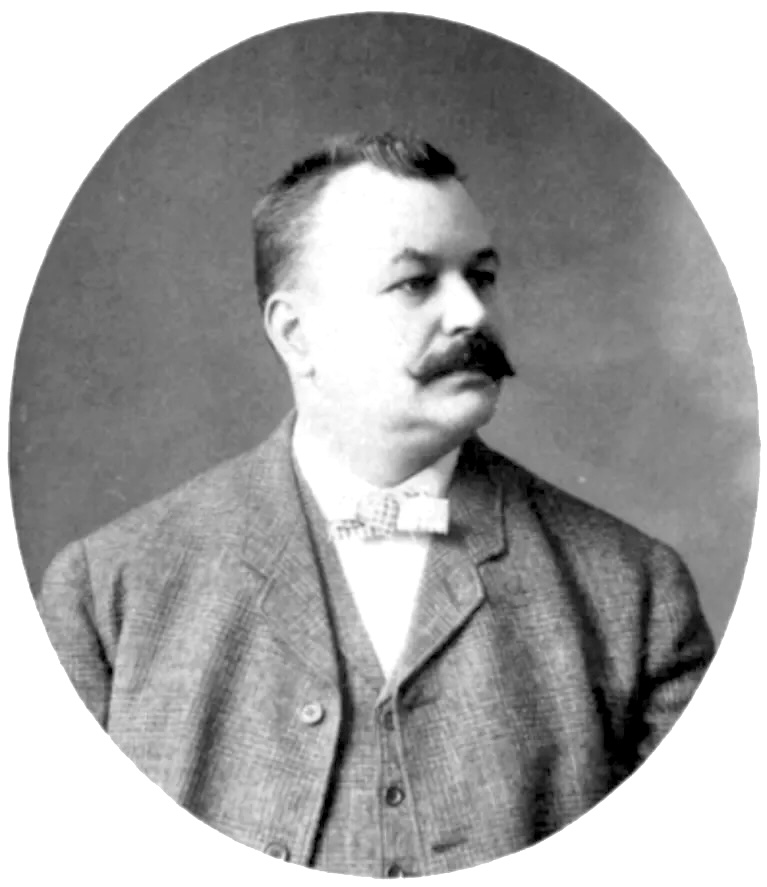
 On March 29 Oscar F. Mayer, chairman of the board of Oscar Mayer & Co., will be 94. If you want to see him you can find him most any day at 1241 Sedgwick st., headquarters of the famed Chicago meat products company, which he founded in 1883. Usually he sits in a salesroom alongside his friend, Bill Poetsch, an assistant sales manager.
As you talk to this gentle and courteous Chicagoan, whose dark eyes glow as he chats, you will find it rather difficult to realize that he was born before Lincoln ran for the Presidency and that he was about 2 when Lincoln was inaugurated.
This writer called on Mayer a few days ago and was enchanted by his stories of an earlier Chicago, of the days when North av. was the city’s northern limit and when there were truck farms just beyond. His memory took the visitor back to the days in Chicago before World War I when the German word ” gemuetlich-keit” had real meaning in the atmosphere of comradeship, good food, and lively singing-not to mention the lovely ladies—-in evidence in such places as the old Bismarck garden and the Rienzi garden.
The years have imposed their weight on Mayer’s shoulders [inci-dentally the “a” in Mayer is pronounced to rhyme with “wisest buyer “], but he remembers well the small boy who so many years ago left Germany to seek his fortune in the United States-and found it.
Works in His Cousin’s Store After Father’s Death in 1870
Mayer was born in Kaesingen, Wurtemburg, not far from the Bavarian border. The Mayers were an old Bavarian family which had been noted for four centuries for its ministers and its foresters. He went to a “Latin school” until he was 11. The death of his father in 1870 reduced the family’s income, so the boy left school and went off to Munich to work for a cousin who owned a grocery store.
Three years later the cousin, John M. Schroll, failed in business and decided to see if he could recoup his fortune in America. He told young Oscar to ask his mother for permission to go with him and his family-his wife and two children. The boy’s mother consented, so young Oscar embarked for the United States with the Schrolls and upon arriving went with them to Detroit. The year was 1873.
The 14 year old youngster set out immediately to make himself self-supporting. He was walking along Gratiot av. in Detroit when he came to a butcher shop at the corner of Antoine which had a sign on the window reading “Boy Wanted.” He applied for the job and got it. Tho he little realized it at the time, this action was one of the most important events of his life; it embarked him in the meat business in which later he was to become so successful. Had chance taken him elsewhere, to a drug store, for instance, his life might have been very much different.
The Schrolls lived in Detroit for three years during which their young relative learned the meat business. In 1876 they left the Michigan city to seek new opportunities in Chicago, as did the cousin. The Schrolls soon opened a drug store on North av. near Larrabee st.
New Hunt for Employment Ends in Clark St. Market
Once more young Mayer went hunting work. He found employment in which he could practice his trade in Kohlhammer’s, a well known market in Clark st. which served the Gold Coast trade: He worked there three years. Then, to learn more about the business, he spent some time at Armour’s.
So when one John Colling decided to give up his little butcher and sausage making shop at Sedgwick and Siegel sts. Mayer had the experience that enabled him to rent it. The year was 1883 and the founder of the little enterprise was 24. The business was a success, so much so that five years after it was started Colling told Mayer that he would not renew the lease on the shop—that Mayer had made “enough money” there and that he wanted to make some for himself.
Mayer quickly bought a piece of property at Sedgwick and Scott st. (formerly Beethoven pl.) on which he erected a small two story building into which he and his family and two brothers moved in 1888. The year before, in 1887, he had married his childhood sweet-heart, Miss Louise Greiner, of Munich. He had courted her during visits to Germany after he had made his home in Chicago. It was in September when the Mayers packed up and moved into the apartment on the second floor of the new building. Mrs. Mayer carried in her arms to the new home an infant son, Oscar G.
The new enterprise was financed in part by savings, a bank loan, and money the young bride had received from her, parents in Germany. Some years before, about 1877, Mayer had persuaded his brother Gottfried to go to Nuremburg to take an apprenticeship in sausage making. On completing the apprenticeship in the city famed for its sausages, Gottfried joined Oscar in Chicago and took over the production department. Still later another brother, Max, joined the enterprise as “bookkeeper.” Oscar was the “outside man.”
Detroit, with its “butcher shop school,” was the starting point for the “unknown” from the old country on his road to success. Chicago provided the soil that nourished the tiny enterprise, as it has done for so many others. There were two circumstances that assured the ultimate success of the business. One was the inheritance by the young business man of a magnetic personality which made him a natural born salesman. The other was the birth of his only son, Oscar G., whom we met a few paragrafts back as an infant. The apartment of Sedgwick st. later was the birthplace of four sisters for the boy. Oscar G. has become one of Chicago’s foremost citizens, a man worthy in his own right of a place in this series.
Mayer built the business rapidly thru his great sales ability, coupled with excellence of the company’s products. He is described as having been in his hey-dey “a complete extrovert.” He enjoyed life-fine food, good wine, and agreeable friends. He had a great capacity for making friends. In a few years after starting his business he numbered among his intimates the owners of many of Chicago’s leading restaurants.
Friend of Carter H. Harrison, the Elder Mayor of Chicago
An early friend in political life was Carter H. Harrison, the elder mayor of Chicago, with whom he had dined at Schlogl’s just before Harrison was slain at the door of his home on the last night of the Chicago World’s Columbian exposition in 1893. And the sort of Damon and Pythias relationship that has existed between Mayer and Carter H. Harrison II, one year his junior, is well known.
When Mayer was 55 his brother Gottfried died. Oscar G., fresh from graduation from Harvard in 1909, gave up his plan for entering the Harvard Business school and went to work for the company of which he is now president. Under his leadership the company has expanded enormously. Sales last year totaled 217 million dollars.
When Oscar G. entered the busi-ness, which is virtually family owned, there were about 200 em-ployes. Now there are more than 9,000.
Third generation members of the Oscar Mayer family and second generation members of the Gottfried Mayer branch hold high executive positions with the com-pany. And a fourth generation is in the offing. The father and son thru the years have worked in perfect harmony.
When he settled in Chicago the father decided that the United States was to be his home and country from then on. He has had little patience with people who come here from overseas, then refuse to get their homelands out of their minds. The old gentleman had been a staunch American in deed as well as in word.
Believes in Higher Education, Tho He Supplied His Own
Tho he had little formal schooling himself, he is a strong believer in college education. He bemoans the fact that he was among the few members of his family who thru the years failed to get a higher education. He has made up for this, however, by study. His favorite reading has been in the classics, with Tacitus among his favorite authors. He has been an ardent student of Christopher Columbus and his life. And for many years he has been a collector of art in a modest way.
Mayer admitted to this writer that he smokes three Havanas a day, always after 4 p.m. The generosity with which he passes smokes out from a box in his desk indicates that he probably does somewhat better. He enjoys a glass of wine or two. The nights find him in bed early in his home at 5727 Sheridan rd. where he has lived since 1914. Mrs. Mayer died in 1931. He goes to his office almost every day. In fact, he currently has been enjoying better health than he did a dozen years ago. His birthday each year is cause for a lively celebration in the company’s offices.
His consideration for others was reflected in the way he rose to bid this writer adieu at the end of an interview. There was a momentary slip as he asked the writer if he had his “horse and buggy” outside. Then he laughed as he corrected himself, “I should say auto – we’ve been talking too much about the old days.”
(The story of another outstanding Chicagoan will appear next Saturday.)
Chicago Tribune, March 12, 1955
PACKER OSCAR F. MAYER IS DEAD AT 95
Rites Set for Monday at 3 P. M.
The funeral of Oscar F. Mayer, 95, chairman of Oscar Mayer & Co., Chicago meat packing firm he founded in 1883, will be held at 3 p.m. Monday in St. Paul’s Evangelical and Reformed church, 2335 Orchard st.
Mr. Mayer died in his sleep at 2:30 a.m. yesterday in his home at 5727 Sheridan rd., where he had lived the last quarter century. He had been ill six weeks.
At his bedside were his son, Oscar G. Mayer, executive committee chairman of the company, and his three daughters, Mrs. Frieda Collins and Mrs. Elsie Steuer of Chicago, and Mrs. Eugenie Bolz of Madison, Wis. Mrs. Mayer died in 1931.
He was a colleague of Carter H. Harrison and Carter Harrison II, both mayors of Chicago.
Long Active in Business
Mr. Mayer had been active until recently despite his advancing years. There was jocular speculation between him and some of his aging pioneer friends, such as Carter Harrison II, who died Christmas day, 1953, as to who would live longest. On his 95th birthday, March 29, 1954, Mr. Mayer was at his plant answering congratulatory phone calls and congratulations. At that time he was asked whether he had decided to retire.
“I haven’t any plans for that,” he replied. “Of course, I don’t spend so much time here at the plant anymore, only a few hours a Some Saturdays I don’t come down at all.”
Chicago Tribune, May 22, 1992
OSCAR MAYER CLOSING KILLS MORE GOOD-PAY CITY JOBS
By Nancy Ryan
Like millions of other workers in the last decade, the nearly 700 Oscar Mayer employees at the Near North Side meatpacking plant long have lived with rumors of a probable shutdown.
But at 9 a.m. Thursday, at least six years of speculation ended when workers on the first shift . were gathered in various rooms and told the 104-year-old plant will close Dec. 4.
Oscar Mayer’s parent company, consumer-goods giant Philip Morris Cos., which is working to boost the profits of Kraft General Foods, its $28 billion food division, said it would cost too much to keep the plant up-to-date over the next 10 years. And at a time when the company is reducing its product lines, Oscar Mayer’s 16 plants have too much production capacity.
Though the announcement surprised few in the plant or on Wall Street, it stung employees worried about their future and community leaders who have struggled to keep high-paying manufacturing jobs in the city.
With wages averaging $11 an hour, the plant’s 550 hourly employees are among the highest paid blue-collar workers in Chicago and nearly the highest paid in the meatpacking industry. And despite labor disputes in the mid-1980s, they’ve enjoyed six years of relatively peaceful relations with Oscar Mayer.
“How am I going to find a job at my age at $11 an hour?” asked Lorenzo Correa, 48. He and his wife, Luz, have worked at the plant for more than 20 years. “There’s no future for me and a lot of the people here.”
“There have been rumors for years that it would close. But it’s still a shock when it happens, said Robert Waters, president of United Food & Commercial Workers Local 100-A, which represents 500 plant employees. “There’s going to be hard feelings. They’ll probably never find jobs that pay that well in the city.”
Employees will receive severance of up to one year’s pay, depending on the length of service. Company officials said they will discuss extending health benefits with the plant’s three unions and offer job training and counseling. Some of he plant’s 125 salaried employee could get a job at other Oscar Mayer operations, Kraft General Foods spokesman Michael Mudd said.
Jobs outside the company were found for half to two-thirds of the 1,400 employees at Oscar Mayer’s Louis Rich turkey-processing plant in California, which closed this month, and their health benefits were extended for six months.
Roman Maier, vice president of operations for Oscar Mayer, said the Chicago plant “is productive and the employees are among the best in the company. But the cost of keeping it up-to-date sets it apart from the other plants.
The design of the plant, Oscar Mayer’s oldest, limits flexibility in setting up new technologies, Maier said. Luncheon meats, hot dogs and bacon are among the products made there.
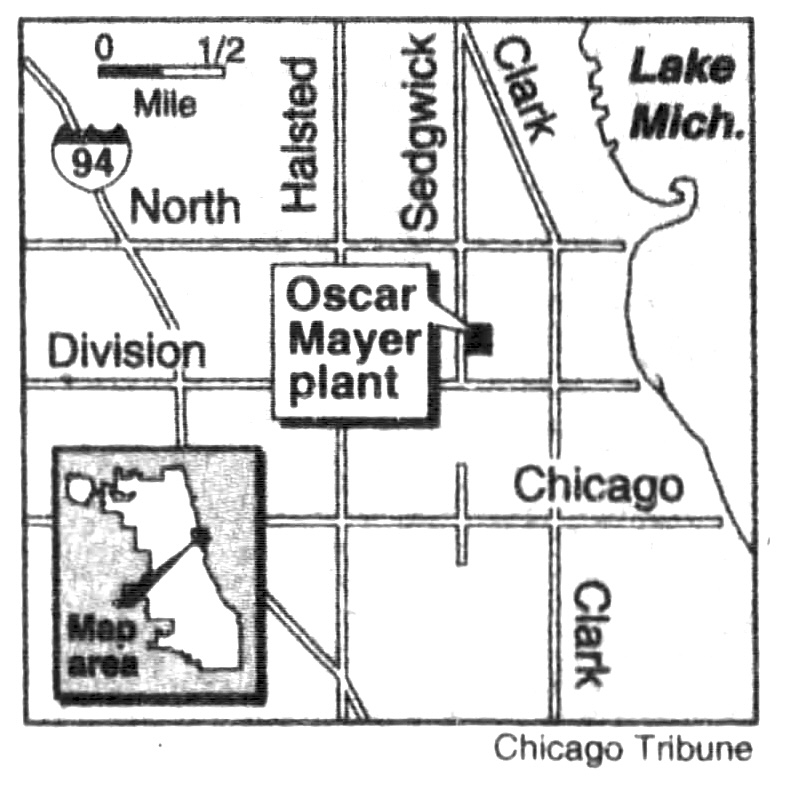
A neighbor of the Cabrini-Green housing project, the eight-story, 650.000-square-foot factory at 1241 N. Sedgwick St. has served as an industrial anchor for the area since the days when North Avenue was the city’s northern border.
But when it closes in seven months, the only activity near the plant will be the trains passing on the Ravenswood-Evanston Express elevated line, which bisects the red brick building, across the street from a playground.
“It’s going to have a big impact. Probably about 75 percent of those people live in Chicago, and the majority of those jobs are hard-to-get, high-paying industrial jobs,” said Michael Holzer, program director of industrial development for the New City YMCA LEED Council.
The plant is one of the largest employers in the North River industrial corridor, the North Side’s largest manufacturing section and an area that has seen 20,000 people lose their jobs in the last 10 to 15 years, Holzer said. The corridor is bounded by Kinzie Street on the south, Diversey Avenue on the north, the Kennedy Expressway on the west and the Ravenswoood tracks on the east.
The last major closing was in 1989, when Procter & Gamble shut down its 59-year-old soap plant at 1232 W. North Ave., where 275 employees worked.
In 1988, the city extended an enterprise zone along nearby Clybourn Avenue and Goose Island to the plant at Oscar Mayer’s request. The classification provided for certain tax reductions, including an exemption from state and city sales taxes on any material used to renovate and expand a Chicago business.
Oscar Mayer only benefited from that classification until 1990, when it stopped expanding, a company spokesman said.
“It’s a great loss to the city,” said Greg Longhini, spokesman for the city Department of Planning and Development. “We’re very saddened by this. We met with them in January because we had heard rumors. We were told there were no plans to shut the facility.”
Easily the most well known of the 600 companies that still employ 20,000 in the corridor, the Oscar Mayer plant stands as a reminder of the city’s industrial roots and the neighborhood’s early German residents.
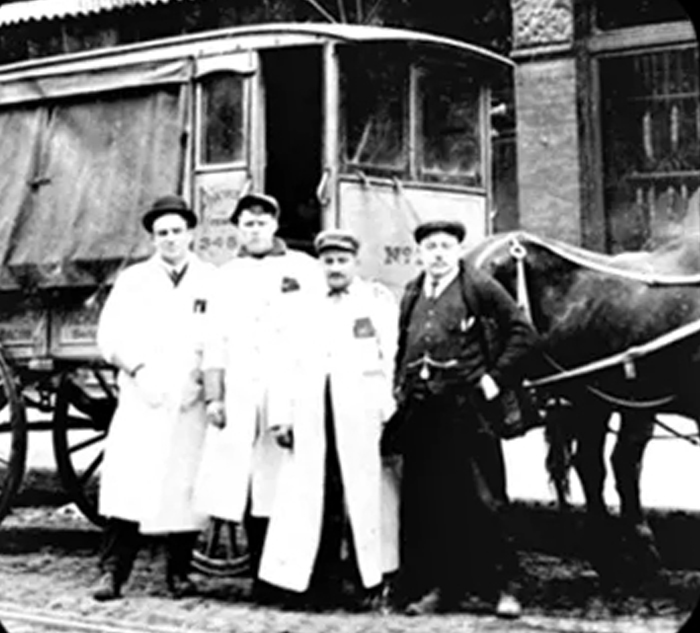
While the city earned its reputation as the hog butcher to the world a century ago, the Oscar Mayer plant was churning out “Old World” sausages and packaging Westphalian hams. It was built by Oscar F. Mayer, an immigrant from Bavaria who had started his company two blocks away in 1883.
The Mayer family moved company headquarters to Madison, Wis., in 1919. It was bought by General Foods in 1981 for $465 million and is now part of North-field-based Kraft General Foods. Last year’s revenues reached an estimated $2.5 billion.
Most analysts had been expecting a major announcement because of Kraft General Foods’ disappointing performance last year.
Next to Kraft’s core cheese business, Oscar Mayer has shown the weakest results in the food divi-sion, with operating margins declining to about 5.7 percent in 1991 from 7.4 percent in 1989, according to John McMillin, an analyst with Prudential Securities. Company officials say this move and its decision to close the Louis Rich plant and offer early retirement to more than 1,000 Kraft General Foods employees are part of a restructuring plan and not a reaction to recent financial results.
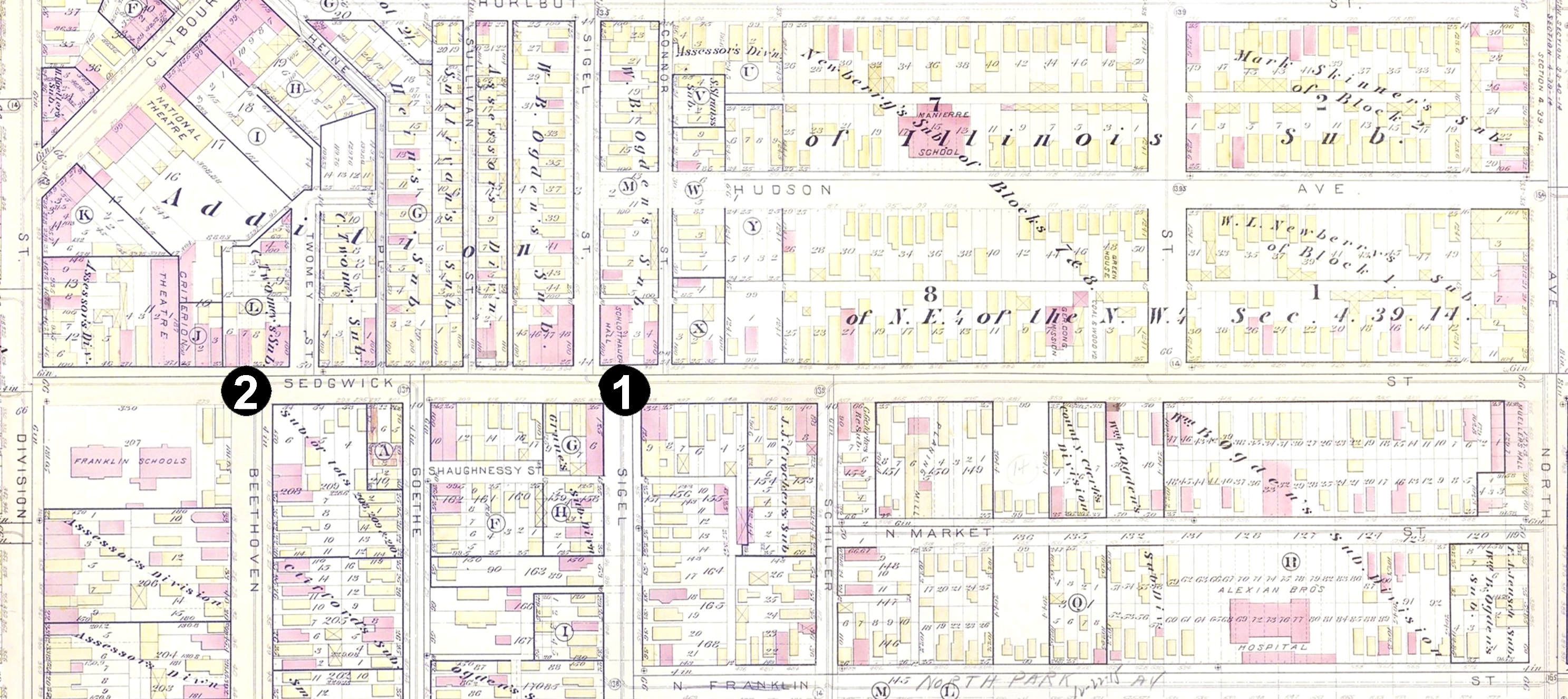
- Oscar Mayer Buildings
① 333 Sedgwick, 1883-1887
② 285 Sedgwick, 1887-1993, (1241 Sedgwick after 1909)
Robinson Fire Insurance Map
1886
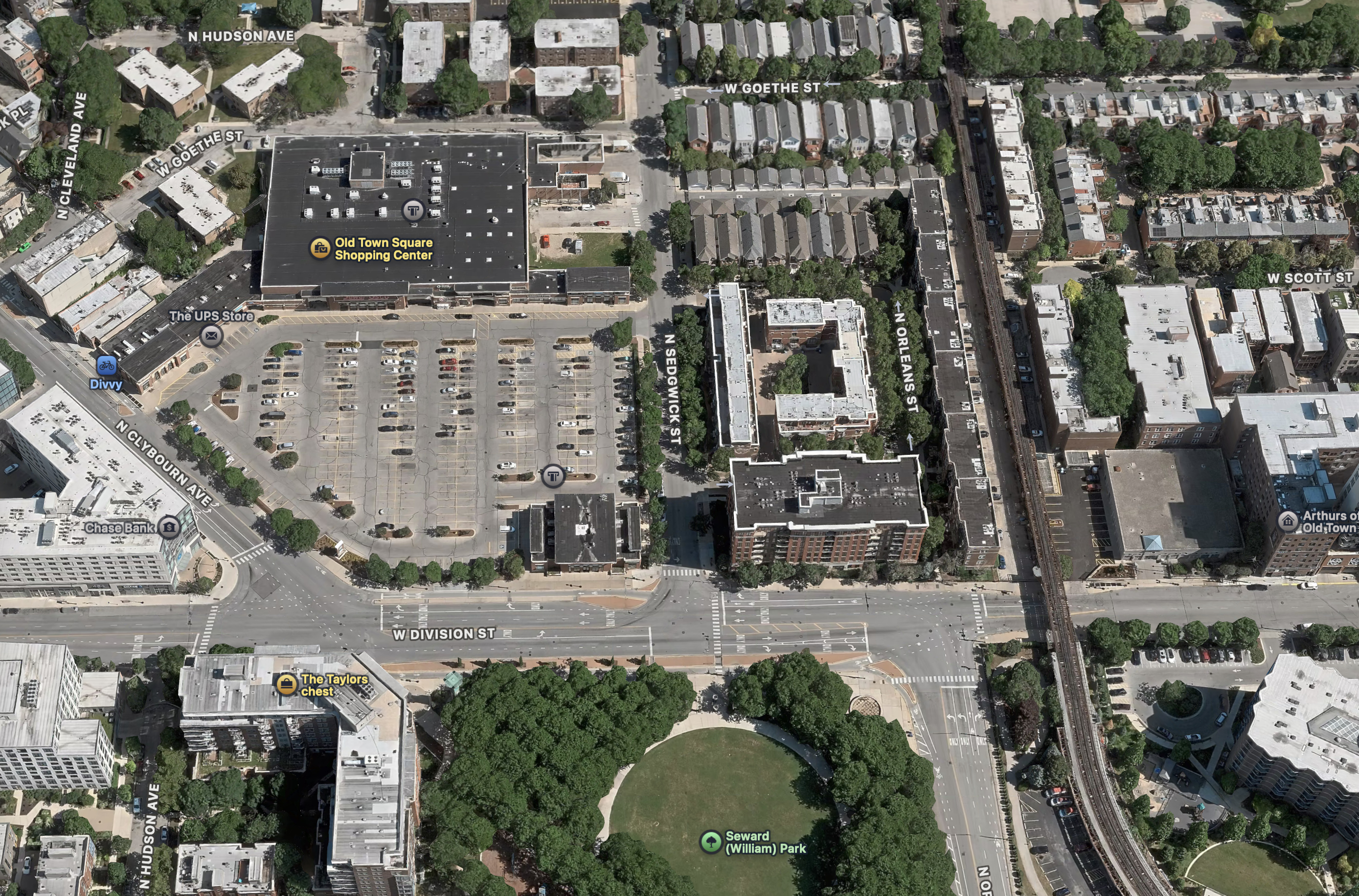
- Division & Sedgwick
Apple Maps
2026

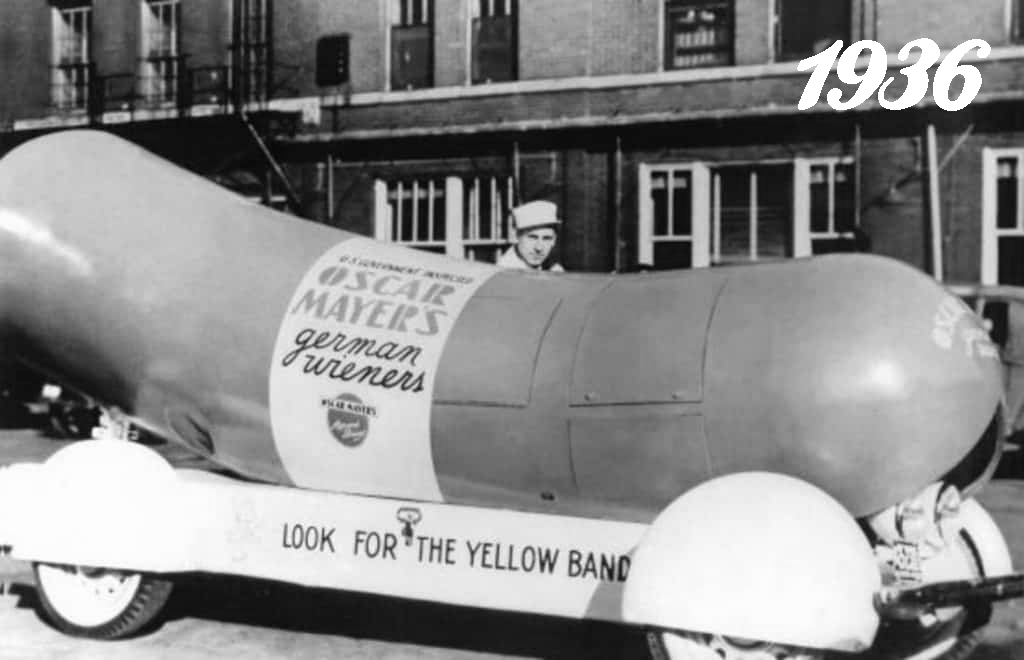
1936 Carl Mayer, nephew of the company’s founder, came up with the idea of a 13-foot metal hot dog on wheels to transport the company spokesperson. General Body Company of Chicago, Illinois, designed the first Wienermobile, which featured open cockpits in the center and rear. It was a common sight on the streets of Chicago as it promoted Oscar Mayer “German-style Wieners.”
1940 A glass enclosure was added to provide protection for the driver and passengers, and the Wienermobile earned fame throughout the East and Midwest. During World War II, the Wienermobile retired from the road due to gas rationing. Oscar Mayer focused efforts on canning meats for our soldiers overseas.
1952 The Wienermobile made a triumphant return as five new vehicles hit the streets of America. Designed by Gerstenslager of Wooster, Ohio, and built on a Dodge chassis, the 22-foot long hot dogs were the first to have a sound system and sunroof. A 1952 Wienermobile is currently on display at the Henry Ford Museum in Dearborn, Michigan.
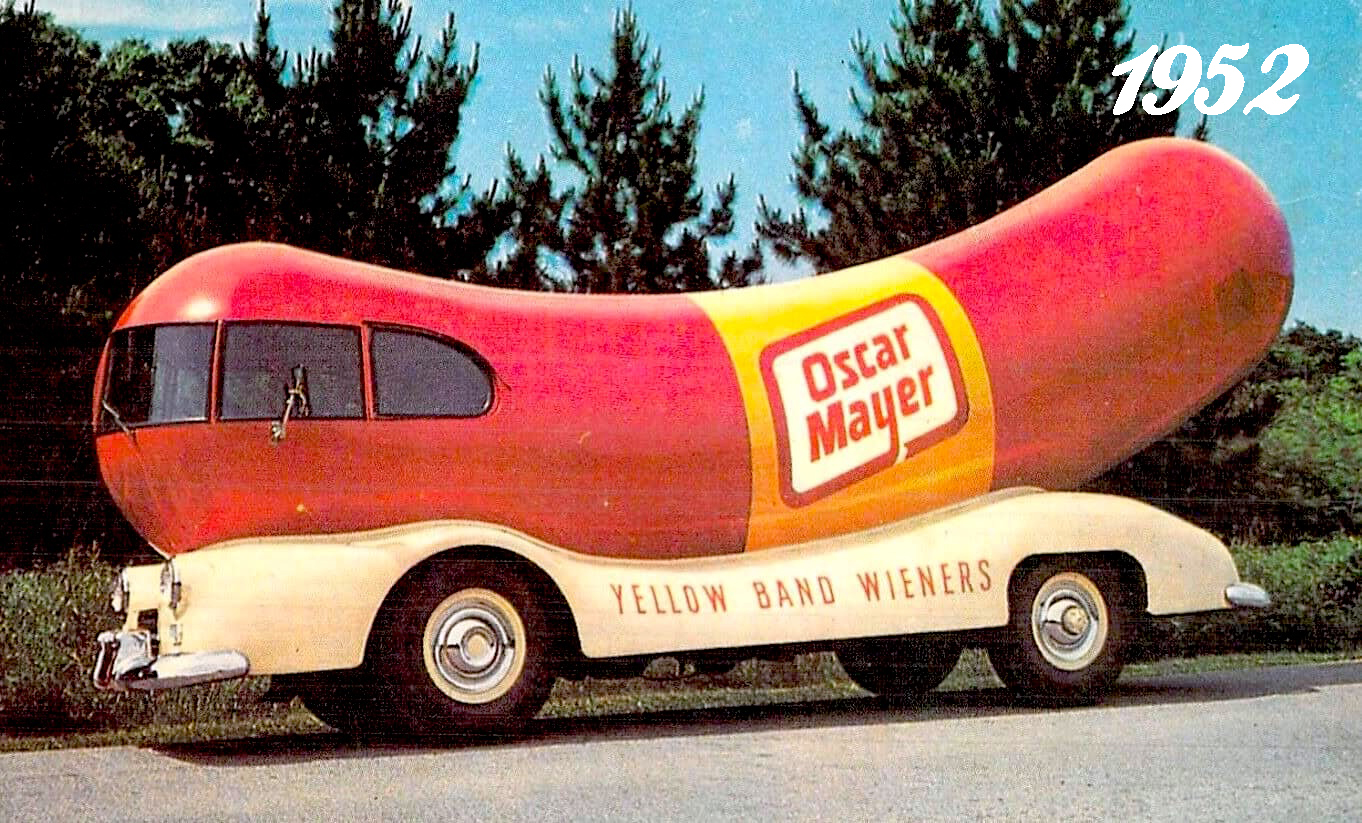
1958 Brooks Stevens, designer of Miller Beer’s first logo and clear beer bottle and inventor of the “Excalibur” car, created the 1958 Oscar Mayer Wienermobile. The futuristic, bubble-nosed wienie on wheels incorporated buns into the design for the first time. Built on a Willys Jeep chassis, Stevens’ design had a tremendous impact on the Wienermobile, which would influence the next three generations of vehicles.
1969 Two new vehicles were introduced by Oscar Mayer mechanics at the company headquarters in Madison, Wisconsin. Using a variety of classic automotive parts, including Ford Thunderbird taillights, these vehicles carried on the Wienermobile tradition.
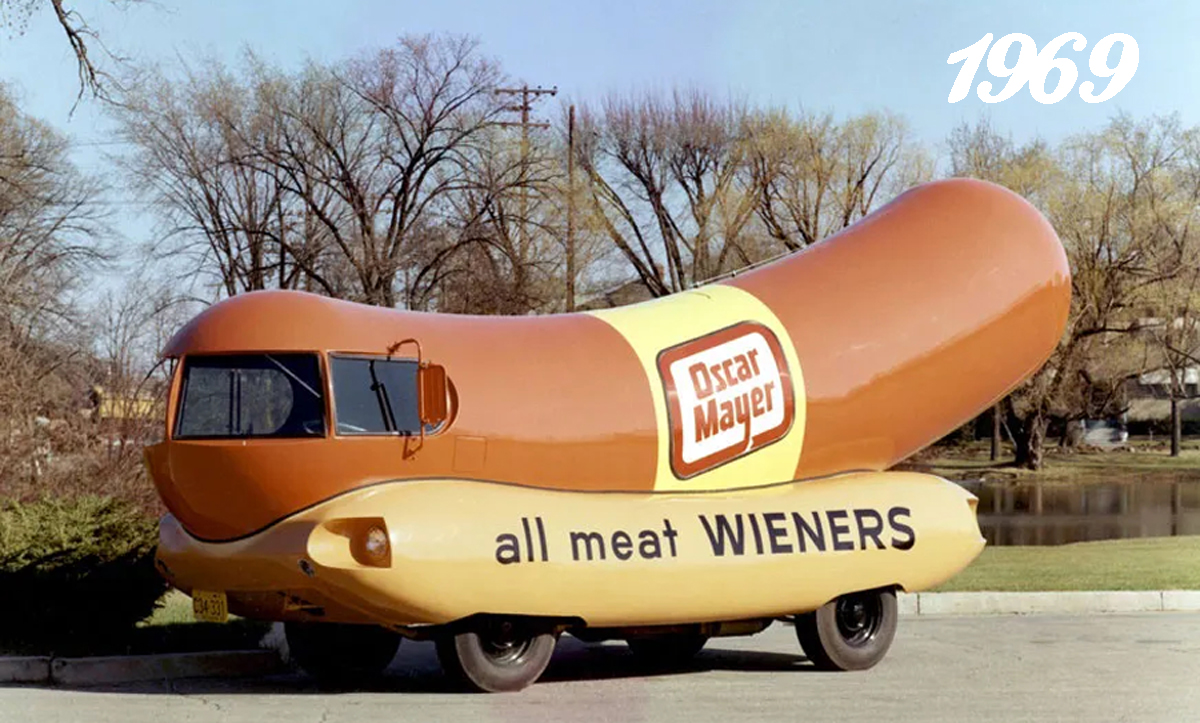
1976 The last Wienermobile built before the program was discontinued in 1977. This Wienermobile was mounted on a 1973 Chevy Motor home chassis. It eventually debuted as the first Wienermobile ever to tour a foreign country, visiting Spain in the early 1980s.
1977 The Wienermobile vehicles were retired from service. Thousands of miles of wear and tear, plus a decision to focus more heavily on television advertising closed the garage door on the program.
1986 The Wienermobile was brought out for a 50th birthday celebration. Huge crowds of people showed up for its appearances. Cards and letters came pouring in requesting to see the famed two-ton frank. A decision was made to build a new fleet and begin touring again in 1988.
1988 Six new 23-foot long fiberglass hot dogs on wheels, toured the country in style. They featured microwave ovens, refrigerators, cellular phones, and stereo systems that played 21 versions of the Oscar Mayer Wiener Jingle. Four additional Wienermobile vehicles originally were built to tour Japan and Spain.
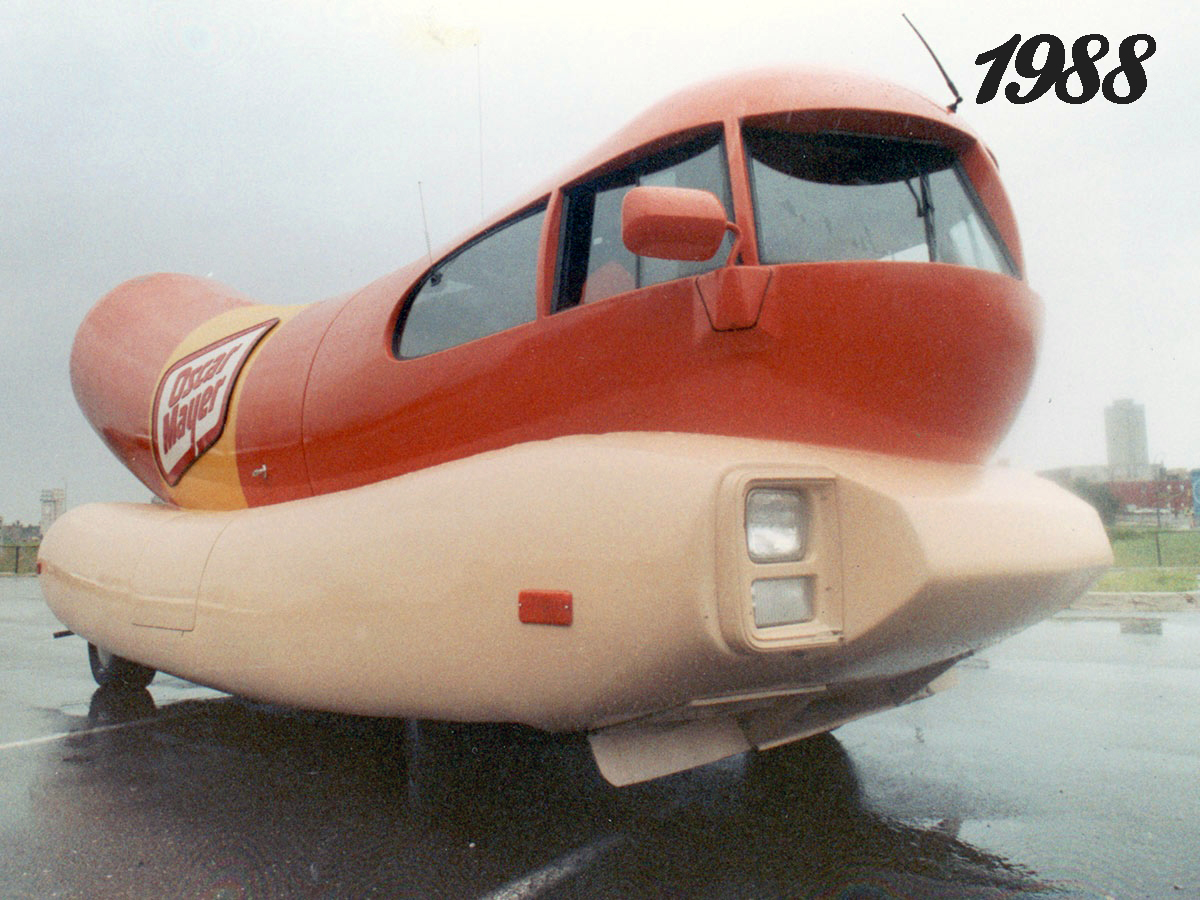
1995 World-renowned California automotive designer Harry Bradley created a concept Wienermobile to link Oscar Mayer in to the next century. This 27-foot long, 11-foot high General Motors unit has an aerodognamic look with state-of-the-art video equipment, a big screen TV and a hot dog shaped dashboard. The model underwent testing in the wind tunnel at the California Institute of Technology in Pasadena and could, theoretically speaking, haul buns. The fleet of six toured the United States from 1995-2003.
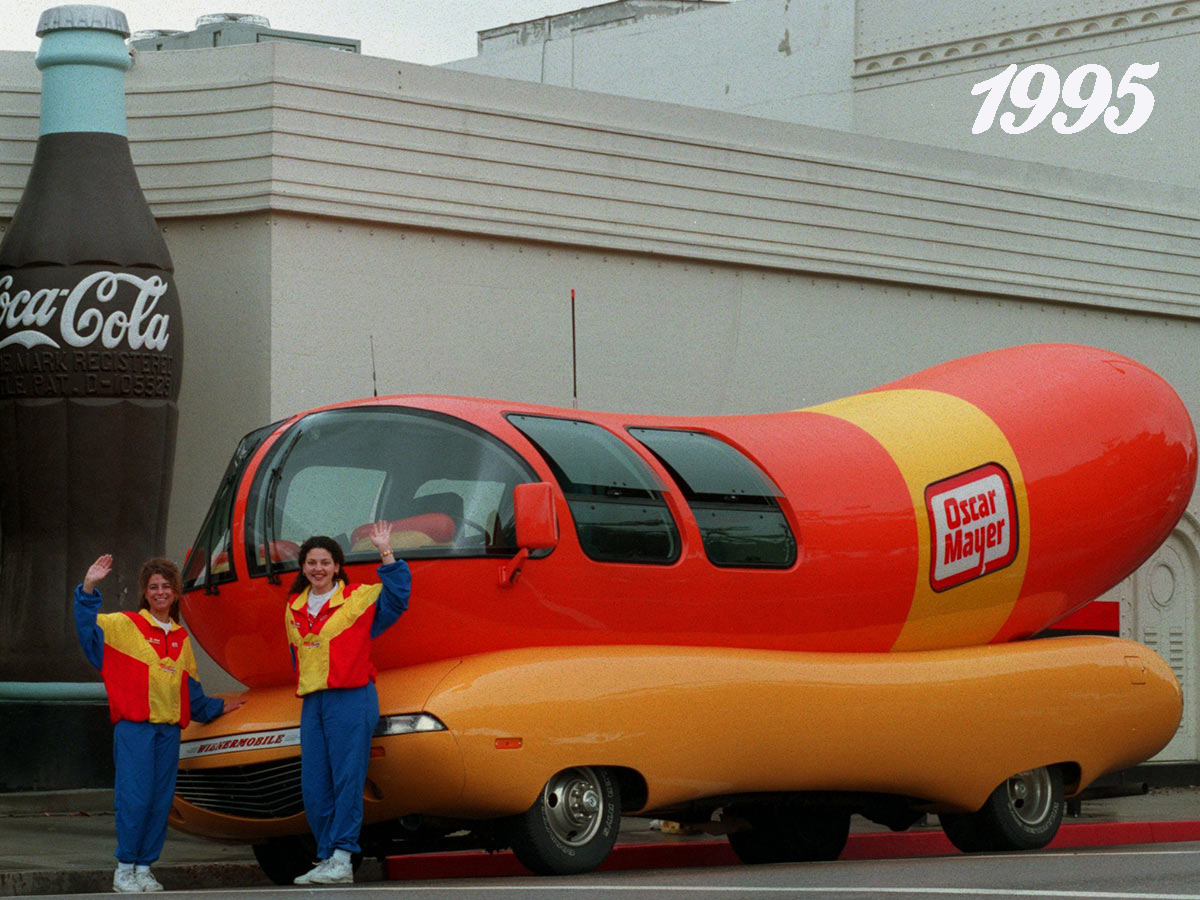
1996 The Oscar Mayer Wienermobile celebrated its 60th Anniversary. The Wienermobile proves an old dog can learn new tricks.
2000 In true 21st century style, Oscar Mayer introduced two new, updated Wienermobile vehicles. These new models built upon the 1995 design featuring GPS Navigational systems, more powerful engines, anti-lock brakes, and state-of-the-art audio and visual centers. With the license plates “WNRMBLE” and “IWSHIWR”, these jumbo dogs of the Wienermobile fleet toured the United States from 2000-2004, bringing miles of smiles to Wienermobile fans of all ages.
2004 With a brand new recipe hot off the grill, new 2004 Wienermobile vehicles hit the road. The inside of these big dogs left nothing to relish. Designed and built at Prototype Source in Santa Barbara, California; Bruce, Dorian and the rest of the crew really Cut the Mustard when they put together this model! The converted Chevrolet—4 speed/W4 series chassis has a Vortec V8, 6.0 liter 300 HP engine. This grilled fiberglass hot dog that is resting on a lightly toasted fiberglass bun runs only on the highest octane of mustard.
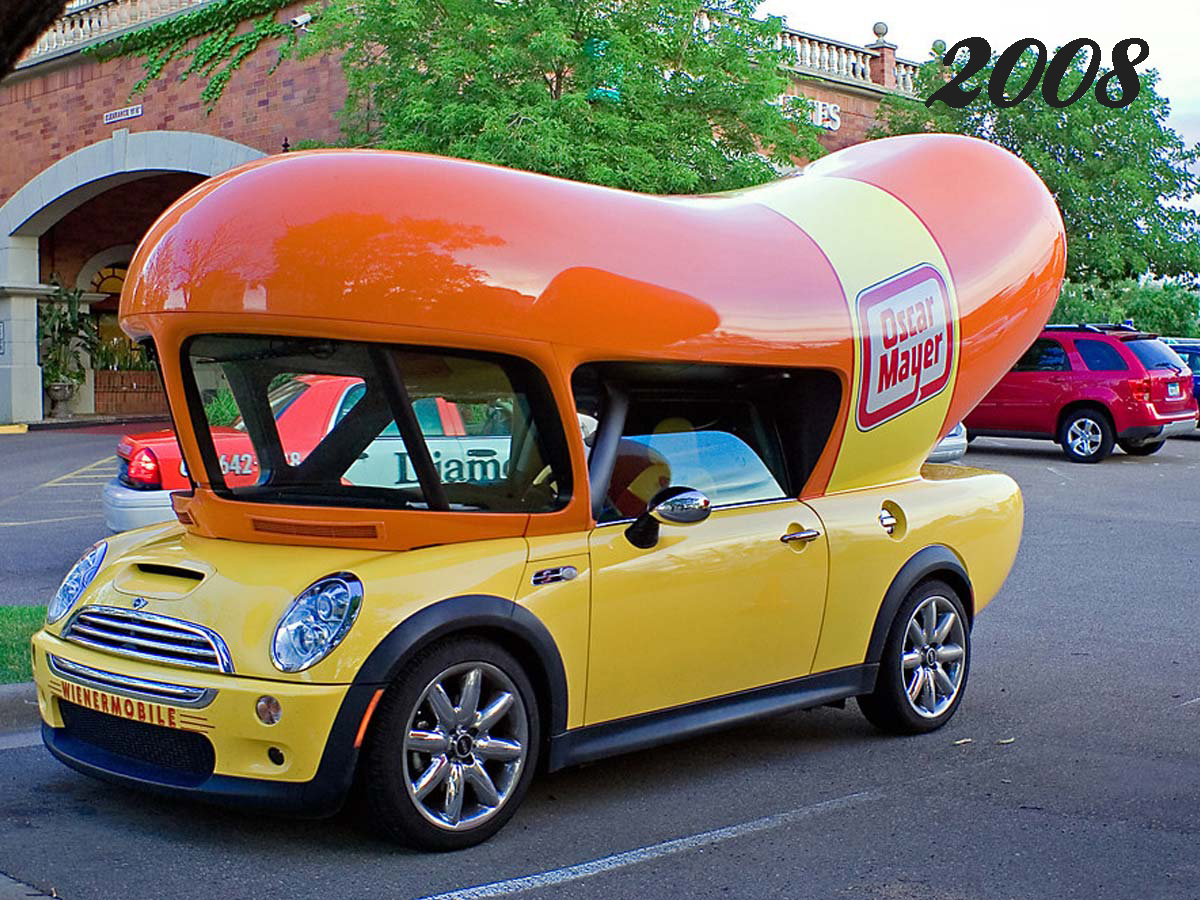
2008 In celebration of the brand’s 125th Anniversary, Oscar Mayer also added a new member to the iconic Wienermobile fleet – the Mini Wienermobile! Created at a Santa Barbara, Calif., auto body shop that specializes in custom cars, the Mini Wienermobile was built on a BMW Mini Cooper “S” chassis, stands 15 feet long, 8 feet high and weighs 3,600 Ibs. Although half the size, the Mini Wienermobile was able to “hang with big dogs” as they helped Oscar Mayer celebrate its 125th anniversary.
2011 To celebrate the 75th anniversary of the Oscar Mayer Wienermobile vehicle, the brand added a new dog to the current Wienermobile fleet—the first-ever, special edition Wienermobile Food Truck. This special-edition vehicle was on the road throughout the summer, serving up Oscar Mayer Selects Beef Franks.
2013 In Summer 2013, the Oscar Mayer Wienermobile tour took on a new form in the Wienermobile Run, a cross-country competition pitting all six Wienermobile vehicles against each other as they compete to earn the most points and be named champion. The Run gave consumers the opportunity to root for one of six personalized Wienermobile vehicles, request tasks, and help determine the course of the Wienermobile for the first time in Oscar Mayer history.
2014 In January 2014, the Wienermobile became the first vehicle available for “lease” solely through Twitter. By way of partnership between the Oscar Mayer brand and Motor Trend Magazine, fans across the country were able to tweet the hashtag #Tweet2Lease for a chance to have the Wienermobile as their personal ride (with the Hotdoggers as their chauffeur’s) for a full eight hours.
Then, in June 2014, the brand launched the first-ever Wienermobile mobile app, which included a virtual 360-degree experience inside the Wienermobile, a Wienermobile racing game, and a schedule of Wienermobile whereabouts on a rolling two weeks.
2015 Oscar Mayer added a new vehicle to its fleet that can go where no Wienermobile has gone before—the Wiener Rover. The Wiener Rover is an all-terrain, off-roading hot dog on wheels. It is about one-seventh the size of the original Wienermobile, is battery-powered and can be controlled by a trained operator via remote control.
2016 At the beginning of 2016, Oscar Mayer customized a full-sized RV and paired it with the Wienermobile to create the Wienie-Bago: an all-American logding option that rolled into San Francisco just in time for football’s biggest game of the year. The Wienie-Bago was available to fans through a charitable auction, which benefitted Stop Hunger Now.
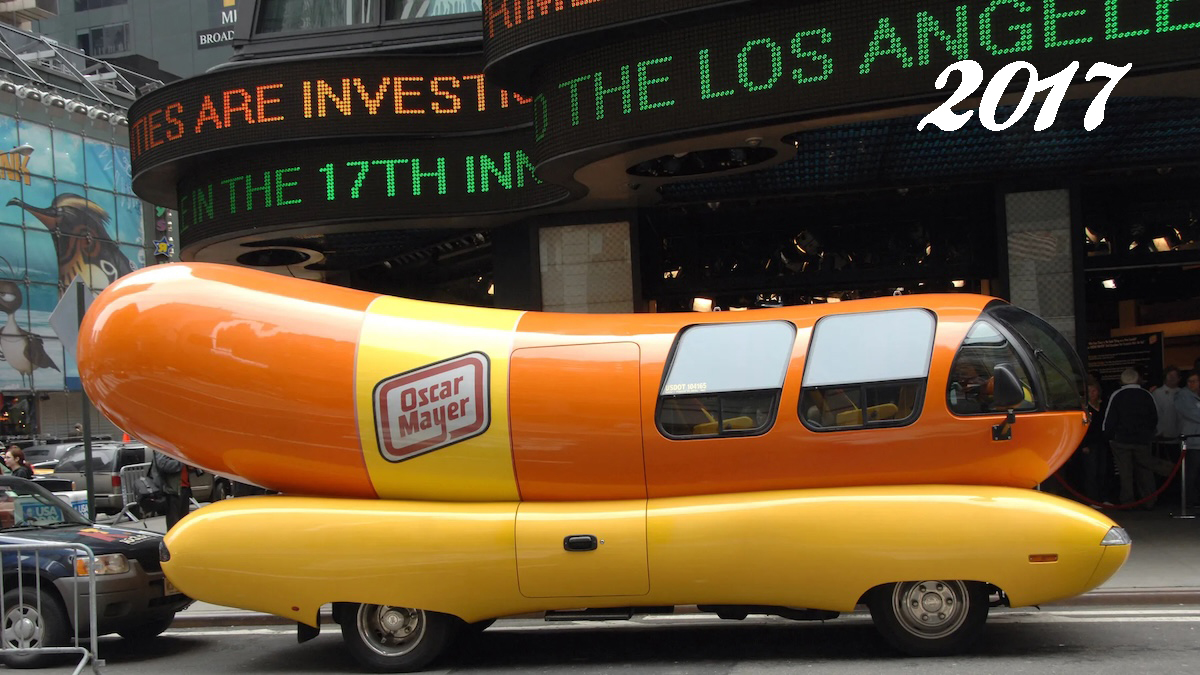
2017 The #ForTheLoveofHotDogs campaign kicked off with two Wienermobile vehicles boarding a barge on Staten Island and traveling to the Statue of Liberty for some breathtaking photo opportunities. They also stopped by Governors Island to hand out samples of the new Oscar Mayer hot dogs, which included a new and improved recipe.
In addition, the Oscar Mayer Wienermobile demonstrated going to great lengths to deliver the brand’s better hot dogs when it made its first-ever stop in Whittier, Alaska, one of the most remote cities in America.
Oscar Mayer also introduced two new assets to the fleet: The WienerDrone and WienerCycle. The WienerCycle is a three-wheeled moped, ideal for tricky urban deliveries, traveling on land with a sidecar that doubles as a hot dog warming station. The WienerDrone is the first unmanned hot dog-carrying aircraft designed for remote location delivery.
2018 To kick off the first week of summer, Oscar Mayer introduced Super Hotdogger—a futuristic, JetPack-powered member of the WienerFleet who went to new heights to continue the brand’s commitment of delivering a better Oscar Mayer hot dog.
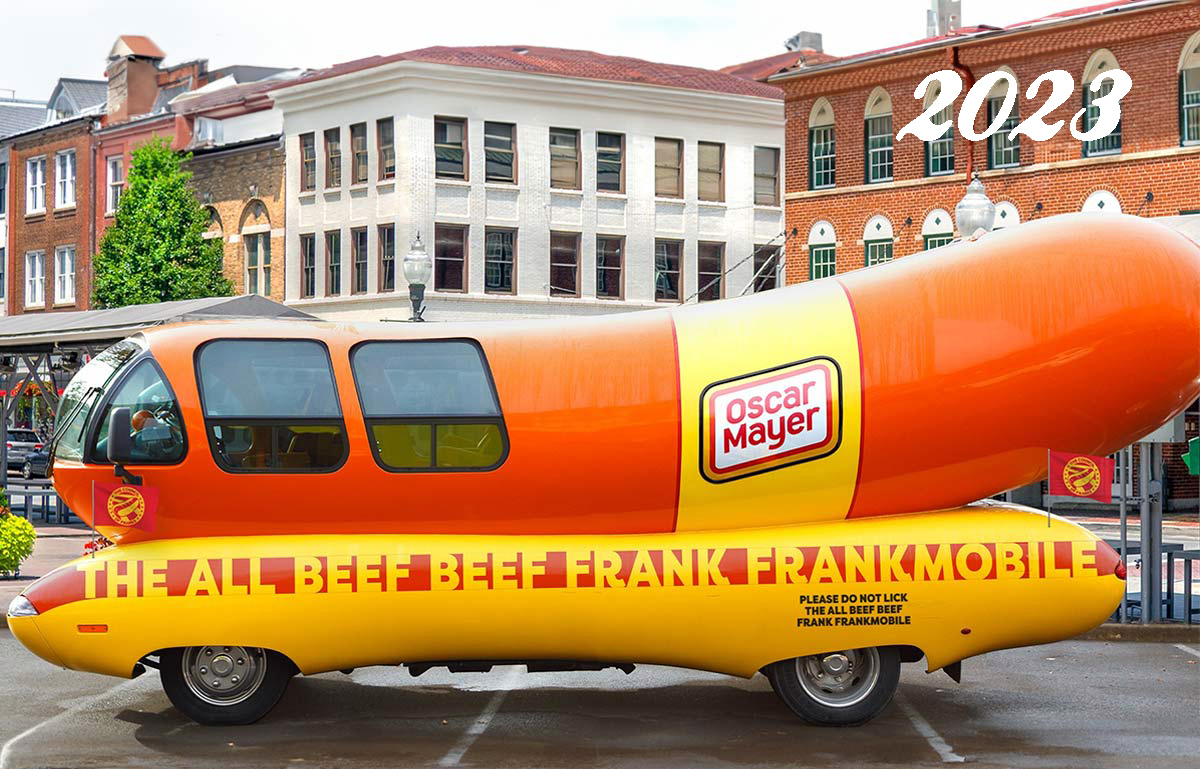
2023 The times really are a-changing for the Wienermobile, in 2023, as it has undergone, easily, its most significant change since its inception. The Wienermobile name is no more. Oscar Mayer has changed its name to the Frankmobile. So, why did the company change the name of its most iconic promotional tool?
Well, it turns out its all part of a rebranding, as the company gravitates toward making more 100% beef frank products rather than the usual combination meat used in their wieners. The good news is that it still looks like the vehicle we’ve come to love – and they’ll still be handing out the whistles and decals.
Source: Oscar Mayer Press Release

Leave a Reply