Workingmen’s Exchange Saloons
Life Span: 1896-TBD
Location: 279 and 300 Clark
Architect:
- Lakeside Business Directory of the City of Chicago, 1897
Kenna Michael saloon 120 Vanburen
Lakeside Business Directory of the City of Chicago, 1899
Kenna Michael saloon 279 and 300 Clark
Lakeside Annual Directory of the City of Chicago, 1904
Kenna Michael saloon 279 and 300 Clark h 276 Michigan av
Lakeside Business Directory of the City of Chicago, 1907
Kenna Michael saloon 279 and 300 Clark
Lakeside Annual Directory of the City of Chicago, 1914
Kenna Michael P saloon 307 S Clark h 804 S Michigan av
In the late 1800s, Michael “Hinky Dink” Kenna (August 20, 1858 – October 9, 1946) purchased a tavern on Clark Street called The Workingman’s Exchange, where he traded food and alcohol for votes. Kenna was elected Alderman in 1897, when he teamed with fellow First Ward Alderman (each ward had two Aldermen until 1923) “Bathhouse” John Coughlin (August 15, 1860 – November 11, 1938) to create a powerful political machine in what was then called The Levee District, the area just north of 22nd Street along the east bank of the Chicago River.
Chicago Chronicle, April 7, 1897
REJOICING IN THE FIRST WARD.
“HINKY DINK” MISSING.
“Where’s ‘Hinky Dink?'” came from 100 dusty, dry and yet vigorous throats in front of the Workingmen’s Exchange, “Mike” Kenna’s saloon, at 128 Clark street, last night. There was no response, and the owners of the throats, re-enforced by several additional thirsty souls, moved around the corner to the Van Buren street entrance of the place.
“Where’s de pride of Clark street?” came a second query, and yet there were no signs of life in the dingy saloon, where so many of those present had in the days gone by refreshed themselves and partaken of free lunch. Those in the front ranks of the crowd could see in the rear of the saloon the form of a man moving around among the barrels of distilled corn Juice and setting in order the array of glasses and other paraphernalia of the bar. A rush was made to force the door, but a stout oaken bar had been placed across It, and the attempt to gain admission to the paradise of the thirsty ones was abandoned.
“Hooray fer de Bat’house. He’s got booze to burn,” shouted a frowzy individual in the front ranks of the faithful, and his follow-ers, whose throats were as parched as an African desert, took the cue and a line was hastily formed in Clark street and the march to the “Silver Dollar” saloon, 167 Madison street, begun. But even this resource was of no avail, as the “Bathhouse” was as wise in his day and generation as his political protege, “Hinky Dink,” and his usually wide-open door was locked and barred. Behind the glass the grinning face of the bartender was the only thing that greeted the thirsty denizens of the first ward as they formed before the place.
Chicago Tribune, April 7, 1897
HILARITY REIGNS ALONG THE “LEVEE”
Extra Bartenders Attend to the General Thirst While Crowds Whoop for Harrison and Kenna.
Since the last election of Carter H. Harrison the elder the levee” district has not witnessed such a scene of hilarity as prevailed last night when the news of the election of Carter H. Harrison the second was made known.
By 7 o’clock the entire ” levee” district was in an uproar. Hundreds of men, armed with horns and banners, paraded the streets shouting for Harrison and Michael Kenna, the victorious candidate for Alderman in the First Ward.
Along Clark street faces of well-known gamblers which have been missed since the election of Mayor Swift, were in evidence last night, and their owners chuckled with glee as they discussed the situation and thought of the rattle of chips they expected soon to hear all along the line.
The few policemen on post duty had their hands full in keeping the small boy from burning down the town. All along Clark street, south of Van Buren, and at numerous places, Harrison street, bonfires were lighted, and everything combustible along the street was gathered up and set on fire.
Three or four policemen acted as fire extinguishers.
In La Salle street, opposite the City Hall, a gang of hoodlums amused themselves by placing large zinc torpedoes on the cable car tracks. As a cable car passed over the torpedoes they exploded, making a noise like the firing of cannons. Several pieces of the zinc shells struck the abutting building and endangered the lives of passersby. Capt. Dutton detailed a squad of policemen to stop the nuisance.
The only black spot to be found in the levee district was Michael Kenna’s saloon, at Van Buren and Clark streets. When it became known that Kenna had been elected Alderman crowds of men hurried to his saloon. Many of them were curious to see the new Alderman, but the great majority were after the free beer which it was supposed would be on tap. All were disappointed. The curtains of the saloon were tightly drawn and not a ray of light could be seen within. The doors were locked and the little proprietor was nowhere to be found.
Chicago Chronicle, April 8, 1897
AS ‘HINKY DINK” VIEWS IT.
A young man with a package under his arm paused in the shadow of the crossing policeman at Van Buren and Clark streets yesterday afternoon.
“Where’s Hinky Dink’s joint?”‘ asked the young man cheerfully.
“I don’t know,” said the policeman severely.
“Don’t know where Hinky Dink keeps?”
“I do not know such a person.”
The young man seemed confused by the policeman’s manner and looked at the package he carried, on which was written “Michael Kenna, Clark and Van Buren streets.”
“That’s him,” said the young man, exhibiting the address to the policeman.
“You mean Alderman-Elect Kenna,” said the policeman a little patronizingly. “That’s his place.” And the policeman pointed to a sign almost over the young man’s head on which broad gold letters ran—”Workingman’s Exchange.”
The exchange for workingmen has a door on Clark street and one on Van Buren street, but the proprietor entered neither yesterday. He disappointed many persons by staying away. The long, narrow, L-shaped exchange was crowded all day with workingmen, who were industriously exchanging nickels for bumpers of beer, each as large as a man’s hat. Others were lined up two deep at the soup counter. In the language of the alderman-elect, the glasses of beer which, on account of their great size, are called “babies,” are strictly “5 a throw,” but the soup is free. A customer who is too poor to buy beer will have to be satisfied with soup. Men paused over beer and soup to ask one another when it was likely the alderman-elect would return. No one could answer and the crowd continued to anxiously wait.
Mr. Kenna, the new alderman, passed the greater part of the day shopping. The young men who went to his place with packages were carrying hats, patent leather shoes, spring ties, cream colored overcoats, silverheaded canes, dress suit cases and silk umbrellas. These things were stacked up in the ice chest until the collection was compiete and then they were taken to the depot in a dray and checked for West Baden, Ind. At 6 o’clock Alderman-Elest Kenna stepped out of a cab and hurried through the depot to the same train that was loaded with all the packages and five minutes later he was being trundled out of the way of his eager camirers. Before he went away he submitted to an interview.
“What do you think of the election, Mr. Kenna?”
“I think it was about right.”
“To what do you attribute your success?”
“To the fact that the other fellows would not do.”
“Did the Municipal Voters’ league take any votes away from you?”
“None that I have discovered. That organization made one of its many mistakes when it failed to indorse me. I never was arrested in my life, and I never was even a witness in court in my life. I never stole anything and no man can say I didn’t do the square thing by him. Don’t you think with a record like that I was entitled to the indorsement? Well, I think. I guess I am too square for them boys.”
“Do you favor compensation for street grants?”
“Every time. If any of these boys with the big mitts reach out for a street I will tell him he’s got to ray the city first.”
“How do you stand on the 3-cent fare proposition?”
“I am with the workingmen and workinggirls. They ought to have 3-cent fares morning and evening. Any man who says a girl who works for $2 a week shouldn’t ride on the street cars for 3 cents aint on the level. I am. no reformer. I just do what is right. That’s the difference between me and the reformers.”
“What do you think of civil service reform?”
“I am against that proposition from the first day. I hate to see a man die in office when he might have put in a few of his last days trying to do some good for the country. I’d like to add that I was born and raised in this city and there are people here who have known me since I had to leave school to earn a living for myself and sister when we were left orphans. I am not trying to swell myself and I don’t care very much what poeple say so long as those who know me know that I am right.”
Alderman-Elect Kenna will return from West Baden in a few days. By that time he thinks everything will be quiet enough in the vicinity of his exchange to permit him to return and check up the cash register.
Chicago Tribune, May 20, 1903
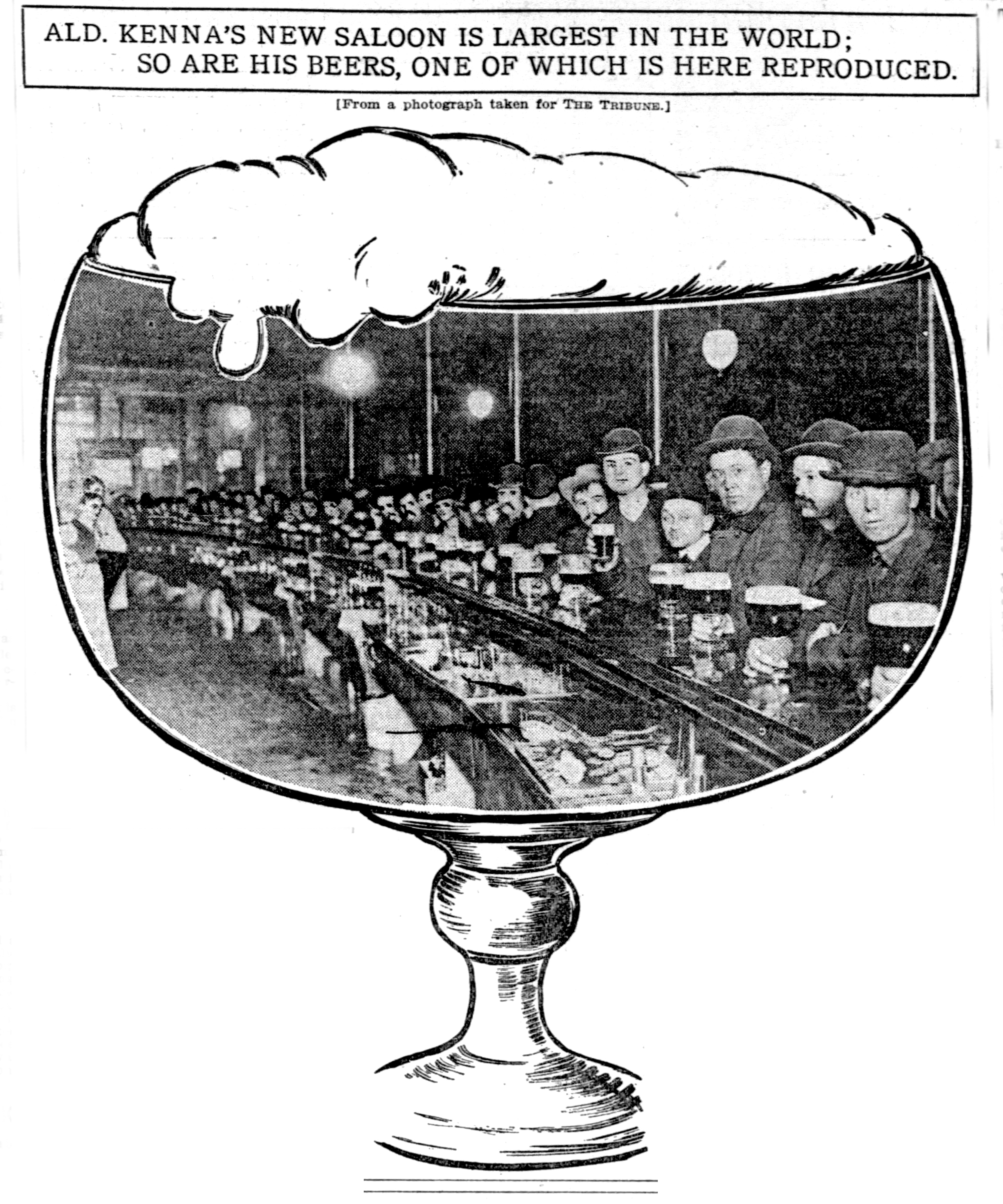
 Resplendent with electric lights and polished mirrors the new “barrel house” owned and conducted by “Hinky Dink,” otherwise Ald. Michael Kenna, has been thrown open to the public. The resort is the pride of the “tired and weary,” and over what is said to be the longest bar in the world thousands of “tubs” are passing daily.
When the “Workmen’s Exchange,” the alderman’s other house, on the opposite side of the street, was closed to make way for a new building, there was sadness and dismay.
“Woe is us,” was the cry. “What is left for us in Chi?”
But the answer came back full of hope and faith.
“‘Hink’ will never desert us. We have trusted him and he has never failed us.”
This faith was not misplaced. The alderman secured a long termed lease on the building on the opposite side of Clark street, a few doors south of Van Buren street, and a hundred carpenters and other mechanics were put to work. The result was known when the doors were opened Saturday evening.
World’s Biggest “Barrel House.”
The room, 100 feet long by 50 feet wide, is said to be the largest ‘barrel house” in the world. The bar, curving slightly to the middle of the room, is eighty-four feet long. A small office is at one end of the bar, and a bread box that is big enough for a refrigerator is at the other.
In the opposite side of the room is a lunch counter, where bowls of sou, prepared in the kitchen below, with unlimited quantities of bread, are always ready for the hungry.
There are no larger receptacles made for beer than the glasses that are handed across the bar. The bowl seems as large as an ordinary hat. The price is 5 cents.
Three bartenders are kept at work, and the sales are recorded on cash registers. Twice or three times a day the alderman comes in from his other saloon, at Clark and Van Buren streets, and empties the contents of the money drawers into a large sack, which he stows away in the safe.
Early in the morning n agent from the brewery comes and counts the dimes and nickels, as there is little other money that reaches the registers. The alderman knows from the indicator how much money there should be, and he has no time to count it himself. The agent gives him or his secretary a receipt, and every month a check is sent for the amount that remains after the price of the beer has been deducted.
Food, Drinks Even Beds.
Above the “barrel house” a lodging house is being made ready. There will be rooms for 250 men—all guaranteed to be filled at registration time. Private lockers, shower baths, iron bedsteads, are some of the conveniences. It is not for the one night lodger, as the rooms are to be rented by the week. The rate will be $1 each.
“I am going to give these poor ‘hobos’ the best home they ever had in their lives,” said Ald. Kenna yesterday.
Between 7 o’clock Saturday evening and the same time on Sunday forty-eight barrels of beer had been sold. The supply ran out, and the bartenders were idle for several hours. There are about ten “tubs” of beer in a gallon, and in a barrel there are thirty-two gallons. Forty-eight barrels means that 15,300 glasses of beer were sold in less than twenty-four hours in the new home of the “bum.”
“I expect to average thirty barrels of beer in this place,” Ald. Kenna explained. “Across the street I have sold on an average of seventeen barrels a day for the last five years, and here I shall have room for all my customers.”
And There’s a Fortune in It.
Is Ald. Kenna making money? Well, here is what one of his friends said last evening:
- ‘Hink’ making money? Well, I guess if I had his place and the trade I’d retire in a year. Just figure it up. With his rebates and his dividends from the stock he holds in the brewery his beer will not cost him more than $3.50 a barrel—and that;s putting it high. He will average 320 glasses from each barrel, so that thirty barrels a day will mean an income of $480. The beer will cost $105. His help, lunch, and other expenses will be about a hundred more.
Is he making money? He will make $100,000 a year out this place alone—twice the salary of the president of the United States, and out of a South Clark street ‘barrel house.’ He will hey a thousand dollars a month from the lodging house, too.
First Drink Is Free.
The beer trade is about the only trade of the house, practically the only whiskey served being the “mornin’s mornin’,” which is given free to each of the lodgers before breakfast.
This drink is known among the lodgers as the “corpse reviver.” It is served in tall, imposing looking glasses that are deceptive as to the amount they hold. A drink from the “ice man’s” bottle in an ordinary saloon is like soothing sirup by comparison, as it is said along Clark street that a teaspoonful of “corpse reviver” would make a Chinaman whip Jeffries. After one free injection of the reviver the lodger, braced for a strenuous day, goes forth to work on his own personal vineyard.
Chicago Tribune March 28, 1906
 The pre-election condition of “wide openness” locations became more pronounced yesterday in all the levee wards of the city where the saloon and gambling element can be of service to I M. O. candidates. The word was spread that a loosened lid was to be the order of things at least until after next Tuesday.
WIth the Second ward, under the skillful leadershIp of I. M. O. Perrigo, thrown’ open as it has not been in months, and the First ward. with some discretion, a close second. the tenor of the administration’s practical politics is supposed to be demonstrated.
Among the wise men of the underworld in these two wards was one who spoke frankly about the conditions, He sad:
- We are going to elect the men the Dunne people want us to. They are here for another year anyway. We have got to live now, and we can do it by placing the votes right.
That is a sample of levee phIlosophy, carried out with more or less accuracy in every district where the loose lid is a factor that cannot be denied.
Gambling in City’s Center.
Gambling is flourishing downtown and in the Twenty-first and Eighteenth wards. The “hotels” of the loop have ceased their watchfulness. Saloons are growing careless about shutting up at 1 o clock; that is, if the saloonkeeper is friendly to the I. M. O. candidates.
Aid. Kenna’s saloon in Clark street, known as the “Workingman’s Exchange,” openly violated the law by opening at 4.a. m. or earlier and dishing out beer to the voters. Everything 0. K.’d by Perrigo, the I. M. O. candidate In the Second ward, is “safe.” In the Nineteenth ward. where Simon O’DonnelI carries the administration banner, things run with a flimsy attempt at obeying the law. In the stockyards conditions are wide open.
Chief Collins and Mayor Dunne assert they have no knowledge of any leniency shown to the saloons and the mayor laughed at the report that the law is violated in wards where municipal ownership candidates are running. The levee people themselves do not claim the mayor is possessed of personal knowledge of their doings.
“I saw the chief this morning and asked him about this,” said the mayor. “The lid Is not off, or if It is I know nothing about it. My instructions have been strict and I am sure Chief Collins is carrying them out.”
Chief. Collins says w-hen. he gets an affi- davit that these things are so he will look into it.
Many Handbooks Are Running.
The gambling situation is illustrative of the condition In the First ward. There are from seventy-five to one hundred handbooks running, and several of the poker combinations put out of business by the activity of south side constables a few weeks ago have con- and found safe places.
Cohen, Wyscopp, and Harrison, well known gamblers, have combined in a poker game at the Midland hotel, said to be under the protection of Ald. Coughlin, another ardent I. M. O. worker. who is playing practical politics. “Tony” Hines, H. Dlnkman, and Hanson, formerly of 14 Custom House place. now run an open poker game at 47 Clark street. They are known as Tom McGinnis’ men.
“Mushmouth” Johnson, who has been put out of business times innumerable, Is conducting a crap game for negroes at 464 State street. Brown, a negro, is at the door. “Dan” McGowan is in charge inside. The poker men who ran games at the Veley and ‘Windsor-Clifton hotels, raided by constables, who found forty decks of marked cards in the outfit, now are running In the Twenty-first ward, at 44 North Clark street. In this combination are Edward Wade. Pierre Marx, “Doc” Raphael, and Charles Felt—all McGInnis men.
“Steerers: Are Working Openly.
The old Dearborn-Vanderbilt club combination, which took refuge In the Sherman house after it was driven from Its places, now is running at Bishop court and West Madison street, in the Eighteenth ward. The men in this are Charles Kirt, Lou Vogel. Max Vogel, “Big” Steve, Billy Barry, and Edward Springer. They have six or seven “steerers ” In the downtown district, and the gang at44 North Clark street has eight “steerers” who have been seen at work in the last few days.
From this evidence it is apparent that I. M. O. Is Implanted in the Eighteenth and Twenty-first wards, and that the opposing candidates will be defeated if saloons and gambling run free can do It.
Mont Tennes Resumes Sway.
Of the seventy-five handbook places the most open is that conducted at 123 Clark street by Mont Tennes, the north side gambling king. Anyone can walk in there ard place a bet. Other handbooks are run at Dale’s hotel, the Imperial hotel, in a barber shop back of 327 Wabash avenue, in room 54 at 119 La Salle street, and 199 South Clark street-
At 157 Clark street there is a handbook, as there also is over “Pat” O’Malley’s saloon at Polk and Clark streets. A poker game is run there also by George Little. At Twenty-first street and Wabash avenue twelve books are run in the saloon of Rafferty & Munter, good I. M. O. adherents.
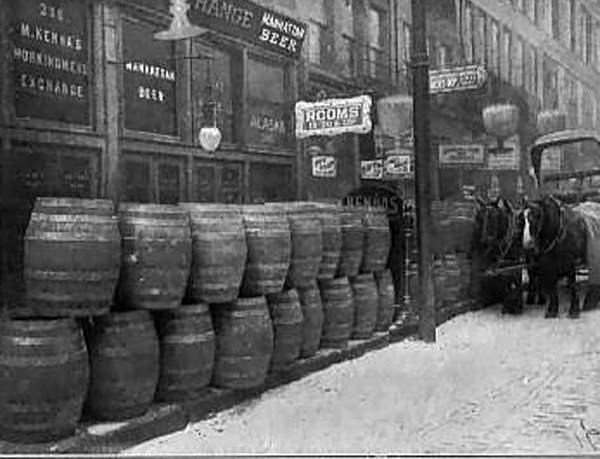
- Workingmen’s Exchange
1905
“Workingmen’s Exchange” Busy.
The “Workingmen’s Exchange” in Clark Street was a busy place at 4 a. m. yesterday. For half an hour previous to that moment the straggling voters of the First ward nad been stumbling down the lodging house steps and forming into line, which soon extended half a block down the street—a line of shifting, ragged men, enlisted to the banner of municipal ownership without any qualifications. No questions of the wisdom of $75,000, Mueller certificates bothered them. The town was alive again. There was something doing.
The general tendency, not only at Aid. Kenna’s place but throughout the downtown district, is to shorten up the hours of saloon closings.
The saloonkeepers apparently have forgotten already the “orders” issued a month ago by Chief Collins that saloons not only must close at 1 o clock, but must remain until 10 a. m. The,”fashionable” hour for opening is now to be 3:40 for those places which shut tight at 1 a. m.
Nineteenth Ward Wide Open.
In the Nineteenth ward, where the administratIon is engaged in a desperate effort to land Simon O’Donnell, the “labor union and municipal ownership candidate,” in the city council. the “wide open” conditions supposed to be popular with a “cosmopolitan” population, were distinctly prevalent East night.
Gambling was rife. particularly In the Greek “coffee houses” along Halsted street, most of which have now learned the drawing powers of “score cards ” and general sporting information. Hand books and policy. the “poor man’s game.” are reported to have crept back into the ward despite the efforts of the Citizens’ association to stamp them out.
As for “1 o’clock closing,” that seemed to have become fiction along Halsted street. Blue Island avenue, and the main streets which cross those teeming thoroughfares. None of the saloons near the headquarters of the candidates, in the vicinity of Halsted and Harrison streets, made any pretense of closing until the last political worker had secured his fill.
George Louterbach, proprietor of Brandt’s hall, at Erie and North Clark streets, was arrested on a warrant sworn out by Inspector Lavin for violating the 1 o’clock cloning ordinance.
Chicago Tribune, February 2, 1920
HINKY DINK PUTS THE ‘TUBS’ AWAY FOR SLL TIME.
“Largest and Coolest in Town” Gone for Good.
It anybody thinks prohibition is not here to stay let him peep in at the Workingmen’s exchange, one of Ald. Kenna’s erstwhile saloons, and it he is an observing person he will be convinced that Old John Barleycorn never will be resurrected.
The “tubs,” or, as Ald. Kenna so aptly christened them, “the largest and coolest in town,” have disappeared from behind the bar. Yes, dear reader, the “scuttle,” the “gold fish bowl,” the “schooner,” the “shuper,” the tankard, the flagon which held the amber fluid that was quaffed by ye merrie hobo has been relegated to the basement.
Packs Up the Heavy Artillery.
Those “scuttles “-now relics of a past age—will never again be filled with the nectar that made a certain western city more or less famous. Farewell to wassail! Bacchus, adieu!
The alderman, who seldom visits the Workingmen’s exchange, sent word to his manager yesterday to pack up all of the “heavy artillery” and put it away.
“Yes,” said the manager,” the ‘little fellow’ sent word over to pack up all the glassware, the large babies, and put them in the basement. I was in hopes that the government was going to let us sell beer and light wines, but it’s all off. We have done no business here since the law went into effect last July, but we kept the ‘tubs’ in sight where the customers could see them while they drank their one-half of one per cent.
“It’s no use. The fellows down here on Clark street refuse to drink that near beer stuff. They won’t fall for it. I don’t know what it tastes like, but those who drink it say that the fellow who named it near beer must have been blind.”
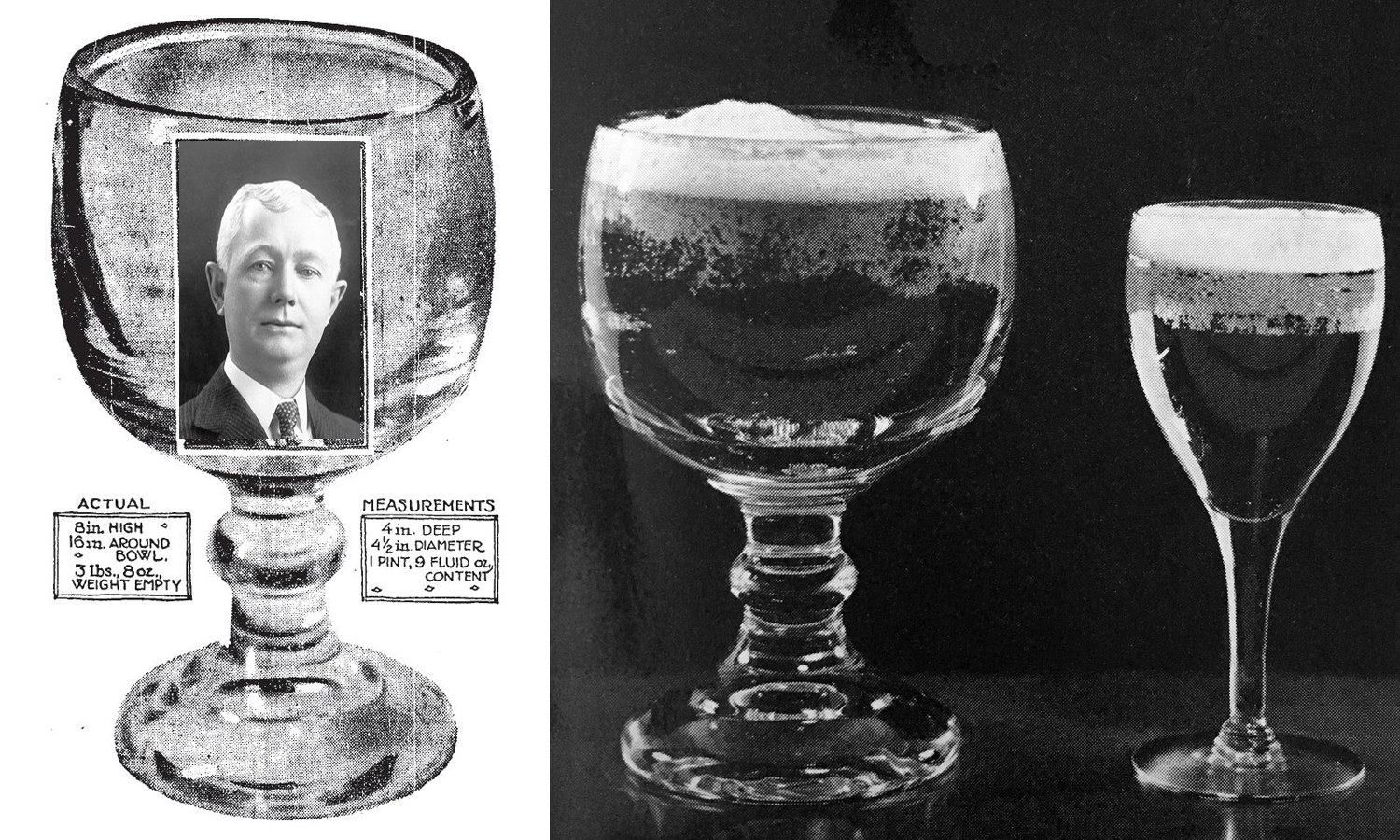
A Gift to Historical Society.
Ald. Kenna is going to present one of the “largest and coolest” glasses to the Chicago Historical society, and another to the Field museum.
A hundred years from now those beer glasses from “Hinky Dink’s ” may be the delight of antiquarians. One can imagine a sight seeing party being conducted through the Field musum and as they pause in front of a show case containing Ald. Kenna’s gift they guide will say:
- Ladies and gentlemen, I would call your attention to this large glass vessel which our ancestors were wont to use as a drinking cup. A beverage they called lager beer was transferred to the cup from a barrel by means of a faucet. This beverage was a mild intoxicant, but if taken in draughts it acted upon one’s pedal extremities, causing him to reel and walk in a zigzag fashion. It also was conducive to vocalization.
A Beverage of Foamy Nature.
The vessel upon which your gaze is fastened was facetiously called a ‘tub.’ It was the invention of a celebrated personage who in the early history of Chicago kept what was called a dram shop. His was a famous resort for tipplers. The name of this man was Michael Kenna, but he was better known by the sobriquet of ‘Hinky Dink.’
The beverage with these ‘tubs’ were filled—and drained to the last drop was of a foamy nature, made so by fermentation. Our ancestors—that is, some of them—have been known to drink as many as twenty of these tankards in a night. Those addicted to the beverage would often make merry by telling the bar attendant not to put a collar on his glass, meaning he did not relish the foam.
Chicago Tribune, March 6, 1921
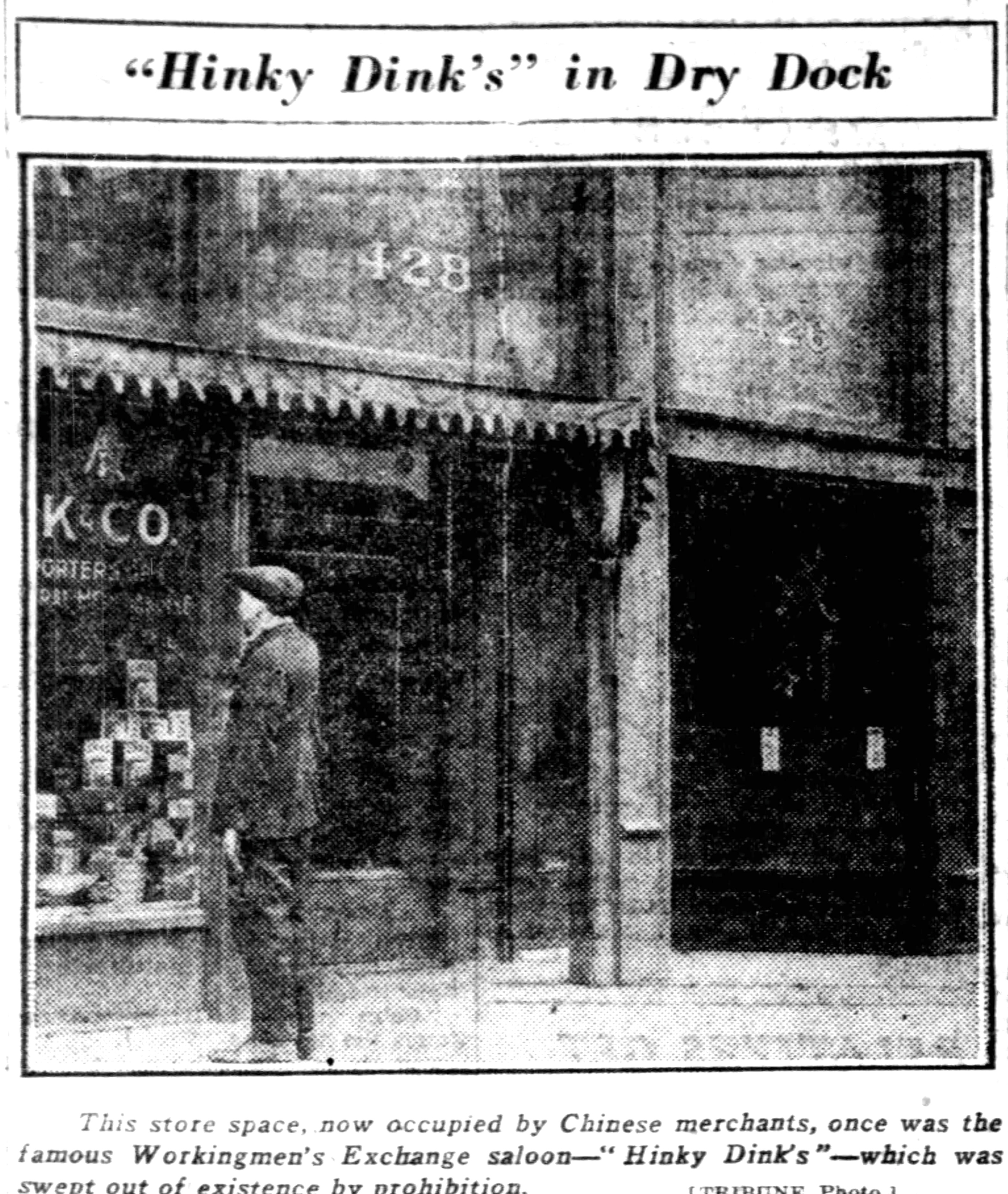 One of the arguments used against prohibition was that storerooms occupied for years as saloons at a high rental would be tenantless if John Barleycorn was knocked out. Real estate men say that, on the contrary, premises formerly used for retail liquor purposes are rented at a high valuation.
Take the Workingmen’s Exchange. for instance, at 426-28 South Clark street. This place was operated for many years by Ald. Michael Kenna. It was known far and wide as “Hinky Dink’s.” The bar was eighty-four feet long and the glasses in which the foamy nectar was dished out were called “tubs.”
Twenty barrels of beer a day the year round was the amount consumed at the Workingmen’s Exchange. A half dozen other saloons in the same block did almost as much business.
Prohibition went into effect and the barrel houses were closed. Were they tenantless? Some were vacant a short time, but others had new tenants waiting.
“Hinky Dink’s” place is occupied by two Chinese merchants. All the other places formerly used for saloon purposes in this block are now occupied by business concerns, and rents, say the real estate men, have been boosted.
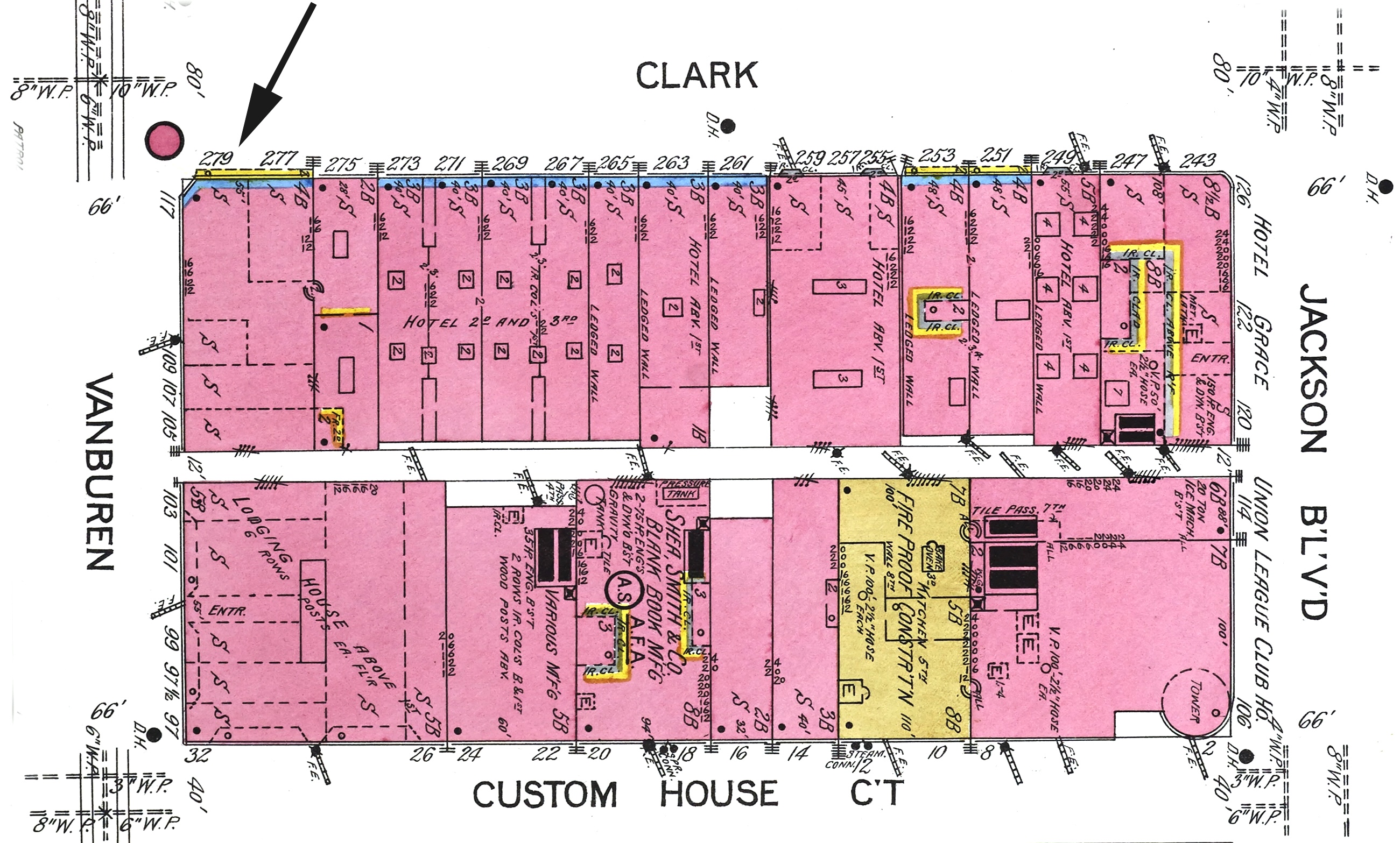
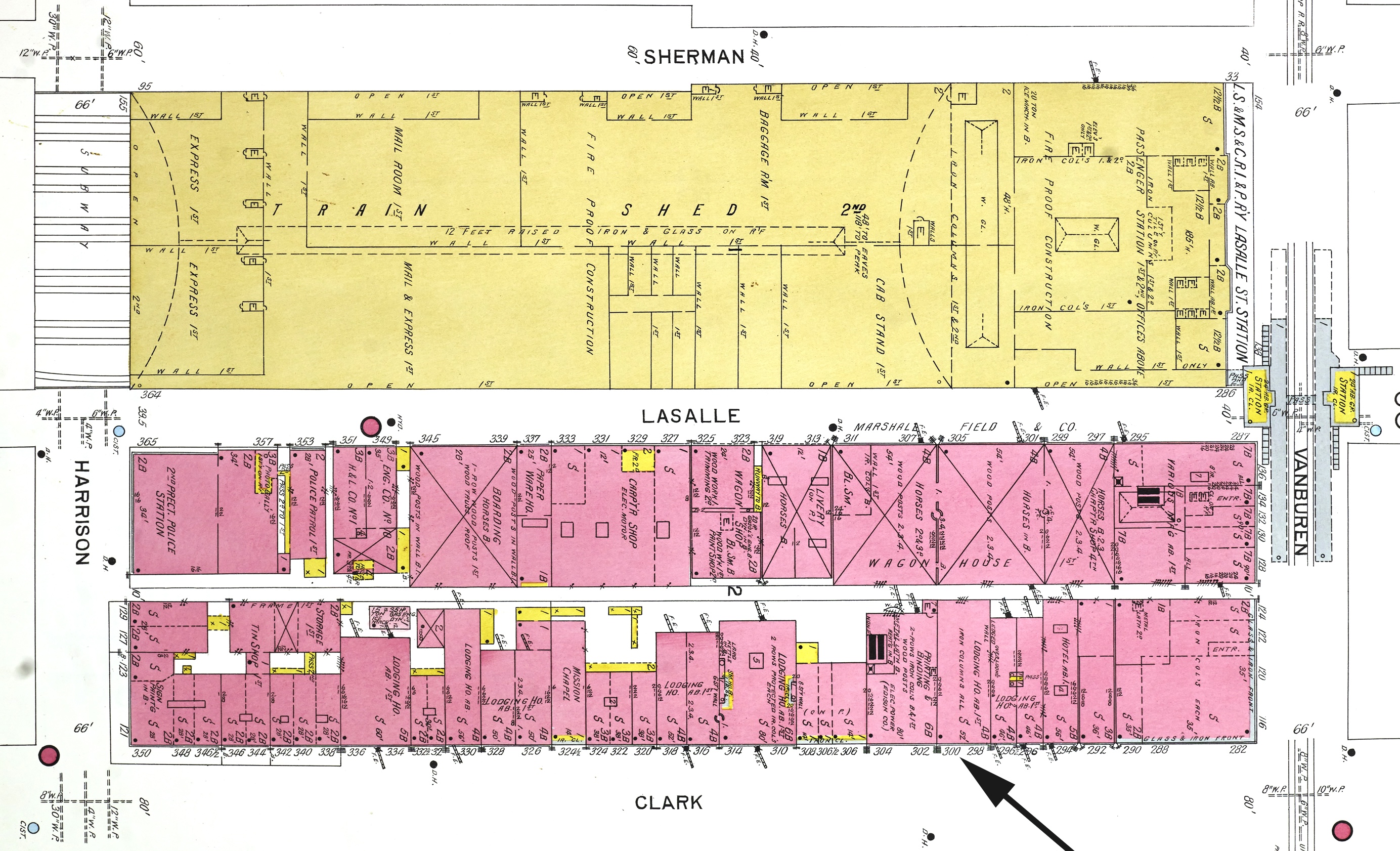
- Michael Kenna’s Saloons
279 Clark and 300 Clark
Sanborn Fire Insurance Map
1906

Leave a Reply