Chicago Tribune, October 12, 1871
PRESERVING ORDER.
The real headquarters of the order-preserving of force of the city is now at No. 540 Wabash avenue. where General Phil Sheridan has established his headquarters, in the house formerly occupied by the Hhoenix Club. Here the head of the city has planted a pine table and outertained his numerous visitors.
The force at the General’s command, in addition to the city regular and special police, consists of seven companies of regulars and six of volunteers. The former are from Omaha and other western points, and are all camped upon the site of the Ball Park, on Michigan avenue. To them, as the most trustworthy and vigilant force at hand, has been entrusted the care of the South Side burnt district, reaching from Harrison street to the main river. In this space is at present the wealth and treasure of the city yet in sales, and in most cases buried in the ruins.
The numbers of thieves now known to be in the city, the presumption that they will make the safes their objective point render this disposition of the troops the most prudent one possible. The orders to the sentinels last night were of the strictest possible kind, and it will be wonderful indeed if the ruffianly element shall triumph.
The Militia are from Bloomington, Springfield and Champaign in this State, and number six companies in all. They arrived in the city on yesterday morning under orders from Adjunct General Dilger, and were immediately stationed in different parts of the city to repress pillage and generally to preserve order. Two companies were placed on the corner of Prairie Ave and 22d street. They were from the Illinois Industrial University at Champaign, and a heartier, healthier, more intelligent set of men would be hard to find.
One other company was stationed at the corner of Canal and Wilson streets for the protection of the thoroughly all-righted residents of that portion of the city.
Another company was placed on Halsted street, with headquarters at the railroad station on 12th street.
The North Side did not need much military protection in its dilapidated condition, and was abundantly guarded by two militia companies stationed in Lincoln Park
A part of the Champaign company was also at the corner of Randolph and Elizabeth streets.
General Sheridan seemed satisfied that the city was perfectly safe under the protection already at hand; but, in order to assure this, more troops will arrive shortly. Three additional companies of regulars were expected last night, and ten companies more will arrive to-day, making a force large enough to keep in order all the roughs in the United States.
Another addition to the order force of the city was on yesterday started by General Frank Sherman, under authority from Mayor Mason and General Sheridan. This will consist of a regiment of militia to be recruited by trustworthy men for twenty day service. The regiment will consist of ten companies of sixty men and three officers each. The Colonel has established his headquarters at the Wabash Avenue Methodist Church, corner of Harrison street, and the only members of his staff yet known are C. H. Dyer, Adjutant, and Marvin Bean, Commissary and Quartermaster.
Chicago Tribune, October 24, 1871
A communication was received from Mayor Mason, giving notice that the military forces under General Sheridan have relinquished ail their functions in the control of the city, which will revert exclusively to the Police Department as before.
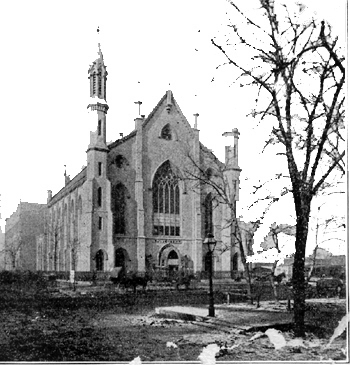
- Wabash Avenue Methodist Church after being converted to the Post Office.
December 20, 1871, Final report to Secretary of War Belknap, from General Sheridan
“Numbers of the leading citizens called upon me (on October 10) and urged me to assume military control of the city as they thought that the condition of affairs was such that nothing but prompt action on my part could save the balance of the city, restore confidence and maintain order. Among those who came to see me was the late Colonel Thos. W. Grosvenor [the citizen killed on October 20 by a volunteer sentry], who very strongly urged this course and said that the people would force me to assume control of affairs whether I desired to do so or not. Realizing, however, that his Honor, the Mayor, was doing all that lay in his power with the partially disorganized and worn out force at his disposal, I felt that my duty was to assist him to the utmost, and furthermore, it was my earnest desire that civil authorities should, if possible, bring the city through its troubles with such aid as the army could give. I accordingly refused to take any action looking towards a military control of the city. During the evening the excitement grew apace; certain persons commenced beating drums and calling the citizens together for organization under the Mayor’s printed notice, (as they claimed) and the most absurd rumors of incendiarism, robberies, murders and lynching prevailed. I did everything that lay in my power to allay the excitement by ridiculing the minute men and denying the various reports, but found to my astonishment that some of our best citizens credited the most startling rumors, though I was utterly unable to find a single individual who had seen in person any of the alleged outrages….
I however finally agreed to be responsible for order in the city, under the direction of the Mayor, and afterwards called upon the Mayor and stated to him that I would be responsible for the peace and good order of the city under his direction, provided he was willing to issue a proclamation to that effect.

Leave a Reply