Harper’s Weekly, November 11, 1871
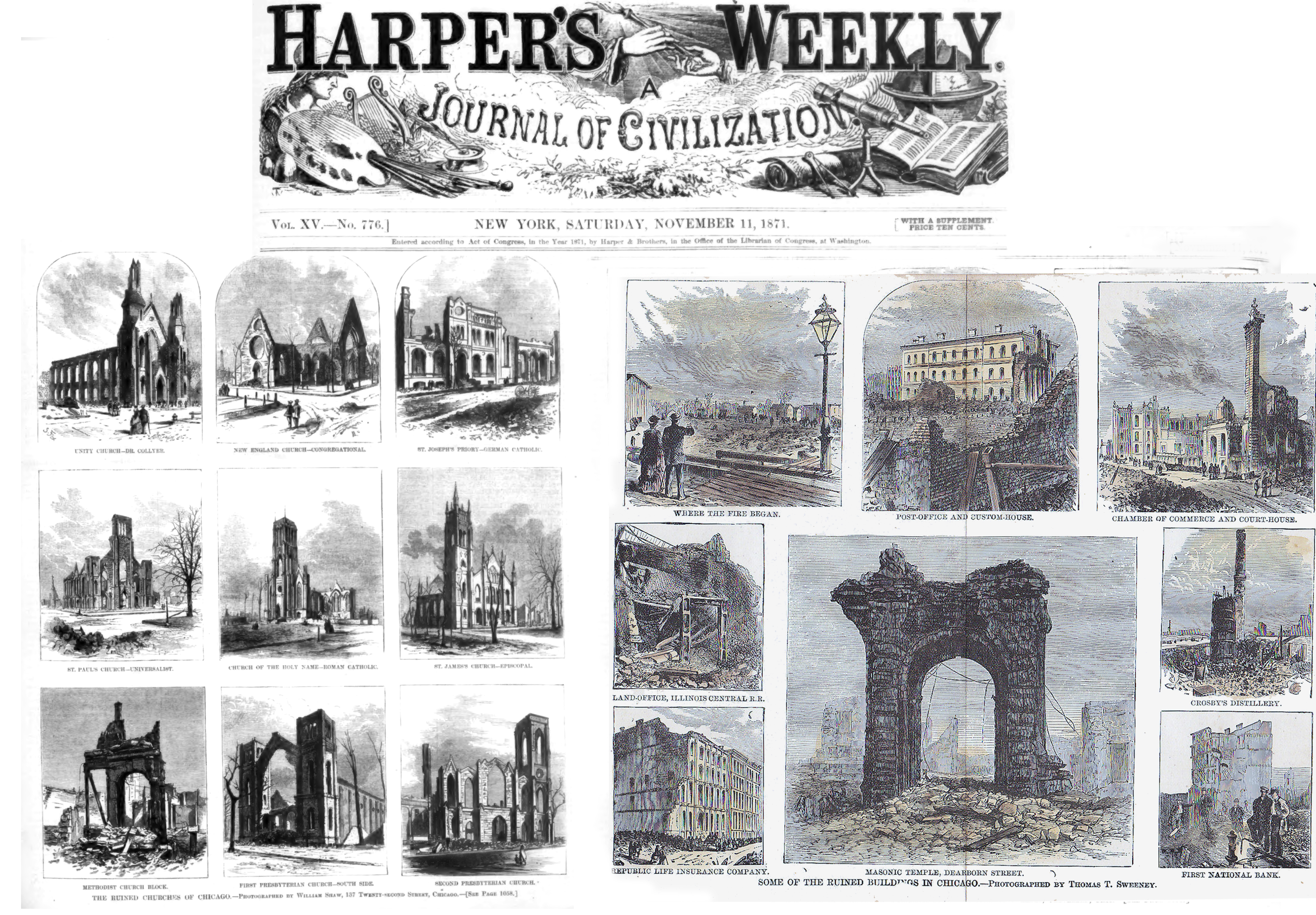
Chicago was noted among American cities for the number and elegance of its churches. The great majority of these edifices were within the burned districts, and, as a glance at our first page this week will show, little now remains of them but a few broken walls, towers, and arches to show what they must have been before the conflagration, and also to indicate what they will be again when Chicago shall have been rebuilt. Our illustrations are from photographs courteously furnished by Mr. Thomas T. Shaw, of Chicago, who was indefatigable in taking views both during and since the fire.
The smaller illustrations on page 1052 show the ruins of a number of prominent buildings in the track of the fire. One of them shows the site of the stable where the conflagration was kindled, on Dekoven Street, West Side. There, where the picture was taken, but too small to be apparent in the sketch, were still lying the remains of the cow whose vicious kick upset the fatal kerosene lamp which occasioned all the mischief. Mr. John Hay, in a letter to the New York Tribune, gives the following interesting account of the aspect of this locality a day or two after the fire:
- I found Dekoven Street at last—a mean little street of shabby wooden houses, with dirty door-yards and unpainted fences falling to decay. It had no look of Chicago about it. Take it up bodily and drop it out on the prairie, and its name might be Lickskillet Station as well as any thing else. The street was unpaved and littered with old boxes and mildewed papers, and a dozen absurd geese wandered about with rustic familiarity. Slatternly women lounged at the gates, and bare-legged children kept up an evidently traditional warfare of skirmishing with the geese. On the south side of the street not a house was touched. On the north only one remained. All the rest were simply ashes. There were no piles of ruin here. The wooden hovels left no landmarks except here and there a stunted chimney too squat to fall. But of all the miserable plain stretching out before me to the burning coal-heaps in the northern distance, I was only interested in the narrow block between Dekoven and Taylor streets, now quite flat and cool, with small gutter-boys marching through the lots, some kicking with bare feet in the light ashes for suspected and sporadic coals, and others prudently mounted on stilts, which sunk from time to time in the spongy soil, and caused the young acrobats to descend ignominiously and pull them out. This was the Mecca of my pilgrimage, for here the fire began. One squalid little hovel alone remained intact in all that vast expanse. A warped and weather-beaten shanty of two rooms, perched on thin piles, with tin plates nailed half-way down them, like dirty pantalets. There was no shabbier hut in Chicago, nor in Tipperary. But it stood there safe, while a city had perished before it and around it. It was preserved by its own destructive significance. It was made sacred by the curse that rested on it a curse more deadly than that which darkened the lintels of the house of Thyestes; for out of that house last Sunday night came a woman with a lamp to the barn behind the house, to milk the cow with the crumpled temper, that kicked the lamp, that spilled the kerosene, that fired the straw, that burned Chicago. And there to this hour stands that craven little house, holding on tightly to its miserable existence.
I stood on the sidewalk opposite, as in duty bound, calling up the appropriate emotions. A strange, wrinkled face on a dwarfish body came up and said, ‘That’s a dreadful sight.’ I assented, and he continued, in a melancholy croon: ‘Forty year I’ve lived here, and there wasn’t a brick house but wan, and that was the Lakeside House, and it’s gone now; an’ ay ye’ll belave me, Soor, I niver see a fire loike that.’ I believed him thoroughly, and he went away. My emotions not being satisfactory from a front view of the shanty, I went around to the rear, and there found the Man of the House sitting with two of his friends. His wife, Our Lady of the Lamp—freighted with heavier disaster than that which Psyche carried to the bedside of Eros—sat at the window, knitting. I approached the Man of the House, and gave him good day. He glanced up with sleepy, furtive eyes. I asked him what he knew about the origin of the fire. He glanced at his friends, and said, civilly, he knew very little; he was waked up about nine o’clock by the alarm, and fought from that time to save his house. At every sentence he turned to his friends and said, ‘I can prove it by them,’ to which they nodded assent. He seemed fearful that all Chicago was coming down upon him for prompt and integral payment of that $200,000,000 his cow had kicked over. His neighbors say this story is an invention, dating from the second day of the fire. There was something unutterably grotesque in this ultimatum feeling a sense of responsibility for a catastrophe so stupendous, and striving by a fiction, which must have heavily taxed his highest powers of imagination, to escape a reckoning he was already free from, ‘Like his fellows the midge and the nit,
Through minuteness, to wit.’
Mrs. Leary tells, however, another story. The Chicago Journal gives the following report of a conversation with her:
- Reporter. ‘Are you the lady of the house ?’
Mrs. Leary. ‘I am, Sir.’
Reporter. ‘Have you lived here long?’
Mrs. Leary. ‘Going on five years.’
Reporter. ‘Do you own this place?’
Mrs. Leary. ‘I do.’
Reporter. ‘Did the fire start in your barn ?’
Mrs. Leary. ‘It did.’
Reporter. ‘What was in it?”
Mrs. Leary. ‘Five cows, a horse, and about two tons of hay in the loft.’
Reporter. ‘Is your husband an expressman?’
Mrs. Leary. ‘Indade, he is not. We all knocked our living out of those five blessed cows, and I never had a cint from the parish in all my life, and the dirty Times had no business to say it, bad cess to it.’
Reporter. ‘How about that kerosene lamp story?’
Mrs. Leary. ‘There is not a word of truth in the whole story. I always milked my cows by daylight, and never had a lamp of any kind or a candle about the barn. It must have been set afire. Two neighbors at the far end of the alley saw a strange man come up about half past nine in the evening. He asked them was the alley straight through. They told him it was, and he went through. It was not five minutes till they saw the barn on fire. Before we had time to get out the horse or any of the cows, it was all gone, and the fire was running in every direction. The boys turned to and saved the house. I hope to die if this isn’t every word of it true. If you was a priest I wouldn’t tell it any different.
All farther questioning was useless. The woman had nothing more to say upon the subject.
The lower illustration on the same page gives a view of the interior of the West Side Rink, now the great central dépot for the distribution of the supplies forwarded for the sufferers from every part of the United States, Canada, and Europe, and without which hundreds must have perished of cold and hunger. It was feared at first that too much might have been done in this way, and that many worthless characters might be encouraged to live in idleness and dependence instead of going to work for themselves; but it is believed that this will be prevented by the thorough system of relief adopted by those in charge of the distribution of supplies.
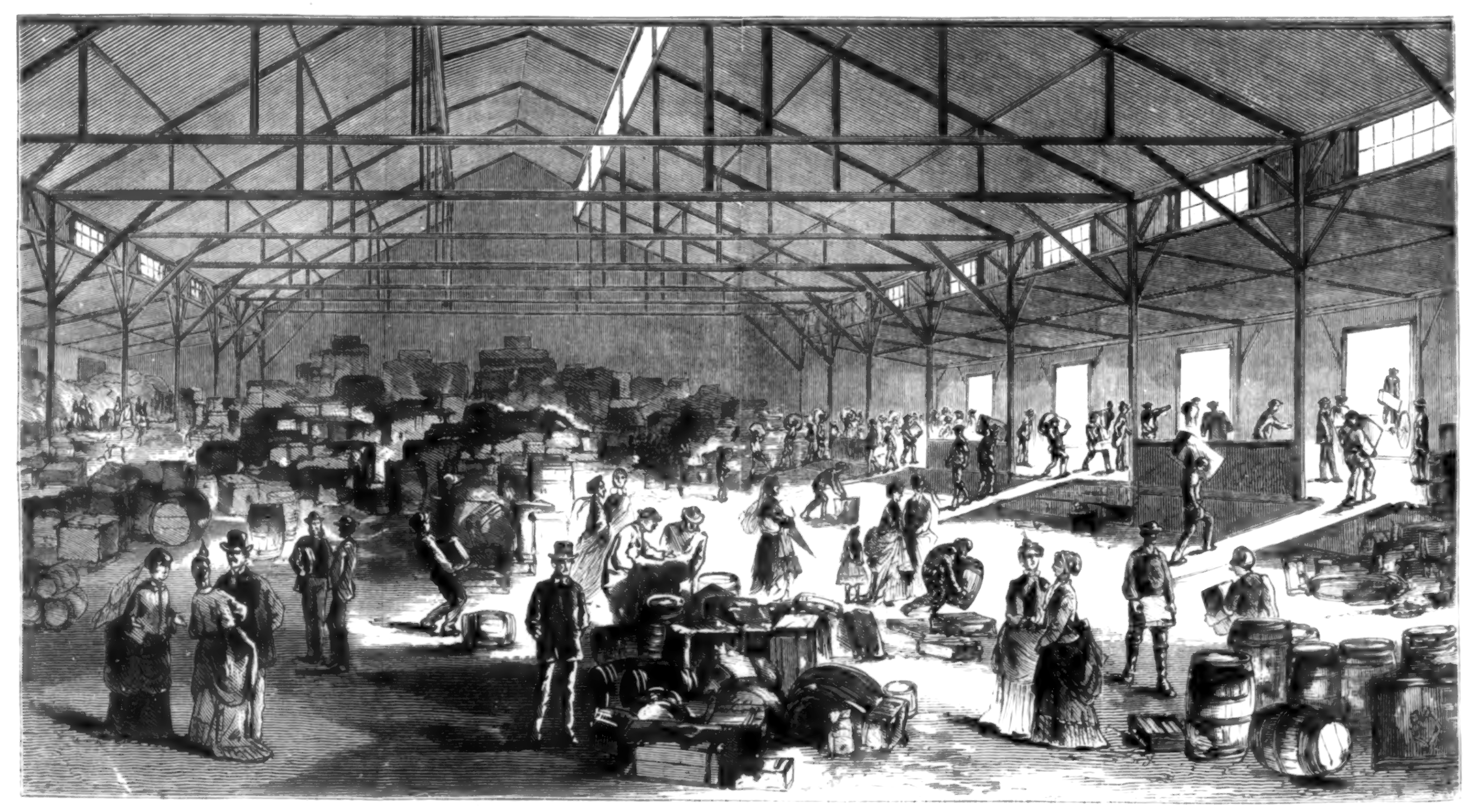
- THE WEST SIDE RINK, CHICAGO—GENERAL DEPOT OF SUPPLIES FOR THE SUFFERERS BY THE FIRE.
From a sketch by Theo. R. Davis—See page 1058
The directors of the Chicago Relief and Aid Society, under whose auspices the work of charity is carried on, report that they receive numerous inquiries as to what is most needed by the sufferers in Chicago at present. Many letters say that persons are desirous of contributing articles who can not well send money. In reference to all such proposed contributions, the society wish to say that nothing is so much needed now as beans, potatoes, and onions. They are advised by the Sanitary Committee that the people must have these articles, if they expect to escape sickness. The society are informed that many farmers would be glad to contribute these articles, and they ask all persons who can to ship beans, or onions, or potatoes to them. By a little proper attention car-loads may be made up at different places for shipment. The society also want straw beds of the usual size for two
persons, and friends in the country are requested to furnish as many as they can. The ticking should be of strong material, filled with straw or prairie hay. ‘The society are feeding and caring for over 40,000 people at the present time, with a very small stock of vegetables on hand and but little coming in.
Our sketch on page 1053 illustrates the energy of the Chicago people in meeting the heavy disaster which has befallen their city. They have gone to work with undaunted hearts, and the determination not only to obliterate within the next five years every trace of the fire, but to make their city still more magnificent and prosperous than it was before.
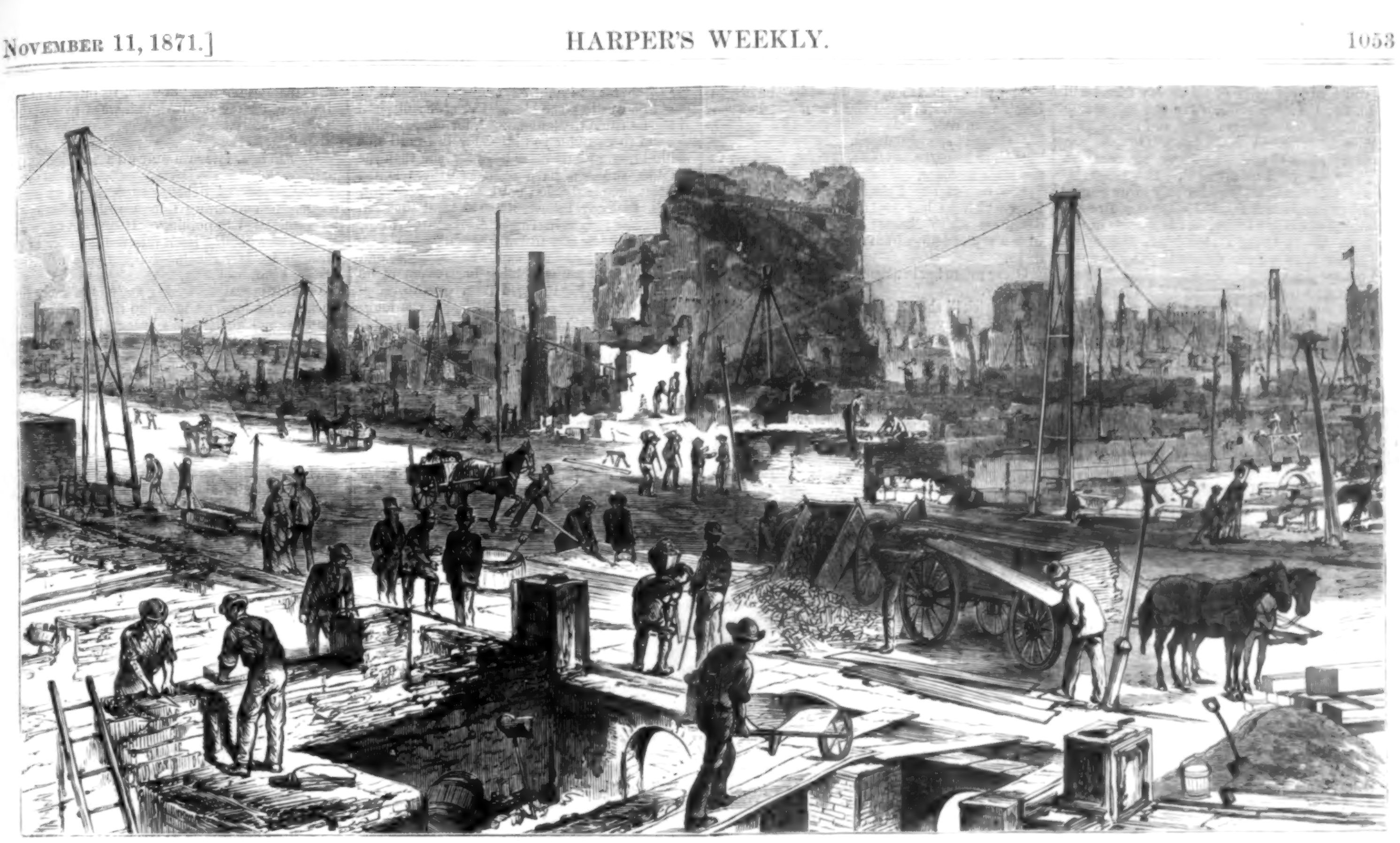
- REBUILDING CHICAGO-VIEW AT THE CORNER OF LAKE AND LA SALLE STREETS, LOOKING TOWARD THE LAKE.
From a sketch by Theo. R. Davis—See page 1058

Leave a Reply