Chicago Tribune, March 4, 1934
Colonial Village Will Turn Back 2 Hundred Years.
In turning back the clock a couple of centuries the Colonial Village at A Century of Progress will transport the 1934 Yankee visitor to Chicago next summer into an early American at m o sphere of history and romance. This was disclosed yesterday when Joseph Beuttas, originator and owner of this attraction. made publie for the first time de-talls of his project. He is president of the B. W. Construction company, which will erect the village.
Work is to start tomorrow on this eighteenth century town which will occupy a two and a half acre site on “Main Street” and represent an investment of $225,-000, according to Mr. Beuttas. It will occupy the former sites of several of last year’s Midway attractions, among them being the Battle of Gettysburg, Miss America, the Life Show, the Funnies, Aero Whirlplane, the Freak Show, and others.
Object Lesson Provided.
Tallmadge & Watson of Chicago are the architects of the Colonial Village, and, according to Thomas Tallmadge, it will not only be a place of varied and profitable amusement but will serve as a full size object lesson in colonial art, history, and patriotism.
The village will have its own elm lined “Main street,” with a village smithy at one end and a village green and a replica of Mount Vernon at the other. Back of Mount Vernon will be a colonial garden with yew and box hedges and bright with geraniums, hollyhocks, and other old fashioned flowers.
The village street will be lined with reproductions of historic bulldings of the various colonies. They will be of the same materials wherever possible and will be built true to scale, though slightly reduced in size.
Will Have Colonial Kitchen.
There’ll be the Old North church of Boston, with Paul Revere’s lantern hanging from the belfry. Not far away will be Washington’s birthplace at Wakefield and also Martha Custis’s Colonial kitchen where the future Father of his Country probably often helped himself to doughnuts.
Tucked into one corner will be a tiny Pilgrim settlement with rude houses of split logs and thatched roofs such as Miles Standish, John Alden, and Priscilla once occupied.
There will be several places of refreshment, both liquid and solid. On one side of the village green will be the Wayside inn and opposite a Virginia tavern.
The Paul Revere house in Boston will be reproduced and also the governor’s palace at Williamsburg. Va., recently restored. The old State house of Boston also will be reproduced. The House of Seven Gables, at Salem, will be nearby.
Marshall to Be Manager.
Benjamin H. Marshall, Chicago architect, is to be general manager of the Colonial village. He said yesterday that everything would be as authentic as possible and everything done to carry out the illusion of early American days. Practically every one will wear colonial costumes and wherever concessions are allowed the materials sold will be authentic reproductions of something colonial and not modern gimcracks usually found on Midway concession stands.
“There’ll be weaving by hand,” he said, “with the woven articles for sale. Wrought iron work will be done by hand. There’ll be early American and southern drinks-colonial concoctions and mint fuleps-and in the Wayside inn will be real Boston baked beans, dark brown and molasses flavored by many hours in the oven.”
Ben Franklin’s press is one of the attractions planned, with Ben himself showing how he turned out his famous Poor Richard’s Almanac. A Betsy Ross house with Betsy industriously sewing on the new American flag, will be shown.
Will Have a Seamy Side.
“The village, so ostensibly Puritan, will, however, have a seamy side,” ex-piained Thomas Tallmadge, who made the picture shown above. “There’s a narrow Cockloft lane, paved with cobblestones and lighted with fitful oil lamps. One has to be careful, for there is the Pirates’ Goal, the Witches’ House, the Haunted House, and, natu-rally, a grog shop.
“You may expect to see Jim Silver himself stamping about on his wooden leg and Hester Prynne and other pretty wenches quite willing to entertain and protect you. Perhaps there’ll be a scold ready for the ducking, and surely a Tory in the stocks.” The village green, at the north end of the town’s Main street, will be used for sham battles and various pageants and amusements.
Colonial Village, it is predicted, will be one of the outstanding features of the 1934 World’s Fair.
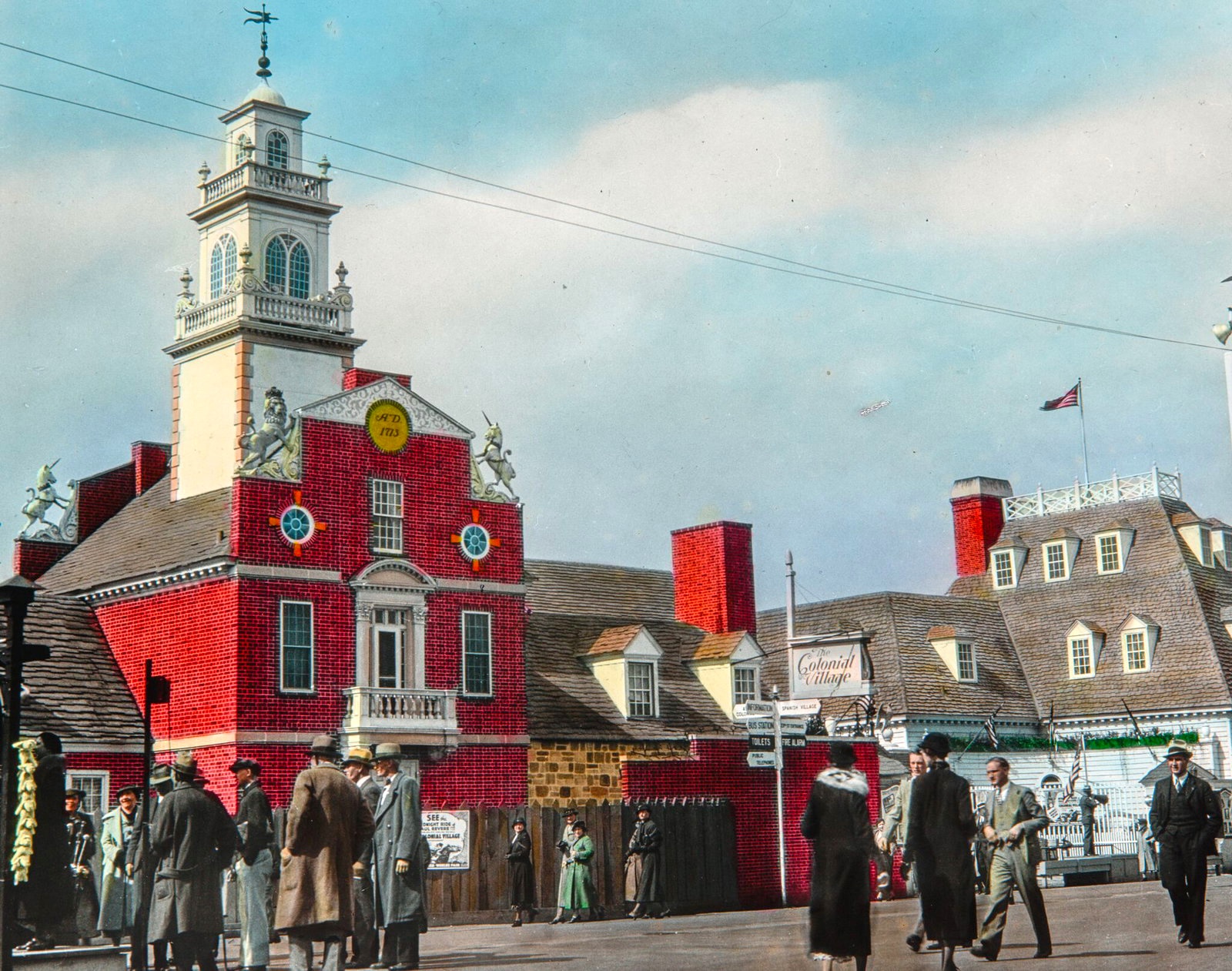
- Colonial Village
Hand colored Lantern Slide, photographed by Anton Rodde, 1934
Chicago Tribune, May 22, 1934
Colonial Village to Present Gay Scene.
Many who are planning to enjoy the Streets of Paris gayety late Saturday night and early Sunday morning intend to go to the Martha Washington ball in the Colonial Village first, for of course Colonial Village festivities will be over long before those of the Streets of Paris will end. Not that the Colonial Village won’t be gay and festive Saturday night, for it will be, but dancing into the wee sma’ hours of the morning hardly would fit in with the authentic colonial atmosphere that Tom Tallmadge has insisted upon having in the village.
The Daughters of the American Revolution are sponsoring affair and the proceeds will go to fund the they are raising to buy the Lincoln monument that is being made by Nellie V. Walker.
The monument will be given to the state to be placed at the end of the Lincoln Memorial bridge in Lawrence county.
Mr. and Mrs. Silas H. Strawn, Mr. and Mrs. Warren Wright, Mr. and Mrs. Harry Lobdell, Mrs. Stanley Zaring, and Mr. and Mrs. Edwin L. Brashcars are some of those who have planned to attend this ball.
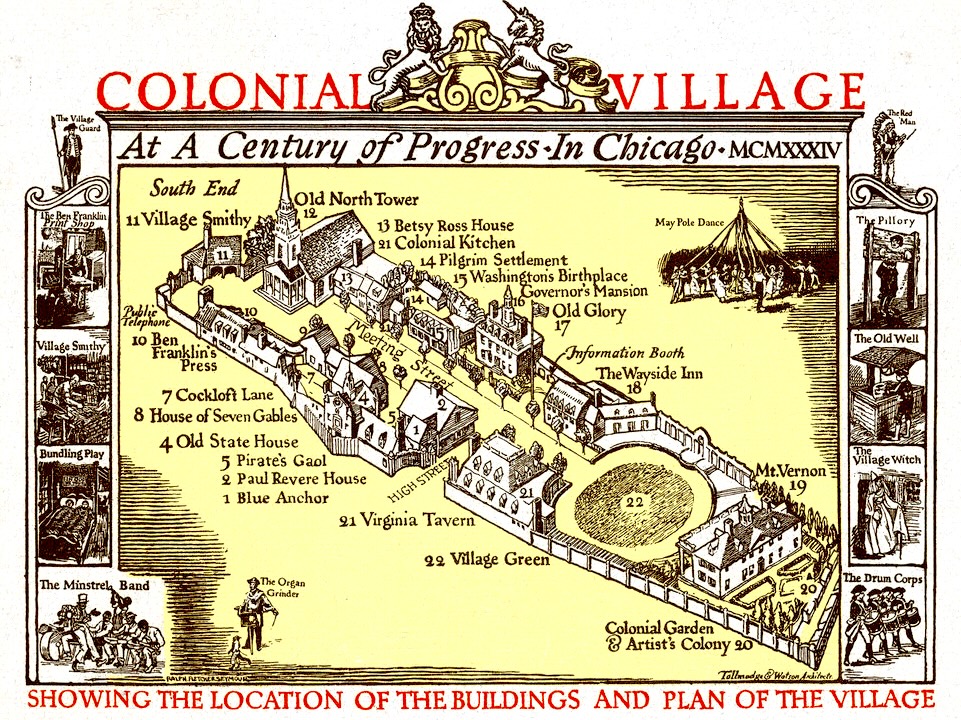
- Colonial Village Map
1934

Leave a Reply