History of Chicago, Rufus Blanchard, 1900
HISTORY OF THE CHICAGO DAILY NEWS
The first copy of the Chicago Daily News was issued December 23, 1875. It was the first one cent newspaper published in Chicago. The founders of the new publication were Melville E. Stone, Percy Meggy and William E. Dougherty. The latter two gentlemen soon became discouraged over the prospects of the struggling sheet, and sold their interests to Mr. Stone, who in turn sold the entire property to Victor F. Lawson. Later, Mr. Stone again acquired a third interest in the property, and the two owners directed all their energies to making the News a success. They accomplished their purpose. Mr. Stone conducted the editorial department, while Mr. Lawson managed the business affairs of the paper. Each was a genius in his own line, and the effect of their joint efforts was that the paper became a phenomenal success.

The purpose of the founders of the Daily News was to establish a paper the price of which should be the lowest unit of American coinage, so that no one could get below them in price; then to make it just as good in point of news as any higher priced paper in the city; to let its price alone carry it to the lower classes of society, and make its tone as high as that of any paper, feeling assured that its price would take care of the lower classes, and relying upon its tone to give it character among the better classes. Their idea, in brief, was to give a five-cent paper for one cent; and they believed there was a fortune in it. The ideal they had in view for the Daily News involved other radical changes. All the other Chicago papers mixed their advertising and news matter, running them together all through the papers. This they felt was an annoyance to every reader, and they purposed that as the chief mission of a paper was to print the news, the first page and the choice positions should be devoted exclusively to news matter, and that all advertising should be given a second place, as of secondary consideration. The policy was to give the most important piece of news the first place on the first page, the next news in importance the next place, and so on until the news columns were filled; then to begin with advertising, and run through to the end. From the first the rule was absolute that nothing should be published in the Daily News, as news or editorial, which should in effect be advertising, and that no advertising should appear under any circumstances which did not bear upon its face some indication of its character. The line between advertising and news matter has always been drawn in the sharpest possible way in the Daily News. When the paper was started on this line, the critics said it wouldn’t work. Every advertiser in Chicago had been taught that the choice place for his advertising was on the first page, and all the other papers gave display advertising on the first page. The advertisers were accustomed also to having their wares written up as news matter at $1 a line, and they liked that sort of thing. “You cannot go in and revolutionize this business,” said the critics, “and make any money out of it.”
The projectors of the Daily News went ahead, however, and the result showed at once that they had made no mistake. Very soon the public saw the justice and wisdom of their position, and the advertising columns became crowded.
The policy of giving one man his advertising at one rate and another at a different price was also considered detrimental, and uniform rates were established, which were not to be varied from under any circumstances.
It was their theory, too, that the value of advertising depended chiefly upon the circulation, and that an advertiser had as much right to know the extent of the circulation of the newspaper which he was patronizing as any citizen has to know the quality or grade of any piece of dry goods that he seeks to purchase. It was for this reason that when the circulation of the News was less than 10,000 copies an affidavit was published every day giving the exact figures. This practice has been continued through all the years since the establishment of the paper. The circulation has fluctuated, sometimes fallen and sometimes risen, but the affidavit has remained there, showing exactly what it was. Some question at first was raised as to the truth of these affidavits, but no man who was interested in the subject held his doubts very long. Every one who cared to could come to the office, examine the books, see the paper printed and satisfy himself.
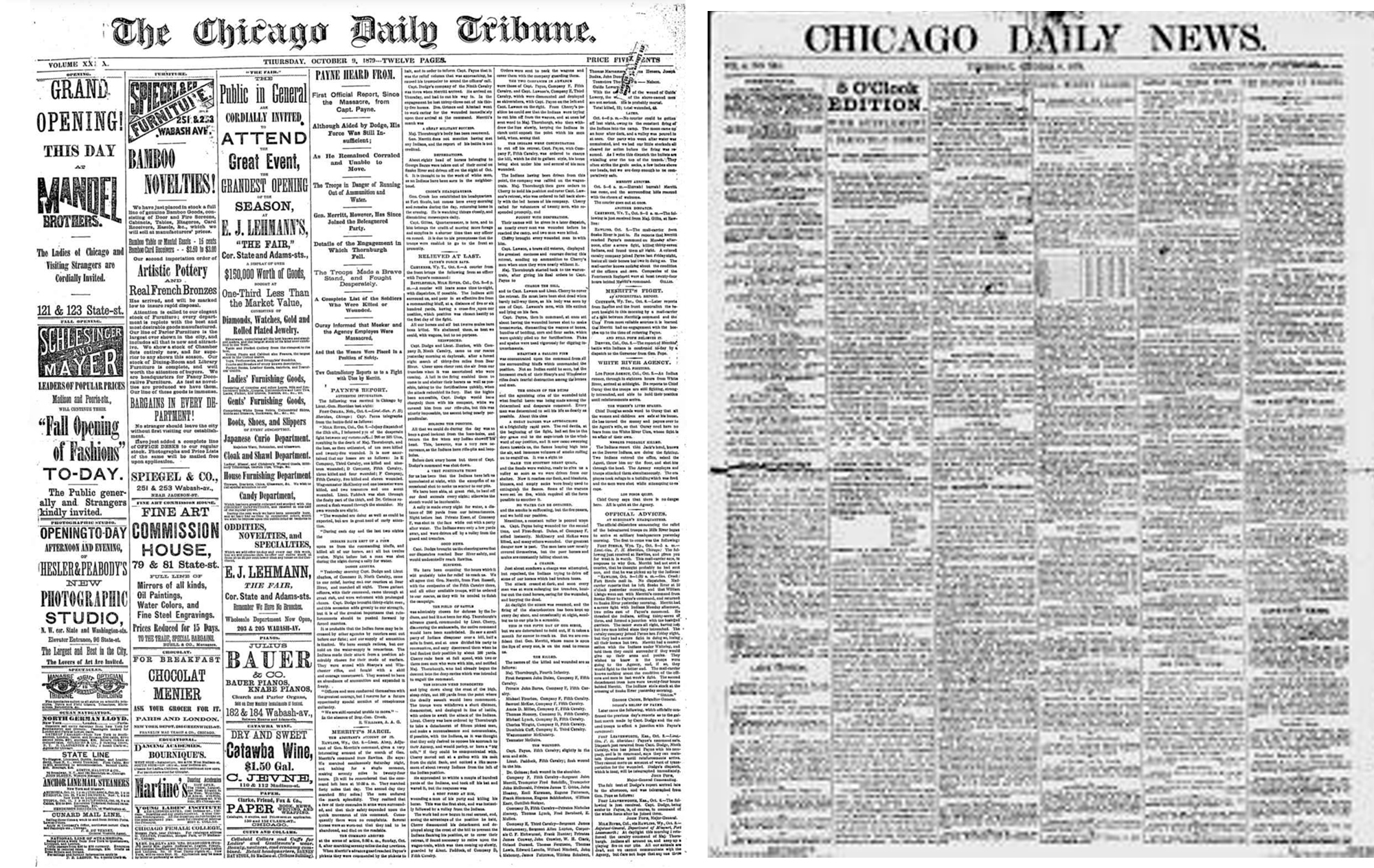
- Left: Chicago Tribune, October 9, 1879
Right: Chicago Daily News October 9, 1879
From the very beginning it was determined that the Daily News should be made as good a newspaper as any competitor, regardless of any difference in price that might exist. With this end in view, the Chicago Evening Post was purchased in 1878, in order to acquire its franchise in the Western Associated Press. The purchase was made for the sole purpose of obtaining the news facilities of the paper. That put the Daily News on an equal footing with any afternoon paper in the country, making it the only evening paper in the United States having a membership in both of the rival press associations. Then correspondents were secured all over this country and several in Europe. The Daily News received the first actual special cablegram ever delivered to any newspaper in the city of Chicago, and during several years paid the Western Union Telegraph Co. more money for special telegrams than any other afternoon paper in America.
A number of episodes in the early history of the paper contributed to establish its reputation for enterprise.
Very early in its career it was found that a con temporary was stealing its dispatches. By the publication of a bogus dispatch in November, 1876, the offending sheet was convicted and publicly exposed.
Three months later, at midnight, the boiler which furnished steam for the machinery exploded, almost wrecking the building. Before daybreak a portable engine and boiler was in place, and that afternoon the editions were run off as usual.
The great railroad riots in the summer of 1877 were covered by the local department of the Daily News in a fashion that had no precedent in the history of western journalism. A corps of reporters mounted on horseback, went through the riotous district and telegraphed the situation hour by hour and almost min ute by minute. Some of them were even disguised as rioters; and one at least fell into the hands of the police because he was in the front ranks of the mob.
The following year the failure of a savings bank furnished a fresh opportunity for a display of enterprise. The collapse of the State Savings Institution and the escape of C. D. Spencer was seized upon and made the most of. When the police department utterly failed to follow the fugitive or learn his whereabouts, the Daily News took up the case, traced him through Canada to Europe, and finally sent a man who after months of search found and interviewed Mr. Spencer.
It was the Daily News also that made the search for Avery Moore, the defaulting west town collector, and found him in the wilds of western Canada, disguised and engaged as an operative in an oil well.
In the fall of 1879, when the Irish members in the British house of parliament began their agitation and laid the foundation for the Land League, their leader, Charles Stewart Parnell, was induced to send a long cablegram explaining his motives and those of his associates, as well as their expectations, to the readers of the Daily News.
In 1880, when General Grant, after his tour around the world, reached his home in Illinois and was accorded a reception, the Daily News secured from the governors of all the states and territories, as well as from the leading men north and south, congratulatory telegrams which were published on the day of General Grant’s arrival in Chicago.
On March 20, 1881, the Morning News was founded, and in June, 1882, the directors of the Associated Press admitted it to membership in that organization.
An innovation inaugurated by the Daily News was that of editing news matter, particularly telegraph, in strict accordance with its news value instead of printing in full the stories received from correspondents. Quality rather than quantity was the object held in view. All the matter received by telegram is carefully edited, and it very frequently happens that the man in charge of the telegraphic news at night edits three times as much into the waste basket as he does into the columns of the paper.
During the first six months of the history of the Daily News its circulation averaged about 4,000 copies a day. At the end of the year the average had grown to 10,000. The yearly averages since that time have been as follows:
- 1877, 22,037;
1878, 38,314;
1879, 45,194;
1880, 54,801;
1881, 64,870;
1882, 66,680;
1883, 75,115;
1884, 88,306;
1885, 99,005;
1886, 113,615;
1887, 125,225;
1888, 128,676;
1889, 134,059;
1890, 132,957;
1891, 142,022;
1892, 164,175;
1893, 192,491;
1894, 200,885;
1895, 202,496;
1896, 204,724;
1897, 222,595;
1898, 275,514;
1899, 259,562;
1900 (to November 30) 276,176.
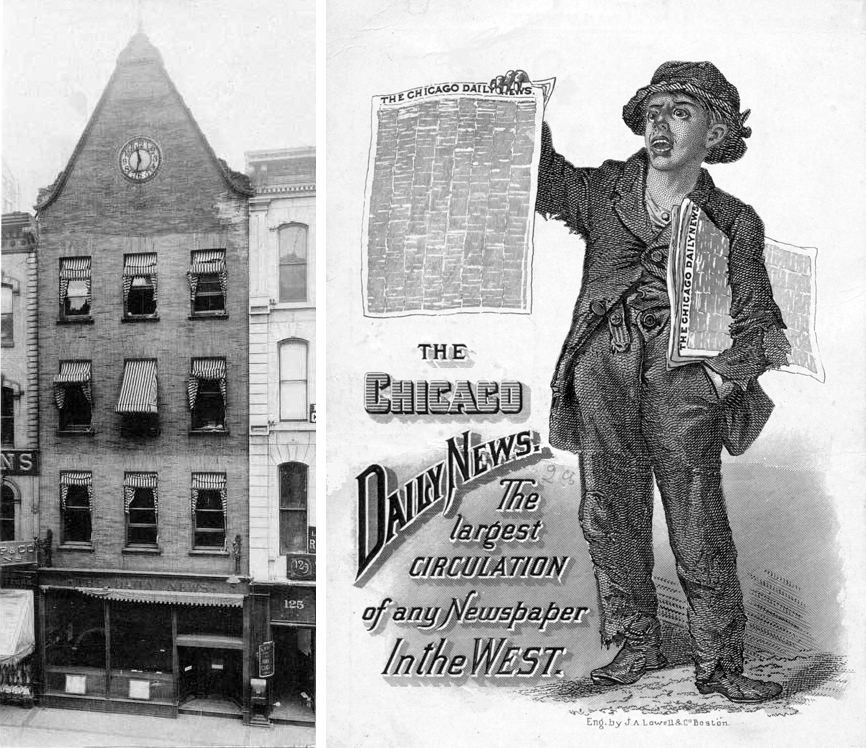
- The original Daily News Building at 15 N. Wells St., (1890-1931)
Chicago Daily News Newsboy Advertisement, circa 1900
The first copies of the Daily News were printed on an ordinary cylinder press, the separate sheets of paper being fed in by hand after having been wet overnight. Then a “four-feed ” machine was introduced, the type being carried on a cylindrical iron frame, and the sheets of paper being fed in at four different places by boys. This was succeeded by one of the first web presses built. Nine quadruple Hoe presses and one Hoe sextuple are now required to print the paper’s daily issue. Each of the quadruple presses is capable of producing 24,000 16-page papers an hour, folded and counted. Besides this, they can print with equal facility 10, 12 or 14-page papers. The present capacity of the entire battery of ten presses is 240,000 10-page papers an hour. Within a year, however, all of these presses will have been enlarged to the sextuple size, which will double their capacity for the production of 10 or 12-page papers. Each will then be capable of turning out 48,000 10 or 12-page papers an hour, giving a combined capacity on these sizes of 480,000 an hour. About seventy tons of paper and nearly three barrels of ink, each barrel containing 420 pounds, are consumed daily by the plant, including the consumption of paper and ink for the morning paper, now known as the Chicago Record, as well as that of the Daily News. Sixty men are regularly employed to operate the presses and the engines which drive them, and additional help is frequently employed. In the stereotype room from 480 to 500 plates are made every day. The composing room is equipped with twenty-eight Mergenthaler linotype machines. A total force of about 155 men are employed in this department and the co-ordinate department for the setting of display advertisements. The total number of employes on the pay roll for all departments exceeds 800, not including 123 cable correspondents abroad nor the numerous correspondents scattered throughout the United States.
- Chicago Daily News Stables and Garage
Racine Avenue
About 1932
Two great public enterprises of a philanthropic nature, carried out by the Chicago Daily News, deserve mention. The chief is the fresh air fund and sanitarium for sick babies established on the lake front in Lincoln park in 1887, and with the co-operation of the public, maintained ever since. In June, 1887, the Daily News made a study of the causes of the enormous increase in the mortality rate among infants and children in July and August, as compared with that of the other months of the year. The experience of 1,300 practicing physicians was obtained, and with substantial unanimity they attributed the increase more largely to the impure air of the tenement house district in summer than to any other cause; and with a like unanimity they insisted on pure fresh air as the first essential for infantile health and life during the summer months.
Out of this grew the Daily News fresh air fund. Over $100,000 has been contributed by the public and expended by the Daily News since this movement was begun. Each year the amount received and expended has been larger, and hundreds of thousands of infants, children, mothers and sewing girls have shared in its benefits. The Daily News has always paid all the expenses of office service, the cost of stationery, etc., and furnished its employes without salary to carry on the good work. Three distinguished citizens of Chicago audit the accounts of the sanitarium yearly and vouch for the fact that all the money received has been expended in the most economical and useful way.
In June, 1888, the Daily News tendered the board of education of Chicago the annual income of an investment of $10,000, such income to be expended in procuring suitable medals to be awarded each year under the auspices of the board, for essays on “American Patriotism” by pupils of the Chicago grammar and high schools. The purpose, as stated in the letter to the board, was to “stimulate interest in the study of patriotic literature by the pupils of the public schools, to the end that familiarity with the causes that led to the founding of the American republic and with the motive which inspired the struggles and sacrifices of its fathers may develop a higher standard of American citizenship.”
It is also worthy of mention that the Daily News has provided amply for the welfare and amusement of the thousands of newsboys who sell or help to distribute the papers. One of the largest rooms in the building is devoted to them. Here is a gymnasium with rings and turning bars, climbing ropes and punching bags, space enough to accommodate nearly 1,000 boys at one time, and every modern appliance, from a restaurant in the comer to a theater stage and scenery and curtains, where innocent amusement can be given. The Daily News Newsboys’ Band was organized late in 1897, and is now beyond doubt one of the finest boys’ bands in the United States. It is a military band of forty-two pieces, fully equipped and uniformed. The Daily News paid all the expenses and gives the boys all the receipts of the numerous entertainments at which their services are in demand. There is also a Newsboys’ Fife and Drum Corps, an entirely separate organization, organized in 1894. Still another organization is a newsboys’ military company called the Zouaves. All the boys in this organization are handsomely uniformed at the expense of the paper.
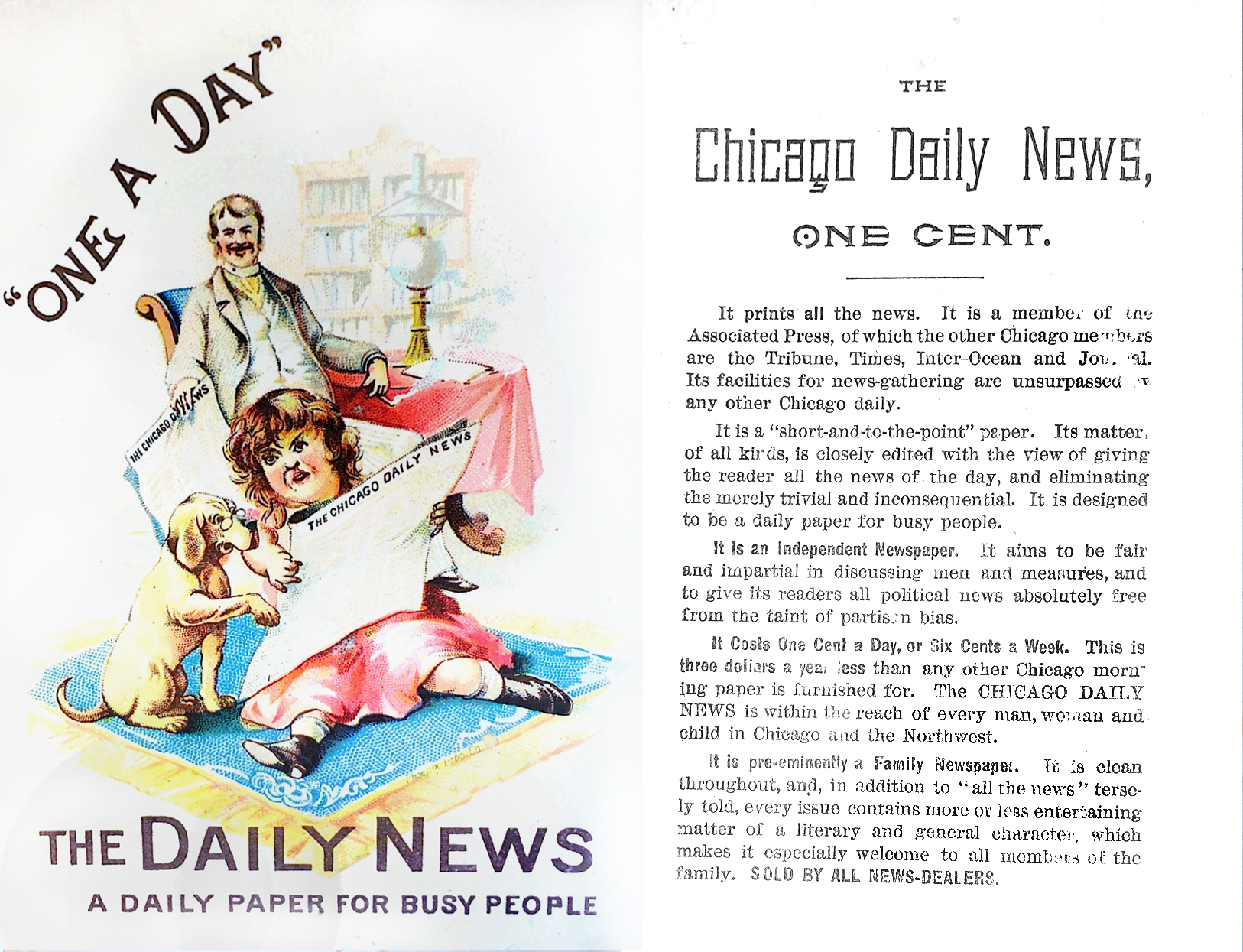
In March, 1881, the issue of a morning edition was begun, under the title of the Morning News. The price was two cents. The new venture was successful from the start, and in 1893 the title was changed to the Chicago Record. Its career has been one of unusual brilliance. Like the Daily News, the Record is a non partisan newspaper. Measures and men are viewed in its columns invariably from the standpoint of the interests of all the people—never from that of the interests of any particular political party. It is distinctively a family newspaper. It caters to the family circle. It prints the news—the news a discriminating public wants—and it prints also the varied literature, interesting, instructive, humorous, practical, that the interests of different members of the household demand. Its foreign service includes in its scope the entire civilized world. One hundred and twenty-three staff correspondents of the Chicago Record are scattered through out the world outside of the United States. Seventy-two are located in the important cities of Europe. Eighteen are in Asia—seven of these in China and Japan; four are in Africa—three of them in South Africa; six are in Australia and New Zealand; eight in South America; five in the West Indies and ten in Canada and Mexico.
It is a rule of both the Record and the Daily News that there shall be no expression of opinion in the news columns proper. No reporter is permitted, under any circumstances, to express any opinion; it is his business simply to relate facts. The expression of opinion is all relegated to the editorial columns. Both papers have always maintained an independent position politically, though always taking an active interest in public questions, sometimes with one party, some times another, but oftener for the better element of both.
Their moral tone has been the subject of special care. Early in the history of the office a rule was made which has always been maintained and is still operative, couched in these words:
Nothing shall appear in the columns of the paper which a young lady cannot read with propriety aloud before a mixed company.
Since 1888 Victor F. Lawson has been sole proprietor of both papers, Mr. Melville E. Stone having retired in that year. Mr. Lawson was born in Chicago September 9, 1850. He was educated at Philips academy, Andover, Mass. On his return to Chicago he took personal charge of his father’s estate, and continued thus occupied until he bought the Daily News.
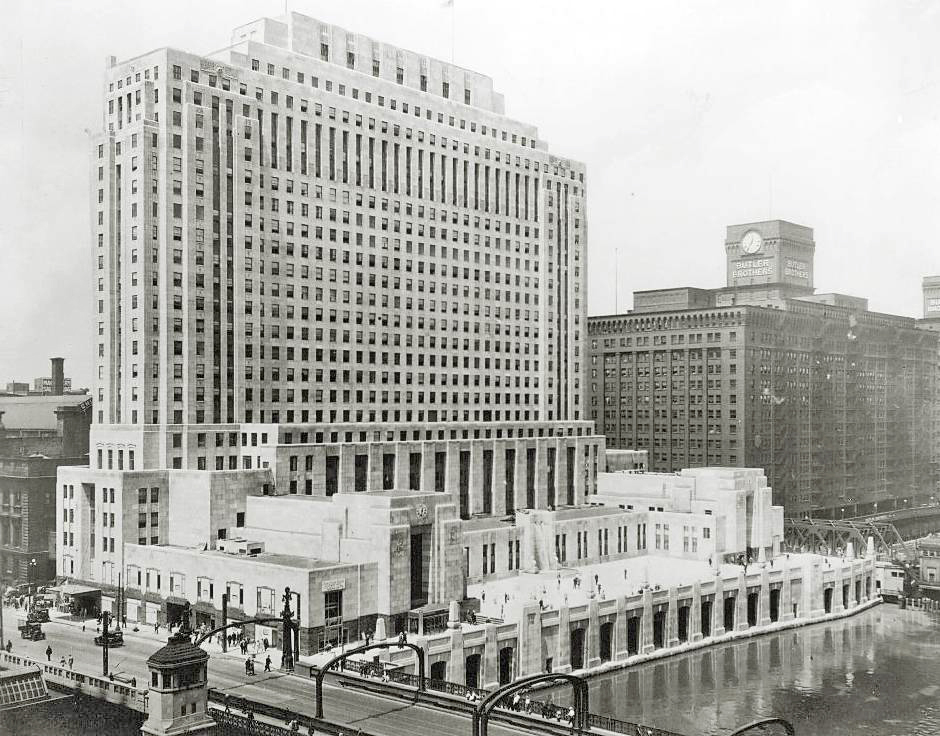
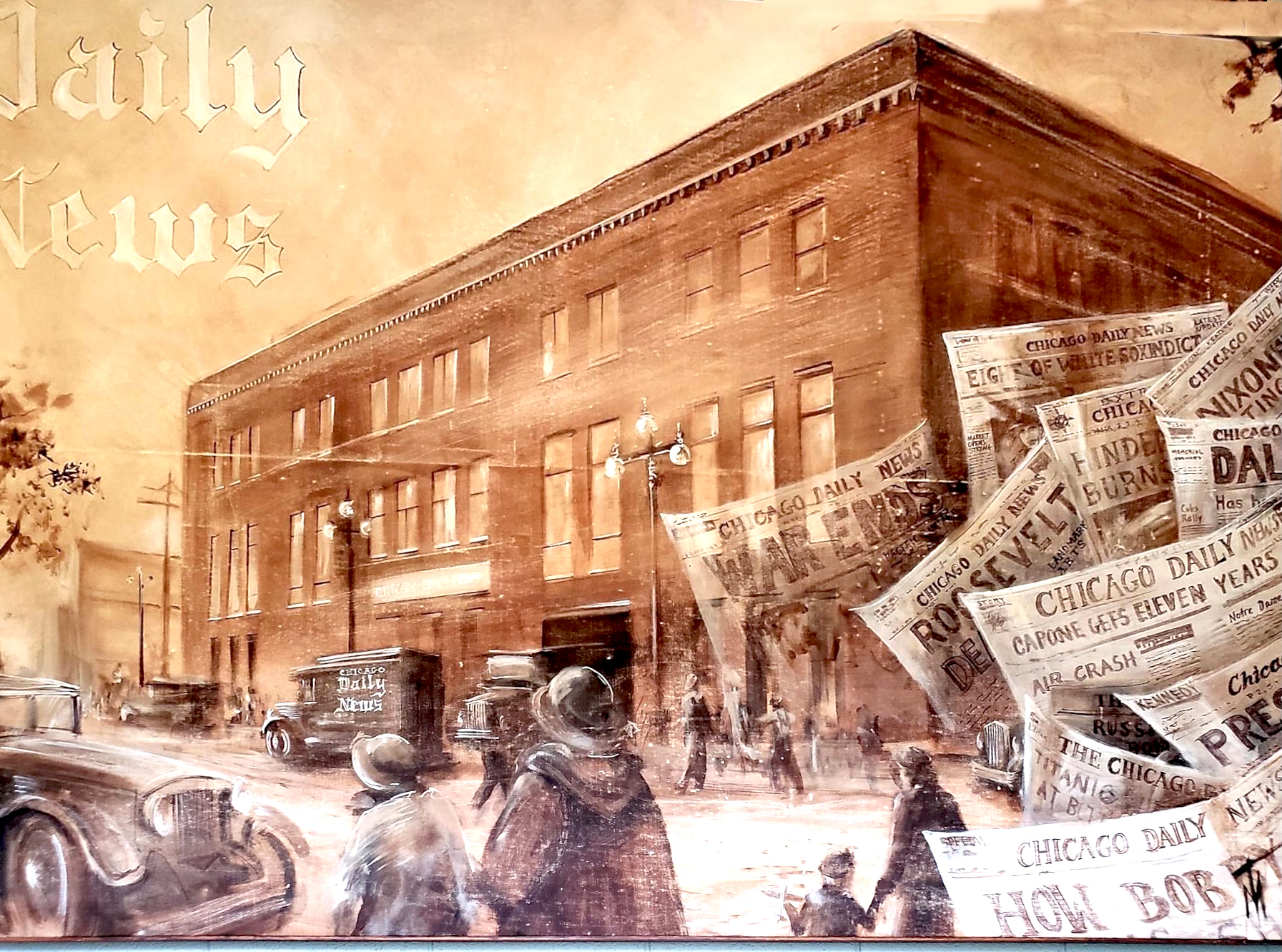
- Chicago Daily News building, at 400 W. Madison street, occupying the block bounded by W. Washington, N. Canal, and W. Madison streets and the Chicago river, was completed in 1929. Holabird & Roche were the architects and Frank E. Brown the engineer. The building is 26 stories high, with three basements, on rock caissons.
AFTERMATH
It remained Chicago’s most popular newspaper until 1918, when its circulation was surpassed by the Chicago Tribune. Even after Lawson died in 1925, however, the Daily News remained an important local publication. By the end of the 1920s, circulation was about 430,000, and the paper employed over two thousand people at its headquarters on West Madison. The Daily News, with a circulation of over six hundred thousand, was purchased by Field Enterprises, who also owned the Chicago Sun-Times, in 1959.
Chicago’s last afternoon newspaper, the brilliant and brawny Chicago Daily News, refused to go quietly. Its final edition on this day was breezily headlined “So long, Chicago.”
It died at the age of 102, the last of a long line of newspapers that tried to survive by reporting and writing from the heart and failed.In the process, though, they gave Chicago its reputation as the city of The Front Page.
In the newspaper cemetery, the Daily News had plenty of company. Less than four years earlier, Tribune Co.’s afternoon paper, Chicago Today, had closed. The Inter-Ocean, the Journal, the Post, the Herald and Examiner–all these and others had already gone to their graves.
The city was down to two papers: the Tribune and the Sun-Times.
The death of the Daily News was one more sorrowful testament to changing times.
People did not read news- papers–especially afternoon newspapers–as they once did.
With jobs and people moving to the suburbs, there were fewer strap-hangers commuting home on public transportation. Instead, people were in their autos, homebound on expressways. Traffic made it harder for delivery trucks to get the paper to the readers who remained. And for many people television’s evening news was enough.
Circulation had skidded from about 614,000 in the 1950s to 327,000. Publisher Marshall Field V, who inherited the paper from his father, decided to shut down the legendary place.
The Daily News had always been a writer’s newspaper. It hired Carl Sandburg and Mike Royko, and scores of lesser-known door-kickers and Balzacs.
The Daily News invented the daily newspaper columnist. The first was Eugene Field, whose children’s poems “Wynken, Blynken and Nod” and “Little Boy Blue” were originally published in the Daily News.
The last was the Pulitzer Prize-winning Royko, voice of Chicago for more than 30 years. Ben Hecht, co-author of the play “The Front Page,” was a reporter for the Daily News. Ground-breaking reporter Lois Wille won a Pulitzer Prize for the paper and went on to win another after joining the Tribune.
In all, the Daily News won 15 Pulitzers, five of them by members of its vaunted Foreign Service.
“It was a reportorial staff half daft with literary dreams,” Hecht said. In the end, that was not enough to save it.
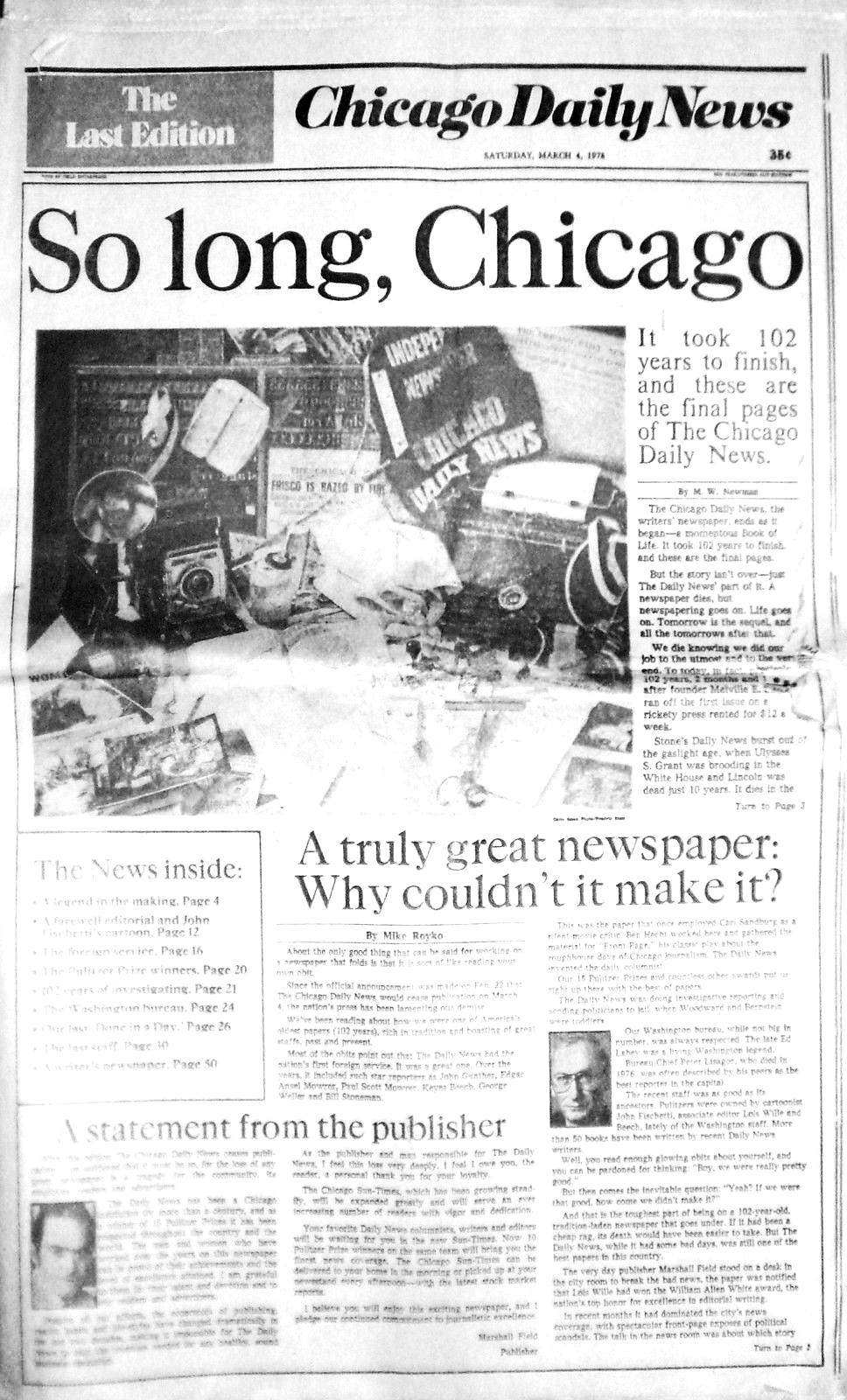
- Chicago Daily News Final Issue
March 4, 1978

I am interested in the short stories that were often featured in the Chicago Daily News Magazine on Saturdays. I grew up reading those stories and I would like to revisit some.
This paper and the building it occupied are a strong part of our history. I am researching for a project and am happy to learn more. As a kid, my job was to bring home the Sun-Times to my pop, but I read baseball scores and learned that the news was updated all day long in other papers. How cool was that! Now all that is available on television, online,..Unimaginable then
At least that magnificent building is still standing.
Alas, newspapers belong to the past. The few that are left in America are slowly dying. It’s faster and easier to just glance at the Twitter feed on our phones. Sigh.
Worked as a copyboy at the CDN in the 1950s. Wonderful, friendly staff, and a cast of colorful characters like Clem Lane. Fond memories.
I’m working on a biography of Walter Strong, who was publisher of the Chicago Daily News between 1926 and 1931. He was responsible for the Chicagp Daily News Building at 400 West Madison. Would be happy to hear from people about the CDN.