Quigley Preparatory Seminary
Life Span: 1917-Present
Location: Rush street, between Pearson to Chestnut streets
Architect: Zachary T. Davis
The Day Book, July 18, 1916
Catholic church has bought property on east side of Rush st., between Pearson and Chestnut for Quigley memorial seminary.
Chicago Tribune, July 1, 1917
Seminary to Be Architectural Gem.
Of course, the war is the chief concern of each one of us. We rise up with it in the morning, we talk and think of it all day, and go to bed with it at night. but still our daily domestic life and the life of the city goes on as before. And an important event in the development of Chicago as a good looking metropolis is the building now going up in Rush street, between Pearson and Chestnut streets. This is to be the Quigley Preparatory seminary, and will be one of the most beautiful and effective pieces of architecture in the city. if designs are carried out as planned.
It is to be of Bedford limestone, that most acceptable of building material. The style is to be early French Gothic. The facade of the main college will be a copy of the beautiful Hotel de Ville at Bruges. The two ornate wings will be in keeping with this main building: the one to the north will house the library and the gymnasium: the one to the south, which will thrust an exquisite spire into the air, will be the seminary chapel dedicated to St. James the Apostle, the patron saint of the late archbishop. for whom the seminary is named. The architects of the building are Mr. Steinbeck of Brooklyn’ and Zachary Taylor Davis of Chicago.
The Gothic lines of the Fourth Presbyterian church on the next block to the northeast of this site spurred the promoters of this new seminary building to an architectural achievement which promises to surpass anything in this line that we have in Chicago.
Europe owes so many of its famous and beautiful monuments and buildings to the Roman Catholic church that there’s not a Protestant who doesn’t feel grateful to the grand old mother church for the heritage of beauty left the world during the last nearly 2,000 years. In this country, however, until of late years the church seemed to have departed from her architectural traditions. That she is once more resuming her sway of beauty is evidenced not only by this Quigiey seminary but by the exquisite church erected on the corner of Sheridan road and Buena avenue, and copied from the famous Santa Maria Trastevere in Rome.
Delay In Construetion.
The seminary was to have been finished this coming autumn, but the contractors and engineers reckoned without taking into consideration the contrarieties of Chicago’s subsoil. Instead of driving in the piles and cement posts the seventy feet first figured on, it was found that a much greater depth would have to be sounded before the necessary foundation was reached. This necessitated a delay of nearly a year in the completion of the building.
The site of the building is part of an ancient burying ground, one that in the forties of the last century stretched from Chicago avenue to North avenue. Therefore it was not to be wondered at that some unrecorded human bones were brought to light during the excavations for the seminary. During the construction of the big apartment building at the corner of State street and North avenue the Italian workmen struck and left the place in a body when five coffins and their contents were exhumed.
The Quigley preparatory seminary has been in operation since 1911 and now there are thirty-five of its graduates who are priests in this diocese. About 300 a year are graduated from it into the priesthood. It is proposed henceforth to support it by scholarships. Twenty-five hundred dollars endows a perpetual fve year scholarship. These can be founded as memorials of some church member and the only return the beneficiary is asked to make is for ten years after graduation to say masses for the soul of the departed in whose memory the $2,500 is given. Five years after the scholarship is founded there will thus be established two masses which will continually and for all time be offered up for the memorialized dead.
Chicago Tribune, October 21, 1917
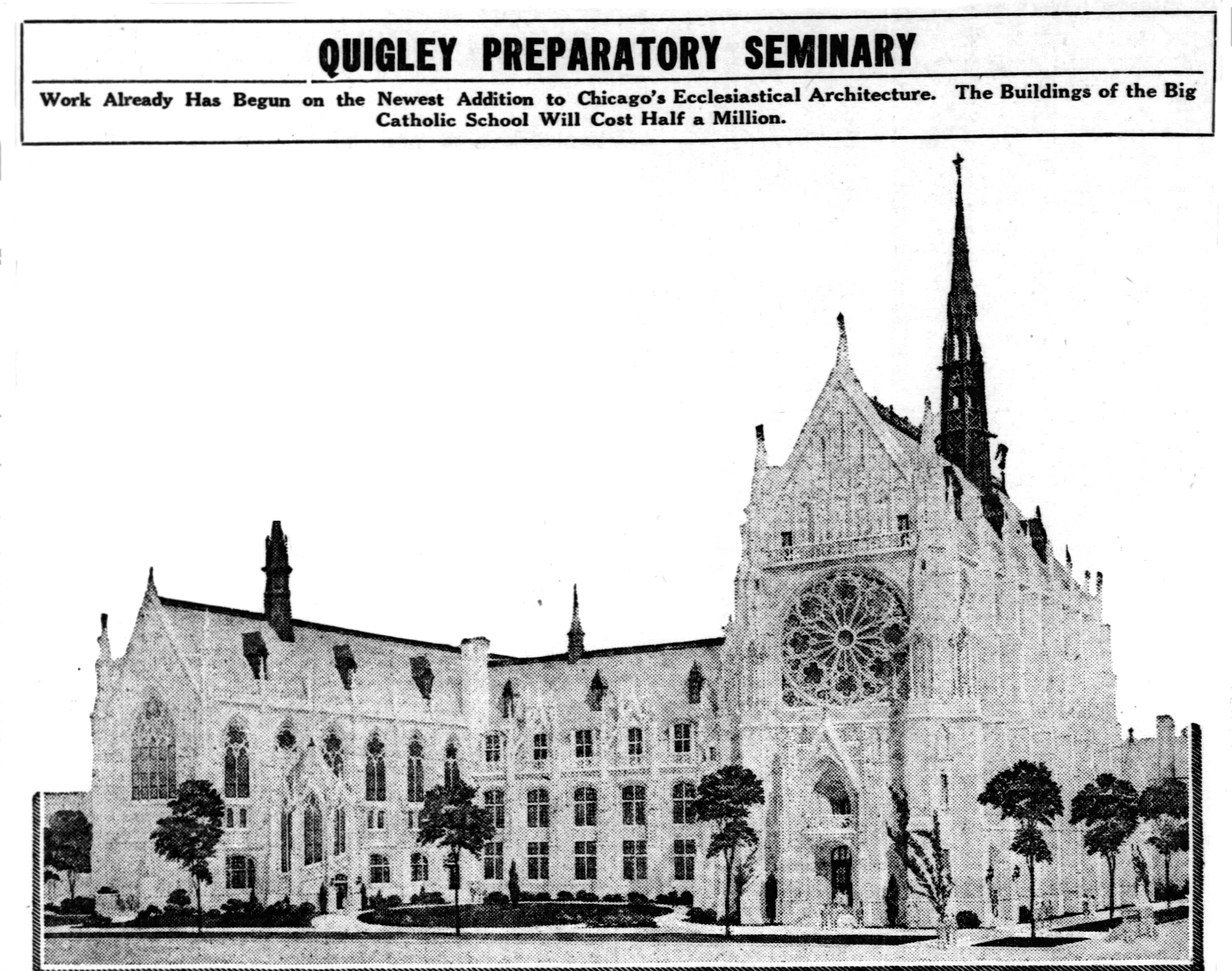
The Quigley Preparatory seminary, now in course of construction on Rush street from Pearson to Chestnut streets, will be in the dignity and beauty of its buildings a notable addition to the ecclesiastical architecture of Chicago. The buildings, which will be three stories high, will be of fireproof construction throughout and will occupy the entire block, with a frontage of 350 feet on Rush street, with a depth of 250 feet.
The exterior finish is to be of pearl gray limestone ornate with carved gargoyles, niches, canopies, arcades, crockets, and pinnacles. In the niches and under canopies applied to the exteriors will be statues representing the patron saints of the former archbishops and bishops, the four western doctors of the church, and twenty other saints. Zachary T. Davis is the architect.
The gymnasium and library will be in the north wing, the dining room, assembly hall, and chapel will be in the south wing, while the center section will contain the twelve classrooms and laboratory, the classrooms and chapel each to have a seating capacity of 600.
The chapel wing is to be similar in many details to the Sainte Chapelle in Paris. Over the entrance door to the chapel will be carved in bas relief the coat of arms of the late Archbishop James E. Quigley.
There will be eight entrances to the buildings and five flights of stairs with spacious corridors connecting all rooms, halls, and chapels. Two flights of stairs in the towers will be circular archways constructed of stone.
Chicago Tribune, May 25, 1919
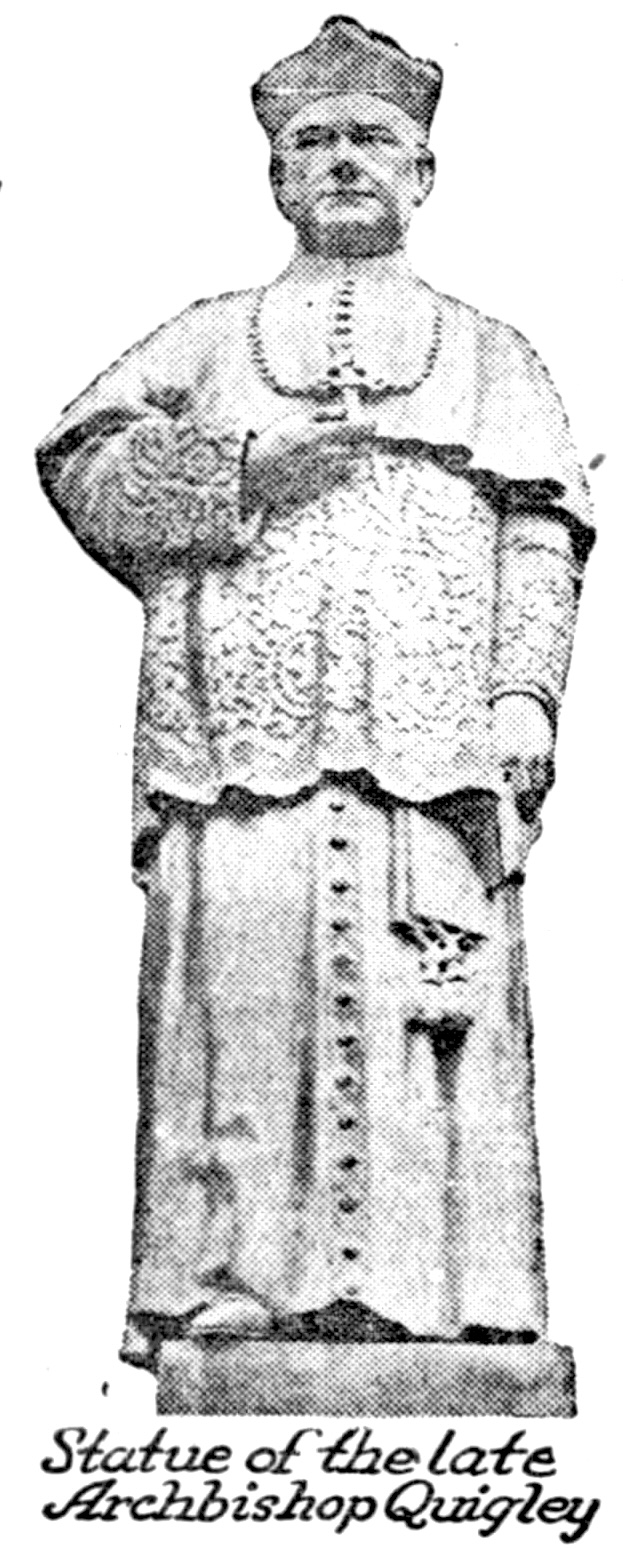
Statue of the Late Archbishop Quigley.
A heroic sized statue in marble of the late Archbishop James Edward Quigley, for thirteen years, from 1902 to 1915, archbishop of Chicago of the Roman Catholic church, now stands on the northeast corner of Rush and Chestnut streets, inside the grounds of the Quigley Preparatory seminary.
The statue will be a perpetual reminder of the widely known prelate in whose honor the preparatory seminary has been erected, under the direction and leadership of his successor in office, Archbishop G. W. Mundelein.
The seminary is the most ornate and imposing ecclesiastical structure in the bounds of the archdiocese. Its dedication will take place in connection with the celebration of the diamond jubilee of the founding of the Chicago diocese. The date of dedication is not yet announced.
Archbishop Quigley was born in Oshawa, Ont., Canada, Oct. 15, 1854, and died in Rochester, N. Y., July 10, 1915. His body was brought to Chicago for burial. Immediately on his investiture Archbishop Mundelein announced his purpose to erect some permanent and important memorial to his predecessor. The seminary is for the training of young men who have in view the priesthood.
Chicago Tribune, January 4, 1920
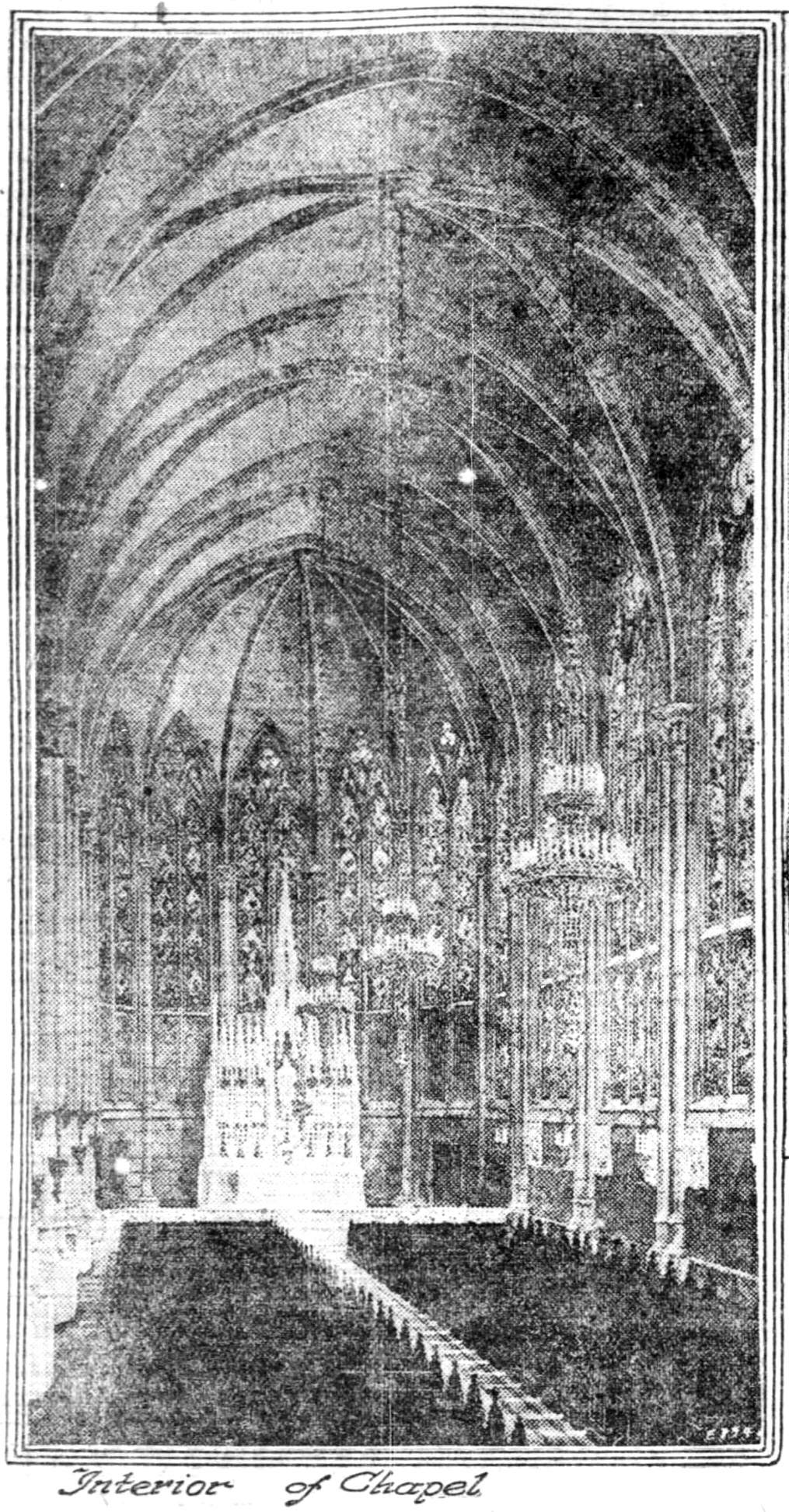
Interior of New Chapel Is Shown for the First Time.
For the first time Chicagoans can, by looking at the adjoining photographic layout, get a glimpse of the interior of what is claimed will be the city’s most beautiful chapel, as part of the Quigley Preparatory seminary, designed by Architect Zachary T. Davis, and under construction in Rush street, between Pearson and Chestnut. And a glimpse behind the closed doors of this building has been sought more and more as rumors of its beauties have spread. But only workmen have been allowed to see-not even a picture has been shown, until today in The Tribune.
The chapel, modeled after the Sainte Chapelle in Paris, is in the south wing of the seminary structure. It can be identified in the exterior view by the large circular window over the en-trance. The construction throughout is fireproof. The exterior face of walls, the tracery in windows, and the statues are of cut stone.
Interior of Stone.
The chapel interior is of cut stone, except the floors, which are of art marble. The ceiling is groined, arched, and ribbed, all of stone, and is 63 feet high.
The altar with statues is constructed of Caen stone. The cross on top of the spire is 38 feet above the floor. The light fixtures throughout are of cast bronze.
The stained glass windows are of richly colored mosaics of about 50,000 pieces of leaded English antique glass, no painting being applied except the flesh parts of the subjects in the medallions. The archbishop when selecting the subjects for the medallions had in mind the young students and the religious educational influence derived from the pictorial lessons portrayed. And it might interest Chicago builders to know that all of the art glass used is being made right here inside our city limits, Mr. Davis claiming that it surpasses anything he could find in New York.
Resembles Fourth Presbyterian.
The architecture of the seminary is Flemish Gothic-the building resembling somewhat the English Gothic Fourth Presbyterian church, a block to the east in North Michigan avenue.
In the north wing of the seminary are the library and gymnasium. The library book stacks will have a capacity of 50,000 volumes.
In connection with the gymnasium there will be a 20×60 swimming pool, faced with ceramic mosaic tile and filtered and purified by the violet ray system.
There also is an auditorium and twelve classrooms. There are to be two fan ventilating systems providing ventilation to all rooms, hall, library, and chapel. The building lot is 225x 175.
Memorial to Archbishop.
The Quigley seminary is the work of Archbishop Mundelein as a memorial to the late Archbishop Quigley, who opened the preparatory seminary with the title of Cathedral college in the building on the southeast corner of Superior and Cass streets, in the autumn of 1905.
Its purpose is to educate boys of the archdiocese for the priesthood. The course of studies comprises high school work and two years of college. Following this are courses in higher institutions. The students are admitted to Quigley seminary by competitive examination..
It is the hope and expectation of Architect Davis to have at least the chapel ready for use by Easter. Work began in November, 1916.
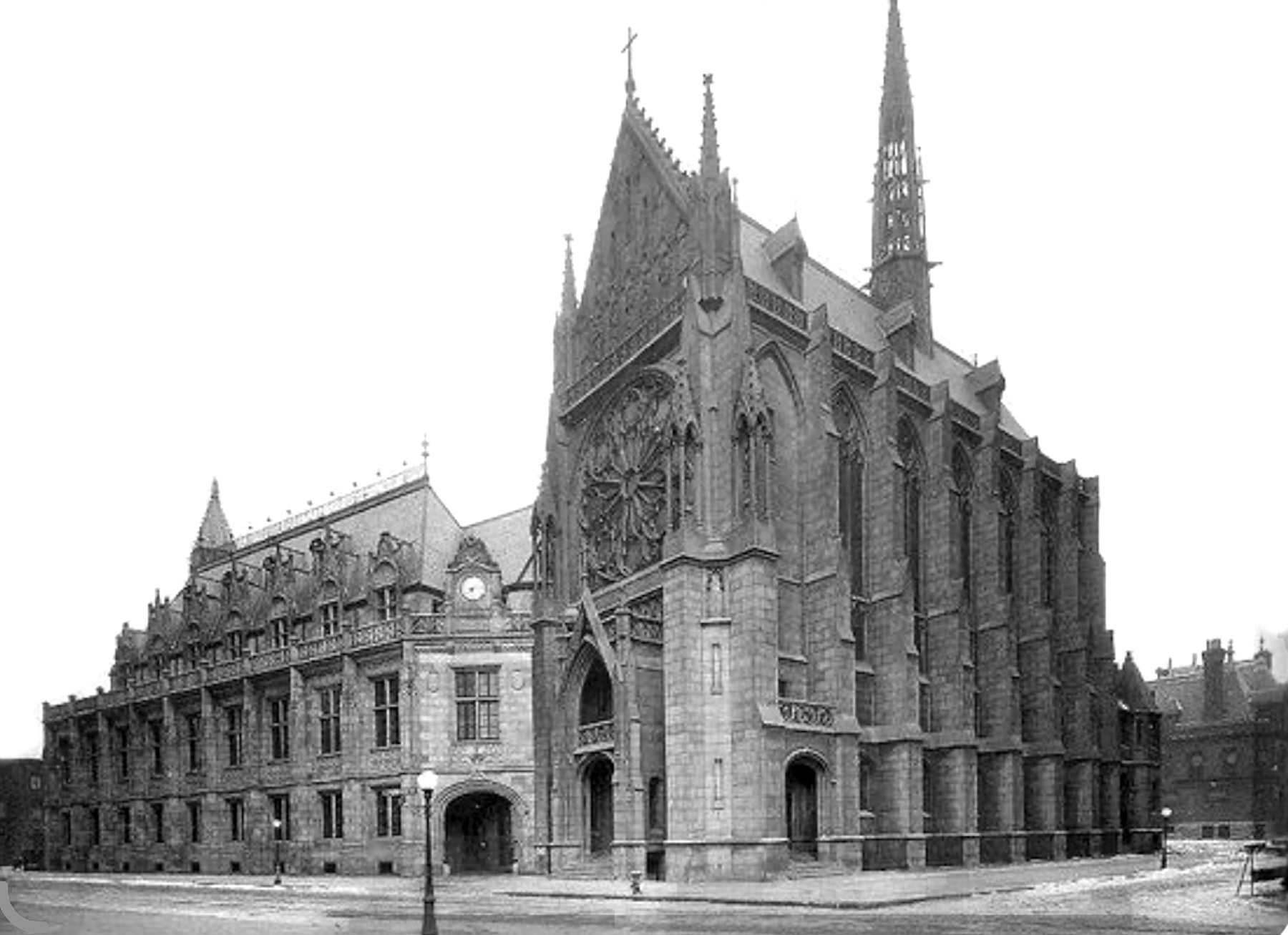
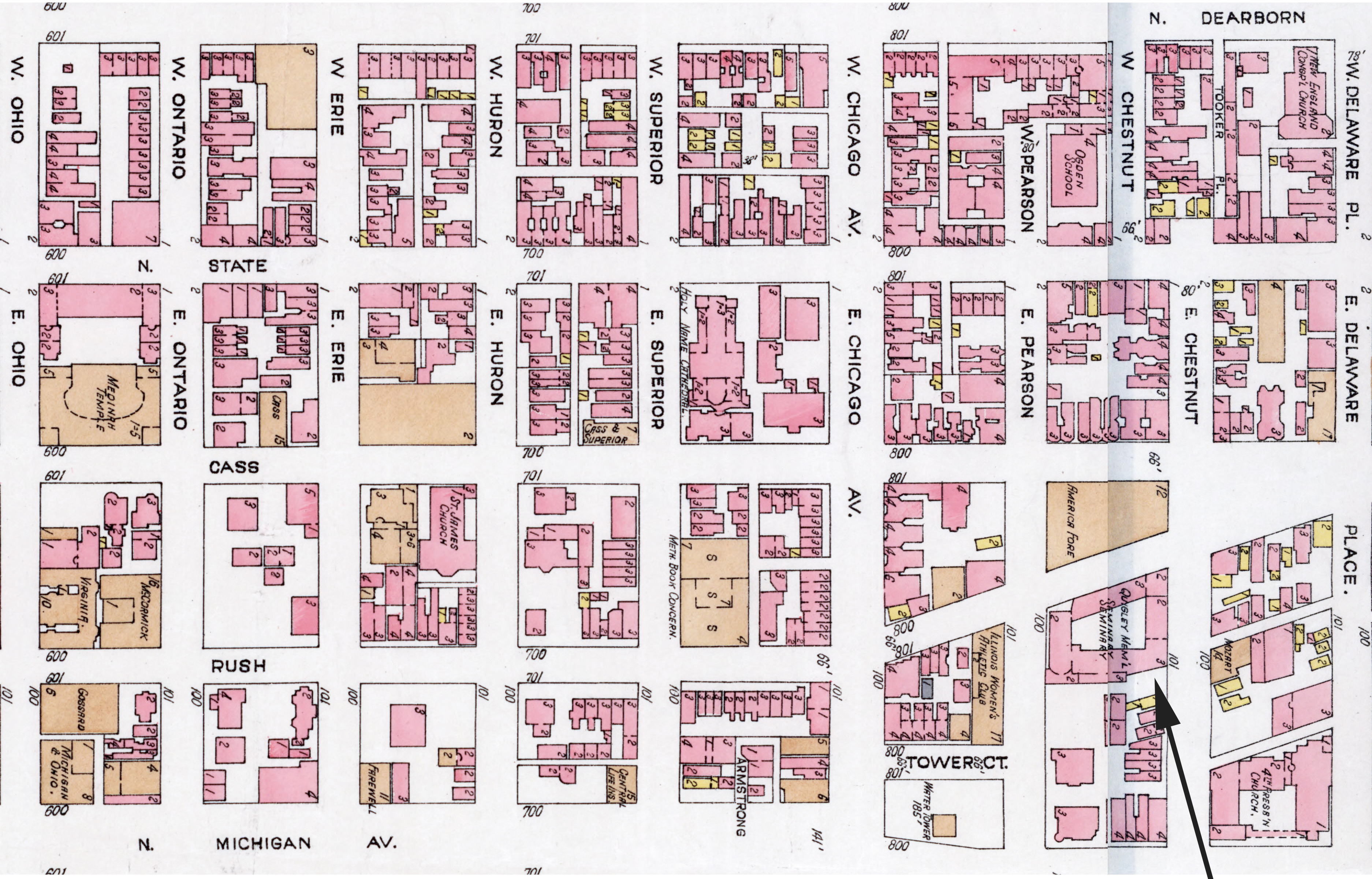
- Quigley Preparatory Seminary
Sanborn Fire Insurance Map
1927

Leave a Reply