Silent Movie and Radio in Chicago
Chicago Tribune, December 13, 1908
Result of Tribune Story. By Robert H. Cochrane.
Two years ago manager of a clothing store in the city of Oshkosh, Wis.
Now founder and president of a company which does business of $10,000 a week—half a million dollars a year! And all as a direct result of reading the Workers’ Magazine of THE CHICAGO SUNDAY TRIBUNE!
That is the record of a Chicago man and his feeling of gratitude toward THE TRIBUNE well may be imagined.
His name is Carl Laemmle.
Two years ago Mr. Laemmle picked up his SUNDAY TRIBUNE in Oshkosh and read a story in the Worker’s Magazine section, dealing with the wonderful possibilities of the moving picture business. It caught his eye and held his interest. His friends, to whom he made casual mention of the article In question, pooh-poohed the idea.1
But he continued to think it over, revolving his mind the different facts brought out THE TRIBUNE’S story. He came to in Chicago and visited some of the moving pioture theaters on State street and elsewhere. He found every assertion of the newspaper story verified—nay, he found it more than verified beyond the wildest flights of his own active imagination.
First Project a Joke?
State street had but one or two 5 cent theaters at that time. Mr. Laemmle cast about for the main thing—”a good location—but was unable to find anything that suited him. True, he was offered one store on State street with a twenty foot frontage at a yearly rental of $1,000 per foot. But he was hardly prepared to go into the deal on such a scale as that.
He finally rented a store on Milwaukee Avenue. His project was considered a good deal of a joke at that time. One of his neighbors predicted that he would not last thirty days.
“You cannot expect to make your theater pay on a street so far removed from the business district,” he was warned.
But he rented the store, nevertheless, and invested nearly all of his capital in making both the exterior and the interior comfortable, safe, and attractive.
Mr. Laemmle’s first week’s profits were $100. The second week he banked $150 over his “high water mark” in receipts was $650 for one week, but that was an exception to the rule, of course. Other theaters sprang into existence in the twinkling of an eye. Naturally this cut down Mr. Laemmle’s receipts, but not to such an extent that he was worried about it.
The thing that bothered him most was his inability to secure the very best pictures, known as films to the trade. He tried firm after firm, agency after agency engaged in renting films to 5 cent theaters—for the films. are rented, not sold outright—but without avail.
Make Next Move Forward.
So he decided to take the next step upward and become a “lessor” himself. With money he had saved from his theater profits he bought several films from the manufacturers. This was six months after the day he opened his theater.
Being a firm believer in printer’s ink, Mr. Laemmle advertised the fact that he had been unable to rent such films as he wanted, so he had bought them. He was now ready to rent them, in turn, to such other theater owners as might desire the sort of pictures he insisted upon for his own house. He did not have many films, but what he had would satisfy the most exacting theater manager, so he declared.
This frank tone of advertising caught the fancy of other theater owners and managers. They rented his films. He bought more. This was the foundation of the present concern known as the Laemmle Film Service.
His first week’s receipts from films rented were $40. The second week he took in $90. By the end of the third week the receipts had grown to $250. Two months later his weekly receipts were $2,000.
He found It necessary to secure larger headquarters three times within less than a year, so rapid and unexpected was the growth of this amazing business. Its possibilities opened before his eyes with kaleidoscopio swiftness. He seized upon them and made the most of them.
Inventor Moves Danger Limit.
Within the next year he had established large branch houses in Evansville, Ind.; Memphis, Tenn.; Minneapolis, Minn.; Omaha, Neb.; Salt Lake City, Utah; Portland, Ore., and Montreal, Canada. Instead of the two assistants who comprised his staff at the beginning he now controlled an organization of nearly 100 experienced moving picture men.
Today his weekly receipts are $10,000, and still the limit is beyond sight. If there had been danger of a near approach of the limit danger was obviated when a Berlin inventor produced a contrivance which forces the phonograph and the moving picture machine to work in perfect unison. Thus were born the “pictures that sing, and talk, and move,” making possible the reproduction of an entire opera, if desired, with all the sights and sounds, acting and music that go with it.
“It all resulted directly—mind you, directly -from reading the Workers’ magazine,” says Mr. Laemmle. “Were it not for that I would be selling clothes in Oshkosh. I would still a salary coward.”
“My suggestion to readers of THE TRIBUNE magazine is this: Do a little thinking while you read. Take your reading seriously. If you find a good story about something accomplished by some other worker don’t throw your hands up and say, ‘O, it’s all very well to read about such things, but it’s another thing to do them.’ Get busy. Form another the habit of forming your judgment quickly and then act upon it. Don’t be afraid to and then upon own ability. The more desperate your gamble the more desperate and perate your gamble will be your own individual efforts to win out.
“Failures” Need Not Count.
This, I will admit, is not the old fashioned advice that is generally doled out to young men. I don’t take much interest stories of men we carried newspapers when they boys and then grew to be millionaires. were Just because you didn’t carry newspapers or saw wood when you were a boy is no reason you cannot become big in your line.
“I claim that regardless of whatever failures you may have made in the past, you can make good if you will really apply yourself. Make up your mind to do one thing then do it with all your might. That’s what I’m doing, and the bigger my business grows the harder I’m doing it.
“For heaven’s sake, keep out of ruts. If you find yourself grubbing along in the same you day after day—and there are old groove thousands of you who do it—break away from if it looks like a risk. It won’t be It even one-half so risky as letting yourself grow automaton. That’s what kills growth—automatic application instead thinking application. I have no more than my share of brains, but I make them work overtime.
“Work with your brains as well as with your hands and eyes and feet. If you read the Workers Magazine, read it with your brains as well as your eyes. You’ll stand a whole lot greater chances of making good this way than by any other method, I don’t care whether you are a hodcarrier or a bank president.
“And whatever you do or don’t do—don’t And be a salary coward.”.
The Moving Picture World, July 15, 1916 by Paul Gulick
Carl Laemmle Made Start in Chicago Store Show
Money Made in the Clothing Business Opened a Little Picture Theatre–Now President of Universal
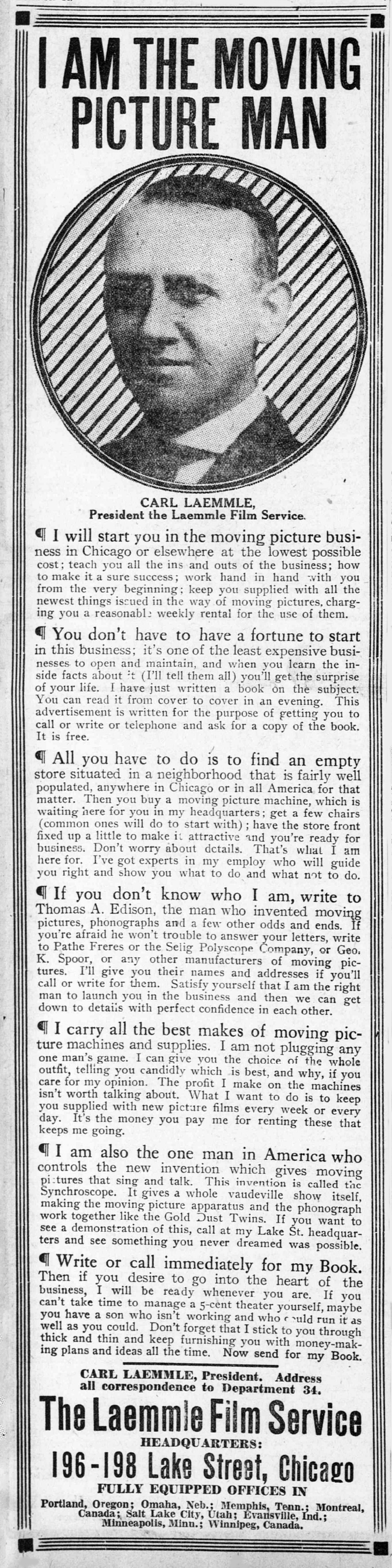
Carl Laemmle, the president of the Universal Film Manufacturing Company, landed in New York City in 1884. His wealth consisted mainly in sterling character and unbounded ambition, and faith in the Land of Liberty. He had no money. In the first place, he learned the language of this country while clerking in a drug store in New York. An opportunity of which he took immediate advantage brought him to Chicago. where he secured employment in a department store. The high price paid for labor in the South Dakota harvest fields attracted him, and his $2.75 a day shocking wheat is not one of the least pleasant remembrances of his career. During the panic of 1893 Mr. Laemmie went to Oshkosh as bookkeeper in a retail clothing store and it was only a few years before he became manager of the store. He entered into the social and civic life of Oshkosh as well as into its business life, and there are hundreds of people in this Wisconsin city who remember him for his business ability, his genial personality, and his keen interest in everything which went on about him.
After twelve years in Oshkosh, during which time he had saved up a considerable sum of money made from ‘the clothing business, Carl Laemmle came to Chicago with his little pile, to invest in a new line of endeavor: His ambition was a chain of five and ten-cent stores, the idea of a small priced commodity in tremendous quantities having made a very strong appeal to his imagination. As he was looking about Chicago for suitable locations he chanced to see the flamboyant pictures of a moving picture show in operation. The picture show was a novelty to him, as it was to millions of others at that time. He immediately investigated it. This theater was located in the Palmer House block, and was owned and operated by Jones, Linick and Schaeffer. Mr. Laemmle does not remember the name of the theater, but he was so pleased with it, and with the idea of the quick turn over of money to be made in this new business, that he visited it several times. He also went into the only other picture theater in Chicago, the Nickelodeon, on Halsted~ street near Van Buren. His decision to put his money into the film business was made right then and there, and the whole course of his life was changed. He saw the opportunity and grasped it unhesitatingly.
In a very short time he had taken a lease on the property located at 909 Milwaukee avenue, remodeled it and opened what was known as the White Front theater, “The coolest 5¢ theater in Chicago.” The opening was on February 24, 1906. The theater contained 214 seats, and was, of course, nothing but a remodeled store. Maurice Fleckles, who later became Mr. Laemmle’s brother-in-law, looked after the remodeling of the theater for him. Later when Mr. Laemmle decided to establish a film exchange of his own, Mr. Fleckles became associated with him, and a little bit later R. H. Cochrane, present vice-president of the Universal, went in with Mr. Laemmle in the exchange, and later in the manufacturing end of the business. This exchange was called the Laemmle Film Service, and was established in October 1, 1906, in the Crilly Building, at Monroe and Dearborn streets. After a few months it moved to 196 West Lake street, where its space was continually enlarged, until its present location was made necessary at 205 West Washington street.
The White Front theater was a success from the very start. Walther Johnson, now manager of the Parkway theater in Chicago, was its first manager, although Mr. Laemmle spent as much time at the theater as he could spare from his other duties. This picture of Mr. Laemmle’s first show house was taken on July 24, 1906, one of the hottest days of the year, and shows Mr. Johnson in his shirt sleeves near the entrance. Mr. Laemmle charged 5¢ in his theater, although one other house in Chicago charged 10¢, and made money at it. But Mr. Laemmle was a merchant and a great advertiser. He believed in letting everyone know about what he had to sell, and as in Oshkosh, where he was known as the largest advertiser in the city, the advertising and the five-cent price packed his house all the time.
The greatest difficulty which a manager in those days faced was getting any film at all to run. The few exchanges in existence were very independent and could afford to be, though they in turn were dependent on the few manufacturers.
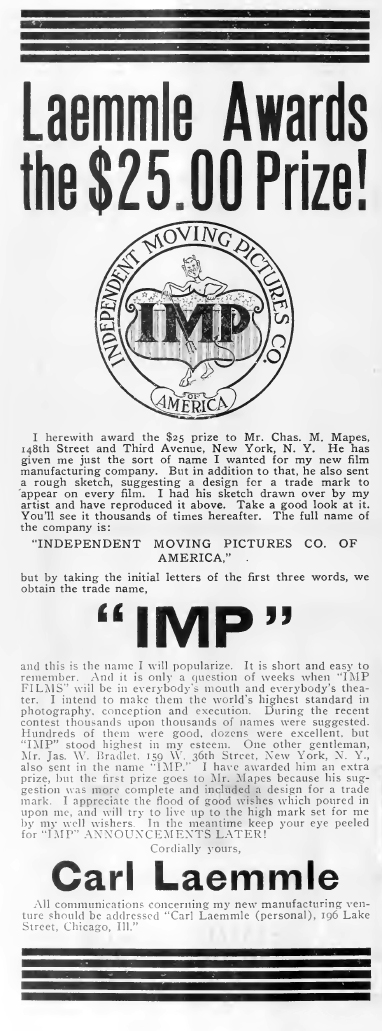
To supply the great demand for film now became the dominant factor of Mr. Laemmle’s life, and made him in turn a successful exchange manager and finally president of the largest film manufacturing concern in the universe. Mr. Laemmle’s first show consisted of one reel of film, and that was only 900 feet long. Each show lasted about twenty-two minutes, and included a song besides the 900-foot reel. Under these circumstances, playing to turn-away business, it was possible for the house to clear as high as $192 in one day, and this is the record for the White Front, though business usually ran around $180. Where is there a 214-seat 5¢ theater which can beat that today?
Mr. Laemmle also owned another house, having acquired it very soon after the White Front, in April, 1906. This theater seems never to have had a definite name. It was located at 1233 So. Halsted street, and like the White Front, was a converted store show. These were the only two houses in which Mr. Laemmle had any considerable interest, and his interest in them soon became secondary to his exchange, and that in turn to his manufacturing interest in the Independent Movie Pictures (IMP) Company.
The later history of the White Front is mainly interesting in that it is now the location of a successful five and ten-cent store. It will be remembered that a chain of five and ten cent stores was Mr. Laemmle’s ambition, when he was diverted by moving pictures, which appealed to him as being a still more attractive small priced investment. ‘
The property, which had a fifty-foot frontage, could have been bought for $40,000. Since then it has changed hands twice, first for $65,000, then for $85,000, and is now worth $140,000. When Mr. Laemmle’s lease of the theater was up at the end of five years, the proposition of buying the property came up again, but Mr. Fleckles was very much against the proposal, as he had come to the conclusion, and so had Mr. Laemmle, that the small theater was a thing of the past, and that large seating capacity was essential for the success of a theater, at least in such a prominent location as this one had. Also, the rental was so greatly advanced that it would have been highly inadvisable to sign another lease on the new terms. This closed Mr. Laemmle’s active management and ownership of picture theaters.
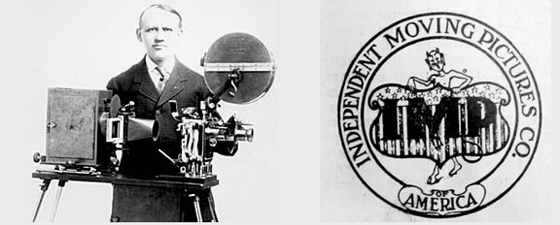
Carl Laemmle and the Independent Movie Pictures (IMP) Company logo
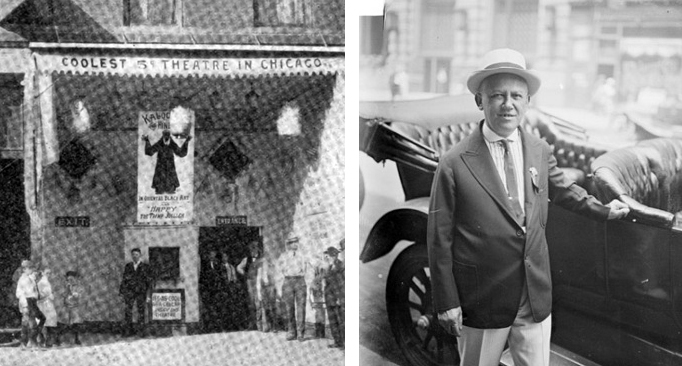
White Front Theatre and Carl Laemmle
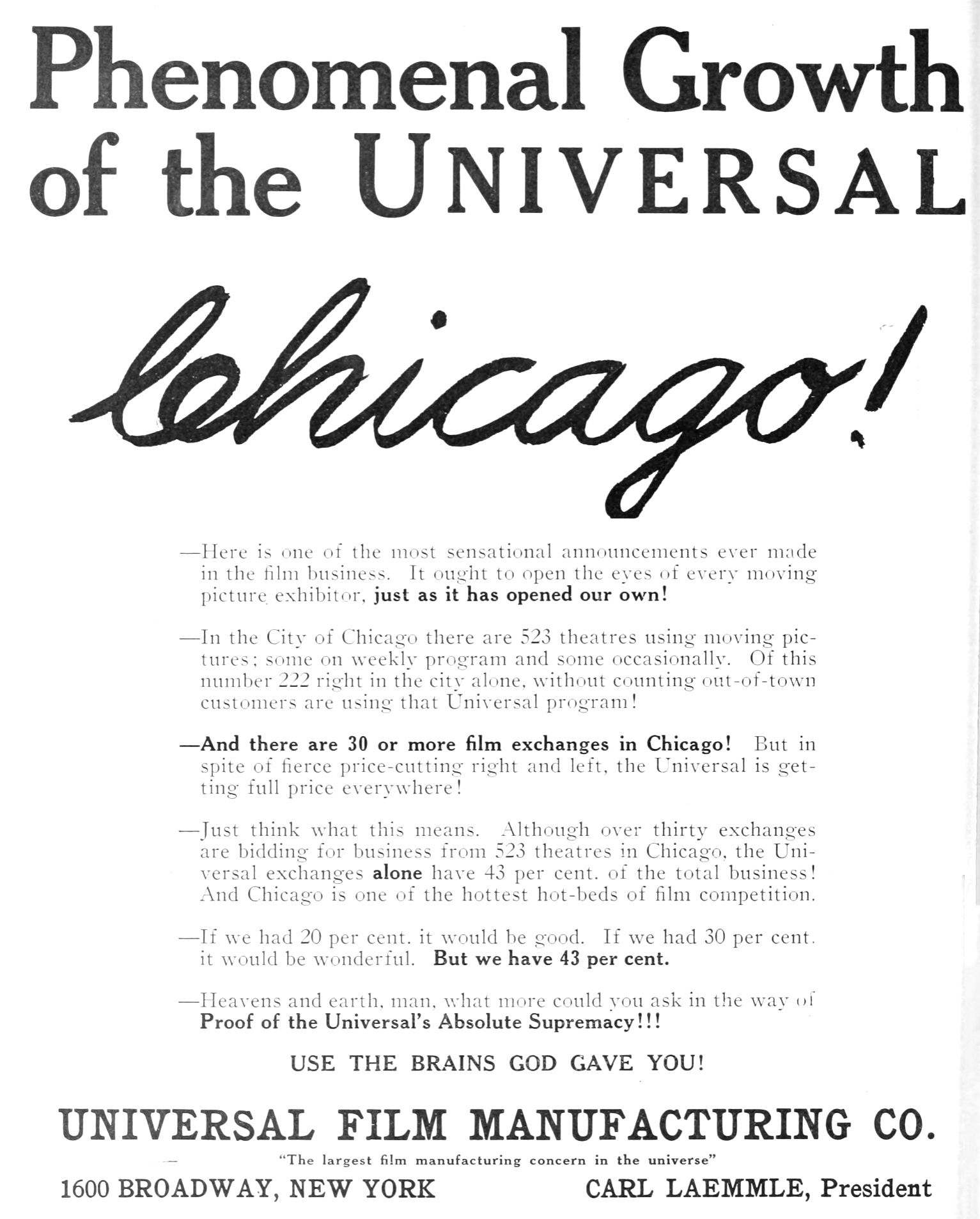
Universal Film Manufacturing
Moving Picture World
November 14, 1914

Nice story if it was only accurate enough. I’ve studied the life and times of Carl Laemmle for nearly 40 years. I could give that writer some pointers. I’ve met a number of people who knew him including his own son. Need not argue the accuracy. A true story should be 100% accurate. Don’t know where the writer was getting information? Nice try.
Thanks for the input.
This is interesting indeed. While I have not been studying Carl Laemmle for 40 years, I have lived with his memory for all my 56 years. A point unmentioned here is that his other brother-in-law, Julius Stern (Carl married Julius’ sister Recha Stern), managed the White Front, then the Film Exchange, was a key player in the management and growth of IMP and then at Universal. How do I know? Julius Stern was my grandfather.
Gilbert Sherman: If you should see this, please contact me. I’m currently researching and writing a book on the Century, Rainbow, and Stern Brothers Comedies of Julius and Abe Stern, and would love to speak with you. You can contact me at ThomasReeder@Live.com. I look forward to hearing from you.