Chittenden’s Block, Honore and Waite’s Bank, Commercial National Bank
Life Span: 1864-1871
Location: Dearborn street, between Randolph and Couch place1
Architect: Otis L. Wheelock, T. V. Wadskier (Blaney’s Hall)
- Edwards’ Annual Directory in the City of Chicago, for 1866
Chittenden George R., room 4, 53 Dearborn, h. 364 Michigan
John C. W. Bailey’s Chicago City Directory for 1867
Chittenden George R., office 53 Dearborn, h. 364 Michigan
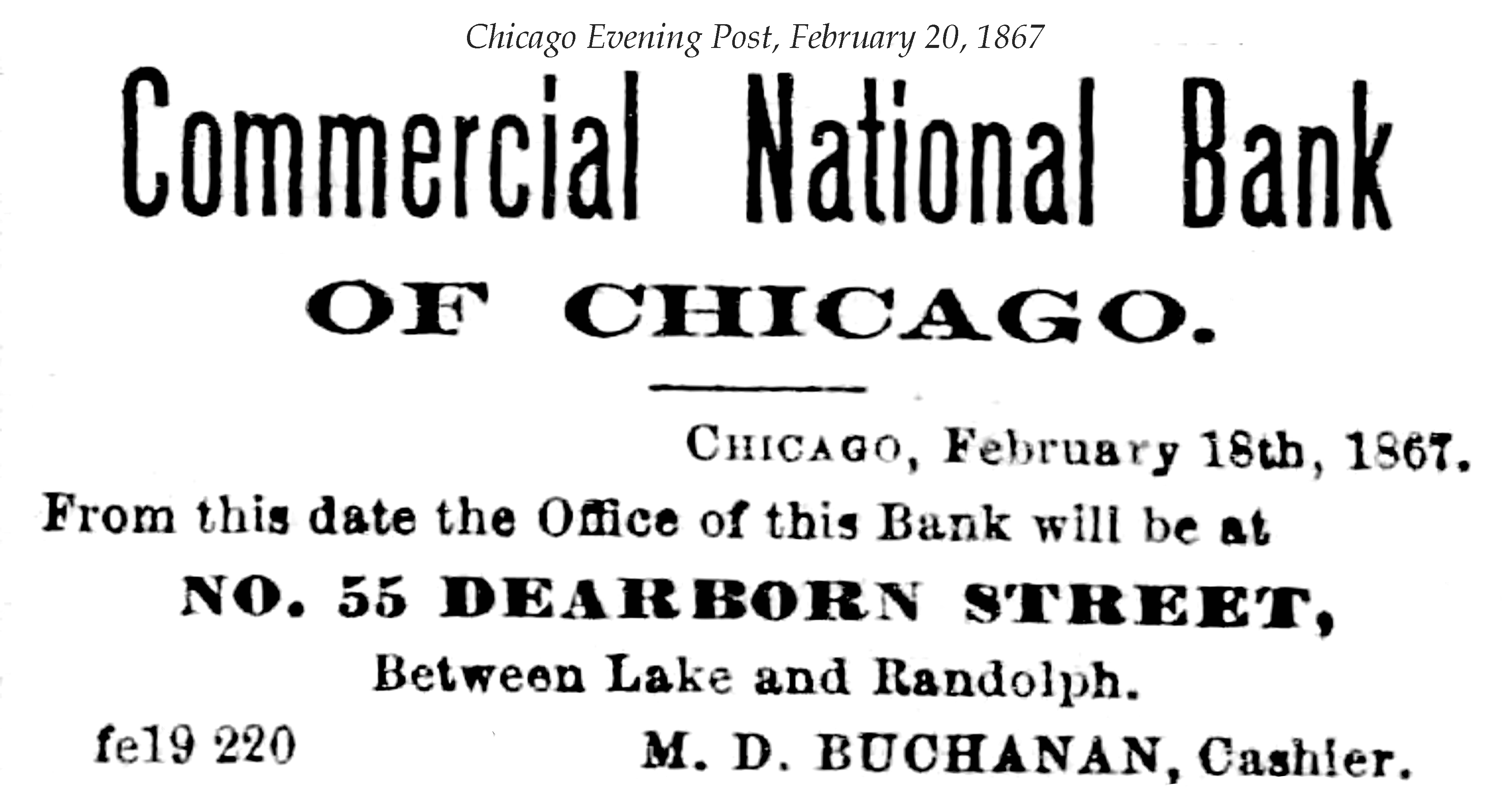
Commercial National Bank, H. F. Eames, pres. M. D. Buchanan, cashr, 55 Dearborn
Blaney Lodge, No. 271, F. & A. M.—Regular meetings 2nd and 4th Wednesday, at Blaney Hall, D. C. Cregier, W. M.; J. D. C. Whitney, Secretary.
Edwards’ Annual Directory in the City of Chicago, for 1870
Chittenden George R. 53 Dearborn, r. 364 Michigan
Commercial National Bank, W. H. Eames, pres. M. D. Buchanan, cash. 55 Dearborn
Blaney No. 971—Meets every Wednesday evening, at Blaney Hall, 53 Dearborn street.
Chicago, Alton and St. Louis Railroad—General office, in basement, 55 Dearborn street.
Edwards’ Annual Directory in the City of Chicago, for 1871
Blaney, No. 271 Meets every Wednesday evening at Blaney Hall, 53 Dearborn
Chicago Tribune, March 24, 1864
New Banking Offices.—Preparations are being made to erect upon the vacant lot south of the Tremont. Exchange, a magnificent double building for the Western Marine Fire Insurance Company, and Messrs. A. C. Badger & Co., as banking-offices. Mr. Waite has effected a lease of the property for ninety-nine years. The main front building will be sixty-two feet in width, sixty-four feet in height, and seventy feet in depth. It will be modeled in modern style, with a French roof, and will be four stories with basement. There will be a rear building, sixty feet in depth, with an alley of fifteen feet in front. On the first floor of the main building will be two offices 24×44 feet. They will be finely fitted up, and it is intended to ornament the screen above the counter with plate glass panels. There will be six fire and burglar-proof vaults in the main building. On the second floor projecting over the front entrance, will be a stone balcony. Mr. O. L. Wheelock is the architect. The buildings are expected to be completed within four months.
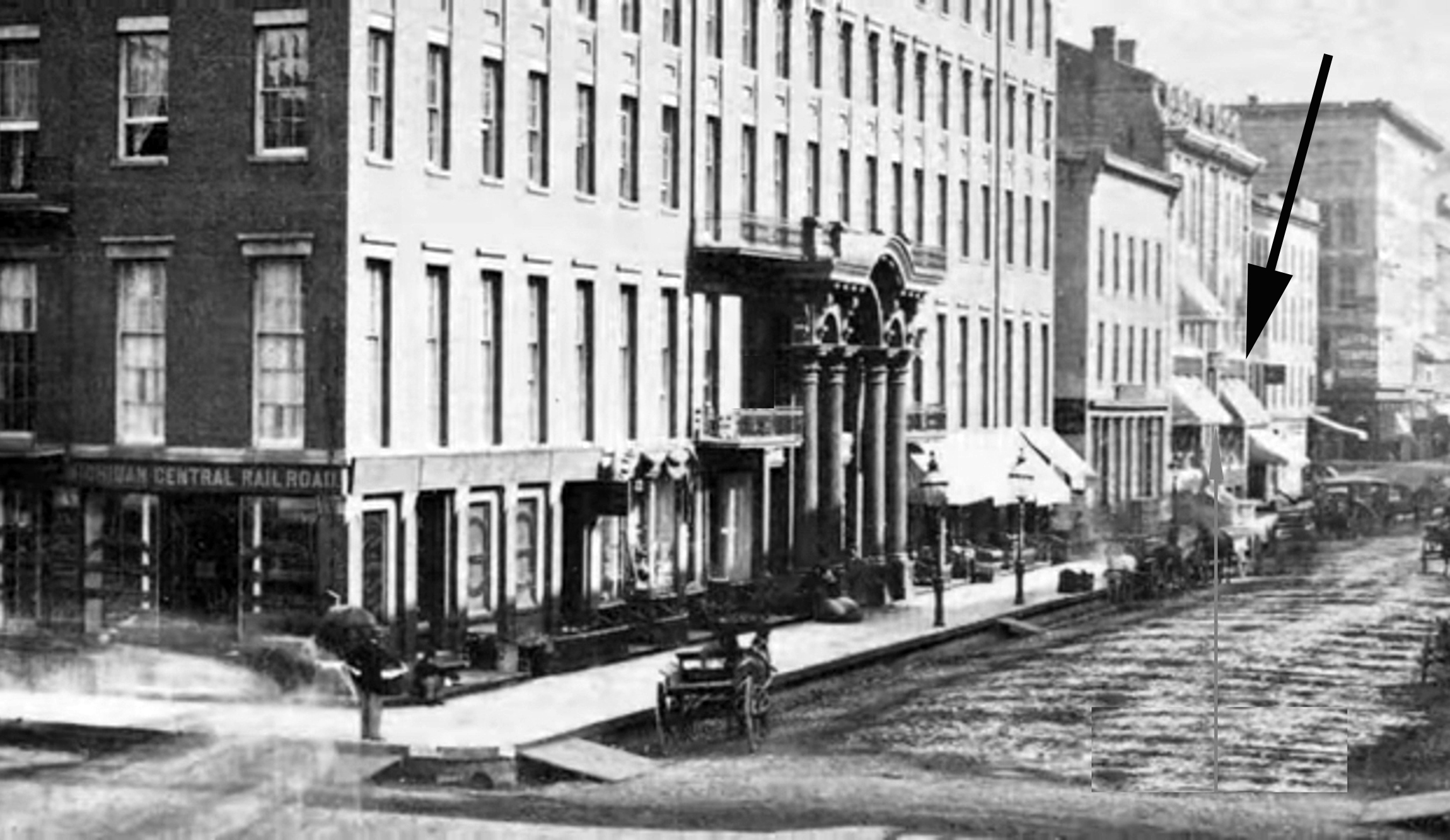
- Chittenden’s Block
Chicago Tribune, July 21, 1864
Building in Chicago.
On the east side of Dearborn street, between Randolph street and the Tremont House, a very handsome banking house with suitable offices for insurance, exchange, and similar business, is being built from plans by Otis L. Wheelock by Messrs. Honore & Waite. The building will have a front of 62 feet on Dearborn street, and will run 145 feet towards State. It will be four stories in height, with a high basement, Mansard slate roof, and handsome marble front. The main entrance is to be on Dearborn street, and will be approached by a broad flight of steps. Over the doorway will be a finely cut stone balcony. The principal floor of the building will be divided into banking houses, one of which will be occupied by Mr. Waite as the office of the Western Marine and Fire Insurance Company, and the other by the banking firm of A.C. Badger & Co. The principal rooms of each firm will be 24 by 40 feet, and each one is provided with fire and burglar proof vaults. The basement will consist of two exchange offices, 24 by 47 feet, with vaults and other conveniences. The second story is leased to the C.A. & ST.L. R.R. CO., and will be fitted according to their wishes as offices, and the third and fourth floors are intended as offices for business and professional men. The block will contain some very fine specimens of stone cutting by Edward Walker, and its cost is estimated at 75,000.
Chicago Tribune, February 15, 1867
The Commercial National Bank has leased the premises on Dearborn street, lately occupied by the Northwestern National, and will occupy the same immediately.
Chicago Tribune, November 10, 1866
Blaney Lodge—T. V. Wadskier, architect, is superintending the addition of another story to Chittenden’s Block, on east side Dearborn, between Lake and Randolph streets. This will form a hall twenty-four feet high, 42 by 63 feet, in Corinthian style, ceiling paneled, with large dome an the centre, and is to be used by Blaney Lodge. The improvement will cost $26,000, and will be completed January 1.
Chicago Tribune, February 24, 1867
Blaney Lodge Room, in Chittenden’s block, on Dearborn street, near Randolph, is nearly completed. It consists of an entire story built upon the roof the rear portion. of that block, forming a room by feet sixty feet, with a lofty celling, twenty-four feet high, terminating in a dome whose apex is about thirty-eight feet from the floor. The walls and ceiling will be splendidly stuccoed, frescoed and gilded, with appropriate paintings. The hall will contain an organ and be handsomely furnished, constituting the finest lodge room in the city, if not in the West. It will be completed about May 1st.
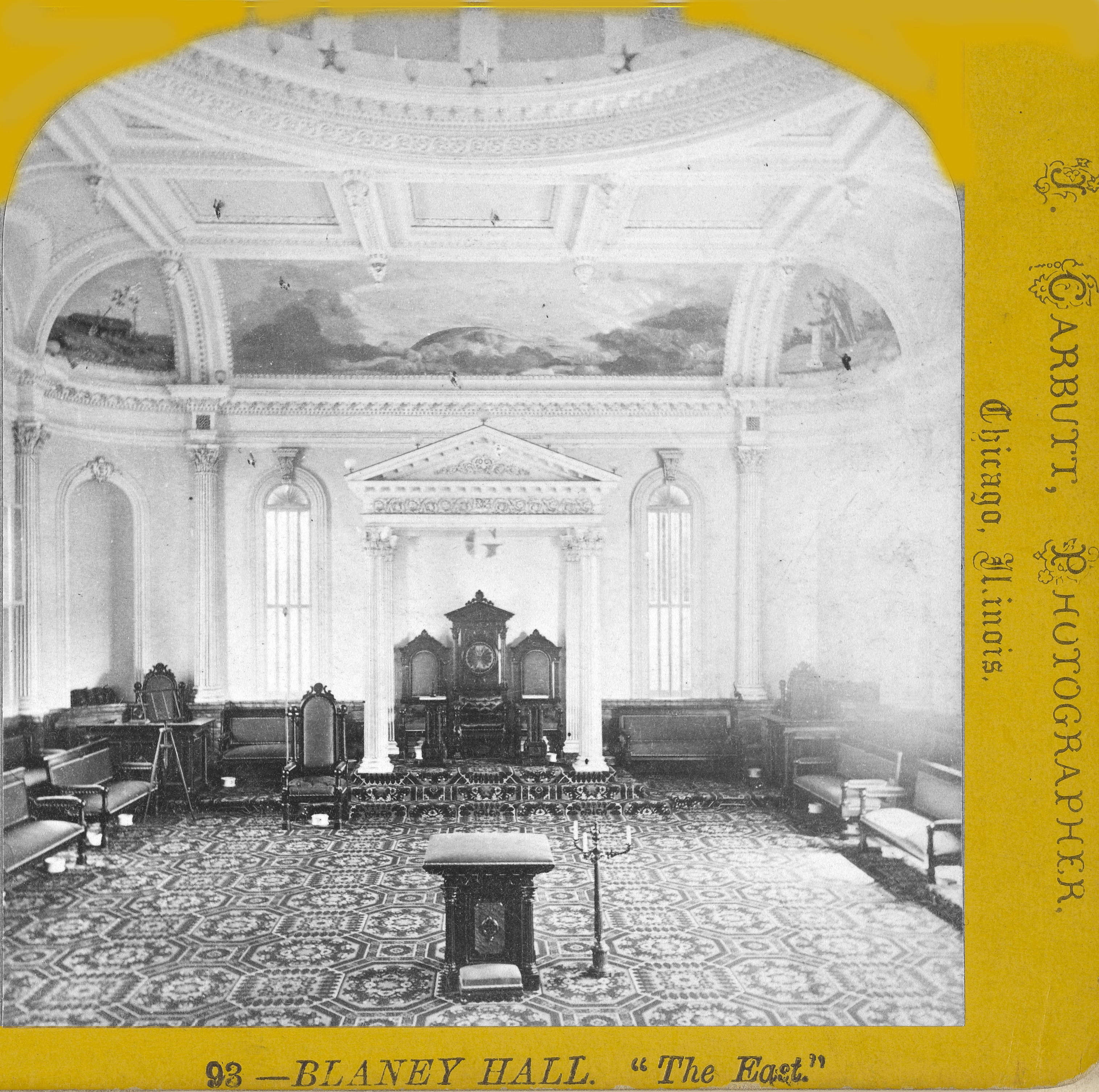
- Blaney Lodge, “The East”
Photographer, John Carbutt
Chicago Evening Post, June 12, 1867
The dedication of their new and beautiful hall, by the Blaney Lodge, last evening, was the occasion of one of those interesting and instructive Masonic celebrations so seldom witnessed by the outside world.
Shortly before nine o’clock the chair was taken by W. M. D. C. Cregier, Esq., in the presence of a large assemblage who had received special invitations for the occasion. At the command of the Master the Grand Lodge of Illinois was notified that Blaney Lodge was ready for their reception. On their entrance the W. M. addressed the Grand Master, J. V. Z. Blaney, and requested the Grand Lodge to dedicate their newly completed ball according to the usual custom.
After invoking the blessing of the Great Master of us all, the ceremonies were proceeded with. After the time-honored custom, by pouring corn, wine and oil on the Lodge and offering an invocation, Rev. Dr. O. H. Tiffany, Grand Chaplain, delivered the oration of the evening, of which space will permit only a few outlines.
He gave a brief history of Blaney Lodge, from its inception in 1863 to the present, with the various misfortunes, by fire and otherwise, which had attended it. He next proceeded with a comprehensive review of Masonry, and in a conclusive manner met the objections urged against it. With the advancement of the world, Masonry steadily keeps pace, and is rapidly permeating every part of Christendom. Its lodges are everywhere to be found, and the unquestioned testimony of public opinion is in favor of its beneficial influence, and its strong aid as a co- worker with civilization and Christianity.
After enumerating the various good ends promoted by Masonry, and at the same time warning his hearers that it must not be mistaken or substituted for religion, the reverend gentleman concluded.
After singing, Auld Lang Syne,” the audience were dismissed with the benediction by the chaplain.
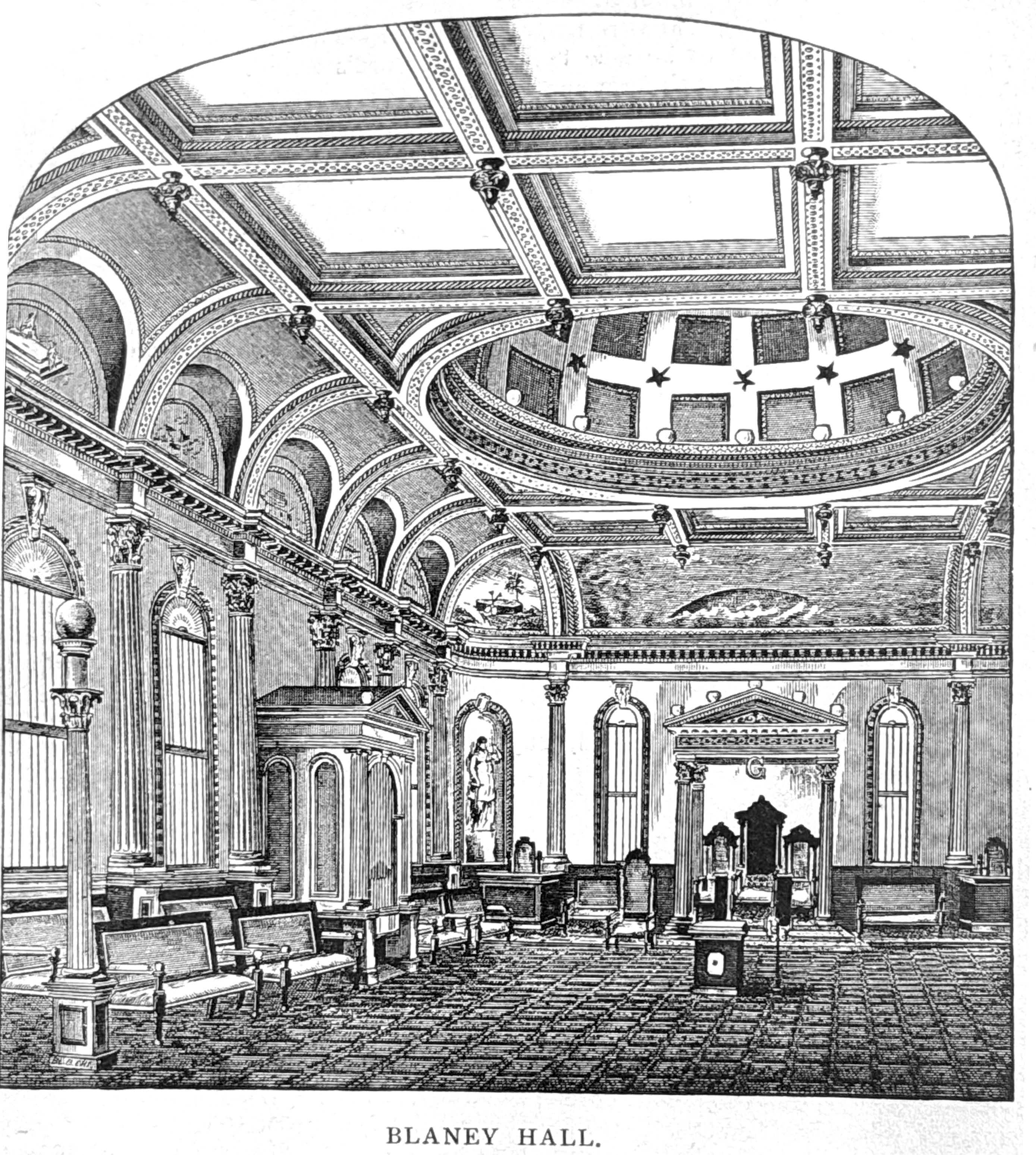
HALL.
The new hall is situated in the marble bank building of Mr. G. R. Chittenden, on Dearborn street, two doors south of the Tremont House. The entrance hall is 7 by 20 feet, leading to an elegant parlor 16 by 20 feet, and several smallrooms for lodge purposes. From these another stairway leads to the main hall, through the ante-room. The hall is 60 by 40 feet, and is probably the finest lodge room in the Union.
It is designed to embrace the five styles of architecture embraced in masonry, but it is mainly Corinthian. Sixteen Corinthian columps adorn the sides, on which rest ribs of tute a beautiful ceiling. At the junction of the fresco work, hang pendants emblematic of the order. There are eighty burners of grained glass, two at each of the sixteen columns, thirty-two about the dome, and sixteen about the sides. In the dome are eighty panels proportionately diminished their in size as they approach the center, and at intersecting is a beautiful gilt star. At the center, or rather the top, is a representation of the All-seeing Eye. The four corners of the room are rounded; and in prepared inches are to be placed statues of Justice, Temperance, Fortitude and Prudence, each nine feet high. In panels above the columns are emblematic paintings, the principal of which are on the west and east sides; these are 7 by 25 feet in size, the former representing the Ephraimites unable to pronounce the test work Shibboleth, and the latter, the creation, with the words, “Sit eux et eux fut.” The other paintings represent, Mortality, Immortality, the Allseeing-Eye, Ark of Hope, forty-seventh problem of Euclid, an hour glass, scythe, Jacob’s dream, the three steps of life, a pot of incense, a hive, the book of constitutions with a sword, and a sword pointing at a naked heart.
In other decorations, furniture and equipments, the same display of elegance and taste is apparent, and no expense has been spared by the justly proud membership. The total cost of hall and furniture, including committee and ante-rooms, is about $24,000. They have been erected under the especial supervision of Mr. T. V. Wadskier, the architect, ably seconded, however, by the a active trustees, Messrs, D. C. Cregier, George B. Carpenter and C. C. Garber.
The appearance of the hall, the success of last night’s celebration, and their prosperous condition must be a matter of congratulation to those actively interested as well as every individual member of Blaney Lodge, and we are sure the gathering will long be remembered by everyone who had an opportunity to witness it.
History of Chicago, A. T. Andreas, 1885
Masonic History.
The communications of the lodge were first held in Temperance Hall, on the corner of West Randolph and Clinton streets, until June 3, 1858, when the lodge was removed to the hall of Cleveland Lodge, No. 211, in the fifth story of the brick building at the southwest corner of Clinton and Fulton streets. On September 15, 1859, this building was burned, and Blaney Lodge lost everything but a silver trowel and its funds. It then determined on having a hall of its own, in the meantime occupying a hall on the northeast corner of Kinzie and North Wells streets. On February 10, 1860, Blaney Hall was dedicated, situated in the third story of the Metropolitan Block. On June 7, 1866, the lodge was again destroyed by fire, with the north end of Metropolitan Block, and again lost all its large property. The jewels and the silver trowel were afterward recovered from the ruins. The lodge then met in Masonic Temple, on Dearborn Street. On June 11, 1867, Blaney Hall, Nos. 53 and 55 Dearborn Street, was publicly dedicated by Grand Master J. V. Z. Blaney, and the first meeting of the lodge was held therein on June 12, 1867. The Chicago Times, of June 12, 1867, said:
- To obtain a just and accurate idea of the beauty of this paragon of halls, it must be seen. No mere written description can convey a just impression of its marvelous perfection of detail, or its beauty as a whole. Let it be known that the mere interior of this Temple of Masonry has cost about twenty thousand dollars.
The last stated communication was held September 27, 1871, in Blaney Hall; on October 9, 1871, it was destroyed. The silver trowel was recovered in a distorted shape, and two jewels were found uninjured, except from discoloration. The loss is impossible to state, the lodge being esteemed the wealthiest in Chicago before the fire; $13,012.50 was subsequently recovered from insurance.
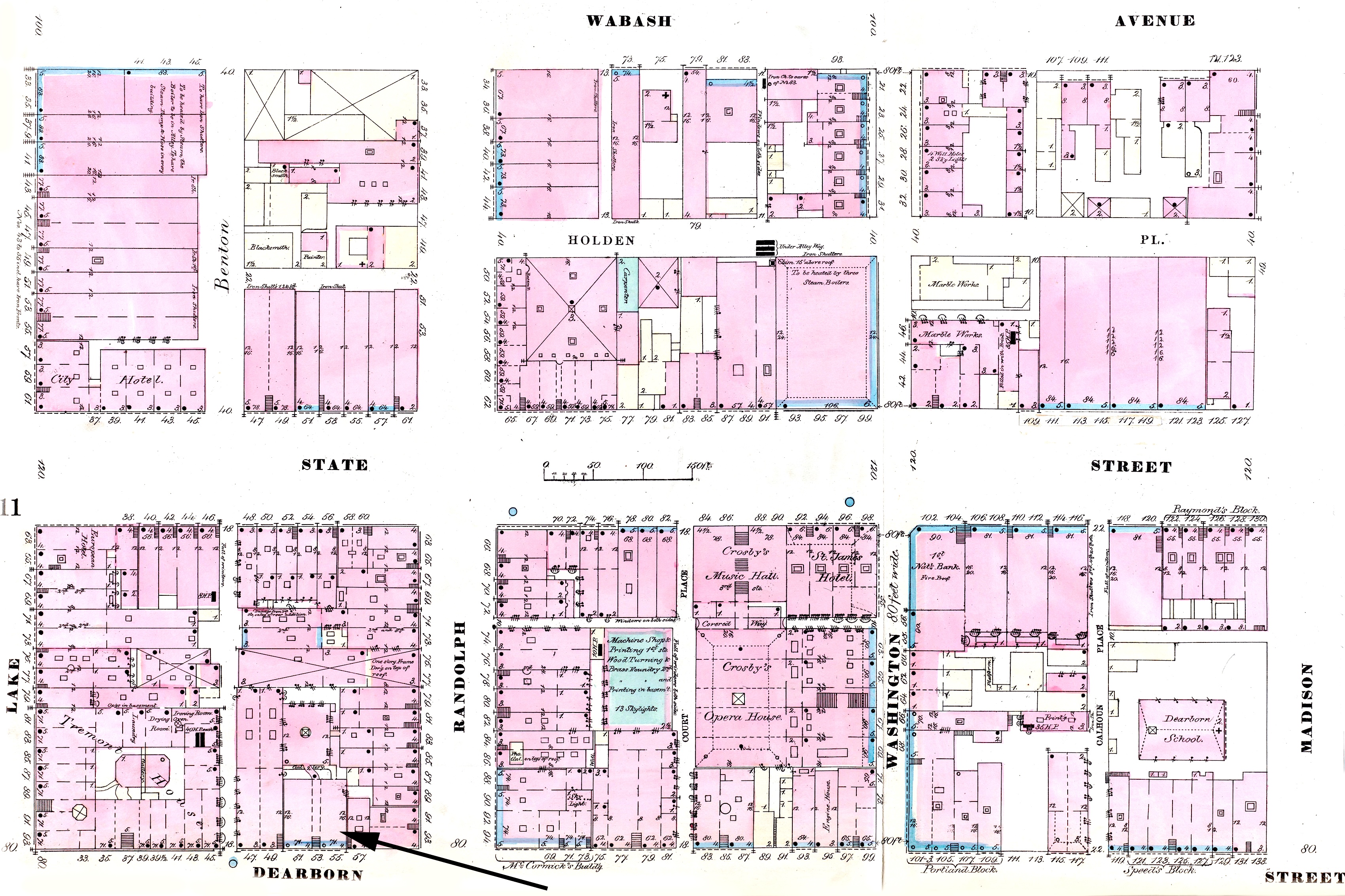
- Chittenden Block (Blaney Lodge in rear)
Sanborn Fire Insurance Map
1869
NOTES:
1Couch place ran from State west to Market. Benton place ran from State east to Michigan av.

Leave a Reply