McCormick’s Building
Life Span: 1860-1871
Location: SE corner Randolph and Dearborn
Architect: TBD
- Halpin & Bailey’s City Directory for the Year 1863
McCormick’s Building, Randolph, s.e. c. Dearborn.
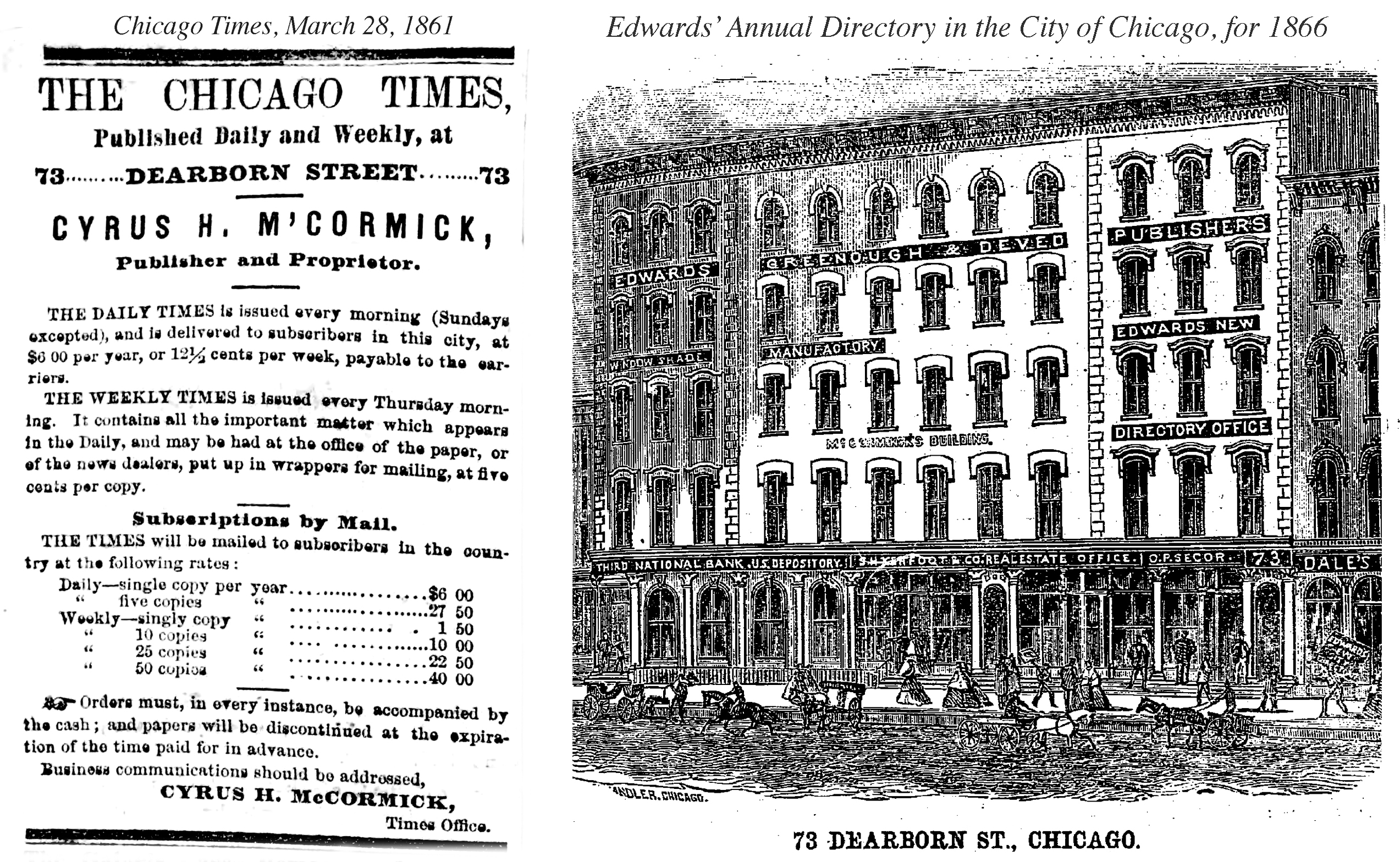
Chicago Times, 74 Randolph.1
Storey & Worden, (Wilbur F. Storey, and Annanias Worden,) publishers Chicago Times, 74 Randolph.
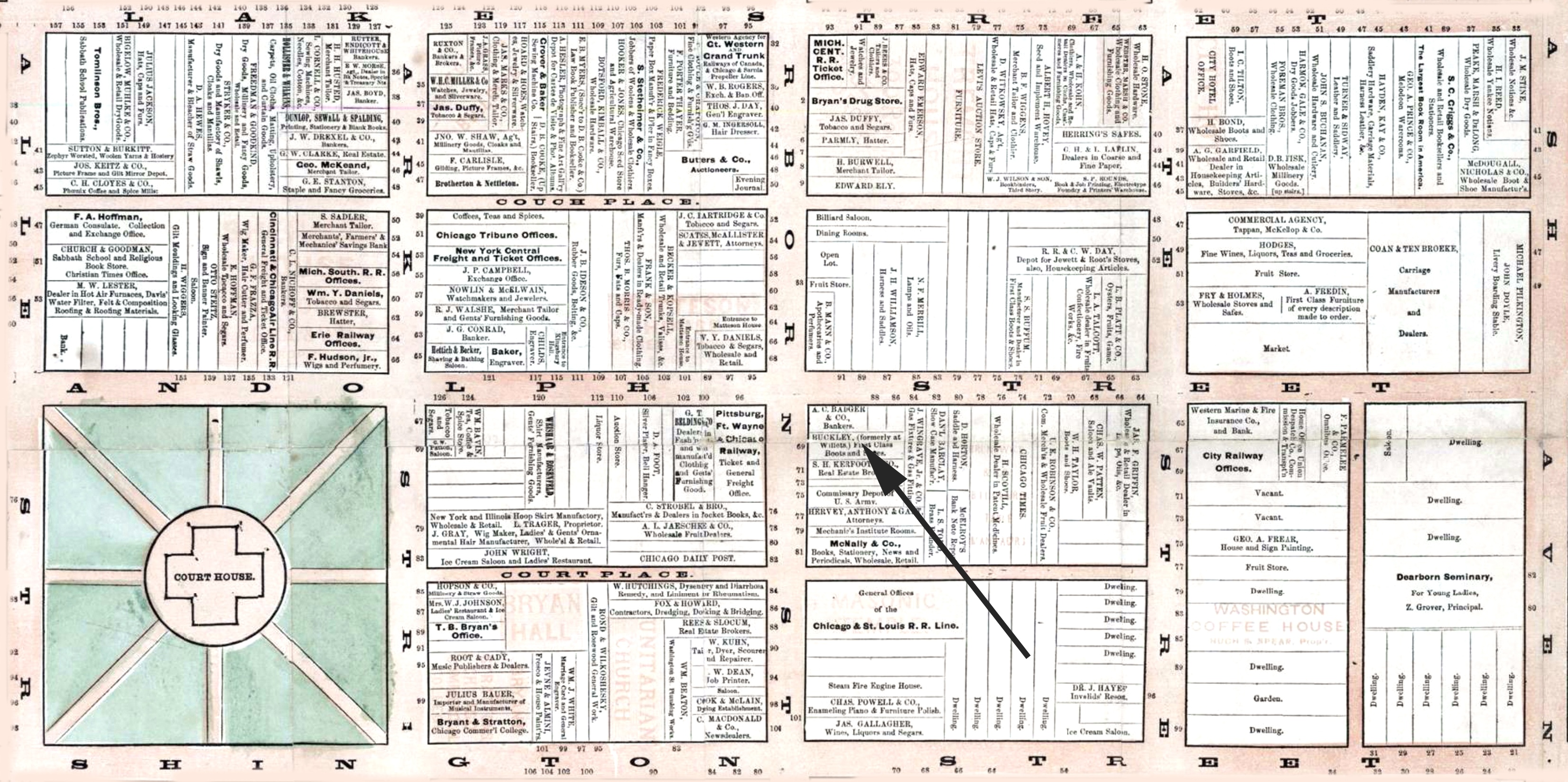
Badger A. C. & Co., (Alpheus C. Badger and Octavius F. Badger,) bankers, Randolph, s.e. cor. Dearborn
Buckley Thomas, boots and shoes, 69 Dearborn, h. 396 N. Dearborn.
Joliet & Chicago R.R. Co., Timothy B. Blackstone, pres., 6 McCormick’s bldg.
Kerfoot S. H. & Co., (Samuel H. Kerfoot,) real estate brokers, McCormick’s bldg, 71 Dearborn. (See advt. opp. p.)
Halpin’s Chicago City Directory for 1864
McCormick’s Building, se. corner Randolph and Dearborn streets
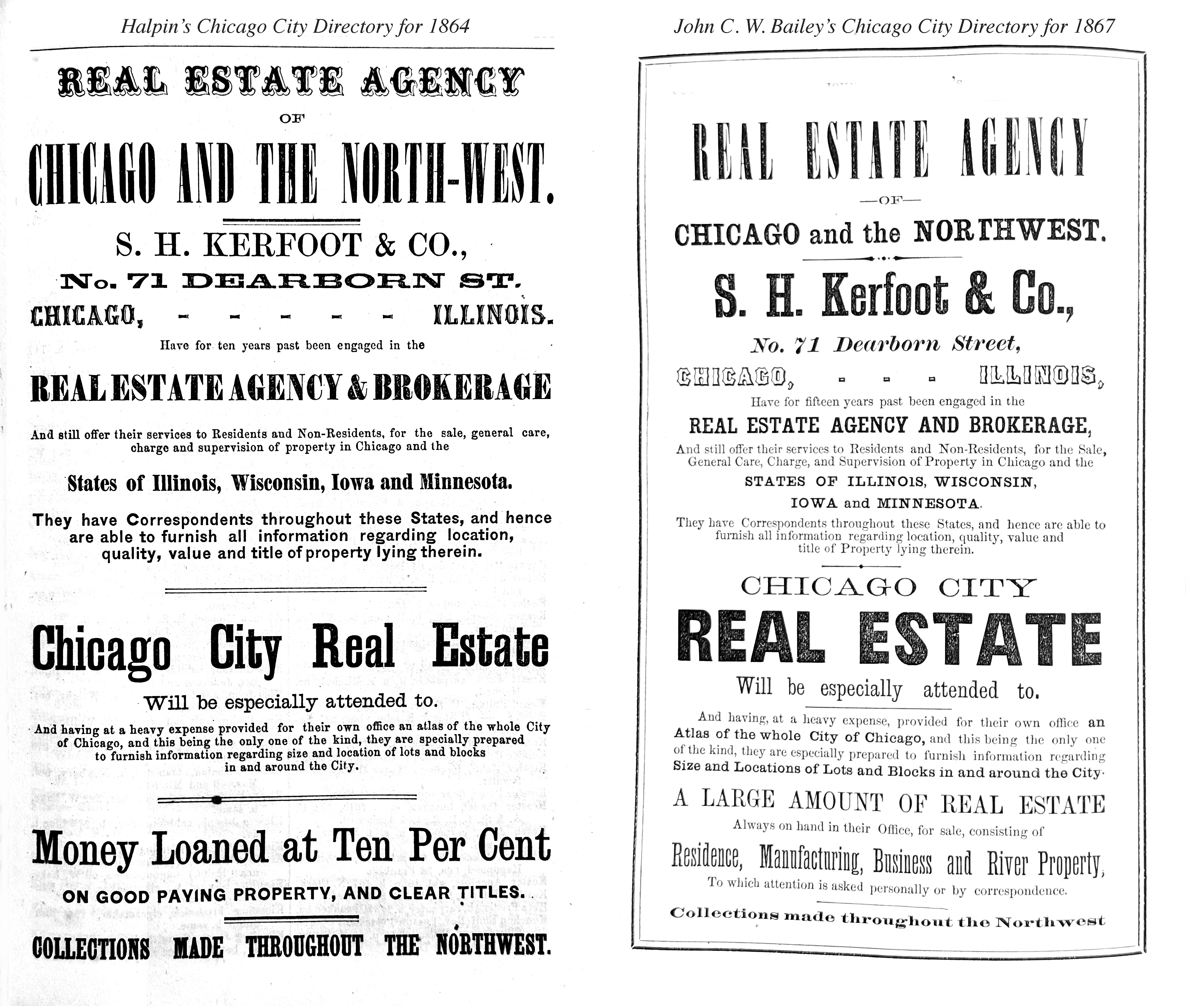
Campbell R. D. & Co., (Richard D. Campbell,) printers and publishers, 73 Dearborn, rooms 49 and 50.
Kerfoot S. H. & Co., (Samuel H. Kerfoot,) real estate brokers, McCormick’s bldg, 71 Dearborn. (See advt. opp. p.)
John C. W. Bailey’s Chicago City Directory for 1867
McCormick’s Building, se cor Randolph and Dearborn streets
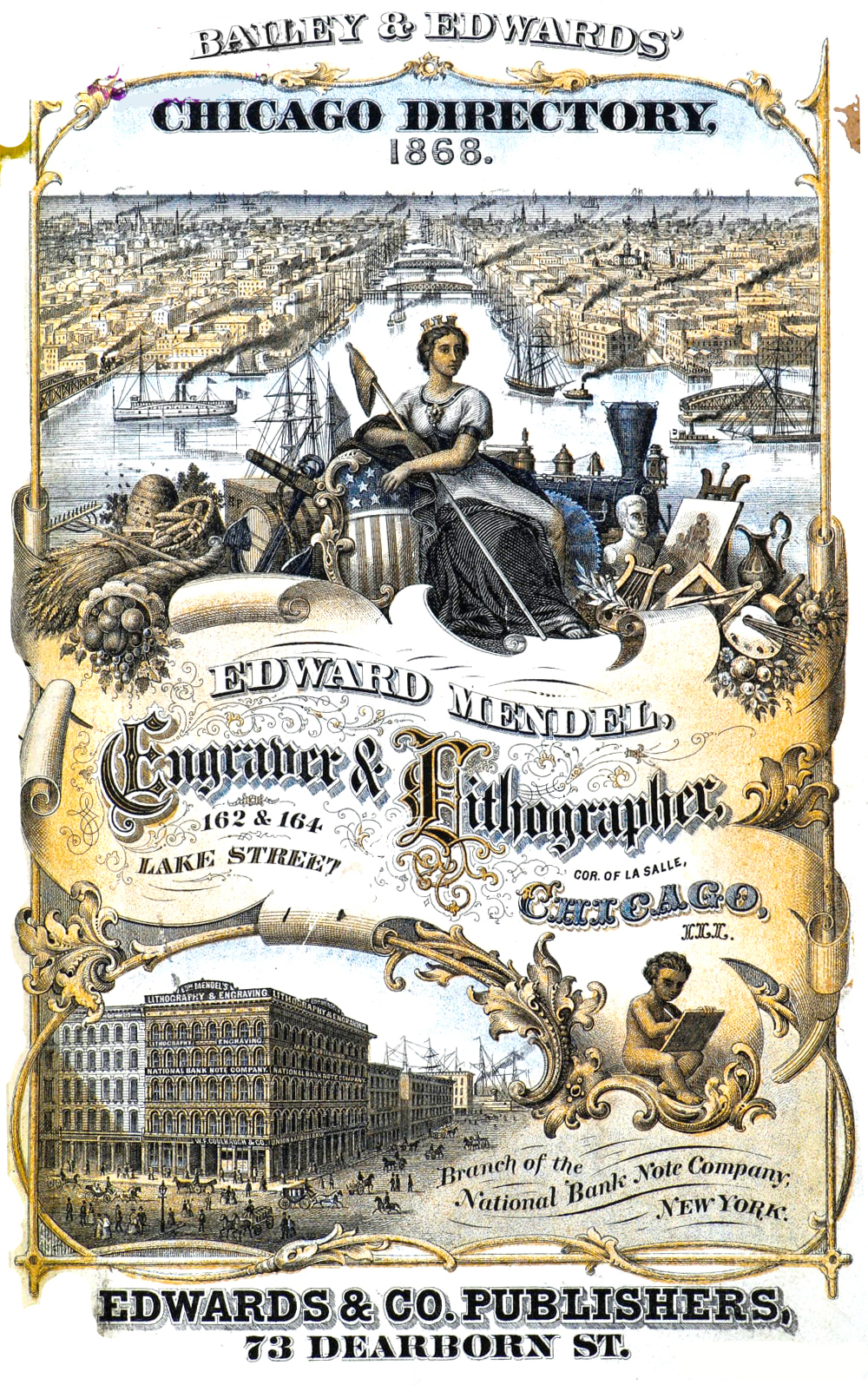
Edwards & Deved, (Richard Edwards, A. J. Deved,) New Chicago Directory, rooms 46, 49 and 50 McCormick’s bldg.
Kerfoot S. H. & Co., (Samuel H. Kerfoot and J. Ford Pierson,) real estate brokers, McCormick’s bldg, No. 71 Dearborn. (See card front cover)
Third National Bank, James H. Brown, pres, Ira Holmes, cashier. Randolph se cor Dearborn.
Edwards’ Annual Directory in the City of Chicago, for 1867
McCormick’s Building, southeast corner Randolph and Dearborn streets
Edwards Richard, rooms 46, 49 and 50, McCormick’s building, 73 Dearborn street, publisher of City Directories for Chicago, Milwaukee, St. Louis, Indianapolis, etc., Mississippi River Gazetteer, State Gazetteers, etc. etc.
New City Directory Office, rooms 48, 49 and 50, McCormick’s bldg. 73 Dearborn
Chicago Medical Journal, office, 2 McCormick’s building. Published monthly. Dr. J. Adams Allen, editor.
Batchelder & Frisbee (James L. Batchelder and William B. Frisbee), publishers, bookbinders and blank book mnfrs. rooms 42, 43 and 44 McCormick’s buildings
U. S. Agent for paying Army and Navy Pensions. C. T. Hotchkiss, offices 20 and 21 McCormicks’s building, corner Randolph and Dearborn streets.
Edwards’ Annual Directory in the City of Chicago, for 1869
McCormick’s Building—Southeast corner Randolph and Dearborn streets
U. S. Agent for Paying Army and Navy Pensions. C. T. Hotchkiss, office 20 and 21 McCormicks’s building, corner Randolph and Dearborn streets.
Metropolitan Temple—Meets every Tuesday evening, in McCormick’s building, southeast coner Randolph and Dearborn streets.
Edwards’ Annual Directory in the City of Chicago, for 1870
McCormick’s Building—Southeast corner Randolph and Dearborn streets
Edwards’ Annual Directory in the City of Chicago, for 1871
McCormick’s Building—Southeast corner Randolph and Dearborn streets
Chicago Tribune, July 26, 1860
The Sale of the Chicago Times.
A matter which has been a theme of busy rumor for a week or two past, took the shape of definite news yesterday, in the consummation of the sale and transfer of the Chicago Times to Cyrus H. McCormick, Esq, Proprietor of the Chicago Herald. It is understood that for the remainder of the present week the Times will be issued as heretofore, and on Monday next its establishment be merged with that of the Herald.
As it is a sale, in which the property is passed to a new possessor, whether the matter present the aspect of a “consolidation” will depend upon the choice of Mr. McCormick, and the value he may attach to the united prestige of the late distinct papers. So that Times and Herald (or vice versa) or simply Herald with Times “understood” rests with the new owner.
As far as at present decided upon, it is understood that the editorial corps of the now sole Democratic organ in this city, are those of the Herald, the corps of its late rival being released from their posts.
The Chicago Times at this period of important change in its affairs is in its sixth volume. In 1853 the Chicago Courant a small daily was started as a penny paper by Wm. Duane Wilson. After a brief experience and struggle with the “diseases of infancy” that new papers are heir to, the Courant was bought by Isaac Cook, then and now Postmaster, and then as zealous a Douglas man as now he isn’t, which is stating the case strongly.
Mr. Cook manned the paper with an editorial corps, gave it a name—the name then borne by his great billiard and bar-room, Young America, and embarked in the fortunes of Douglas. On the advent of Mr. Sheahan as Editor in Chief, the paper was enlarged to a first class sheet, and took, as it has since borne, the name which has passed with its establishment, to its purchaser of yesterday.
It is said that in his own new block, now building on the corner of Dearborn and Ranpolph streets, Mr. McCormick is to fit up quarters and accommodations for his newspaper establishment, now occupying leased premises on South Clark street.
Chicago Evening Post, April3, 1867
Dissolution of Co-Partnership.
The firm of Edwards, Greenough & DeVed is this day dissolved by mutual consent. All accounts due said firm and owing by said firm will be settled by Richard Edwards, 73 Dearborn street, Chicago, and A. J. De Ved, 423 North Fifth street, St. Louis. Richard Edwards, Wm. A. Greenough, Jr, A. J. DeVed.
- McCormick’s Building.
Southeast corner Randolph and Dearborn streets
1862
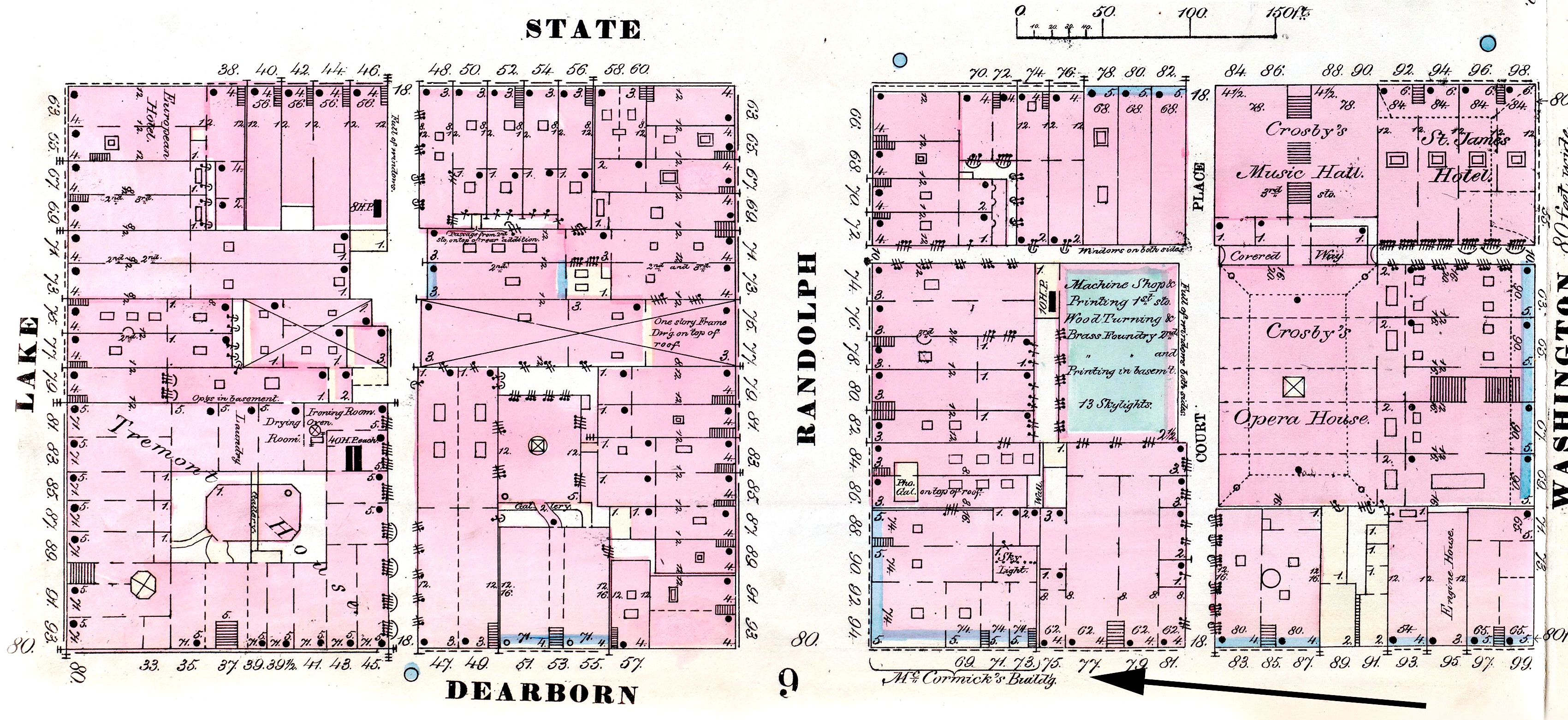
- McCormick’s Building.
Southeast corner Randolph and Dearborn streets
Sanborn Fire Insurance Map
1869
NOTES:
1 CHICAGO TIMES, 1861-1895
W. F. Storey took over the Times from C . H. McCormick, and it soon became one of the leading papers of the country. The policy of the paper antagonized the prosecution of the civil war, and an order for its suppression was issued by Gen. Burnside, commanding the Department of the Northwest. This was put into execution on June 3, 1863, the suspension lasting two days, President Lincoln revoking the order. After the war the paper gradually assumed a more independent attitude, and while leaning in the direction of the Democratic party, it was because of its news features and fearless discussion of questions that the Times made itself felt. Mr. Storey’s personality dominated the paper for more than twenty years, his death occurring in 1884. For a time the paper was conducted by a receiver, and in 1887 a new organization took the property. In 1891 Carter H. Harrison bought the Times, and in March, 1895, it was merged with the Herald. Four years later a consolidation of these papers was effected with the Record, under the name of the Record-Herald—
The Story of Chicago In Connection with the Printing, Regan Printing House, 1912

Leave a Reply