Chicago Tribune, November 7, 1863
 The Convention of representatives of the Fenian Brotherhood, who have been sitting for the past few days in this city, and whose labors closed upon Thursday night last, issued a series of resolutions which are of great importance to the Irish and Irish American people, and of which we give an synopsis:
What the Fenian Brotherhood Is.
An important epoch having arrived,
Resolved 1, That our organization consists of as association principally of citizens of the United States of Irish birth or descent, but open to all who are friendly to the liberation of Ireland from the domination of England by every honest means which are not in violation of the Constitution and the laws under which we live and to which we owe our allegiance. We assert an unquestionable right, under said Constitution and laws, to associate together or this purpose. Exiles of every country, and especially those of Ireland, having found homes, personal freedom, and equal political rights, in this American republic, and deeming its preservation necessary to the well being and social elevation of the human race, be it
Resolved 2. That we do hereby solemnly declare our entire allegiance to the Constitution and laws of the United States of America.
From the hostile attitude assumed by England, her oligarchy, merchants and press, towards the United Stales, a war seems fast approsching.
Resolved 3. That the younger members of the Fenian Brotherhood be instructed to study military tactics, and apply themselves seriously to leara the use of arms, in order to be prepared as organized and disciplined bodies, to offer their services to the United States Government, by land or sea, against England’s myrmidons.
Deeming the resurrection of Ireland to nationhood to be of immense interest not alone to Irishmen, but to all sincere lovers of human freedom.
Resolved 4. That every man of Irish birth or descent who lives on the American continent, is admissible to the Fenian Brotherhood, without distinction of class or creed, provided his character is unblemished and his devotion to Ireland unquestioned, and that we earnestly invite every American who is loyal to the principles of self-government, to aid and sustain us by his moral influence against our enemies, the emissaries of foreign despotism, who would fain crush the growth of republican principles, and stop the onward march of freedom in this free land.
Politics, partisanship and religion being the great obstacles which the Fenian Brotherbocd will have to surmount, be it
Resolved, That every subject relating to partisan American politics, and to differences in religion, be absolutely and forever excluded from the counsels and deliberations of the F.B; and that we furthermore invite every sincere friend of liberty, without distinction of party or creed, to join cordially and harmoniously with us upon the neutral platform of Irish independence.
The annexed resolutions will be embodied in tomorrow’s paper, we appending now only the captions in order to make room for the addrees of the congress to the people in Ireland.
6. “The Fenian Brotherhood not a Secret or an Illegal Society.”
7. “Pledge and Fraternal Bond of the F.B.”
8. “Present Position and Sentiment of the Irieh Race at Home and Abroad—Duties of the Brotherhood.”
10. “The Irish People a Distinct Nationality—Their Right to Self Government.”
11 and 12 not for publication; for private circulation in the organization only.
13. “The Fenian Brotherhood Permanently Established in America.”
15. Organism—Government Regulations.”
16. “Sympathy with Poland.”
We annex the eloquent and pointed address of the Congress to the Irish people at home.
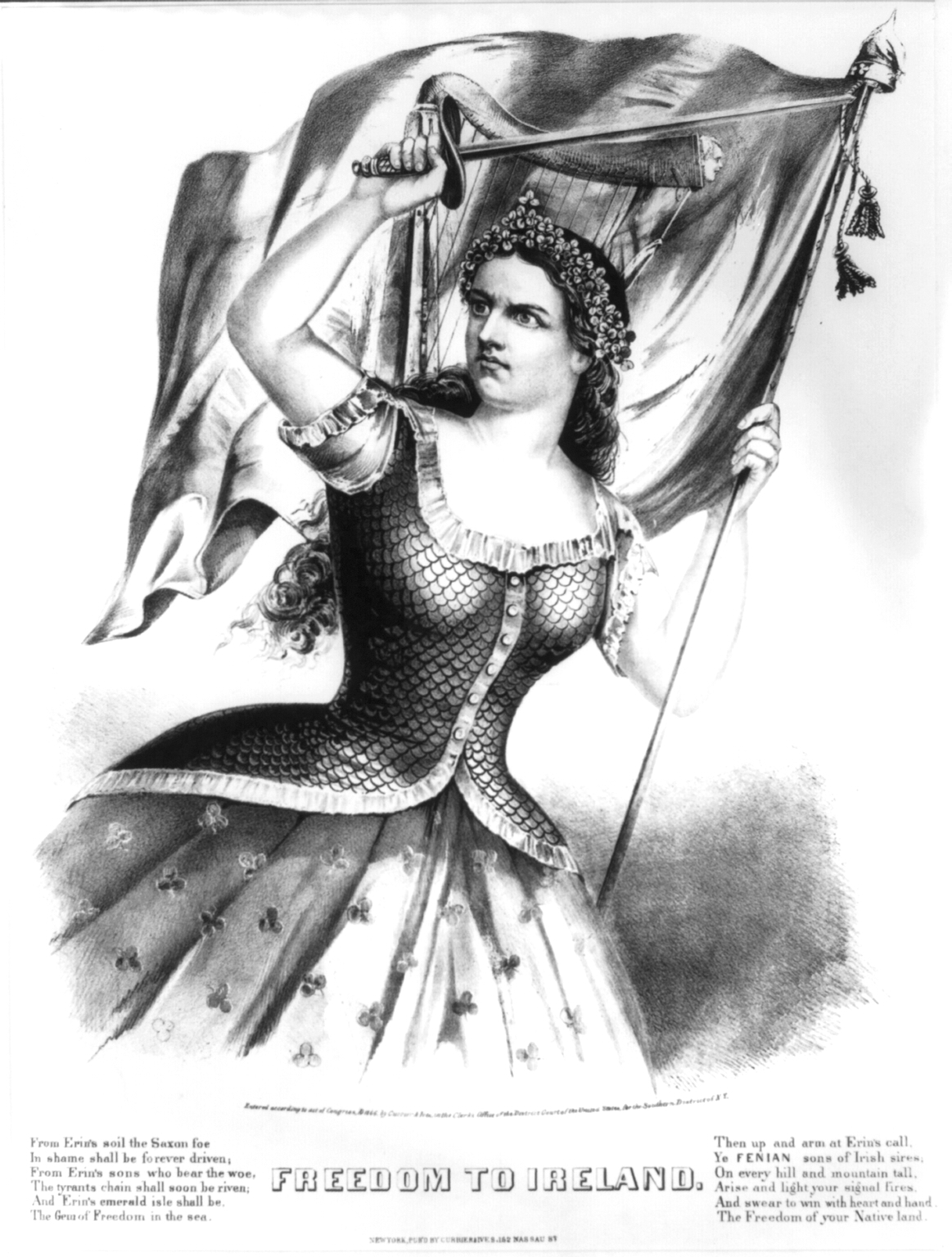
Address of the Centres and Delegates of the Fenian Brotherhood in America, assembled in Convention in the city of Chicago, to their fellow-countrymen in Ireland, who share their views as to the best means of achieving the in: dependence of Irdand.
Brothers: We deem it prudent to withhold for the present from publication in the newspapers certain important resolutions, baying special reference to the revolutionary element in Ireland, which have been submitted to this Convention by the Head Centre of the Fenian Brotherhood in America, and unanimously adopted. Printed copies of these resolutions will be placed before the different circles of our organization in this country; and will also be transmitted at the earliest fitting opportunity to our friends at home. In the meantime, we do not wish to separate without addressing to you a few guarded words—such as we can afford to have read by all whom it may concern—regarding the present aspect of our affairs.
We are solemnly pledged to labor earnestly and continuously for the regeneration on our beloved Ireland. That pledge, with the blessing of Divine Providence, we shall redeem. And when the wished for hour shall have arrived, we shall be prepared with you to meet the implacable persecutions of our race in battle array; to put an end forever to the acursed system under which our unhappy people have suffered such cruel tortures, or die like men in the attempt. And in what holier cause has man ever died? How much Irish blood has fallen upon the battle-fields of the world? Alas! how much Irish blood has been shed in the service of our country’s oppressor, the plunderer and murderer of her people, fell enemy of her faith? Over this subject, and others connected with it, we bave pondered long and bitterly. But our resolve is fixed and irrevocable; the foul stigma which attaches to our name must be wiped out.
We do not ask, will you be ready? We know. you are ready. Nine-tenths of the Irish people buy. been at all times ready, in heart and will, to dispute with armed hand the invader’s right to enslave or exterminate them. But this is not enough. We must be “skilled to do” as well as ready to dare.” We are thoroughly convinced of the utter futility of legal and constitutional agitations, parliamentary policies,” and all similar delusions. These things have brought more suffering upon our people than would be caused by the most protracted and devastating war. The best of them would but expose the ardent and the brave to the vengeance of local despots; and be it remembered that such sacrifices beget no noble aspirations.
No enslaved people ever regained their independence or became tormidable to the en • slaver without “illegal” (in the enslaver’s sense) pre-organization. Poland had its illegal (in the Russian ‘sense) organization long before those glorious “legions of despair unfurled the flag of revolution. Had Italy no illegal (in the Austrian sense) organization, the sword of McMahon had never flashed in victory on the field of Magenta. Had not the American colonies of England their trained militia, the “trampled province” could not bare sprung into a “free and glorious republic.” Hungary was pre organized -but wby multiply instances? The lesson which history teaches to struggling nationalitiesillustrates by many a bright and macy a dark example-is that pre-organization is essential to success With it, there may be defeat and glory. Without it there must be defeat and shame. Some politicians seem to think anything approaching to a military organization imposeible in Ireland. Bat its possibility and feasibility, when guided bycourage, prudence, devotion and ability, hare been proved to our satisfaction: and this fact is the very foundation of our conviction, that the day of our deliverance is at hand. We Bay our delireiance, for the privileges of living among a free reople, and of sharing the blessings of free institutions, but mase us feel the more keenly the sufferings and degradation of our own old land. Bui our hearts swell with hope and exultation when we think of the living fire that burns within her shores, defying the combined efforts of open foe and folie friend to extioguish it. No matter how powerful and devoted her exiled children might be, we should tremble for the issue if there were no true men left in Ireland; no wortby descendants and disciples of the Leroes of ’98. We do not wonder at the enemy’s persistent ondeavors to emasculate or to banish you.
Americans already admit that the non-recognition of the revolted States by England is due to the attitude which the Irish people have assumed both at home and in this Republic. If the Irish people, at home and abroad, were united in a band of brotherhood for the salvation of their country, would the United States hesitate for an hour to strike a blow which would be followed by two inevitable results—peace in America and liberty in Ireland?
A deep responsibility rests upon Irishmen in the present generation. The fate of this country trembles in the balance. Emigration is doing its exhausting work. Other influences are leagued with the oppressor to quench the spirit which has triumphed over the dungeon and the scaffold, and which even famine could not kill. Let us falter now, and Ireland’s doom is sealed; a grand old nationgrand even in her chains is blotted from the map of the world. But there shall be no faltering, no cowardice. Our country cries to us for aid, and points to the grave which the foe has dug for her. Armed legions shall interpose between her and that grave.
Here we have soldiers armed and trained, (thousands of them trained in the tented field and amid the smoke and thunder of battle,) with able and experienced Generals to lead them. Let the cites ana towns and parishes of Irelard bave their brigades, regiments, battalions and companies of partially disciplined soldiers of liberty silently enrolled. Above all things let every man be pledged to obey the commands of his superiors, and pledged also never to more without such command, for obedience to command is the first and most important requisite of the perfect soldier—all the rest is secondary. Thus you will not only be prepared to strike with effect, but all rash attempts at insurrection will be prevented. Without such an organization as we contemplate, partial uprisings of the people will be sure to occur, leaving no results but the sacrifice of brave men, and, perhaps, the ruin of our cause. When we strike, let us strike home. And are there not strong arms within the enemy’s own shores to second the blow? Circumstances are in our favor such as Providence never before voucheafed to an enslaved people. We have but to act as besEemS brave and reasoning men, and ours ball be the pride and the glory of lifting our sorrowing Eire of the Streams to her place smorg the nations. Brothers, rely upon us -we rely upon you.
James Gibbons, Ch’n, Philadelphia,
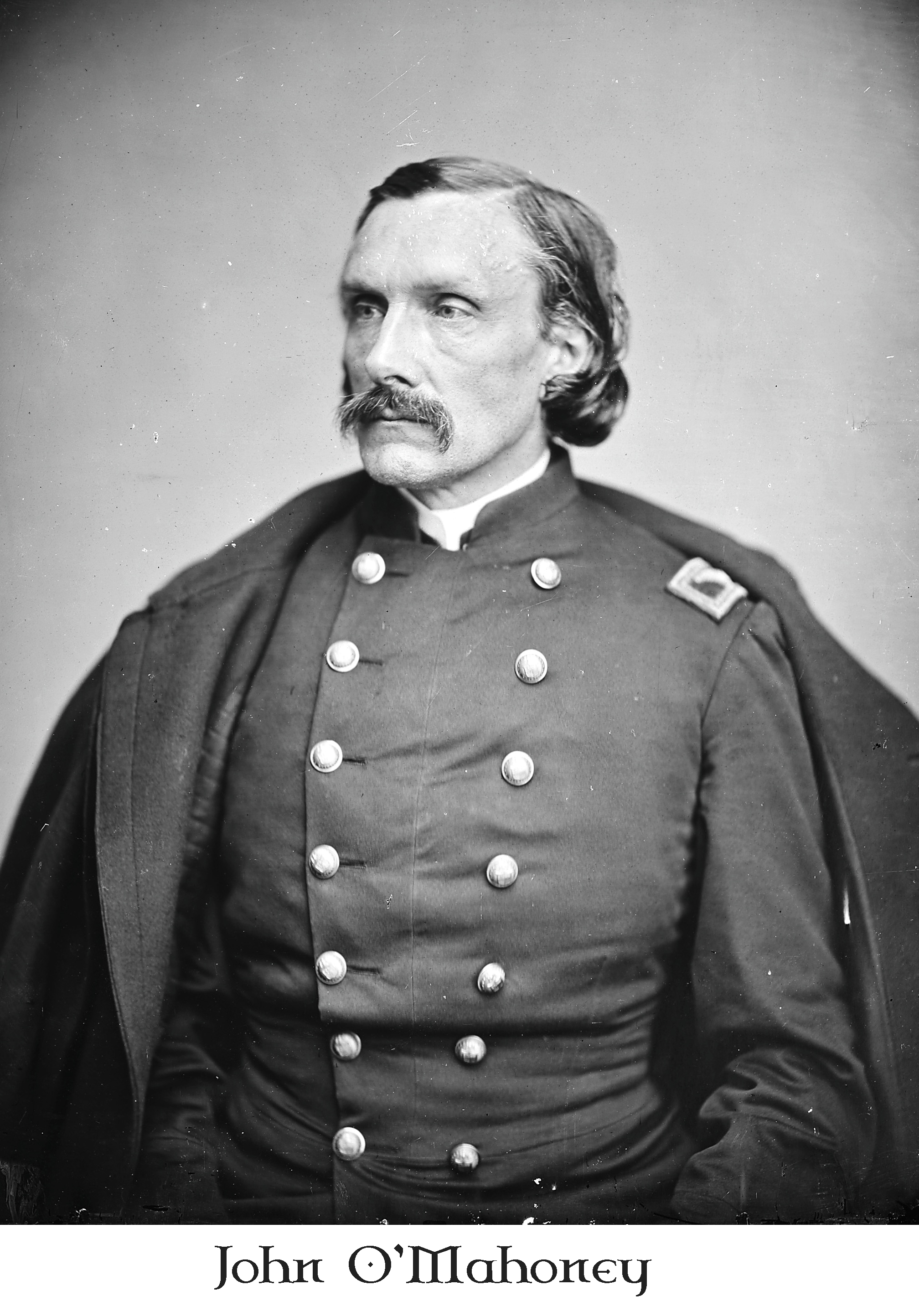
Jno. O’ Mahoney, Pres’t and H. C.
Richard Doherty, Ind., Vice P’t.
Danl. Grady, D.C., Vice P’t.
Danl. Carmody, Wis., Vice Pr’t.
H. O’C. McCarthy, Sec’y.
Jno. A. Stuart, Ind., As’t Sec’y
Irish Convention, Fenian Brotherhood Hall, Northwest corner Randolph and Wells streets, Chicago
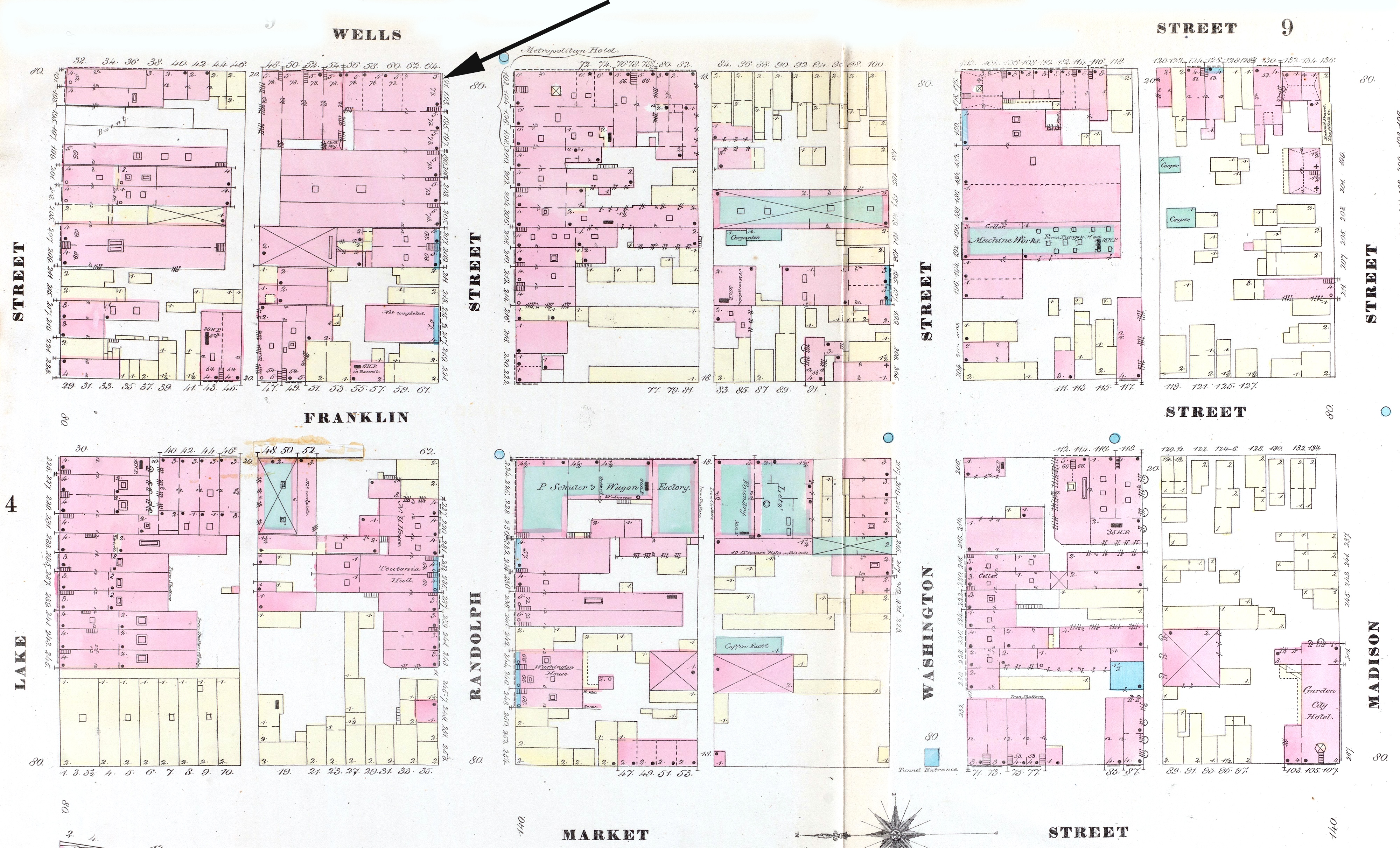
- Fenian Hall
NW Corner Randolph and Wells
1869
Chicago Tribune, June 4, 1866
THE FENIAN COLLAPSE.
The Fenian invasion of Canada has ended as suddenly as it began. The raiders who crossed at Buffalo are all dispersed, captured, or killed. The greater portion of them are prisoners of the U. S. steamer Michigan, which intercepted them in their attempted flight, at three o’clock, Sunday morning. They retreated just in time to escape a Canadian force of 3,500 men, who were preparing to attack them at daylight. It appears that they got away with good appetites, having had nothing to eat since they left Buffalo, but what they picked up on the road. Nobody but an Irishman would have thought of sending an army into Canada without rations. Nobody but an Irishman would have thought of invading Canada by private subscription. If Gen. Sweeney had heeded the maxim of his great countryman, the Duke of Wellington, that “armies march on their stomachs,” he might have prolonged his stay in Canada by twenty-four or thirty-six hours. The net results of the raid are that the Fenians have murdered and robbed a few Canadians, spent their money, lost their army, and brought their cause to ruin. This is as much as a Fenian republie could expect to accomplish in so short a time. The 0’Mahoney faction exhausted their assets three weeks ago gazing at Campo Bello Island. The Sweeney-Roberts faction have now depleted their exchequer. Both treasuries being empty, they have no further occasion to quarrel with each other. Those who escape can now betake themselves to some honest calling, and reflect that they have postponed the day of Ireland’s independence a long time by their blundering and wicked raid upon a people who are in no way responsible for the wrongs of Ireland.
We give no heed to the theory that the movement at Fort Erie is a mere feint to draw off the attention of the British forces from St. Albans or Ogdensburgh, where the real movement is to begin. There has been no concentration of Fenians at either of these points of sufficient magnitude to create apprehensions at Montreal. The whole movement has collapsed, and the Fenians themselves should be thankful that the end has come before any more of them got into the scrape.
A perplexing question is raised by the capture of seven hundred of the fugitives by the steamer Michigan. Whether they are to be dealt with under the neutrality laws or under the extradition treaty, is a. question for the Courts to decide. It may be held that the neutrality laws contemplate a state of war between two belligerent powers, and that AS the Fenians represent no belligerent power, they have not rendered themselves liable to be proceeded against under that act. Moreover, the neutrality act applies only to officers, and persons engaged in enlisting others to serve in hostile expeditions against foreign powers or States. If, in view of these facts, they are not liable to be proceeded against for violation of neutrality, they are subject to the operation of the extradition treaty, which requires persons, who have committed 4 murder or assault with intent to commit murder, or piracy, or arson, or robbery, or forgery, or the utterance of forged papers,” on the territory of Great Britain, and have escaped to the United States, to be delivered up on the demand of the Government against which the offence was committed. The hearing of any case arising under the extradition treaty may be had before any Justice of the Supreme Court, or any Judge of the United States District Courts, or of the State Courts, or any duly authorized Commissioner of the United States Courts. The chances of a successful application under the extradition treaty in the present instance would be much greater if the Canadian Judges, Coursol and Smith, had not practically nullified it by discharging the St. Albans raiders from custody—an act which we know was sincerely regretted by the Canadian Government, but which was nevertheless the official act of the province. It is not unlikely that Sweeny and Roberts had enough method in their madness to count upon the exasperation on this side of the line, consequent upon the St. Albans raid, as one of the elements in their favor in the contingency which has happened. If the bad precedent, which Coursol and Smith established, shall become the common law of the two countries, and public law and solemn treaties shall be violated, and life and property thereby jeoparded, the mischief and demoralization will not have had their beginning en this side of the line.

Leave a Reply