
Chicago Tribune, July 28, 1912

Hundreds of Irish inhabitants of Chicago and out of town visitors will assemble at Gaelic park1 today for the unique Irish “Feis” or festival to be held there under the auspices of the Gaelic league.
Everything on the program will in some way recall the ancient customs and national traditions of Erin, The “Feis” was one of the most famous of the Irish festivals in the middle ages and as near as possible today the characteristics of these events of ancient times will be carried out to the letter.
Not only will music and speeches be made in the native Irish tongue, partly with an idea to aiding the campaign now on to revive it, but the music also will be of the real Irish kind. Irishmen prominent in the Catholic church will be present.
Old men and young will compete in the story telling contests, and one of the conditions is that they must be told in the Irish tongue. Irish singing, and Irish plays will also be prominent features of the festival. Some of the men will wear saffron hued kilts, the color that was outlawed in Ireland by an English king in 1446, and others will wear blue, which is the national color of Ireland. The women will be attired in dainty costumes of the fifteenth century.
Demonstration of Lace Making.
Music will be furnished by war pipers, highland pipers, and union pipers, and of course there will be fiddlers without number. One of the amusements will be the royal game of hurling, which has been played in Ireland from the coming of the Milesians to the present day.
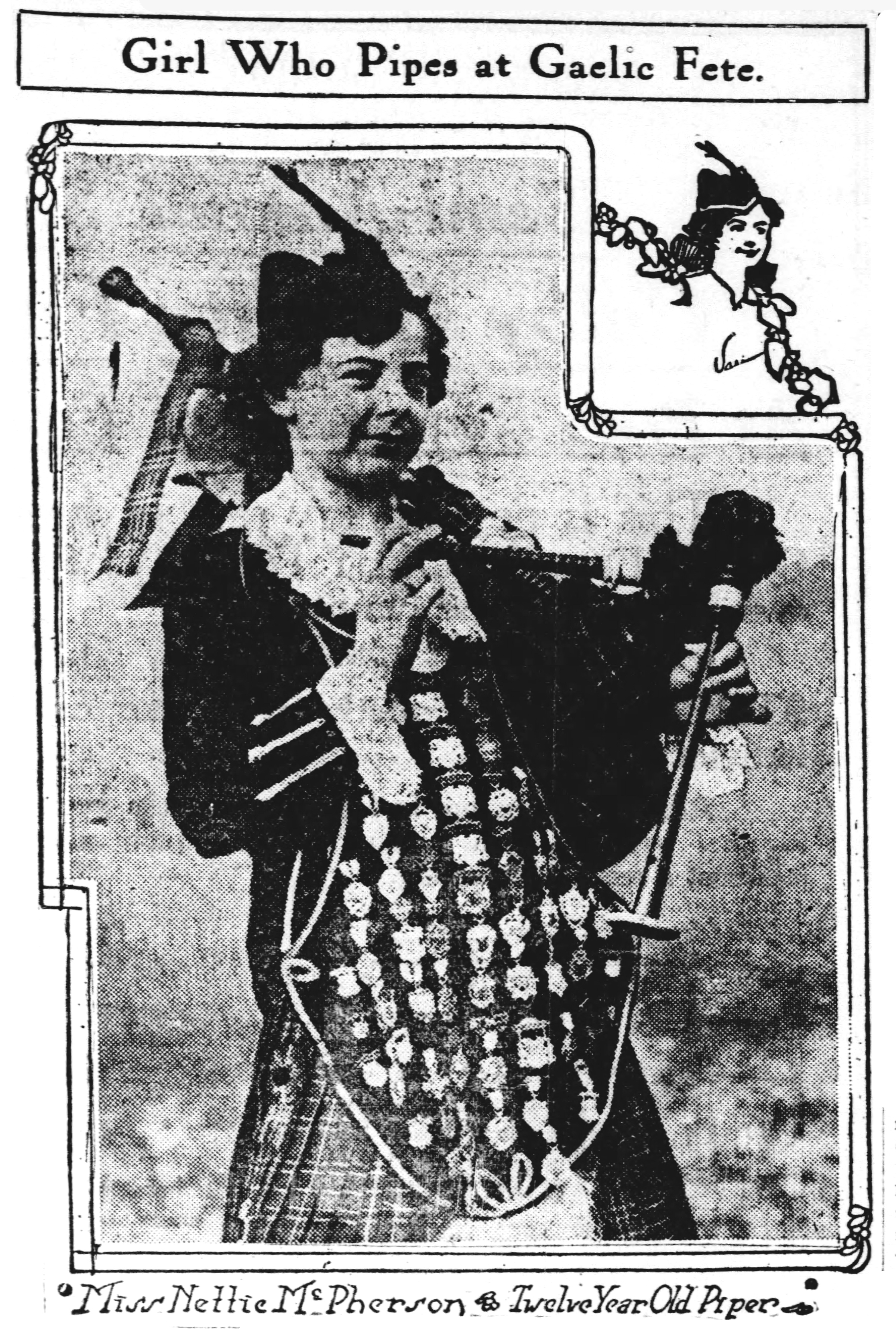
Besides the feis there is a demonstration of Irish lace making and rug making. This is given by the exhibitors sent out from Ireland by the Gaelic league, and was held in the La Salle hotel for a week commencing July 15. The exhibit was in charge of Fionan MacCollum, who is head organizer of the Gaelic league in Ireland. He is a fluent speaker and prolific writer of Irish, and has collected many of the old folksongs and folk stories from the peasantry in the west of Ireland. The women members of the exhibit were Bride MacLoughlin of Dublin, Bridgie O’Quinn of County Sligo, and Mary O’Flannagan, of Sligo.
Former Chief of Police Francis O’Neill is an active worker in behalf of the feis, and is particularly interested in the Irish music section. John A. McGarry, is former president of the feis. The principal address of the day will be delivered by the Rev. Michael O’Flannegan, envoy of the Gaelic league.
The modern feis, as revived by the Gaelic league, possesses many of the attributes of the old time festival. The Ard Fheis (pronounced Aurd Esh) is held annually in Dublin and is attended by delegates from all parts of Europe. The business is conducted solely in the Irish language, and several thousand dollars is distributed in prizes for literary, musical, and dancing contests.
One Way to Win Salvation.
Ireland now believes that the only way to win her salvation is by going back to the language and the customs of her old days. Irish, which was fast dying, is again being revived; the songs, the dances, the music, and the folk tales are all getting careful attention, and it looks as if Ireland in the near future will again be an Irish speaking Ireland.
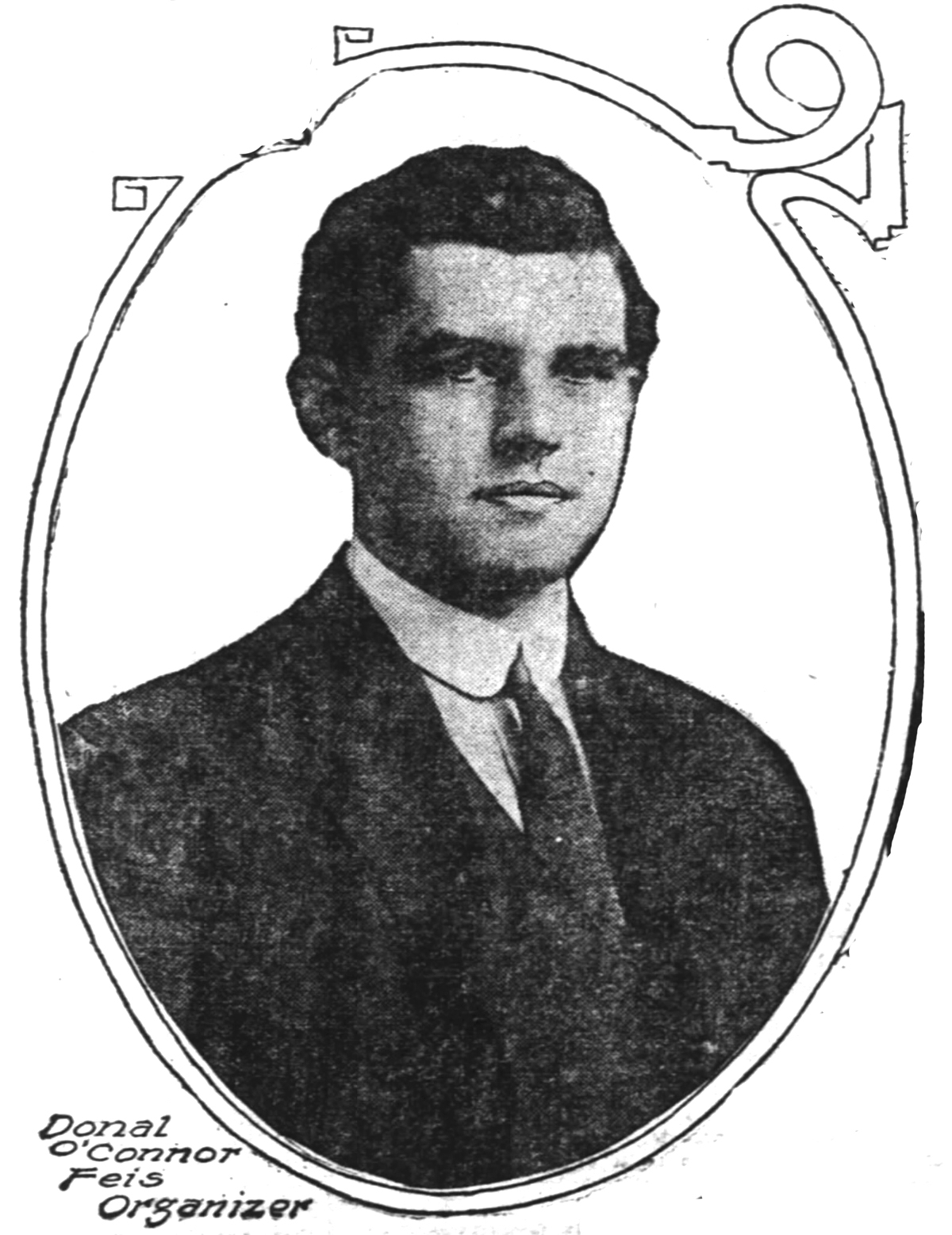
The success of the Gaelic revival has been rightly attributed to the feis. The feis has been the most popular means of creating an interest in the study of the Irish language, and because of its success in Ireland the Gaelic league decided to introduce it to America, wherever there is a sufficient number of Irishmen to take the matter up. Donal O’Connor, a native of County Kerry, one of the most important Irish speaking counties in Ireland, was selected as the man to organize these interesting events in America, and since his arrival in this country from Ireland a few months ago he has succeeded in establishing six feisecanna in the eastern states.
The first feis of which there is any authentic record was held in Tara, the site of the palace of the ancient kings of Ireland, and was convened by King Eochy, surnamed Ollamh Fodla. Ollamh means a doctor of learning and Fodla is a poetic name for Ireland. Ollamh Fodla was high king of Ireland about 800 B.C. and is considered to have been the greates scholar and statesman produced in the pagan Ireland.
The feis in the old days was more in the nature of a parliament. It was usually convened by the king of Ireland, and in its deliberations occupied several days. Here the laws were promulgated and the famous Tailteann games held. Here Finn MscCumhaill and Cuhubin performed some of their greatest deeds of warlike skill at Tara, before King Laoghaire (now spelled O’Leary), St. Patrick first spoke of his mission in behalf of Christianity.
After the matters of state were were discussed at the feis the king distributed prizes to the story tellers, to the bards, and to the athletes.
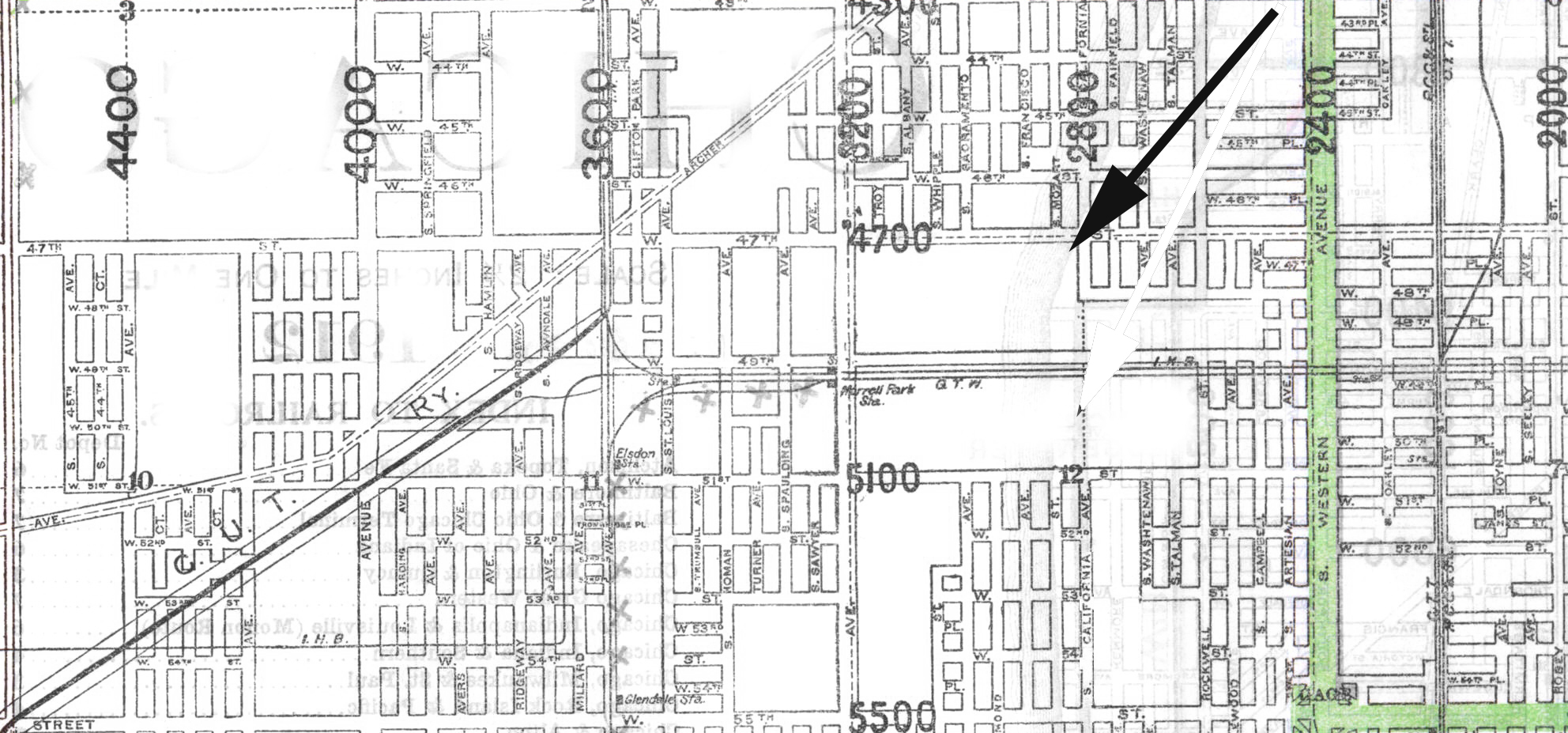
- Gaelic Park
47th and California
1912
The Inter Ocean, August 3, 1913
By Donald O’Connor
Representative in the United States of the Gaelic League of Ireland.
The greatest Irish event ever organized in this city will be the Gaelic Feis at Comiskey Park today. It isn to be, as far as circumstances will allow, an exact reproduction of the real Irish Feiseanna which are doing so much in Ireland today for the revival of the language, games, customs and traditions of the old land.
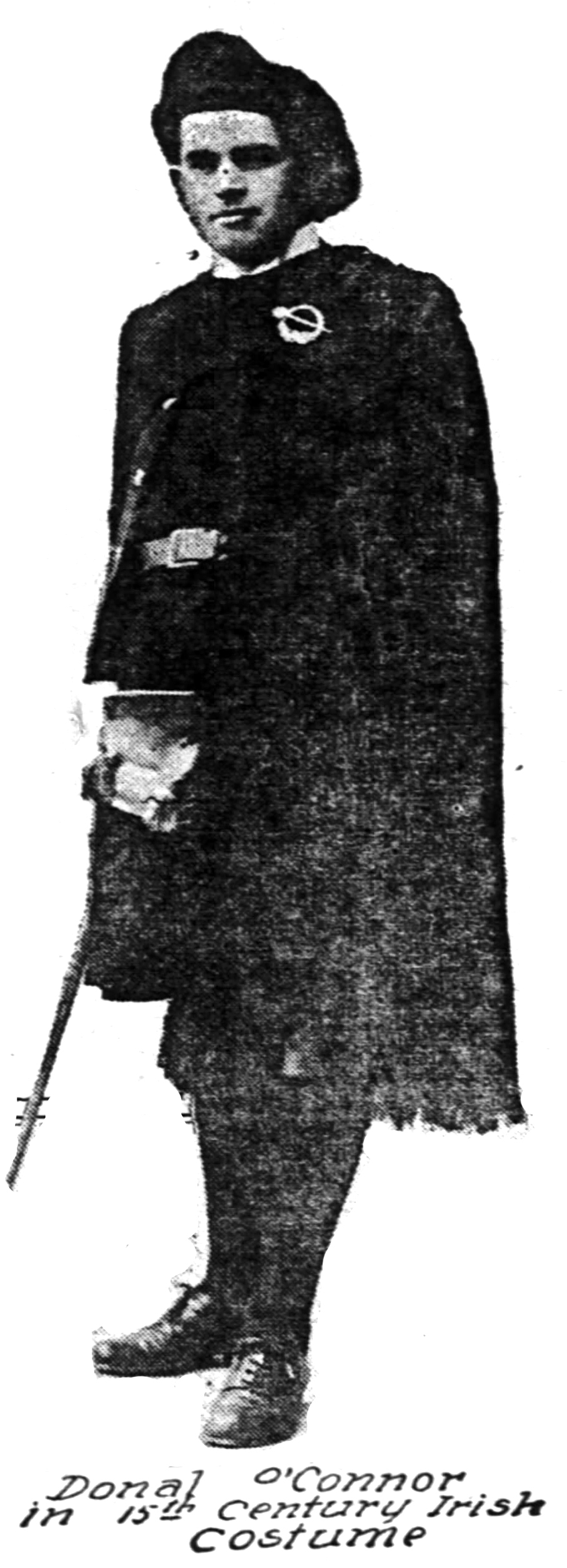
These feiseanna, or Gaelic festivals, have been fostered by the Gaelic league as a means of furthering the Celtic renaissance. They aim at reviving not alone the Irish language, but the old time songs, dances, music and traditions of the Irish race.
All over Ireland a most energetic effort of the Gaelic tongue and everything else that remains of our old Irish civilization. The harp and the bagpipes, which had fallen into disuse and so remained until the advent of the Gaelic league, are now heard again at all Gaelic concerts and festivals. Rural life in Ireland is brightened by bands of pipers attired in the old Gaelic costume of “filleadh beag,” or kilt, with mantle, breech and aparan, marching from village to village during the fine summer evenings to the martial airs of “O’Donnell Abu” or “Brian Boru’s March.” The national dances—reel, jig, hornpipe, “Blackbird,” “Three Sea Captains,” “St. Patrick’s Day,” “The Job of Journeywork,” “The Garden of Daisies”—and all the beautiful figure dances are well practiced in village halls, in the schoolrooms, in the parlors of the well-to-do, in the laborer’s cottage and, on fine evenings, at the cross roads in the country districts.
The Gaelic league aims to re-create the historic Irish nation; to rebuild the Ireland of the future with her ancient civilization the foundation, her language the corner stone and her history and traditions the pillars of the structure.
The special features of the Feis will be a Gaelic football3 match and a hurling match; an exhibition drill by the Seventh regiment, kindly detailed by Colonel Moriarty, and the Seventh Regiment band will discourse Irish music all the afternoon.
The Inter Ocean, August 4, 1913
Nearly five thousand persons, mostly Irish, gathered at Comiskey’s White Sox park yesterday afternoon and made the second annual Chicago Feis the biggest thing of its kind ever held in America.
Singers, dancers, pipers, orators, story-tellers, athletes and soldiers vied with one another for honors offered by the committee.
The Feis is a regeneration of the ancient Irish parliament, or “meeting of the people,” and has been revived by the Gaelic League of Ireland to prevent the extinction of the Irish language and customs.
The Feis was under the direction of the Gaelic League of Ireland, assisted by the Gaelic League of Chicago. Donal O’Connor, sent from Ireland, had charge of the festivities. David Ryan Twoney was president of the committee.
Governor Officiates.
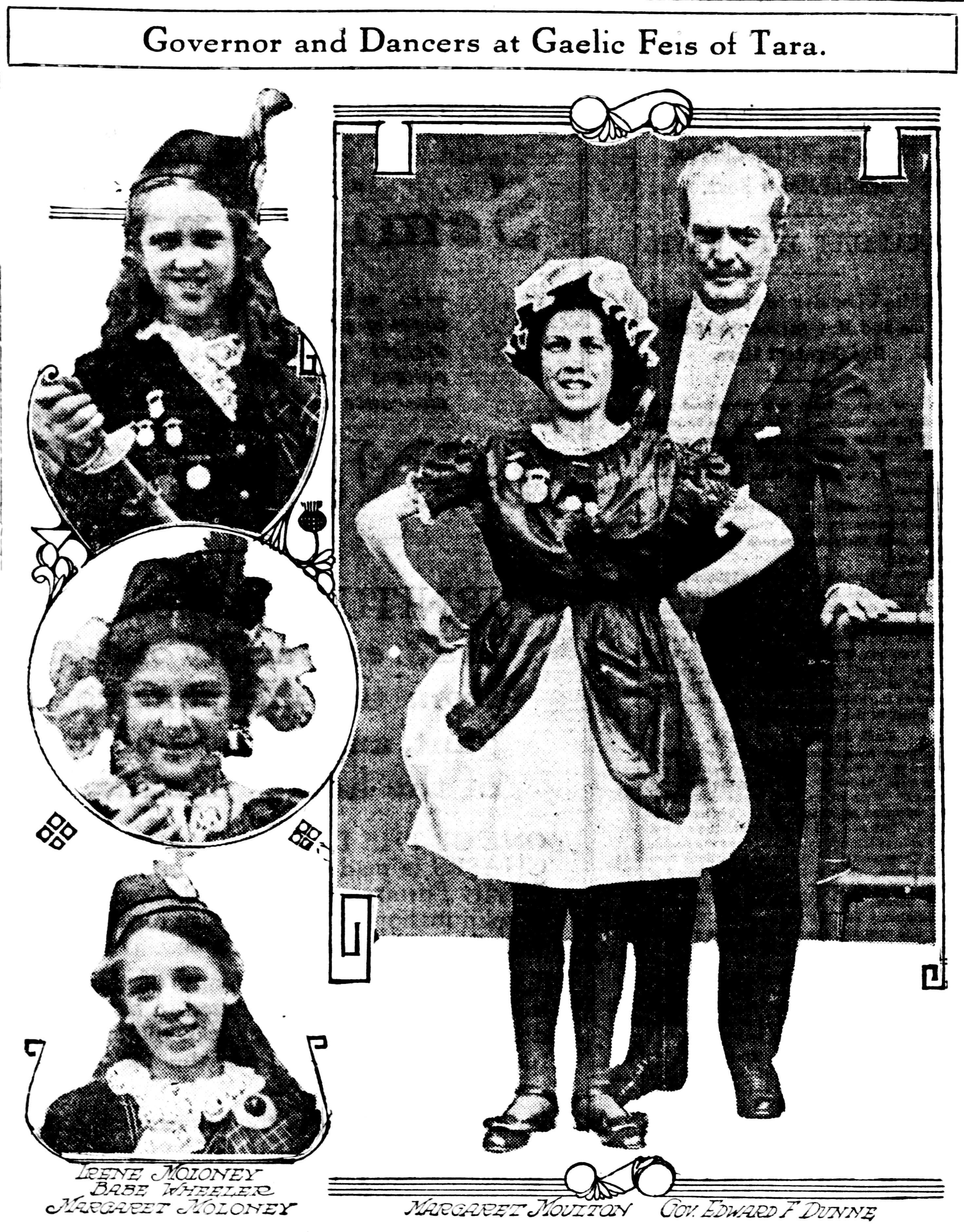
Governor Dunne presided at the speech-making, which comprised the first part of the program. Judge John P. McGoorty of the Municipal court, Daniel Sheehan of Ireland, and Michael O’Gallagher spoke. The latter talked in Gaelic.
The Governor congratulated the Irish on the revival of their language and compared the fight of the Irish for individualism to that of the Greeks, who have been fighting for twenty centuries.
“The Irish are bound to come into their own,” he said, “because they are the most patriotic of all races and are not afraid to fight for their convictions.”
After the speaking the people crowded onto the field and surrounded the platforms where the various competitions were held.
Gaelic Tongue Spoken.
In one corner the girls jigged to the tune of a bagpipe and a fiddle. On another platform were held contests in story telling, singing, reciting, and conversation, all in the Gaelic language.
The Shannon Rovers defeated Erin’s Hopes at Gaelic football (5-4), while two more teams played the Irish game of hurling.
Contests in violin and flute playing of Irish airs were features. Piper James Early and Fiddler O’Malley sat on their little stools on the platform and played jig after jig, keeping time with their feet, watching the youngsters skip through their parts.
“It was the best thing of its kind ever held in America,” said Mr. O’Connor at the close. “I most thought I was back in Ireland myself.”
The judges of the dances and native reeds were the Rev. M. J. Keyes of Washington, D.C., and John Curtin of Chicago.
Announcement of the winners of the various contests will be made by the judges in a few days.
Irish Minstrels and Musicians, Chicago Police Captain Francis O’Neil, 1913
William Walsh, Chicago Police Officer
William Walsh was born in 1859, at Oughterard, on the banks of Lough Corrib, County Galway, and, although coming to America with his parents in childhood, he is a fluent speaker and reader of the Irish language, and few are so well versed in the history and lore of his native land.
Self-taught in music, as in most other things, he took up the study of the Highland pipes when but little more than a boy. So zealous was he in his practice that the present writer has seen him lay down his dinner pail on returning home from work and, without waiting to change his begrimed clothing, put on the pipes and play while his mother was preparing supper. We may as well admit, however, that the neighbors were by no means unanimous in their approval of his tireless assiduity.
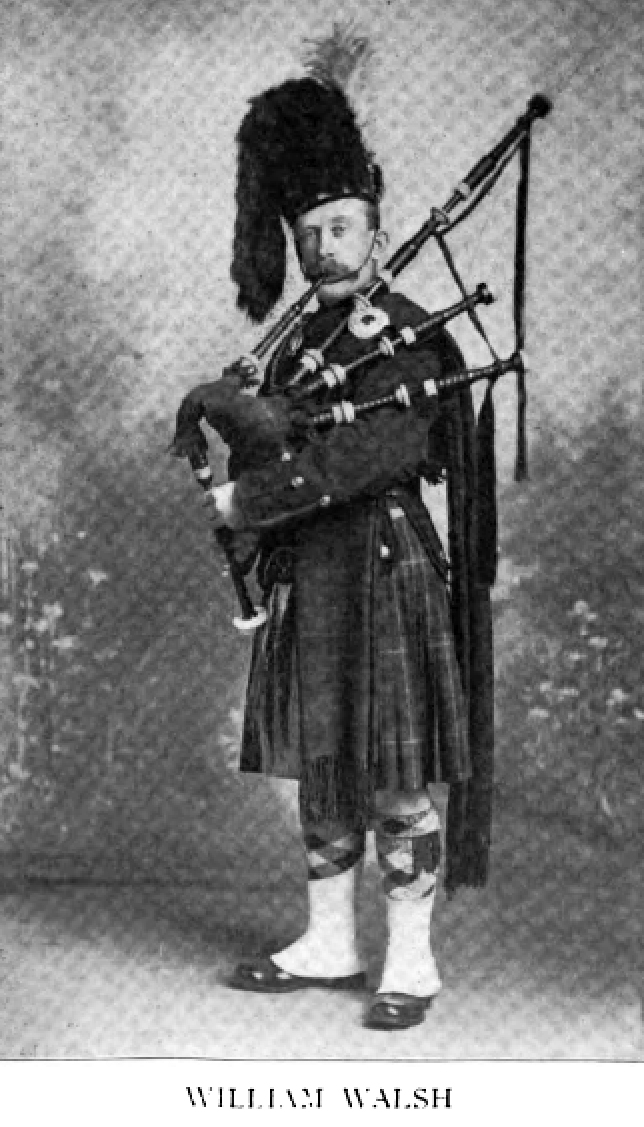
It would be but natural to suppose that, after listening for months to the mellow music of “Jimmy” O’Brien’s Union pipes, young Walsh would favor the Irish instrument, but he didn’t. Provided with suitable music, he learned to play by note and eventually to write music according to the Scottish scale, but not a little of his inspiration came from his frequent visits to William McLean, Joseph Cant, and some others, all famous performers on the Highland bagpipes.
Liberal, even lavish, with his music, he was the most obliging of men, and his only lapse into professionalism was a season’s engagement with Sells Brothers’ circus in 1881. This of course was long before his connection with the Chicago police force, which commenced in 1891. Timidity or bashfulness being entirely foreign to his nature, he makes the acquaintance of every Scotch piper who comes to town, and it is owing to his energy and promptness in this respect that he induced no less than seven of them, on short notice, to enter the contests at the Gaelic Feis held at Chicago in July, 1912, and by the same token the prize winners happened to be only casual visitors in the city.
On that occasion, by the advice of the present writer, Walsh dismantled one of his tenor drones, thereby converting his set of Highland pipes into an Irish warpipe. This metamorphosed instrument served for all, but Walsh easily won the gold medal, the silver trophy being awarded to Walter Kilday. This triumph he repeated in 1913. The second prize was won by James Adamson.
Officer Walsh attends all Scotch picnics as a conservator of the peace, and although he does not compete in the piping contests, often acting as one of the judges, it would indeed be a queer day that he wouldn’t take a whirl at them for an hour or two; and whether it be on account of the excellence of his execution, or partiality for the Irish tunes which he plays, he is sure to have a large and appreciative audience.
Possibly with a view to finding an additional vent for his versatility, “Willy” learned to play the flute—by note, of course, for he scorns ear players. Dividing honors with the best of them for the gold medal at the Gaelic Feis before mentioned is no slight testimony to his proficiency. He was equally successful at the great Feis in Comiskey Park in 1913, tying for first honors with Charles Doyle. The triumphs above set forth, though notable, do not constitute our hero’s chief claim to fame. In these days of costly living, William Walsh supports on a policeman’s salary a family of fifteen. Thirteen of his fourteen children are living. Oh ! what a boon men like Walsh would be to a decadent nation like France, in which the births barely equal the deaths.
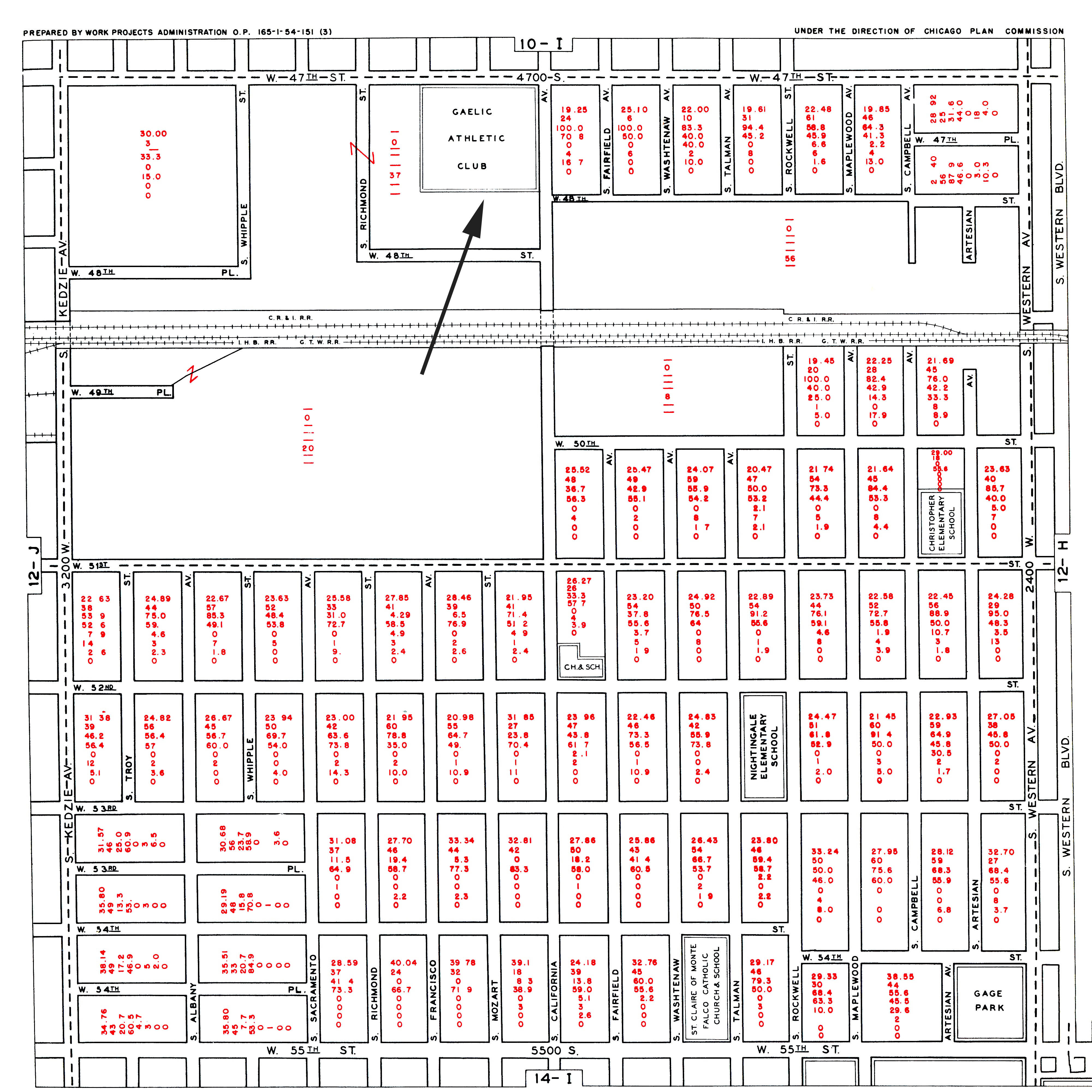
- Gaelic Athletic Club
47th and California
Land Use Survey
1943
NOTES:
1 Gaelic Park was at Forty-sixth and California Avenue from May, 1908 till November, 1931.

Leave a Reply