Chicago Tribune, February 24, 1892
WORK OF THE REAPER. DEATH CLAIMS EDWARD BURLING, AN OLD RESIDENT.
Some of the Buildings in Chicago with Which He Was Closely Identified
Edward a Burling died yesterday morning after a lingering sickness at his residence, No. 299 Belden avenue.
Mr. Burling began his career as an architect with William B. Ogden, who was the first Mayor of Chicago, and had charge of all the buildings put up by Ogden and Sheldon. Among those erected before the fire were the old Marine Bank Building, the Portland Block, Methodist Church Block, Board of Trade Building, First National Bank Building, the old TRIBUNE Building, and many more of the most important buildings constructed in the days before the fire. Aside from the United States Government buildings, the old TRIBUNE Building, the First National Bank Building, and the Historical Society’s Building were the first attempts at fireproof construction ever made in Chicago.
Up to a year before the fire Mr. Burling was associated in business with Frederick and Edward Baumann, and finally formed a business connection with A. Adler, which lasted eight years. The firm of Burling & Adler took a prominent part in the reconstruction of Chicago after the great fire. In the first three years succeeding the calamity this firm had charge of buildings which aggregated four miles in street frontage. Prominent among them were THE TRIBUNE Building, First National Bank Building, Marine Bank Building, Prairie State Bank ing, Merchants’ Loan and Trust company’s bank building, Ogden Building, Methodist Church Block, Dickey Building, Greenebaum Building, Unity Church, Grace Methodist Church, and many others. Mr. Burling had charge of the Ogden homestead, which has been one of the city’s landmarks from the fact that it was the only house on the North Side not destroyed by the great fire.
In 1889 he associated himself with Frank M. Whitehouse and this partnership was kept up until within a few months of his death. The firm of Burling & Whitehouse had charge of the present First National Bank building, and such residences as John Cudahy’s, S. M. Nickerson’s, H. N. Higinbotham’s, C. B. T. Yerkes’, and many other of the finest homes in the city.
Mr. Burling was a member of the commission of ten architects which had in charge the designing of the World’s Fair buildings.
A widow, two married daughters, and a son survive the husband and father.
Edward Burling was born at Kingston-on-the-Hudson, and was 72 years old at the time of his death. When 10 years of age his parents came West. Mr. Burling has been a resident of Chicago for forty years. He was a member of the Methodist Church. In politics he was an ardent Republican, and served as County Commissioner in 1876 and 1877. He was a splendid specimen of the best type of self-made men. He had a liberal education and was familiar with all the English classics and poets. Progressive in every sense, he was well posted on scientific matters. He was a man of the strictest honesty, and, while millions of dollars of other people’s money passed through his hands, he never succeeded in amassing even a moderate fortune.
Chicago Tribune, June 10, 1897
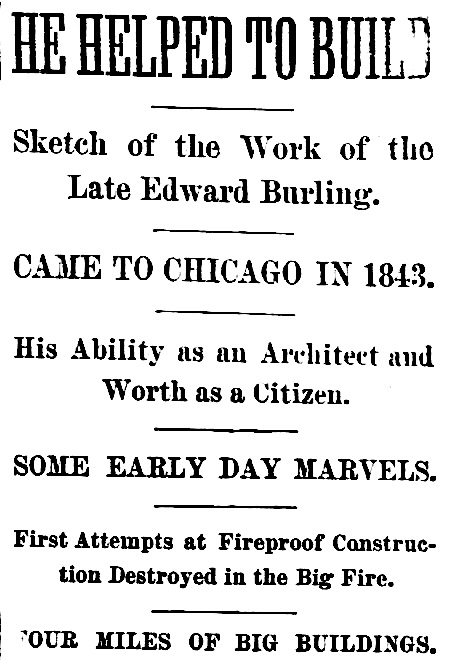 One of the men who took a prominent part In the building of Chicago, both before and after the big fire, was Edward Burling, who came here from the East in 1843 and quicklv forced recognition of his ability as an architect and worth as a citizen. Mr. Burling died in 1892, but his venerable widow, who has been a continuous resident in Chicago for fifty-three years, is now living at Wrightwood avenue and Sydney court, on the North Side. When Mr. Burling first came West in 1843 from his home at Newburg, in New York State, it was as a pioneer seeking a promising location. He stopped for a year in Chicago, and, being satisfied that the city had a golden future, returned to Newburg and was married, bringing his bride at once to his new home in the West, the journey being made by way of the Erie Canal and the lakes. He shortly afterward built himself a residence in what is now Monroe street on the site where Chapin & Gore’s establishment stands, but which was then a mere roadway, well south of the business district of the young town. Among Mrs. Burling’s possessions which she brought with her from New York was a Brussels carpet, the first of its kind ever seen here, and when it was laid for the first time on the floor of the “best” room in their Monroe street house the occasion was considered one of grave social dignity. Rag carpet had up to that time been the ultra fashionable floor covering, and even this was not plenty. The putting into regular use of a real “boughten” carpet, and one of the Brussels variety at that, was too important an event to be passed over lightly, and for weeks the neighbors made frequent calls to feast their eyes on the bright colorings and intricate pattern—some of them being moved with honest admiration, while other shook their heads in doubt and gravely expressed fears as to the final outcome of such awful extravagance.
Mr. Burling’s practice as an architect was at first confined to the erection of a modest class of stores and residence buildings, but as the city began to expand he was called upon to put up more pretentious structures, and in a short time became an important factor in shaping the city’s growth. He constructed the first grain elevator ever built in Chicago, and in later years designed many more big structures of the same kind for such men as George W. Dole and P. D. Armour. Many of the elevators now in use on the South Branch of the river are specimens of Mr. Burling’s handiwork. He also designed and superintended the building of: the first bridge across the river at Rush street, and afterwards took a leading part in the extension of the municipal bridge system. Mr. Burling erected the old Marine Block, Portland Block, First Methodist Church Block, old First National Bank Building. The Tribune Building which was burned in the fire of 1871, and many other edifices of equal importance, as well as homes for a number of Chicago’s leading citizens. The Tribune Building was at that time looked upon as one of his greatest works, as it was the first attempt at what was then called fireproof construction. That it failed to resist the flames of the great fire of Oct. 9, 1871, brought no disrepute to the skill or judgment of the architect, as no work made by mortal man could have withstood the heat and fury of that fire. Massive iron floor beams actually melted away in liquid streams, and the exterior stone walls were disintegrated and baked to a crumbling powder. The old Ogden homestead, the only house left on the North Side when the fire had run its course, was also built under Mr. Burling’s supervision. In the rebuilding of Chicago after the fire Mr. Burling took a leading part. It is computed that the houses and business structures erected by him between 1871 and the time of his death in 1892, if placed in a continuous line, would cover a distance of four miles. One of his first works in this connection was to rebuild The Tribune’s home. In doing this the only change of any importance made from the original plans was to substitute Lake Superior old red sandstone for the Joliet limestone used in the building erected in 1869 on account of its better fire-resisting qualities. After doing this work Mr. Burling built the present First National Bank Block, the home of the Chicago Historical Society, the Churches of the Epiphany, St. Paul, and St. James, the Board of Trade, Sinal Temple, and many other extensive and costly edifices. He also constructed the Grant monument in Lincoln Park and was a member of the committee of architects which had in charge the general plan of the World’s Fair buildings. Many handsome residences, including those owned by H. N. Higinbotham, John Cudahy, P. D. Armour, S. M. Nickerson, C. T. Yerkes, and William Lynn, are the result of Mr. Burling’s architectural skill. He was long associated with the American Society of Architects, in the affairs and councils of which distinguished body his influence was largely felt.

Leave a Reply