Cyclorama, Cleveland Theater, The Strand
Life Span: 1883-
Location: Wabash and Hubbard Court (Blabo)
Architect:
- Lakeside Annual Directory of the City of Chicago, 1880
American Panorama Co. Wabash av. se. cor. Hubbard ct.
Lakeside Annual Directory of the City of Chicago, 1885
Battle of Gettysburg, Wabash av. sw. cor. Hubbard ct.
Siege of Paris, Wabash av. se. cor. Hubbard ct.
Battle of Shiloh, Michigan av. nr. Monroe
Lakeside Annual Directory of the City of Chicago, 1904
Cleveland’s Theatre W S Cleveland mngr 401 Wabash
Reed & Gross Panorama Co., 425 W.61st St. ca 1885-1901
Simeon W.King Panorama Company (Chicago Fire)
Philadelphia Panorama Company of Chicago
Palentine Exhibition Company of Chicago
Chicago Tribune, July 29, 1883
The New Panorama Building, and the Picture It Is Designed For.
The foundations for the new panorama building which Messrs. Bauer & Hut are erecting for Mssrs. Eugene Davis and Eugene Marder, of Brussels, Belgium at te southwest corner of Wabash and Hubbard street, are now in, and the work of building the superstructure is rapidly progressing. The structure will be a sixteen-sided polygon, with a circumscribing diameter of 135 feet. The constructive framework will be of wrought iron, composed of sixteen pillars, made of angle and channel irons, to which will be fastened sixteen arched and trussed ribs, forming a dome-shaped roof, terminating in a wrought-iron wrought-iron ring piece, which is to support a ventilating cupola. The circumscribed walls will be filled in between these iron pillars with brick-work and in rusticated courses to a hight of eighteen feet, where a heavy bell-course will be placed, surmounting the entire building. Above these the corner sides will be carried up to the main corner, which will have a wide arcaded frieze. This will be bold in detail and constructed of galvanized iron. The hight of the building from the sidewalk to the eave of the roof will be fifty-one feet. The dome-shaped roof will be twenty-five feet above this, and the cupola twenty feet higher, giving an extreme altitude of ninety-six feet. Diagonal to the intersections of the streets will be the entrance containing the general ticket offices and vestibule, which will be laid in tile. Leading from the vestibule will be a double passageway, one of entrance to the panorama-room amd the other of exit from it, so that persons passing in and out will not meet. The passageway leads to the center of the building, where there is a double spiral staircase running to a hight of thirty feet and leading to a circular pltform forty feet in diameter, from which point the panorama will be seen. Above this and suspended from the roof will be an umbrella-shaped canvas, so arranged in the circumscribed circle that the line of sight will terminate at the top of the picture, and nothing can be seen except the picture and the surrounding foreground. This arrangement will have the effect of making the observer think he is in the midst of a landscape instead of looking at a picture. There will be no windows in the surrounding walls, but a full flood of light will fall upon the picture from a bed of of glass twelve feet wide, but will not encounter the gaze of the spectators directly. The picture is 400 feet in length and forty-five feet high. It was painted by Paul Philippoteaux, of Paris, who worked steadily upon it for over two years. He secured photographs of the Gettysburg battleground, and by courtesy of Gen. Hancock and others was permitted to know the exact positions of the contending forces during the terrible struggle.
In 1864 the first panorama was erected in Paris, Gen. McMahon, Thiers, Grevy, and other prominent men taking a special interest in it. The picture displayed was the battle of Solferino, painted by Philippoteaux. The shares in the enterprise were originally valued at 500 francs. Now they held at 7,500 francs, and none are in the market. In 1871 the oicture was changed, the Siege of Paris being substituted. Since the erection of the first building structures like it have been built in London, Berlin, Hamburg, St. Petersburg, Madrid, Frankfort-on-the-Main, Brussels, and New York. At present there is another being erected in Paris, which will cost 5,000,000 francs. The building will be opened about Oct. 1.
Chicago Times, December 2, 1883
Battle of Gettysburg
The establishment and sudden spring into public favor of the Panorama of the Battle of Gettysburg, at the corner of Wabash avenue and Hubbard court, have been quite out of the usual fashion of the day. It is rare that any single amusement enterprise,— if, indeed, this can be classed as an amusement simply,—projects and erects a large and substantial building for its own use, and especially one wholly unfit for any other use, and it is quite as rare that any such scheme is entered upon absolutely without resort to any of the “circussing” advertising devices so common in our day. This one came among us so quiet and proceeded so unostentatiously in the erection of its building that next to nobody had any idea, as the building made daily progress, what it was designed for, and the most ludicrous conjectures were common. The very quietness of the proceeding, however, argued in its projectors the most absolute confidence, and the event has shown this confidence to be solidly founded. The panorama is universally conceded by all who have seen it to be the most extraordinary work of art ever seen in this city. To describe it in words is impossible. It must be seen in order to have any idea of its striking realistic effect.
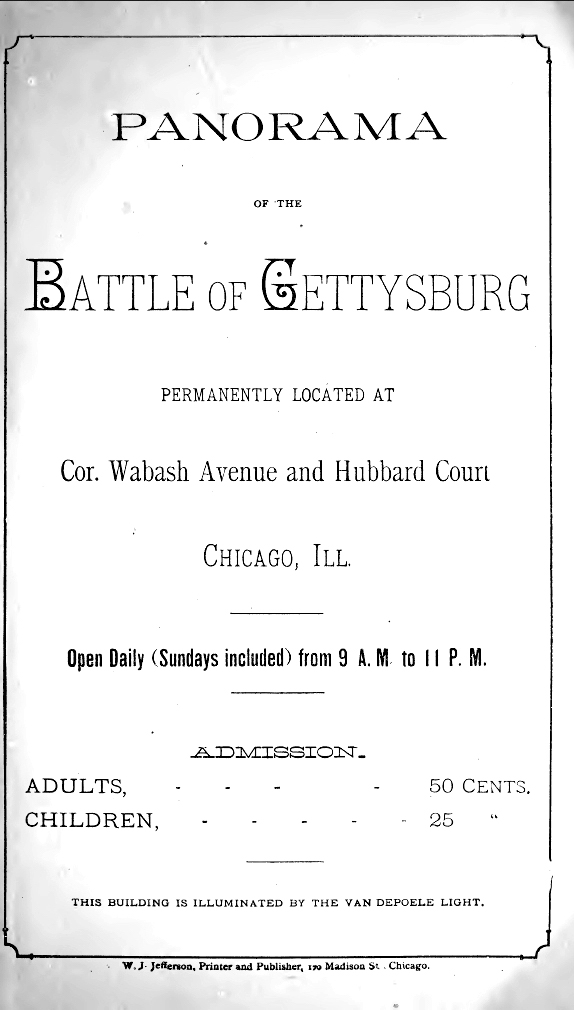
The curious building, brilliantly illuminated by night with electric lights, with windowless walls, lighted during the day only through the roof without a single glaring poster to catch the eye of the passers along the streets, has become the center of attraction to the most intelligent and cultivated classes of the community to that extent that is often difficult to gain admission by reason of the throng. The moral is an obvious and encouraging one, for the stimulating influence of such an exhibition on the growth of a general public taste for the higher forms of art can hardly be overestimated.
The entrance fee to these remarkable illusions and pictures is 50 cents, and you may stay as long as you please, an interesting lecture being delivered meanwhile. Paris by Moonlight was the first cyclorama seen in Chicago. It was shown in the Exposition Building in 1875. Jerusalem, The Siege of Paris, Shiloh, and the Monitor and Merrimac have since been exhibited to admiring throngs. The artist who gained greatest celebrity in this work had the alarming name of Philippoteaux.
Paul Philippoteaux (1846-1923), principal artist and creator of the Gettysburg Cyclorama, first visited the battlefield in 1882. To prepare the project, he built a 30 foot platform on site to view the landscape. He studied War Department maps and conducted interviews with participants— Generals Hancock, Webb, Gibbon, and Doubleday, among others. He also relied on photographs of the battlefield taken by William Tipton. Philippoteaux first created a 1/10 scale oil study. He then sketched the entire composition in pen and ink upon which he drew grid lines and projected the drawing, with grid lines, onto the full canvas. The process of planning and executing the project took about two years.
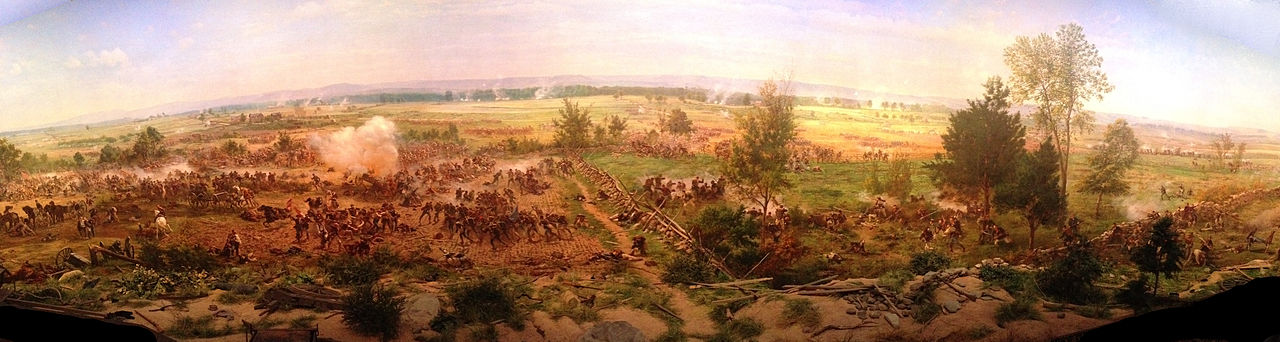
- Detail of the Battle of Gettysburg
The effect of these creations was variously described as “simply astounding” and creating “a suspension of reality that took one‘s breath away.” It was called “so realistic it could be confused with reality.” General John Gibbon, who commanded a division at Gettysburg, extolled the virtues of the painting:
- …you may rest assured you have got a sight to see before you die. It is simply wonderful and I never before had an idea that the eye could be so deceived by paint and canvas….The perspective and representation of the landscape is simply perfect….it was difficult to disabuse my mind of the impression that I was actually on the ground.
At Hubbard Court and Wabash Avenue will be found two similar exhibitions on opposite corners. The western one is Battle of Gettysburg, the first of permanent institutions of this character. The illusions of these devices can not be described, all are interesting and remarkable. Across the way from Battle of Gettysburg is Jerusalem and the Crucifixion. The panorama of the Battle of Gettysburg is 50 feet high by 400 feet long.
The Battle of Gettysburg opened on October 22, 1883 in its Rotunda at Wabash and Hubbard (7th Street). The other three followed: Boston, December, 1884; Philadelphia, July, 1886; and Brooklyn, October, 1886.
Chicago Tribune, March 8, 1884
AMERICAN PANORAMA COMPANY.
The American Panorama Company, which was recently incorporated with a capital of $200,000 by Franklin A. Wattriss and J. P. Breese, has been figuring on the property at the southeast corner of Hubbard court and Wabash avenue. This site, which is directly opposite the Gettysburg panorama, is about 150 feet front on Wabash avenue and has a depth of 175 feet to the alley, is owned by Mr. Byron L. Smith, who is now in Europe. The new Panorama Company bas been figuring for a lease of this property, which is amply large enough for the proposed building, but it is quite certain that no lease bas been signed yet. The lot is occupied by two one-story brick stores on the corner and two two-story brick stores adjoining on the south. The occupant of one of the larger stores informed a Tribune reporter last evening that he had heard it intimated that the property was to be leased over them, but he had received no formal notice to vacate. Later he had heard that the company had secured a site for their building on the North Side. He bad a conditional two years’ lease of his building, and would expect to be reimbursed for improvements made if he was forced to vacate. He did not believe the other tenants had leases.
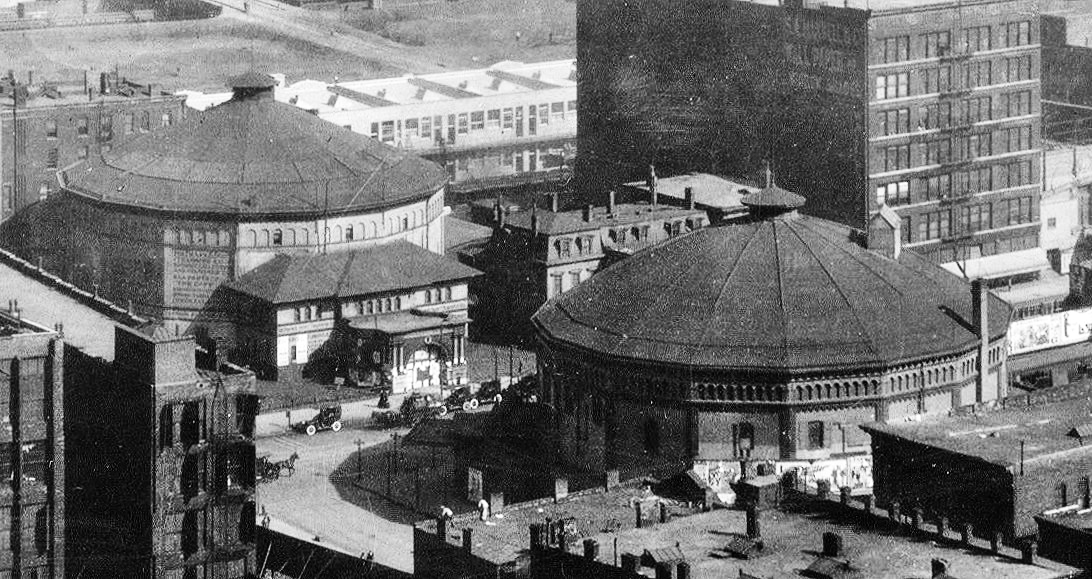
- Aerial View of Cyclorama Buildings at Wabash Ave and Hubbard Court
Circa 1890
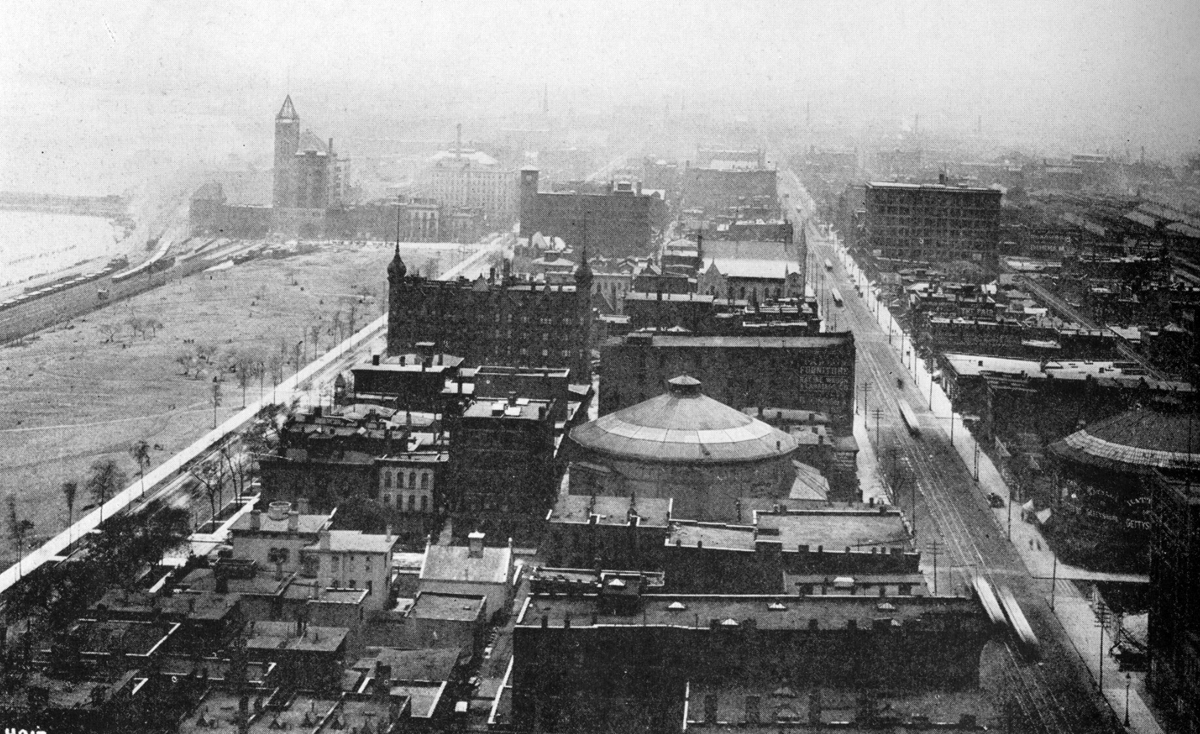
- Cyclorama Buildings at Wabash Ave and Hubbard Court (Balbo Avenue today)
1912
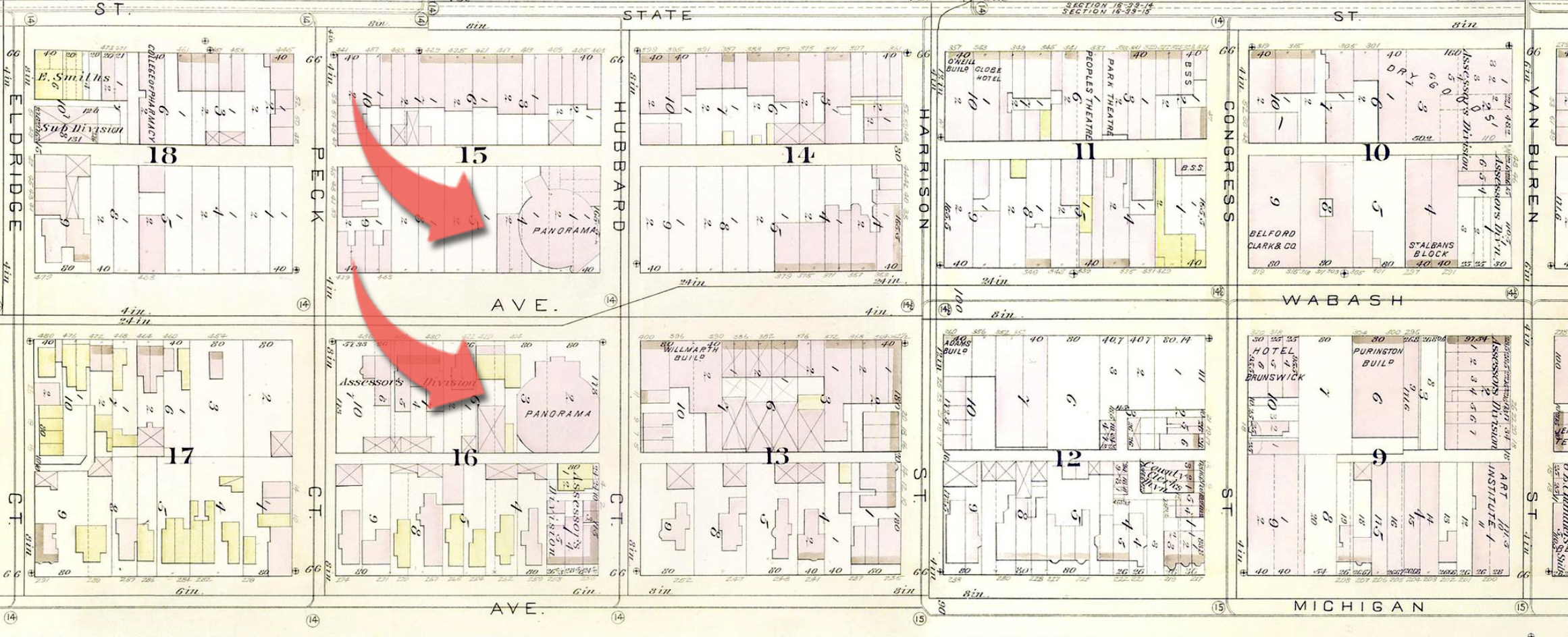
- Cyclorama Buildings at Wabash Ave and Hubbard Court
Robinson Fire Map
1886
Standard Guide to Chicago for the Year 1892
Cyclorama Buildings on the South.
While you are down here you might as well spend an hour looking at the wonderful picture, “The Battle of Gettysburg.” Other cities have” Battle of Gettysburg Cycloramas,” but they are copies. This is the original. On the opposite corner is the new and magnificent “Niagara” Cyclorama, which is attracting great crowds.
Standard Guide to Chicago for the Year 1893
Battle of Gettysburg Cyclorama.
Located at the Cor. Wabash ave. and Panorama pl. Take Wabash ave. cable line. This magnificent cyclorama has been one of the leading attractions of Chicago for several years, and hundreds of thousands of people have seen and admired it. The building in which the painting is exhibited is similar to those in the leading continental cities of Europe. Open day and evening. Admission, 50 cents; children, half price.
Rand, McNally & Co.’s Bird’s-Eye Views of Chicago, 1893
The entrance fee to these remarkable illusions and pictures is 50 cents, and you may stay as long as you please, an interesting lecture being delivered meanwhile. “Paris by Moonlight” was the first cyclorama seen in Chicago. It was shown in the Exposition Building in 1875. “Jerusalem, “The Siege of Paris,” “Shiloh,” and the “Monitor and Merrimac” have since been exhibited to admiring throngs. The artist who gained greatest celebrity in this work had the alarming name of Philippoteaux.
Panoramas.
We thus have arrived at a point which may be called a northern terminus, at least of this description. Two cycloramas are at hand. In one at the west is the Battle of Gettysburg, the most popular of paintings. It has been on exhibition for over ten years, and represents Pickett’s charge. In the other house there have been displayed the Siege of Paris, the Battle of Lookout Mountain, Jerusalem at the Crucifixion, and Niagara Falls, the fidelity of the latter being perfect. A new and striking cyclorama of Jerusalem and the Crucifixion has just been placed on exhibition in this house. The other cycloramas, north on Michigan Avenue, have shown the Battle of Shiloh and the Monitor and Merrimac. The Chicago Fire is now on exhibition. The first cyclorama ever seen in Chicago was in 1874, at the Exposition Building on the Lake Front Paris by Moonlight, a beautiful and descriptive scene. Parisian guide books of 1802 show five cycloramas at that date. Philippoteaux was the greatest painter of these monster canvases. We have thus carefully and sincerely shown such of the chief beauties of the South Side as may be seen in a drive of twenty-two miles. Taking the region as it is, and for what it promises to become, it is indeed a wonderful display of luxury, art, and taste; and the visitor who has taken the three drives laid out in this Guide will be convinced that Chicago is already a city of vast extent more like London than any other American metropolis.
Rand, McNally & Co.’s Bird’s-Eye Views of Chicago, 1898
The northernmost is opposite the Art Institute, and represents the Chicago Fire. It is more truly the burned district as it appeared on the morning of October 9, 1871. It is accurately historical, and should be seen. The color, however, is far too low in tone, a truer effect being obtained by viewing it through red glass. Located on Michigan ave,, near Madison St., opposite the old Exposition building. This is a cycloramic building, formerly occupied by the picture of the Battle of Shiloh. Slides, roller skating, music by military band and novelties make up the entertainment. Open day and evening. Admission, 50 cents ; children, half-price.
The success of the Chicago Cyclorama generated imitators – at one time there were two dozen such paintings. But by the end of the 1880s, the cyclorama was no longer the attraction it once was.
The Chicago Cyclorama closed in 1890 but was refurbished for the Columbian Exposition in 1893. It closed in 1895 and was allegedly destroyed in a fire.
Chicago Tribune, October 17, 1903
MUST PAY FOR POSTING BILLS.
Judgment Is Given Given Panorama Building
Owners Against the Empire Circuit Company.
Judgment for $10 and costs against the Empire Circuit company and the Fine Arts building yesterday afternoon was obtained in Justice Underwood’s court by George G. Newbury, agent for the Battle of Manila building, Hubbard court and Wabash avenue. Employés of the defendants are said to have, without permission, posted bills on the panorama structure.
It was asserted by the attorneys for the complainant that the companies had violated an ordinance forbidding the posting of bills on private property.
Suits against the Hopkins, the Illinois, and the Great Northern theaters were dismissed, the agents for the theaters having promised, it is said, to remove the offending posters.
Chicago Tribune, October 25, 1903
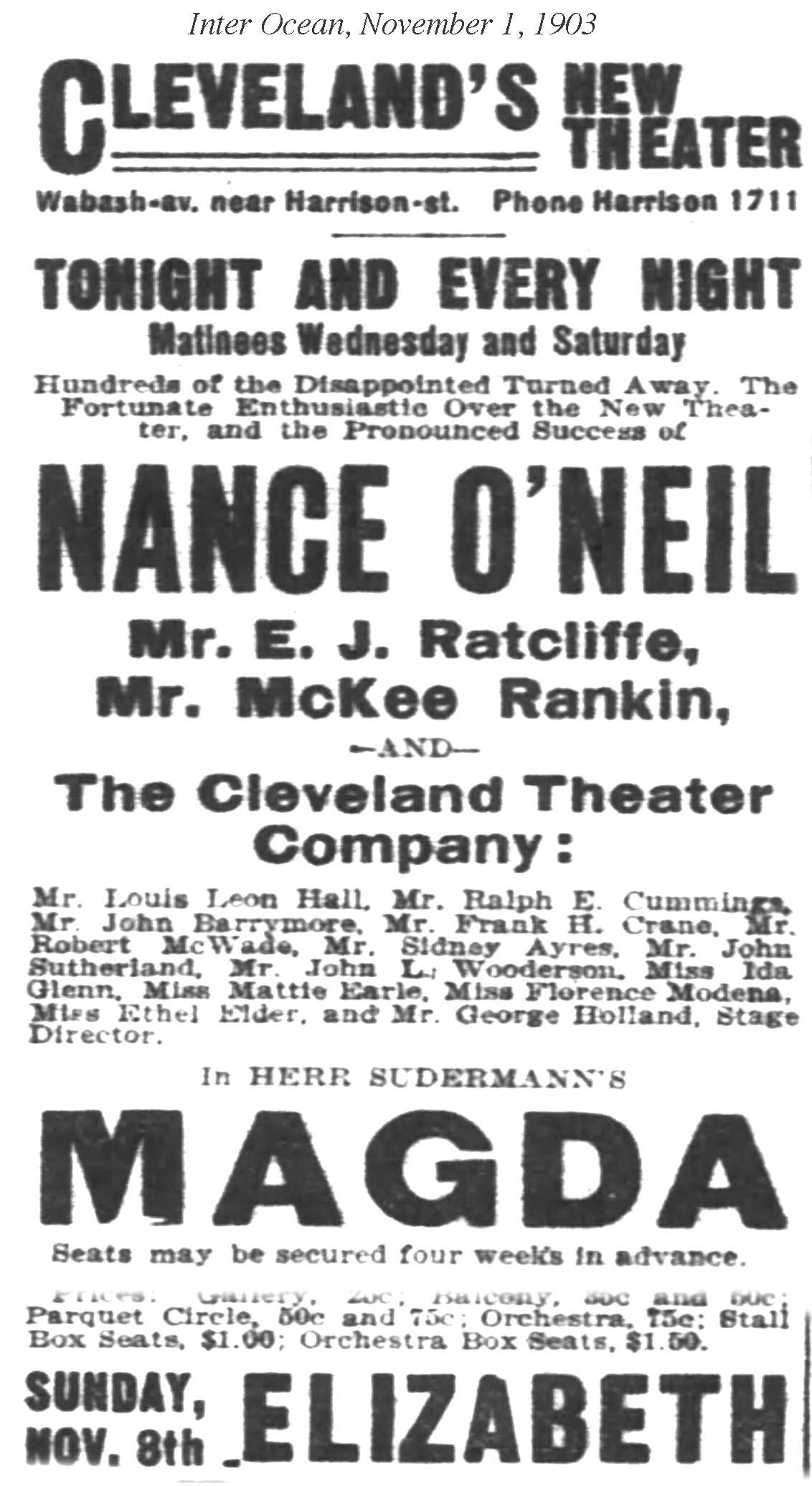
Next Saturday evening will see the adding of a new theater to Chicago’s list of play-houses. The Cleveland is now in sufficient readiness to make possible the announcing of its opening for the last day of the present week. The walls of the old Cyclorama building, at Wabash avenue and Hubbard court, have been used as the inclosing portions of the new place of amusement and within them a theater seating some 1,400 persons has been constructed. The management is authority for the statement that the structure is one of the safest and most perfeet in the country, and the fact that it is open on all sides and has been liberally supplied with exits would certainly seem to assure the safety of the place. Manager W. S. Cleveland has outlined a policy that shall include the presenting of the better class of plays by a stock company and the occasional appearance of stars of prominence. For the opening weeks he has engaged Miss Nance O’ Neil, an emotional actress, who was seen here some seven years ago, and who since that time has made a tour of the world, and has in many places been awarded critical praise as an actress of exceptional gifts. In addition to Miss O’Neil Mr. Cleveland has also engaged for her special support MeKee Rankin and E. J. Ratcliffe, two actors of whose sterling abilities Chicago has had proof on many occasions in the past. These three players are to be the stellar attractions of the house for the next few weeks. The regular stock company which will be employed in their support, and which will offer the regular repertory later on, includes Louis Leon Hall, Ralph E. Cummings, Sydney Ayres, John Sutherland, John Barrymore (son of Maurice Barrymore and brother of Ethel Barrymore), John L. Wooderson, Robert McWade Sr. of “Rip Van Winkle” fame, Frank H. Crane. Miss Ida Glenn, Miss Mattie Earle, Miss Florence Modena, Miss Ethel Elder, and George Holland. For the opening bill Sudermann’s “Magda” has been selected, the title role being regarded by Miss O’Neil’s admirers as one of her best parts.
The cast will include Mr. Rankin as the father Col. Schwartz, Mr. Rateliffe as the pastor Hefferdingdt, Mr. Cummings as Dr. von Keller, Mr. Barrymore as Lieut. Max, Mr. Wooderson as Maj. von Klebs, Mr. Mc-Wade as Prof. Beckman, Miss Glenn as Marie, Miss Earle as Mrs. Schwartz, Miss Allen as Franziska, and Miss Modena as Theresa.
Chicago Tribune August 16, 1894
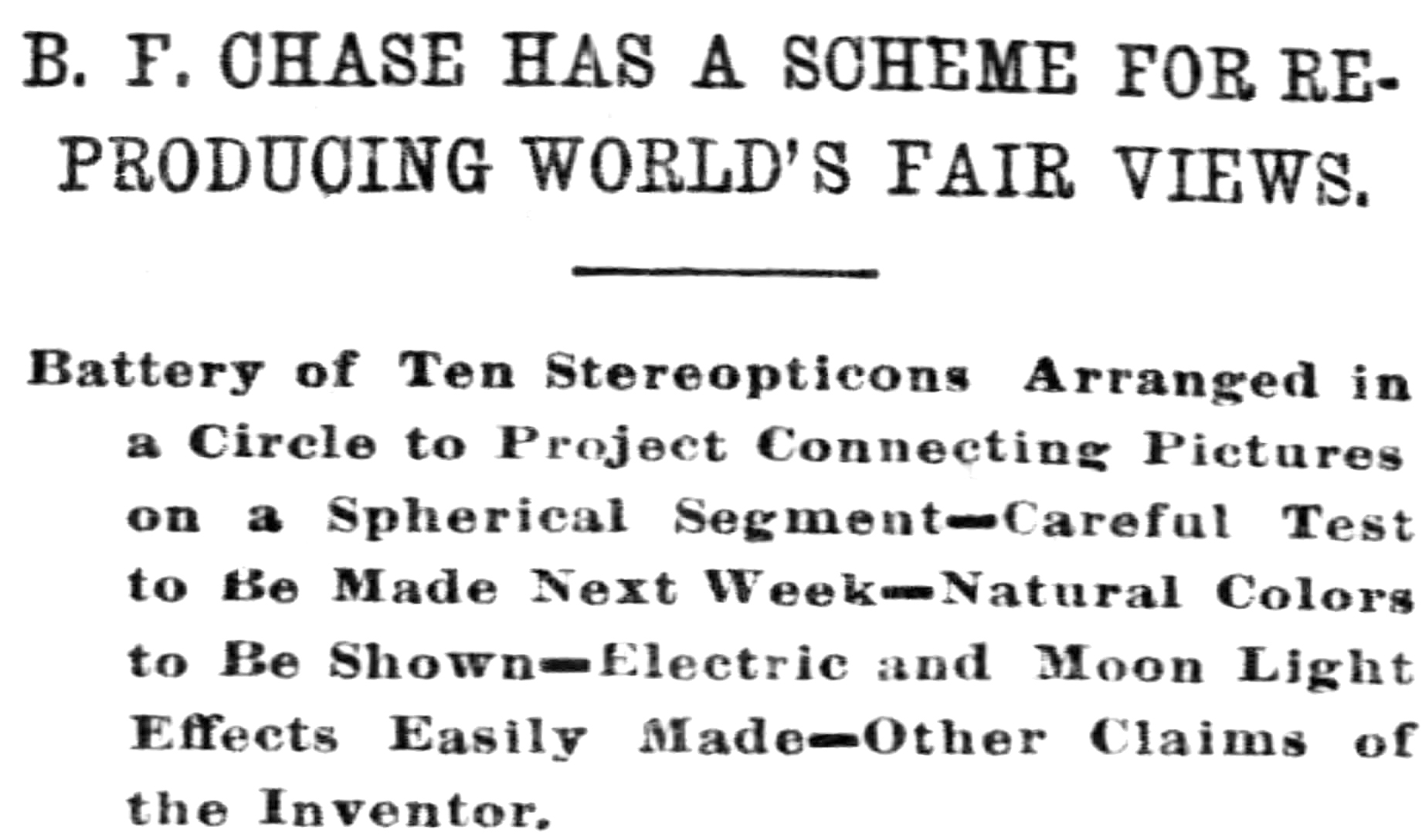
A cyclorama of the Court of Honor and other World’d Fair views will be on exhibition at the Chicago Fire Cyclorama building several clays next week. The of scheme reproducing the Scenes is the invention of B. F. Chase. No. 6647 Yale avenue, an expert in photography. Mr. Chase says he can reproduce any complete horizon view in nature’s colors. The invention embraces the idea of a photographic cyclorama, using a battery of ten stereopticons to project on a blank circular wall any picture or series of pictures In the nature of consecutive views. By the aid of the battery of stereopticons a connected can be made from films, and so arranged that the spectator has the same scene spread before him in as if he stood in the position of the camera when the negative was taken.
The exhibition next week will be in the nature of an experiment and test of the invention. Although there been already several private demonstrations of the success of the scheme, the present trial, it is said, will be of such a nature as to determine whether or not the Dlan will be successful on a large scale. If the test Is as satisfactory as the inventor and his friends predict scheme may supplant that of painting a panorama of the Fair. The views may be changed at will and instantaneously.
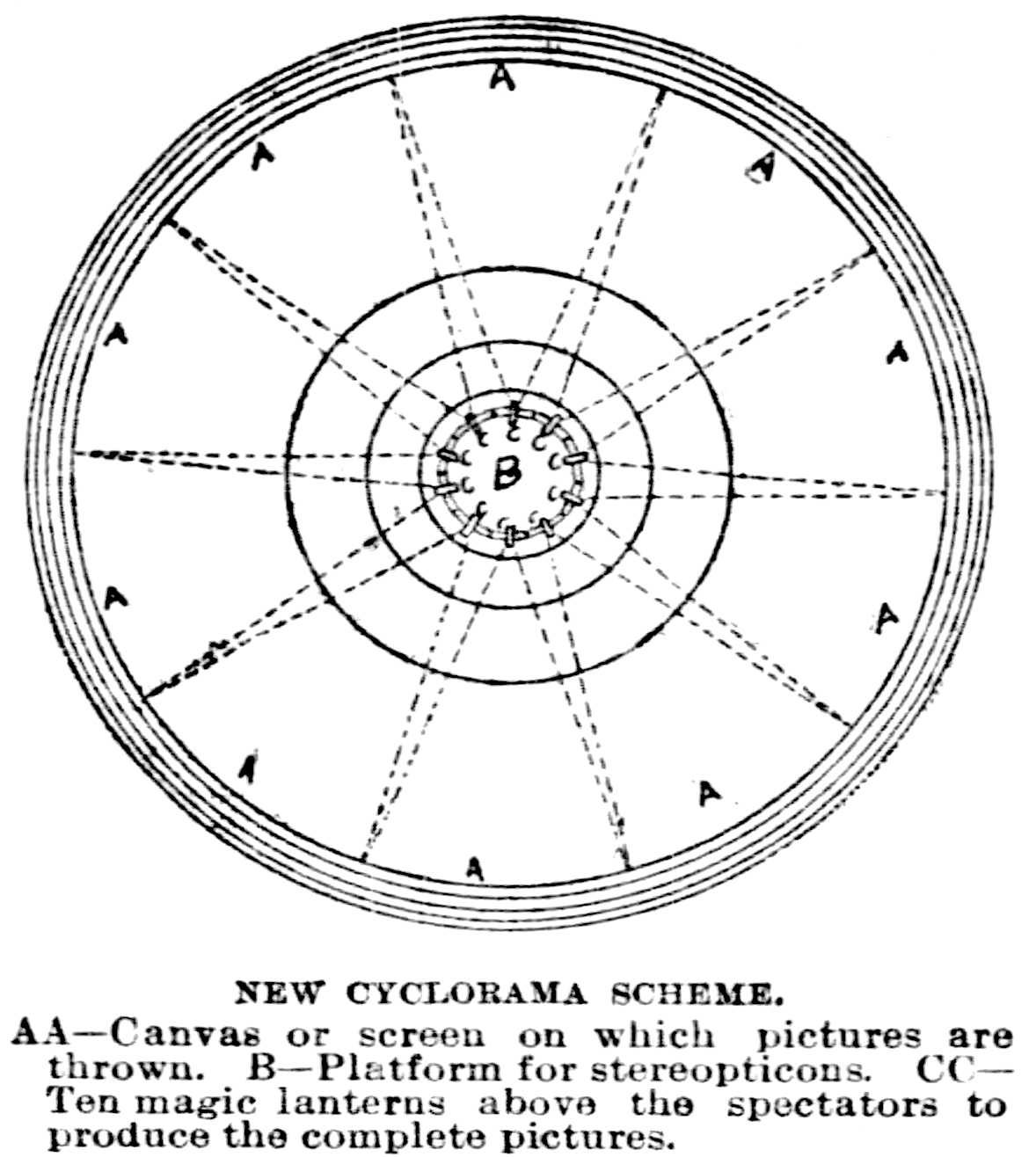
The invention is simple enough and the cost but nominal in comparison with that of painting in oils a picture several hundred feet in length such as are used in cycloramas. The principal item in the east would be the remodeling of an ordinary panorama building. To secure the proper perspective and improve the foreground the walls of the interior of the building should be spherical in form like the interior of a globe. For experimental purposes a perpendicular wall will be used. It will be hung with white canvas and from above by black hangings. Tho operating room stands in the center, under which a platform is for the spectators. The ten stereopticons are arranged in a circle about the operating room and the lenses focused equally on the circular canvas-covered wall. By tho aid of an automatic electric apparatus the views may be made to change at regular intervals. Dissolving views may be used. Electric light and moonlight effects are easily given and the reproduction made as lifelike as possible.
The present test or demonstration is on a much smaller scale than the plans for the perfected and elaborated plant which Mr. Chase expects to build. The exhibition will take place Monday, Tuesday, Wednesday, and Thursday. Invitations will be issued to prominent men and those interested in perpetuating views of the World’s Fair.
The Chicago Fie Cyclorama was produced by The Simeon W.King Panorama Company. About 144,000 people attended the Cyclorama annually. After the exhibit closed, the canvas was stored on a warehouse on South Indiana Avenue then was sold to a junk dealer for $2.00 in 1913.
Chicago Tribune, April 19, 1913
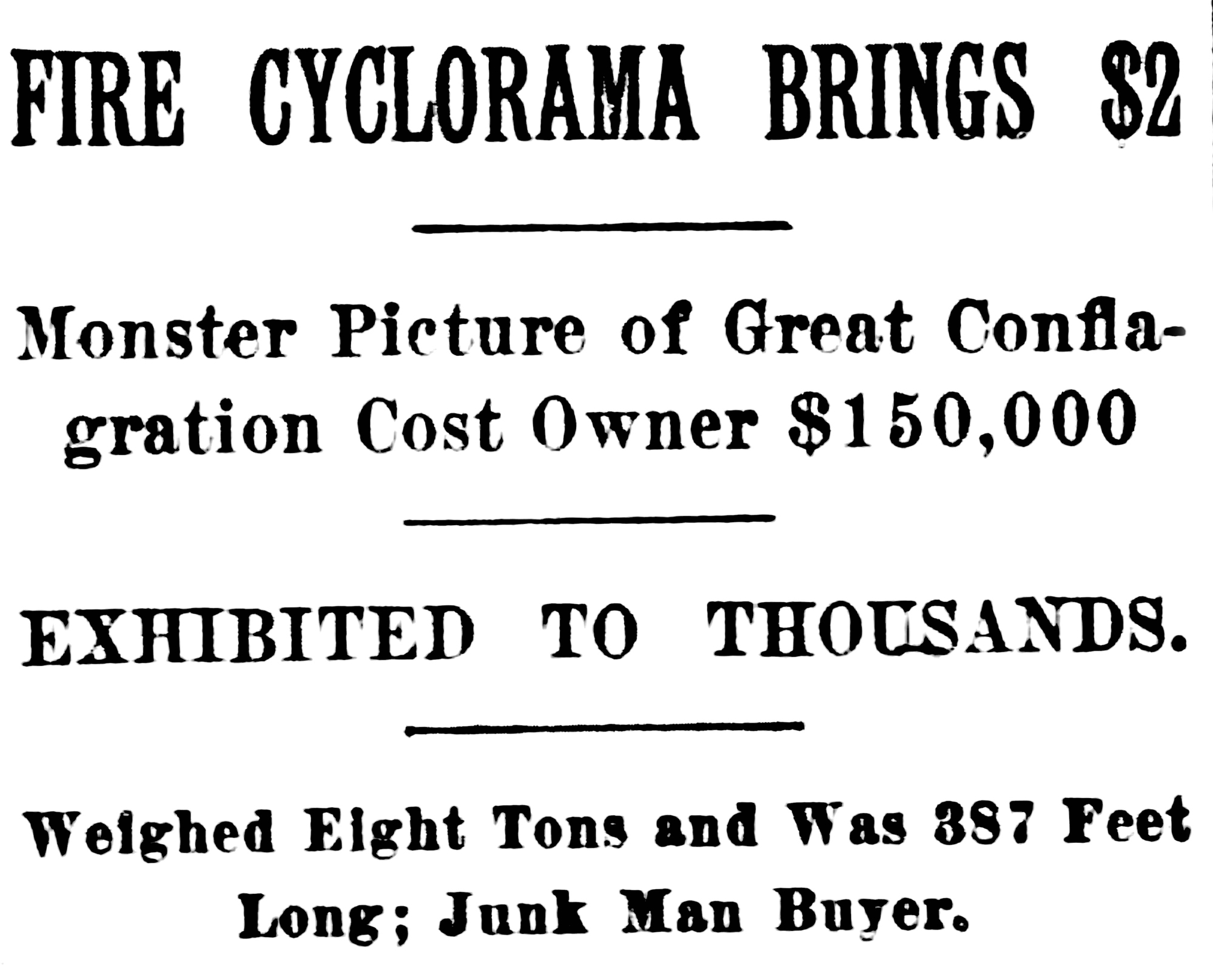 The old cyclorama of the Chicago fire, viewed by thousands of visitors to the world’s fair in 1893 and which cost $150,000 to paint and set-up, was yesterday sold to a junk dealer for $2. The canvas, which weighed eight tons, has lain for many years in a box on a lot at 6001 Indiana avenue.
H. H. Gross, a former member of the board of education, was the owner and producer of the picture. It was first shown in the spring of 1893 in a round building which stood on the present site of the Chicago Athletic association clubhouse. It was on exhibition about one year.
Eight artists spent one year in painting it. Its dimensions were forty-seven feet high and 378 feet long. Among the artists who came to Chicago and worked on the picture were Mege, Corwin, Wilhelmi, Austin, Grover, Collins, and Peraud, About it $15,000 worth of silhouettes used in the building during the exhibition of the painting were destroyed.
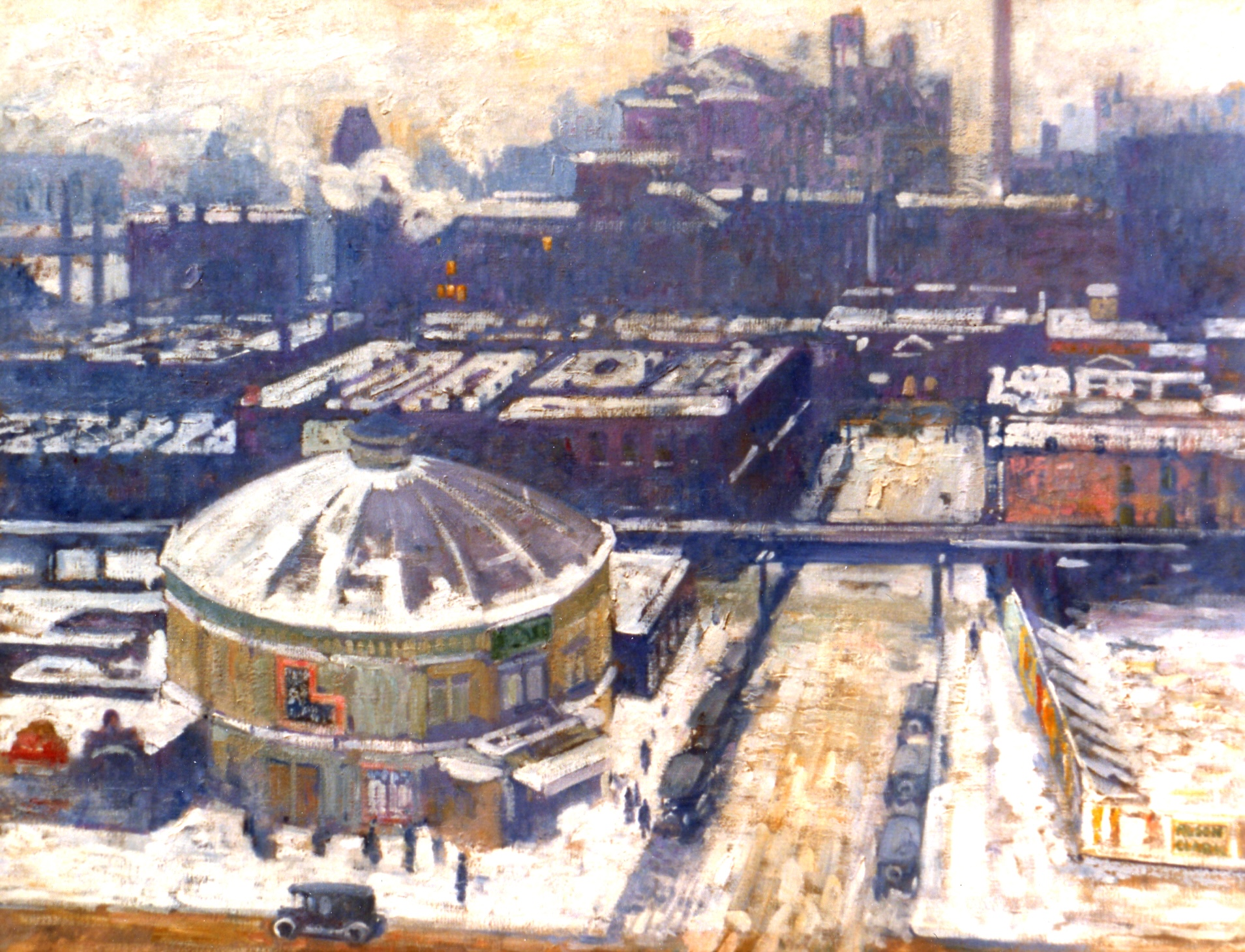
- The Panorama
Oil Painting by Alison Skinner Clark
1916
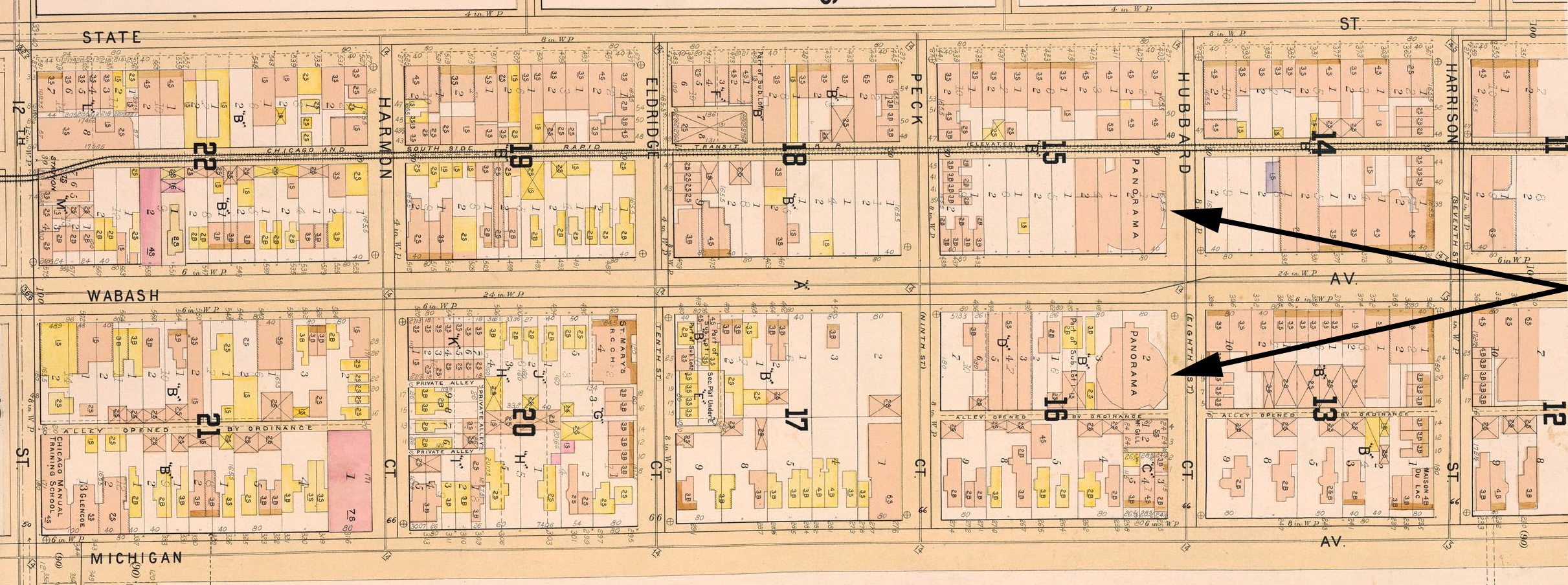
- Cycloramas
Greeley-Carlson Atlas of Chicago
1891
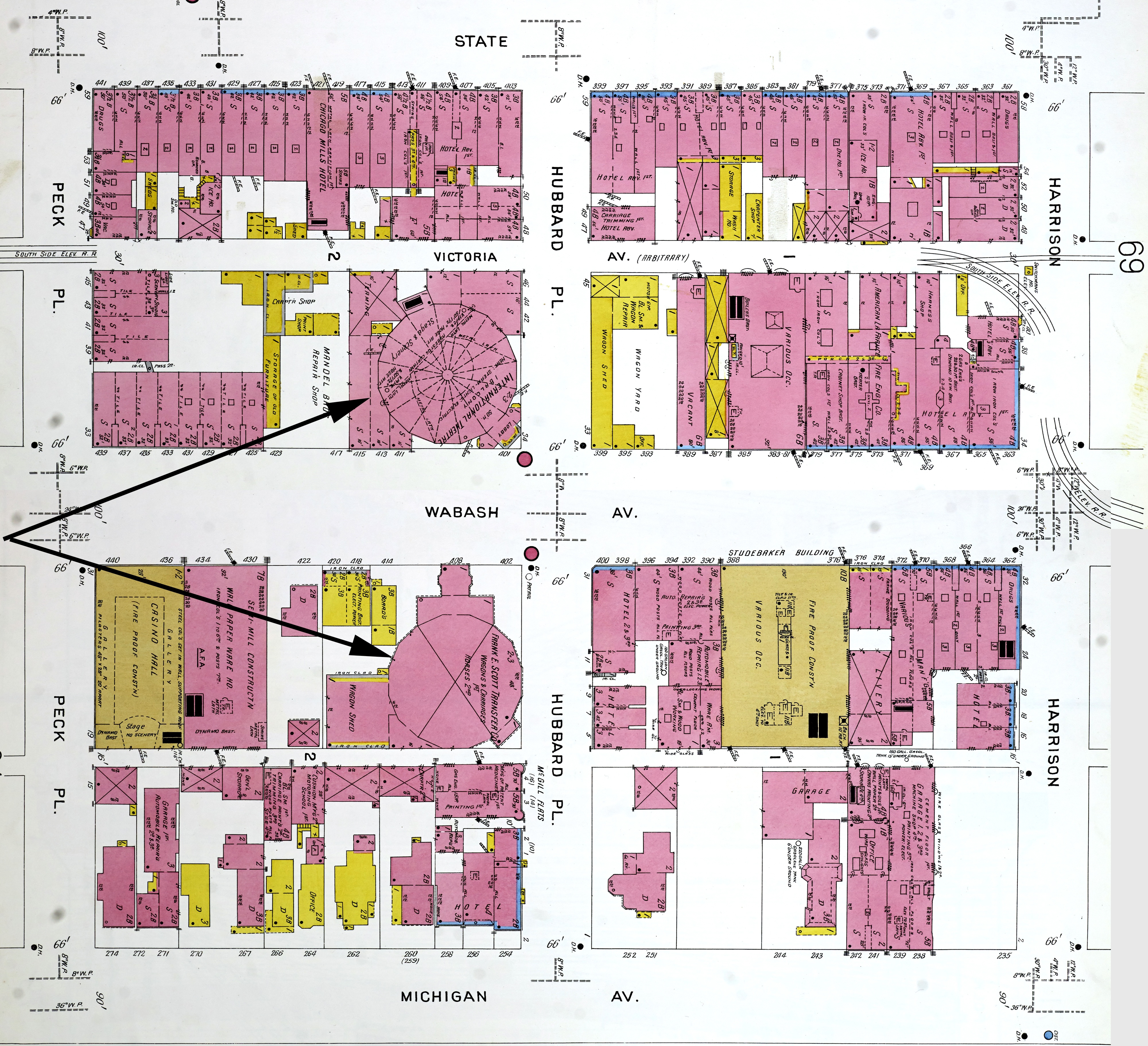
- International Theater Company, SW corner Wabash and Hubbard
Frank E. Scott Transfer Co., SE corner Wabash and Hubbard
Sanborn Fire Insurance Map
1906

Leave a Reply