Chicago Police
The Irish in Chicago
- Lakeside Annual Directory of the City of Chicago, 1876
O’Neill Frank, police, house 16 Emerald
Lakeside Annual Directory of the City of Chicago, 1880
O’Neill Frank, police, house 2702 Wallace
Lakeside Annual Directory of the City of Chicago, 1884
O’Neill Frank, desk sergt. Deering st. police station, house 2702 Wallace
Lakeside Annual Directory of the City of Chicago, 1904
O’Neill Francis supt police 127 city hall h 5448 Drexel av
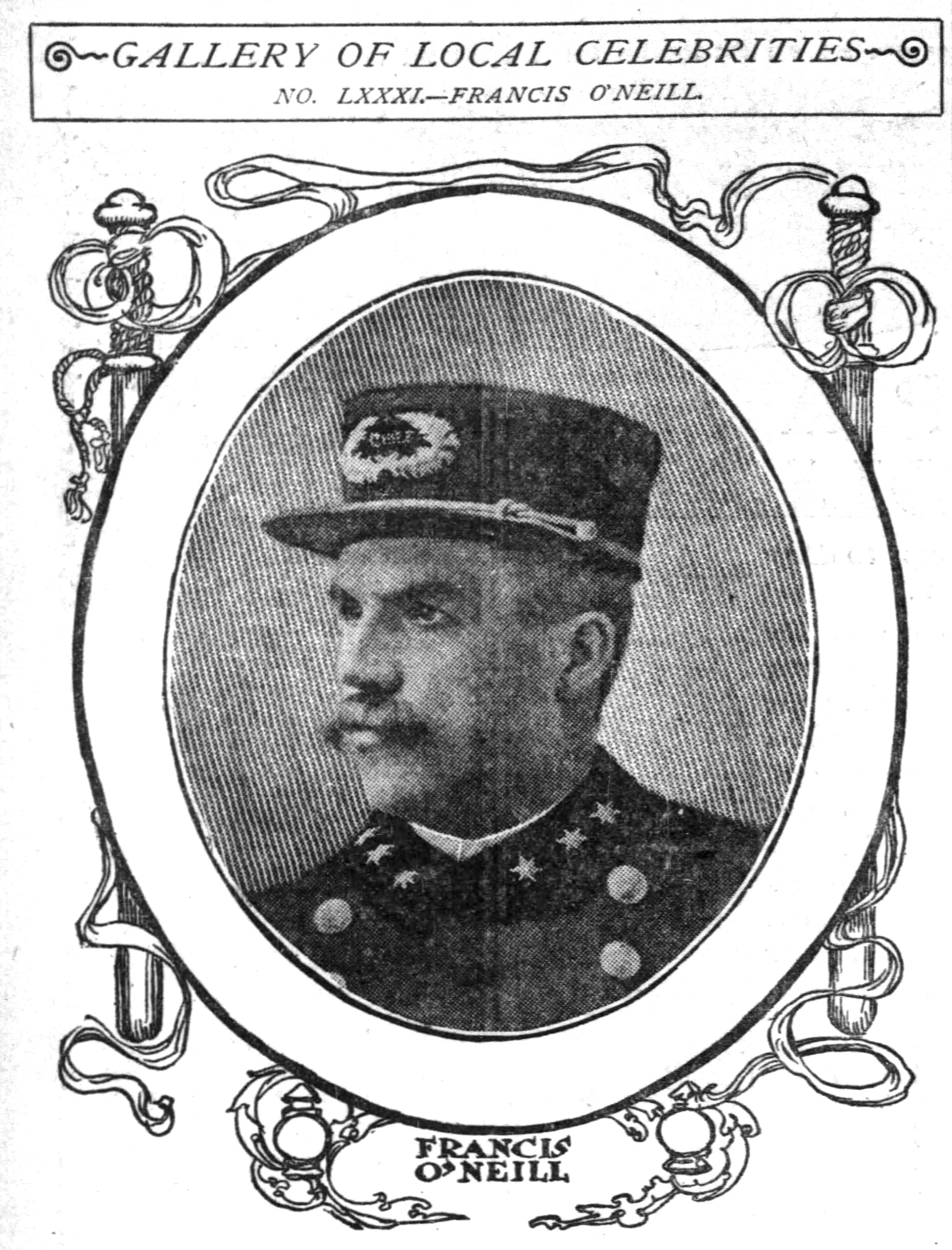
Francis O’Neill, August 28, 1848 – January 26, 1936
Chicago Evening Post, August 18, 1873
Shooting an Officer.
At 6 o’clock yesterday morning Officer Michael O’Donnell, of Pinkerton’s force, observed a well-known scoundrel, named John Bridges, getting out of a rear window of W. L. Barnum’s clothing store, No. 154 Dearborn street. The officer called on the fellow to halt, and was replied to by three shots from a navy revolver, neither of which took effect. Then the thief ran, vigorously pursued by O’Donnell, who shouted “Stop thief!” with remarkable vigor. Officer O’Neil, of the regular force, heard the outcry, and observed the runaway. He called out to the latter to pull up, when Bridges fired once more, striking the officer in the left shoulder, and inflicting a deep flesh wound. O’Neil charged the enemy in gallant style, and knocked him down with his club. A severe struggle followed, which, by the aid of O’Donnell and Officer Herman Myer, ended in the capture of Bridges. It was found that the burglar had assorted a nice lot of goods for transportation, and had some already in the alley way. Officer O’Neil will not be permanently injured by his wound. Bridges is good for ten years, at least, in Joliet.
The ruffian John Bridges, who wounded Officer O’Neil yesterday morning, was before Justice Banyon this forenoon and was held in $10,000 bail for deadly assault and $2,000 additional for larceny.
Inter Ocean, August 26, 1884
Frank O’Neill has been appointed Captain of the life-saving station in place of John Evenson.
History of the Chicago Police, John J. Flinn, 1887
FRANCIS O’NEILL, patrol sergeant, was born in the town of Bantry, County Cork, Ireland, in 1848; came to Chicago in 1867, and entered the force July 17, 1873; was shot in the left breast by the burglar John Bridges, whom he arrested Aug. 17, 1873, just one month after joining the service; was appointed regular patrolman by the police board on the following day for meritorious conduct, and stationed at the Armory; was appointed desk sergeant at Deering street in August, 1878, find transferred to general superintendent’s office in February, 1884; was class 3d as patrol sergeant on January 1, 1887; has never been fined, suspended or reprimanded while connected with the police department.
Chicago Tribune, April 18, 1894
Sec. 4. Lieut. Francis O’Neill is hereby promoted Captain of Police, transferred from police headquarters to the Second Division and assigned to duty at the Eighth District, vice William Ward. resigned.
Chicago Tribune, June 1, 1895
Capt. Francis O’Neill, Detective Bureau, is hereby transferred to the Eighth District, vice Rehm, reduced.
Chicago Eagle, July 29, 1899
Capt. Francis O’Neill of 35th street district is hereby transferred to Harrison street district.
Chicago Tribune, August 25, 1901
 It is hard to say whether Francis O’Neill, the Superintendent of Police of Chicago, is a bard who became a policeman, or a policeman who became a bard.
At any rate he is both a scholar and a police officer, and he seems to have possessed the characteristics demanded by these generally supposed widely separated calling from his earliest youth. He has given full swing all his life both to the inclinations that made him a typical police officer and also to his disposition for study and research which made him a scholar.
In Chief O’Neill there always have been the two natures which sometimes have worked peacefully side by side and at other times warred furiously. The excitement loving, adventurous, romantic side of his nature, which finally made of Francis O’Neill a policeman. was set off by an intense love of study and reflection and such a remarkable ability of acquiring knowledge that before he was 14 years old he had raced through the Bantry school and been made a teacher.
The parents of Francis O’Neill were bothered when he was a child to make up their minds as to whether their boy would be a pirate or a priest. One day he would run away from school and explore all the strange territory surrounding the little lake that lay near the family’s cottage, and that night he would feel the hand of parental wrath and be set down as a wild good for nothing whom nothing could restrain once he got out into the world. But the next day the boy would recite his Latin and Greek so glibly that his teachers would listen to him in amazement and his parents would rejoice that their boy was sure to be a priest.
At the beginning of his career, too, Chief O’Neill often stood on the verge of following one of his dual natures to the limit to the entire abandonment of the other. His thirst for travel and adventure made him want to become a sailor and travel. He made all arrangements to ship in a vessel from Sunderland, but while he was waiting for his vessel to be put in readiness, his scholastic and religious nature temporarily obtained the upper hand, and he determined to be a priest, as his teachers at Bantry had intended. So he went to see the Bishop at Cork, who had proposed at Bantry to the boy that he enter the clergy. The Bishop was overjoyed to receive his visitor, and bade him come the next day and be formally enrolled as a candidate for the priesthood and assigned to a college for study and preparation for his life’s work.
That night the dual natures in Francis O’Neill had a furious war. Strange lands and far off seas in tropical lands reached out with beckoning hands towards the boy, and at the same time the cloistered walls of the old convent under which he stood called to him to hide himself in their classic shades. When morning came the boy was still undecided. A church bell rang in the distance. It called to him from a convent. He sighed and turned his back on far off lands and sunlit oceans, and slowly walked away towards the Bishop’s house and the church life that lay before him. But somehow he got hopelessly lost in the narrow winding streets of old Cork, and though he walked all day he could not find the Bishop’s house.
The next day was too late, for the Bishop had gone away. Then the boy decided that fate had settled the question his warring nature could not, and he hurried down to Sunderland and the shipping and went to sea.
For several years he was a sailor, but all this time the scholastic side of his nature was quarreling violently with him, and at last, for the sake of peace and harmony within his own bosom, he quit the sea and began teaching school in Missouri. This quieted the scholastic side of him, but now the other side rose in revolt until O’Neill quit school teaching and came to Chicago and finally secured peace with himself by becoming a policeman (1873) and securing a library. His adventurous, excitement-loving disposition found its outlet in a policeman’s career, and the work he began as a collector of Irish literature and song lulled his bard side of his nature to rest.
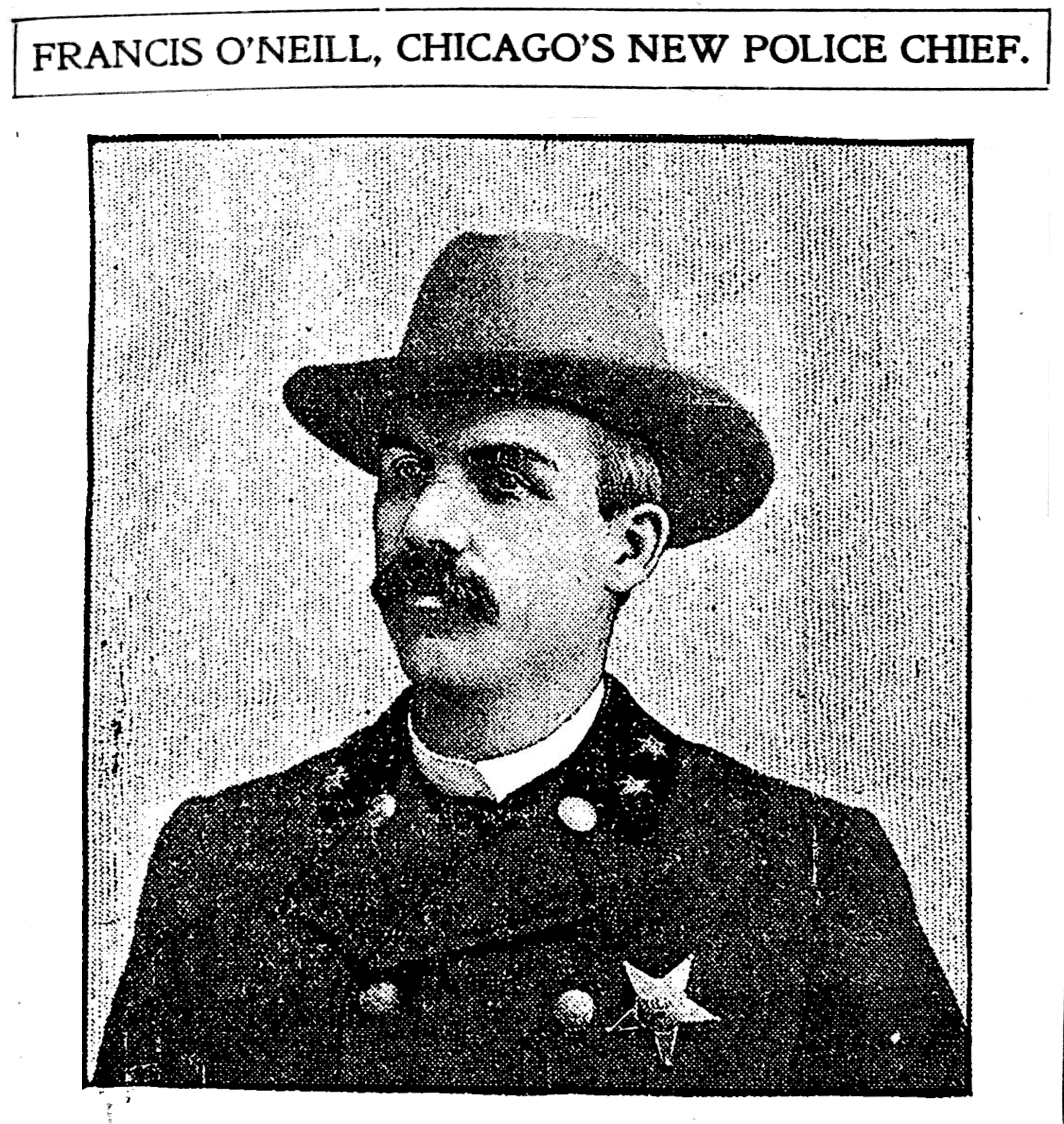
So, a policeman by day and a bard by night, or vice versa (when he was a patrolman he was on the night shift), Francis O’Neill was gone along for for over twenty-eight years happily enough. One meeting O’Neill on police business and when he wore his uniform and star would believe he was a typical policeman completely absorbed in his profession and with no inclination for dry-as-dust tomes and wearisome research. One meeting O’Neill in his library and listening to him talk of his books or of Irish history would see nothing but the enthusiastic scholar full of the knowledge of the pedant but a stranger in the cold, garish, workaday world outside of library walls.
In his office at the City Hall when visited in regard to anything pertaining to police affairs Chief O’Neill is aggressive, short, quick, with a policeman’s bluntness in expressing his opinion. He never feels for words or phrases. He blurts out anything which comes to his tongue just so long as it expresses his simple, honest opinion. He will trifle with no one. No question needs to be argued with him. He rapidly decides in his own mind what is right and what is wrong in every case brought before him and he cannot be moved from his position.
As a policeman Chief O’Neill is not a diplomat. He is not skilled in “bending the pregnant hinges of the knee that thrift may follow fawning.” He has ever been a thorn in the sides of the bosses whose shadows lay black across the floors of police stations. The bosses were set at defiance when O’Neill would snap his finger under their noses.
So the natural result was that O’Neill wandered about from one police station to another, a sort of modern pariah with his hand against every precinct boss and unmade things things like police captain that he once whaled an Alderman, a political joss, and sent him to the police station in a patrol wagon. Of course he was transferred for this act, but he did not care. He would have done it again the next day with pleasure.
This is O’Neill, the policeman.
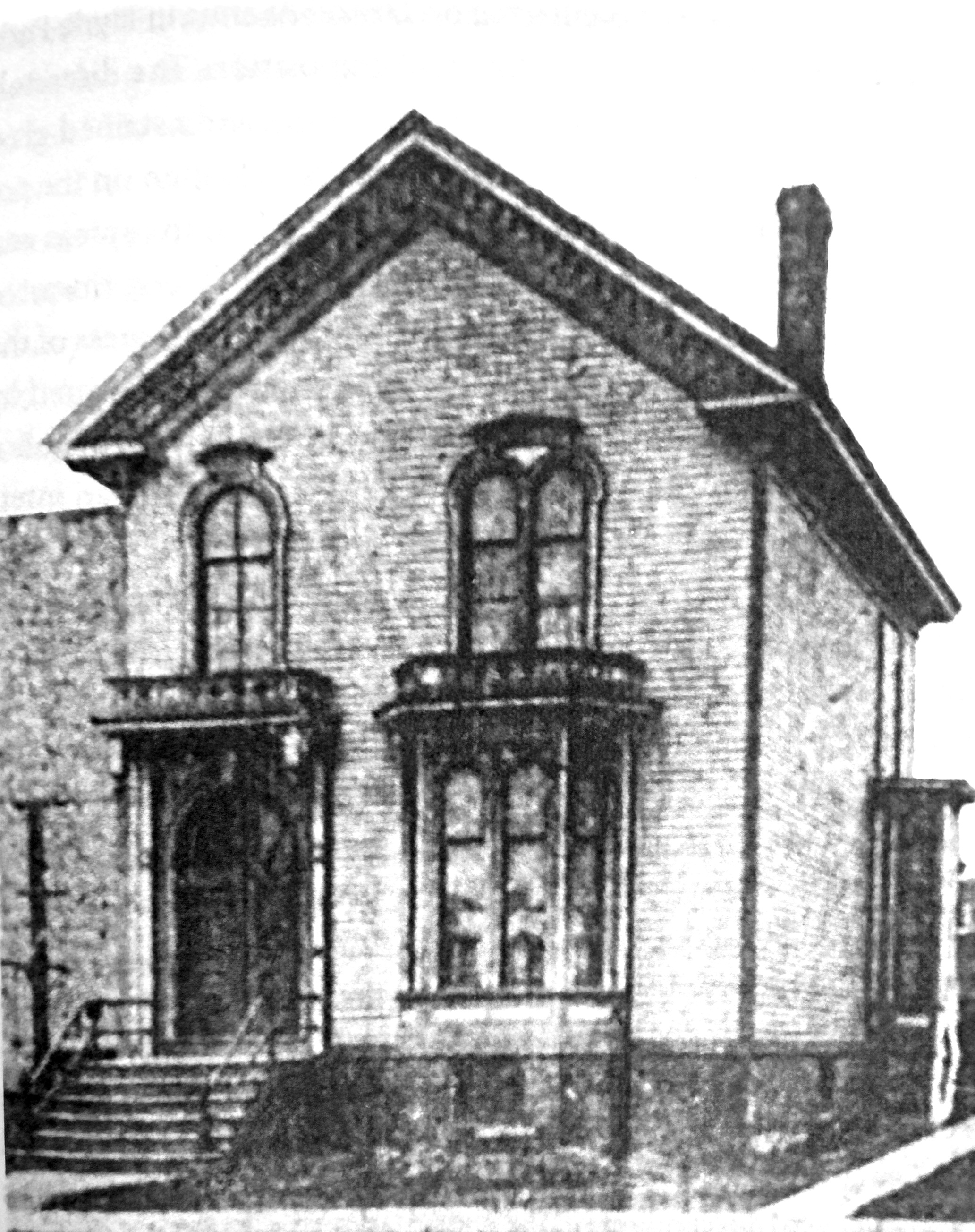
Go to his house at 5448 Drexel boulevard (right) any night, and O’Neill, the scholar and bibliophile, may be encountered. In his library are 1,500 volumes of rare works, first editions and curios. One division of his library is devoted to histories of Ireland by every author who ever entered that field. In the collection are books three and four centuries old that were picked up by Chief O’Neill after years of patient search among the old book shops of a dozen different cities. Chief O’Neill’s reputation as a bibliophile and antiquarian has won him a membership in the Cork Historical and Archaeological society and he is famed on both sides of the Atlantic as an authority in all matters pertaining to Irish history and tradition.
Chief O’Neill is the custodian of the richest treasury of Irish music in the world. Through his zealous efforts, covering a period of over a dozen years, 1,500 Irish airs hitherto preserved only through traditions have been rescued from oblivion and written down that they might endure as a precious heritage for the sons and daughters of Erin.
In his library Chief O’Neill becomes the scholar and pedant. He loses the quickness and abruptness that characterize him in the City Hall. He speaks slowly and frequently, holds his words until he has looked through some of his ancient volumes to be sure of his position. His memory is marvelous, and he has a thousands of old facts and traditions at his tongues end.
Chief O’Neil is now 53 years old. He was born in Tralibane, three miles from Bantry, County of Cork, Ireland. In 1865 he shipped as a sailor from Sunderland and visited Odessa and Russia. Then he made a voyage to New York, and from there he shipped before the mast to Japan, and on the return voyage was shipwrecked, and after a few weeks on a desert island in the South Pacific was picked up by a passing vessel and carried to San Francisco. In 1871 he came to Chicago and became a laborer in the Chicago and Alton yards. In 1873 he became a patrolman under Commissioner Elmer Washburn, and a month after he had donned his star was sent to the hospital with a bullet in his breast fired by a tough whom he had placed under arrest. In 1878 he was a desk sergeant at the Deering Street Station, and three years later was a Lieutenant and confidential secretary to the Superintendent of Police.
In 1870 Chief O’Neill married Miss Anna Rogers of Bloomington (Illinois), whom he had met when she was a passenger and he a sailor on the Emerald Island, the ship which brought him to New York on his first trip to this country. Five children have been born to Mr. and Mrs. O’Neill; Mrs. Julia Mooney, the wife of Patrol Sergeant James Mooney; Caroline, a teacher in the Chicago schools; Roger, May, and Anna, all in school.
Chicago Tribune March 2, 1902
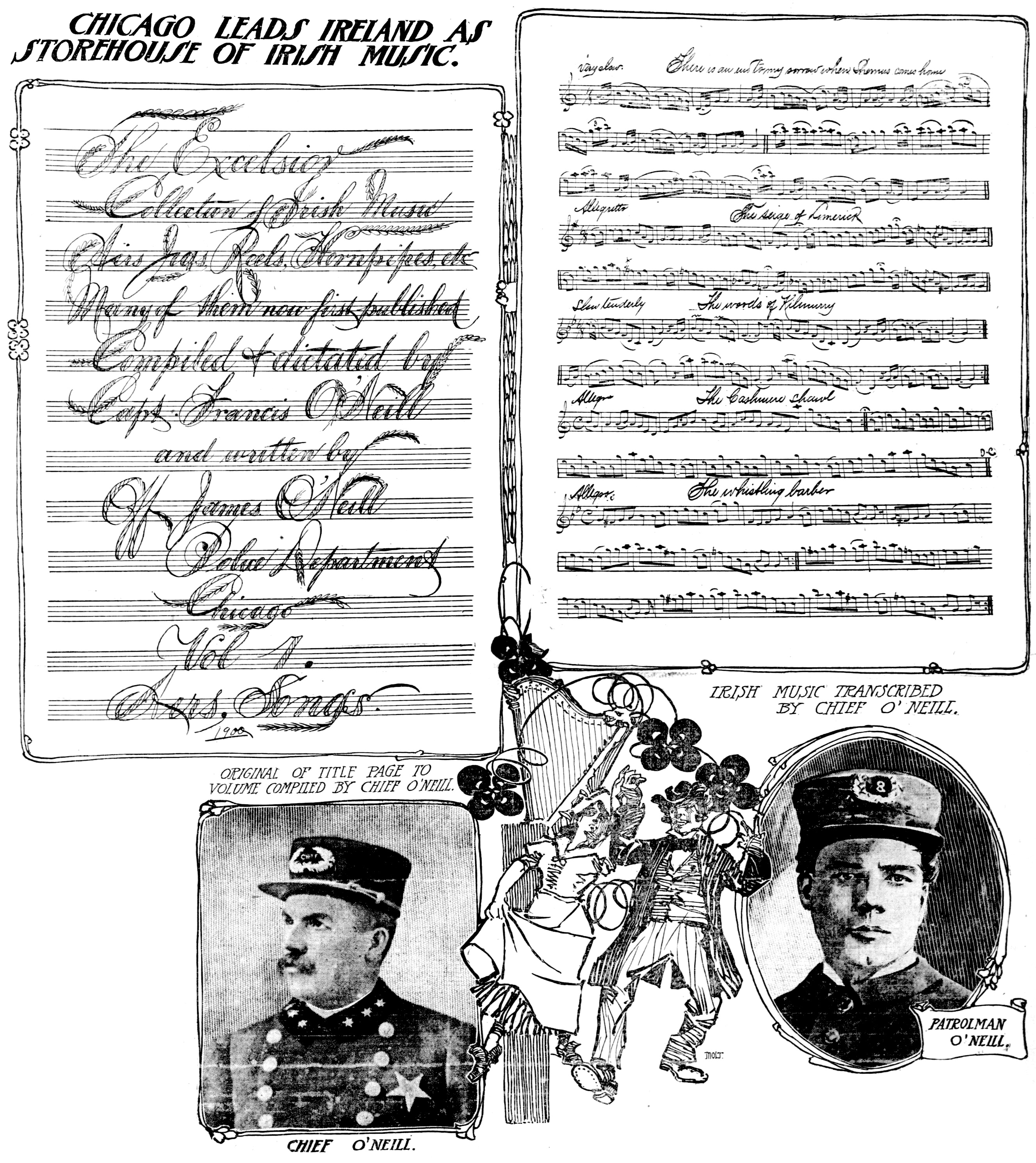 Chicago as the home and storehouse of Irish music in all its pristine color, lilt, and swing may seem an anomaly. That the Superintendent of Police of this second city of the United States found here and put into collections has 1,800 pieces of Irish music, nearly half of which never before had been without out, is one of the accomplishments ten must be taken into account when Chicago finally comes to making her showing Chicago as an art center.
But without question Chief of Police Francis O’Neill has one of the most remarkable collections of Irish music in existence, and after more than five years devoted to the work, he is still finding Chicago a mine to the of Irish melodies. Working with the Chief in all of this has been Police Officer James O’Neill of the Brighton Park Station. The two men are not relations; the Chief is from County Cork and his namesake is from the Belfast country. Only the tie of music makes them kin, and in this copartnership it is admitted by mutual friends that the Chief has been furnishing the purpose and the idea, against the talent of the subordinate officer.
As a matter of truth, most of the facts concerning the particular part of Chief O’Neill in the collections must come from the Chief’s friends. That he has been more than five years at the work, unknown to many of his neighbors, indicates that he has not done much talking on the subject, and his silence on that subject now would be sasy to set to music in quarter rests.
Chief’s Early Love of Music.
It is known, however, that Chief O’Neill came away from Ireland at 16 years old, bringing with him the recollections of a mother, singing at her wheel, humming the old airs of the Green Isle as she went about her household duties, and at nightfall crooning the baby to sleep with a cradle song. As a lad he had been taught by a neighbor to play the flute, and as a stranger in the strange land of America it was not especially significant that the boy’s heart turned to a resurrection of some of the old folk-songs of his childhood. Many of these songs were local, never having been set to music, and Chief O’Neill’s first volume was to have been devoted to these.
Perhaps something more than boyish recollections of a mother made this purpose strong. The music of Ireland was in the heart of Francis O’Neill as a boy, and when, Perhaps something more than boyish recollections of a mother made this purpose strong. The music of Ireland was in the heart of Francis O’Neill as a boy, and when, as a patrolman, he had a post out of Desplaines Street Station, the history of Irish music was in his head. The fate of the Irish harpers of old, driven to exile and death; the proclamations of Elizabeth that all of them should be hanged, and her appointment of Lord Barrymore as executioner-inchief, had filled the Irishman with regret that the music of his native land thus had been driven to the homes of the peasantry and even there put under ban. Wars and the efforts of the Irish at simple self-preservation had strangled music in its growth, and the prediction of Professor Sullivan that the archsologist of a dim future would have to resurrect whatever of this music might be possible, was an incentive to the young collector.
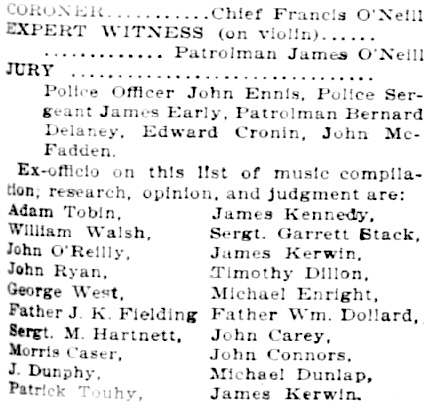
Today that incentive has led not only to the greatest collection of Irish music in existence, but it has given to Chicago a more or less formal Irish music lovers’ club, whose “Inquest committee” is sitting in judgment almost every Sunday upon the O’Neill collections, accepting, alternating, polishing, and discarding as it sees fit from all the seven volumes now filled with Irish melodies. At this inquest the jury is made up as follows:
Remarkable Ear for Music.
Not a single man on this list has failed to furnish at least one important contribution to the O’Neill collection. Edward Cronin of Lake View has furnished more than thirty pieces to the set. As to Mr. Cronin’s contributions, not one of them can be found in print, yet he left Ireland more than forty years ago and had only his remarkable ear for music to retain them. Most of these tunes are inland and wholly local, and Mr. Cronin has contributed them while whistling. humming, or singing them to Officer James O’Neill. Officer O’Neill, with music paper and pencil, sits writing down these notes as they come to his ears. He cannot write as fast as they are whistled to instance. but under almost any circumstances, pickIng up a tune even at random and under adverse circumstances, Officer O’Neill can take the air down in full if it have only two or three renditions.
It is in this way that so much of Chief O’Neill’s collection has been contributed. Frequently, when a half forgotten tune has come to the Chief, he has had Officer O’Neill listen to it from the flute, taking the fragments down as the Chief played or whistled. Now and then a bar has been missing. Then the genius of Officer O’Neill has come in and the necessity of the “Inquest committee” has been emphasized. The officer has a considerable knowledge of composing, and out of a still fuller knowledge of the “brogue” of Irish music the building in of three or four missing bars is easy to him. On this work the “inquest” sits in especial judgment, and when it has been O. K.’d it is ready for a final transcription into an entirely new set of music books. So far the original collection of Irish airs in Chicago is in seven volumes of eighty pages each, averaging twelve music staffs of six bars to the page. In this “inquest work,” half of the music considered has been dug up from the memories of men and women and is in need of careful editing. Already the inquest has passed upon the songs, airs, and reels of the collection, leaving the hornpipes, jigs, and miscellanies to be considered. Already nearly all of this music has been written three times, and its final transcription into a new set of volumes is going on at the hands of Officer O’Neill. These new books have pages of fourteen staffs, each staff averaging eight bars.
Some of the music presented with this article shows the difficulties which O’Neill and Officer O’Neill have encountered in the general work. Every bar in these selections is new to print and nearly every one of them has made several kinds of trouble for all concerned.
Elusive Fugitive Airs.
A striking example of this is in the air, “The Woods of Kilmurry.” This was one of the old, elusive, and ever fugitive airs which Chief O’Neill had tried to call back from the time when, at the spinning wheel, his mother wound up the old song with the words:
- The flourishing state of Kilmurry.
Only the last bars going with these words were remembered sufficiently to recall. Officer O’Neill put these bars on paper, played them to the taste of the Chief, and then set to work to write backward on a strange Irish air to a logical Irish beginning. This he has done and Chief and Inquest committee are satisfied that the world’s judges of Irish music will find it so.
“The Whistling Barber” of this collection is considered a gem. The manner of its acquirement is related in some degree to municipal history.
A year ago, at the eity elections, Patrolman O’Neill was stationed at the polling booth at Thirty-second and Halsted streets. Incidents were not numerous there and O’Neill chanced to step inside an adjoining barber shop. The barber lived in the rear of his shop and one of his children, a mere babe, had toddled into the shop and set up a roar of protest at the world in general. The barber laid down his paper, picked the babe up, and trotting it on his knee, struck up a whistling rendition of an especially lively Irish reel.
Quick as a flash O’Neill had out pencil and paper, and while the baby squalled and the heels of the barber beat noisy time on the floor he caught the reel to the last two bars. Then, in despair, the barber dived back into his living quarters and staid there so long that the policeman finally had to follow him back to the family kitchen to beg for the few remaining notes. From this incident the title ” The Whistling Barber” was easy.
Picked Up on the Street Car.
Another air greatly treasured by the collectors was overheard by Patrolman O’Nelll while riding on the front platform of a trolley car, and the motorman was in such genuine good temper that he whistled it over and over until Officer O’Neill got it without attracting the motorman’s attention in any way. This is “The Cashmere Shawl” of the collection here given, and James Kennedy, a motorman of the Chicago City railway company contributed it.
“The Siege of Limerick” is one of Chief O’Neill’s resurrected pieces, which he found in an old volume of miscellaneous music bearing the date of 1811. “There’s an End to My Sorrow When Shamus Comes Home” is typically Irish, but it was necessary for the collectors to build it up to a considerable extent.
In Patrolman O’Neill’s work of catching Irish airs “oft the bat,” time nor place cuts any figure. It is said of him that on one occasion a watchman at a railway crossing in Thirty-fifth street broke into an Irish melody, and that O’Neill, spreading a piece of paper against the outside of the watchman’s house, took down an excellent bit of Irish music that was new to every member of the committee on inquisition.
Chicago, as the storehouse of all this music, presents some striking phases to the collectors. More Irish music is to be found here, and with less effort, than is possible in Ireland itself. The reason has been found easily. War drove Irish music to the cabins of the Irish peasantry. When war was done a popular prejudice made it still something not to be made conspicuous. Finally the charity fiddler and the piper for pay made the pipes and fiddle unpopular even in the better cabins. Many an irate parent broke these instruments which talented children secreted in the home, and from the instruments of music the prejudice ran rapidly to the “mihul,” or dancing bee and the “patron,” which assembled the young, having light feet, to dance on Sunday afternoon at country corners. The priests joined with the parents, and often swung the blackthorn upon the bodies of those who persisted in this merriment.
From Birthplace to Graveyard.
Thus Irish music went into decadence until before it was lost altogether the world just to awaken to the fact of what it was began losing. From the birthplace of music and poetry, Ireland rapidly was becoming the graveyard of it. Petrie in forty years found 1,000 tunes only. Bunting and Joyce overlooked much of it, and yet in Chicago a Lake View man, away from Ireland for forty years, digs up thirty tunes which no one of years, these three collectors found.
This fact was made possible through Irish emigration of long ago. Forty years ago the Ireland which was inclined to sing was singing and playing upon violin, flute, and union pipes. War measures had released it and the people themselves had not degraded it. Thus the boy or girl with music in his soul had a chance to imbibe it and bring its melody to America.
The great mass of this Irish music was traditional. Ireland had a music scheme of its own and was writing its melodies on a perpendicular stave long before the Italians or Germans had put it to paper in horizontal lines and spaces. The circumstances of war, however, left the music of the Irish to the hearts of the Irish people only, and nearly all the resurrecting of Irish music has been done in the simple treble clef. It was written that way, in fact, as the violin, pipes, and flute were the chief instruments after the bards, and required no further harmonizing. Now, with the modern piano as the test for nearly all instrumental music, this resurrected music of Ireland is handicapped for lack of a proper harmonizing and arrangement in the bass clef. In all the past this arrangement of Irish music for the piano has resulted in mutilation or even destruetion of that something called its ” brogue” No one can explain just what this brogue is; it is not capable of demonstration in words. The Irishman’s heart simply leaps to it at its first bar and warms to it to its last one.
One of the physical marks of the music is that it most frequently is written in the keys of D, E, G, and A, and some Irish composer even has referred to the ” impossible keys ofF and B.” Being traditional, too, it has been subject to prunings and interpolations by the modern German school. Even Moore has expressed regret that the publisher’s censor was once disposed to use such an unsparing hand upon the unconventionalities that gave the music distinction.
Stolen by Other Countries.
Today our Chicago collectors are bemoanthe fact that nearly every nation of ing Europe has filched from the Irish melody to serve their own “compositions.” It is declared that Flowtow’s “Martha” has only “The Last Rose of Summer” to endear it, and that this air distinctly is Irish. The Scotch “Farewell to Loch Aber” is the Irish “The Breach of Aughrim”; the “Battle of Killicrankie” is “Planxty Davis,” and even “The Campbells Are Coming” is branded on the Irish ” Sean Dhina Dota.” Chief O’Neill has this last named Irish air in three settings. One of them is from his mother’s rendition and another from an early Munster collection.
Searching Chicago for Irish music, to find within 200 square miles a wider selection than Ireland itself probably contains at this time, Chief O’Neill and his coworkers have found some interesting conditions. As a mine of Irish music, taking the number of individuals into consideration, Brighton Park, lying to the west of the Stock-Yards district, has been richest in its yieldings. South Chicago, while the home of many Irish people, is considered the barrenest of all Chicago’s territory.
“We got just two tunes out of one man in South Chicago,” said James O’Nelll. “One of these we had already and the other had a title, ‘Raking Paudeen Rhue.’ The only reason I can see for the lack of Irish music in South Chicago Irishmen is that too many other people down there wind up their names with a sneeze or a ‘ski.'”
Excitement in Quests.
In collecting this folk-music in Chicago some experiences of the collectors have shown the contrariness of things. Sometimes a whole company of enthusiasts have been enlisted to run down a certain air, jig, reel, or hornpipe which was known to them by name, or perhaps by a single strain. Weeks and months have been spent on the lookout for it and perhaps after many difficulties it would be picked up in the whistle, song, or humming of some unexpected and adopted citizen of Chicago. Patrolman O’Neill might have had to make a trip somewhere between dutles to take the air down and then, when it had come to the “inquest” and been passed upon, maybe some friend would send in to Chief O’Neill an old, out-of-the-way print of the veritable plece that had caused so much work.
In this, however, the collectors have found something more than the interest of comparison. Frequently this old music, as printed, has been arranged in London. It is never to be found in collected Irish works, and it is by no means certain that for the publisher’s purpose it was not quite as well for him to mutilate the Irish air, anyhow. For this reason, or for genuine Irish that was in the custodian of air, the music as sung or whistled for Patrolman O’Neill has been pronounced by the committee as better Irish and better music than were embodied in the print.
“Not a few of these men have originality in composition,” said James O’Neill. ” They can whistle as closely to a jig or hornpipeas any violinist can play to the music after it 1s written. In such cases where we have found a pleasing variation from a set piece we have had no hesitancy in adopting it, for it must be Irish.”
Leads All Other Collections.
About one-half of the O’Neills’ collections are not to be found in any other collection of Irish music. Connellan, predecessor of Carolan, left only five airs to the remembrance of the Irish people, and two of these have been taken by the Scotch. Carolan, who died 168 years ago, left 200 pieces of music, of which Chief O’Neill has more than fifty. Of Carolan’s music the Chief’s collection has pieces that are in no other collection.
For years Chief O’Neill has been a buyer of old music books in general and of Yinglish books of the last two centuries in particular. The oldest of these dates back to 1786 and the newest to 1840. The Irish Musical Repository of 1811 has been valuable to the collectors above almost any other book. Many books which the Chief has bought at sight have not yielded even so much as one Irish air; others have been gold mines of Irish melody.
As the unquestioned leader in this movement for the recovery of Irish music, Chief O’Neill is looked to by all the others. For himself, he slights his own ability as a judge of music or as a performer upon the flute. He had only the purpose to save the wandering melodies of Erin, in the beginning, and the work has grown beyond expectation.
Chicago Tribune July 26, 1905
 John M. Collins, author of the popular romance, “Mike Smith, or the Adventures of the Phantom Ship.” will succeed Francis O’Neill, author of “Songs of Ireland,” today as general superintendent of the Chicago police force.
The appointment was yesterday morning by Mayor Dunne, though announcement of it was withheld, and in the afternoon the formal papers making the selection were drawn up and signed In the mayor’s office.
A special meeting of the city council has been convened for 10 o’clock this morning for the purpose of receiving the appointment at the hands of the mayor. The appointment will be confirmed and Capt. Collins will at once furnish the bonds and take the desk. Then Chlef O’Neil will be free to pack his trunks for his eastern trip and to plan fall work for his arm at Pales.
Mayor Admits Choice Is Made.
Mayor Dunne was disinclined last night to admit that John Collins, long time and trusted family friend, was to be at the head of the police force, preferring to give the name first to the council. All he would say was this:
- I have selected the man for the place. It will not be made known until .morning When he takes office he will enforce the laws.
O’Neill Has Little to Say.
The retiring chief spent the day in winding up his affairs. He was not in an amiable mood, and refused to become ” reminiscent,” as his friends, who flocked to his office, wished. He would not discuss the respective merits of the men mentioned for his office.,and professed to have no information as to the identity of his successor.
The chief to be is famous for two things, either of which, according to precedent would fit him for the office to be upon him. One Is the immortalizing of Patrolman Mike Smith, while Collins was detailed at the Rogers Park station, and, the other is Collins’ own record. as a police officer. The combination of the two has turned the balance in his favor.
The outgoing chief, in addition to his lyrical talents, plays the flute, and his penchant for Irish minstrelcy he will be able to cultivate to its fullest extent as a farmer. Capt.Collins smokes his “dream pipe.” There never was a man on the police force who broke the pencils of so many “cub” reporters trying to get down the weird tales he gave them as this well educated Irish-American, John Collins.
Irish Minstrels and Musicians, Chicago Police Captain Francis O’Neil, 1913
William Walsh, Chicago Police Officer
William Walsh was born in 1859, at Oughterard, on the banks of Lough Corrib, County Galway, and, although coming to America with his parents in childhood, he is a fluent speaker and reader of the Irish language, and few are so well versed in the history and lore of his native land.
Self-taught in music, as in most other things, he took up the study of the Highland pipes when but little more than a boy. So zealous was he in his practice that the present writer has seen him lay down his dinner pail on returning home from work and, without waiting to change his begrimed clothing, put on the pipes and play while his mother was preparing supper. We may as well admit, however, that the neighbors were by no means unanimous in their approval of his tireless assiduity.
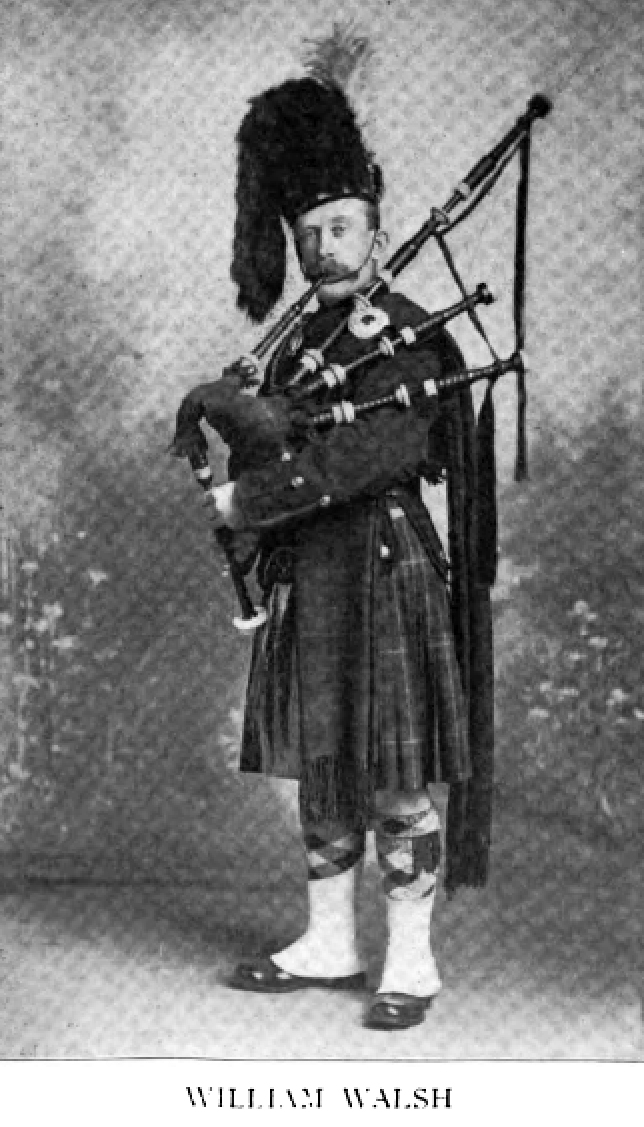
It would be but natural to suppose that, after listening for months to the mellow music of “Jimmy” O’Brien’s Union pipes, young Walsh would favor the Irish instrument, but he didn’t. Provided with suitable music, he learned to play by note and eventually to write music according to the Scottish scale, but not a little of his inspiration came from his frequent visits to William McLean, Joseph Cant, and some others, all famous performers on the Highland bagpipes.
Liberal, even lavish, with his music, he was the most obliging of men, and his only lapse into professionalism was a season’s engagement with Sells Brothers’ circus in 1881. This of course was long before his connection with the Chicago police force, which commenced in 1891. Timidity or bashfulness being entirely foreign to his nature, he makes the acquaintance of every Scotch piper who comes to town, and it is owing to his energy and promptness in this respect that he induced no less than seven of them, on short notice, to enter the contests at the Gaelic Feis held at Chicago in July, 1912, and by the same token the prize winners happened to be only casual visitors in the city.
On that occasion, by the advice of the present writer, Walsh dismantled one of his tenor drones, thereby converting his set of Highland pipes into an Irish warpipe. This metamorphosed instrument served for all, but Walsh easily won the gold medal, the silver trophy being awarded to Walter Kilday. This triumph he repeated in 1913. The second prize was won by James Adamson.
Officer Walsh attends all Scotch picnics as a conservator of the peace, and although he does not compete in the piping contests, often acting as one of the judges, it would indeed be a queer day that he wouldn’t take a whirl at them for an hour or two; and whether it be on account of the excellence of his execution, or partiality for the Irish tunes which he plays, he is sure to have a large and appreciative audience.
Possibly with a view to finding an additional vent for his versatility, “Willy” learned to play the flute—by note, of course, for he scorns ear players. Dividing honors with the best of them for the gold medal at the Gaelic Feis before mentioned is no slight testimony to his proficiency. He was equally successful at the great Feis in Comiskey Park in 1913, tying for first honors with Charles Doyle. The triumphs above set forth, though notable, do not constitute our hero’s chief claim to fame. In these days of costly living, William Walsh supports on a policeman’s salary a family of fifteen. Thirteen of his fourteen children are living. Oh ! what a boon men like Walsh would be to a decadent nation like France, in which the births barely equal the deaths.
Chicago Tribune, 10 June 1923
 Former Chief of Police Francis O’Neil writes from Ocean Springs, Miss., to an old Chicago friend that he is fast losing his eyesight. One eye is totally blind, he says, and the other is dimming. It is only a question of time when he will no longer be able to see the sunlight.
The unwelcome news was told by the friend who received the letter to several of Capt. o’Neil’s old cronies, and messages expressing sympathy for him in his affliction were yesterday dispatched to Mississippi.
Captain O’Neill, by which name he prefers to be called, was a member of the Chicago police department about 32 years. He joined the force in 1873 and rose through every rank to captain. Mayor Carter H. Harrison appointed him superintendent of police in April, 1891, and he served until August, 1905. Mayor Harrison was was succeeded in 1905, by Mayor Dunne, but the latter kept Chief O’Neill on account of a teamsters’ strike that was in progress when he took office.
At the conclusion of the strike, Chief O’Neil asked to be relieved of his task, and his registration was accepted. He served longer as head of the department of the police department than any other chief.
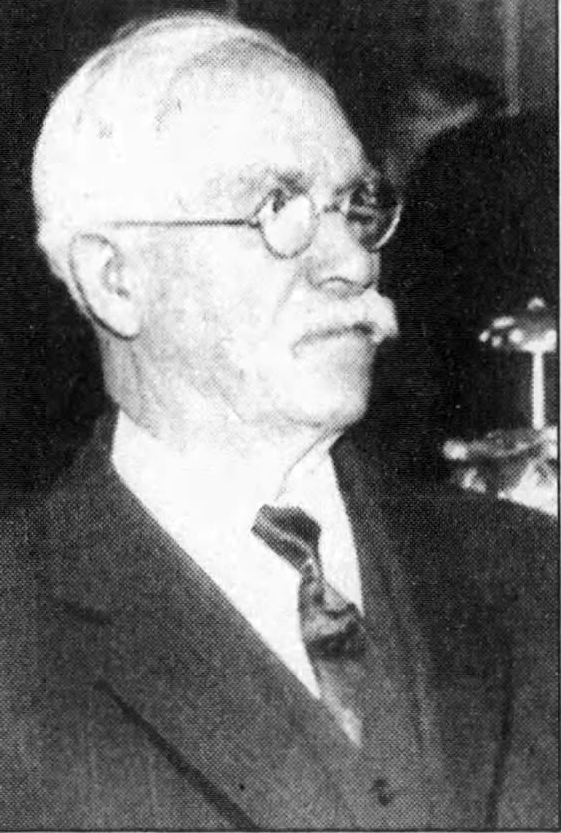
Friend of Irish Music
Capt. O’Neill is known to lovers of Irish music all over the world. He has rescued hundreds of old Irish airs from oblivion, in the pursuit of what he calls a “fascinating hobby.”
He is recognized by the best musicians of Ireland an authority on Irish music. The greater part of his life has been devoted to gathering and compiling Irish airs. He also is the author of the more elaborate history of Irish music ever produced. This volume, which was the cherished ambition of his career, leaves nothing to be added on the subject which it treats. The work, which is entitled “Irish Minstrels and Musicians,” was dedicated by the captain “To the memory of my parents, whose tuneful tastes and memorized melodies are cherished as a most precious heritage.”
Himself as a performer of no mean merit on the flute and violin, Capt. O’Neill was particularly fitted for the self-imposed task of rescuing old Irish airs from oblivion. He compiled four or five books of these old reels, jigs and airs, and they were given a favorable reception, especially in the music centers of his native land. The last book of this nature, issued last Christmas time, was “Waifs and Strays of Irish Melody.” In this work he showed that such tunes as the “Arkansaw Traveler” and “Turkey in the Straw” were played by the fiddlers and pipers of Ireland many years before they were heard in America.
Trailed Down Quaint Tunes
When O’Neill was chief of police, he would go to any part of the city where he was told some one “had a tune.” Sergt. James O’Neill, who by the way was no relative of the captain, usually accompanied him on these jaunts. The sergeant was a good musician and had an aptitude for “putting down notes.”
One day, while a sensational murder case held the attention of the police department, Chief O’Neill received a telephone call from a sergeant “back of the yards.” The sergeant, Dennis Dillon, had found a woman 93 years old who “had a tune.”
“She got it from her grandmother,” explained Dillon over the telephone, “and I’m sure you never heard it. Will you be out?”
Sending for his driver (it was before the police department had automobiles), the chief made ready for the trip. He telephoned Sergt. O’Neill at the Brighton Park station, to meet him at some point “back of the yards.:”
“Hot Tip” for Reporters
Reporters who saw the chief leaving his office hurriedly figured that he was going out on a hot tip concerning the murder case. All the evening papers gave this story a “scream” head.
Upon his return to the office he was besieged by the reporters.
Calling the boys into his office he told them of his trip. He brought back with him the notes of a tune he had never heard. And he called it “The Little Red Hen.”
Capt. O’Neill was born in County Cork, Ireland. He is 75 years old. His Chicago home is at 5448 Drexel avenue.
Excerpted from Inter Ocean, June 16, 1901
Opium Pipes as Decorations.
When Frank O’Neill, the present chief, was captain at Harrison street, he had a fondness for playing the flute in his leisure hours. He also is a clever performer on the bagpipes and the fiddle. One day O’Neill was playing the flute, which, by the way, looks very much like an opium pipe, and on a table in his office were a dozen pipes that had beea confiscated in court that morning. O’Neill was called to the telephone, and as he stepped out of bis office he laid the flute down on the table with the pipes. Some policeman who had promised to “swipe” a pipe for a Michigan avenue woman passed the captain’s office during his absence and saw the -display on the table. He entered quickly and grabbed two of the pipes. One of them was the captain’s flute. The next day the flute was returned to O’Neill without explanation.
O’Neill’s Legacy
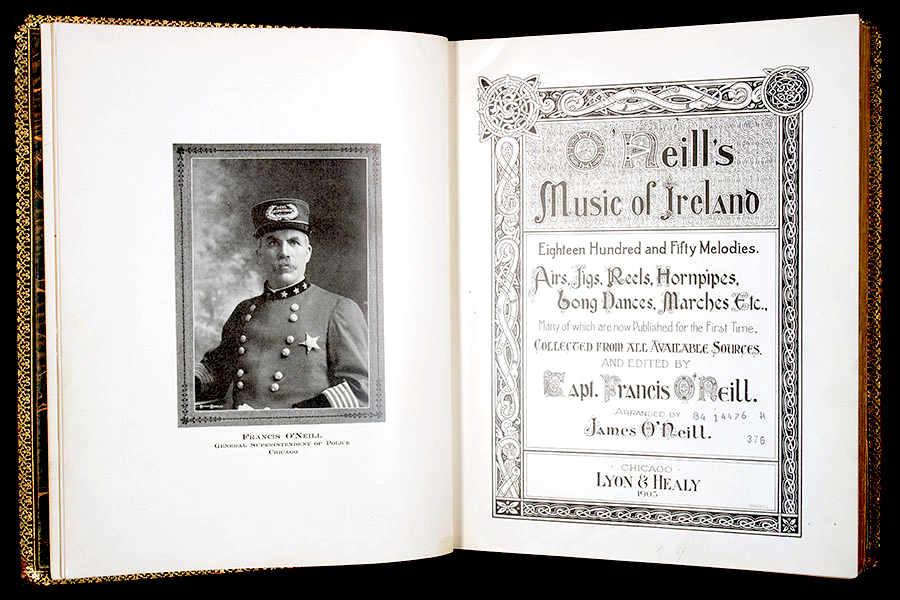
- O’Neill’s Irish Minstrels and Musicians
Regan Printing House
1904
Inter Ocean, September 25, 1910
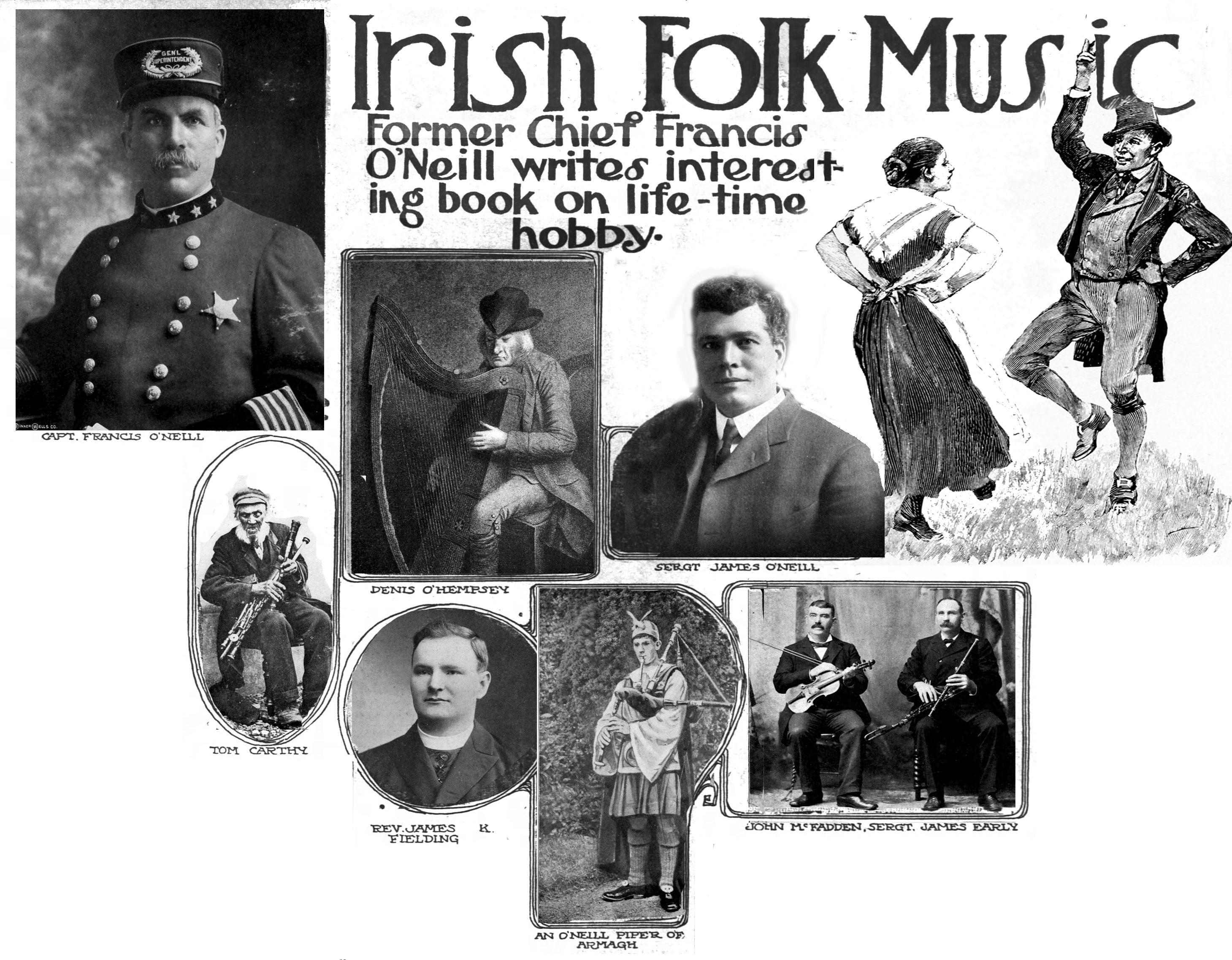
No melodies are more tuneful than Irish melodies. No songs stir the heart more surely than Irish songs.
No tunes set the pulses leaping or the feet dancing more quickly than the dance music of Ireland.
Who has not been moved to joy or sorrow. smiles or tears by the lyric witchery of Tom L Moore? The words of his songs were his own, but the music to which he set them was the music of the Irish race.
Irish folk music is a wonderful treasure house of quaint melody. It has been due to the indefatigable industry and antiquarian zeal of former Chief of Police Francis O’Neill and other Chicago Irishmen that much of the ancient folk music of Ireland has been rescued from oblivion.
Captain O’Neill’s two former books, “The Dance Music of Ireland” and “The Music of Ireland,’ were collections of music which resulted from his researches. Another volume has just been published which also is an outgrowth of his delvings in the music lore of his native land. He has called it “Irish Folk Music.” It sets out the history of the ancient tunes and is full of interesting and gossipy information about them.
“No alluring prospect of gain or glory,” says Captain O’Neill in a foreword, “prompted the preparation or publication of this series of sketches, dealing with the writer’s research and experience while indulging in the fascinating hobby of collecting Irish folk music. That much miscellaneous information of value to those interested in the subject had been acquired in the many years devoted to it is quite obvious and it was not alone in response to the persuasion of men of prominence in the Irish revival, but through the desire to give publicity to certain features of the study, of which the public had but limited knowledge, that the work was undertaken.”
Captain O’Neill is a native of West Cork, the glens of which, says, are a storehouse of musical treasures unexplored by the great collectors of Irish melodies. Near the Castle Donovan, his grandfather, O’Mahony Mor, or as he was generally called Cianach Mor—his clan title—kept open house for the wandering minstrels of his time.
“Born and brought up in such a home amid an environment of traditional music and says Captain O’Neill, “it was to be expected that my mother—God rest her soul—would memorize much of the folk music of Munster and naturally transmit it by her lilting and singing to her children, who inherited a keen ear, a retentive memory and an intense love of the haunting melodies of their race. Similarly gifted was our father. who full of peace and content and occupying his accustomed chair beside the spacious replace, sang the old songs in English or Irish for pleasure or the entertainment of those who cared to listen. Pipers, fluters and fiddlers were far from scarce and between ‘patrons’ at cross-roads in summer and flax ‘mehils’ at the farm houses in the winter, the tunes and songs were kept alive and in circulation.”
After he came to Chicago Captain O’Neill soon established friendly relations with those of his countrymen who, like himself, were interested in the preservation of Irish music. Among these friends is specially to be mentioned Sergeant James O’Neill of the police force, who assisted Captain O’Neill in setting to writing the jigs and songs they chanced upon among their Irish acquaintances. The “Irish Music club” was formed.
Among the Chicago Irishmen who shared Captain O’Neill’s interest in the folk music of Ireland and who assisted him in greater or lesser degree in his researches may be mentioned Sergeant James O’Neill, Sergeant James Cahill, Bernard Delaney, John Hicks, Alderman Michael McInerney, Sergeant James Early, Patrick Tuohey, James Kennedy, John McFadden. John Carey, Patrolman Ennis, Sergeant Hartnett, Mr. Dillon. “Big John” Ryan, “Willy” Walsh, Sergeant James Kerwin, Adam Tobin, Edward Cronin, the Rev. James K. Fielding, the Rev. William Dollard and the Rev. John J. Carroll. Of these Bernard Delaney and Patrick Tuohey were famous pipers others were skilled musicians.
“After many years of intercourse with all manner of Irish musicians, native and foreign born, who were addicted to playing popular Irish music with any degree of proficiency,” says Captain O’Neill, “I began to realize that there was yet much work left for the collectors of Irish folk music. Many, very many, of the airs, as well as the lilting Jigs, reels and hornpipes which I had heard in West Cork in my youth, were new and unknown to the musicians of my acquaintance in cosmopolitan Chicago. Neither were those tunes to be found in any of the printed collections accessible.
“The desire to preserve specially this precious heritage from both father and mother, for the benefit of their descendants at least, directed my footsteps to Brighton Park, where James O’Neill. the versatile northern representative of the great Irish clan, committed to paper all that I could remember from day to day and from month to month, as memory yielded up Its stores. Many trips involving more than twenty miles travel were made at opportune times, and I remember an occasion when twelve tunes were dictated at one sitting.
“Originally there was no intention of compiling more than a private manuscript collection of those rare tunes remembered from choice, boyhood days, to which might be added some specimens picked up in later years, equally worthy of preservation. Drawing the line anywhere was found to be utterly impracticable, so. we never knew when or where to stop.
“Some difficulties were at first encountered in acquiring any tunes from some of our best traditional musicians, but curiosity in time awakened an interest in our work. and, as in the old story, those who came to scoff remained to pray, or rather play, and it was not long before the most selfish and secretive displayed a spirit of liberality and helpfulness truly commendable. Mutual exchange of tunes proved pleasant and profitable.
“In the course of time enthusiasts on the subject were frequent visitors to Brighton park, the Mecca of all who enjoyed traditional Irish music. They came to hear James O’Neill play the grand old music of Erin which had been assiduously gathered from all available sources for years, and, pleased with the liberality displayed in giving everything so acquired circulation and publicity, they cheerfully entered into the spirit of enterprise and contributed any music in their possession which was desired. Many pleasant evenings were thus spent and those who enjoyed them will remember the occasions as among the most delightful of their lives.”
From various sources the collectors were favored with manuscript collections of Irish music. Captain O’Neill tells of a joke on a citizen of Chicago in this connection.
Meeting an Irish-American of prominence one day was quite in sympathy with our musical vagaries,” be says, ‘he generously offered to send us an old book of music which we took to be an heirloom In his family. His father, whom I had known for years, was a fine type of the Irish immigrant who attains substantial prosperity in America. Taking those circumstances into consideration, there were good reasons to anticipate the discovery of a rare volume. When the | carefully wrapped paekage errived Sergeant O’Neill, with a tenderness bordering on ven• !eration, untied It and disclosed the precious treasure-soiled and tattered, of course, from the handlings of generations, as we supposed. What our feelings and remarks were can be better imagined than described when we found that in his innocence of music our patriotic friend had sent a modern copy of ‘Moore’s Melodies.’ That unsophisticated promoter of Irish music has since been elected and served as president of the Irish Choral society of Chicago.”
Query—Who man? One of the dimculties the indefatigable collectors had to overcome was found in the diversity of names by which the same tune was known and in the bewildering variety of settings or versions of traditional Irish tunes. Captain O’Neill gives an instance to show the amount of research necessary in the work of collection.
“A ballad called ‘The Fair at Dungarvan,’ he says, “was a great favorite in Munster. | The air, which I remembered since boyhood, was noted down and printed under that name, no other being known for it at that time. It developed that it was an air great antiquity, much varied by time and taste, but never beyond easy identification. As ‘Rose Connolly.’ Bunting printed it in 1840 in his third collection and notes that it was obtained in Coleraine in 1811, ‘author and date unknown.’ It is to be found under that name Surenne’s ‘Songs of Ireland,’ published in 1854. Probably its most ancient title was the ‘The Lament for Cill Caisi,’ or ‘Klilcash,’ a setting of which is to be found in Dr. Petrie’s ‘Complete Collection of Irish Music.’ Among the songs which I find are sung to this air are ‘Alas. My Bright Lady,’ ‘Nelly, My Love, and Me,’ ‘There Is a Beech Tree Gove’ and ‘Were You Ever in Sweet Tipperary?'”
Captain O’Neill Illustrates the diversity of titles in connection with other popular tunes: “One of the earliest recollections of youth is my father’s singing of an affecting song, the last line of every verse being ‘Mo Muirnin na Gruaige Baine,’ he says. “This fine oid air is mentioned in Hardiman’s ‘Irish Minstrelsy,’ published in 1831. The original Irish stanzas are preserved, but no trace of the melody has been found in any of the old printed collections. Neither the above name nor its English equivalent, ‘My Fair Haired Darling,’ appears in the index to Dr. Petrie’s ‘Complete Collection of Irish Music,’ but No. 202, a nameless air obtained from Tige McMahon of county Clare, and an air named ‘One Evening in June’ contributed by Paddy Coneely, the Galway piper, are variants of the melody which I learned from my father. ‘Dobbin’s Flowery Vale,’ in Dr. Joyce’s ‘Ancient Irish Music,’ resembles our setting of the air. He speaks of it as one of the best known tunes in Munster. Conceding that it was, who can explain why such a delightful melody has been overlooked so long. Other songs sung to this air are are ‘The Maid of Templenoe’ and ‘The Charmer With the Fair Locks.’
“That popular melody known as ‘The Rose Tree’ has many other titles,” Captain O’Neill continues. “It is probable, but not certain, that its original name was ‘Moirin ni Chuileannain’ or ‘Little Mary Cullinan,’ from a song written to the air by the Munster poet John O’Tuomy, who died in 1775. O’Keefe introduced it in ‘The Poor Soldier’ in 1783 with verses beginning ‘A rose tree in full bearing.’ hence the name by which Moore inserted it in his ‘Irish Melodies’ as the air to his verses beginning ‘I’d mourn the hopes that leave me.’ It was also called ‘The Rose Tree of Paddy’s Land’ and in Oswald’s ‘Caledonian Pocket Companion,’ printed in 1760, a version was called ‘The Gimlet.’ As ‘The Irish Lilt,’ Thompson included it in his ‘Country Dances’ in 1764. In Aird’s ‘Selections of Scotch, English, Irish and Foreign Airs,’ published in 1782, a setting of the air is called ‘The Dainty Besom Maker,’ and in Gow’s ‘Second Collection,’ published in 1788. it is included under the name of ‘Old Lee Rigg or Rose Tree.’ Mulholland introduces it among his ‘Irish Tunes’ in 1804 as ‘Killeavy.’ and it is printed under that name also in Thompson’s ‘Original Irish Airs’ in 1814. Other names by which the air is known are ‘Maureen Gibberland,’ ‘Forgive the Muse That Slumbered’ and ‘Fare You Well, Killeavy.’
“‘The Green Woods of Truigha’ is a melody of great antiquity. Besides the above name, which it bears in Ulster. It is known in Leinster as ‘Ned of the Hill,’ in Connaught as ‘Colonel O’Gara’ and in Munster as ‘Mor no Beag,’ with a variety of other aliases.
“That delightfully poetic name ‘O Arranmore, Loved Arranmore’ in Moore’s ‘Melodies’ has come to de better known than ‘Kildroughalt Fair,’ the air to which it set. Variants ofthis air are ‘Lough Sheeling,’ ‘Old Truicha’ and ‘Thy Fair Bosom.’ Another setting is ‘Bridget O’Neill.’ An older version of this air is ‘My Lodging Is Uncertain.’ One of Gerald Griffin’s poems commencing “I’ve come unto my home again’ is set to the music of ‘Kildroughalt Fair’ in Moffat’s ‘Ministrelsy of Ireland.’
Here is a list of titles by which the same tune is: known, as given by Captain O’Neill:
“Dombnall na Griene”—”Donald na Greana,” “O. My Dear Judy” and “The Boney Highlander.”
“Thady You Gander”—”She is the Girl That Can Do It.” “Bully for You,” “I Gave to My Nelly,” “Girls of the West,” “The Leg of a Duck,” “From the Court to the Cottage,” “You May Talk as You Please” and “Bucky Highlander.”
“An Rogaire Dubh”—”Brigid of the Fair Hair,” “Johnny MacGill,” “Come Under My Plaidie.’ “The Bunch of Green Bushes,’ Moore’s “Life Is Checkered With Pleasures and “The Woe,” Little “Michael Malloy,” “Tom Linton,” Bunch of Rushes,’ “God Bless the Gray Mountain.” -“The Bark Is on the Swelling Shore,’ “Nature and Melody,” “The Humors of Donnybrook Fair,” “Inishowen, “‘The Irish Lady,’ “the Irish Lass.” “Oh. Pleasant Was the Moon,” ” ‘Tis Bit of a Thing” and “What Sounds Can Compare.” “Kate The Beardless Boy,” “The Dissipated Youth” and “Kate Martin.” “Savourneen Deelish” “‘The Molecatcher’s Daughter,” “Miss Molly, My Love, I’ll Go,” “The Exile of Erin,” “I Saw From the Beach,” “‘There Came to the Beach.” ” ‘Tis Gone and Forever” and “Erin Go Bragh.” “Ta Na is Day,” “Tow Row Row.” “Paddy, Will You Now?” **The Humors of Bandon”-“‘The Humors of Listivain,” “The Merry Old Woman.”
“The Kinnegad Slashers’ – ‘The Land of Sweet Erin,” “Oh. an Irishman’s Heart.” “Oh. Merry Am I.” “‘Powers of Whisky” and “Paddy Digging for Gold” and the Scotch versin. “The Bannocks of Barley Meal.”
“The Frost Is All Over”- “The Praties Are Dug.” “The Mist of Clonmel,” “On a Monday Morning’ and “What Would You Do if You Married a Soldier?” “‘Lannigan’s -“Dribbles of Brandy.” Brandy.”
“My Love Is Fair and Handsome””Paddy McFadden,” “John Roy Stewart.”
“The Rakes of Kildare”-“Get Up “Swift Early,” *The Barn Door. Jig.” Moore’s From the Covert” is sung to this air. “The Irish Washerwoman”-“Jackson’s Delight, “The Irishwoman.’
“Lough Allen”-“‘The Mill Stream,’ “Box A About the Fireplace,”* “A Munster Reel.”
“Rolling on the Rye, old Molly Ahern.” “The Piper’s Lass,” “The Rathkeale Hunt.” “Maureen Playboy” and “The Shannon Breeze.”
“Go to the Devil and Shake Yourself””When You Are Sick Is It Tea You Want?” “The Penniless Traveler.” “Get Up, Old Woman, and Shake Yourself.”
“Fisher’s Hornpipe”-“The Egg Hornpipe,” “Lord Howe’s Hornpipe.” “Blanchard’s Ho “‘The College Hornpipe.”
“‘The Fame of Father O’ Flynn, Alfred Percival Graves’ inimitable song,” says Captain O’Neill, “Is world wide, and there is reason to believe the spirited air, ‘The Top of Cork Road,’ to which it is sung, contributed something to its popularity.
It was not a rare tune in West Cork in my boyhood days. The tune found its way Into three English collections of country dances between 1770 and 1781 as ‘The Yorkshire Lasses.’ Alfred Moffat tells us that its first publication distinctly connected with Ireland was in Holden’s ‘Masonic Songs,’ Dublin, 1798. The second strain of ‘The Irish Lilt’ and the second strain of ‘The Top of Cork Road’ bear a very close resemblance. Its being known as ‘The Irish Lilt’ at such an early date disposes of any English claim to the tune. Other names by which are air is known are ‘Trample Our Enemies,’ “To Drink With the Devil’ and ‘The Rollicking Irishman.’
“Who has not heard of ‘Tatter Jack Walsh’ and who has not wondered at the meaning of that peculiar title? Patient Investigation disclosed the fact that the correct name in English is ‘Father Jack Walsh.’ The title in connection with the tune.
It appears, WAS originally written down ‘An t-athalr Jack Walsh,’ the first and second words being idiomatic Irish for ‘reverend father.’ transcribing that name some one, probably ignorant of the Irish language, corrupted ‘t-athair’ into ‘tatter,’ hence the meaningless error which has been perpetuated to this day.
In a chapter upon curious and incomprehensible titles, Captain O’Neill presents much of interest as a result of patient and scholarly investigation.
“The Englishman who in naming one of the tunes in ‘A Handetull of Pleasant Dellties.’ printed in 1584, as ‘Calen o custure me,’ furnished our Arst published puzzle.” he says. “It had been rendered into Irish by Grattan Flood as Callin og a stutre me.’ The tune was included do several Engiieh collections in the seventeenth century and entitled Irish Air,’ and also as ‘Callino Custurame.’ Some of our best Irish scholars, such as Dr. Pettle and Dr. Stokes, equated it as ‘Calleen oge asthore,’ which freely translated means ‘My Dear Young Girl.’ In Chappell’s ‘Old English Popular Music’ the air is headed ‘Calino Casturame,’ or “Colleen oge astore.’
“But is the puzzle solved? As Dr. Flood points out, the final ‘me’ (Irish of ‘my’) persists in all the readings–which would hardly be the case were ‘Colleen oge asthore’ the correct interpretation. “The oldest printed collection of Irish aris the author’s library are ‘Twelve Scotch and Twelve Irish Airs With Variations’ and ‘Twelve English and Twelve Irish Airs With Variations’ by Burk Thumoth, printed in London in 1742 and 1745.
“‘Yemon O nock’ we have no difficulty in identifying as ‘Eamoon an or ‘Ned of the HIll.’ Under the same grotesque title It appears in *The Hibernian Muse,’ published in 1787. Pocket Volume of Airs, Duets, Songs, Marches,’ etc., printed by Paul Alday in Dublin about 1800. It Improves slightly as ‘Emon 0 Knuck.’ O’Daly, in ‘Poets and Poetry of Munster,’ prints the name ‘Eamonn an Chnole,’ from which orthography Grattan Flood deviates by spelling the final word ‘Chnoic.’
“As it would prove tiresome to enter into details in all such cases, we must pass on to Burk Thumoth’s next absurdity-‘Chiling 0 guiry.”
“This name, we may as well explain at once, wasintended to represent ‘Sighile ni Gadhra’ (Sheela ni Gara); in English, Celia, or Cecelia, O’Gara. “What the pubishers did to it can be seen from the fellowing: The Thompsone in ‘The Hibernian Muse’ faithfully copied Thumoth. In Goulding’s edition of Aird’s ‘Selection of Scotch, English, Irish and Foreign Airs,’ 1782, It is ‘Shilling O’Gatrey’ and ‘Sheling Gafrey.’ Gara,’ Other forms of the name are ‘Sightle nt ‘Sheela ne Gaura,’ and ‘Sheela na Guira. A dance tune in nine-eighths time is printed in Aird’s ‘Selections’ as ‘Sheela Da Jigs’ and ‘Shella na Gigg.’
“A very popular air must have been ‘Health to King Philip’ under its Irish name, ‘Slainte Righ Pilib,’ in which ridiculous reading it is copied in ‘The Hibernian Muse,’ 1787, and in Thompson’s ‘Select Collection of Original Irish Atre,’ 1814-16.
“The word ‘Ri’ is excusable, being phonetic, but ‘PIllb* would be laughable were It not absurd and meaningless. No one, it would seem, who obtained airs from Thumoth, cared to inquire the significance of his titles aDd as result we And the original but erroneous phrases copied and perpetuated to the present day.
“‘Drimen Duff’ is a long departure from Dubb,’ but as its meaning, or rather the intention of its author is apparent, we will let it pass without comment except to say that in English it signifies white-backed black cow.’ The name, like that of many other Irish airs, is allegorical. Bunting wrote it in one word, ‘Druimindubh, and translated it, ‘The Black- Backed Cow. In ‘The Bee’ and in Clinton’s ‘Gems of Ireland’ it de corrupted into ‘Drimindoo.’ It was popular tune during the Jacobite wars by the party favoring the exiled monarch.
“Gratan Flood in ‘A History of Irish Music* tells us that the exquisite air entitled ‘An Ceann dubh dills,’ or ‘The Black-Hearted Dearie,’ was composed about the commencement of the seventeenth century.
It is to be found in Thumoth’s first volume as ‘Curri Koun Dilich.’ This is quite a departure from the original.
“The seventh Irish number in Burk Thumoth’s second volume is entitled ‘The Dangling of the Irish Bearns.’ Under the same title it is printed in The Hibernian Muse, 1787, and quite a few modern publications. What that name means is beyond our.comprehension, and although purporting to be in the English language, neither inquiry nor research has brought us any nearer a solution of Its hidden significance.
“There are other names of airs more or less difficult to understand in Burk Thumoth’s volumes, such as ‘The Irish a *The Fin Galian’s Dance’ and that crude attempt at giving ‘O’Rouk’s Feast,’ or ty O’Rourke,’ In the Irish language, viz., “Plea Rorkeh na Rourkough.’
“Another air, named ‘Stack in Virgo’ In the same work was a poser for a time. It was finally equated with ‘Staca an Margaidh,’ of Market Stake.’ The first letter of “Margaidh’ in conversation is aspirated, hence the co phonetic ‘V’ in McGoun’s title.
“A title that has defied solution by even our best Irish scholars is ‘Gillan na drover,’ an old Irish march. That the first word should be ‘giolla,’ a boy or man servant, can be seen at a glance, but the word ‘drover, in either form or sound, suggests nothing in Irish which would complete a rational phrase. The tune has been printed In O’Neill’s ‘Irish Music’ under the name ‘Gillan the Drover,’ that being the nearest common -sense phrase I could think of.
“‘Captain Oakhain,’ in the same work does not much disguise the plaintive melody ‘Captain O’Kane,’ or ‘The Wounded Hussar.’
“Ever since we have been able to read we bave wondered what information or meaning was hidden by the eryptogrammic announcement printed over certain Ga -Fane.’ In one instance, at least, it was ‘Gang Fane,’ but that no more Illuminating than the other. “the Irish word ‘fein’ is easily translatable into ‘self,’ but no ingentous surmises as to the significance of ‘Gang Fane’ would result in an intelligent name or phrase. “At the moment of returning consciousness from sleep one morning the solution came to me like a flash. ‘Gage Fane’ stood for ‘An Gaedhana Fladhalne.’ or *The Wild Geese’ the name by which the thousands of Irish were called who fled to France and Spain after the treaty of Limerick.
“Bunting says that this fine melody was composed as a farewell to the gallant remnant of the Irish army who, upon the capitulation of Limerick in 1691, preferred an honorable exile to remaining in their country after their cause was lost.
“The mystifying “Gage Fane’ confronts us in Smith’s ‘Irish Minstrel,’ Moore’s Melodies,” Molfat’s ‘Minstrelsy of Ireland’ and many less pretentious publications. Who would believe, were not the fact indisputable, that countless editions of Moore’s ‘Melodies’ in all English speaking countries would present to its readers with unvarying monotony the same absurd and meaningless titles originally printed through censurable carelessness if not pitiable ignorance?
“Among the melodies mentioned by Bunting which the harpers played at the Belfast assembly in 1792 is one named ‘Graga-nish.’ This title had defed our best efforts to discover the hidden meaning disguised by this combination of letters. It is more than likely that it would have remained inexpli-, cable had I not noticed that the air was known by a name in English also, viz., ‘Love in Secret.
“The idiomatic Irish for this phrase is written gan fios,* literally ‘Love Without Knowledge, ‘Gra gon los’ would represent the Irish name phonetically, hence the puzzling “Graga nish,’ understood by Bunting.
“‘Cruachan na Feinne’ (“The Fenian Mound or Stronghold”) given as the title of an old Irish air to be seen in many collections of Irish music and song besides Moore’s “Melodies, is variously introduced in such forms as ‘Crooghan a Venee,’ “Crookaun Venee,’ ‘Croghan a Venee,’ etc. As in the preceding case, Perceval Graves breaks away from traditional error, and prints the correct Irish title.
“A fine traditional air is the ‘Palstin Fionn” or The Fair-haired Child,’ published in Bunting’s ‘General Collection of the Ancient Irieb Music, 1796. Evidently few collectors cared for correctness in the Irish names of their tunes. So careless were they in this respect that names in the index sometimes differed from those over the printed music. O’Farrell in his work before mentioned published the melody under the title ‘Pausteem Feaun.’ In Crosby’s ‘Irish Musical Repository,’ 1808, and in Alday’s ‘Pocket Volume of Airs,’ a few years later it is ‘Pastheen Fuen,’ while in an old collection from which the title is missing a still turther departure confronts us in ‘Patheen a Fuen.’ As’ ‘Paistheen Fuen’ it is alluded to by Alfred Moffat in his *Minstrelsy of Ireland.’ Phonetically, ‘Paustheen Fune’ represents it.
“The battle cry of the Irish Brigade, ‘Fag an Baile,’ is historic, yet the phrase in connection with the Irish air of that name bas seldom been correctly printed as far can remember. It signifies literally, ‘Leave the Towa or Place,’ although the very tree translation as commonly understood is ‘Clear the Way.’
“Of course, the barbarous orthography perpetuated even in Perceval Graves’ Song Book,’ where in the index it appears as *Feag a Balleach’; but as the air to the song, ‘To ‘Ladies’ Eyes,’ it is changed to ‘Fag an Bealach,’ or ‘Leave the Gap or Passage.’
“In some old collections -its form is still further varted, such as *Fague an Bealach and ‘Fagua a Ballagh.’ In editing Moore’• *Melodies’ restored Sir Villiers Stanford evidently did not concern himself with restoring the titles when he tolerates ‘Faugh Ballagh.’
“Alfred Moffat mentions in ‘The Minstrelsy of Ireland’ that ‘Fague a Ballagh’ was first published in the seventh number of Moore’s ‘Melodies.’ In telling us that the phrase was the war cry of the Munster and Connaught clans be changes the spelling to •Fag an Bealach.’ As the latter form is part of his own diction, be leaves us to infer its correctness.”
Some chapter beadings of Captain O’Neill’s volume are: “Stories of Tune With a History,” “Tunes of Disputed Origin,’ “Diversity of Titles “Duplication of Titles,’ “Sketches of Early Collections of Irish Music,” “Curious and Incomprehensible Titles,’ “Sketches of Irish Music Commencing With Moore’s ‘Irish Melodies,’ **The Decline of Irish Music.” “The Past and Future of Irish Music,” “Dr. P. W. Joyce’s Estimate of the Total Number of Irish Airs Questioned,” “Remarks on Irish Dances,” “Remarks on the Evolution of the Irish or Union Pipes,” “O’Farrell’s Treatise and Instructions on the Union Pipes.” and “Hints to Amateur Pipers.” by Patrick J. Tuohey.
Captain O’Neill is one of the leading authoritles of the world on Irish music. His library in the department of Hibernicana is one of the best selected anywhere and one of the largest private collections in this country. Rev. Richard Henneberry, the noted Irish scholar, now of Queen’s college, Cork, declared that he never had seen even in Europe a better selected library upon Irish subjects. Captain O’Neill’s library is made use of frequently by University of Chicago professors and by delvers into early Irish literature. The captain has been book lover all his life and has spent a great deal of money in collecting rare volumes.
“Irish Folk Music” is a vastly informative book. It will interest lovers of Irish musio everywhere and especially those of Chicago, many of whom figure in its pages.
O’Neill retired from the police force in 1905. After that, he devoted much of his energy to publishing the music he had collected. His musical works include:
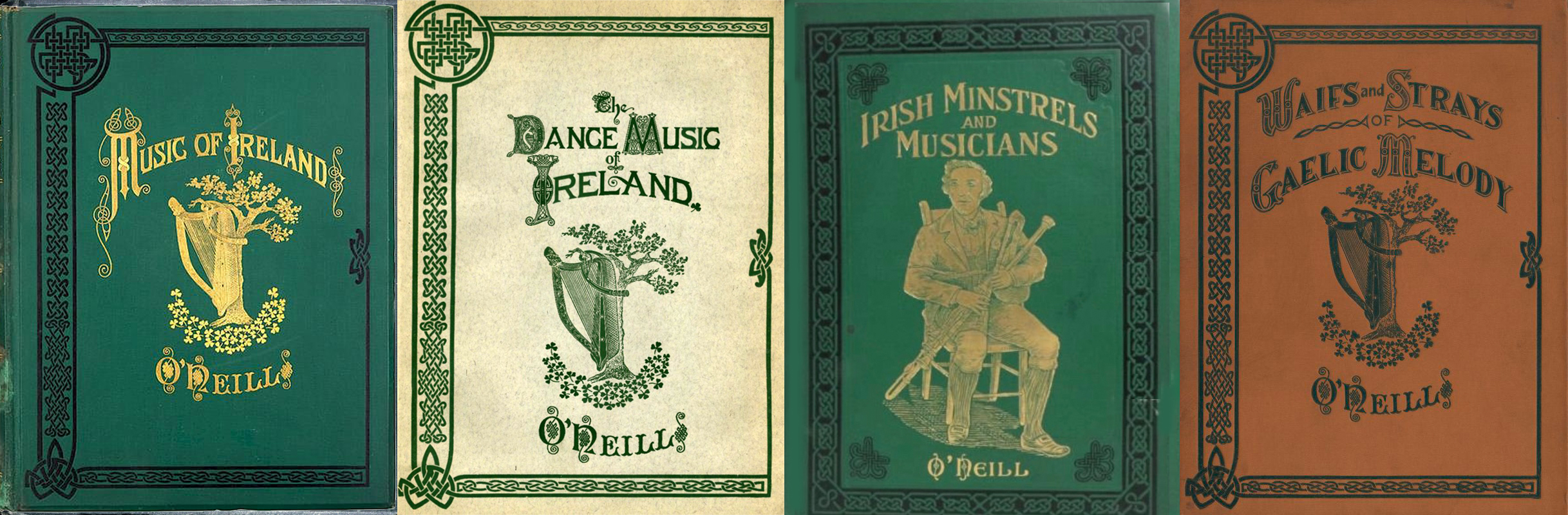
- O’Neill’s Music of Ireland (1903)
The Dance Music of Ireland (1907
400 tunes arranged for piano and violin (1915)
Waifs and Strays of Gaelic Melody (1922)
Irish Folk Music: A Fascinating Hobby (1910)
Irish Minstrels and Musicians (1913)
Chicago Tribune, January 29, 1936
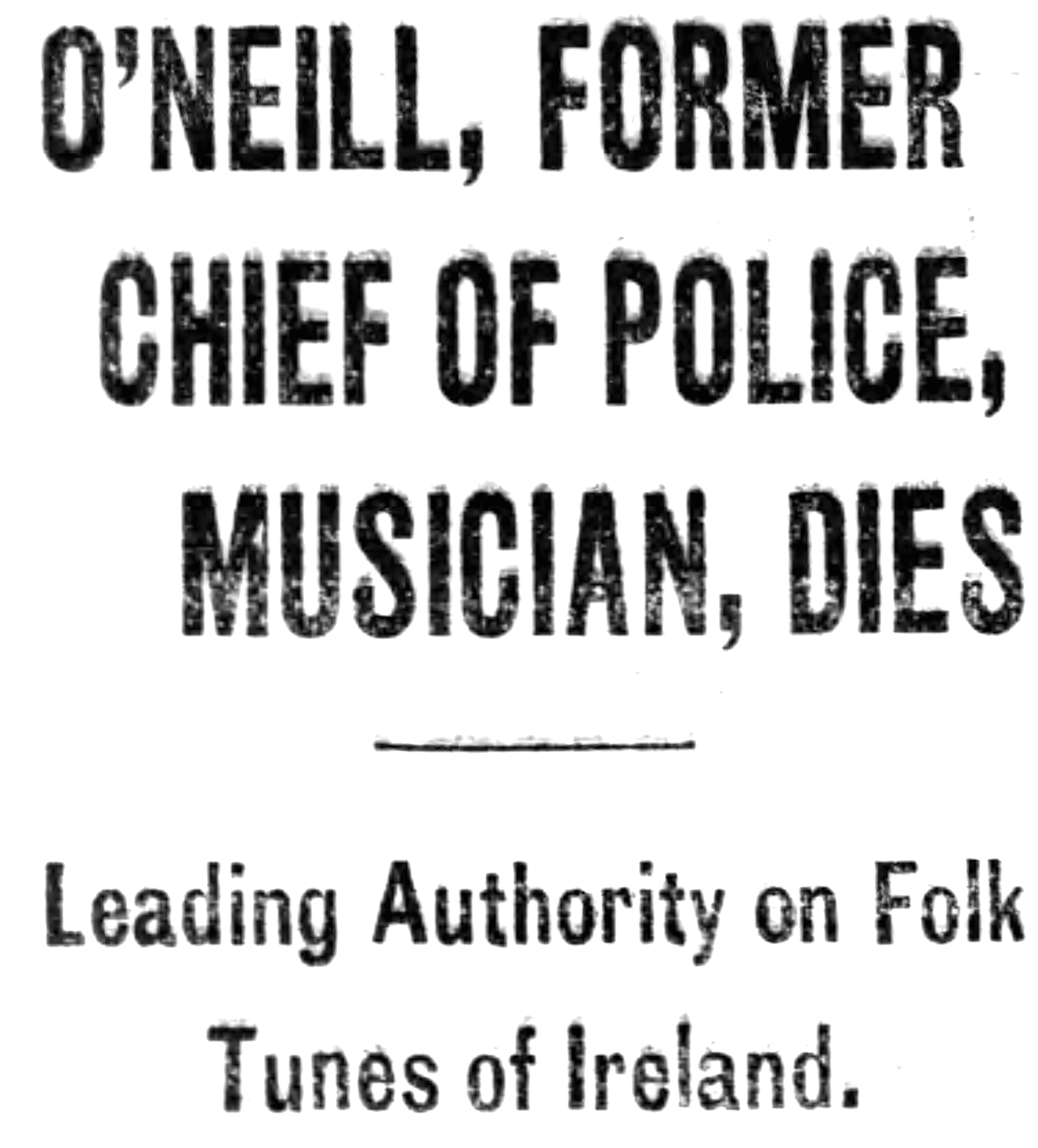 Francis O’Neill, who was chief of the Chicago police force from 1901 to 1905, and was known as one of the greatest modern authorities on Irish folk tunes, died yesterday in his home at 5448 Drexel boulevard. He was 87 years old.
Mr. O’Neill had been in ill health since the death of his wife, Anna, 18 months ago, and had been confined to bed since Christmas. Death was attributed to a heart ailment.
Born near Bantry in Cork county, Ireland, Mr. O’Neill had an adventurous youth. He was cabin boy and sailor on vessels engaged in Mediterranean and Black sea trade for several years, and sailed around the Horn to New York, circumnavigating the globe from 1866 to 1869. He joined the Chicago police force in 1873, and remained in the department 32 years until his retirement in 1905.
Wounded by Burglar.
A month after Mr. O’Neill joined the force he was shot in the back by a burglar, whom he captured. He carried the bullet in his body the rest of his life. He became a sergeant in 1887, a lieutenant in 1890, and a captain in 1894.
He was named chief of police (the title then was general superintendent) by Mayor Carter Harrison in 1901, and was reappointed twice, serving until July 25, 1905, when he went into retirement. From then on he devoted himself to the study of Irish music and wrote seven books on the subject, collecting the lyrics and detailing the picturesque traditions surrounding them.
Library Given to Notre Dame.
Among the books are “O’Neill’s Music of Ireland,” “O’Neill’s Irish Music,” ” O’Neill’s Dance Music of Ireland,” ” Waifs and Strays,” and “Minstrels and Music of Ireland.” Some years ago Mr. O’Neill presented his famous library of Hiberniana to the University of Notre Dame.
Mr. O’Neill is survived by four daughters, Mrs. James L. Mooney, the wife of Capt. Mooney of the Wabash avenue station; Mrs. Daniel F. Crowe, Miss Mary O’Neill, and Miss Anna O’Neill.
Funeral services will be held at 9:30 tomorrow morning at St. Thomas Apostle church, 55th street and Kimbark avenue. Burial will be at Mount Olivet cemetery.
Chicago Tribune, May 4, 1997
In tune with past
Thanks to a Chicago police chief, Irish folk music was preserved
By Dave Newbart Tribune Staff Writer
More than a century ago, a Chicago police officer with a love of Irish music and remarkable foresight began collecting the traditional folk tunes he had learned while growing up in the mountains of southwest Ireland.
The officer recognized that with the chaos caused by the great famine in his homeland and the subsequent scattering of musicians who had immigrated to the United States, melodies that had been passed down orally from generation to generation could be lost forever if they were not recorded.
By the time Francis O’Neill published his first collection of tunes in 1903, he had gathered 1,850 songs and had been promoted to Chicago’s chief of police. Indeed, after O’Neill became chief in 1901, it became widely known that if you were Irish and played a mean fiddle- or bagpipe or flute- you could count on a job in the Chicago police force.
Although he would serve as chief for only four years, he would publish another five volumes of songs before he died in 1936 and go down in history as the savior of Irish folk music.
Until recently, appreciation for O’Neill didn’t go much beyond hard-core Irish music fans and history professors, and he enjoyed little public recognition. But a renewed appreciation for Irish folk music around the world has motivated O’Neill’s admirers here and abroad to finally commemorate his place in history.
In Chicago, Mary Lesch, O’Neill’s great granddaughter and only remaining relative in the area, recently formed the Francis O’Neill Foundation to promote his memory, and a new campaign in Ireland to establish a monument to O’Neill has also gathered local support.
“What he did is so important,” Lesch said. “It’s through art that civilization lives, and music is truly the art of the Irish people.”
A group known as the Francis O’Neill Club holds dancing sessions a few nights a week at the Irish Heritage Center, 4626 N. Knox Ave., and at Gaelic Park in Oak Forest. The club distributes information sheets to newcomers explaining O’Neill’s role.
In Tralibane, Ireland, the tiny farming community where O’Neill grew up, residents plan to erect a statue of a folk musician in his honor. The project is receiving support from musicians from all over: the Boston Gaelic Police Column, a group of bagpipers, played a benefit during St. Patrick’s Day celebrations in Ireland last month. Comhaltas, the Francis O’Neill Club’s parent organization, also plans to pitch in.
The first book-length account of O’Neill’s life, “A Harvest Saved: Francis O’Neill and Irish Music in Chicago,” by Dublin author Nicholas Carolan, was released in March. A computer updated collection of every tune O’Neill gathered—2,500 in all—will be published in a new volume later this year. A CD-ROM is also coming.
“O’Neill created a legacy that we still enjoy,” said Gearóid 0 hAllmhurain, an Irish music historian at the University of San Francisco. “He left us a well that has never dried up.”
Indeed, O’Neill’s books—some of which have been reprinted several times—are still available for sale.
The monument that is planned a half-mile from O’Neill’s boyhood home about 220 miles southwest of Dublin-would be the first memorial to honor O’Neill. Plans are to construct atop a hillside a bronze or stone statue of a fiddler or flutist, with a plaque memorializing the area’s most famous resident. Of course, there will be room to play a tune and dance a jig.
That the movement to build the first monument O’Neill is coming from his home township is somewhat ironic, because many locals didn’t even learn of his contributions until recently.
O’Neill had left the area back in 1865 at age 16, when County Cork was still recovering from the devastation caused by the great famine. Although O’Neill learned to play the flute as a boy, Irish folk music began a gradual decline in popularity and practice in its native land and lived on largely through immigrants who fled their country’s poverty for the United States.
After a stint working on a ship, O’Neill eventually landed in Chicago in 1871. He joined the police force two years later. Here he found an active circle of flutists, pipers and other musicians who played in each other’s homes on Sundays. He had an incredible musical memory and could still play nearly 400 songs that his mother had taught him.
In the late 1880s, realizing that few Irish dance tunes had ever been put on paper, he began his collection. When Irish musicians moved to Chicago or passed through the city, he would have them play for him. He would then play the songs for a friend in the police force who could write music, since O’Neill could not.
In 1903, he published “O’Neill’s Music of Ireland.” In 1907, he published a shorter version of popular dance songs that many musicians now simply refer to as the bible of Irish music, “1001 Dance Tunes.”
He retired from the force in 1905, but he published four more works. He died in 1936..


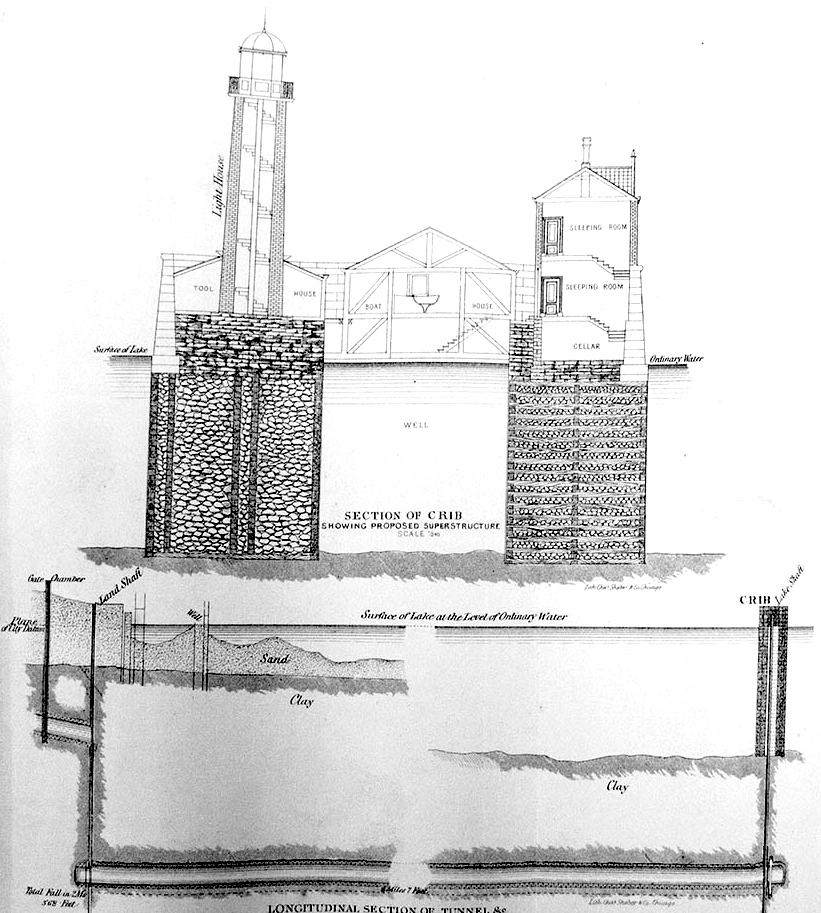
 Ground was first broken for the great Chicago Lake Tunnel, on St. Patrick’s Day, March 17th , 1864. The various causes which led to the undertaking of this gigantic work , and compelled such an enormous expenditure on the part of the city, now being supplemented by a still greater outlay, may be briefly stated. The old inhabitants of Chicago are painfully aware of them.



 On Saturday fternoon the three members of the Bard of Public Works, and Mr, Chesebrough, their Chief Engineer, took the tug
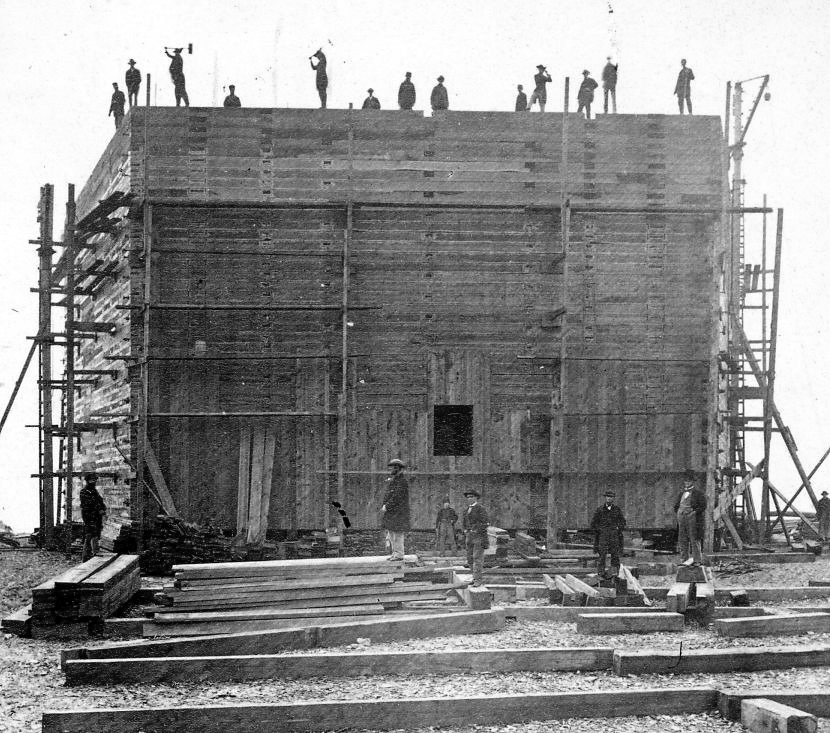
  The launch of the giant crib for the East end of the great lake tunnel was safely accomplished yesterday morning, after innumerable delays, extending through a period of several weeks. It was done so neatly and so easily as to astonish every one among the thousands who watched the passage from its native element into the water. It will be observed that we invert the usual phrase, according to which a vessel is native in the element to which it emegrates—a phrase, by the way, quite foreign to the subject.
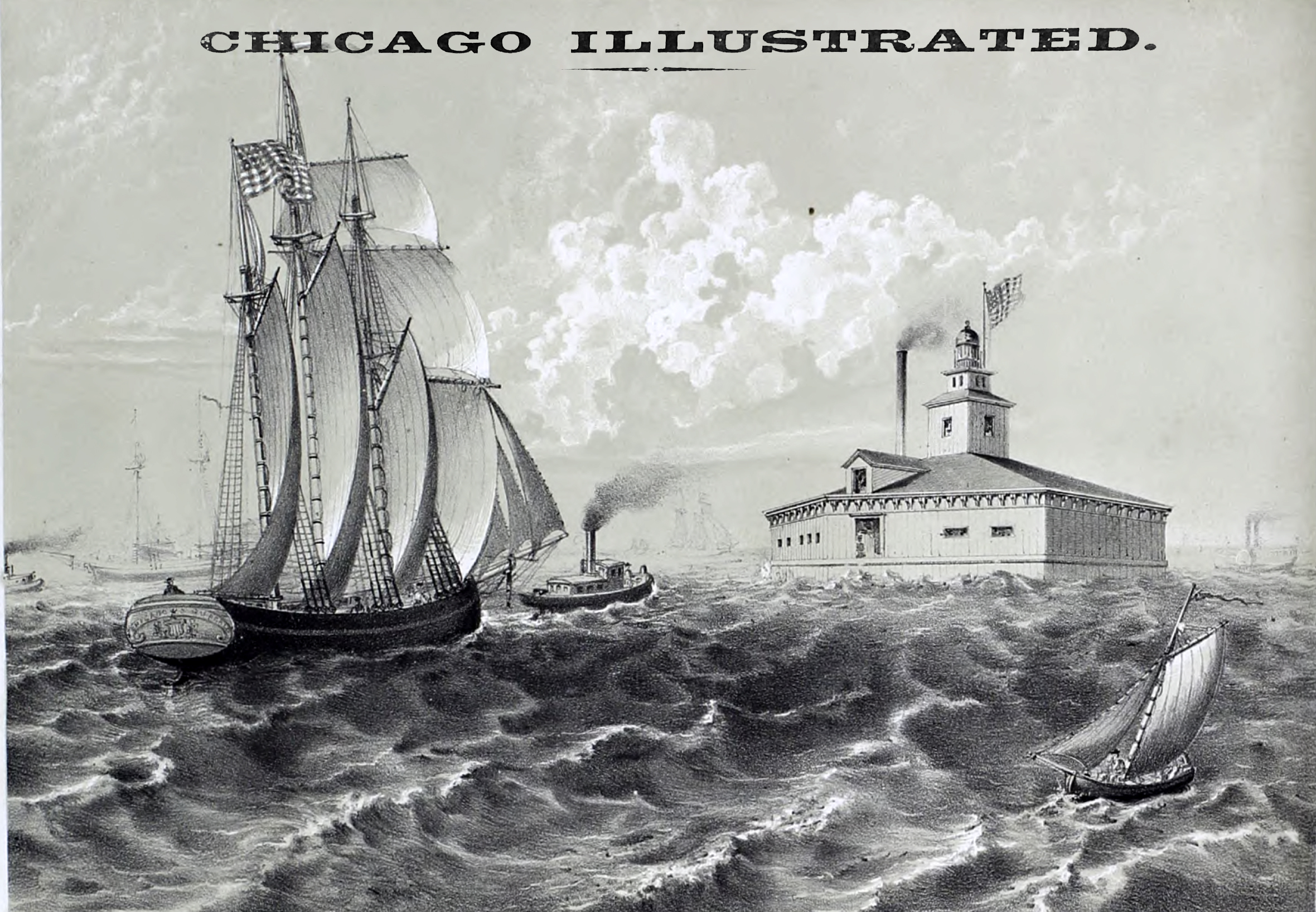
 The dusty mortals who look to Father Michigan this weather for relief from the parching atmosphere of summer seldom pause to consider the thousand necessary expedients by which the refreshing fluid is conveyed from its limpid reservoir to their dry and feverish lips. They look out from the lake-shore occasionally, and, pointing to the unsightly wooden structure nearly two miles off, say to the unsophisticated stranger ton the rural districts, “Yonder is our reservoir; there’s where we get our water from. It’s quite clean out there, too, because it comes from below the surface.” Quite clean. Well, it ought to be, after the wonderful efforts we have made to obtain it. We have tunneled the lake, and rung the changes on that feat until the world is tired of bearing of our performance. Now we are reporting the operation for the sake of posterity. Wonderful city, that tunnels the lake for the sake of posterity! But posterity here means only those who come to Chicago for the next five years. She has nearly doubled her population in the past half decade, and seriously anticipates a similar showing for the balance of that term.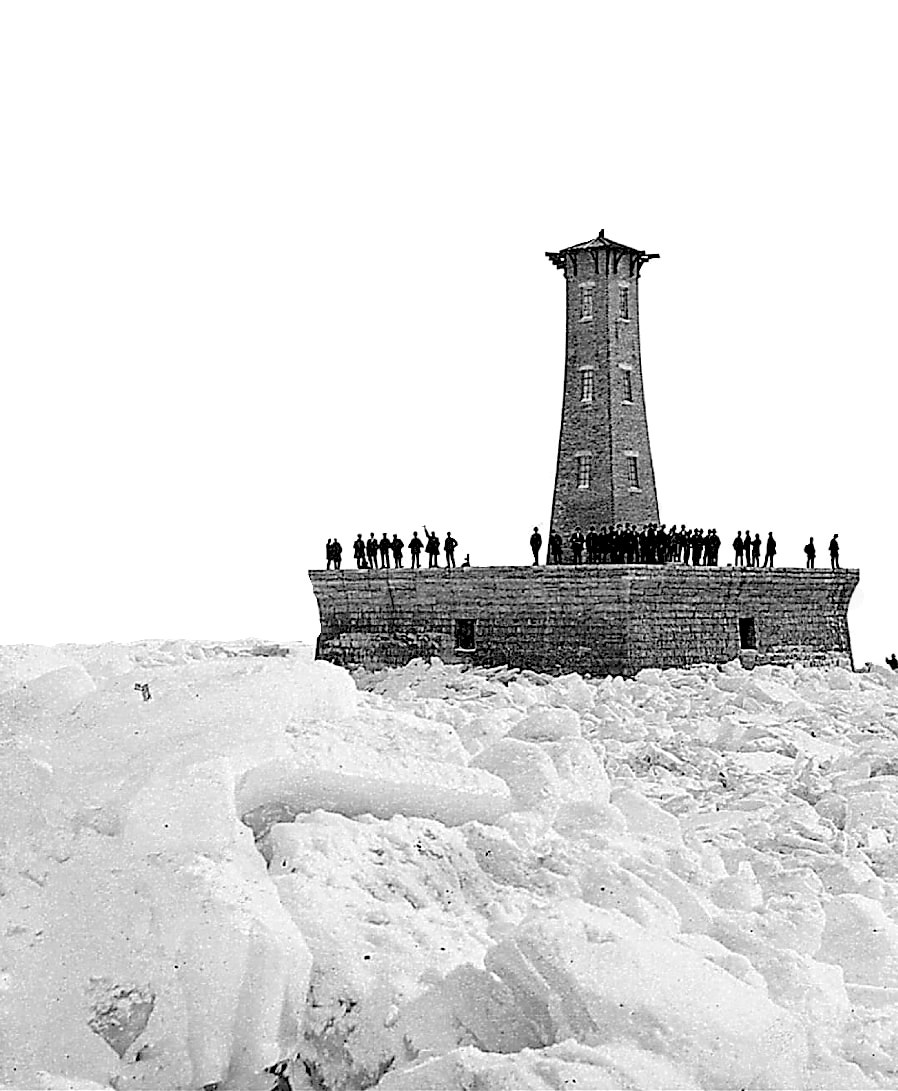


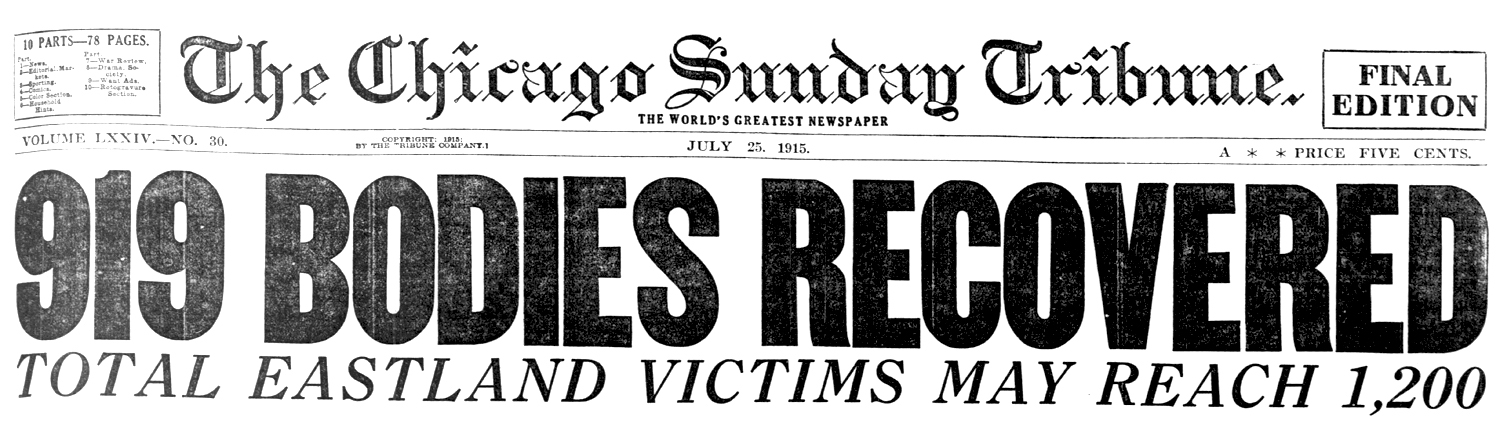
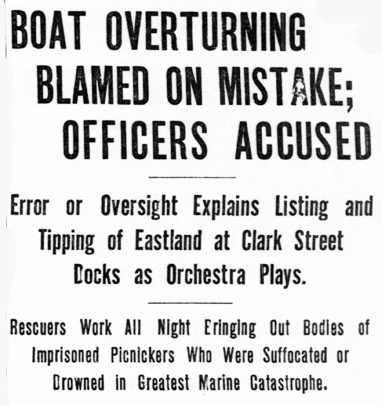
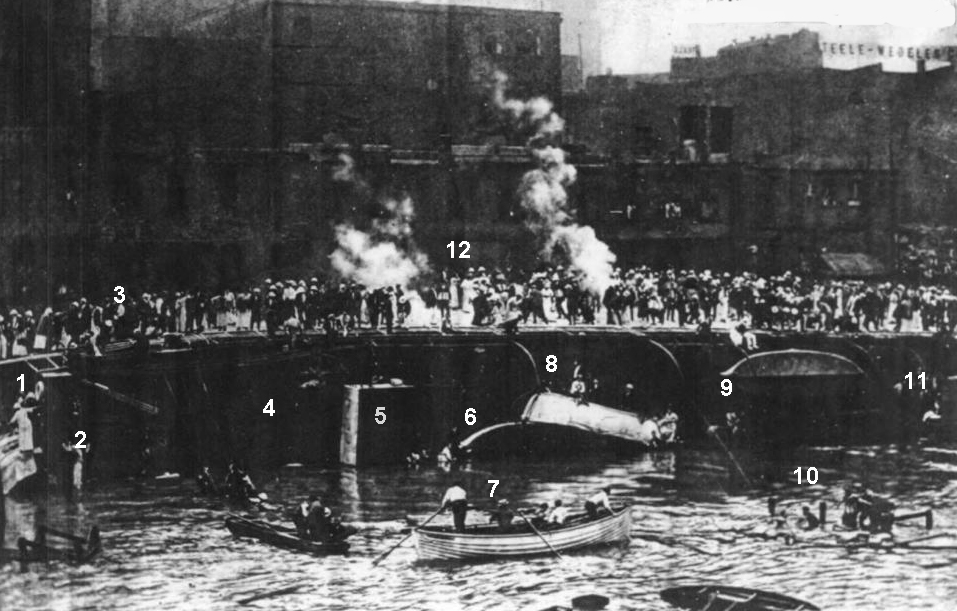
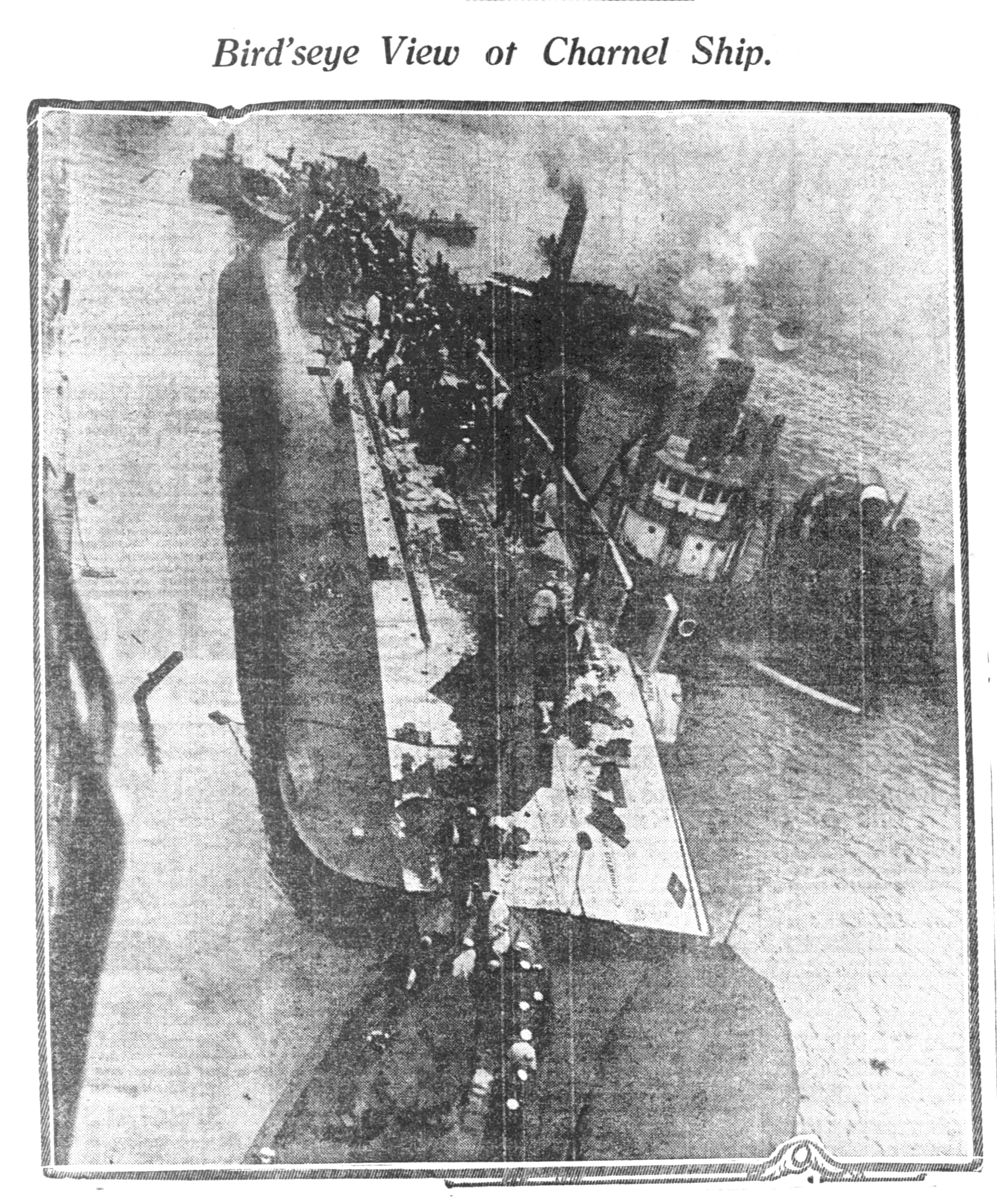
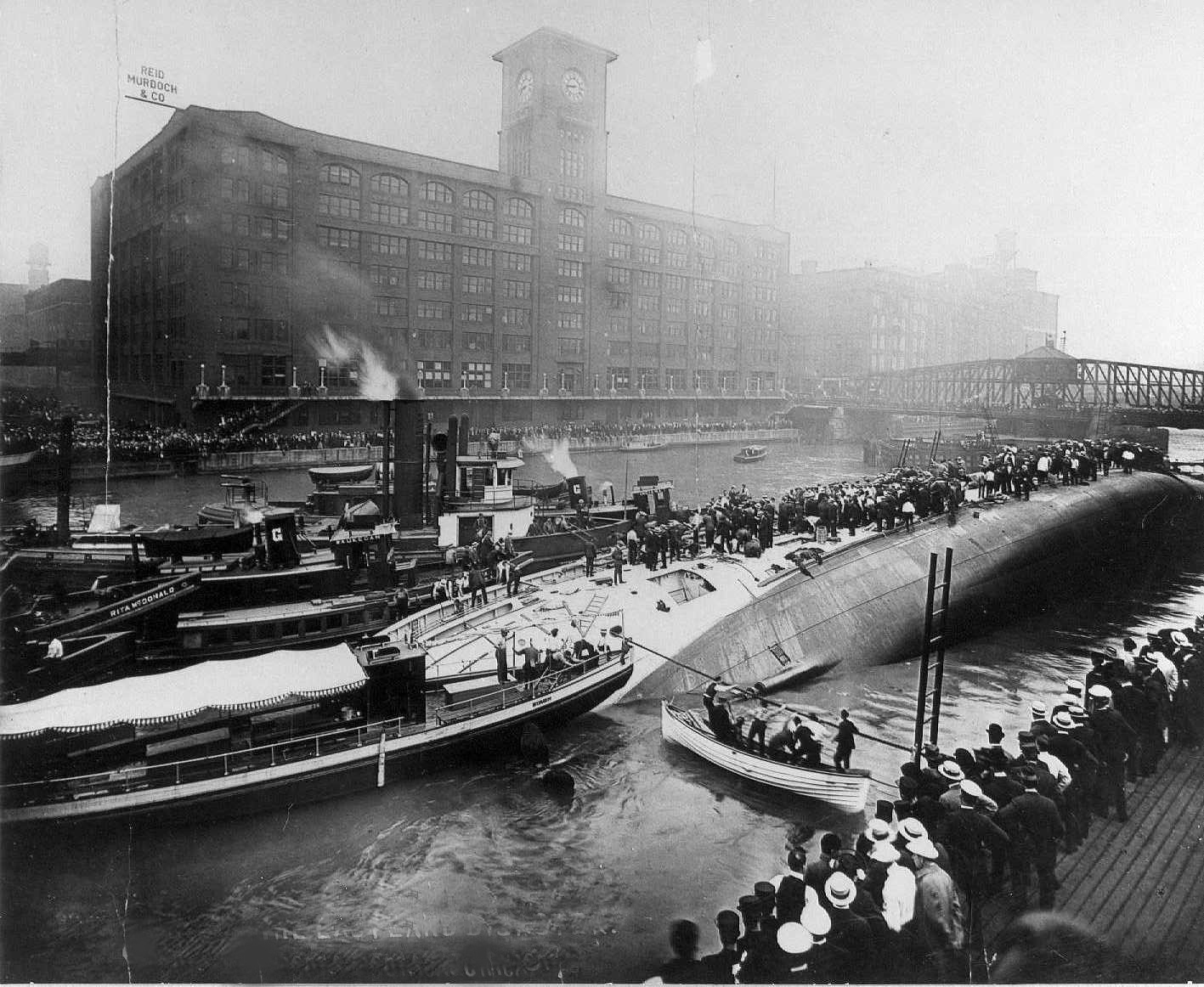
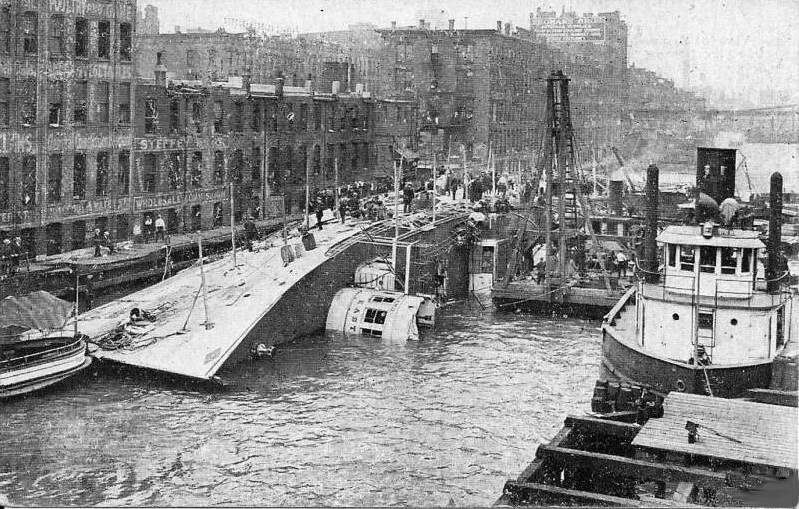

 Providence permitting the Eastland will be raised today.