Back to Notorious Chicago
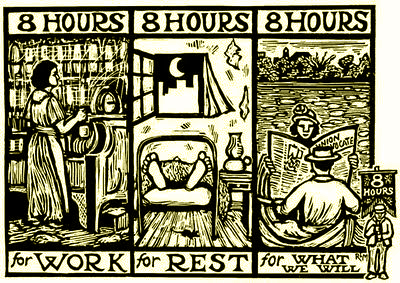
Early in 1886 labor unions were beginning a movement for an eight-hour day. Union activists called a one day general strike in Chicago. On May 1 many Chicago workers struck for shorter hours. An active group of radicals and anarchists became involved in the campaign. Two days later a shooting and one death occurred during a riot at the McCormick Reaper plant when police tangled with the strikers.
On May 4 events reached a tragic climax at Haymarket Square, an open market near Des Plaines Ave. and Randolph St., where a protest meeting was called to denounce the events of the preceding day at the McCormick Works. Speakers exhorted the crowd from a wagon which was used for a makeshift stage. Mayor Carter Harrison joined the crowd briefly, then left, believing everything was orderly. Toward the end of this meeting, while police were undertaking to disperse the crowd, a bomb was exploded. Policeman Mathias J. Degan died almost instantly and seven other officers died later.
Harper’s Weeky, May 15, 1886.
ANARCHIST RIOTS IN THE WEST.
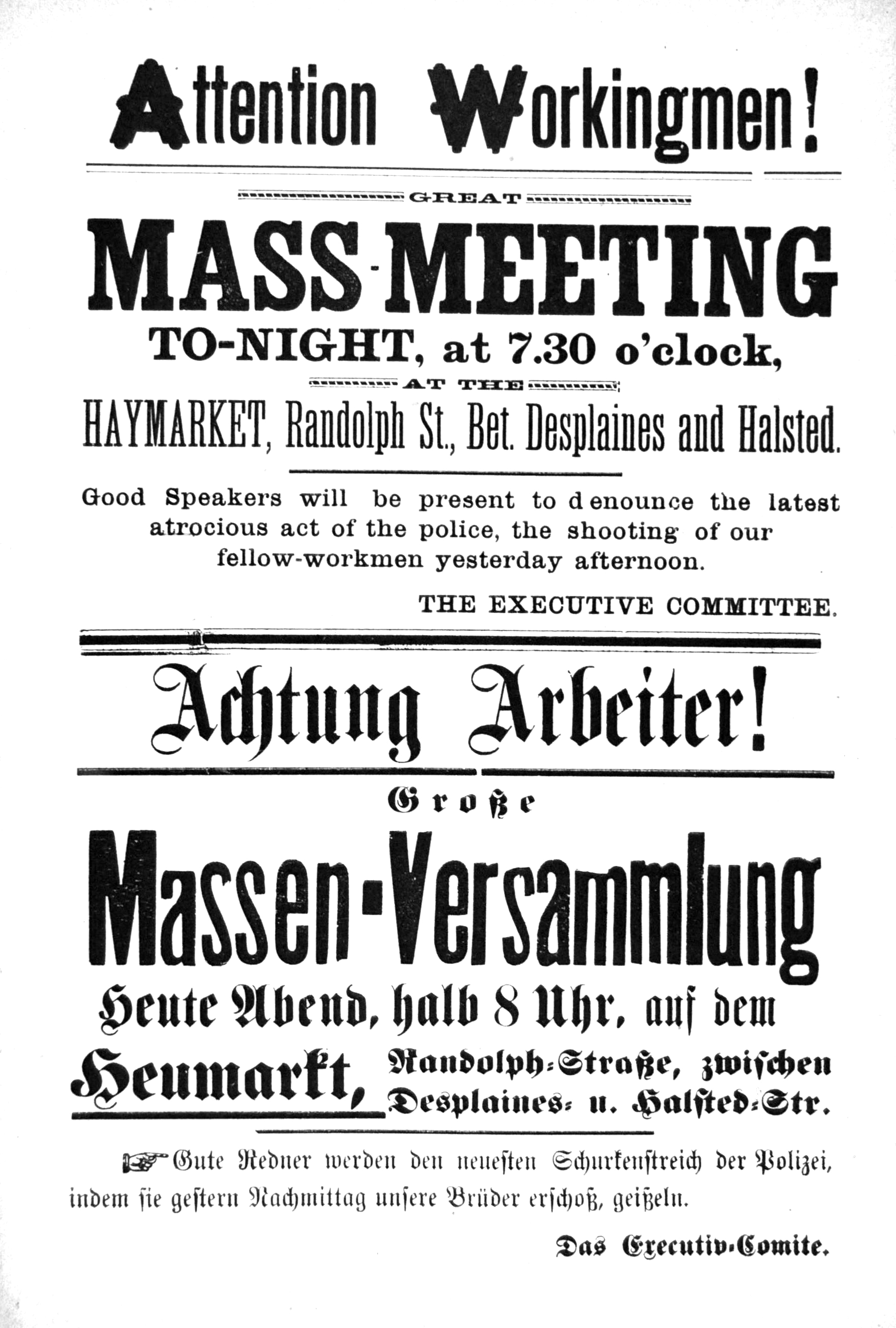
ALTHOUGH the statute-books of perhaps all the States in the Union contain laws against seditious meetings, and even against seditious publications, the anarchists in America have been allowed to proclaim their doctrine by speeches and in print until they have at last carried it into action. As many as 20,000 men were idle in Chicago on May 3 because of the agitation for the eight-hour rule, and the anarchists, who have been bolder in that city than in any other, took this general unrest as the occasion to use dynamite as a social force for the first time in the United States. On the evening of May 4 a meeting of the most turbulent element was called, by means of an incendiary handbill, at a point in Desplaines Street, to listen to speeches about the strikes and a fight that had taken place between the police and a company of strikers. The speakers were AUGUST SPIES, the editor of the daily anarchist paper the Arbeiter Zeitung, and his fellows, SAM FIELDEN and A. R. PARSONS, the most notorious preachers of the doctrine of destruction. When {ARSONS had wrought the crowd to desperation, and exclaimed,
- To arms! To arms!
the force of one hundred and fifty policemen who were in readiness at a neighboring station was ordered out to disperse the excited crowd. When they reached the edge of the crowd, FIELDEN, who was the most incendiary of all orators, was raising the excitement to a still higher pitch. The officer in command of the police advanced to the wagon which was used as a rostrum, and commanded the crowd to disperse.
He had hardly given the command when a spluttering fuse was seen flying through the air toward the policemen. It was a dynamite bomb, which was well aimed, and fell directly in the middle of the street between the two double columns of the police. It exploded as soon as it struck the ground. The policemen were for a moment thrown into confusion. The orator closed his harangue abruptly, and the crowd assembled in a menacing attitude before the body of police. The bomb had killed and wounded twenty-nine men, and the anarchists in front and on either side opened fire directly on the policemen that had escaped the bomb. The men quickly recovered themselves, and returned the fire until the crowd fled. In the flight many persons were knocked down and trampled on. Then the work of taking away the bodies of the killed and of removing the wounded was begun. Two officers and one citizen were already dead; six other policemen were fatally wounded; twenty-six more received wounds which for the time disabled them; eight citizens were mortally hurt, and ten disabled. It is believed that a number of anarchists were killed or seriously wounded, who were removed by their comrades as the crowd ran away. On the next day there were sixty-four patients in the county hospital who were injured by the bomb or in the battle that followed the esxplosion.
The after the explosion. AUGUST SPIES, his associate editor SCHWAB, FIELDEN, and CHRIS SPIES, who were in his employment, were arrested in the Arbeiter Zeitung office, and all who were on the paper, including twenty-five printers, were temporarily taken into custody. In a cupboard in the office four or five pounds of dynamite were found, of such strength that when it was exploded at the lake front it shook the ground several hundred yards away. In SPIE’S editorial desk there were two bombs with fuses attached. These men have been imprisoned without privilege of bail, and they will be tried as accessories to the crime. The giving of advice to resort to violence comes from the meaning of the statute which describes an accessory to a murder. The discovery of explosives in SPIE’S desk and office and at the residence of PARSONS, the editor of the Alarm, an anarchist paper printed in English language, together with proof that inflammatory circulars were printed in SPIE’S office, and other circumstantial evidence, are thought to be sufficient to cause the conviction of these notorious leaders.
AUGIST SPIES is a German who went to Chicago in his youth. After he became interested in the cause of anarchy he soon became conspicuous in the society in which JOHN MOST, the agitator, moved. Eight years ago he obtained editorial control of the Arbeiter Zeitung, and he made it the mouth-piece of the most numerous and most dangerous company of socialistic foreigners that has infested any American city. He was made the more desperate by the killing of his brother two years ago by a policemen while resisting arrest. He then swore revenge on the police. CHRIS SPIES, a younger brother, now imprisoned with him, was employed as a printer in Zeitung office. MICHAEL SCHWAB, assistant editor to AUGUST SPIES, is the most notorious of the whole company. He too is a German by birth. PARSONS, the only American among them, eluded the officers. He is an adventurer who went from Texas to Chicago, and has an additional claim to distinction in that he has for wife a mulatto who is no less vigorous an agitator and public speaker than he is himself. FIELDEN, an English anarchist, has been an active organizer of socialistic clubs among English-speaking converts to the doctrine.
Within a day after the battle $28,000 had been given by the citizens of Chicago, and several checks of $500 each had been sent from New York, for the benefit of the wounded policemen and of the families of those who were killed.
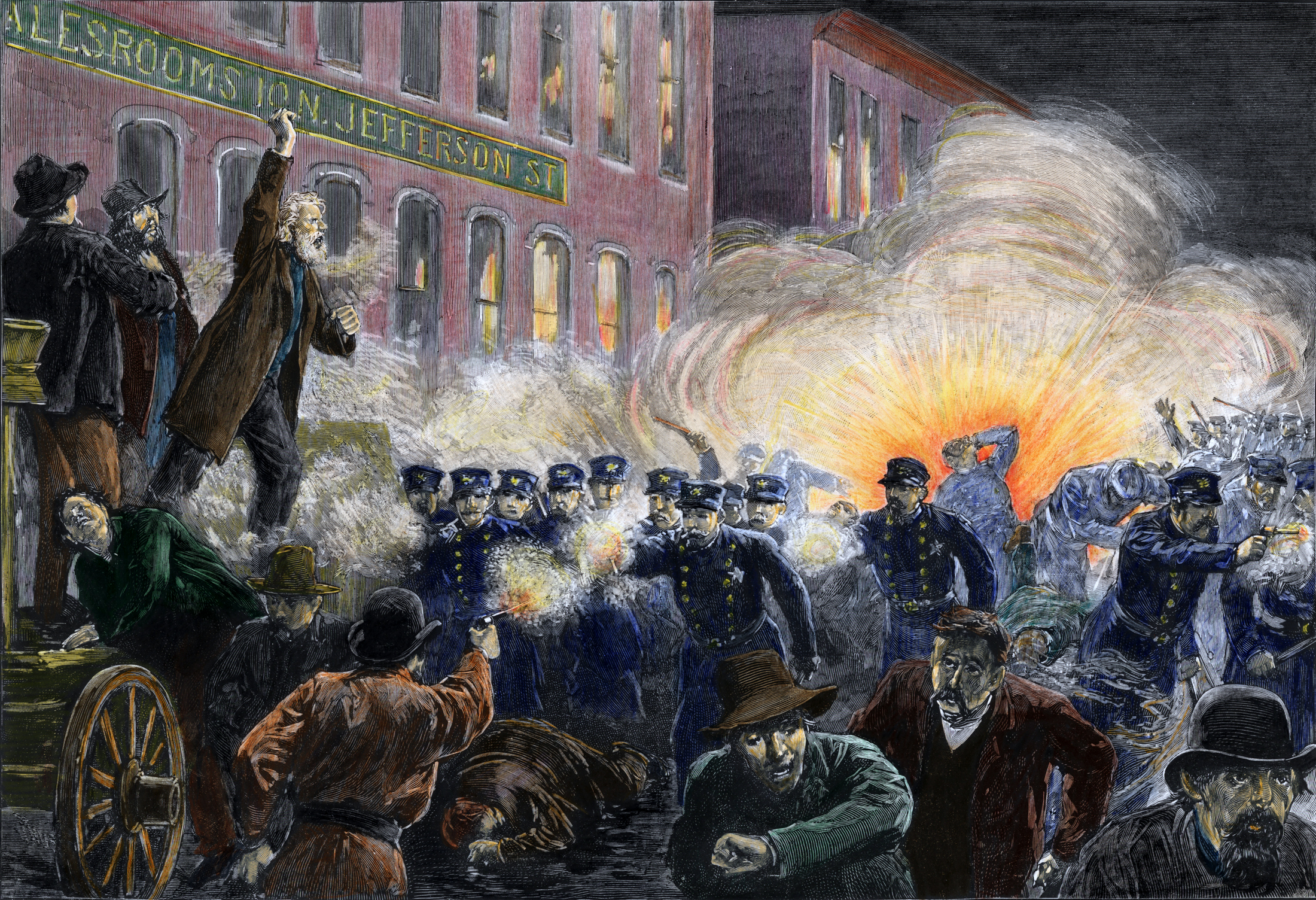
THE ANARCHIST RIOT IN CHICAGO—A DYNAMITE BOMB EXPLODING AMONG THE POLICE
Drawn by T. Thulstrup from Sketches and Photographs Furnished by H. Jeanneret
This violence in Chicago was followed on the next day by a battle in Milwaukee between a mob of Polish strikers and the militia. The mills, which these socialists had threatened to storm, were guarded by four companies of militia. The mob, early on the day of May 5, marched with a red flag toward the mills, uttering threats to demolish them. The commanding officer ordered them to retire, but they continued to advance, and the militia fired into the crowd with deadly aim. The flag-bearer was struck by several bullets and mortally wounded; five others were killed, and an unknown number injured. GOVERNOR RUSK of WISCONSIN, who, by-the-way, entered the war as a volunteer, and was brevetted Brigadier General for gallantry, not only used the militia State into military service to do it.”
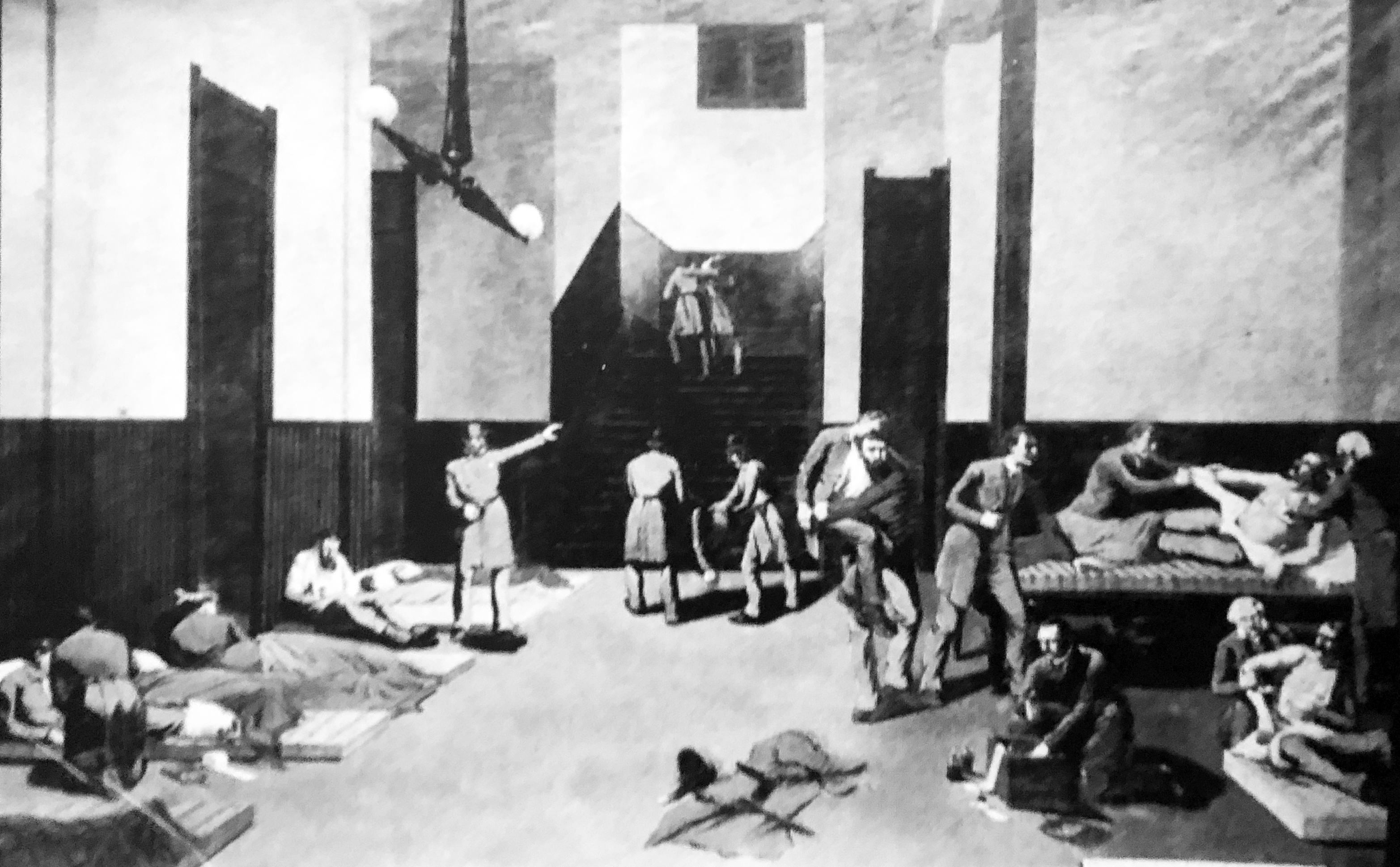
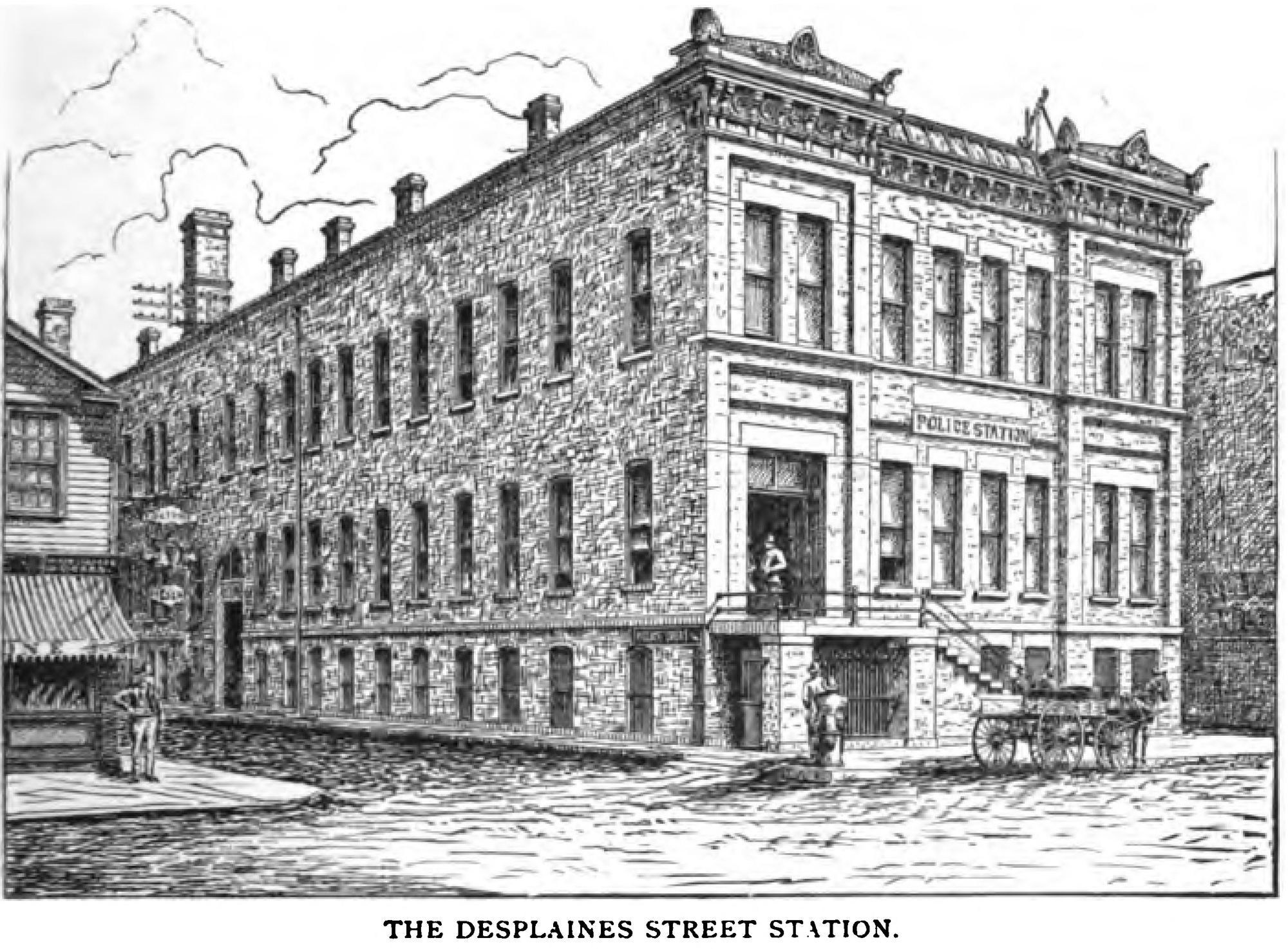
Desplaines Street Police Station
Set-up for the wounded in the aftermath of the Haymarket incident
Patrolmen Mathias Degan, Patrolman John Barrett, Patrolman George Miller, Patrolman Timothy Flavin, Patrolman Thomas Redden, Patrolman Nels Hansen and Patrolman Michael Sheehan.
No bloodshed in twenty years, except that which was caused by the railroad strike of 1877, has created such general excitement as these battles in Chicago and Milwaukee; but the vigorous dealing with these anarchists by the police and the militia, as well as the punishment that awaits their leaders by the calmer process of trial for inciting riot, is the most discouraging reception that their doctrine, when put in practice, has received in any country in the world. These outbreaks have given new vitality to the sections of the penal code of every State prohibiting seditious speech.
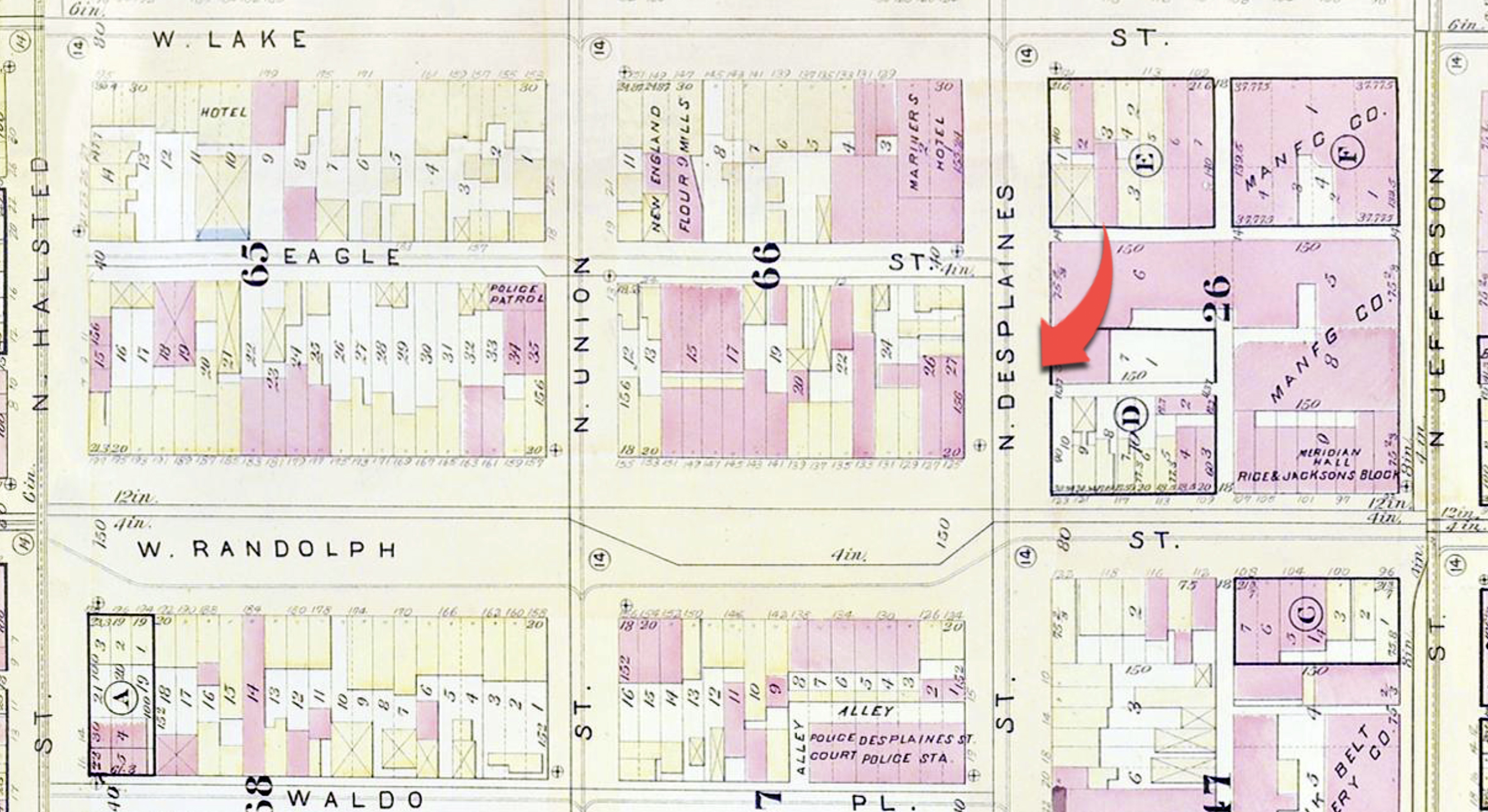
Haymarket Square
Robinson Fire Map
1886
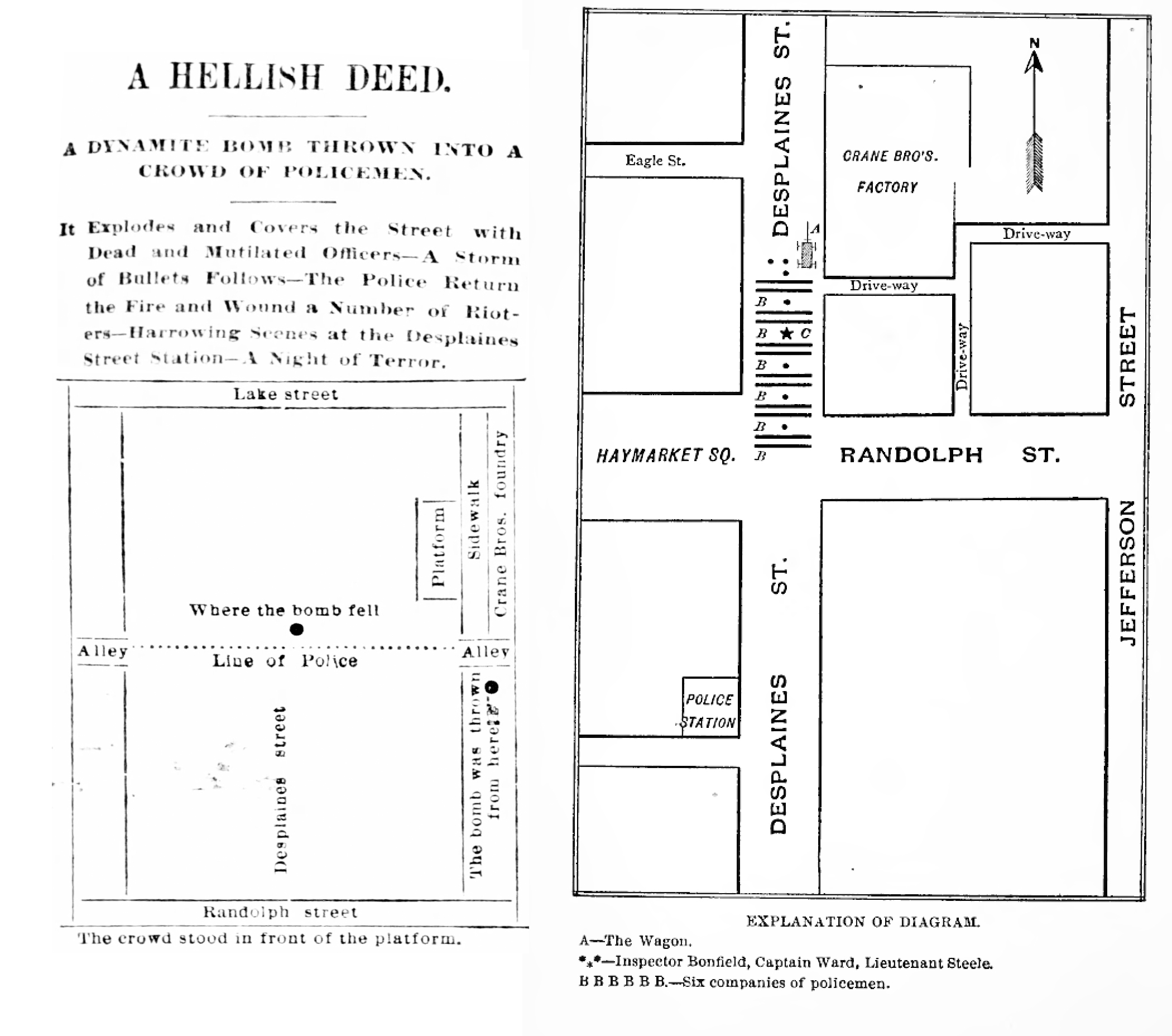
LEFT: Headline & Diagram, Chicago Tribune, May 5, 1886
RIGHT: Haymarket Square, History of Chicago Police, Flinn, 1887
John J. Flinn’s 1887 History of the Chicago Police from the Settlement of Community to the Present Time
The following day, under the direction of State’s Attorney Julius Grinnel, police began a fierce roundup of radicals, agitators and labor leaders, siezing records and closing socialist and labor press offices. Eight men were finally brought to trial for conspiracy.
Despite the fact that the bomb thrower was never identified, and none of these eight could be connected with the crime, Judge Joseph E. Gary imposed the death sentence on seven of them and the eighth was given fifteen years in prison. The court held that the “inflammatory speeches and publications” of these eight incited the actions of the mob. The Illinois and U.S. Supreme Courts upheld the verdict.
On November 11, 1887 four men, Albert Parsons, August Spies, Adolph Fischer, and George Engel were hanged. Louis Lingg committed suicide in prison awaiting the death sentence. The sentences of two others were commuted from death to imprisonment for life. On June 26, 1893, Governor John P. Altgeld pardoned the three who were in the penitentiary.
The Verdict
Jury Room, Criminal Court,
Cook Co., Illinois.
August 19th, 1886.
We, the jury,find the defendants, August Spies, Michael Schwab, Samuel Fielden, Albert R.Parsons, Adolph Fischer, George Engel and Louis Lingg, guilty of murder in manner and form as charged in the indictment and fix the penalty at death.
- James H.Cole,
S. G. Randall,
T. E. Denker,
C. B. Todd,
Frank S. Osborn,
Androw Hamilton,
J. H. Brayton,
Alanson H. Reed,
John B.Greiner,
Charles H. Ludwig,
George W. Adams,
Harry T. Sanford.
We, the jury,find the defendant Oscar W. Neebe, guilty of murder in manner and form as charged in the indictment and fix the penalty at imprisonment in the penitentiary for fifteen years.
- James H. Cole,
S. G. Randall,
T. E. Denker,
C. B. Todd,
Frank S. Osborn,
Andrew Hamilton,
Chas. H. Ludwig,
J.H. Brayton,
Alanson H. Reed,
John B.Greiner,
Geo. W. Adams,
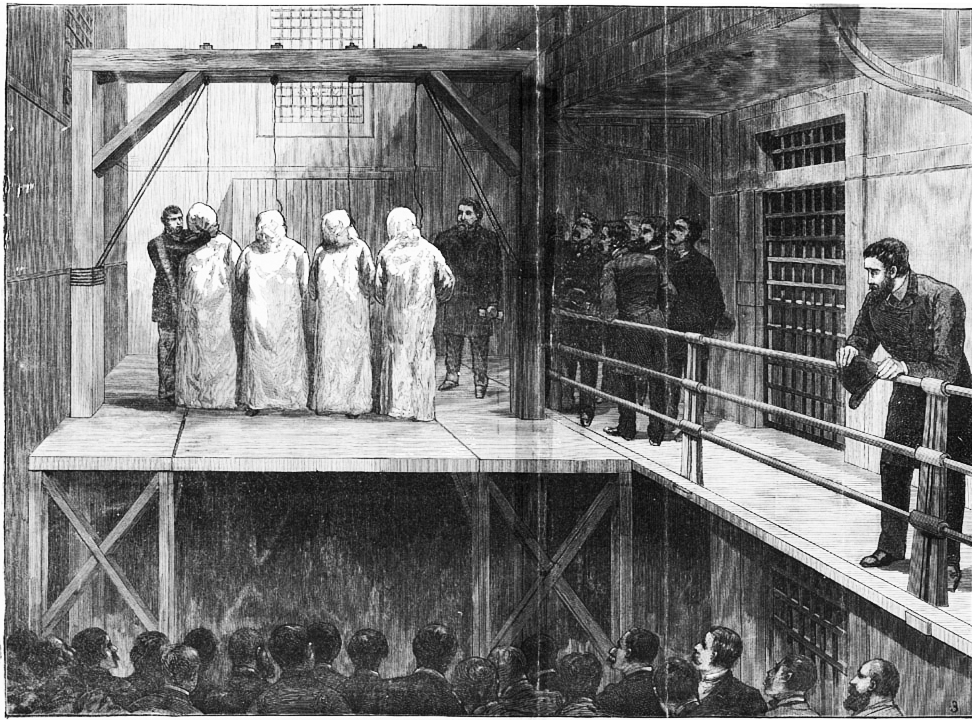
CHICAGO ANARCHISTS PAY THE PENALTY OF THEIR CRIME
From Sketches by Will RE. Chapin
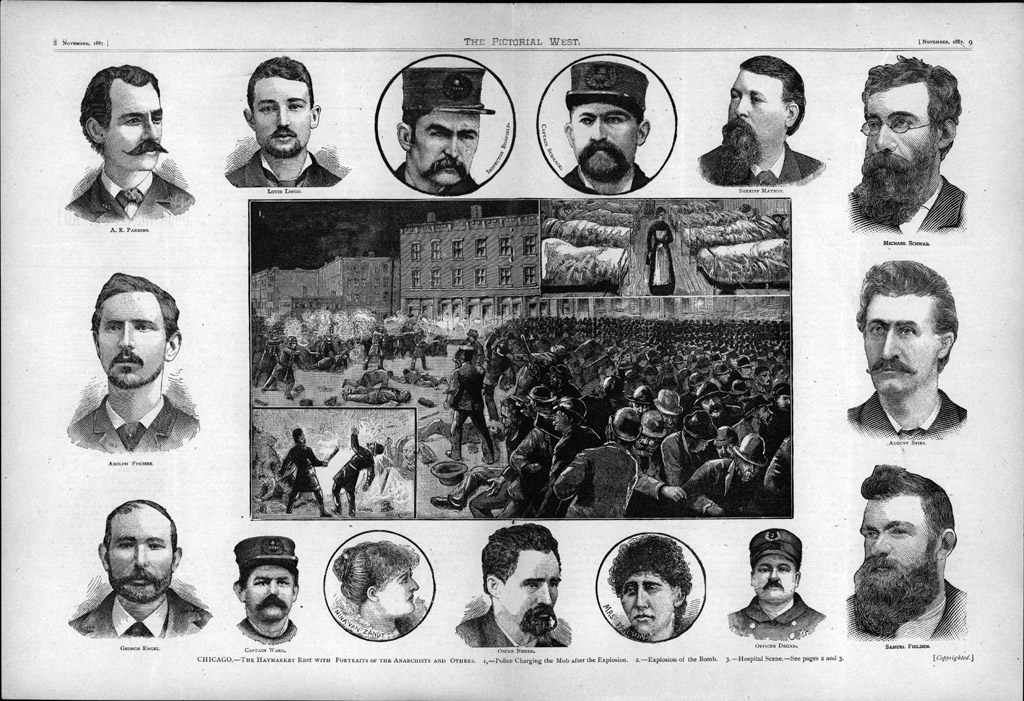
Police charging the mob after the explosion, Explosion of the bomb, and Hospital scene.
Border images include clockwise from left: A.R. Parsons, Louis Lingg, Inspector Bonfield, Captain Schaack, Sheriff Matson, Michael Schwab, August Spies, Samuel Fielden, Officer Mathias Degan, Mrs. Parsons, Oscar Neebe, Nina van Zandt, Captain Ward, George Engel, and Adolph Fischer.
Pictorial West. Vol. 11, no. 11 (Nov. 20, 1887)
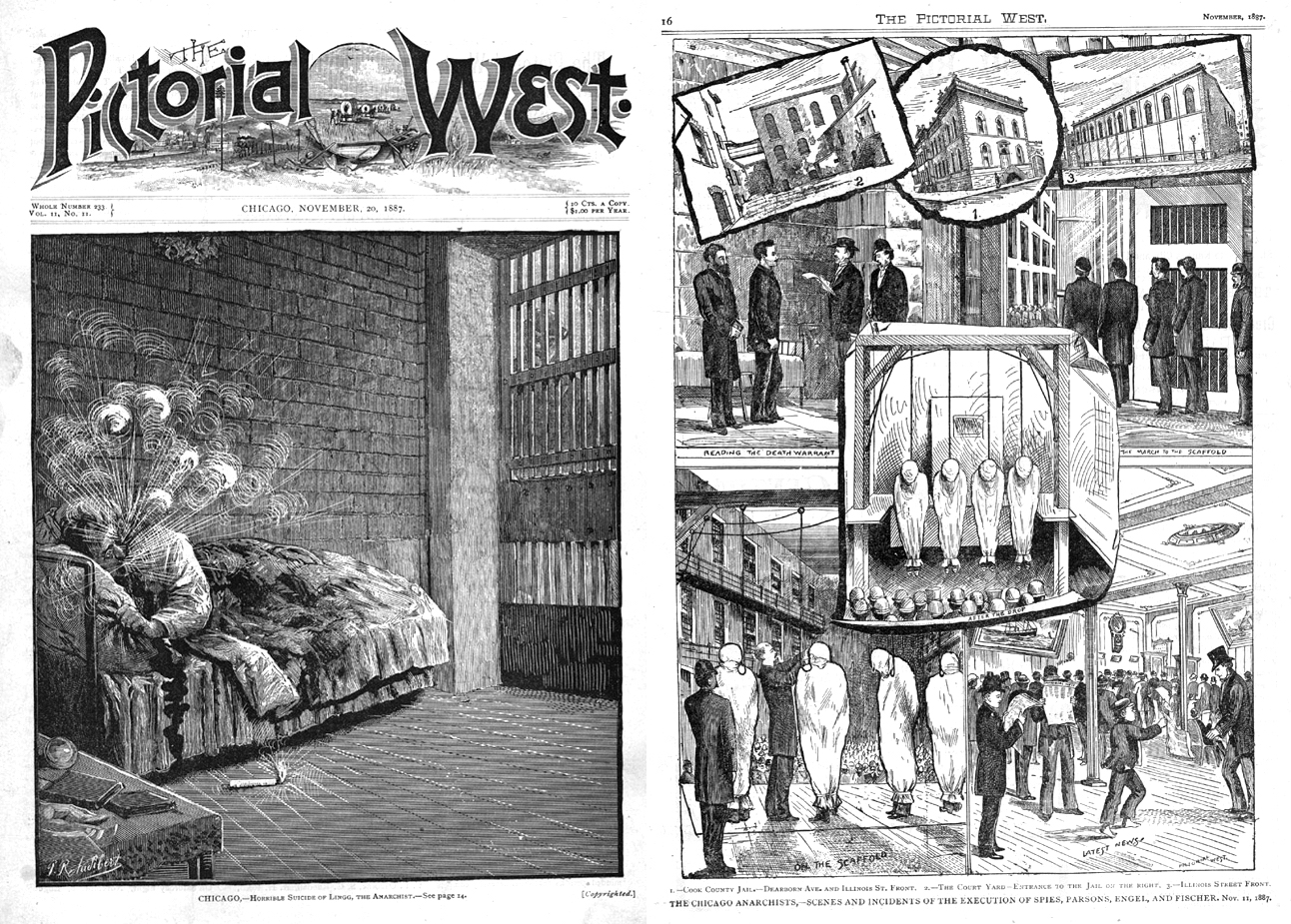
Left: Chicago.-Horrible suicide of Lingg, the anarchist.
Right: The execution of Spies, Parsons, Engel, and Fischer.
Insets include: Cook County Jail (Dearborn Ave. and Illinois St. Front); the court yard (entrance to the Jail on the right); and Illinois Street front.
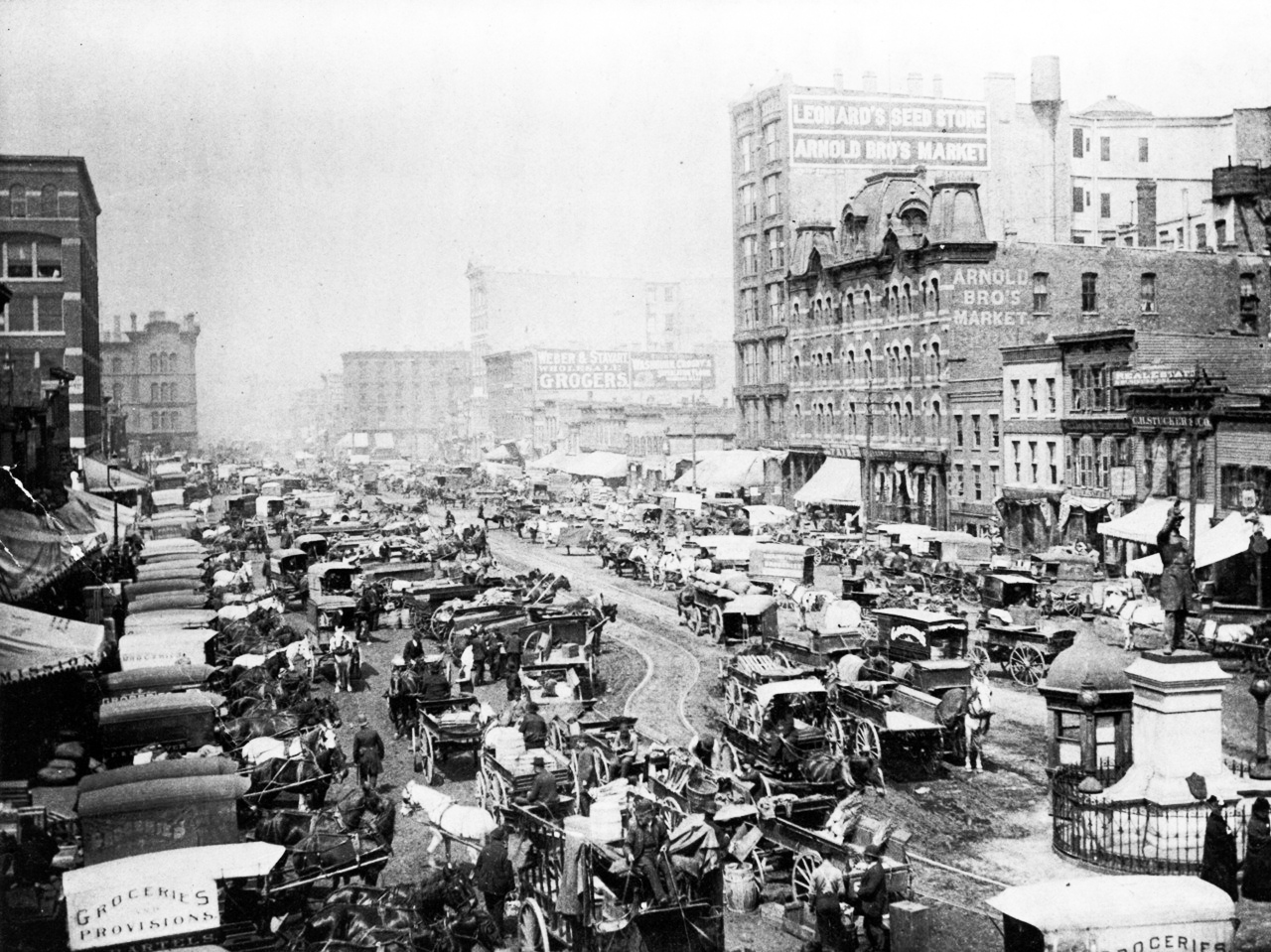
Haymarket Square during normal business hours in 1890, Note the famous Haymarket Policeman statue.
Aftermath
At the convention of the American Federation of Labor (AFL) in 1888, the union decided to campaign for the shorter workday again. May 1, 1890, was agreed upon as the date on which workers would strike for an eight-hour work day.
The first international May Day was a spectacular success. The front page of the New York World on May 2, 1890, was devoted to coverage of the event. Two of its headlines were “Parade of Jubilant Workingmen in All the Trade Centers of the Civilized World” and “Everywhere the Workmen Join in Demands for a Normal Day.” The Times of London listed two dozen European cities in which demonstrations had taken place, noting there had been rallies in Cuba, Peru and Chile. Commemoration of May Day became an annual event the following year.
In the United States and Canada, the official holiday for workers is Labor Day in September. This day was promoted by the Central Labor Union and the Knights of Labor, who organized the first parade in New York City. After the Haymarket Square riot in May, 1886, US President Grover Cleveland feared that commemorating Labor Day on May 1 could become an opportunity to commemorate the riots. Thus he moved in 1887 to support the Labor Day that the Knights supported.
In 1955, the Catholic Church dedicated May 1 to “Saint Joseph The Worker”. The Catholic Church considers Saint Joseph the patron saint of (among others) workers, craftsmen, and “people fighting communism”.