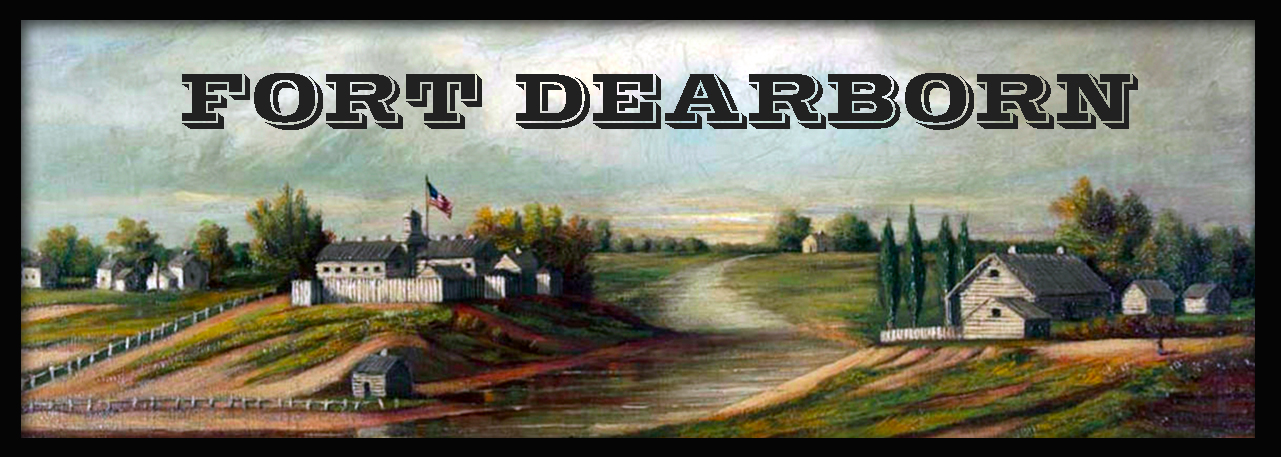
Fort Dearborn
Fort Dearborn | The Massacre Tree |
The outline of where Fort Dearborn stood is still engraved on the sidealks of Wacker Drive. On 9 July 1856, Mark Beaubien requested that the remains of the old fort be removed from his property. A detailed description of Fort Dearborn was published in series articles of Chicago Magazine in 1857. Here is an excerpt from one of the articles:
The fort stood on the same spot as the one of 1804. It was built on a larger scale, and in a more substantial manner. It was surrounded like the previous one, by palisades, made of timber standing upright, and driven onto the earth. Inside of the paling, on the west side, were a row of buildings which were used for the quarters of the officers and their families. On the east side, nearest to the lake, were the barracks, or quarters of the soldiers. Gateways were left on the north and south sides, admitting a free passage through the parade ground and the enclosure. On the north side, inside of the enclosure, was a brick structure, repaired from the old ruins, which was the magazine. On the south, on either side of the main entrance, was the store-house and guardroom. On the southwest stood the block house, which has remained the ancient landmark, until a few weeks, when it has been removed to yield to the improvements about the locality of the old fort, in widening the river, and in the erection of the Rush Street bridge.
The main buildings of the fort, which included the quarters of the officers, and the barracks of the soldiers, were torn down during the summer of 1856. The blockhouse was removed in the spring of the following year.
The photo below was taken in 1856.


