DESCRIPTIONS OF THE GREAT FIRE.
Lakeside Monthly
The Lakeside Monthly (1869-1874), was originally called the Western Monthly, and under the leadership of F. F. Browne is succeeded in gaining much prominence, but due to Mr. Browne’s health, the publication was suspended in April, 1874. It never resumed.
Description of the Great Fire—January, 1872
Harper’s Weekly
Harper’s Weekly (A Journal of Civilization) was an American political magazine based in New York. Published by Harper & Brothers from 1857 until 1916, it featured foreign and domestic news, fiction, essays on many subjects, and humor, alongside illustrations. It carried extensive coverage of the American Civil War, including many illustrations of events from the war.
Chicago In Ashes—October 28, 1871
Graphic Account by John R. Chapin—October 28, 1871
Chicago in Ruins—November 4, 1871
The Ruined Churches in Chicago—November 11, 1871
The Ruins of Chicago—November 11, 1871
Bird’s Eye View Before and During the Fire—October 21 & 28, 1871
Homeless Citizens Taking Refuge From the Flames Among the Ruins—1872
Chicago Fire Department — December 19, 1874
Every Saturday
Every Saturday (1866–1874) was an American literary magazine published in Boston, Massachusetts. It was edited by Thomas Bailey Aldrich and published by Ticknor and Fields (1866–1868); Fields, Osgood, & Co. (mid-1868–1870); James R. Osgood & Co. (1871–1873); and H. O. Houghton & Co. (1874). Every Saturday featured work by C. G. Bush, Wilkie Collins, F. O. C. Darley, Charles Dickens, J.W. Ehninger, Sol Eytinge Jr., Harry Fenn, Alfred Fredericks, Thomas Hardy, J.J. Harley, W.J. Hennessy, Winslow Homer, Augustus Hoppin, Ralph Keeler, S.S. Kilburn, Granville Perkins, W.L. Sheppard, Alfred Tennyson, Alfred Waud and others.
The Great Fire in Chicago — November 4, 1871
The Chicago Newspapers
Cheer Up—Chicago Shall Rise Again
Letter from Horace White, Chicago Tribune, to Murat Halstead, Editor of The Cincinnati Commercial—Published in that newspaper—October 14, 1871.
Firms Destroyed—October 13, 1871
Origin of the Fire
National & International Newspapers
Boston Daily Evening Transcript (Associated Press’ despatch)
Frank Leslie’s Illustrated Newspaper
Kellogg & Bulkeley Lithographs
The Chicago Graphic
Currier & Ives
Newspaper Front Pages
The Illustrated London News
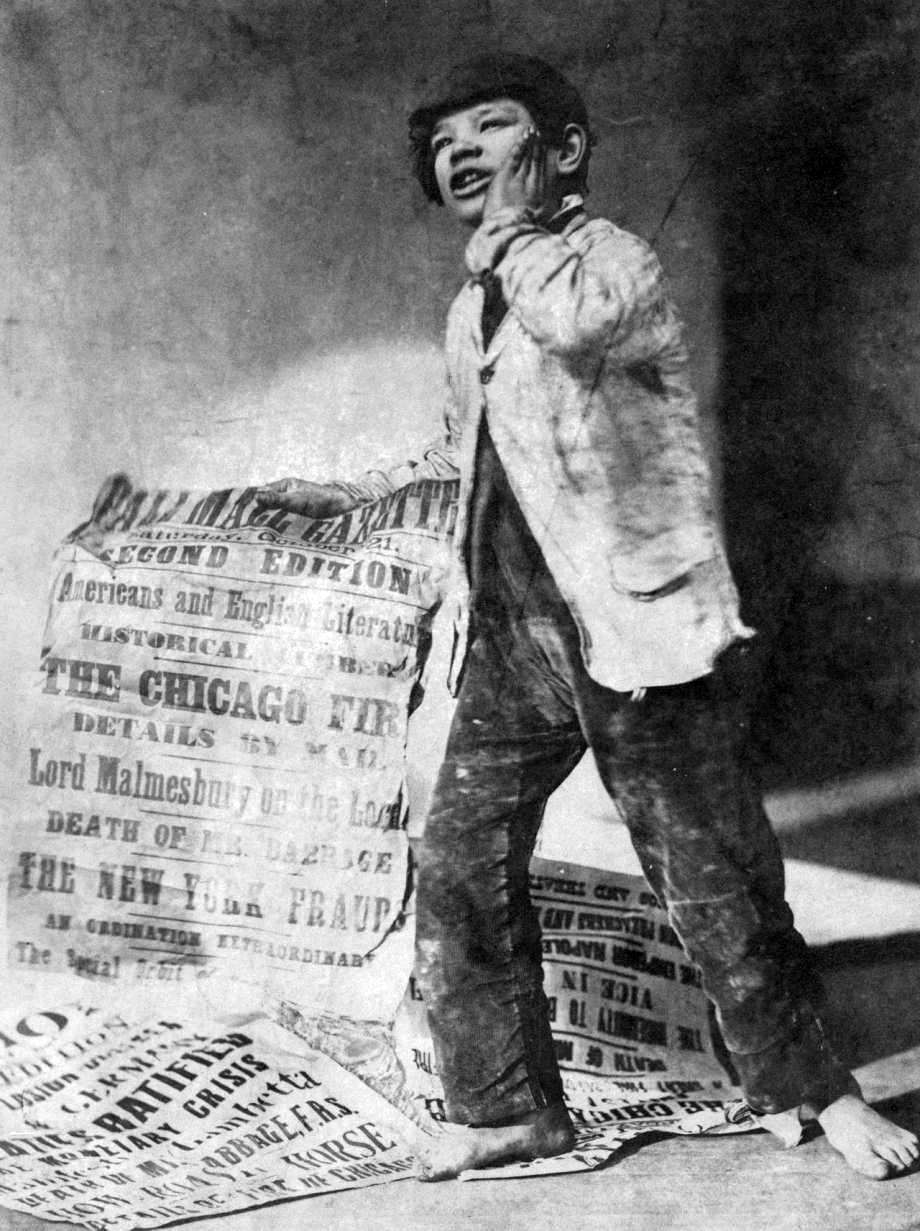
Newsboy Crying the News of the Chicago Fire
Photographer: Oscar Gustave Rejlander, 1871
The Ruins
Jex Bardwell’s Photographs of the Ruins
Views of the Burnt District
Hand-Colored Lantern Slides of Ruins
Lovejoy & Foster’s Views of the Ruins—George Barnard
Burnt District Maps and Bird’s Eye Views.
Burnt District Maps
Bird’s Eye Views of the Fire
Chicago Fire Panoramas
George Barnard’s Panorama
Joseph Battersby’s Panorama
James Landy’s Panorama
William Shaw’s Panorama
Joshua Smith’s Panorama
Graphics and Articles.
1871—The Fire Before The Great Fire
Chicago Fire Victims
Cincinnati Soup House
Julia Lemos—Refugees Gathered at Menomonee and Wells
Jules Emile Saintin
State House on Fire During the Great Chicago Fire
Erie Ferry in New York City
Leary’s Cottage
After Fire Predictions.
Equipment Used During the Great Fire
Homeless Citizens Taking Refuge
Directory of Temporary Locations
Book Reviews.
1871—Sheahan/Upton—History of the Great Conflagration
1871—Colbert/Chamberlin—Chicago and the Great Conflagration
1872—Lakeside Memorial of the Burning of Chicago
Leave a Reply